Proceedings of the 12th Conference of the European Chapter of the ACL, pages 442–450,
Optimization in Coreference Resolution Is Not Needed:
A Nearly-Optimal Algorithm with Intensional Constraints
Manfred Klenner & ´Etienne Ailloud Computational Linguistics Zurich University, Switzerland
{klenner, ailloud}@cl.uzh.ch
Abstract
We show how global constraints such as transitiv-ity can be treated intensionally in a Zero-One Inte-ger Linear Programming (ILP) framework which is geared to find the optimal and coherent partition of coreference sets given a number of candidate pairs and their weights delivered by a pairwise classifier (used as reliable clustering seed pairs). In order to find out whether ILP optimization, which is NP-complete, actually is the best we can do, we com-pared the first consistent solution generated by our adaptation of an efficient Zero-One algorithm with the optimal solution. The first consistent solution, which often can be found very fast, is already as good as the optimal solution; optimization is thus not needed.
1 Introduction
One of the main advantages of Integer Linear Pro-gramming (ILP) applied to NLP problems is that prescriptive linguistic knowledge can be used to pose global restrictions on the set of desirable so-lutions. ILP tries to find an optimal solution while
adhering to the global constraints. One of the
central global constraints in the field of corefer-ence resolution evolves from the interplay of intra-sentential binding constraints and the transitivity of the anaphoric relation. Consider the following sentence taken from the Internet: ’He told him that he deeply admired him’. ’He’ and ’him’ are ex-clusive (i.e. they could never be coreferent) within their clauses (the main and the subordinate clause, respectively). A pairwise classifier could learn this given appropriate features or, alternatively, bind-ing constraints could act as a hard filter preventbind-ing such pairs from being generated at all. But in ei-ther case, since pairwise classification is trapped in its local perspective, nothing can prevent the classifier to resolve the ’he’ and ’him’ from the subordinate clause in two independently carried out steps to the same antecedent from the main clause. It is transitivity that prohibits such an as-signment: if two elements are both coreferent to a common third element, then the two are (transi-tively given) coreferent as well. If they are known
to be exclusive, such an assignment is disallowed. But transitivity is beyond the scope of pairwise classification—it is a global phenomena. The so-lution is to take ILP as a clustering device, where the probabilities of the pairwise classifier are in-terpreted as weights and transitivity and other re-strictions are acting as global constraints.
Unfortunately, in an ILP program every con-straint has to be extensionalized (i.e. all instantia-tions of the constraint are to be generated). Cap-turing transitivity for e.g. 150 noun phrases (about 30 sentences) already produces 1,500,000 equa-tions (cf. Section 4). Solving such ILP programs is far too slow for real applications (let alone its brute force character).
A closer look at existing ILP approaches to NLP reveals that they are of a special kind, namely Zero-One ILP with unweighted constraints. Al-though still NP-complete there exist a number of algorithms such as the Balas algorithm (Balas, 1965) that efficiently explore the search space and reduce thereby run time complexity in the mean. We have adapted Balas’ algorithm to the special needs of coreference resolution. First and fore-most, this results in an optimization algorithm that
treats global constraints intensionally, i.e. that
generates instantiations of a constraint only on de-mand. Thus, transitivity can be captured for even the longest texts. But more important, we found out empirically that ’full optimization’ is not re-ally needed. The first consistent solution, which often can be found very fast, is already as good— in terms of F-measure values—as the optimal so-lution. This is good news, since it reduces runtime and at same time maintains the empirical results.
qual-ity loss) when the first consistent solution has been found.
2 Zero-One Integer Linear Programming (ILP)
The algorithm in (Balas, 1965) solves Zero-One Integer Linear Programming (ILP), where a
weighted linear function (the objective function)
of binary variables F(x1, . . . ,xn) = w1x1+. . .+
wnxn is to be minimized under the regiment of
linear inequalitiesa1x1+. . .+anxn≥A.1 Unlike its real-valued counterpart, Zero-One ILP is NP-complete (cf., say, (Papadimitriou and Steiglitz, 1998)), but branch-and-bound algorithms with ef-ficient heuristics exist, as the Balas Algorithm: Balas (1965) proposes an approach where the ob-jective function’s addends are sorted according to
the magnitude of the weights: 0 ≤w1 ≤. . . ≤
wn. This preliminary ordering induces the follow-ing functionfollow-ing principles for the algorithm (see (Chinneck, 2004, Chap. 13) for more details):
1. It seeks to minimizeF, so that a solution with as few 1s as possible is preferred.
2. If, during exploration of solutions, con-straints force anxito be set to 1, then it should bear as small an index as possible.
The Balas algorithm follows a depth-first search while checking feasibility (i.e., through the con-straints) of the branches partially explored: Upon
branching, the algorithm bounds the cost of
set-ting the current variable xN to 1 by the costs
ac-cumulated so far: w1x1+. . .+wN−1xN−1+wN is now the lowest cost this branch may yield. If,
on the contrary, xN is set to 0, a violated ≥
-constraint may only be satisfied via anxi set to 1 (i>N), so the cheapest change to ameliorate the partial solution is to set the right-next variable to 1: w1x1+. . .+wN−1xN−1+wN+1 would be the cheapest through this branch.
If setting all weights past the branching variable to 0 yields a cheaper solution than the so far mini-mal solution obtained, then it is worthwile explor-ing this branch, and the algorithms goes on to the next weighted variable, until it reaches a feasible solution; otherwise it backtracks to the last unex-plored branching. The complexity thus remains exponential in the worst case, but the initial order-ing of weights is a clever guide.
1Maximization and coping with≤-constraints are also ac-cessible via simple transformations.
3 Our Baseline Model
The memory-based learner TiMBL (Daelemans et al., 2004) is used as a (pairwise) classifier. TiMBL stores all training examples, learns fea-ture weights and classifies test instances accord-ing to the majority class of the k-nearest (i.e. most similar) neighbors. We have experimented with various features; Table 1 lists the set we have fi-nally used (Soon et al. (2001) and Ng and Cardie (2002) more thoroughly discuss different features and their benefits):
- distance in sentences and markables
- part of speech of the head of the markables
- the grammatical functions
- parallelism of grammatical functions
- do the heads match or not
- where is the pronoun (if any): left or right
- word form if POS is pronoun
- salience of the non-pronominal phrases
- semantic class of noun phrase heads
Table 1: Features for Pairwise Classification
As a gold standard the T¨uBa-D/Z (Telljohann et al., 2005; Naumann, 2006) coreference corpus is used. The T¨uBa is a treebank (1,100 German newspaper texts, 25,000 sentences) augmented with coreference annotations2. In total, there are 13,818 anaphoric, 1,031 cataphoric and 12,752 coreferential relations. There are 3,295 relative pronouns, 8,929 personal pronouns, 2,987 reflex-ive pronouns, and 3,921 possessreflex-ive pronouns.
There are some rather long texts in the T¨uBa corpus. Which pair generation algorithm is rea-sonable? Should we pair every markable (even from the beginning of the text) with every other succeeding markable? This is linguistically im-plausible. Pronouns are acting as a kind of local variables. A ’he’ at the beginning of a text and a second distant ’he’ at the end of the text hardly tend to corefer, except if there is a long chain of coreference ’renewals’ that lead somehow from the first ’he’ to the second ’he’. But the plain ’he’-’he’ pair does not reliably indicate coreference.
A smaller window seems to be appropriate. We have experimented with various window sizes and found that a size of 3 sentences worked best. Candidate pairs are generated only within that
window, which is moved sentence-wise over the whole text.
4 Our Constraint-Based Model
The output of the TiMBL classifier is the input to the optimization step, it provides the set of
variables and their weights. In order to utilize
TiMBL’s classification results as weights in a min-imization task, we have defined a measure called
classification costs(see Fig. 1).
wi j=
|negi j|
|negi j∪ posi j |
Figure 1: Score for Classification Costs
|negi j |(|posi j|) denotes the number of instances similar (according to TiMBL’s metric) tohi,jithat are negative (positive) examples. If no negative in-stances are found, a safe positive classification de-cision is proposed at zero cost. Accordingly, the cost of a decision without any positive instances is high, namely one. If both sets are non-empty, the ratio of the negative instances to the total of all in-stances is taken. For example, if TiMBL finds 10 positive and 5 negative examples similar to the yet unclassified new examplehi,jithe cost of a posi-tive classification is 5/15 while a negaposi-tive classifi-cation costs 10/15.
We introduce our model in an ILP style. In sec-tion 6 we discuss our Balas adaptasec-tion which al-lows us to define constraints intensionally.
The objective function is:
min:
∑
hi,ji∈O0.5
wi j·ci j+ (1−wi j)·cji (1)
O0.5 is the set of pairshi,ji that have received
a weight ≤0.5 according to our weight function
(see Fig. 1). Any binary variableci jcombines the
ith markable (of the text) with the jth markable
(i<j) within a fixed window3.
cjirepresents the (complementary) decision that
i and j are not coreferent. The weight of this
decision is (1−wi j). Please note that every op-timization model of coreference resolution must
include both variables4. Otherwise optimization
3As already discussed, the window is realized as part of the vector generation component, soO0.5automatically only captures pairs within the window.
4Even if an anaphoricity classifier is used.
would completely ignore the classification deci-sions of the pairwise classifier (i.e., that≤0.5 sug-gests coreference). For example, the choice not to set ci j =1 at costs wi j ≤0.5 must be sanc-tioned by instantiating its inverse variablecji=1
and adding (1−wi j) to the objective function’s
value. Otherwise minimization would turn—in
the worst case—everything to be non-coreferent, while maximization would preferentially set ev-erything to be actually coreferent (as long as no constraints are violated, of course).5
The first constraint then is:
ci j+cji=1, ∀hi,ji ∈O0.5 (2)
A pairhi,jiis either coreferent or not.
Transitivity is captured by (see (Finkel and Manning, 2008) for an alternative but equivalent formalization):
ci j+cjk≤cik+1,∀i,j,k(i< j<k)
cik+cjk≤ci j+1,∀i,j,k(i< j<k)
ci j+cik≤cjk+1,∀i,j,k(i< j<k)
(3)
In order to take full advantage of ILP’s reason-ing capacities, three equations are needed given three markables. The extensionalization of tran-sitivity thus produces 3!(nn−!3)!·3 equations for n
markables. Note that transitivity—as a global
constraint—ought to spread over the whole can-didate set, not just within in the window.
Transitivity without further constraints is point-less.6 What we really can gain from transitivity is consistency at the linguistic level, namely (glob-ally) adhering to exclusiveness constraints (cf. the example in the introduction). We have defined two predicates that replace the traditional c-command (which requires full syntactical analysis) and
ap-proximate it:clause boundandnp bound.
Two mentions areclause-boundif they occur in
the same subclause, none of them being a reflex-ive or a possessreflex-ive pronoun, and they do not form an apposition. There are only 16 cases in our data set where this predicate produces false negatives (e.g. in clauses with predicative verbs: ’Heiis still prime ministeri’). We currently regard this short-coming as noise.
5The need for optimization or other numerical preference mechanisms originates from the fact that coreference reso-lution is underconstrained—due to the lack of a deeper text understanding.
Two markables that are clause-bound (in the sense defined above) are exclusive, i.e.
ci j=0, ∀i,j(clause bound(i,j)). (4)
A possessive pronoun is exclusive to all markables in the noun phrase it is contained in (e.g. ci j=0
given a noun phrase “[herimanagerj]”), but might
get coindexed with markables outside of such a
lo-cal context (“Annei talks to heri manager”). We
define a predicate np bound that is true of two
markables, if they occur in the same noun phrase.
In general, two markables thatnp-bindeach other
are exclusive:
ci j=0, ∀i,j(np bound(i,j)) (5)
5 Representing ILP Constraints Intensionally
Existing ILP-based approaches to NLP (e.g. (Pun-yakanok et al., 2004; Althaus et al., 2004; Marciniak and Strube, 2005)) belong to the class of Zero-One ILP: only binary variables are
needed. This has been seldom remarked (but
see (Althaus et al., 2004)) and generic (out-of-the-box) ILP implementations are used. More-over, these models form a very restricted variant of Zero-One ILP: the constraints come without any weights. The reason for this lies in the logical na-ture of NLP constraints. For example in the case of coreference, we have the following types of con-straints:
1. exclusivity of two instantiations (e.g. either coreferent or not, equation 2)
2. dependencies among three instantiations (transitivity: if two are coreferent then so the third, equation 3)
3. the prohibition of pair instantiation (binding constraints, equations 4 and 5)
4. enforcement of at least one instantiation of a markable in some pair (equation 6 below).
We call the last type of constraints ’boundness en-forcement constraints’. Only two classes of pro-nouns strictly belong to this class: relative (POS label ’PRELS’) and possessive pronouns (POS
label ’PPOSAT’)7. The corresponding ILP
con-straint is, e.g. for possessive pronouns:
∑
i
ci j≥1, ∀j s.t.pos(j) =0PPOSAT0 (6)
7In rare cases, even reflexive pronouns are (correctly) used non-anaphorically, and, more surprisingly, 15% of the personal pronouns in the T¨uBa are used non-anaphorically.
Note that boundness enforcement constraints lead to exponential time in the worst case. Given that such a constraint holds on a pair with the highest costs of all pairs (thus being the last element of the Balas ordered list withnelements): in order to prove whether it can be bound (set to one), 2n (bi-nary) variable flips need to be checked in the worst case. All other constraints can be satisfied by set-ting someci j=0 (i.e. non-coreferent) which does not affect already taken or (any) yet to be taken assignments. Although exponential in the worst case, the integration of constraint (6) has slowed down CPU time only slightly in our experiments.
A closer look at these constraints reveals that most of them can be treated intensionally in an efficient manner. This is a big advantage, since now transitivity can be captured even for long texts (which is infeasible for most generic ILP models). To intensionally capture transitivity, we only need to explicitly maintain the evolving corefer-ence sets. If a new markable is about to enter a set (e.g. if it is related to another markable that is already member of the set) it is verified that it is compatible with all members of the set.
A markable iiscompatiblewith a coreference
set if, for all members j of the set, hi,ji does not violate binding constraints, agrees morpholog-ically and semantmorpholog-ically. Morphological agreement depends on the POS tags of a pair. Two personal pronouns must agree in person, number and gen-der. In German, a possessive pronoun must only agree in person with its antecedent. Two nouns might even have different grammatical gender, so no morphological agreement is checked here.
Checking binding for the clause bound
con-straint is simple: each markable has a subclause ID attached (extracted from the T¨uBa). If two mark-ables (except reflexive or possessive pronouns) share an ID they are exclusive. Possessive pro-nouns must not be np-bound. All members of the noun phrase containing the possessive pronoun are exclusive to it.
Note that such a representation of constraints is intensional since we need not enumerate all exclu-sive pairs as an ILP approach would have to. We simply check (on demand) the identity of IDs.
positionpof a Balas solutionv(cf. Section 6); no extensional modelling is necessary.
Although our special-purpose Balas adaptation no longer constitutes a general framework that can be fed with each and every Zero-One ILP formal-ization around, the algorithm is simple enough to justify this. Even if one uses an ILP translator such
as Zimpl8, writing a program for a concrete ILP
problem quickly becomes comparably complex.
6 A Variant of the Balas Algorithm
Our algorithm proceeds as follows: we generate the first consistent solution according to the Balas algorithm (Balas-First, henceforth). The result is a vectorvof dimensionn, wherenis the size ofO0.5. The dimensions take binary values: a value 1 at positionprepresents the decision that thepth pair
ci j from the (Balas-ordered) objective function is coreferent (0 indicates non-coreference). One mi-nor difference to the original Balas algorithm is that the primary choice of our algorithm is to set a variable to 1, not to 0—thus favoring coreference. However, in our case, 1 is the cheapest solution (with cost wi j ≤0.5). Setting a variable to zero
has cost 1−wi j which is more expensive in any
case. But aside from this assignment convention, the principal idea is preserved, namely that the as-signment is guided by lowest cost decisions.
The search for less expensive solutions is done a bit differently from the original. The Balas algo-rithm takes profit from weighted constraints. As discussed in Section 5, constraints in existing ILP models for NLP are unweighted. Another differ-ence is that in the case of coreferdiffer-ence resolution both decisions have costs: setting a variable to 1 (wi j) and setting it to 0 (1−wi j). This is the key to our cost function that guides the search.
Let us first make some properties of the search space explicit. First of all, given no constraints were violated, the optimal solution would be the one with all pairs from O0.5 set to 1 (since any 0
would add a suboptimal weight, namely 1−wi j).
Now we can see that any less expensive solution than Balas-First must be longer than Balas-First, where the length (1-length, henceforth) of a Balas solution is defined as the number of dimensions with value 1. A shorter solution would turn at least a single 1 into 0, which leads to a higher objective function value.
8http://zimpl.zib.de/
Any solution with the same 1-length is more ex-pensive since it requires swapping a 1 to 0 at one position and a 0 to 1 at a farther position. The per-mutation of 1/0s from Balas-First is induced by
the weights and the constraints. A 0 at positionq
is forced by (a constraint together with) some (or more) 1 at position p(p<q). Thus, we can only swap a 0 to 1 if we swap at least one preceding 1 to 0. The costs of swapping a preceding 1 to 0 are higher than the gain from swapping the 0 to 1 (as a consequence of the Balas ordering). So no solu-tion with the same 1-length can be less expensive than Balas-First.
We then have to search for solutions with higher 1-length. In Section 7 we will argue that this actu-ally goes in the wrong direction.
Any longer solution must swap—for every 1 swapped to 0—at least two 0s to 1. Otherwise the costs are higher than the gain. We can utilize this for a reduction of the search space.
Let p be a position index of Balas-First (v),
where the value of the dimension at p is 1 and
there exist at least two 0s with position indices
q>p.
Consider v =h1,0,1,1,0,0i. Positions 1, 3 and 4 are such positions (identifying the follow-ing parts ofvresp.: h1,0,1,1,0,0i,h1,1,0,0iand
h1,0,0i).
We define a projection c(p) that returns the
weightwi j of the pth pair ci j from the Balas or-dering.v(p)is the value of dimensionpinv(0 or 1). The cost of swapping 1 at positionpto 0 is the difference between the cost of cji (1−c(p)) and
ci j (c(p)):costs(p) =1−2·c(p).
We define the potential gainpg(p) of swapping
a 1 at position pto 0 and every succeeding 0 to 1
by:
pg(p) =costs(p)−
∑
q>p s.t.v(q)=0
1−2·c(q) (7)
For example, let v =h1,0,1,1,0,0i, p = 4,
c(4) =0.2 and (the two 0s) c(5) =0.3, c(6) = 0.35. costs(4) =1−0.4=0.6 and pg(4) =0.6−
(0.4+0.3) =−0.1. Even if all 0s (after position 4) can be swapped to 1, the objective function value is lower that before, namely by 0.1. Thus, we need not consider this branch.
by a certain cost factor. If the potential gain is exhausted that way, we can stop searching.
7 Is Optimization Really Needed? Empirical Evidence
The first observation we made when running our algorithm was that in more than 90% of all cases, Balas-First already constitutes the optimal solu-tion. That is, the time-consuming search for a less expensive solution ended without further success. As discussed in Section 6, any less expensive solution must be longer (1-length) than Balas-First. But can longer solutions be better (in terms
of F-measure scores) than shorter ones? They
might: if the 1-length re-assignment of variables removes as much false positives as possible and raises instead as much of the true positives as can be found inO0.5. Such a solution might have a bet-ter F-measure score. But what about its objective function value? Is it less expensive than Balas-First?
We have designed an experiment with all (true) coreferent pairs fromO0.5(as indicated by the gold standard) set to 1. Note that this is just another kind of constraints: the enforcement of corefer-ence (this time extensionally given).
The result was surprising: The objective func-tion values that our algorithm finds under these constraints were in any case higher than Balas-First without that constraint.
Fig. 2 illustrates this schematically (Fig. 4 be-low justifies the curve’s shape). The curve
rep-Figure 2: The best solution is ’less optimal’
resents a function mapping objective values to
F-measure scores. Note that it is not
monotoni-cally decreasing (from lower objective values to higher ones)—as one would expect (less expensive
= higher F-measure). The vertical line labelledb
identifies Balas-First. Starting with Balas-First, optimization searches to the left, i.e. searching for smaller objective function values. The
hori-zontal line labelled mshows the local maximum
of that search region (the arrow from left points to it). But unfortunately, the global maximum (the arrow from right), i.e. the 1-length solution with all (true) coreferent pairs set to 1, lies to the right-hand side of Balas-First.
This indicates that, in our experimental con-ditions, optimization efforts can never reach the global maximum, but it also indicates that search-ing for less expensive solutions nevertheless might lead (at least) to a local maximum. However, if it is true that the goal function is not monotonic, there is no guarantee that the optimal solution ac-tually constitutes the local maximum, i.e. the best solution in terms of F-measure scores.
Unfortunately, we cannot prove mathematically any hypotheses about the optimal values and their
behavior. However, we can compare the
[image:6.595.73.257.520.659.2]opti-mal value’s F-measure scores to the Balas-First F-measure scores empirically. Two experiments were designed to explore this. In the first exper-iment, we computed for each text the difference between the F-measure value of the optimal so-lution and the F-measure value of Balas-First. It is positive if the optimal solution has higher F-measure score than Balas-First and negative oth-erwise. This was done for each text (99) that has more than one objective function value (remem-ber that in more than 90% of texts Balas-First was already the optimal solution).
Fig. 3 shows the results. The horizontal line is
Figure 3: Balas-First or Optimal Solution
[image:6.595.312.496.545.687.2](for readability, we have drawn a curve). Taking the mean of loss and gain across all texts, we found that the optimal solution shows no significant F-measure difference with the Balas-First solution: the optimal solution even slightly worsens the
F-measure compared to Balas-First by−0.086%.
The second experiment was meant to explore the curve shape of the goal function that maps an objective function value to a F-measure value. This is shown in Fig. 4. The values of that func-tion are empirically given, i.e. they are produced
by our algorithm. The x-axis shows the mean of
the nth objective function value better than Balas-First. They-value of the nthx-value thus marks the effect (positive or negative) in F-measure scores while proceeding to find the optimal solution. As can be seen from the figure, the function (at least
empirically) is rather erratic. In other words,
[image:7.595.318.515.273.346.2]searching for the optimal solution beyond Balas-First does not seem to lead reliably (and monoton-ically) to better F-measure values.
Figure 4: 1st Compared to Balas-nth Value
In the next section, we show that Balas-First as the first optimization step actually is a significant improvement over the classifier output. So we are not saying that we should dispense with optimiza-tion efforts completely.
8 Does Balas-First help? Empirical Evidence
Besides the empirical fact that Balas-First slightly outperforms the optimal solution, we must demon-strate that Balas-First actually improves the base-line. Our experiments are based on a five-fold cross-validation setting (1100 texts from the T¨uBa coreference corpus). Each experiment was carried out in two variants. One where all markables have been taken as input—an application-oriented
set-ting, and one where only markables that represent true mentions have been taken (cf. (Luo et al., 2004; Ponzetto and Strube, 2006) for other ap-proaches with an evaluation based on true men-tions only). The assumption is that if only true mentions are considered, the effects of a model can be better measured.
We have used the Entity-Constrained Measure (ECM), introduced in (Luo et al., 2004; Luo, 2005). As argued in (Klenner and Ailloud, 2008), it is more appropriate to evaluate the quality of
coreference sets than the MUC score.9
To obtain the baseline, we merged all pairs that TiMBL classified as coreferent into coreference sets. Table 2 shows the results.
all mentions true mentions
Timbl B-First Timbl B-First
F 61.83 64.27 71.47 78.90
P 66.52 72.05 73.81 84.10
[image:7.595.76.258.364.505.2]R 57.76 58.00 69.28 74.31
Table 2: Balas-First (B-First) vs. Baseline
In the ’all mentions setting’, 2.4% F-measure im-provement was achieved, with ’true mentions’ it is 7.43%. These improvements clearly demonstrate that Balas-First is superior to the results based on the classifier output.
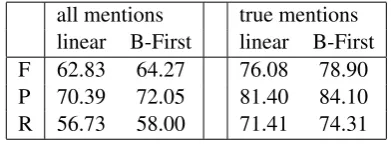
But is the specific order proposed by the Balas algorithm itself useful? Since we have dispensed with ’full optimization’, why not dispense with the Balas ordering as well? Since the ordering of the pairs does not affect the rest of our algorithm we have been able to compare the Balas order to the more natural linear order. Note that all constraints are applied in the linear variant as well, so the only difference is the ordering. Linear ordering over pairs is established by sorting according to the in-dex of the first pair element (theifromci j).
all mentions true mentions
linear B-First linear B-First
F 62.83 64.27 76.08 78.90
P 70.39 72.05 81.40 84.10
R 56.73 58.00 71.41 74.31
Table 3: Balas Order vs. Linear Order
Our experiments (cf. Table 3) indicate that the
[image:7.595.318.514.610.683.2]Balas ordering does affect the empirical results. The F-measure improvement is 1.44% (’all men-tions’) and 2.82% (’true menmen-tions’).
The search for Balas-First remains, in general, NP-complete. However, constraint models with-out boundness enforcement constraints (cf. Sec-tion 5) pose no computaSec-tional burden, they can be solved in quadratic time. In the presence of bound-ness enforcement constraints, exponential time is required in the worst case. In our experiments, boundness enforcement constraints have proved to be unproblematic. Most of the time, the classi-fier has assigned low costs to candidate pairs con-taining a relative or a possessive pronoun, which means that they get instantiated rather soon (al-though this is not guaranteed).
9 Related Work
The focus of our paper lies on the evaluation of the benefits optimization could have for coreference resolution. Accordingly, we restrict our discus-sion to methodologically related approaches (i.e. ILP approaches). Readers interested in other work on anaphora resolution for German on the basis of the T¨uBa coreference corpus should consider (Hinrichs et al., 2005) (pronominal anaphora) and (Versley, 2006) (nominal anaphora).
Common to all ILP approaches (incl. ours)
is that they apply ILP on the output of pairwise
machine-learning. Denis and Baldridge (2007;
2008) have an ILP model to jointly determine anaphoricity and coreference, but take neither transitivity nor exclusivity into account. So no complexity problems arise in their approach. The model from (Finkel and Manning, 2008) utilizes transitivity, but not exclusivity. The benefits of transitivity are thus restricted to an optimal bal-ancing of the weights (e.g. given two positively classified pairs, the transitively given third pair in some cases is negative, ILP globally resolves these cases to the optimal solution). The authors do not mention complexity problems with
exten-sionalizing transitivity. Klenner (2007) utilizes
both transitivity and exclusivity. To overcome the overhead of transitivity extensionalization, he pro-poses a fixed transitivity window. This, however, is bound to produce transitivity gaps, so the bene-fits of complete transitivity propagation are lost.
Another attempt to overcome the problem of complexity with ILP models is described in (Riedel and Clarke, 2006) (dependency parsing).
Here an incremental—or better, cascaded—ILP model is proposed, where at each cascade only those constraints are added that have been vio-lated in the preceding one. The search stops with the first consistent solution (as we suggest in the present paper). However, it is difficult to quantify the number of cascades needed to come to it and moreover, the full ILP machinery is being used (so again, constraints need to be extensionalized).
To the best of our knowledge, our work is the first that studies the proper utility of ILP optimiza-tion for NLP, while offering an intensional alter-native to ILP constraints.
10 Conclusion and Future Work
In this paper, we have argued that ILP for NLP reduces to Zero-One ILP with unweighted con-straints. We have proposed such a Zero-One ILP model that combines exclusivity, transitivity and boundness enforcement constraints in an inten-sional model driven by best-first inference.
We furthermore claim and empirically demon-strate for the domain of coreference resolution that NLP approaches can take advantage from that new perspective. The pitfall of ILP, namely the need to extensionalize each and every constraint, can be avoided. The solution is an easy to carry out reimplementation of a Zero-One algorithm such as Balas’, where (most) constraints can be treated intensionally. Moreover, we have found empiri-cal evidence that ’full optimization’ is not needed. The first found consistent solution is as good as the optimal one. Depending on the constraint model this can reduce the costs from exponential time to polynomial time.
Optimization efforts, however, are not superflu-ous, as we have showed. The first consistent so-lution found with our Balas reimplementation im-proves the baseline significantly. Also, the Balas ordering itself has proven superior over other or-ders, e.g. linear order.
In the future, we will experiment with more complex constraint models in the area of corefer-ence resolution. But we will also consider other domains in order to find out whether our results actually are widely applicable.
Acknowledgement The work described herein is partly funded by the Swiss National Science
Foundation (grant 105211-118108). We would
References
E. Althaus, N. Karamanis, and A. Koller. 2004.
Com-puting locally coherent discourses. InProc. of the
ACL.
A. Bagga and B. Baldwin. 1998. Algorithms for
scor-ing coreference chains. In Proceedings of the
Lin-guistic Coreference Workshop at The First Interna-tional Conference on Language Resources and
Eval-uation (LREC98), pages 563–566.
E. Balas. 1965. An additive algorithm for solving
lin-ear programs with zero-one variables. Operations
Research, 13(4):517–546.
J.W. Chinneck. 2004. Practical optimization:
a gentle introduction. Electronic document:
http://www.sce.carleton.ca/faculty/ chinneck/po.html.
W. Daelemans, J. Zavrel, K. van der Sloot, and A. van den Bosch. 2004. TiMBL: Tilburg Memory-Based Learner.
P. Denis and J. Baldridge. 2007. Joint determination of anaphoricity and coreference resolution using
in-teger programming. Proceedings of NAACL HLT,
pages 236–243.
P. Denis and J. Baldridge. 2008. Specialized models
and ranking for coreference resolution. In
Proceed-ings of the Empirical Methods in Natural Language
Processing (EMNLP 2008), Hawaii, USA. To
ap-pear.
J.R. Finkel and C.D. Manning. 2008. Enforcing tran-sitivity in coreference resolution. Association for Computational Linguistics.
E. Hinrichs, K. Filippova, and H. Wunsch. 2005. A data-driven approach to pronominal anaphora reso-lution in German. In Proc. of RANLP ’05.
M. Klenner and ´E. Ailloud. 2008. Enhancing
coref-erence clustering. In C. Johansson, editor,Proc. of
the Second Workshop on Anaphora Resolution (WAR
II), volume 2 ofNEALT Proceedings Series, pages
31–40, Bergen, Norway.
M. Klenner. 2007. Enforcing consistency on
corefer-ence sets. InRecent Advances in Natural Language
Processing (RANLP), pages 323–328, September.
X. Luo, A. Ittycheriah, H. Jing, N. Kambhatla, and S. Roukos. 2004. A mention-synchronous coref-erence resolution algorithm based on the Bell tree. Proceedings of the 42nd Annual Meeting on
Associ-ation for ComputAssoci-ational Linguistics.
X. Luo. 2005. On coreference resolution
perfor-mance metrics. InProceedings of the conference on
Human Language Technology and Empirical
Meth-ods in Natural Language Processing, pages 25–32.
Association for Computational Linguistics Morris-town, NJ, USA.
T. Marciniak and M. Strube. 2005. Beyond the
pipeline: Discrete optimization in NLP. InProc. of
the CoNLL.
K. Naumann. 2006. Manual for the annotation of
indocument referential relations. Electronic
doc-ument: http://www.sfs.uni-tuebingen.de/
de_tuebadz.shtml.
V. Ng and C. Cardie. 2002. Improving machine learn-ing approaches to coreference resolution. In Proc. of the ACL.
C. Nicolae and G. Nicolae. 2006. Best Cut: A graph
algorithm for coreference resolution. In
Proceed-ings of the 2006 Conference on Empirical Methods
in Natural Language Processing, pages 275–283.
Association for Computational Linguistics.
C.H. Papadimitriou and K. Steiglitz. 1998.
Combi-natorial Optimization: Algorithms and Complexity.
Dover Publications.
S.P. Ponzetto and M. Strube. 2006. Exploiting seman-tic role labeling, WordNet and Wikipedia for
coref-erence resolution. In Proc. of HLT-NAACL,
vol-ume 6, pages 192–199.
V. Punyakanok, D. Roth, W. Yih, and D. Zimak. 2004. Semantic role labeling via integer linear
program-ming inference. InProc. of the COLING.
S. Riedel and J. Clarke. 2006. Incremental integer linear programming for non-projective dependency
parsing. InProc. of the EMNLP.
W.M. Soon, H.T. Ng, and D.C.Y. Lim. 2001. A
machine learning approach to coreference
resolu-tion of noun phrases. Computational Linguistics,
27(4):521–544.
H. Telljohann, E.W. Hinrichs, S. K¨ubler, and H.
Zins-meister. 2005. Stylebook for the T¨ubingen
treebank of written German (T¨uBa-D/Z).
Semi-nar fur Sprachwissenschaft, Universit¨at T¨ubingen,
T¨ubingen, Germany.