HTM: A Topic Model for Hypertexts
Congkai Sun∗
Department of Computer Science Shanghai Jiaotong University
Shanghai, P. R. China [email protected]
Bin Gao
Microsoft Research Asia No.49 Zhichun Road
Beijing, P. R. China [email protected]
Zhenfu Cao
Department of Computer Science Shanghai Jiaotong University
Shanghai, P. R. China [email protected]
Hang Li
Microsoft Research Asia No.49 Zhichun Road
Beijing, P. R. China [email protected]
Abstract
Previously topic models such as PLSI (Prob-abilistic Latent Semantic Indexing) and LDA (Latent Dirichlet Allocation) were developed for modeling the contents ofplain texts. Re-cently, topic models for processing hyper-texts such as web pages were also proposed. The proposed hypertext models are generative models giving rise to both wordsand hyper-links. This paper points out that to better rep-resent the contents of hypertexts it is more es-sential to assume that the hyperlinks are fixed and to define the topic model as that of gen-erating words only. The paper then proposes a new topic model for hypertext processing, referred to as Hypertext Topic Model (HTM). HTM defines the distribution of words in a document (i.e., the content of the document) as a mixture over latent topics in the document
itselfand latent topics in the documents which
the document cites. The topics are further characterized as distributions of words, as in the conventional topic models. This paper fur-ther proposes a method for learning the HTM model. Experimental results show that HTM outperforms the baselines on topic discovery and document classification in three datasets.
1 Introduction
Topic models are probabilistic and generative mod-els representing contents of documents. Examples of topic models include PLSI (Hofmann, 1999) and LDA (Blei et al., 2003). The key idea in topic mod-eling is to represent topics as distributions of words
* This work was conducted when the first author visited Microsoft Research Asia as an intern.
and define the distribution of words in document (i.e., the content of document) as a mixture over hid-den topics. Topic modeling technologies have been applied to natural language processing, text min-ing, and information retrieval, and their effective-ness have been verified.
In this paper, we study the problem of topic mod-eling for hypertexts. There is no doubt that this is an important research issue, given the fact that more and more documents are available as hypertexts cur-rently (such as web pages). Traditional work mainly focused on development of topic models for plain texts. It is only recently several topic models for pro-cessing hypertexts were proposed, including Link-LDA and Link-PLSA-Link-LDA (Cohn and Hofmann, 2001; Erosheva et al., 2004; Nallapati and Cohen, 2008).
We point out that existing models for hypertexts may not be suitable for characterizing contents of hypertext documents. This is because all the models are assumed to generate both words and hyperlinks (outlinks) of documents. The generation of the latter type of data, however, may not be necessary for the tasks related to contents of documents.
In this paper, we propose a new topic model for hypertexts called HTM (Hypertext Topic Model), within the Bayesian learning approach (it is simi-lar to LDA in that sense). In HTM, the hyperlinks of hypertext documents are supposed to be given. Each document is associated with one topic distribu-tion. The word distribution of a document is defined as a mixture of latent topics of the document itself and latent topics of documentswhich the document cites. The topics are further defined as distributions
of words. That means the content (topic distribu-tions for words) of a hypertext document is not only determined by the topics of itself but also the top-ics of documents it cites. It is easy to see that HTM contains LDA as a special case. Although the idea of HTM is simple and straightforward, it appears that this is the first work which studies the model.
We further provide methods for learning and in-ference of HTM. Our experimental results on three web datasets show that HTM outperforms the base-line models of LDA, Link-LDA, and Link-PLSA-LDA, in the tasks of topic discovery and document classification.
The rest of the paper is organized as follows. Sec-tion 2 introduces related work. SecSec-tion 3 describes the proposed HTM model and its learning and infer-ence methods. Experimental results are presented in Section 4. Conclusions are made in the last section.
2 Related Work
There has been much work on topic modeling. Many models have been proposed including PLSI (Hof-mann, 1999), LDA (Blei et al., 2003), and their extensions (Griffiths et al., 2005; Blei and Lafferty, 2006; Chemudugunta et al., 2007). Inference and learning methods have been developed, such as vari-ational inference (Jordan et al., 1999; Wainwright and Jordan, 2003), expectation propagation (Minka and Lafferty, 2002), and Gibbs sampling (Griffiths and Steyvers, 2004). Topic models have been uti-lized in topic discovery (Blei et al., 2003), document retrieval (Xing Wei and Bruce Croft, 2006), docu-ment classification (Blei et al., 2003), citation analy-sis (Dietz et al., 2007), social network analyanaly-sis (Mei et al., 2008), and so on. Most of the existing models are for processing plain texts. There are also models for processing hypertexts, for example, (Cohn and Hofmann, 2001; Nallapati and Cohen, 2008; Gru-ber et al., 2008; Dietz et al., 2007), which are most relevant to our work.
Cohn and Hofmann (2001) introduced a topic model for hypertexts within the framework of PLSI. The model, which is a combination of PLSI and PHITS (Cohn and Chang, 2000), gives rise to both the words and hyperlinks (outlinks) of the document in the generative process. The model is useful when the goal is to understand the distribution of links
as well as the distribution of words. Erosheva et al (2004) modified the model by replacing PLSI with LDA. We refer to the modified mode as Link-LDA and take it as a baseline in this paper. Note that the above two models do not directly associate the top-ics of the citing document with the toptop-ics of the cited documents.
Nallapati and Cohn (2008) proposed an extension of Link-LDA called Link-PLSA-LDA, which is an-other baseline in this paper. Assuming that the cit-ing and cited documents share similar topics, they explicitly model the information flow from the cit-ing documents to the cited documents. In Link-PLSA-LDA, the link graph is converted into a bi-partite graph in which links are connected from cit-ing documents to cited documents. If a document has both inlinks and outlinks, it will be duplicated on both sides of the bipartite graph. The generative process for the citing documents is similar to that of Link-LDA, while the cited documents have a differ-ent generative process.
Dietz et al (2007) proposed a topic model for ci-tation analysis. Their goal is to find topical influ-ence of publications in research communities. They convert the citation graph (created from the publica-tions) into a bipartite graph as in Link-PLSA-LDA. The content of a citing document is assumed to be generated by a mixture over the topic distribution of the citing document and the topic distributions of the cited documents. The differences between the topic distributions of citing and cited documents are measured, and the cited documents which have the strongest influence on the citing document are iden-tified.
pre-Table 1: Notations and explanations. T Number of topics
D Documents in corpus D Number of documents αθ,αβ Hyperparameters forθandβ
λ Hyperparameter to control the weight between the citing document and the cited documents θ Topic distributions for all documents β Word distribution for topic
b,c,z Hidden variables for generating word d document (index)
wd Word sequence in documentd Nd Number of words in documentd
Ld Number of documents cited by documentd
Id Set of cited documents for documentd
idl Index oflthcited document of documentd
ξd Distribution on cited documents of documentd
θd Topic distribution associated with documentd
bdn Decision on way of generatingnthword in
doc-umentd
cdn Cited document that generatesnthword in
doc-umentd
zdn Topic ofnthword in documentd
dict contents of documents, the use of HTM seems more reasonable.
3 Hypertext Topic Model
3.1 Model
In topic modeling, a probability distribution of words is employed for a given document. Specifi-cally, the probability distribution is defined as a mix-ture over latent topics, while each topic is fumix-ture characterized by a distribution of words (Hofmann, 1999; Blei et al., 2003). In this paper, we introduce an extension of LDA model for hypertexts. Table 1 gives the major notations and their explanations.
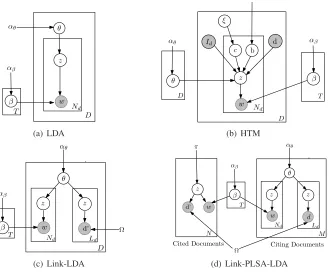
The graphic representation of conventional LDA is given in Figure 1(a). The generative process of LDA has three steps. Specifically, in each document a topic distribution is sampled from a prior distribu-tion defined as Dirichlet distribudistribu-tion. Next, a topic is sampled from the topic distribution of the document, which is a multinominal distribution. Finally, a word is sampled according to the word distribution of the topic, which also forms a multinormal distribution.
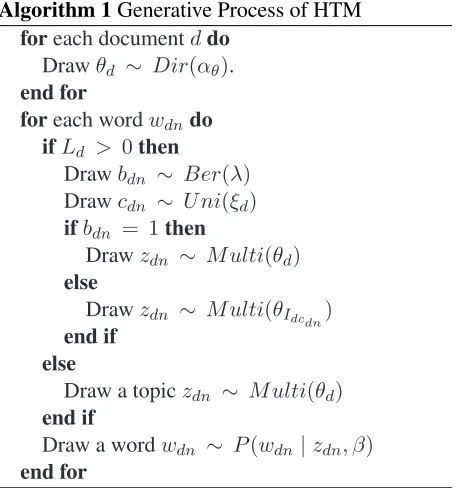
The graphic representation of HTM is given in Figure 1(b). The generative process of HTM is de-scribed in Algorithm 1. First, a topic distribution is sampled for each document according to Dirich-let distribution. Next, for generating a word in a document, it is decided whether to use the current
Algorithm 1Generative Process of HTM
foreach documentddo
Drawθd ∼ Dir(αθ).
end for
foreach wordwdndo
ifLd > 0then
Drawbdn ∼ Ber(λ) Drawcdn ∼ U ni(ξd)
ifbdn = 1then
Drawzdn ∼ M ulti(θd)
else
Drawzdn ∼ M ulti(θIdcdn)
end if else
Draw a topiczdn ∼ M ulti(θd)
end if
Draw a wordwdn ∼ P(wdn |zdn, β)
end for
document or documents which the document cites. (The weight between the citing document and cited documents is controlled by an adjustable hyper-parameterλ.) It is also determined which cited doc-ument to use (if it is to use cited docdoc-uments). Then, a topic is sampled from the topic distribution of the se-lected document. Finally, a word is sampled accord-ing to the word distribution of the topic. HTM natu-rally mimics the process of writing a hypertext docu-ment by humans (repeating the processes of writing native texts and anchor texts).
The formal definition of HTM is given be-low. Hypertext document d has Nd words wd = wd1· · ·wdNd andLd cited documentsId =
{id1, . . . , idLd}. The topic distribution of d is θd
and topic distributions of the cited documents are
θi, i∈Id. Givenλ,θ, andβ, the conditional proba-bility distribution ofwdis defined as:
p(wd|λ, θ, β) = Nd Y
n=1
X
bdn
p(bdn|λ)
X
cdn
p(cdn|ξd)
X
zdn
p(zdn|θd)bdnp(zdn|θidcdn)1−bdnp(wdn|zdn, β).
Here ξd, bdn, cdn, and zdn are hidden vari-ables. When generating a wordwdn,bdndetermines
[image:3.612.311.541.66.310.2] [image:3.612.82.284.79.299.2]is whenbdn = 0. In this paper, for simplicity we
as-sume that the cited documents are equally likely to be selected, i.e.,ξdi= 1
Ld.
Note that θ represents the topic distributions of all the documents. For anyd, its word distribution is affected by both θd and θi, i ∈ Id. There is a
propagation of topics from the cited documents to the citing document through the use ofθi, i∈Id.
For a hypertext document d that does not have cited documents. The conditional probability dis-tribution degenerates to LDA:
p(wd|θd, β) = Nd Y
n=1
X
zdn
p(zdn|θd)p(wdn|zdn, β).
By taking the product of the marginal probabil-ities of hypertext documents, we obtain the condi-tional probability of the corpusDgiven the hyper-parametersλ, αθ, β,
p(D|λ, αθ, β) =
Z YD
d=1
p(θd|αθ)
Nd Y
n=1
X
bdn
p(bdn|λ)X
cdn
p(cdn|ξd)
X
zdn
p(zdn|θd)bdnp(zdn|θIdcdn)1−bdn
p(wdn|zdn, β)dθ. (1)
Note that the probability function (1) also covers the special cases in which documents do not have cited documents.
In HTM, the content of a document is decided by the topics of the document as well as the topics of the documents which the document cites. As a result contents of documents can be ‘propagated’ along the hyperlinks. For example, suppose web page A cites page B and page B cites page C, then the content of page A is influenced by that of page B, and the con-tent of page B is further influenced by the concon-tent of page C. Therefore, HTM is able to more accu-rately represent the contents of hypertexts, and thus is more useful for text processing such as topic dis-covery and document classification.
3.2 Inference and Learning
An exact inference of the posterior probability of HTM may be intractable, we employ the mean field
variational inference method (Wainwright and Jor-dan, 2003; Jordan et al., 1999) to conduct approxi-mation. Let I[·]be an indicator function. We first define the following factorized variational posterior distributionqwith respect to the corpus:
q=
D
Y
d=1
q(θd|γd)
Nd Y
n=1
µ
q(xdn|ρdn)(q(cdn|ψdn)
¶I[Ld>0]
q(zdn|φdn),
whereγ,ψ,φ, andρdenote free variational parame-ters. Parameterγis the posterior Dirichlet parameter corresponding to the representations of documents in the topic simplex. Parameters ψ, φ, and ρ cor-respond to the posterior distributions of their asso-ciated random variables. We then minimize the KL divergence betweenq and the true posterior proba-bility of the corpus by taking derivatives of the loss function with respect to variational parameters. The solution is listed as below.
Letβiv bep(wdnv = 1|zi = 1)for the wordv. If Ld > 0, we have
E-step:
γdi = αθi+
Nd X
n=1
ρdnφdni+
D
X
d0=1 Ld0 X
l=1
I[id0l =d]
Nd0
X
n=1
(1−ρd0n)ψd0nlφd0ni.
φdni ∝ βivexp
©
ρdnEq[log (θdi)|γd]
+ (1−ρdn)
Ld X
l=1
ψdnlEq[log (θIdli)|γIdl]ª.
ρdn = µ
1 + ³
exp©
k
X
i=1
¡
(φdniEq[log(θdi)|γd]
−
Ld X
l=1
ψdnlφdniEq[log(θIdli)|γIdl] ¢
+ logλ−log¡1−λ¢ª´−1
¶−1
z
w β
θ αθ
αβ
T Nd D
(a) LDA
w
β θ
αθ αβ
D T
d
z
D Nd
λ
c ξ
b
Id
(b) HTM
z
w β
θ αθ
αβ
T Nd
D z
d’ Ω
Ld
(c) Link-LDA
z
w β
θ αθ
αβ
T
Nd
z
Ω
Ld
π
z
w
d’
N M
Cited Documents Citing Documents
d
[image:5.612.143.472.70.342.2](d) Link-PLSA-LDA Figure 1: Graphical model representations
ϕdnl ∝ ξdlexp{(1−ρdn) k
X
i=1
φdniEq[log(θIdli)|γIdl]}.
Otherwise,
γdi =αθi +
Nd X
n=1 φdni+
D
X
d0=1 Ld0
X
l=1
I[id0l=d] Nd0
X
n=1
(1−ρd0n)ψd0nlφd0ni.
φdni ∝ βivexp
©
Eq[log (θdi)|γd]
ª
.
From the first two equations we can see that the cited documents and the citing document jointly af-fect the distribution of the words in the citing docu-ment.
M-step:
βij ∝ D
X
d=1 Nd X
n=1
φdniwjdn.
In order to cope with the data sparseness problem due to large vocabulary, we employ the same tech-nique as that in (Blei et al., 2003). To be specific, we treatβas aK∗V random matrix, with each row being independently drawn from a Dirichlet distri-bution βi ∼ Dir(αβ) . Variational inference is
modified appropriately.
4 Experimental Results
We compared the performances of HTM and three baseline models: LDA, Link-LDA, and Link-PLSA-LDA in topic discovery and document classification. Note that LDA does not consider the use of link in-formation; we included it here for reference.
4.1 Datasets
We made use of three datasets. The documents in the datasets were processed by using the Lemur Took kit (http://www.lemurproject.org), and the low fre-quency words in the datasets were removed.
The second dataset Wikipedia (available at http://www.mpi-inf.mpg.de/˜angelova) contains four subjects (categories): Biology, Physics, Chem-istry, and Mathematics. There are 2,970 documents and 45,818 links. The vocabulary size is 3,287.
The third dataset is ODP composed of homepages of researchers and their first level outlinked pages (cited documents). We randomly selected five sub-jects from the ODP archive. They are Cognitive Science (CogSci), Theory, NeuralNetwork (NN), Robotics, and Statistics. There are 3,679 pages and 2,872 links. The vocabulary size is 3,529.
WebKB and Wikipedia are public datasets widely used in topic model studies. ODP was collected by us in this work.
4.2 Topic Discovery
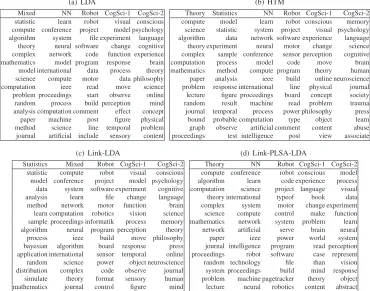
We created four topic models HTM, LDA, Link-LDA, and Link-PLSA-LDA using all the data in each of the three datasets, and evaluated the top-ics obtained in the models. We heuristically set the numbers of topics as 10 for ODP, 12 for WebKB, and 8 for Wikipedia (i.e., two times of the number of true subjects). We found that overall HTM can construct more understandable topics than the other models. Figure 2 shows the topics related to the subjects created by the four models from the ODP dataset. HTM model can more accurately extract the three topics: Theory, Statistic, and NN than the other models. Both LDA and Link-LDA had mixed topics, labeled as ‘Mixed’ in Figure 2. Link-PLSA-LDA missed the topic of Statistics. Interestingly, all the four models split Cognitive Science into two top-ics (showed as CogSci-1 and CogSci-2), probably because the topic itself is diverse.
4.3 Document Classification
We applied the four models in the three datasets to document classification. Specifically, we used the word distributions of documents created by the mod-els as feature vectors of the documents and used the subjects in the datasets as categories. We further randomly divided each dataset into three parts (train-ing, validation, and test) and conducted 3-fold cross-validation experiments. In each trial, we trained an SVM classifier with the training data, chose param-eters with the validation data, and conducted evalu-ation on classificevalu-ation with the test data. For HTM,
Table 2: Classification accuracies in 3-fold cross-validation.
[image:6.612.320.523.174.215.2]LDA HTM Link-LDA Link-PLSA-LDA ODP 0.640 0.698 0.535 0.581 WebKB 0.786 0.795 0.775 0.774 Wikipedia 0.845 0.866 0.853 0.855
Table 3: Sign-test results between HTM and the three baseline models.
LDA Link-LDA Link-PLSA-LDA ODP 0.0237 2.15e-05 0.000287 WebKB 0.0235 0.0114 0.00903 Wikipedia 1.79e-05 0.00341 0.00424
we chose the bestλvalue with the validation set in each trial. Table 2 shows the classification accura-cies. We can see that HTM performs better than the other models in all three datasets.
We conducted sign-tests on all the results of the datasets. In most cases HTM performs statistically significantly better than LDA, LDA, and Link-PLSA-LDA (p-value < 0.05). The test results are shown in Table 3.
4.4 Discussion
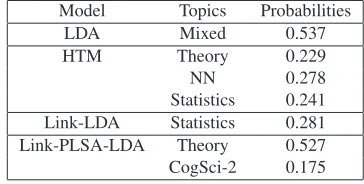
We conducted analysis on the results to see why HTM can work better. Figure 3 shows an example homepage from the ODP dataset, where superscripts denote the indexes of outlinked pages. The home-page contains several topics, including Theory, Neu-ral network, Statistics, and others, while the cited pages contain detailed information about the topics. Table 4 shows the topics identified by the four mod-els for the homepage. We can see that HTM can really more accurately identify topics than the other models.
The major reason for the better performance by HTM seems to be that it can fully leverage the
infor-Table 4: Comparison of topics identified by the four mod-els for the example homepage. Only topics with proba-bilities>0.1and related to the subjects are shown.
Model Topics Probabilities
LDA Mixed 0.537
HTM Theory 0.229
NN 0.278
[image:6.612.331.513.622.714.2](a) LDA
Mixed NN Robot CogSci-1 CogSci-2 statistic learn robot visual conscious compute conference project model psychology algorithm system file experiment language theory neural software change cognitive complex network code function experience mathematics model program response brain model international data process theory science compute motor data philosophy computation ieee read move science problem proceedings start observe online random process build perception mind analysis computation comment effect concept paper machine post figure physical method science line temporal problem journal artificial include sensory content
(b) HTM
Theory Statistics NN Robot CogSci-1 CogSci-2 compute model learn robot conscious memory science statistic system project visual psychology algorithm data network software experience language theory experiment neural motor change science complex sample conference sensor perception cognitive computation process model code move brain mathematics method compute program theory human paper analysis ieee build online neuroscience problem response international line physical journal lecture figure proceedings board concept society random result machine read problem trauma journal temporal process power philosophy press bound probable computation type object learn graph observe artificial comment content abuse proceedings test intelligence post view associate
(c) Link-LDA
Statistics Mixed Robot CogSci-1 CogSci-2 statistic compute robot visual conscious model conference project model psychology data system software experiment cognitive analysis learn file change language method network motor function brain learn computation robotics vision science sample proceedings informatik process memory algorithm neural program perception theory process ieee build move philosophy bayesian algorithm board response press application international sensor temporal online random science power object neuroscience distribution complex code observe journal simulate theory format sensory human mathematics journal control figure mind
(d) Link-PLSA-LDA
[image:7.612.118.488.68.359.2]Theory NN Robot CogSci-1 CogSci-2 compute conference robot conscious model algorithm learn code experience process computation science project language visual theory international typeof book data complex system motor change experiment science compute control make function mathematics network system problem learn network artificial serve brain neural paper ieee power world system journal intelligence program read perception proceedings robot software case represent random technology file than vision system proceedings build mind response problem machine pagetracker theory object lecture neural robotics content abstract
Figure 2: Topics identified by four models
Radford M.Neal
Professor, Dept. of Statistics and Dept. of Computer Science, University of Toronto I0m currently highlighting the following
:
∗A new R function for performing univariate slice sampling.1
∗A workshop paper on Computing Likelihood Functions for High-Energy Physics Experiments when Distributions are Defined by Simulators with Nuisance Parameters.2
∗Slides from a talk at the Third Workshop on Monte Carlo Methods on
“Short-Cut MCMC: An Alternative to Adaptation”, May 2007: Postscript, PDF. Courses I0m teaching in Fall 2008
: ∗STA 437: Methods for Multivariate Data3
∗STA 3000: Advanced Theory of Statistics4
You can also find information on courses I’ve taught in the past.5 You can also get to information on:
∗Research interests6(with pointers to publications) ∗Current and former graduate students7
∗Current and former postdocs8
∗Curriculum Vitae: PostScript, or PDF. ∗Full publications list9
∗How to contact me10 ∗Links to various places11
If you know what you want already,you may wish to go directly to:
∗Software available on-line12
∗Papers available on-line13 ∗Slides from talks14 ∗Miscellaneous other stuff15
[image:7.612.144.462.377.673.2]Information in this hierarchy was last updated 2008-06-20.
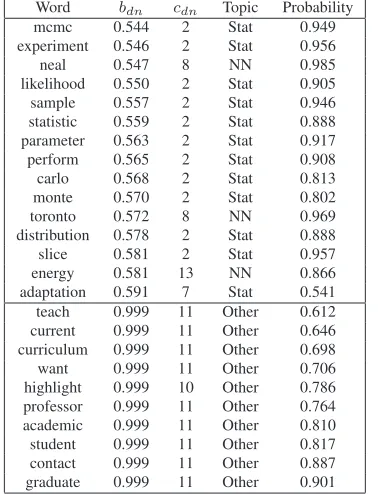
Table 5: Word assignment in the example homepage. Word bdn cdn Topic Probability
mcmc 0.544 2 Stat 0.949 experiment 0.546 2 Stat 0.956 neal 0.547 8 NN 0.985 likelihood 0.550 2 Stat 0.905 sample 0.557 2 Stat 0.946 statistic 0.559 2 Stat 0.888 parameter 0.563 2 Stat 0.917 perform 0.565 2 Stat 0.908 carlo 0.568 2 Stat 0.813 monte 0.570 2 Stat 0.802 toronto 0.572 8 NN 0.969 distribution 0.578 2 Stat 0.888 slice 0.581 2 Stat 0.957 energy 0.581 13 NN 0.866 adaptation 0.591 7 Stat 0.541 teach 0.999 11 Other 0.612 current 0.999 11 Other 0.646 curriculum 0.999 11 Other 0.698 want 0.999 11 Other 0.706 highlight 0.999 10 Other 0.786 professor 0.999 11 Other 0.764 academic 0.999 11 Other 0.810 student 0.999 11 Other 0.817 contact 0.999 11 Other 0.887 graduate 0.999 11 Other 0.901
Table 6: Most salient topics in cited pages. URL Topic Probability
2 Stat 0.690 7 Stat 0.467
8 NN 0.786
13 NN 0.776
0.6 0.65 0.7 0.75 0.8 0.85 0.9
0.95 0.9 0.85 0.8 0.75 0.7 0.65 0.6 0.55 0.5 ODP Webkb Wiki
Ac cu ra cy
λ
Figure 4: Classification accuracies on three datasets with differentλvalues. The cross marks on the curves cor-respond to the average values of λin the 3-fold cross-validation experiments.
mation from the cited documents. We can see that the content of the example homepage is diverse and not very rich. It might be hard for the other base-line models to identify topics accurately. In con-trast, HTM can accurately learn topics by the help of the cited documents. Specifically, if the content of a document is diverse, then words in the document are likely to be assigned into wrong topics by the existing approaches. In contrast, in HTM with prop-agation of topic distributions from cited documents, the words of a document can be more accurately as-signed into topics. Table 5 shows the first 15 words and the last 10 words for the homepage given by HTM, in ascending order of bdn, which measures
the degree of influence from the cited documents on the words (the smaller the stronger). The table also gives the values ofcdn, indicating which cited
docu-ments have the strongest influence. Furthermore, the topics having the largest posterior probabilities for the words are also shown. We can see that the words ’experiment’, ’sample’, ’parameter’, ’perform’, and ’energy’ are accurately classified. Table 6 gives the most salient topics of cited documents. It also shows the probabilities of the topics given by HTM. We can see that there is a large agreement between the most salient topics in the cited documents and the topics which are affected the most in the citing document.
Parameterλis the only parameter in HTM which needs to be tuned. We found that the performance of HTM is not very sensitive to the values ofλ, which reflects the degree of influence from the cited doc-uments to the citing document. HTM can perform well with differentλvalues. Figure 4 shows the clas-sification accuracies of HTM with respect to differ-entλvalues for the three datasets. We can see that HTM works better than the other models in most of the cases (cf., Table 2).
5 Conclusion
[image:8.612.90.279.105.352.2]hyper-texts are given and only the words of the hyperhyper-texts are stochastically generated. Furthermore, the word distribution of a document is determined not only by the topics of the document in question but also from the topics of the documents which the doc-ument cites. It can be regarded as ‘propagation’ of topics reversely along hyperlinks in hypertexts, which can lead to more accurate representations than the existing models. HTM can naturally mimic hu-man’s process of creating a document (i.e., by con-sidering using the topics of the document and at the same time the topics of the documents it cites). We also developed methods for learning and inferring an HTM model within the same framework as LDA (Latent Dirichlet Allocation). Experimental results show that the proposed HTM model outperforms the existing models of LDA, LDA, and Link-PLSA-LDA on three datasets for topic discovery and document classification.
As future work, we plan to compare the HTM model with other existing models, to develop learn-ing and inference methods for handllearn-ing extremely large-scale data sets, and to combine the current method with a keyphrase extraction method for ex-tracting keyphrases from web pages.
6 Acknowledgement
We thank Eric Xing for his valuable comments on this work.
References
Ricardo Baeza-Yates and Berthier Ribeiro-Neto. 1999. Modern Information Retrieval. ACM Press / Addison-Wesley.
David Blei, Andrew Ng, and Michael Jordan. 2003. La-tent Dirichlet allocation.Journal of machine Learning Research, 3:993–1022.
David Blei and John Lafferty. 2005. Correlated Topic Models. InAdvances in Neural Information Process-ing Systems 12.
David Blei and John Lafferty. 2006. Dynamic topic models. InProceedings of the 23rd international con-ference on Machine learning.
Chaitanya Chemudugunta, Padhraic Smyth, and Mark Steyvers. 2007. Modeling General and Specific As-pects of Documents with a Probabilistic Topic Model. In Advances in Neural Information Processing Sys-tems 19.
David Cohn and Huan Chang. 2000. Learning to Proba-bilistically Identify Authoritative Documents. In Pro-ceedings of the 17rd international conference on Ma-chine learning.
David Cohn and Thomas Hofmann. 2001. The missing link - a probabilistic model of document content and hypertext connectivity. In Neural Information Pro-cessing Systems 13.
Laura Dietz, Steffen Bickel and Tobias Scheffer. 2007. Unsupervised prediction of citation influences. In Pro-ceedings of the 24th international conference on Ma-chine learning.
Elena Erosheva, Stephen Fienberg, and John Lafferty. 2004. Mixed-membership models of scientific pub-lications. InProceedings of the National Academy of Sciences, 101:5220–5227.
Thomas Griffiths and Mark Steyvers. 2004. Finding Scientific Topics. In Proceedings of the National Academy of Sciences, 101 (suppl. 1).
Thomas Griffiths, Mark Steyvers, David Blei, and Joshua Tenenbaum. 2005. Integrating Topics and Syntax. In
Advances in Neural Information Processing Systems, 17.
Amit Gruber, Michal Rosen-Zvi, and Yair Weiss. 2008. Latent Topic Models for Hypertext. InProceedings of the 24th Conference on Uncertainty in Artificial Intel-ligence.
Thomas Hofmann. 1999. Probabilistic Latent Semantic Analysis. InProceedings of the 15th Conference on Uncertainty in Artificial Intelligence.
Michael Jordan, Zoubin Ghahramani, Tommy Jaakkola, and Lawrence Saul. 1999. An Introduction to Varia-tional Methods for Graphical Models.Machine Learn-ing, 37(2):183–233.
QiaoZhu Mei, Deng Cai, Duo Zhang, and ChengXiang Zhai. 2008. Topic Modeling with Network Regular-ization. InProceeding of the 17th international con-ference on World Wide Web.
Thomas Minka and John Lafferty. 2002. Expectation-Propagation for the Generative Aspect Model. In Pro-ceedings of the 18th Conference in Uncertainty in Ar-tificial Intelligence.
Ramesh Nallapati and William Cohen. 2008. Link-PLSA-LDA: A new unsupervised model for topics and influence of blogs. In International Conference for Webblogs and Social Media.
Martin Wainwright, and Michael Jordan. 2003. Graph-ical models, exponential families, and variational in-ference. InUC Berkeley, Dept. of Statistics, Technical Report, 2003.