Proceedings of the 2019 Conference on Empirical Methods in Natural Language Processing
5426
Learning Programmatic Idioms for Scalable Semantic Parsing
Srinivasan Iyer†, Alvin Cheung§and Luke Zettlemoyer†‡
†Paul G. Allen School of Computer Science and Engineering, Univ. of Washington, Seattle, WA
{sviyer, lsz}@cs.washington.edu
§Department of Electrical Engineering and Computer Sciences, UC Berkeley, Berkeley, CA [email protected]
‡Facebook AI Research, Seattle [email protected]
Abstract
Programmers typically organize executable source code using high-level coding patterns or idiomatic structures such as nested loops, exception handlers and recursive blocks, rather than as individual code tokens. In contrast, state of the art (SOTA) semantic parsers still map natural language instructions to source code by building the code syntax tree one node at a time. In this paper, we introduce an it-erative method to extract code idioms from large source code corpora by repeatedly col-lapsing most-frequent depth-2 subtrees of their syntax trees, and train semantic parsers to
ap-ply these idioms during decoding.
Apply-ing idiom-based decodApply-ing on a recent context-dependent semantic parsing task improves the SOTA by 2.2% BLEU score while reducing
training time by more than 50%. This
im-proved speed enables us to scale up the model by training on an extended training set that
is 5× larger, to further move up the SOTA
by an additional 2.3% BLEU and 0.9% exact match. Finally, idioms also significantly im-prove accuracy of semantic parsing to SQL on the ATIS-SQL dataset, when training data is limited.
1 Introduction
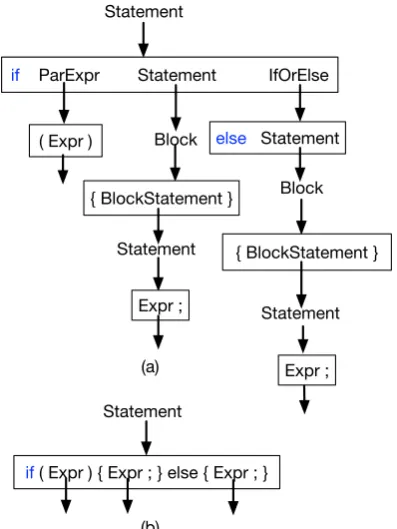
When programmers translate Natural Language (NL) specifications into executable source code, they typically start with a high-level plan of the major structures required, such as nested loops, conditionals, etc. and then proceed to fill in spe-cific details into these components. We refer to these high-level structures (Figure1 (b)) as code idioms (Allamanis and Sutton,2014). In this pa-per, we demonstrate how learning to use code id-ioms leads to an improvement in model accuracy and training time for the task of semantic parsing, i.e., mapping intents in NL into general purpose source code (Iyer et al.,2017;Ling et al.,2016).
( Expr )
if ParExpr Statement IfOrElse Statement
Block
Statement Block
Statement
(b) (a)
if ( Expr ) { Expr ; } else { Expr ; }
{ BlockStatement } { BlockStatement }
Expr ;
Expr ;
else Statement
Statement
Figure 1: (a) Syntax tree based decoding for seman-tic parsing uses as many as 11 rules (steps) to pro-duce the outer structure of a very frequently used
if-then-elsecode snippet. (b) Direct application of anif-then-elseidiom during decoding leads to im-proved accuracy and training time.
[image:1.595.307.506.225.490.2]before ultimately filling in the slots for theif con-dition, thethen expression and theelse expres-sion. However, the if-then-else block can be seen as a higher level structure such as shown in Figure1 (b) that can be applied in one decoding step and reused in many different programs. In this paper, we refer to frequently recurring sub-trees of programmatic parse sub-trees ascode idioms, and we equip semantic parsers with the ability to learn and directly generate idiomatic structures as in Figure1(b).
We introduce a simple iterative method to ex-tract idioms from a dataset of programs by re-peatedly collapsing the most frequent depth-2 sub-trees of syntax parse sub-trees. Analogous to the byte pair encoding (BPE) method (Gage, 1994; Sen-nrich et al., 2016) that creates new subtokens of words by repeatedly combining frequently occur-ring adjacent pairs of subtokens, our method takes a depth-2 syntax subtree and replaces it with a tree of depth-1 by removing all the internal nodes. This method is in contrast with the approach using probabilistic tree substitution grammars (pTSG) taken by Allamanis and Sutton (2014), who use theexplanation qualityof an idiom to prioritize id-ioms that are more interesting, with an end goal to suggest useful idioms to programmers using IDEs. Once idioms are extracted, we greedily apply them to semantic parsing training sets to provide super-vision for learning to apply idioms.
We evaluate our approach on two semantic pars-ing tasks that map NL into 1) general-purpose source code, and 2) executable SQL queries, re-spectively. On the first task, i.e., context depen-dent semantic parsing (Iyer et al.,2018) using the CONCODE dataset, we improve the state of the art (SOTA) by 2.2% of BLEU score. Furthermore, generating source code using idioms results in a more than 50% reduction in the number of decod-ing steps, which cuts down traindecod-ing time to less than half, from 27 to 13 hours. Taking advan-tage of this reduced training time, we further push the SOTA on CONCODE to an EM of 13.4 and a BLEU score of 28.9 by training on an extended version of the training set (with 5× the number of training examples). On the second task, i.e., mapping NL utterances into SQL queries for a flight information database (ATIS-SQL;Iyer et al. (2017)), using idioms significantly improves de-notational accuracy over SOTA models, when a limited amount of training data is used, and also
marginally outperforms the SOTA when the full training set is used (more details in Section7).
2 Related Work
Neural encoder-decoder models have proved ef-fective in mapping NL to logical forms (Dong and Lapata, 2016) and also for directly produc-ing general purpose programs (Iyer et al., 2017, 2018). Ling et al. (2016) use a sequence-to-sequence model with attention and a copy mech-anism to generate source code. Instead of di-rectly generating a sequence of code tokens, recent methods focus on constrained decoding mecha-nisms to generate syntactically correct output us-ing a decoder that is either grammar-aware or has a dynamically determined modular structure par-alleling the structure of the abstract syntax tree (AST) of the code (Rabinovich et al., 2017; Kr-ishnamurthy et al.,2017;Yin and Neubig,2017). Iyer et al.(2018) use a similar decoding approach but use a specialized context encoder for the task of context-dependent code generation. We aug-ment these neural encoder-decoder models with the ability to decode in terms of frequently oc-curring higher level idiomatic structures to achieve gains in accuracy and training time.
also be nested with other idioms or grammar rules. More closely related to the idioms that we use for decoding isAllamanis and Sutton (2014), who develop a system (HAGGIS) to automatically mine idioms from large code bases. They focus on finding interesting and explainable idioms, e.g., those that can be included as preset code tem-plates in programming IDEs. Instead, we learn frequently used idioms that can be easily associ-ated with NL phrases in our dataset. The produc-tion of large subtrees in a single step directly trans-lates to a large speedup in training and inference.
Concurrent with our research,Shin et al.(2019) also develop a system (PATOIS) for idiom-based semantic parsing and demonstrate its benefits on the Hearthstone (Ling et al.,2016) and Spider (Yu et al.,2018) datasets. While we extract idioms by collapsing frequently occurring depth-2 AST sub-trees and apply them greedily during training, they use non-parametric Bayesian inference for idiom extraction and train neural models to either apply entire idioms or generate its full body.
3 Idiom Aware Encoder-Decoder Models
We aim to train semantic parsers having the ability to use idioms during code generation. To do this, we first extract frequently used idioms from the training set, and then provide them as supervision to the semantic parser’s learning algorithm.
Formally, if a semantic parser decoder is guided by a grammar G = (N,Σ, R), where N and Σ are the sets of non-terminals and terminals respec-tively, andR is the set of production rules of the formA → β, A ∈ N, β ∈ {N ∪Σ}∗, we would
like to construct an idiom setI with rules of the formB → γ, B ∈ N, γ ∈ {N ∪Σ}∗, such that
B =≥⇒2 γ underG, i.e.,γ can be derived in two or more steps fromB under G. For the example in Figure1, Rwould contain rules for expanding each non-terminal, such as Statement → if Par-Expr Statement IfOrElseandParExpr→ {Expr}, whereasI would contain the idiomatic rule State-ment→if ( Expr ){Expr ;}else{Expr ;}.
The decoder builds trees fromGˆ= (N,Σ, R∪
I). Although the set of valid programs under both
G and Gˆare exactly the same, this introduction of ambiguous rules into G in the form of idioms presents an opportunity to learn shorter deriva-tions. In the next two sections, we describe the idiom extraction process, i.e., how I is chosen, and the idiom application process, i.e., how the
de-coder is trained to learn to apply idioms.
1 ProcedureExtract-Idioms(D,G,n)
Input:D →Training Programs
Input:G →Parsing Grammar
Input:n→Number of idioms 2 T ← {}. Stores all parse trees 3 ford∈Ddo
4 T ←T ∪Parse-Tree(d,G) 5 end
6 I ← {}
7 fori←1toKdo 8 s←Most-frequent
Depth-2-Subtree(T) 9 fort∈T do
10 t←Collapse-Subtree(t, s)
11 end
12 I ←I ∪ {s} 13 end
14 end
15 ProcedureCollapse-Subtree(t, s)
Input:t→parse-tree
Input:s→Depth 2 subtree 16 whilessubtree-oftdo
17 Replacesintwith Collapse(s) 18 end
19 end
20 ProcedureCollapse(s)
Input:s→Depth 2 subtree 21 frontier←leaves(s)
22 return Tree(root(s),frontier) 23 end
Algorithm 1:Idiom Extraction.
4 Idiom Extraction
Algorithm 1 describes the procedure to add id-iomatic rules, I, to the regular production rules,
R. Our goal is to populate the set I by identi-fying frequently occurring idioms (subtrees) from the programs in training set D. Since enumer-ating all subtrees of every AST in the training set is infeasible, we observe that all subtrees s0
Statement Statement
(a) (b)
(c)
Statement
(d) New Idiom Rule:
Statement if ( Expr ) { Statement }
New Idiom Rule:
Statement if ( Expr ) { return Expr ; } { Statement }
if ( Expr ) Statement if ( Expr ) { Statement }
Statement
if ( Expr ) { Statement }
return Expr ;
[image:4.595.309.525.63.228.2]if ( Expr ) { return Expr ; }
Figure 2: Two steps of the idiom extraction process
described in Algorithm1. (a) First, we find the most
frequent depth-2 syntax subtree under GrammarG in
datasetD, collapse it to produce a new production rule
(b), and replace all occurrences in the dataset with the collapsed version. Next, (c) is the most frequent depth-2 subtree which now happens to contain (b) within it. (c) is collapsed to form an idiom (d), which is effec-tively a depth-3 idiom.
trees have an additional constraint, i.e., either all or none of the children of non-terminal nodes are included, since a grammar rule has to be used en-tirely or not at all.
We perform idiom extraction in an iterative fashion. We first populateT with all parse trees of programs inD using grammarG (Step 4). Each iteration then comprises retrieving the most fre-quent depth-2 subtreesfromT (Step 8), followed by post-processingT to replace all occurrences of
sinTwith a collapsed (depth-1) version ofs(Step 10 and 17). The collapse function (Step 20) sim-ply takes a subtree, removes all its internal nodes and attaches its leaves directly to its root (Step 22). The collapsed version ofsis a new idiomatic rule (a depth-1 subtree), which we add to our set of id-ioms,I (Step 12). We illustrate two iterations of this algorithm in Figure2((a)-(b) and (c)-(d)). As-suming (a) is the most frequent depth-2 subtree in the dataset, it is transformed into the idiomatic rule in (b). Larger idiomatic trees are learned by com-bining several depth-2 subtrees as the algorithm progresses. This is shown in Figure 2 (c) which contains the idiom extracted in (b) within it owing to the post-processing of the dataset after idiom (b) is extracted (Step 10 of Algorithm1) which effec-tively makes the idiom in (d), a depth-3 idiom. We perform idiom extraction forK iterations. In our experiments we vary the value ofKbased on the number of idioms we would like to extract.
Statement
{ Statement } if ( Expr ) Statement
return Expr ; { Statement } if ( Expr ) Statement
Statement
if ( Expr ) { Statement }
return Expr ; if ( Expr ) { Statement }
(i)
(ii)
Statement
if ( Expr ) { Statement }
if ( Expr ) { return Expr ; }
(iii)
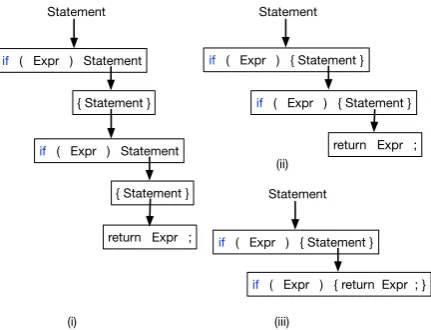
Figure 3: (i) Application of the two idioms extracted
in Figure 2 on a new training example. (ii) We first
perform two applications of the idiom in Figure2b, (iii)
followed by an application of the idiom in Figure2d.
The resulting tree can be represented with just 2 parsing rules instead of 5.
5 Model Training with Idioms
Once a set of idiomsI is obtained, we next train semantic parsing models to apply these idioms while decoding. We do this by supervising gram-mar rule generation in the decoder using a com-pressed set of rules for each example, using the id-iom setI (see Algorithm2). More concretely, we first obtain the parse tree ti (or grammar rule set
pi) for each training program yi under grammar
G (Step 3) and then greedily collapse each depth-2 subtree inti corresponding to every idiom inI
(Step 5). Onceti cannot be further collapsed, we
translate ti into production rules ri based on the
collapsed tree, with|ri| ≤ |pi|(Step 7).
1 ProcedureCompress(D,G, I)
Input:D →Training Programs
Input:G →Parsing Grammar
Input:I →Idiom set 2 ford∈Ddo
3 t←Parse-Tree(d,G) 4 fori∈Ido
5 t←Collapse-Subtree(t, i)
6 end
7 Train decoder using Production-Rules(t) 8 end
9 end
Algorithm 2:Training Example Compression.
[image:4.595.72.289.64.211.2]Adds a scalar to this vector in place NL query:
Variables: [Type, Name] double[] vecElements double[] weights
Methods: [Return Type, Name] void inc ( )
float dotProduct ( )
float multiply ( ) Context
publicvoid add(finaldouble arg0) {
for (int i = 0; i < vecElements.length(); i++){ vecElements[i] += arg0;
} }
MemberDeclaration MethodDeclaration MethodDeclaration
TypeTypeOrVoid IdentifierNT FormalParameters MethodBody
TypeTypeOrVoid void IdentifierNT add
FormalParameters ( FormalParameterList ) FormalParameterList FormalParameter …
Primary IdentifierNT IdentifierNT arg0 Source code:
AST Derivation:
(a)
[image:5.595.79.294.77.378.2](b)
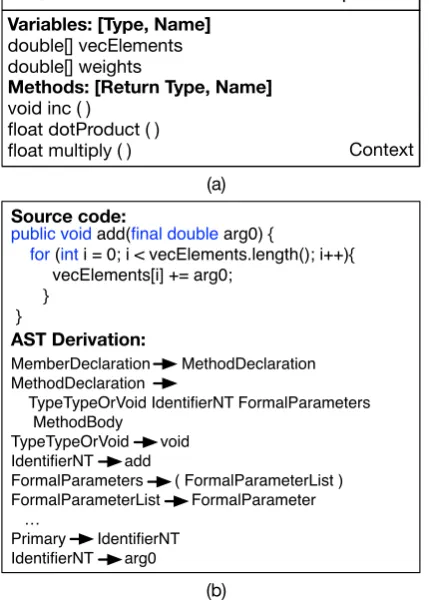
Figure 4: Context dependent code generation task of
Iyer et al.(2018) that involves mapping an NL query to-gether with a set of context variables and methods (each having an identifier name and data type) (a) into source code, represented as a sequence of grammar rules (b).
perform two applications of the first idiom from Figure 2 (b), followed by one application of the second idiom from Figure 2 (d), after which the tree cannot be further compressed using those two idioms. The final tree can be represented using |ri| = 2 rules instead of the original |pi| = 5
rules. The decoder is then trained similar to pre-vious approaches (Yin and Neubig, 2017) using the compressed set of rules. We observe a rule set compression of more than 50% in our experiments (Section7).
6 Experimental Setup
We apply our approach on 1) the context depen-dent encoder-decoder model ofIyer et al. (2018) on the CONCODE dataset, where we outperform an improved version of their best model, and 2) the task of mapping NL utterances to SQL queries on the ATIS-SQL dataset (Iyer et al.,2017) where an idiom-based model using the full training set outperforms the SOTA, also achieving significant
List all flights from Denver to Seattle
S E L E C T D I S T I N C T f l i g h t _ 1 . f l i g h t _ i d FROM
f l i g h t f1 , a i r p o r t _ s e r v i c e as1 , city c1 , a i r p o r t _ s e r v i c e as2 , city c2 WH ERE
f1 . f r o m _ a i r p o r t = as1 . a i r p o r t _ c o d e
AND as1 . c i t y _ c o d e = c1 . c i t y _ c o d e
AND c1 . c i t y _ n a m e = " D e n v e r "
AND f1 . t o _ a i r p o r t = as2 . a i r p o r t _ c o d e
AND as2 . c i t y _ c o d e = c2 . c i t y _ c o d e
AND c2 . c i t y _ n a m e = " S e a t t l e ";
Figure 5: Example NL utterance with its corresponding executable SQL query from the ATIS-SQL dataset.
gains when using a reduced training set.
6.1 Context Dependent Semantic Parsing
The CONCODE task involves mapping an NL query together with a class context comprising a list of variables (with types) and methods (with re-turn types), into the source code of a class mem-ber function. Figure4(a) shows an example where the context comprises variables and methods (with types) that would normally exist in a class that implements a vector, such as vecElements and dotProduct(). Conditioned on this context, the task involves mapping the NL queryAdds a scalar to this vector in placeinto a sequence of parsing rules to generate the source code in Figure4(b).
Formally, the task is: Given a NL utteranceq, a set of context variables{vi}with types{ti}, and
a set of context methods{mi} with return types
{ri}, predict a set of parsing rules{ai}of the
tar-get program. Their best performing model is a neural encoder-decoder with a context-aware en-coder and a deen-coder that produces a sequence of Java grammar rules.
{qi} represent the set of BPE tokens of the NL,
and {tij}, {vij},{rij} and {mij} represent the
jth BPE token of the ith variable type, variable name, method return type, and method name re-spectively. First, all these elements are embedded using a BPE token embedding matrix B to give us
qi, tij, vij, rij andmij. Using Bi-LSTM f, the
encoder then computes:
h1,· · · , hz =f(q1, . . . ,qz) (1) vi=Avg(vi1, . . . ,vij) (2)
Similarly, computemi,ti,ri (3)
ˆ
ti,vˆi =f(ti,vi) (4)
ˆ
ri,mˆi =f(ri,mi) (5)
Then,h1, . . . , hz, andtˆi,vˆi,rˆi,mˆiare passed to
the attention mechanism in the decoder, exactly as inIyer et al.(2018). The decoder remains the same as described in Iyer et al.(2018), and produces a probability distribution over grammar rules at each time step (full details in Supplementary Materi-als). This forms our baseline model (Iyer-Simp).
Idiom Aware Training To utilize idioms, we augment this decoder by retrieving the top-K most frequent idioms from the training set (Algorithm 1), followed by post-processing the training set by greedily applying these idioms (Algorithm 2; we denote this model as Iyer-Simp-K). We eval-uate all our models on the CONCODE dataset which was created using Java source files from github.com. It contains 100K tuples of (NL, code, context) for training, 2K tuples for develop-ment, and 2K tuples for testing. We use a BPE vo-cabulary of 10K tokens (for matrixB) and get the best validation set results using the original hyper-parameters used byIyer et al.(2018). Since idiom aware training is significantly faster than without idioms, it enables us to train on an additional 400K training examples thatIyer et al.(2018) released as part of CONCODE. We report exact match accu-racy, corpus level BLEU score (which serves as a measure of partial credit) (Papineni et al.,2002), and training time for all these configurations.
6.2 Semantic Parsing to SQL
This task involves mapping NL utterances into executable SQL queries. We use the ATIS-SQL dataset (Iyer et al., 2017) that contains NL ques-tions posed to a flight database, together with their SQL queries and a database with 25 tables
Model Exact BLEU
Seq2Seq† 3.2 (2.9) 23.5 (21.0) Seq2Prod† 6.7 (5.6) 21.3 (20.6) Iyer et al.(2018)† 8.6 (7.1) 22.1 (21.3)
[image:6.595.306.529.281.444.2]Iyer-Simp 12.5 (9.8) 24.4 (23.2) Iyer-Simp + 200 idioms 12.2 (9.8) 26.6 (24.0)
Table 1: Exact Match and BLEU scores for our simpli-fied model (Iyer-Simp) with and without idioms, com-pared with results fromIyer et al.(2018)† on the test (validation) set of CONCODE. Iyer-Simp achieves sig-nificantly better EM and BLEU score and reduces train-ing time from 40 hours to 27 hours. Augmenttrain-ing the decoding process with 200 code idioms further pushes up BLEU and reduces training time to 13 hours.
Model Exact BLEU Training Time (h)
Seq2Seq† 2.9 21.0 12 Seq2Prod† 5.6 20.6 36 Iyer et al.(2018)† 7.1 21.3 40
Iyer-Simp 9.8 23.2 27 + 100 idioms 9.8 24.5 15 + 200 idioms 9.8 24.0 13 + 300 idioms 9.6 23.8 12 + 400 idioms 9.7 23.8 11 + 600 idioms 9.9 22.7 11
Table 2: Variation in Exact Match, BLEU score, and training time on the validation set of CONCODE with number of idioms used. After top-200 idioms are used, accuracies start to reduce, since using more specialized idioms can hurt model generalization. Training time plateaus after considering top-600 idioms.
to execute them against (Figure 5 shows an ex-ample). The dataset is split into 4,379 training, 491 validation, and 448 testing examples follow-ingKwiatkowski et al.(2011).
The SOTA by Iyer et al. (2017) is a Seq2Seq model with attention and achieves a denotational accuracy of 82.5% on the test set. Since using our idiom-based approach requires a model that uses grammar-rule based decoding, we use a modified version of the Seq2Prod model described in Iyer et al.(2018) (based onYin and Neubig(2017)) as a baseline model (Seq2Prod), and augment the de-coder with SQL idioms (Seq2Prod-K).
Model Exact BLEU
[image:7.595.326.504.63.128.2]1×Train 12.0 (9.7) 26.3 (23.8) 2×Train 13.0 (10.3) 28.4 (25.2) 3×Train 13.3 (10.4) 28.6 (26.5) 5×Train 13.4 (11.0) 28.9 (26.6)
Table 3: Exact Match and BLEU scores on the test (validation) set of CONCODE by training
Iyer-Simp-400 on the extended training set released byIyer et al.
(2018). Significant improvements in training speed
after incorporating idioms makes training on large amounts of data possible.
hidden states to an attention mechanism in the decoder. Note that the Seq2Prod encoder de-scribed in Iyer et al. (2018) encodes a concate-nated sequence of NL and context, but ATIS-SQL instances do not include contextual information. Thus, if qi represents each lemmatized token of
the NL, they are first embedded using a token em-bedding matrixB to give usqi. Using Bi-LSTM
f, the encoder then computes:
h1,· · · , hz=f(q1, . . . ,qz) (6)
Then,h1, . . . , hzare passed to the attention
mech-anism in the decoder.
The sequential LSTM-decoder uses attention and produces a sequence of grammar rules {at}.
The decoder hidden state at time t, st, is
com-puted based on an embedding of the current non-terminalnt to be expanded, an embedding of the
previous production rule at−1, an embedding of
the parent production rule, par(nt), that produced
nt, the previous decoder state st−1, and the
de-coder state of the LSTM cell that producednt,
de-noted assnt.
st=LSTMf(nt, at−1,par(nt), st−1, snt) (7)
stis then used for attention and finally, produces a
distribution over grammar rules.
We make two modifications in this decoder. First, we remove the dependence of LSTMf on the
parent LSTM cell statesnt. Second, instead of
us-ing direct embeddus-ings of rulesat−1and par(nt)in
LSTMf, we use another Bi-LSTM across the left
and right sides of the rule (using separator sym-bol SEP) and use the final hidden state as inputs to LSTMf instead. More concretely, if a grammar
Model Accuracy
Iyer et al.(2017)† 82.5
Seq2Prod 79.1
[image:7.595.93.268.63.141.2]Seq2Prod + 400 idioms 83.2
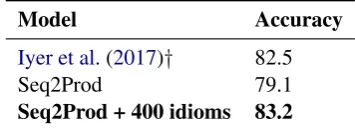
Table 4: Denotational Accuracy for Seq2Prod with and
without idioms, compared with results fromIyer et al.
(2017)†on the test set of ATIS using SQL queries. Re-sults averaged over 3 runs.
Figure 6: Accuracy of the Seq2Seq baseline (Iyer et al.,
2017) compared with Seq2Prod-K, on the test set of
ATIS-SQL for varying fractions of training data. Id-ioms significantly boost accuracy when training data is scarce. (Mean and Std. Dev. computed across 3 runs). 20-40% use 100 idioms and the rest use 400 idioms.
rule is represented asA→B1. . . Bn, then:
Emb(A→B1. . . Bn) =
LSTMg({A,SEP, B1, . . . , Bn})
st=LSTMf(nt,Emb(at−1),Emb(par(nt)),
st−1) (8)
This modification can help the LSTMf cell
locate the position of nt within rules at−1 and
par(nt), especially for lengthy idiomatic rules. We
present a full description of this model with all hy-perparameters in the supplementary materials.
Idiom Aware Training As before, we augment the set of decoder grammar rules with top-K id-ioms extracted from ATIS-SQL. To represent SQL queries as grammar rules, we use the python sqlparsepackage.
7 Results and Discussion
[image:7.595.308.526.197.363.2]System.out.println ( StringLiteral ) ; Statement
QualifiedName
Identifier Expr
Arguments Identifier
Statement
Expr LocalVariable
Declaration
PrimitiveType
int
(b)
(c) (d)
Statement
Block
Statement
Expr
String Literal
“String”
(a)
(e)
try Block CatchClause
CreatedName ClassCreatorRest
( ExprList )
new Creator
catch ( CatchType Identifier ) Block
if ParExpr Statement
( ParExpr )
{ BlockStatement }
Arguments Identifier
CreatedName ClassCreatorRest
( ExprList )
new Creator
throw Expr ;
ForInit ; Expr ; ExprList
for ( ForControl ) Statement
TypeType VariableDeclarators Expr ++ Expr < Expr
Statement
Expr ;
Expr ( ExprList )
Expr
Primary
LIteral
StringLiteral Expr . ExprCont
Expr . ExprCont Identifier
Identifier println
out Primary
Identifier
System Expr new Identifier
( ExprList )
Idiom:
Statement
try Block
catch (Identifier Identifier ) Block
Idiom:
Statement
for ( int VariableDeclarators ; Expr < Expr ; Expr ++ ) Statement
Idiom:
Statement
Idiom: Statementif ( ParExpr )
{ thrownew
Identifier (“String“) ; }
[image:8.595.72.525.63.350.2]Idiom:
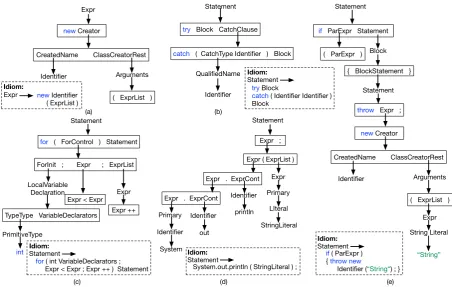
Figure 7: Examples of idioms learned from CONCODE. (a)-(c) represent idioms for instantiation of a new object, exception handling and integer-based looping respectively. (d) represents an idiom for applying a very commonly
used library method (System.out.println). (e) is a combination of various idioms viz. an if-then idiom, an
idiom for throwing exceptions and finally, reusing idiom (a) for creating new objects.
Iyer-Simp yields a large improvement of 3.9 EM and 2.2 BLEU over the best model of Iyer et al. (2018), while also being significantly faster (27 hours for 30 training epochs as compared to 40 hours). Using a reduced BPE vocabulary makes the model memory efficient, which allows us to use a larger batch size that in turn speeds up train-ing. Furthermore, using 200 code idioms further improves BLEU by 2.2% while maintaining com-parable EM accuracy. Using the top-200 idioms results in a target AST compression of more than 50%, which results in fewer decoder RNN steps being performed. This reduces training time fur-ther by more than 50%, from 27 hours to 13 hours.
In Table 2, we illustrate the variations in EM, BLEU and training time with the number of id-ioms. We find that 200 idioms performs best over-all in terms of balancing accuracy and training time. Adding more idioms continues to reduce training time, but accuracy also suffers. Since we permit idioms to contain identifier names to cap-ture frequently used library methods, having too many idioms hurts generalization, especially since the test set is built using repositories disjoint from
the training set. Finally, the amount of compres-sion, and therefore the training time, plateaus after the top-600 idioms are incorporated.
Compared to the model ofIyer et al.(2018), our significantly reduced training time enables us to train on their extended training set. We run Iyer-Simp using 400 idioms (taking advantage of even lower training time) on up to 5 times the amount of data, while making sure that we do not include in training any NL from the validation or the test sets. Since the original set of idioms learned from the original training set are quite general, we di-rectly use them rather than relearn the idioms from scratch. We report EM and BLEU scores for dif-ferent amounts of training data on the same valida-tion and test sets as CONCODE in Table3. In gen-eral, accuracies increase with the amount of data with the best model achieving a BLEU score of 28.9 and EM of 13.4.
form larger ones; it combines an if-then idiom with athrow-exceptionidiom, which throws an object instantiated using idiom (a). The decoder also learns idioms to directly generate common library methods such as System.out.println( StringLiteral )in one decoding step (d).
For the NL to SQL task, we report denotational accuracy in Table 4. We observe that Seq2Prod underperforms the Seq2Seq model of Iyer et al. (2017), most likely because a SQL query parse is much longer than the original query. This is remedied by using top-400 idioms, which com-presses the decoded sequence size, marginally out-performing the SOTA (83.2%). Finegan-Dollak et al. (2018) observed that the SQL structures in ATIS-SQL are repeated numerous times in both train and test sets, thus facilitating Seq2seq mod-els to memorize these structures without explicit idiom supervision. To test a scenario with limited repetition of structures, we compare Seq2Seq with Seq2Prod-K for limited training data (increments of 20%) and observe that (Figure6) idioms are ad-ditionally helpful with lesser training data, consis-tent with our intuition.
8 Conclusions
We presented a general approach to make seman-tic parsers aware of target idiomaseman-tic structures, by first identifying frequently used idioms, fol-lowed by providing models with supervision to apply these idioms. We demonstrated this ap-proach on the task of context dependent code gen-eration where we achieved a new SOTA in EM ac-curacy and BLEU score. We also found that de-coding using idioms significantly reduces training time and allows us to train on significantly larger datasets. Finally, our approach also outperformed the SOTA for a semantic parsing to SQL task on ATIS-SQL, with significant improvements under a limited training data regime.
Acknowledgements
University of Washington’s efforts in this research was supported in part by DARPA (FA8750-16-2-0032), the ARO (ARO-W911NF-16-1-0121), the NSF (IIS-1252835, IIS-1562364, IIS-1546083, IIS-1651489, OAC-1739419), the DOE (DE-SC0016260), the Intel-NSF CAPA center, and gifts from Adobe, Amazon, Google, Huawei, and NVIDIA. The authors thank the anonymous re-viewers for their helpful comments.
References
Miltiadis Allamanis and Charles Sutton. 2014.
Min-ing idioms from source code. InProceedings of the
22nd ACM SIGSOFT International Symposium on Foundations of Software Engineering, pages 472– 483. ACM.
Li Dong and Mirella Lapata. 2016. Language to
logi-cal form with neural attention. InProceedings of the 54th Annual Meeting of the Association for Compu-tational Linguistics (Volume 1: Long Papers), pages 33–43. Association for Computational Linguistics.
Li Dong and Mirella Lapata. 2018. Coarse-to-fine
de-coding for neural semantic parsing. In
Proceed-ings of the 56th Annual Meeting of the Association for Computational Linguistics (Volume 1: Long Pa-pers), volume 1, pages 731–742.
Catherine Finegan-Dollak, Jonathan K Kummerfeld, Li Zhang, Karthik Ramanathan, Sesh Sadasivam, Rui Zhang, and Dragomir Radev. 2018.
Improv-ing text-to-sql evaluation methodology. In
Proceed-ings of the 56th Annual Meeting of the Association for Computational Linguistics (Volume 1: Long Pa-pers), pages 351–360.
Philip Gage. 1994. A new algorithm for data
compres-sion.The C Users Journal, 12(2):23–38.
Shirley Anugrah Hayati, Raphael Olivier, Pravalika Avvaru, Pengcheng Yin, Anthony Tomasic, and
Gra-ham Neubig. 2018. Retrieval-based neural code
generation. InProceedings of the 2018 Conference on Empirical Methods in Natural Language Pro-cessing, pages 925–930. Association for Computa-tional Linguistics.
Srinivasan Iyer, Ioannis Konstas, Alvin Cheung, Jayant Krishnamurthy, and Luke Zettlemoyer. 2017.
Learning a neural semantic parser from user feed-back. InProceedings of the 55th Annual Meeting of the Association for Computational Linguistics (Vol-ume 1: Long Papers), pages 963–973, Vancouver, Canada. Association for Computational Linguistics.
Srinivasan Iyer, Ioannis Konstas, Alvin Cheung, and
Luke Zettlemoyer. 2018. Mapping language to code
in programmatic context. In Proceedings of the 2018 Conference on Empirical Methods in Natural Language Processing, pages 1643–1652. Associa-tion for ComputaAssocia-tional Linguistics.
Jayant Krishnamurthy, Pradeep Dasigi, and Matt
Gard-ner. 2017. Neural semantic parsing with type
con-straints for semi-structured tables. InProceedings of the 2017 Conference on Empirical Methods in Natural Language Processing, pages 1516–1526, Copenhagen, Denmark. Association for Computa-tional Linguistics.
Tom Kwiatkowski, Luke Zettlemoyer, Sharon
Gold-water, and Mark Steedman. 2011. Lexical
Empirical Methods in Natural Language
Process-ing, pages 1512–1523. Association for
Computa-tional Linguistics.
Wang Ling, Phil Blunsom, Edward Grefenstette, Moritz Karl Hermann, Tom´aˇs Koˇcisk´y, Fumin
Wang, and Andrew Senior. 2016. Latent predictor
networks for code generation. InProceedings of the 54th Annual Meeting of the Association for Compu-tational Linguistics (Volume 1: Long Papers), pages 599–609. Association for Computational Linguis-tics.
Vijayaraghavan Murali, Letao Qi, Swarat Chaudhuri, and Chris Jermaine. 2018. Neural sketch learning for conditional program generation.
Maxwell Nye, Luke Hewitt, Joshua Tenenbaum,
and Armando Solar-Lezama. 2019.
Learn-ing to infer program sketches. arXiv preprint
arXiv:1902.06349.
Kishore Papineni, Salim Roukos, Todd Ward, and Wei-Jing Zhu. 2002. Bleu: a method for automatic
eval-uation of machine translation. In Proceedings of
the 40th annual meeting on association for compu-tational linguistics, pages 311–318.
Maxim Rabinovich, Mitchell Stern, and Dan Klein.
2017. Abstract syntax networks for code
genera-tion and semantic parsing. In Proceedings of the 55th Annual Meeting of the Association for Com-putational Linguistics (Volume 1: Long Papers), pages 1139–1149, Vancouver, Canada. Association for Computational Linguistics.
Rico Sennrich, Barry Haddow, and Alexandra Birch.
2016. Neural machine translation of rare words
with subword units. InProceedings of the 54th An-nual Meeting of the Association for Computational Linguistics (Volume 1: Long Papers), pages 1715– 1725, Berlin, Germany. Association for Computa-tional Linguistics.
Richard Shin, Miltiadis Allamanis, Marc
Brockschmidt, and Oleksandr Polozov. 2019. Pro-gram synthesis and semantic parsing with learned
code idioms. arXiv preprint arXiv:1906.10816.
Pengcheng Yin and Graham Neubig. 2017.A syntactic
neural model for general-purpose code generation. InProceedings of the 55th Annual Meeting of the As-sociation for Computational Linguistics (Volume 1: Long Papers), pages 440–450, Vancouver, Canada. Association for Computational Linguistics.