Detecting Highly Confident Word Translations from Comparable
Corpora without Any Prior Knowledge
Ivan Vuli´c and Marie-Francine Moens Department of Computer Science
KU Leuven Celestijnenlaan 200A
Leuven, Belgium
{ivan.vulic,marie-francine.moens}@cs.kuleuven.be
Abstract
In this paper, we extend the work on using latent cross-language topic models for iden-tifying word translations across compara-ble corpora. We present a novel precision-oriented algorithm that relies on per-topic word distributions obtained by the bilin-gual LDA (BiLDA) latent topic model. The algorithm aims at harvesting only the most probable word translations across lan-guages in a greedy fashion, without any prior knowledge about the language pair, relying on a symmetrization process and the one-to-one constraint. We report our re-sults for Italian-English and Dutch-English language pairs that outperform the current state-of-the-art results by a significant mar-gin. In addition, we show how to use the al-gorithm for the construction of high-quality initial seed lexicons of translations.
1 Introduction
Bilingual lexicons serve as an invaluable resource of knowledge in various natural language pro-cessing tasks, such as dictionary-based cross-language information retrieval (Carbonell et al., 1997; Levow et al., 2005) and statistical machine translation (SMT) (Och and Ney, 2003). In or-der to construct high quality bilingual lexicons for different domains, one usually needs to possess parallel corpora or build such lexicons by hand. Compiling such lexicons manually is often an ex-pensive and time-consuming task, whereas the methods for mining the lexicons from parallel cor-pora are not applicable for language pairs and do-mains where such corpora is unavailable or miss-ing. Therefore the focus of researchers turned to comparable corpora, which consist of documents
with partially overlapping content, usually avail-able in abundance. Thus, it is much easier to build a high-volume comparable corpus. A representa-tive example of such a comparable text collection is Wikipedia, where one may observe articles dis-cussing the similar topic, but strongly varying in style, length and vocabulary, while still sharing a certain amount of main concepts (or topics).
Over the years, several approaches for min-ing translations from non-parallel corpora have emerged (Rapp, 1995; Fung and Yee, 1998; Rapp, 1999; Diab and Finch, 2000; D´ejean et al., 2002; Chiao and Zweigenbaum, 2002; Gaussier et al., 2004; Fung and Cheung, 2004; Morin et al., 2007; Haghighi et al., 2008; Shezaf and Rappoport, 2010; Laroche and Langlais, 2010), all sharing the same Firthian assumption, often called the
distributionial hypothesis (Harris, 1954), which
states that words with a similar meaning are likely to appear in similar contexts across languages. All these methods have examined different rep-resentations of word contexts and different meth-ods for matching words across languages, but they all have in common a need for a seed lexicon of translations to efficiently bridge the gap between languages. That seed lexicon is usually crawled from the Web or obtained from parallel corpora. Recently, Li et al. (2011) have proposed an ap-proach that improves precision of the existing methods for bilingual lexicon extraction, based on improving the comparability of the corpus un-der consiun-deration, prior to extracting actual bilin-gual lexicons. Other methods such as (Koehn and Knight, 2002) try to design a bootstrapping algo-rithm based on an initial seed lexicon of transla-tions and various lexical evidences. However, the quality of their initial seed lexicon is disputable,
since the construction of their lexicon is language-pair biased and cannot be completely employed on distant languages. It solely relies on unsatis-factory language-pair independent cross-language clues such as words shared across languages.
Recent work from Vuli´c et al.(2011) utilized the distributional hypothesis in a different direc-tion. It attempts to abrogate the need of a seed lex-icon as a prerequisite for bilingual lexlex-icon extrac-tion. They train a cross-language topic model on document-aligned comparable corpora and intro-duce different methods for identifying word trans-lations across languages, underpinned by per-topic word distributions from the trained per-topic model. Due to the fact that they deal with compa-rable Wikipedia data, their translation model con-tains a lot of noise, and some words are poorly translated simply because there are not enough occurrences in the corpus. The goal of this work is to design an algorithm which will learn to harvest only the most probable translations from the per-word topic distributions. The translations learned by the algorithm then might serve as a highly ac-curate, precision-based initial seed lexicon, which can then be used as a tool for translating source word vectors into the target language. The key ad-vantage of such a lexicon lies in the fact that there is no language-pair dependent prior knowledge involved in its construction (e.g., orthographic features). Hence, it is completely applicable to any language pair for which there exist sufficient comparable data for training of the topic model.
Since comparable corpora often construct a very noisy environment, it is of the utmost impor-tance for a precision-oriented algorithm to learn when to stop the process of matching words, and which candidate pairs are surely not translations of each other. The method described in this paper follows this intuition: while extracting a bilingual lexicon, we try to rematch words, keeping only the most confident candidate pairs and disregard-ing all the others. After that step, the most con-fident candidate pairs might be used with some of the existing context-based techniques to find translations for the words discarded in the pre-vious step. The algorithm is based on: (1) the assumption of symmetry, and (2) the one-to-one constraint. The idea of symmetrization has been borrowed from the symmetrization heuristics in-troduced for word alignments in SMT (Och and Ney, 2003), where the intersection heuristics is
employed for a precision-oriented algorithm. In our setting, it basically means that we keep a translation pair(wS
i , wTj)if and only if, after the
symmetrization process, the top translation candi-date for the source wordwS
i is the target wordwTi
and vice versa. The one-to-one constraint aims at matching the most confident candidates during the early stages of the algorithm, and then exclud-ing them from further search. The utility of the constraint for parallel corpora has already been evaluated by Melamed (2000).
The remainder of the paper is structured as follows. Section 2 gives a brief overview of the methods, relying on per-topic word distribu-tions, which serve as the tool for computing cross-language similarity between words. In Section 3, we motivate the main assumptions of the al-gorithm and describe the full alal-gorithm. Sec-tion 4 justifies the underlying assumpSec-tions of the algorithm by providing comparisons with a current-state-of-the-art system for Italian-English and Dutch-English language pairs. It also con-tains another set of experiments which inves-tigates the potential of the algorithm in build-ing a language-pair unbiased seed lexicon, and compares the lexicon with other seed lexicons. Finally, Section 5 lists conclusion and possible paths of future work.
2 Calculating Initial Cross-Language Word Similarity
This section gives a quick overview of the Cue
zS
ji wjiS
α θ
zT
ji wjiT
φ
β
ψ
MS
MT
[image:3.595.98.270.69.216.2]D
Figure 1: Plate model for bilingual Latent Dirichlet Allocation
1
Figure 1: The bilingual LDA (BiLDA) model
(for language S) andψ(for language T).
2.1 Cue Method
A straightforward approach to express similarity between words tries to emphasize the associative relation in a natural way - modeling the proba-bility P(wT
2|w1S), i.e. the probability that a
tar-get wordwT
2 will be generated as a response to a
cue source wordwS
1, where the link between the
words is established via the shared topic space: P(wT
2|wS1) =
PK
k=1P(w2T|zk)P(zk|w1S), where Kdenotes the number of cross-language topics.
2.2 TI Method
This approach constructs word vectors over a shared space of cross-language topics, where val-ues within vectors are the TF-ITF scores (term frequency - inverse topic frequency), computed in a completely analogical manner as the TF-IDFscores for the original word-document space (Manning and Sch¨utze, 1999). Term frequency, given a source wordwS
i and a topiczk, measures
the importance of the wordwS
i within the
particu-lar topiczk, whileinverse topical frequency (ITF)
of the wordwS
i measures the general importance
of the source word wS
i across all topics. The
fi-nalTF-ITFscore for the source wordwS
i and the
topiczkis given byT F−IT Fi,k =T Fi,k·IT Fi.
TheTF-ITFscores for target words associated
with target topics are calculated in an analogical manner and the standard cosine similarity is then used to find the most similar target word vectors for a given source word vector.
2.3 Combining the Methods
Topic models have the ability to build clusters of words which might not always co-occur together
in the same textual units and therefore add ex-tra information of potential relatedness. These two methods for automatic bilingual lexicon ex-traction interpret and exploit underlying per-topic word distributions in different ways, so combin-ing the two should lead to even better results. The two methods are linearly combined, with the over-all score given by:
SimT I+Cue(wS1, w2T) =λSimT I(wS1, w2T)
+ (1−λ)SimCue(w1S, wT2) (1)
Both methods posses several desirable proper-ties. According to Griffiths et al. (2007), the con-ditioning for theCuemethod automatically com-promises between word frequency and semantic relatedness since higher frequency words tend to have higher probability across all topics, but the distribution over topicsP(zk|w1S)ensures that
se-mantically related topics dominate the sum. The similar phenomenon is captured by theTImethod by the usage ofTF, which rewards high frequency words, and ITF, which assigns a higher impor-tance for words semantically more related to a specific topic. These properties are incorporated in the combination of the methods. As the final result, the combined method provides, for each source word, a ranked list of target words with as-sociated scores that measure the strength of cross-language similarity. The higher the score, the more confident a translation pair is. We will use this observation in the next section during the al-gorithm construction.
The lexicon constructed by solely applying the combination of these methods without any addi-tional assumptions will serve as a baseline in the results section.
3 Constructing the Algorithm
This section explains the underlying assumptions of the algorithm: theassumption of symmetry
and theone-to-one assumption. Finally, it pro-vides the complete outline of the algorithm.
3.1 Assumption of Symmetry
First, we start with the intuition that the assump-tion of symmetrystrengthens the confidence of a translation pair. In other words, if the most prob-able translation candidate for a source wordwS
1 is
a target wordwT
2 and, vice versa, the most
prob-able translation candidate of the target word wT
is the source word wS
1, and their TI+Cuescores
are above a certain threshold, we can claim that the wordswS
1 andw2T are a translation pair. The
definition of the symmetric relation can also be relaxed. Instead of observing only one top can-didate from the lists, we can observe topN can-didates from both sides and include them in the search space, and then re-rank the potential candi-dates taking into account their associatedTI+Cue
scores and their respective positions in the list. We will callN thesearch space depth. Here is the outline of the re-ranking method if the search space consists of the top N candidates on both sides:
1. Given is a source wordwS
s, for which we
ac-tually want to find the most probable trans-lation candidate. Initialize an empty list F inals = {} in which target language
candidates with their recalculated associated scores will be stored.
2. Obtain TI+Cue scores for all target words. Keep onlyN best scoring target candidates:
{wT
s,1, . . . , ws,NT }along with their respective
scores.
3. For each target candidate from
{wT
s,1, . . . , ws,NT } acquire TI+Cue scores
over the entire source vocabulary. Keep only N best scoring source language candidates. Each word wT
s,i ∈ {ws,T1, . . . , wTs,N} now
has a list of N source language candidates associated with it:{wS
i,1, wi,S2. . . , wSi,N}.
4. For each target candidate word wT s,i ∈
{wT
s,1, . . . , ws,NT }, do as follows:
(a) If one of the words from the associated list is the given source word wS
s,
re-member: (1) the positionm, denoting how high in the list the word wS
s was
found, and (2) the associated TI+Cue
score SimT I+Cue(wTs,i, wi,mS = wsS).
Calculate:
(i)G1,i =SimT I+Cue(wsS, wTs,i)/i
(ii)G2,i=SimT I+Cue(wTs,i, wi,mS )/m
Following that, calculateGMi, the
ge-ometric mean of the values G1,i and
G2,i1: GMi =
p
G1,i·G2,i. Add a
tu-1
ScoresG1,i and G2,i are structured in such a way to balance between positions in the ranked lists and theTI+Cue scores, since they reward candidate words which have high TI+Cuescores associated with them, and penalize words if they are found lower in the list of potential candidates.
ple(wT
s,i, GMi)to the listF inals.
(b) If we have reached the end of the list for the target candidate wordwT
s,i
with-out finding the given source word wS s,
andi < N, continue with the next word wT
s,i+1. Do not add any tuple toF inals
in this step.
5. If the listF inalsis not empty, sort the tuples
in the list in descending order according to their GMi scores. The first element of the
sorted list contains a wordwT
s,high, the final
translation candidate of the source wordwS s.
If the listF inals is not empty, the final
re-sult of this process will be the cross-language word translation pair(wS
s, ws,highT ).
We will call this symmetrization process the
symmetrizing re-ranking. It attempts at push-ing the correct cross-language synonym to the top of the candidates list, taking into account both the strength of similarities defined through the
TI+Cue scores in both directions, and positions
in ranked lists. A blatant example depicting how this process helps boost precision is presented in Figure 2. We can also design a thresholded variant of this procedure by imposing an extra constraint. When calculating target language candidates for the source word wS
s in Step 2, we proceed
fur-ther only if the first target candidate scores above a certain thresholdP and, additionally, in Step 3, we keep lists of N source language candidates for only those target words for which the first source language candidate in their respective list scored above the same thresholdP. We will call this procedure thethresholded symmetrizing re-ranking, and this version will be employed in the final algorithm.
3.2 One-to-one Assumption
abdij
monastery
monk
abbey
klooster
monnik
benedictijn
klooster
monnik
abdij
abdij
monnik
klooster 0.2237
0.1586
0.1155
0.3049
0.1740
0.1338
0.2266
0.1494
0.1131
0.2549
0.1496
[image:5.595.134.461.71.381.2]0.1288
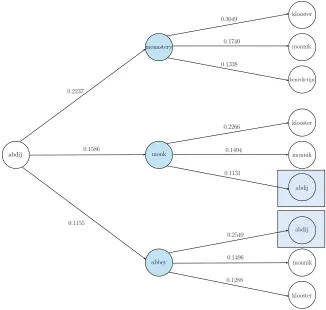
Figure 2: An example where the assumption of symmetry and the one-to-one assumption clearly help boost precision. If we keep top Nc = 3candidates from both sides, the algorithm is able to detect that the correct
Dutch-English translation pair is(abdij, abbey). TheTI+Cuemethod without any assumptions would result with an indirect association(abdij, monastery). If only the one-to-one assumption was present, the algorithm would greedily learn the correct direct association (monastery, klooster), remove those words from their respective vocabularies and then again result with another indirect association(abdij, monk). By additionally employing the assumption of symmetry with the re-ranking method from Subsection 3.1, the algorithm correctly learns the translation pair(abdij, abbey). Correct translation pairs(klooster, monastery)and(monnik, monk)are also obtained. Again here, the pair(monnik, monk)would not be obtained without the one-to-one assumption.
will prove that the assumption leads to better pre-cision scores even for bilingual lexicon extraction from such comparable data. The intuition be-hind introducing this constraint is fairly simple. Without the assumption, the similarity scores be-tween source and target words are calculated in-dependently of each other. We will illustrate the problem arising from the independence assump-tion with an example.
Suppose we have an Italian word arcipelago, and we would like to detect its correct English translation (archipelago). However, after the
TI+Cue method is employed, and even after the
symmetrizing re-ranking process from the previ-ous step is used, we still acquire a wrong transla-tion candidate pair (arcipelago, island). Why is that so? The word (arcipelago) (or its translation) and the acquired translation (island) are
semanti-cally very close, and therefore have similar distri-butions over cross-language topics, butislandis a much more frequent term. The TI+Cue method concludes that two words are potential trans-lations whenever their distributions over cross-language topics are much more similar than ex-pected by chance. Moreover, it gives a preference to more frequent candidates, so it will eventually end up learning anindirect association2between wordsarcipelagoandisland. The one-to-one as-sumption should mitigate the problem of such in-direct associations if we design our algorithm in such a way that it learns the most confidentdirect associations2first:
2A direct association, as defined in (Melamed, 2000), is
1. Learn the correct direct association pair
(isola, island).
2. Remove the words isola and island from their respective vocabularies.
3. Since island is not in the vocabulary, the indirect association betweenarcipelago and
island is not present any more. The
algo-rithm learns the correct direct association
(arcipelago, archipelago).
3.3 The Algorithm
3.3.1 One-Vocabulary-Pass
First, we will provide a version of the algorithm with a fixed threshold P which completes only one pass through the source vocabulary. LetVS
denote a given source vocabulary, and letVT
de-note a given target vocabulary. We need to define several parameters of the algorithm. Let N0 be
the initial maximum search space depth for the thresholded symmetrizing re-ranking procedure. In Figure 2, the current depth Ncis 3, while the
maximum depth might be set to a value higher than 3. The algorithm with the fixed thresholdP proceeds as follows:
1. Initialize the maximum search space depth NM =N0. Initialize an empty lexiconL.
2. For each source wordwS
s ∈VS do:
(a) Set the current search space depthNc=
1.3
(b) Perform the thresholded symmetrizing re-ranking procedure with the current search space set toNcand the threshold
P. If a translation pair(wS
s, wTs,high)is
found, go to the Sub-step 2(d).
(c) If a translation pair is not found, and Nc < NM, increment the current
search spaceNc=Nc+ 1and return to
the previous Sub-step 2(b). If a trans-lation pair is not found andNc =NM,
return to Step 2 and proceed with the next word.
(d) For the found translation pair (wS
s, ws,highT ), remove words wSs
and wT
s,high from their respective
3
The intuition here is simple – we are trying to detect a direct association as high as possible in the list. In other words, if the first translation candidate for the source word
isolais the target word island, and, vice versa, the first translation candidate for the target wordislandisisola, we do not need to expand our search depth, because these two words are the most likely translations.
vocabularies: VS = VS − {wS s} and
VT = VT − {wT
s,high} to satisfy the
one-to-one constraint. Add the pair (wS
s, wTs,high)to the lexiconL.
We will name this procedure the one-vocabulary-pass and employ it later in an iter-ative algorithm with a varying threshold and a varying maximum search space depth.
3.3.2 The Final Algorithm
Let us now define P0 as the initial threshold, let Pf be the threshold at which we stop
decreas-ing the value for threshold and start expanddecreas-ing our maximum search space depth for the thresh-olded symmetrizing re-ranking, and letdecp be a
value for which we decrease the current threshold in each step. Finally, letNf be the limit for the
maximum search space depth, andNM denote the
current maximum search space depth. The final algorithm is given by:
1. Initialize the maximum search space depth NM = N0 and the starting threshold P = P0. Initialize an empty lexiconLf inal.
2. Check the stopping criterion: IfNM > Nf,
go to Step 5, otherwise continue with Step 3. 3. Perform the one-vocabulary-pass with the current values ofP and NM. Whenever a
translation pair is found, it is added to the lexicon Lf inal. Additionally, we can also
save the threshold and the depth at which that pair was found.
4. Decrease P: P = P −decp, and check
if P < Pf. If still not P < Pf, go to
Step 3 and perform theone-vocabulary-pass
again. Otherwise, ifP < Pf and there are
still unmatched words in the source vocab-ulary, reset P: P = P0, increment NM:
NM =NM + 1and go to Step 2.
5. ReturnLf inalas the final output of the
algo-rithm.
The parameters of the algorithm model its be-havior. Typically, we would like to setP0to a high
value, and N0 to a low value, which makes our
re-laxes them by lowering the threshold and expand-ing the search space by incrementexpand-ing the max-imum search space depth. The algorithm may leave some of the source words unmatched, which is also dependent on the parameters of the algo-rithm, but, due to the one-to-one assumption, that scenario also occurs whenever a target vocabulary contains more words than a source vocabulary.
The number of operations of the algorithm also depends on the parameters, but it mostly depends on the sizes of the given vocabularies. The com-plexity isO(|VS||VT|), but the algorithm is
com-putationally feasible even for large vocabularies.
4 Results and Discussion
4.1 Training Collections
The data used for training of the models is col-lected from various sources and varies strongly in theme, style, length and its comparableness. In order to reduce data sparsity, we keep only lem-matized non-proper noun forms.
For Italian-English language pair, we use 18, 898 Wikipedia article pairs to train BiLDA, covering different themes with different scopes and subtopics being addressed. Document align-ment is established via interlingual links from the Wikipedia metadata. Our vocabularies consist of 7, 160 Italian nouns and 9, 116 English nouns.
For Dutch-English language pair, we use 7, 602 Wikipedia article pairs, and 6, 206 Europarl doc-ument pairs, and combine them for training.4 Our final vocabularies consist of 15, 284 Dutch nouns and 12, 715 English nouns.
Unlike, for instance, Wikipedia articles, where document alignment is established via interlin-gual links, in some cases it is necessary to perform document alignment as the initial step. Since our work focuses on Wikipedia data, we will not get into detail with algorithms for document ment. An IR-based method for document align-ment is given in (Utiyama and Isahara, 2003; Munteanu and Marcu, 2005), and a feature-based method can be found in (Vu et al., 2009).
4.2 Experimental Setup
All our experiments rely on BiLDA training with comparable data. Corpora and software for
4
In case of Europarl, we use only the evidence of docu-ment aligndocu-ment during the training and do not benefit from the parallelness of the sentences in the corpus.
BiLDA training are obtained from Vuli´c et al. (2011). We train the BiLDA model with 2000 topics using Gibbs sampling, since that number of topics displays the best performance in their paper. The linear interpolation parameter for the combinedTI+Cuemethod is set toλ= 0.1.
The parameters of the algorithm, adjusted on a set of 500 randomly sampled Italian words, are set to the following values in all experiments, except where noted different: P0 = 0.20, Pf = 0.00,
decp = 0.01,N0 = 3, andNf = 10.
The initial ground truth for our source vocab-ularies has been constructed by the freely avail-ableGoogle Translatetool. The final ground truth for our test sets has been established after we have manually revised the list of pairs obtained by
Google Translate, deleting incorrect entries and
adding additional correct entries. All translation candidates are evaluated against this benchmark lexicon.
4.3 Experiment I: Do Our Assumptions Help Lexicon Extraction?
With this set of experiments, we wanted to test whether both the assumption of symmetry and the one-to-one assumption are useful in improv-ing precision of the initialTI+Cuelexicon extrac-tion method. We compare three different lexicon extraction algorithms: (1) the basic TI+Cue ex-traction algorithm (LALG-BASIC) which serves as the baseline algorithm5, (2) the algorithm from Section 3, but without the one-to-one assump-tion (LALG-SYM), meaning that if we find a translation pair, we still keep words from the translation pair in their respective vocabularies, and (3) the complete algorithm from Section 3 (LALG-ALL). In order to evaluate these lexicon extraction algorithms for both Italian-English and Dutch-English, we have constructed a test set of 650 Italian nouns, and a test set of 1000 Dutch nouns of high and medium frequency. Precision scores for both language pairs and for all lexicon extraction algorithms are provided in Table 1.
Based on these results, it is clearly visible that both assumptions our algorithm makes are valid
5We have also tested whether LALG-BASIC outperforms
LEX Algorithm Italian-English Dutch-English
LALG-BASIC 0.6708 0.6560
LALG-SYM 0.6862 0.6780
[image:8.595.315.522.69.275.2]LALG-ALL 0.7215 0.7170
Table 1: Precision scores on our test sets for the 3 dif-ferent lexicon extraction algorithms.
and contribute to better overall scores. Therefore in all further experiments we will use the LALG-ALLextraction algorithm.
4.4 Experiment II: How Does Thresholding Affect Precision?
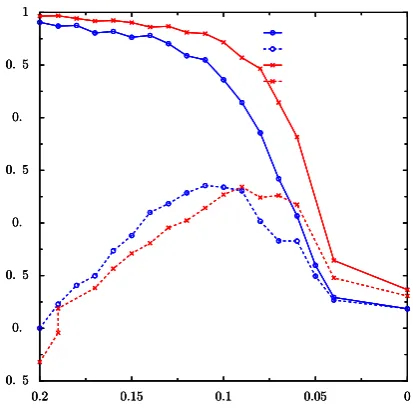
The next set of experiments aims at exploring how precision scores change while we gradually de-crease threshold values. The main goal of these experiments is to detect when to stop with the ex-traction of translation candidates in order to pre-serve a lexicon of only highly accurate transla-tions. We have fixed the maximum search space depthN0 =Nf = 3. We used the same test sets
from Experiment I. Figure 3 displays the change of precision in relation to different threshold val-ues, where we start harvesting translations from the thresholdP0 = 0.2down toPf = 0.0. Since
our goal is to extract as many correct translation pairs as possible, but without decreasing the pre-cision scores, we have also examined what impact this gradual decrease of threshold also has on the number of extracted translations. We have opted for theFβ measure (van Rijsbergen, 1979):
Fβ = (1 +β2)
P recision·Recall
β2·P recision+Recall (2)
Since our task is precision-oriented, we have set β = 0.5. F0.5 measure values precision as twice
as important as recall. The F0.5 scores are also
provided in Figure 3.
4.5 Experiment III: Building a Seed Lexicon
Finally, we wanted to test how many accurate translation pairs our best scoring LALG-ALL al-gorithm is able to acquire from the entire source vocabulary, with very high precision still remain-ing paramount. The obtained highly-precise seed lexicon then might be employed for an additional bootstrapping procedure similar to (Koehn and Knight, 2002; Fung and Cheung, 2004) or sim-ply for translating context vectors as in (Gaussier et al., 2004).
0.65 0.7 0.75 0.8 0.85 0.9 0.95 1
Precision/F-score
0 0.05
0.1 0.15
0.2
Threshold
IT-EN Precision IT-EN F-score NL-EN Precision NL-EN F-score
0.65 0.7 0.75 0.8 0.85 0.9 0.95 1
Precision/F-score
0 0.05
0.1 0.15
0.2
Threshold
IT-EN Precision IT-EN F-score NL-EN Precision NL-EN F-score
0.65 0.7 0.75 0.8 0.85 0.9 0.95 1
Precision/F-score
0 0.05
0.1 0.15
0.2
Threshold
IT-EN Precision IT-EN F-score NL-EN Precision NL-EN F-score
0.65 0.7 0.75 0.8 0.85 0.9 0.95 1
Precision/F-score
0 0.05
0.1 0.15
0.2
Threshold
IT-EN Precision IT-EN F-score NL-EN Precision NL-EN F-score
Figure 3: Precision and F0.5 scores in relation to
threshold values. We can observe that the algorithm retrieves only highly accurate translations for both lan-guage pairs while the threshold goes down from value 0.2 to 0.1, while precision starts to drop significantly after the threshold of 0.1. F0.5scores also reach their
peaks within that threshold region.
If we do not know anything about a given lan-guage pair, we can only use words shared across languages as lexical clues for the construction of a seed lexicon. It often leads to a low precision lexicon, since many false friends are detected.
For Italian-English, we have found 431 nouns shared between the two languages, of which 350 were correct translations, leading to a precision of 0.8121. As an illustration, if we take the first 431 translation pairs retrieved by LALG-ALL, there are 427 correct translation pairs, lead-ing to a precision of 0.9907. Some pairs do not share any orthographic similarities: (uccello, bird), (tastiera, keyboard), (salute, health),
(terre-moto, earthquake)etc.
[image:8.595.81.281.71.121.2]Italian-English Dutch-English Lexicon # Correct Precision F0.5 # Correct Precision F0.5
LEX-1 350 0.8121 0.1876 898 0.8618 0.2308
LEX-2 766 0.8938 0.3473 1376 0.9011 0.3216 LEX-LALG 782 0.8958 0.3524 1106 0.9559 0.2778
LEX-1+LEX-LALG 1070 0.8785 0.4290 1860 0.9082 0.3961
LEX-R+LEX-LALG 1141 0.9239 0.4548 1507 0.9642 0.3500
[image:9.595.101.495.71.176.2]LEX-2+LEX-LALG 1429 0.8926 0.5102 2261 0.9217 0.4505
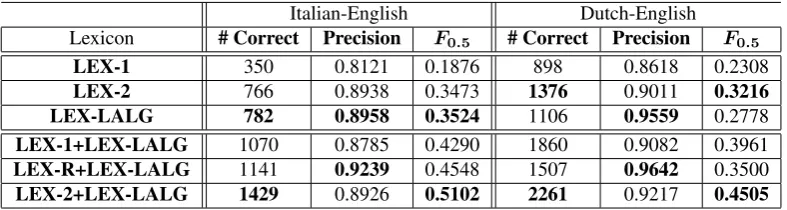
Table 2: A comparison of different lexicons. For lexicons employing our LALG-ALL algorithm, only translation candidates that scored above the thresholdP = 0.11have been kept.
it with−phy. Similar rules have been introduced for Dutch-English: the suffix−tieis replaced by
−tion,−sieby−sion, and−teitby−ty. Finally, we have compared the results of the following constructed lexicons:
• A lexicon containing only words shared across languages (LEX-1).
• A lexicon containing shared words and trans-lation pairs found by applying the language-specific transformation rules (LEX-2).
• A lexicon containing only translation pairs obtained by the LALG-ALL algorithm that score above a certain threshold P ( LEX-LALG).
• A combination of the lexicons LEX-1 and LEX-LALG (LEX-1+LEX-LALG). Non-matching duplicates are resolved by taking the translation pair from LEX-LALG as the correct one. Note that this lexicon is com-pletely language-pair independent.
• A lexicon combining only translation pairs found by applying the language-specific transformation rules and LEX-LALG ( LEX-R+LEX-LALG).
• A combination of the lexicons LEX-2 and LEX-LALG, where non-matching dupli-cates are resolved by taking the translation pair from LEX-LALG if it is present in LEX-1, and from LEX-2 otherwise ( LEX-2+LEX-LALG).
According to the results from Table 2, we can conclude that adding translation pairs extracted by our LALG-ALL algorithm has a major posi-tive impact on both precision and coverage. Ob-taining results for two different language pairs proves that the approach is generic and appli-cable to any other language pairs. The previ-ous approach relying on work from Koehn and
Knight (2002) has been outperformed in terms of precision and coverage. Additionally, we have shown that adding simple translation rules for lan-guages sharing same roots might lead to even bet-ter scores (LEX-2+LEX-LALG). However, it is not always possible to rely on such knowledge, and the usefulness of the designed LALG-ALL algorithm really comes to the fore when the algo-rithm is applied on distant language pairs which do not share many words and cognates, and word translation rules cannot be easily established. In such cases, without any prior knowledge about the languages involved in a translation process, one is left with the linguistically unbiased LEX-1+LEX-LALG lexicon, which also displays a promising performance.
5 Conclusions and Future Work
We have designed an algorithm that focuses on ac-quiring and keeping only highly confident trans-lation candidates from multilingual comparable corpora. By employing the algorithm we have improved precision scores of the methods rely-ing on per-topic word distributions from a cross-language topic model. We have shown that the al-gorithm is able to produce a highly reliable bilin-gual seed lexicon even when all other lexical clues are absent, thus making our algorithm suitable even for unrelated language pairs. In future work, we plan to further improve the algorithm and use it as a source of translational evidence for differ-ent alignmdiffer-ent tasks in the setting of non-parallel corpora.
Acknowledgments
References
Jaime G. Carbonell, Jaime G. Yang, Robert E. Fred-erking, Ralf D. Brown, Yibing Geng, Danny Lee, Yiming Frederking, Robert E, Ralf D. Geng, and Yiming Yang. 1997. Translingual information re-trieval: A comparative evaluation. InProceedings of the 15th International Joint Conference on Arti-ficial Intelligence, pages 708–714.
Yun-Chuang Chiao and Pierre Zweigenbaum. 2002. Looking for candidate translational equivalents in specialized, comparable corpora. In Proceedings of the 19th International Conference on Computa-tional Linguistics, pages 1–5.
Philipp Cimiano, Antje Schultz, Sergej Sizov, Philipp Sorg, and Steffen Staab. 2009. Explicit versus latent concept models for cross-language informa-tion retrieval. In Proceedings of the 21st Inter-national Joint Conference on Artifical Intelligence, pages 1513–1518.
Wim De Smet and Marie-Francine Moens. 2009. Cross-language linking of news stories on the Web using interlingual topic modeling. InProceedings of the CIKM 2009 Workshop on Social Web Search and Mining, pages 57–64.
Herv´e D´ejean, ´Eric Gaussier, and Fatia Sadat. 2002. An approach based on multilingual thesauri and model combination for bilingual lexicon extraction. InProceedings of the 19th International Conference on Computational Linguistics, pages 1–7.
Mona T. Diab and Steve Finch. 2000. A statis-tical translation model using comparable corpora. InProceedings of the 6th Triennial Conference on Recherche d’Information Assist´ee par Ordinateur (RIAO), pages 1500–1508.
Pascale Fung and Percy Cheung. 2004. Mining very-non-parallel corpora: Parallel sentence and lexicon extraction via bootstrapping and EM. In Proceed-ings of the Conference on Empirical Methods in Natural Language Processing, pages 57–63. Pascale Fung and Lo Yuen Yee. 1998. An IR
ap-proach for translating new words from nonparallel, comparable texts. InProceedings of the 17th Inter-national Conference on Computational Linguistics, pages 414–420.
Eric Gaussier, Jean-Michel Renders, Irina Matveeva, Cyril Goutte, and Herv´e D´ejean. 2004. A geomet-ric view on bilingual lexicon extraction from com-parable corpora. InProceedings of the 42nd Annual Meeting of the Association for Computational Lin-guistics, pages 526–533.
Thomas L. Griffiths, Mark Steyvers, and Joshua B. Tenenbaum. 2007. Topics in semantic represen-tation.Psychological Review, 114(2):211–244. Aria Haghighi, Percy Liang, Taylor Berg-Kirkpatrick,
and Dan Klein. 2008. Learning bilingual lexicons from monolingual corpora. InProceedings of the
46th Annual Meeting of the Association for Compu-tational Linguistics, pages 771–779.
Zellig S. Harris. 1954. Distributional structure. Word 10, (23):146–162.
Philipp Koehn and Kevin Knight. 2002. Learning a translation lexicon from monolingual corpora. In
Proceedings of the ACL-02 Workshop on Unsuper-vised Lexical Acquisition, pages 9–16.
Audrey Laroche and Philippe Langlais. 2010. Re-visiting context-based projection methods for term-translation spotting in comparable corpora. In Pro-ceedings of the 23rd International Conference on Computational Linguistics, pages 617–625. Gina-Anne Levow, Douglas W. Oard, and Philip
Resnik. 2005. Dictionary-based techniques for cross-language information retrieval. Information Processing and Management, 41:523–547.
Bo Li, Eric Gaussier, and Akiko Aizawa. 2011. Clus-tering comparable corpora for bilingual lexicon ex-traction. InProceedings of the 49th Annual Meeting of the Association for Computational Linguistics: Human Language Technologies, pages 473–478. Christopher D. Manning and Hinrich Sch¨utze. 1999.
Foundations of Statistical Natural Language Pro-cessing. MIT Press, Cambridge, MA, USA. I. Dan Melamed. 2000. Models of translational
equiv-alence among words. Computational Linguistics, 26:221–249.
David Mimno, Hanna M. Wallach, Jason Naradowsky, David A. Smith, and Andrew McCallum. 2009. Polylingual topic models. In Proceedings of the 2009 Conference on Empirical Methods in Natural Language Processing, pages 880–889.
Emmanuel Morin, B´eatrice Daille, Koichi Takeuchi, and Kyo Kageura. 2007. Bilingual terminology mining - using brain, not brawn comparable cor-pora. In Proceedings of the 45th Annual Meeting of the Association for Computational Linguistics, pages 664–671.
Dragos Stefan Munteanu and Daniel Marcu. 2005. Improving machine translation performance by ex-ploiting non-parallel corpora. Computational Lin-guistics, 31:477–504.
Xiaochuan Ni, Jian-Tao Sun, Jian Hu, and Zheng Chen. 2009. Mining multilingual topics from Wikipedia. InProceedings of the 18th International World Wide Web Conference, pages 1155–1156. Franz Josef Och and Hermann Ney. 2003. A
sys-tematic comparison of various statistical alignment models. Computational Linguistics, 29(1):19–51. Reinhard Rapp. 1995. Identifying word translations in
non-parallel texts. InProceedings of the 33rd An-nual Meeting of the Association for Computational Linguistics, pages 320–322.
Meeting of the Association for Computational Lin-guistics, pages 519–526.
Daphna Shezaf and Ari Rappoport. 2010. Bilingual lexicon generation using non-aligned signatures. In
Proceedings of the 48th Annual Meeting of the As-sociation for Computational Linguistics, pages 98– 107.
Masao Utiyama and Hitoshi Isahara. 2003. Reliable measures for aligning Japanese-English news arti-cles and sentences. InProceedings of the 41st An-nual Meeting of the Association for Computational Linguistics, pages 72–79.
C. J. van Rijsbergen. 1979. Information Retrieval. Butterworth.
Thuy Vu, Ai Ti Aw, and Min Zhang. 2009. Feature-based method for document alignment in compara-ble news corpora. InProceedings of the 12th Con-ference of the European Chapter of the Association for Computational Linguistics, pages 843–851. Ivan Vuli´c, Wim De Smet, and Marie-Francine Moens.