A New Process-Based Approach for
Implementing an Integrated Management
System: Quality, Security, Environment
Ahmed Badreddine
∗Taieb Ben Romdhane
∗∗Nahla Ben Amor
∗Abstract—This paper presents a new approach for implementing an integrating quality, environment and security management system on the basis of three aspects: process-based approach, risk management and a global monitoring system used as integrating factors to satisfy three important levels of integra-tion, namely, correspondence, coordination and in-tegration. The different steps of the proposed ap-proach cover the whole PDCA (Plan, Do, Check, Act) scheme.
Keywords: Integrated management system, Process-based approach, Risk management, Monitoring Sys-tem.
1
Introduction
The evolution of the current industrial context and the increasing of competition pressure led the companies to adopt new concepts of management. This evolution started with focusing on control, customers requirements and continuous improvement, which leads organizations to be more oriented towards the standard ISO 9001 [8]. Later, the companies felt the need to consider the envi-ronmental requirements for civil society, which led them to focus on the environmental management system ISO 14001 [9]. Soon after, the safety of peoples and goods became a major concern as result of recurrent industrial accidents such as Chernobyl explosion and AZF. For this reason OHSAS 18001 [13] was formulated as the basis for certification of occupational health and safety manage-ment.
The major problem with these three management sys-tems is that they were proposed separately and thus their combination is not an obvious task. Generally, paral-lel management systems are used, leading to separate and independent implementations of each system suffer-ing from several weaknesses since they require many du-plicate management tasks, such as written procedures, checking, control forms and other paper work suggested
∗LARODEC, Institut Sup´erieur de Gestion de Tunis, 41
Av-enue de la libert´e, 2000 Le Bardo, Tunisie. **Institut National des Sciences Appliqu´ees et de la Technologie, Centre Urbain Nord BP 676 - 1080, Tunisie. Email: [email protected], [email protected], [email protected]
by the three standards.
Hence, proposing an integrated management system (IMS) including Quality, Environment and Safety man-agement systems also known as QSE manman-agement system have drawn the attention of both academics and practi-tioners. These researches studied the integration of the three systems from various viewpoints, including examin-ing the possibility of integratexamin-ing, analyzexamin-ing the potential benefits of it and exploring possible ways and criteria for its success. Nevertheless, a few studies have developed methodologies and approaches to implement an IMS.
This paper proposes a new process-based approach of implementing an integrated management system (IMS), on the basis of three aspects used as integrated factors namely, process approach, risk managementand aglobal monitoring systemand satisfies the three integration lev-els recently defined by Jorgensen et al. [10], namely, cor-respondence, coordination and integration. The different steps of the proposed approach cover the whole PDCA (Plan, Do, Check, Act) scheme.
The remainder of this paper is organized as follows: Sec-tion 2 presents a brief recall on internaSec-tional standards. Section 3 gives an overview on existing integrated man-agement systems. Finally, Section 4 details our new ap-proach for implementing an integrated management sys-tem.
2
A brief recall on international
stan-dards
This section gives a brief recall on quality, environment and security management systems.
2.1
Quality Management System standard
(ISO 9001)
prin-ciples of the quality management system (QMS) are cus-tomer focusing,organizations,leadership,involvement of people, process approach, continual improvement, factual approach andsupplier relationship.
Figure 1 shows the continual improvement of the quality management system which is a process-based approach composed by four types of processes i.e. management responsibility, resource management, product realization and measurement analysis and improvement. In fact, in order to maximize the customers satisfaction and the efficiency of the organization, this system considers the customers requirements as input for product realization process and their expectations as input for management responsibility. Then, a measure of their satisfaction and of the effectiveness and the efficiency of the organization will be considered as input for the measurement analysis and improvement process in order to ensure the continual improvement of the quality management system.
Figure 1: Model of process-based quality management system [8]
2.2
Environmental Management System
standard (ISO 14001)
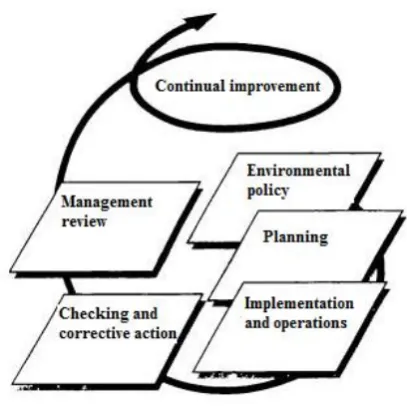
The standard relative to the Environmental Management System (EMS), known as ISO 14001, was first published in 1996 and revised in 2004 [9]. This system is used to develop and implement the environmental policy and to manage its aspects by providing tools to enable the orga-nizations to control the impact of their activities, prod-ucts and services on the natural environment aspect. Fig-ure 2 shows different steps for continual improvement in EMS.
Figure 2: The environmental management system ac-cording to ISO 14001 [9]
2.3
Occupational Health and Safety
Man-agement
System
standard
(OHSAS
18001)
The standard relative to the Occupational Health and Safety Management System (OHSAS), actually known as ISO 18001, was first proposed in 1999 [13] and revised in 2007 in order to create and maintain a safe working environment. This standard is applicable for any organi-zation to establish an OHS management system, which will help it to minimize risks regarding its employees and customers. It is important to note that this standard has the same structure than the standard ISO 14001(see figure 2).
3
Related work
Research concerning integrated management systems, started at the same time with the publication of EMS in 1996 by Puri [14] where a set of guidelines were pro-posed in order to integrate the EMS and QMS. Once the OHSAS was formulated, the need to consider the three systems was resented and many researches have been car-ried out in order to build more sustainable integrated management systems.
[image:2.595.54.290.327.505.2]an immediate and visible improvement in OHS, service quality and EMS. Moreover, Jorgensen et al. [10], pro-pose three ambitious levels of integration i.e. correspon-dence,coordinationandintegrationfor a more sustainable IMS, then, Zeng et al. [17] define the internal and exter-nal factors affecting the implementation of IMS through a structured questioner survey conducted in china and recently, Jorgensen [11] proposes more sustainable man-agement systems through life cycle manman-agement on the basis of the three levels proposed in [10]. Using results and ideas from the second category, the third one pro-poses models and approaches to implement an IMS. In this context, Wilkinon and Dale [16] propose two ap-proaches, the first consists in achieving integration in-cluding the emergence of documentation through aligned approach and similarities in the three standards and the second implements the integrated system through a total quality management approach.
Another important work is the one of Labodova [12] who proposes two ways of integration, the first consists of the introduction of individual systems followed by the inte-gration of originally separate ones and the second is an integrating management system based on the risk analy-sis. Finally, Zeng et al. [17], propose a different approach based on the definition of specific integration factors ex-tacted from questionnaires then they propose a synergetic multi-level model for implementing an IMS.
We can also mention the case of several countries which developed their own integrated management standard such as Australia [2] and France [1]. However, these lo-cal standards can not be intended for certification since they just represent guidelines and recommendations for the integration.
From this review, it is clear that the proposed approaches, are not still in coherence with the original and recent ideas proposed by Jorgensen et al. [10]. Indeed the ap-proach proposed by Labodova [12] involves only the cor-respondence level, by introducing the risk management, which is not sufficient to deal with all management sys-tems since it allows a separate evaluation of risks levels relative to each system and ignoring the interaction be-tween them. Also the approach proposed by Zeng et al. [17] is only based on the internal and external factors affecting the implementation and does not take into ac-count the three levels of integration. Thus, our idea is overcame the weaknesses of existing systems by propos-ing a new process-based approach for implementpropos-ing an IMS dealing with the three integrating levels proposed by Jorgensen et al. [10]. This approach will be detailed in the next section.
4
New approach for total integration of
IMS
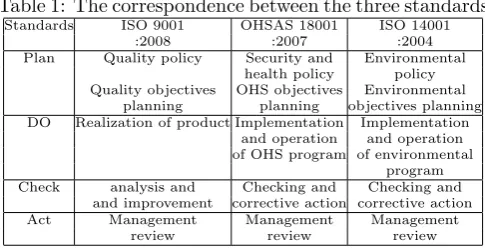
[image:3.595.306.549.275.399.2]We propose now a new approach for a total integration of the three management systems i.e. Quality, Security and Environment by considering different interactions be-tween their policies, objectives and resources. Indeed, the three systems are based on the same continual improve-ment approach i.e. PLAN, Do, Check, Act (PDCA) as shown in table 1 and their consideration in the same or-ganization can generate confusion, incoherence and in-compatibility while integrating them. Thus, in order to implement a robust integrated management system, we propose the use of the three integration levels recently defined by Jorgensen et al. [10] and detailed as follows:
Table 1: The correspondence between the three standards Standards ISO 9001 OHSAS 18001 ISO 14001
:2008 :2007 :2004
Plan Quality policy Security and Environmental health policy policy Quality objectives OHS objectives Environmental
planning planning objectives planning DO Realization of product Implementation Implementation
and operation and operation of OHS program of environmental
program Check analysis and Checking and Checking and
and improvement corrective action corrective action Act Management Management Management
review review review
Correspondence: this level is important since it increases the compatibility between the three systems in order to reduce add-problems issued from parallel systems as bu-reaucracy and duplication of work tasks. In addition, this level minimizes duplication of paper work and confusion between standards. It also, simplifies the internal and external audits.
Coordination: this level is based on a common under-standing of generic process and tasks management cycles (Plan-Do-Check-Act) and it, essentially, ensures syner-gies and tradeoffs between the three systems by aligning their policies and coordinating their objectives and tar-gets.
Integration: this level leads to the interaction with stake-holders, continuous improvement of the performance, a better understanding of internal and external challenges and also to a responsibility culture.
(Plan-Do-Check-Act). Before detailing our approach, we just give some basic concepts regarding these three integrating factors.
4.1
Integrating factors
4.1.1 Risk management
The use of risk management as integrating factor, in-creases the compatibility and the correspondence between the three systems in order to reduce add-problems issued from parallel implementations since the same source of hazard can causes risks to targets in many management areas, as the risk on the environment, the risk for health and safety, and risk for quality and economic losses. For instance, an explosion in a plant (as the AZF one) can cause:
- a security problem sine employees can be injured, - an environmental problem since it can blew the win-dows of nearby residents and pollute the air,
- and a quality problem since it can generate a supply disruption for customers.
The risk management is the common factor between each management system to identify each risk source and pos-sible target system relating to quality, security and envi-ronment leading to a possible failure to reach up differ-ent objectives. Once, the sources of risks are iddiffer-entified, we have to evaluate each risk by the combination of the probability of occurrence and the consequences of it. This evaluation allows us to define the appropriate preventive, corrective and improvement plans to reduce the levels of risks. Finally, we should provide the personnel, technical and financial resources required for each program.
4.1.2 Process-based approach
To deal with coordination as integration level, we should consider all the activities of a company and their interac-tions in the same model. To satisfy this requirement, the process based approach seems to be an adequate tool. This approach is only a normative requirement of the standard ISO 9001 V2008, and our idea is to adopt it for the three standards to have a global process-based ap-proach integrating the requirements of stakeholders and taking into account quality, security and environment as-pects. The process based-approach consists in modeling all the whole process of a company and their interaction in the same model namely process cartography. Thus, this cartography allows us in one hand to identify the in-put and the outin-put of each process, therefore it leads us to a common understanding of the generic process and the examination of synergies and trade-offs, in the other hand to the alignment of policy, objectives and tar-gets. In addition, the process analysis allows the iden-tification of sources of hazard. This ideniden-tification is the starting point to control the process and to define the
requirements such as personnel, technical, and financial resources to reach up different objectives. Also, the pro-cess approach provides an adequate framework to analyze the potential causes of risks and help decision makers to adopt the appropriate decisions for the three systems.
4.1.3 Monitoring System
To ensure the monitoring of the global system and the integration as a continuous improvement of the perfor-mance we have to evaluate the states of processes. An adequate tool to ensure this task is the use of perfor-mance indicators which are variables indicating the effec-tiveness and/or efficiency of a part or whole of any pro-cess or system in order to evaluate its state with regard to pre-set objectives. Typically, a model of performance indicators is composed of three main parameters i.e. ob-jectives, measures and evaluations [4]. Measures can be provided from four different sources, such as customers, audits, controls and ouridea is to consider each of them as a performance indicator.
4.2
Proposed process-based approach for
IMS
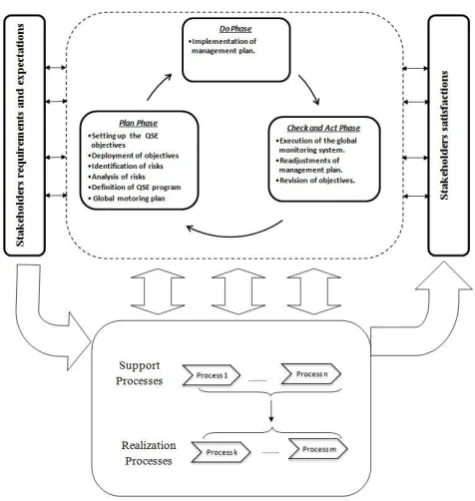
[image:4.595.309.547.469.720.2]Our approach for integrating management system is il-lustrated by figure 3, where the different steps cover the whole PDCA (Plan, Do, Check, Act) scheme. The idea here is to gather these steps into three phases such that the first one concerns thePlan step, the second, theDo step and the third the Check and the Act steps. These three phases can be detailed as follows:
• Plan phase: This phase leads us to a better under-standing of the current situation in order to carry out the objectives and to define for each process the re-quirements, tools, methods, responsibilities and the resources. To this end, we propose six steps, the first consists in setting up all quality, security and environment objectives issued from the requirements and the expectations of stakeholders (i.e. customers, employees, population, environment, etc.). In the second, we will deploy all these objectives in each process on the basis of the support and the realiza-tion process to coordinate and balance them, from this step each process will have its own objectives. The third step consists in the analysis of each pro-cess with respect to the pre-set objectives defined in the second one in order to identify the sources of hazard and possible targets leading to a possi-ble failure to reach up the objectives. In the fourth step, each identified risk has to be analyzed in term of potential consequences in each management area. Unfortunately, existing approaches for risk evalua-tion aspreliminary risk analysis preliminary(APR), hazard operability (HAZOP), failure mode and ef-fects analysis(FMEA),fault tree analysis,event tree analysisandbow tieanalysis are not appropriate to deal with many management areas simultaneously and they are usually limited to technical level. In a previous work, we have proposed an extension of the FMEA analysis method in order to take into ac-count a risk level for each management area using a multi-criticity system based on a fuzzy logic [3], such an approach can be used in order to deal with many management areas, also the process-based approach provides an adequate framework to analysis the po-tential causes of risks. In the fifth step we have to define a global management plan QSE to implement selected treatments as preventive and corrective ac-tions, in order to reduce levels of risks already identi-fied and to improve the efficiency of the IMS. To this end, we have to consider the interaction between the different management areas, indeed some decisions can be beneficial for some management areas and harmful for others, for this, we propose to use the multi-criteria approach proposed by Ben Romdhane et al. [3], this approach is based on the Analytic Hi-erarchical Process (AHP) methodology to define the appropriate action plan when many criteria (as the management areas) should be considered. finally, the sixth step is devoted to the definition of an appropri-ate monitoring plan, in order to ensure the well im-plementation of the global management plan. This monitoring plan should, obviously, take into account the importance of different processes, their interac-tions and the level of identified risks . The global monitoring plan can be built by several tools such as: customers satisfaction, audits, controls and per-formance indicators of processes. The idea here is
to consider of all these tools as performance indica-tors. Since they are heterogeneous, to this end we propose the use a system of performance indicators such as the one proposed by Berrah et al. [5] which considers several performance indicators allowing us to take into account different diversified objectives.
• Do phase: This phase has as input the global man-agement plan QSE and the corresponding global monitoring plan generated from the plan phase and will implement the selected treatments. Note that we have to define the appropriate Scheduling to op-timize the resources in order reach up the objectives more efficiently.
• Check and Act phase: Once the do phase achieved, this phase will finalize the process of inte-gration by the measure of the effectiveness of differ-ent decisions and their readjustmdiffer-ents via three steps. In the first one, we have to measure all the indicators already defined indicators in order to evaluate the effectiveness of selected treatments and to estimate the degree of achievement of objectives. For this reason, we have to aggregate the indicators of each objectives. In the second step, a readjustment of the management plan will be done in order to satisfy un-reached objectives. To deal with these two steps, we can adopt the approach developed by Cliville et al. [6] which is based on Berraha et al. methodologies [5] to aggregate the performance measurements and to allow decision-makers to define appropriate correc-tive actions in order to reach up all the objeccorrec-tives. Although, some objectives may not be reached, that is why we should revise some of the initial assigned objectives in order to make their satisfaction possi-ble, in this context we propose the third step (i.e. revision of objectives) in order to contribute to sus-tainable development.
5
Conclusion
respecting the three standards. Once the global planning is initialized on a Plan phase, a Do phase ensures its execution. Finally, the proposed integrated system will be controlled in a Plan and Check phase, by adopting the principles of the factual approach of decision-making. One of the main advantages of our approach consists in the fact that it is in adequacy with the eight fundamental principles of quality management, namely:
• Theleadership andcustomers’ orientationextended to stakeholders and that have been considered in the definition and the planning of the objectives.
• Theprocess-based approach that we have used to de-fine the global monitoring plan.
• The factual approach of decision-making and the continuous improvement which constitute the base to guarantee the cohabitation of the three systems in a unique one which is self- adaptive due to its dynamic aspect.
• The two remaining principles, namely, thepersonnel implicationand themutually beneficial relations with the supplierswill be considered as important criteria in theDo phaserelative to the implementation of the integrated system.
In addition to these eight principles, we remain in co-herence with the three integration levels recently defined by Jorgensen et al. [10], namely the correspondence, co-ordination and the integration which will be taken into account in the various phases of our approach. Finally, the concretization of our approach depends on its enrich-ment by adequate tools in order to ensure the effective and operational integration by objectives. This will be the subject of our future work.
References
[1] AC X50-200:2004, Syst`emes de management : Bonnes pratiques et retours d’exp´eriences, AFNOR, 2004.
[2] AS/NZS 4581:1999, Management system integra-tion, Guidance to business, Government and com-munity organizations, Australian / New Zealand Standards, 1999.
[3] Ben Romdhane, T., Ben Ammar, F., Badred-dine, A., “Une approche par la logique floue pour l’optimisation multicrit`ere de la prise de d´ecision ap-pliqu´ee `a l’AMDEC,”Journal of Decision Systems, V16, N4, pp.505-545, 2007.
[4] Berrah, L., Mauris, G., Foulloy L., Haurat A.,“Fuzzy performance indicators for the control of the manu-facturing processes,”In Fuzzy system design: social
and engineering applications, eds, Physica-Verlag, 1998.
[5] Berraha, L., Maurisb, G., Haurata, A., Foulloy, L.,“Global vision and performance indicators for an industrial improvement approach,”Computers in in-dustrie], N43, pp. 211-225, 2000.
[6] Cliville, V., Berrah, L., Mauris, G.,“Quantitative expression and aggregation of performance mea-surements based on the MACBETH multi-criteria method,”International journal of Production Eco-nomics, N105, pp. 171-189, 2007.
[7] Fresner, J., Engelhardt, G.,“ Experiences with inte-grated management systems for two small companies in Austria,”Journal of Cleaner Production, V12, N6, pp. 623-631, 2004.
[8] ISO 9001:2008,Quality managment system. Require-ments, ISO, 2008.
[9] ISO 14001:2004,Environmental managment system. Requirements with guidance for use, ISO, 2004.
[10] Jorgensen, TH., Remmen, A., Mellado, MD.,“Integrated Management Systems-three different levels of integration,” Journal of Cleaner Production, N14, pp. 713-722, 2006.
[11] Jorgensen, TH.,“Towards more sustainable manage-ment systems:Through lide cycle managmanage-ment and in-tegration,” Journal of cleaner production, N16, pp. 1071-1080, 2008.
[12] Labodova, A. “Implementing integrated manage-ment systems using a risk analysis based ap-proach,”Journal of Cleaner Production, V12, N6, pp. 571-580, 2004.
[13] OHSAS 18001:2000,Occupational health and safety management systems-specification, BSI: British standard institution, 2007.
[14] Puri, SC., “Integrating environmental quality with ISO 9000 and TQM,” Portland, OR: Productivity Press, 1996.
[15] Wilkinson G., Dale B.G.,“System integration: the views and activities of certification bodies,” The TQM Magazine, V10, N4, PP. 288-292, 1998.
[16] Wilkinson, G., Dale, B.G.,“An examination of the ISO 9001:2000 standard and its influence on the inte-gration of management systems,” Production Plan-ning and Control, V13, N3, pp. 284-297, 2002.