Detection of Product Comparisons – How Far Does an Out-of-the-box
Semantic Role Labeling System Take You?
Wiltrud Kessler and Jonas Kuhn Institute for Natural Language Processing
University of Stuttgart
Abstract
This short paper presents a pilot study in-vestigating the training of a standard Seman-tic Role Labeling (SRL) system on product reviews for the new task of detecting com-parisons. An (opinionated) comparison con-sists of a comparative “predicate” and up to three “arguments”: the entity evaluated posi-tively, the entity evaluated negaposi-tively, and the aspect under which the comparison is made. In user-generated product reviews, the “predi-cate” and “arguments” are expressed in highly heterogeneous ways; but since the elements are textually annotated in existing datasets, SRL is technically applicable. We address the interesting question how well training an out-of-the-box SRL model works for English data. We observe that even without any feature en-gineering or other major adaptions to our task, the system outperforms a reasonable heuristic baseline in all steps (predicate identification, argument identification and argument classifi-cation) and in three different datasets.
1 Introduction
Sentiment analysis deals with the task of determin-ing the polarity of an opinionated document or a sentence, in product reviews typically with regard to some target product. A common way to express sentiment about some product is by comparing it to a different product. In the corpus data we use, around 10% of sentences contain at least one comparison. Here are some examples of comparison sentences from our corpus:
(1) a. “[This camera]E+. . . its [screen]Ais much
big-gerthan the [400D].”
b. “[D70]E+ beats[EOS 300D]E− in almost
[ev-ery category]A, EXCEPT ONE.”
c. “[Noise suppression]A1A2 was generally
better1than the [D80]E−1’s and muchbetter2
than the [Rebel]E−2’s.”
d. “A striking difference between the [EOS 350D]E−and the new [EOS 400D]E+concerns
the [image sensor]A.”
Note that our definition of comparisons is broader than the linguistic category of comparative sen-tences, which only includes sentences that contain a comparative adjective or adverb. For our work, we consider comparisons expressed by any Part of Speech (POS).
A comparison contains several parts that must be identified in order to get meaningful information. We call the word or phrase that is used to express the comparison (“better”, “beats”, . . . ) acomparative
predicate. A comparison involves twoentities, one
or both of them may be implicit. In our data, most of the entities are products, e.g., the two cameras “D70” and “EOS 300D” in sentence 1b. In graded comparisons, entity+ (E+) is the entity that is being evaluated positively, entity- (E-) the entity evaluated negatively. In many sentences one attribute or part of a product is being compared, like “image sensor” in sentence 1d. We call this theaspect(A).
The task we want to solve for a given compari-son sentence is to detect the comparative predicate, the entities that are involved and the aspect that is being compared. We borrow our methodology from Semantic Role Labeling (SRL). In SRL,eventsare expressed by predicates and participants of these events are expressed by arguments that fill differ-ent semantic roles. Adapted to the problem of de-tecting comparisons, the events we are interested in are comparative predicates and the arguments are the two entities and the aspect that is being compared.
Due to the diversity of possible ways of express-ing comparisons, the “predicates” and “arguments”
in this task are more heterogeneous categories than in standard SRL based on PropBank and Nom-Bank annotations. Moreoever, the existing labeled datasets are based on an annotation methodology which gave the annotators a lot of freedom in de-ciding on the linguistic anchoring of the “predicate” and “arguments”. This adds to the heterogeneity of the observed constructions and makes it even more interesting to ask the question how far an out-of-the-box SRL model can take you.
In this work, we re-train an existing SRL system (Bj¨orkelund et al., 2009) on product review data la-beled with comparative predicates and arguments. We show that we can get reasonable results with-out any feature engineering or other major adap-tions. This is an encouraging result for a linguis-tically grounded modeling approach to comparison detection.
2 Related Work
The syntax and semantics of comparative sentences have been the topic of research in linguistics for a long time (Moltmann, 1992; Kennedy, 1999). How-ever, our focus is on computational methods and we also treat comparisons that are not comparative sen-tences in a linguistic sense.
In sentiment analysis, some studies have been pre-sented to identify comparison sentences. Jindal and Liu (2006a) report good results on English using class sequential rules based on keywords as features for a Naive Bayes classifier. A similar approach for Korean is presented by Yang and Ko (2009; 2011b; 2011a). In our work, we do not address the task of identifying comparison sentences, we assume that we are given a set of such sentences.
The step we are concerned with is the detection of relevant parts of a comparison. To identify entities and aspect, Jindal and Liu (2006b) use an involved pattern mining process to mine label sequential rules from annotated English sentences. A similar ap-proach is again presented by Yang and Ko (2011a) for Korean. In contrast to their complicated process-ing, we simply use an existing SRL system out of the box. Both approaches consider only nouns and pronouns for entities and aspects, we use all POS and allow for multi-word arguments. Jindal and Liu (2006b) base the recognition of comparative
predi-cates on a list of manually compiled keywords. We use this as our baseline. Our approach is not de-pendent on a set of keywords and is therefore more easily adaptable to a new domain.
All works label the entities according to their po-sition with respect to the predicate. This requires the identification of the preferred entity in a non-equal comparison as an additional step. Ganapathibhotla and Liu (2008) use hand-crafted rules based on the polarity of the predicate for this task. As we label the entities with their roles from the start, we solve both problems at the same time.
Xu et al. (2011) cast the task as a relation extrac-tion problem. They present an approach that uses conditional random fields to extract relations (
bet-ter, worse, sameandno comparison) between two
entitites, an attribute and a predicate phrase.
The approach of Hou and Li (2008) is most re-lated to our approach. They use SRL with standard SRL features to extract comparative relations from Chinese sentences. We confirm that SRL is a vi-able method also for English. In their experiments they report good results on gold parses, but observe a drop in performance when they use their method on automatic parses. All our experiments are con-ducted on automatically obtained parses.
3 Approach
The input to our system is a sentence that we assume to contain at least one comparison. The result of our processing are one or more comparative predicates and for each predicate three arguments: The two en-tities that are being compared, and the aspect they are compared in. More formally speaking, for ev-ery sentence we expect to get one or more 4-tupels (predicate, entity+, entity-, aspect). Entity+ is the entity that is being evaluated as better than entity-. Any of the arguments may be empty. Currently, we treat only single words as comparative predicates. Annotated multi-word predicates are mapped to one word. We allow for multi-word arguments, but an-notate only the head word of the phrase and treat it as a one word argument for evaluation. We do not place any restrictions on possible POS.
disambiguation to identify the different frames this predicate can express. As we do not have such frame information, predicate disambiguation is not performed in our pipeline.
After we have identified the predicates, the next step is to identify their arguments. The identifica-tion step is a binary classificaidentifica-tion whether a word in the sentence is some argument of the identified pred-icate. As a final classification step, it is determined for each found argument whether this argument is entity+, entity- or the aspect.
We use an existing SRL system (Bj¨orkelund et al., 2009)1and the features developed for SRL, based on the output of the MATE dependency parser (Bohnet, 2010). Features use attributes of the predicate itself, its head or its dependents. Additionally, for argu-ment identification and classification there are fea-tures that describe the relation of predicate and argu-ment, the argument itself, its leftmost and rightmost dependent and left and right sibling.
For the classification tasks of the pipeline, the SRL system uses regularized linear logistic regres-sion from the LIBLINEAR package (Fan et al., 2008). We set the SRL system to train separate clas-sifiers for predicates of different POS. In preliminary experiments, we have found this to perform slightly better than training one classifier for all kinds of predicates, although the difference is not significant. We do not use the reranker.
4 Experiments
Data. We use the JDPA corpus2by J. Kessler et al.
(2010) for our experiments. It contains blog posts about cameras and cars. We use the annotation class “Comparison” that has four annotation slots. We convert the “more” slot to entity+, the “less” slot to entity- and the “dimension” slot to the aspect. For now, we ignore the “same” slot which indicates if the two mentions are ranked as equal.
We have also tested our approach on the dataset used in (Jindal and Liu, 2006b)3. We use all
com-1http://code.google.com/p/mate-tools/
2
Available from http://verbs.colorado.edu/ jdpacorpus/ – we ignore cars batch 009 where no arguments of comparative predicates are annotated.
3
Available from http://www.cs.uic.edu/˜liub/ FBS/data.tar.gz– although the original paper works on some unknown subset of this data, so our results are not directly
JDPA J&L cameras cars
all sentences 5230 14003 7986 comparison sentences 505 1094 649 predicates 642 1327 695 distinct predicates 147 252 122 preds. occurring once 87 147 61 Entity+ / 1 517 1091 657 Entity- / 2 511 1068 331
[image:3.612.314.525.57.179.2]Aspect 623 1107 526
Table 1: Statistics about the datasets
parisons annotated as types 1 to 3 (ignoring type 4, non-gradable comparisons). In this dataset (J&L), entities are annotated as entity 1 or entity 2 depend-ing on their position before or after the predicate. We keep this annotation and train our system to as-sign these labels.
We do sentence segmentation and tokenization with the Stanford Core NLP4. Annotations are mapped to the extracted tokens. We ignore anno-tations that do not correspond to complete tokens. In the JDPA corpus, if an annotated argument is out-side the current sentence, we follow the coreference chain to find a coreferent annotation in the same sen-tence. If this is not successful, the argument is ig-nored. We extract all sentences where we found at least one comparative predicate as our dataset.
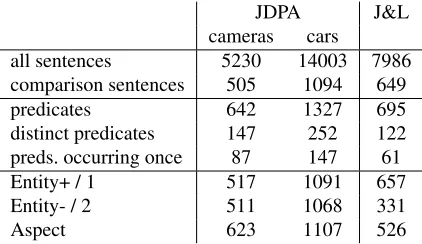
Table 1 shows some statistics of the data.
Evaluation Setup. We evaluate on each dataset
separately using 5-fold cross-validation. We report precision (P), recall (R), F1-measure (F1), and for argument classification macro averaged F1-measure (F1m) over the three arguments. Bold numbers
de-note the best result in each column and dataset. We mark a F1-measure result with * if it is significantly higher than all previous lines.5
Results on Predicates. We have implemented
two baselines based on previous work. The sim-plest baseline, BL POS classifies all tokens with a comparative POS (’JJR’, ’JJS’, ’RBR’, ’RBS’) as predicates. A more sophisticated baseline, BL
Keyphrases, uses a list of about 80 manually
com-comparable to the results reported there.
4
http://nlp.stanford.edu/software/ corenlp.shtml
5Statistically significant atp < .05using the approximate
P R F1
cams
BL POS 66.6 38.2 48.5 BL Keyphrases 53.1 62.8 57.5∗ SRL 73.8 58.7 65.4∗
cars
BL POS 62.5 34.7 44.6 BL Keyphrases 51.9 56.5 54.1∗ SRL 73.2 55.5 63.2∗
J&L
[image:4.612.96.282.57.178.2]BL POS 74.3 52.9 61.8 BL Keyphrases 61.5 80.0 69.5∗ SRL 77.0 68.1 72.3∗
Table 2: Results predicate identification
P R F1
cams
BL 49.4 47.1 48.2 SRL 66.5 38.0 48.4
cars
BL 50.2 50.1 50.1 SRL 68.7 42.2 52.3∗
J&L
BL 38.7 44.6 41.5 SRL 68.5 45.2 54.5∗
Table 3: Results argument identification (gold predicates)
Entity+ / 1 Entity- / 2 Aspect F1m
P R F1 P R F1 P R F1
cams
BL 30.1 31.7 30.9 21.2 21.3 21.3 61.8 51.2 56.0 36.1 SRL 38.6 17.4 24.0 43.7 24.5 31.4 69.9 47.7 56.7 37.3
cars
BL 31.1 32.7 31.9 23.0 24.0 23.5 49.3 44.5 46.8 34.0 SRL 39.5 22.9 29.0 48.1 31.0 37.7 58.4 36.2 44.7 37.1∗
J&L
[image:4.612.354.496.75.158.2]BL 43.2 39.4 41.2 19.0 31.1 23.6 15.0 17.1 16.0 26.9 SRL 58.3 47.2 52.1 60.8 35.6 45.0 58.8 30.6 40.3 45.8∗
Table 4: Results argument classification (gold predicates)
piled comparative keyphrases from (Jindal and Liu, 2006a) in addition to the POS tags.
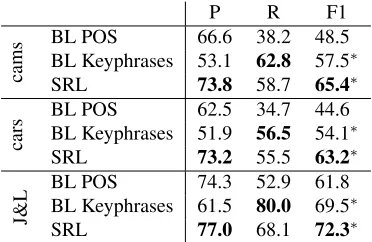
Table 2 shows the result of our experiments. Our method significantly outperforms both baselines in all datasets. The generally low recall values are mainly a result of the wide variety of predicates that are used to express comparisons (see Discussion).
Results on Arguments. To get results indepent of
the errors introduced by the relatively low perfor-mance on predicate identification, we use annotated predicates (gold predicates) as a starting point for the argument experiments. All results drop about 10% when system predicates are used.
As a baseline (BL) for argument identification
and classification, we use some heuristics based on the characteristics of our data. Most entities are (pro)nouns and most predicates are positive, so we classify the first noun or pronoun before the predi-cate as entity+ (entity 1 for J&L) and the first noun or pronoun after the predicate as a entity- (entity 2). If the predicate is a comparative adjective, we clas-sify the predicate itself as aspect, because this type of annotation is very frequent in the JDPA data. For other predicates except nouns and verbs, we classify the direct head of the predicate as aspect.
Table 3 shows the results for argument
identifica-tion, the results for argument classification can be seen in Table 4. Our system outperforms the base-line for all datasets. The differences are significant except for the cameras dataset. In general, the num-bers are low. We will discuss some reasons for this in the next section.
5 Discussion
Sparseness. There are many ways to express a
comparison and the size of the available training data is relatively small. This strongly influences the recall of our system as many predicates and argu-ments occur only once. As we can see in Table 1, 60% of the predicates in the cameras dataset occur only once. In contrast, only 12 predicates occur ten times or more. The trends are similar in the other datasets. This particularily affects verbs and nouns, where many colloquial expressions are used (“ham-mers”, “pwns”, “go head to head with”, “put X to the sword”, . . . ).
[image:4.612.126.483.216.312.2]Sentiment Relevance. The following examples show a problem that is typical for sentiment analysis and responsible for many false positive predicates:
(2) a. “Relatively [lower]Anoise at higher ISO . . . ”
b. “. . . but [higher]Athen [Sony]E+”
Although “higher” often expresses a comparison like in sentence 2b, in sentence 2a it only describes a camera setting and should not be extracted as a comparative predicate. There has been considerable work in the areas of subjectivity classification (Wil-son and Wiebe, 2003) and the related sentiment rel-evance (Scheible and Sch¨utze, 2013) which we will try to use to detect such irrelevant, “descriptive” uses of comparative words.
Linguistic anchoring. In contrast to SRL, the task
of comparison detection in reviews is a relatively new task without universally recognized definitions and annotation schemes. The annotators of the cor-pora had a lot of freedom in their choice of linguis-tic anchoring of the predicates and arguments. Con-sider these examples from the cameras dataset:
(3) a. “[Lighter]A in weight compared to the
[others]E−.”
b. “. . . [its]E+ [better]A and faster compared vs
the [SB800 flash]E−as well.”
c. “. . . this camera’s [screen]E+is [smaller]Athan
the [ones]E−on some competing models . . . ”
Sentences 3a and 3b show a situation where two words are used to express the same comparison and it is unclear which one to chose as a predicate. The decision is left to the individual annotators.
There is some variety of annotations on arguments as well. In the JDPA data, a comparative adjective is often annotated as aspect, sometimes even when there is an alternative, e.g., “weight” in sentence 3a. Also, for a phrase like “its screen”, we find “screen” annotated as the aspect (sentence 1a) or an entity (sentence 3c) – and both have their merit. We want to further study how different linguistic anchorings of comparisons effect classification performance.
Equative comparisons. As we can see from the
confusion matrix of our system, the distinction be-tween entity+ and entity- is very difficult to learn. In graded comparisons, the distinction is informa-tive, but sentiment information would be needed for
the correct assignment. There are also some prob-lematic cases where the ranking cannot be inferred without the broader context, e.g., sentence 1d.
A more annotation-related problem concerns equative comparisons, i.e., both entities are rated as equal. The difference between entity+ and entity- is meaningless in this case. In the JDPA corpus, en-tities still have to be annotated as either entity+ or entity- and the annotation guidelines allow the anno-tator to choose freely. As a result, the data is noisy, for the same predicate sometimes entity- is before the predicate, sometimes entity+. If we eliminate this noise by always assigning the entities in order of surface position, we see a gain in macro averaged F1-measure for all systems of about 2% (cameras) to 4% (cars).
6 Conclusions
We presented a pilot experiment on using an SRL-inspired approach to detect comparisons (compara-tive predicate, entity+, entity-, aspect) in user gener-ated content. We re-trained an existing SRL system on data that is labeled with comparative predicates and arguments. Even without feature engineering or major adaptions, our approach outperforms the base-lines in three datasets in every task. This is an en-couraging result for a linguistically grounded mod-eling approach to comparison detection.
For future work, we plan to include features that have been tailored specifically to the task of detect-ing product comparisons. To address the inherent di-versity of expressions typical for user generated con-tent, we want to employ generalization techniques, e.g., to detect product names. We also want to fur-ther study the different possible linguistic anchor-ings of comparisons and their effect on classification performance. Studies of this kind may also inform future data annotation efforts in that certain ways of anchoring the elements of a comparison linguis-tically may be more helpful than others. We also believe that the explicit modeling of different types (equative, superlative, non-equal gradable) of com-parisons will have a positive effect on performance.
Acknowledgments
References
Anders Bj¨orkelund, Love Hafdell, and Pierre Nugues. 2009. Multilingual Semantic Role Labeling. In Pro-ceedings of CoNLL ’09 Shared Task, pages 43–48. Bernd Bohnet. 2010. Very high accuracy and fast
depen-dency parsing is not a contradiction. InProceedings of COLING ’10, pages 89–97.
Rong-En Fan, Kai-Wei Chang, Cho-Jui Hsieh, Xiang-Rui Wang, and Chih-Jen Lin. 2008. Liblinear: A library for large linear classification. J. Mach. Learn. Res., 9:1871–1874, June.
Murthy Ganapathibhotla and Bing Liu. 2008. Mining opinions in comparative sentences. InProceedings of COLING ’08, pages 241–248.
Feng Hou and Guo-hui Li. 2008. Mining Chinese com-parative sentences by semantic role labeling. In Pro-ceedings of ICMLC ’08, pages 2563–2568.
Nitin Jindal and Bing Liu. 2006a. Identifying compar-ative sentences in text documents. InProceedings of SIGIR ’06, pages 244–251.
Nitin Jindal and Bing Liu. 2006b. Mining comparative sentences and relations. InProceedings of AAAI ’06, pages 1331–1336.
Christopher Kennedy. 1999. Projecting the Adjective: The Syntax and Semantics of Gradability and Compar-ison. Outstanding Dissertations in Linguistics. Gar-land Pub.
Jason S. Kessler, Miriam Eckert, Lyndsay Clark, and Nicolas Nicolov. 2010. The 2010 ICWSM JDPA Sen-timent Corpus for the Automotive Domain. In Pro-ceedings of ICWSM-DWC ’10.
Friederike Moltmann. 1992.Coordination and Compar-atives. Ph.D. thesis, Massachusetts Institute of Tech-nology.
Eric W. Noreen. 1989. Computer-intensive methods for testing hypotheses – an introduction. Wiley & Sons. Christian Scheible and Hinrich Sch¨utze. 2013.
Senti-ment relevance. In Proceedings of ACL ’13, pages 954–963.
Theresa Wilson and Janyce Wiebe. 2003. Annotating opinions in the world press. InProceedings of SIGdial ’03, pages 13–22.
Kaiquan Xu, Stephen Shaoyi Liao, Jiexun Li, and Yuxia Song. 2011. Mining comparative opinions from cus-tomer reviews for competitive intelligence. Decis. Support Syst., 50(4):743–754, March.
Seon Yang and Youngjoong Ko. 2009. Extracting com-parative sentences from Korean text documents us-ing comparative lexical patterns and machine learnus-ing techniques. InProceedings of the ACL-IJCNLP ’09, pages 153–156.
Seon Yang and Youngjoong Ko. 2011a. Extracting parative entities and predicates from texts using com-parative type classification. In Proceedings of HLT ’11, pages 1636–1644.