Detecting Compositionality of Multi-Word Expressions using Nearest
Neighbours in Vector Space Models
Douwe Kiela
University of Cambridge Computer Laboratory
Stephen Clark
University of Cambridge Computer Laboratory
Abstract
We present a novel unsupervised approach to detecting the compositionality of multi-word expressions. We compute the compositional-ity of a phrase through substituting the con-stituent words with their “neighbours” in a se-mantic vector space and averaging over the distance between the original phrase and the substituted neighbour phrases. Several meth-ods of obtaining neighbours are presented. The results are compared to existing suvised results and achieve state-of-the-art per-formance on a verb-object dataset of human compositionality ratings.
1 Introduction
Multi-word expressions (MWEs) are defined as “id-iosyncratic interpretations that cross word bound-aries” (Sag et al., 2002). They tend to have a standard syntactic structure but are often semanti-cally non-compositional; i.e. their meaning is not fully determined by their syntactic structure and the meanings of their constituents. A classic example iskick the bucket, which meansto dierather thanto hit a bucket with the foot. These types of expres-sions account for a large proportion of day-to-day language interactions (Schuler and Joshi, 2011) and present a significant problem for natural language processing systems (Sag et al., 2002).
This paper presents a novel unsupervised ap-proach to detecting the compositionality of MWEs, specifically of verb-noun collocations. The idea is
that we can recognize compositional phrases by sub-stituting related words for constituent words in the phrase: if the result of a substitution yields a mean-ingful phrase, its individual constituents are likely to contribute toward the overall meaning of the phrase. Conversely, if a substitution yields a non-sensical phrase, its constituents are likely to contribute less or not at all to the overall meaning of the phrase. For the phraseeat her hat, for example, we might consider the following substituted phrases:
1. consumeher hat
2. eat hertrousers
Both phrases are semantically anomalous, implying thateat hatis a highly non-compositional verb-noun collocation. Following a similar procedure for eat apple, however, would not lead to an anomaly: con-sume appleandeat pear are perfectly meaningful, leading us to believe thateat appleis compositional. In the context of distributional models, this idea can be formalised in terms of vector spaces:
the average distance between a phrase vector and its substituted phrase vectors is related to its compositionality.
Since we are relying on the relative distances of
phrases in semantic space, we require a method for computing vectors for phrases. We experi-mented with a number of composition operators from Mitchell and Lapata (2010), in order to com-pose constituent word vectors into phrase vectors. The relation between phrase vectors and substituted phrase vectors is most pronounced in the case of
pointwise multiplication, which has the effect of placing semantically anomalous phrases relatively close together in space (since the vectors for the con-stituent words have little in common), whereas the semantically meaningful phrases are further apart. This implies that compositional phrases are less sim-ilar to their neighbours, which is to say that the greater the average distance between a phrase vec-tor and its substituted phrase vecvec-tors, the greater its compositionality.
The contribution of this short focused research pa-per is a novel approach to detecting the composition-ality of multi-word expressions that makes full use of the ability of semantic vector space models to cal-culate distances between words and phrases. Using this unsupervised approach, we achieve state-of-the-art performance in a direct comparison with existing supervised methods.
2 Dataset and Vectors
The verb-noun collocation dataset from Venkatapa-thy and Joshi (2005), which consists of 765 verb-object pairs with human compositionality ratings, was used for evaluation. Venkatapathy & Joshi used a support vector machine (SVM) to obtain a Spear-manρs correlation of0.448. They employed a
va-riety of features ranging from frequency to LSA-derived similarity measures and used 10% of the dataset as training data with tenfold cross-validation. McCarthy et al. (2007) used the same dataset and ex-panded on the original approach by adding WordNet and distributional prototypes to the SVM, achieving aρscorrelation of0.454.
The distributional vectors for our experiments were constructed from the ukWaC corpus (Baroni et al., 2009). Vectors were obtained using a stan-dard window method (with a window size of 5) and the 50,000 most frequent context words as features, with stopwords removed. We also experimented with syntax-based co-occurrence features extracted from a dependency-parsed version of ukWaC, but in agreement with results obtained by Schulte im Walde et al. (2013) for predicting compositional-ity in German, the window-based co-occurrence method produced better results.
We tried several weighting schemes from the liter-ature, such as t-test (Curran, 2004), positive mutual
information (Bullinaria and Levy, 2012) and the ra-tio of the probability of the context word given the target word1to the context word’s overall
probabil-ity (Mitchell and Lapata, 2010). We found that a tf-idf variant called LTU yielded the best results, de-fined as follows (Reed et al., 2006):
wij =
(log(fij) + 1.0)log(nNj) 0.8 + 0.2×|avg context word|context word| |
wherefij is the number of times that the target word
and context word co-occur in the same window,nj
is the context word frequency, N is the total fre-quency and|context word|is the total number of oc-currences of a context word. Distance is calculated using the standard cosine measure:
dist(v1, v2) = 1−
v1·v2 |v1||v2|
wherev1 andv2 are vectors in the semantic vector space model.
3 Finding Neighbours and Computing
Compositionality
We experimented with two different ways of obtain-ing neighbours for the constituent words in a phrase. Since vector space models lend themselves naturally to similarity computations, one way to get neigh-bours is to take the k-most similar vectors from a similarity matrix. This approach is straightforward, but has some potential drawbacks: it assumes that we have a large number of vectors to select neigh-bours from, and becomes computationally expensive when the number of neighbours is increased.
An alternative source for obtaining neighbours is the lexical database WordNet (Fellbaum, 1998). We define neighbours as siblings in the hypernym hier-archy, so that the neighbours of a word can be found by taking the hyponyms of its hypernyms. Word-Net also allows us to extract only neighbours of the same grammatical type (yielding noun neighbours for nouns and verb neighbours for verbs, for exam-ple). Since not every word has the same number of neighbours in WordNet, we use only the first k
1
neighbours, which means that the neighbours have to be ranked. An obvious ranking method is to use the frequency with which each neighbour co-occurs with the other constituent(s) of the same phrase. For example, for all the WordNet neighbours ofeat(for all senses ofeat), we count the co-occurrences with
hat in a given window size and rank them accord-ingly. This ranking method also has the desirable side-effect of performing some word sense disam-biguation, at least in some cases. For example, the highly ranked neighbours ofappleforeat appleare likely to be items of food, and not (inedible) trees (apple is also a tree in WordNet).
In order to obtain frequency-ranked neighbours, we used the ukWaC corpus with a window size of 5. One reason for having multiple neighbours is that it allows us to correct for word sense disambigua-tion errors (as mendisambigua-tioned above), since averaging over results for several neighbours reduces the im-pact of including incorrect senses. For example, the first 20 neighbours ofeat, ranked by co-occurrence frequency with all the objects ofeatin the dataset, are:
eat use consume drink sample smoke swallow spend break hit save afford burn partake dine breakfast worry damage de-plete drug
One problem with the evaluation dataset is that it does not solely consist of verb-noun pairs: 84 phrases contain pronouns, while there are also sev-eral examples containing words that WordNet con-siders to be adjectives rather than nouns. This prob-lem was mitigated by part-of-speech tagging the dataset. As neighbours for pronouns (which are not included in WordNet), we used the other pronouns present in the dataset. For the remaining words, we included the part-of-speech when looking up the word in WordNet.
3.1 Average distance compositionality score
We considered several different ways of construct-ing phrasal vectors. We chose not to use the com-positional models of Baroni and Zamparelli (2010) and Socher et al. (2011) because we believe that it is important that our methods are completely unsuper-vised and do not require any initial learning phase.
Hence, we experimented with different ways of con-structing phrasal vectors according to Mitchell and Lapata (2010) and found that pointwise multiplica-tion worked best in our experiments. Thus, we define the composed vector−−−−→eat hatas:
−→
eat−→hat
We can now compute a compositionality scorescby
averaging the distance between the original phrase vector and its substituted neighbour phrase vectors via the following formula:
sc(−−−−→eat hat) = 1 2k(
k X
i=1
dist(−→eat−→hat,
−→
eat−−−−−−−→neighbouri) + k X
j=1
dist(−→eat−→hat,
−−−−−−−→
neighbourj
−→
hat))
We also experimented with substituting only for the noun or the verb, and in fact found that only tak-ing neighbours for the verb yields better results:
sc(
−−−−→
eat hat) = 1 k
k X
j=1
dist(−→eat−→hat,
−−−−−−−→
neighbourj
−→
hat)
To illustrate the method, consider the collocations
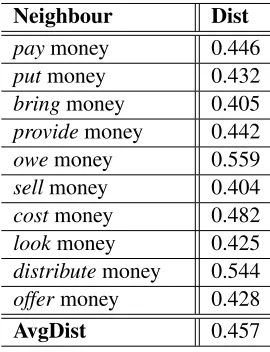
take breath and lend money. The annotators as-signed these phrases a compositionality score of 1 out of 6 and 6 out of 6, respectively, meaning that the former is non-compositional and the latter is com-positional. The distances between the first ten verb-substituted phrases and the original phrase, together with the average distance, are shown in Table 1 and Table 2.
Neighbour Dist
getbreath 0.049
findbreath 0.051
usebreath 0.050
workbreath 0.060
holdbreath 0.094
runbreath 0.079
carrybreath 0.076
lookbreath 0.065
playbreath 0.071
buybreath 0.100
[image:4.612.117.254.50.231.2]AvgDist 0.069
Table 1: Exampletake breath
Neighbour Dist
paymoney 0.446
putmoney 0.432
bringmoney 0.405
providemoney 0.442
owemoney 0.559
sellmoney 0.404
costmoney 0.482
lookmoney 0.425
distributemoney 0.544
offermoney 0.428
[image:4.612.319.536.52.185.2]AvgDist 0.457
Table 2: Examplelend money
the idiomatic sense in take breath, its neighbour-substituted phrases also have little overlap, result-ing in a smaller change in distance upon substitu-tion. Conversely, substituting the verb in the com-positional phrase yields meaningful vectors, putting them in locations in semantic vector space which are sufficiently far apart to distinguish them from the non-compositional cases.
4 Results
Results are given for the two methods of obtaining neighbours: via frequency-ranked WordNet neigh-bours and via vector space neighneigh-bours. The com-positionality score was computed by using only the verb, only the noun, or both constituent neighbours in the substituted phrase vectors.
System ρs
Venkatapathy and Joshi (2005) 0.447
McCarthy et al. (2007) 0.454
AvgDist VSM neighbours-both 0.131
AvgDist VSM neighbours-verb 0.420
AvgDist VSM neighbours-noun 0.245
AvgDist WN-ranked neighbours-both 0.165 AvgDist WN-ranked neighbours-verb 0.461
[image:4.612.117.252.263.439.2]AvgDist WN-ranked neighbours-noun 0.169
Table 3: Spearmanρsresults
The results are compared with the scores reported in Venkatapathy and Joshi (2005) and McCarthy et al. (2007), which were achieved using SVMs with a wide variety of features. Values of1≤k≤20were tried. If a phrase has fewer than k neighbours be-cause not enough neighbours have been found to co-occur with the other constituent, we use all of them. The results for k = 20 are reported here because that gave the best overall score. The dataset has an inter-annotator agreement of Kendall’sτ of0.61and a Spearmanρs of0.71 and all reported differences
in values are highly significant. Table 3 gives the results.
Note that, even though the current approach is un-supervised (in terms of not having access to compo-sitionality ratings during training, although it does rely on WordNet), it outperforms SVMs that require an ensemble of complex feature sets (some of which are also based on WordNet).
the contribution of individual constituents in such a way that the modifier’s contribution is included but is weighted less highly than the head’s contribution, which led to an improvement in performance. Our results might be improved by weighting the contri-bution of constituent words in a similar fashion, and by more closely examining the impact of light verbs for the compositionality of a phrase.
5 Related Work
The past decade has seen extensive work on compu-tational and statistical methods in detecting the com-positionality of MWEs (Lin, 1999; Schone and Ju-rafsky, 2001; Katz and Giesbrecht, 2006; Sporleder and Li, 2009; Biemann and Giesbrecht, 2011). Many of these methods rely on distributional mod-els and vector space modmod-els (Sch¨utze, 1993; Tur-ney and Pantel, 2010; Erk, 2012). Work has been done on different types of phrases, including work on particle verbs (McCarthy et al., 2003; Bannard et al., 2003), verb-noun collocations (Venkatapathy and Joshi, 2005; McCarthy et al., 2007), adjective-noun combinations (Vecchi et al., 2011) and adjective- noun-noun compounds (Reddy et al., 2011), as well as on languages other than English (Schulte im Walde et al., 2013). Recent developments in distributional compositional models (Widdows, 2008; Mitchell and Lapata, 2010; Baroni and Zamparelli, 2010; Co-ecke et al., 2010; Socher et al., 2011) have opened up a number of possibilities for constructing vectors for phrases, which have also been applied to com-positionality tests (Giesbrecht, 2009; Kochmar and Briscoe, 2013).
This paper takes that work a step further: by con-structing phrase vectors and evaluating these vectors on a dataset of human compositionality ratings, we show that existing compositional models allow us to detect compositionality of multi-word expressions in a straightforward and intuitive manner.
6 Conclusion
We have presented a novel unsupervised approach that can be used to detect the compositionality of multi-word expressions. Our results show that the underlying intuition appears to be sound: substitut-ing neighbours may lead to meansubstitut-ingful or meansubstitut-ing- meaning-less phrases depending on whether or not the phrase
is compositional. This can be formalized in vec-tor space models to obtain compositionality scores by computing the average distance to the original phrase’s substituted neighbour phrases. In this short focused research paper, we show that, depending on how we obtain neighbours, we are able to achieve a higher performance than that achieved by super-vised methods which rely on a complex feature set and support vector machines.
Acknowledgments
This work has been supported by EPSRC grant EP/I037512/1. The authors would like to thank Di-ana McCarthy for providing the dataset; and Ed Grefenstette, Eva Maria Vecchi, Laura Rimell and Tamara Polajnar and the anonymous reviewers for their helpful comments.
References
Colin Bannard, Timothy Baldwin, and Alex Lascarides. 2003. A statistical approach to the semantics of verb-particles. InProceedings of the ACL 2003 Workshop on Multiword expressions: analysis, acquisition and treatment, MWE 03.
M. Baroni and R. Zamparelli. 2010. Nouns are vectors, adjectives are matrices: Representing adjective-noun constructions in semantic space. In Proceedings of the Conference on Empirical Methods in Natural Lan-guage Processing, EMNLP ’10, pages 1183–1193. Marco Baroni, Silvia Bernardini, Adriano Ferraresi, and
Eros Zanchetta. 2009. The wacky wide web: A collection of very large linguistically processed web-crawled corpora. Language Resources and Evalua-tion, 43(3):209–226.
Chris Biemann and Eugenie Giesbrecht. 2011. Disco-11: Proceedings of the workshop on distributional se-mantics and compositionality.
John A. Bullinaria and Joseph P. Levy. 2012. Extracting Semantic Representations from Word Co-occurrence Statistics: Stop-lists, Stemming and SVD. Behavior Research Methods, 44:890–907.
Bob Coecke, Mehrnoosh Sadrzadeh, and Stephen Clark. 2010. Mathematical foundations for a compositional distributional model of meaning. In J. van Bentham, M. Moortgat, and W. Buszkowski, editors,Linguistic Analysis (Lambek Festschrift), volume 36, pages 345– 384.
Katrin Erk. 2012. Vector space models of word meaning and phrase meaning: A survey. Language and Lin-guistics Compass, 6(10):635–653.
Christiane Fellbaum. 1998. WordNet: An Electronic Lexical Database. Bradford Books.
Eugenie Giesbrecht. 2009. In search of semantic com-positionality in vector spaces. In Sebastian Rudolph, Frithjof Dau, and SergeiO. Kuznetsov, editors, Con-ceptual Structures: Leveraging Semantic Technolo-gies, volume 5662 ofLecture Notes in Computer Sci-ence, pages 173–184. Springer Berlin Heidelberg. Graham Katz and Eugenie Giesbrecht. 2006. Automatic
identification of non-compositional multi-word ex-pressions using latent semantic analysis. In Proceed-ings of the Workshop on Multiword Expressions: Iden-tifying and Exploiting Underlying Properties, MWE ’06, pages 12–19.
Ekaterina Kochmar and Ted Briscoe. 2013. Capturing Anomalies in the Choice of Content Words in Com-positional Distributional Semantic Space. In Recent Advances in Natural Language Processing.
Dekang Lin. 1999. Automatic identification of non-compositional phrases. In Proceedings of the 37th annual meeting of the Association for Computational Linguistics on Computational Linguistics, ACL ’99, pages 317–324.
Diana McCarthy, Bill Keller, and John Carroll. 2003. Detecting a continuum of compositionality in phrasal verbs. In Proceedings of the ACL 2003 workshop on Multiword expressions: analysis, acquisition and treatment - Volume 18, MWE ’03, pages 73–80. Diana McCarthy, Sriram Venkatapathy, and Aravind
Joshi. 2007. Detecting compositionality of verb-object combinations using selectional preferences. In
Proceedings of the 2007 Joint Conference on Empir-ical Methods in Natural Language Processing and Computational Natural Language Learning (EMNLP-CoNLL), pages 369–379.
Jeff Mitchell and Mirella Lapata. 2010. Composition in distributional models of semantics. Cognitive Science, 34(8):1388–1429.
Siva Reddy, Diana McCarthy, and Suresh Manandhar. 2011. An empirical study on compositionality in com-pound nouns. In Proceedings of The 5th Interna-tional Joint Conference on Natural Language Process-ing 2011 (IJCNLP 2011), Thailand.
J.W. Reed, Y. Jiao, T.E. Potok, B.A. Klump, M.T. El-more, and A.R. Hurson. 2006. TF-ICF: A new term weighting scheme for clustering dynamic data streams. InMachine Learning and Applications, 2006. ICMLA ’06. 5th International Conference on, pages 258–263. Ivan A. Sag, Timothy Baldwin, Francis Bond, Ann A.
Copestake, and Dan Flickinger. 2002. Multiword
ex-pressions: A Pain in the Neck for NLP. In Proceed-ings of the Third International Conference on Com-putational Linguistics and Intelligent Text Processing, CICLing ’02, pages 1–15.
Patrick Schone and Daniel Jurafsky. 2001. Is knowledge-free induction of multiword unit dictionary headwords a solved problem? In Proceedings of Empirical Methods in Natural Language Processing, EMNLP ’01.
William Schuler and Aravind K. Joshi. 2011. Tree-rewriting models of multi-word expressions. In Pro-ceedings of the Workshop on Multiword Expressions: from Parsing and Generation to the Real World, MWE ’11, pages 25–30.
Sabine Schulte im Walde, Stefan M¨uller, and Stephen Roller. 2013. Exploring Vector Space Models to Predict the Compositionality of German Noun-Noun Compounds. InProceedings of the 2nd Joint Confer-ence on Lexical and Computational Semantics, pages 255–265, Atlanta, GA.
Hinrich Sch¨utze. 1993. Word space. InAdvances in Neural Information Processing Systems 5, pages 895– 902. Morgan Kaufmann.
Richard Socher, Cliff Lin, Andrew Y. Ng, and Christo-pher D. Manning. 2011. Parsing Natural Scenes and Natural Language with Recursive Neural Net-works. InThe 28th International Conference on Ma-chine Learning, ICML 2011.
Caroline Sporleder and Linlin Li. 2009. 2009. unsuper-vised recognition of literal and non-literal use of id-iomatic expressions. InProceedings of the 12th Con-ference of the European Chapter of the ACL, EACL ’09.
Peter D. Turney and Patrick Pantel. 2010. From fre-quency to meaning: vector space models of semantics.
J. Artif. Int. Res., 37(1):141–188, January.
Eva Maria Vecchi, Marco Baroni, and Roberto Zampar-elli. 2011. (linear) maps of the impossible: Capturing semantic anomalies in distributional space. In Pro-ceedings of the Workshop on Distributional Seman-tics and Compositionality, pages 1–9, Portland, Ore-gon, USA, June. Association for Computational Lin-guistics.
Sriram Venkatapathy and Aravind K. Joshi. 2005. Mea-suring the relative compositionality of verb-noun (v-n) collocations by integrating features. InProceedings of the conference on Human Language Technology and Empirical Methods in Natural Language Processing, HLT ’05, pages 899–906.