Correcting Semantic Collocation Errors with L1-induced Paraphrases
Daniel Dahlmeier1 and Hwee Tou Ng1,2
1NUS Graduate School for Integrative Sciences and Engineering 2Department of Computer Science, National University of Singapore
{danielhe,nght}@comp.nus.edu.sg
Abstract
We present a novel approach for automatic collocation error correction in learner English which is based on paraphrases extracted from parallel corpora. Our key assumption is that collocation errors are often caused by se-mantic similarity in the first language (L1-language) of the writer. An analysis of a large corpus of annotated learner English con-firms this assumption. We evaluate our ap-proach on real-world learner data and show that L1-induced paraphrases outperform tradi-tional approaches based on edit distance, ho-mophones, and WordNet synonyms.
1 Introduction
Grammatical error correction (GEC) is emerging as a commercially attractive application of natural lan-guage processing (NLP) for the booming market of English as foreign or second language (EFL/ESL1).
The de facto standard approach to GEC is to build a statistical model that can choose the most likely correction from aconfusion set of possible correc-tion choices. The way the confusion set is defined depends on the type of error. Work in context-sensitive spelling error correction (Golding and Roth, 1999) has traditionally focused on confusion sets with similar spelling (e.g., {dessert,desert}) or similar pronunciation (e.g., {there,their}). In other words, the words in a confusion set are deemed con-fusable because of orthographic or phonetic simi-larity. Other work in GEC has defined the
confu-1For simplicity, we will collectively refer to both terms as
English as a foreign language (EFL)
sion sets based on syntactic similarity, for exam-ple all English articles or the most frequent English prepositions form a confusion set (see for example (Tetreault et al., 2010; Rozovskaya and Roth, 2010; Gamon, 2010; Dahlmeier and Ng, 2011) among oth-ers).
In contrast, we investigate in this paper a class of grammatical errors where the source of confusion is the similar semanticsof the words, rather than or-thography, phonetics, or syntax. In particular, we focus on collocation errors in EFL writing. The termcollocation(Firth, 1957) describes a sequence of words that is conventionally used together in a particular way by native speakers and appears more often together than one would expect by chance. The correct use of collocations is a major difficulty for EFL students (Farghal and Obiedat, 1995).
In this work, we present a novel approach for au-tomatic correction of collocation errors in EFL writ-ing. Our key observation is that words are poten-tially confusable for an EFL student if they have similar translations in the writer’s first language (L1-language), or in other words if they have the same semantics in the L1-language of the writer. The Chinese word 看 (kàn), for example, has over a
dozen translations in English, including the words see,look,read, andwatch. A Chinese speaker who still “thinks” in Chinese has to choose from all these possible translations when he wants to express a sen-tence likeI like towatchmoviesand might instead produce a sentence like*I like tolook movies. Al-though the meanings of watch and look are simi-lar, the former is clearly the more fluent choice in this context. While these types of L1-transfer
rors have been known in the EFL teaching litera-ture (Swan and Smith, 2001; Meng, 2008), research in GEC has mostly ignored this fact.
We first analyze collocation errors in the NUS Corpus of Learner English (NUCLE), a fully an-notated one-million-word corpus of learner English which we will make available to the community for research purposes (see Section 3 for details about the corpus). Our analysis confirms that many col-location errors can be traced to similar translations in the writer’s L1-language. Based on this result, we propose a novel approach for automatic collo-cation error correction. The key component in our approach generates L1-induced paraphraseswhich we automatically extract from an L1-English par-allel corpus. Our proposed approach outperforms traditional approaches based on edit distance, ho-mophones, and WordNet synonyms on a test set of real-world learner data in an automatic and a human evaluation. Finally, we present a detailed analysis of unsolved instances in our data set to highlight direc-tions for future work.
Our work adds to a growing body of research that leverages parallel corpora for semantic NLP tasks, for example in word sense disambiguation (Ng et al., 2003; Chan and Ng, 2005; Ng and Chan, 2007; Zhong and Ng, 2009), paraphrasing (Bannard and Callison-Burch, 2005; Liu et al., 2010a), and ma-chine translation evaluation (Snover et al., 2009; Liu et al., 2010b).
The remainder of this paper is organized as fol-lows. The next section reviews related work. Sec-tion 3 presents our analysis of collocaSec-tion errors. Section 4 describes our approach for automatic col-location error correction. The experimental setup and the results are described in Sections 5 and 6, re-spectively. Section 7 provides further analysis. Sec-tion 8 concludes the paper.
2 Related Work
In this section, we give an overview of related work on collocation error correction. We also highlight differences between collocation error correction and related NLP tasks like context-sensitive spelling er-ror correction, synonym extraction, lexical substitu-tion, and paraphrasing.
Most work in collocation error correction has re-lied on dictionaries or manually created databases
to generate collocation candidates (Shei and Pain, 2000; Wible et al., 2003; Futagi et al., 2008). Other work has focused on finding candidates that collo-cate with similar words, e.g., verbs that appear with the same noun objects form a confusion set (Liu et al., 2009; Wu et al., 2010). The work most similar to ours is probably the one presented by Chang et al.(2008), as they also use translation information to generate collocation candidates. However, they do not use automatically derived paraphrases from par-allel corpora but bilingual dictionaries. Dictionaries usually have lower coverage, do not contain longer phrases or inflected forms, and do not provide any translation probability estimates. Also, their work focuses solely on verb-noun collocations, while we target collocations of arbitrary syntactic type.
Context-sensitive spelling error correction is the task of correcting spelling mistakes that result in another valid word, see for example (Golding and Roth, 1999). It has traditionally focused on a small number of pre-defined confusion sets, like homo-phones or frequent spelling errors. Even when the confusion sets are formed automatically, the simi-larity of words in a confusion set has been based on edit distance or phonetic similarity (Carlson et al., 2001). In contrast, we focus on words that are confusable due to their similar semantics instead of similar spelling or pronunciation. Also, we do not assume that the set of confusion sets is already given to us. Instead, we automatically extract confusable candidates from a parallel corpus.
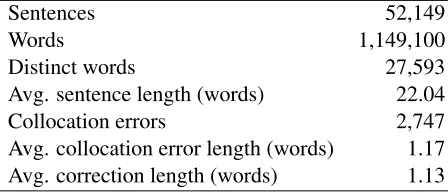
Sentences 52,149
Words 1,149,100
Distinct words 27,593
Avg. sentence length (words) 22.04
Collocation errors 2,747
Avg. collocation error length (words) 1.17
[image:3.612.74.298.55.152.2]Avg. correction length (words) 1.13
Table 1: Statistics of the NUS Corpus of Learner En-glish (NUCLE)
3 Analysis of EFL collocation errors
While the fact that collocation errors can be caused by L1-transfer has been ascertained by EFL re-searchers (Meng, 2008), we need to quantify how frequent collocation errors can be traced to these types of transfer errors in order to estimate how many errors in EFL writing we can potentially hope to correct with information about the writer’s L1-language.
We base our analysis on the NUS Corpus of Learner English (NUCLE). The corpus consists of about 1,400 essays written by EFL university stu-dents on a wide range of topics, like environmen-tal pollution or healthcare. Most of the students are native Chinese speakers. The corpus contains over one million words which are completely annotated with error tags and corrections. All annotations have been performed by professional English instructors. The statistics of the corpus are summarized in Ta-ble 1. The annotation is stored in a stand-off fashion. Each error tag consists of the start and end offset of the annotation, the type of the error, and the appro-priate gold correction as deemed by the annotator. The annotators were asked to provide a correction that would result in a grammatical sentence if the selected word or phrase would be replaced by the correction.
In this work, we focus on errors which have been marked with the error tag wrong colloca-tion/idiom/preposition. As preposition errors are not the focus of this work, we automatically filter out all instances which represent simple substitutions of prepositions, using a fixed list of frequent English prepositions. In a similar way, we filter out a small number of article errors which were marked as collo-cation errors. Finally, we filter out instances where
the annotated phrase or the suggested correction is longer than 3 words, as we observe that they contain highly context-specific corrections and are unlikely to generalize well (e.g.,“for the simple reasons that these can help them”→“simply to”).
After filtering, we end up with 2,747 collocation errors and their respective corrections, which ac-count for about 6% of all errors in NUCLE. This makes collocation errors the 7th largest class of er-rors in the corpus after article erer-rors, redundancies, prepositions, noun number, verb tense, and mechan-ics. Not counting duplicates, there are 2,412 distinct collocation errors and corrections. Although there are other error types which are more frequent, collo-cation errors represent a particular challenge as the possible corrections are not restricted to a closed set of choices and they are directly related to seman-ticsrather than syntax. We analyzed the collocation errors and found that they can be attributed to the following sources of confusion:
Spelling:We suspect that an error is caused by simi-lar orthography if the edit distance between the erro-neous phrase and its correction is less than a certain threshold.
Homophones:We suspect that an error is caused by similar pronunciation if the erroneous word and its correction have the same pronunciation. We use the CuVPlus English dictionary (Mitton, 1992) to map words to their phonetic representations.
Synonyms: We suspect that an error is caused by synonymy if the erroneous word and its correction are synonyms in WordNet (Fellbaum, 1998). We use WordNet 3.0.
L1-transfer: We suspect that an error is caused by L1-transfer if the erroneous phrase and its correction share a common translation in a Chinese-English phrase table. The details of the phrase table con-struction are described in Section 4. We note that although we focus on Chinese-English translation, our method is applicable to any language pair where parallel corpora are available.
Spelling . . . it receivedcritics (criticism)as much as complaints. . . . . . budget for the aged toimprovise (improve)other areas. Homophones . . . diverse spending canaide (aid)our country.
. . . insure (ensure)the safety of civilians. . . Synonyms . . . rapidincrement (increase)of the seniors. . .
. . . energy that we canapply (use)in the future. . .
L1-transfer . . . andgive (provide, 给予 )reasonable fares to the public. . .
[image:4.612.73.298.228.383.2]. . . andconcerns (attention, 关注 )that the nation put on technology and engineering. . .
Table 3: Examples of collocation errors with different sources of confusion. The correction is shown in parenthesis. For L1-transfer, we also show the shared Chinese translation. The L1-transfer examples shown here do not belong to any of the other categories.
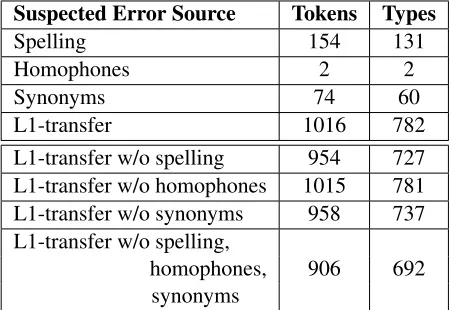
Suspected Error Source Tokens Types
Spelling 154 131
Homophones 2 2
Synonyms 74 60
L1-transfer 1016 782
L1-transfer w/o spelling 954 727
L1-transfer w/o homophones 1015 781
L1-transfer w/o synonyms 958 737
L1-transfer w/o spelling,
homophones, 906 692
synonyms
Table 2: Analysis of collocation errors. The threshold for spelling errors is one for phrases of up to six characters and two for the remaining phrases.
The results of the analysis are shown in Table 2. Tokens refer to running erroneous phrase-correction pairs including duplicates, and types refer to distinct erroneous phrase-correction pairs. As a collocation error can be part of more than one category, the rows in the table do not sum up to the total number of errors. The number of errors that can be traced to L1-transfer greatly outnumbers all other categories. The table also shows the number of collocation er-rors that can be traced to L1-transfer but not the other sources. 906 collocation errors with 692 dis-tinct collocation error types can be attributed only to L1-transfer but not to spelling, homophones, or syn-onyms. Table 3 shows some examples of collocation errors for each category from our corpus. We note that there are also collocation error types that cannot be traced to any of the above sources. We will return to these errors in Section 7.
4 Correcting Collocation Errors
In this section, we propose a novel approach for cor-recting collocation errors in EFL writing.
4.1 L1-induced Paraphrases
We use the popular technique of paraphrasing with parallel corpora (Bannard and Callison-Burch, 2005) to automatically find collocation candidates from a sentence-aligned L1-English parallel corpus. As most of the essays in our corpus are written by native Chinese speakers, we use the FBIS Chinese-English corpus, which consists of about 230,000 Chinese sentences (8.5 million words) from news articles, each with a single English translation. We tokenize and lowercase the English half of the cor-pus in the standard way. We segment the Chinese half of the corpus using the maximum entropy seg-menter from (Ng and Low, 2004; Low et al., 2005). Subsequently, we automatically align the texts at the word level using the Berkeley aligner (Liang et al., 2006; Haghighi et al., 2009). We extract English-L1 and L1-English phrases of up to three words from the aligned texts using the widely used phrase ex-traction heuristic in (Koehn et al., 2003). The para-phrase probability of an English para-phrasee1 given an
English phrasee2 is defined as
p(e1|e2) = X
f
p(e1|f)p(f|e2) (1)
wherefdenotes a foreign phrase in the L1 language. The phrase translation probabilities p(e1|f) and
p(f|e2) are estimated by maximum likelihood
para-phrases with a probability above a certain threshold (set to 0.001 in our work).
4.2 Collocation Correction with Phrase-based SMT
We implement our approach in the framework of phrase-based statistical machine transla-tion (SMT) (Koehn et al., 2003). Phrase-based SMT tries to find the highest scoring translation e
given an input sentencef. Thedecodingprocess of
finding the highest scoring translation is guided by a log-linear model which scores translation candidates using a set of feature functionshi, i= 1, . . . , n
score(e|f) = exp n
X
i=1
λihi(e,f)
!
. (2)
Typical features include a phrase translation proba-bilityp(e|f), an inverse phrase translation probabil-ityp(f|e), a language model scorep(e), and a con-stant phrase penalty. The optimization of the feature weightsλi, i = 1, . . . , n can be done using mini-mum error rate training (MERT) (Och, 2003) on a development set of input sentences and their refer-ence translations.
Because of the great flexibility of the log-linear model, researchers have used the framework for other tasks outside SMT, including grammatical er-ror correction (Brockett et al., 2006). We adopt a similar approach in this work. We modify the phrase table of the popular phrase-based SMT decoder MOSES (Koehn et al., 2007) to include collocation corrections with features derived from spelling, ho-mophones, synonyms, and L1-induced paraphrases.
• Spelling:For each English word, the phrase ta-ble contains entries consisting of the word itself and each word that is within a certain edit dis-tance from the original word. Each entry has a constant feature of 1.0.
• Homophones: For each English word, the phrase table contains entries consisting of the word itself and each of the word’s homophones. We determine homophones using the CuVPlus dictionary. Each entry has a constant feature of 1.0.
• Synonyms:For each English word, the phrase table contains entries consisting of the word it-self and each of its synonyms in WordNet. If a word has more than one sense, we consider all its senses. Each entry has a constant feature of 1.0.
• L1-paraphrases:For each English phrase, the phrase table contains entries consisting of the phrase and each of its L1-derived paraphrases as described in Section 4.1. Each entry has two real-valued features: a paraphrase probability according to Equation 1 and an inverse para-phrase probability.
• Baseline We combine the phrase tables built for spelling, homophones, and synonyms. The combined phrase table contains three binary features for spelling, homophones, and syn-onyms, respectively.
• All We combine the phrase tables from spelling, homophones, synonyms, and L1-paraphrases. The combined phrase table con-tains five features: three binary features for spelling, homophones, and synonyms, and two real-valued features for the L1-paraphrase probability and inverse L1-paraphrase proba-bility.
Additionally, each phrase table contains the standard constant phrase penalty feature. The first four ta-bles only contain collocation candidates for individ-ual words. We leave it to the decoder to construct corrections for longer phrases during the decoding process if necessary.
5 Experiments
In this section, we empirically evaluate our approach on real collocation errors in learner English.
5.1 Data Set
keep conditions as realistic as possible, we make no attempt to filter the test set in any way.
We build phrase tables as described in Section 4.2. For the purpose of the experiments reported in this paper, we only need to generate phrase table entries for words and phrases which actually appear in the development or test set.
5.2 Evaluation Metrics
We conduct an automatic and a human evalua-tion. Our main evaluation metric is mean recipro-cal rank (MRR)which is the arithmetic mean of the inverse ranks of the first correct answer returned by the system
MRR= 1
N N
X
i=1 1
rank(i) (3)
whereN is the size of the test set. If the system did not return a correct answer for a test instance, we set
1
rank(i)to zero.
In the human evaluation, we additionally report precision at rankk, k = 1,2,3, which we calculate as follows:
P@k=
P
a∈Ascore(a)
|A| (4)
whereAis the set of returned answers of rankkor less and score(·) is a real-valued scoring function between zero and one.
5.3 Collocation Error Experiments
Automatic correction of collocation errors can con-ceptually be divided into two steps:i) identification of wrong collocations in the input, and ii) correc-tionof the identified collocations. In this work, we focus on the second step and assume that the erro-neous collocation has already been identified. While this might seem like a simplification, it has been the common evaluation setup in collocation error cor-rection (see for example (Wu et al., 2010)). It also has a practical application where the user first selects a word or phrase and the system displays possible corrections.
In our experiments, we use the start and end offset of the collocation error provided by the human anno-tator to identify the location of the collocation error. We fix the translation of the rest of the sentence to
its identity. We remove phrase table entries where the phrase and the candidate correction are identi-cal, thus practically forcing the system to change the identified phrase. We set the distortion limit of the decoder to zero to achieve monotone decoding. We previously observed that word order errors are virtually absent in our collocation errors. For the language model, we use a 5-gram language model trained on the English Gigaword corpus with modi-fied Kneser-Ney smoothing. All experiments use the same language model to allow a fair comparison.
We perform MERT training with the popular BLEU metric (Papineni et al., 2002) on the devel-opment set of erroneous sentences and their correc-tions. As the search space is restricted to changing a single phrase per sentence, training converges rel-atively quickly after two or three iterations. After convergence, the model can be used to automatically correct new collocation errors.
6 Results
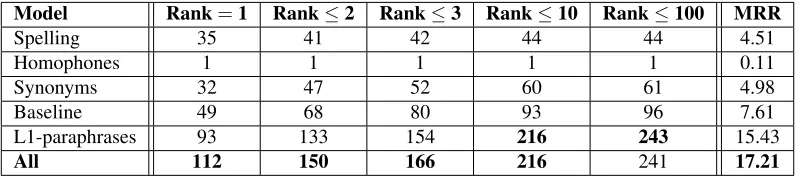
We evaluate the performance of the proposed method on our test set of 856 sentences, each with one collocation error. We conduct both an automatic and a human evaluation. In the automatic evalua-tion, the system’s performance is measured by com-puting the rank of the gold answer provided by the human annotator in the n-best list of the system. We limit the size of the n-best list to the top 100 out-puts. If the gold answer is not found in the top 100 outputs, the rank is considered to be infinity, or in other words, the inverse of the rank is zero. We also report the number of test instances for which the gold answer was ranked among the top kanswers, k = 1,2,3,10,100. The results of the automatic evaluation are shown in Table 4
Model Rank=1 Rank≤2 Rank≤3 Rank≤10 Rank≤100 MRR
Spelling 35 41 42 44 44 4.51
Homophones 1 1 1 1 1 0.11
Synonyms 32 47 52 60 61 4.98
Baseline 49 68 80 93 96 7.61
L1-paraphrases 93 133 154 216 243 15.43
[image:7.612.106.506.54.142.2]All 112 150 166 216 241 17.21
Table 4: Results of automatic evaluation. Columns two to six show the number of gold answers that are ranked within the topkanswers. The last column shows the mean reciprocal rank in percentage. Bigger values are better.
P(A) 0.8076 Kappa 0.6152
Table 5: Inter-annotator agreement.P(E) = 0.5.
larger than three will not be very useful in a prac-tical application. The candidates are displayed to-gether in alphabetical order without any information about their rank or which system produced them or the gold answer by the annotator. The difference between the candidates and the original sentence is highlighted. The judges were asked to make a bi-nary judgment for each of the candidates on whether the proposed candidate is a valid correction of the original or not. We represent valid corrections with a score of 1.0 and invalid corrections with a score of 0.0. Inter-annotator agreement is reported in Ta-ble 5. The chance of agreementP(A)is the percent-age of times that the annotators agree, andP(E)is the expected agreement by chance, which is 0.5 in our case. The Kappa coefficient is defined as
Kappa = P(A)−P(E) 1−P(E)
We obtain a Kappa coefficient of 0.6152. A Kappa coefficient between 0.6 and 0.8 is considered as showingsubstantialagreement according to Landis and Koch (1977). To compute precision at rankk, we average the judgments. Thus, a system can re-ceive a score of 0.0 (both judgments negative), 0.5 (judges disagree), or 1.0 (both judgments positive) for each returned answer. To compute MRR, we cannot simply average the judgments as MRR re-quires binary judgments on whether an item is cor-rect or not. Instead, we report MRR on the union and the intersection of the judgments. In the first case, the rank of the first correct item is the minimum
rank of any item judged correct byeither judge. In the second case, the rank of the first correct item is the minimum rank of any item judged correct by both judges. The results for the human evaluation are shown in Table 6. Our best system ALL outper-forms the BASELINE approach on all measures. It receives a precision at rank1of 38.20% and a MRR of 33.16% (intersection) and 57.26% (union). Ta-ble 7 shows some examples from our test set.
Unfortunately, comparison of our results with pre-vious work is complicated by the fact that there cur-rently exists no standard data set for collocation er-ror correction. We will make our corpus available for research purposes in the hope that it will allow researchers to more directly compare their results in future.
7 Analysis
In this section, we analyze and categorize those test instances for which the ALL system could not pro-duce an acceptable correction in the top 3 candi-dates. We manually analyze 100 test sentences for which neither judge had deemed any candidate an-swer to be a valid correction. Based on our findings, we categorize the 100 sentences into eight categories which are shown below. Table 8 shows examples from each category.
Out-of-vocabulary (21/100)The most frequent rea-son why the system does not produce a good correc-tion is that the erroneous collocacorrec-tion is out of vocab-ulary. These collocations often involve compound words, likeman-hoursorcarefully-nurturing, or in-frequent expressions, like copy phenomena, which do not appear in the FBIS parallel corpus. We ex-pect that this problem can be reduced by using larger parallel corpora for paraphrase extraction.
Model Rank = 1 Rank≤2 Rank≤3 P@1 P@2 P@3 MRR Baseline 43 | 141 69 | 201 83 | 237 18.40 16.68 15.36 12.13 | 36.60 All 137 | 245 176 | 303 204 | 340 38.20 32.87 29.30 33.16 | 57.26
Table 6: Results of human evaluation. Rank and MRR results are shown for the intersection (first value) and union (second value) of human judgments.
Original it must be clear, concise and unambiguous topreventany off-track Gold it must be clear, concise and unambiguous toavoidany off-track
All it must be clear, concise and unambiguous toavoidany off-track it must be clear, concise and unambiguous tostopany off-track it must be clear, concise and unambiguous toblockany off-track Baseline *it must be clear, concise and unambiguous topresentany off-track
it must be clear, concise and unambiguous toforestallany off-track *it must be clear, concise and unambiguous tolockany off-track
Original although many mayagreethat public spending on the elderly should be limited. . . Gold although many mayarguethat public spending on the elderly should be limited. . . All although many maybelievethat public spending on the elderly should be limited. . .
although many maythinkthat public spending on the elderly should be limited. . . although many mayacceptthat public spending on the elderly should be limited. . . Baseline *although many mayagreedthat public spending on the elderly should be limited. . .
[image:8.612.73.562.443.664.2]*although many mayholdthat public spending on the elderly should be limited. . . *although many mayagreesthat public spending on the elderly should be limited. . .
Table 7: Examples of test sentences with the top 3 answers of the ALLand BASELINE system. An answer judged incorrect by at least one judge is marked with an asterisk (*).
Out of vocabulary . . . many illegalcopy phenomena (copy phenomena,copies)in china.
. . . lead to reducedman-hours (man-hours,productivity)as people fall sick. . . Near miss . . . smaller groups of people, sometimeseven (more,only)individual .
. . . take pre-emptiveactions (activities,measures). . . Function/auxiliary words . . . entertainment an elderly person canhave (be,enjoy).
. . . and the security issue is solvedalso (and,too)
Discourse specific . . . make other countries respect and fearyou (<question mark>,a country) . . . will contribute nothing to theaccident (explosion,problem).
Spelling errors thisincidence (rate,incident)had also resulted in 4 fatalities. . .
refrigerator did notcompromise (yield,comprise)of any moving parts. . . Word sense . . . refers to the desire or shortage of agood (better,commodity)and. . .
. . . members are always from differentmajors (major league,specialties) Preposition constructions . . . can be an area worthinvesting (investing,investing in)
. . . in spending theirresources (resources,resources on) Others this mightredirect (make sound,reduce)foreign investments. . .
. . . a trading hub sincebritish ’s (british ’s,british)rule.
consists of instances where the system barely misses the gold standard answer. This includes cases where the extracted L1-paraphrases do not contain the ex-act phrase required, e.g., the paraphrase table con-tains even|||only get when the gold correction was even → only, or the phrase table actually contains the gold answer but fails to rank it among the top 3 answers. The first problem could be addressed by modifying the phrase extraction heuristic to produce more fine-grained phrase pairs. The second prob-lem requires a better language model. Although our language model is trained on the large English Giga-word corpus, it is not always successful in promot-ing the correct candidate to the top. The domain mis-match between the newswire domain of Gigaword and student essays could be one reason for this. Function/auxiliary words (14/100) We observe that collocation errors that involve function words or auxiliary words are not handled very well by our model. Function words and auxiliary words in En-glish lack direct counterparts in Chinese, which is why the word alignments and therefore the extracted phrases for these words contain a high amount of noise. As function words and auxiliaries are essen-tially a closed set, it might be more promising to build separate models with fixed confusion sets for them.
Discourse specific (14/100) Some of the gold an-swers are highly specific to the particular discourse that they appear in. As our model corrects colloca-tion errors at the sentence level, such gold answers will be very difficult or impossible to determine cor-rectly. Including more context beyond the sentence level might help to overcome this problem, although it is not easy to integrate this larger context informa-tion.
Spelling errors (9/100)Some of the collocation er-rors are caused by spelling mistakes, e.g.,incidence instead of incident. Although the ALL model in-cludes candidates which are created through edit dis-tance, paraphrase candidates created from the mis-spelled word can dominate the top 3 ranks, e.g.,rate andfrequentlyare paraphrases ofincidence. A pos-sible solution would be to perform spell-checking as a separate pre-processing step prior to collocation correction.
Word sense (7/100) Some of the failures of the model can be attributed to ambiguous senses of the
collocation phrase. As we do not perform word sense disambiguation in our current work, candi-dates from other word senses can end up as the top candidates. Including word sense disambiguation into the model might help, although accurate word sense disambiguation on noisy learner text may not be easy.
Preposition constructions (6/100)Some of the col-location errors involve preposition constructions, e.g., the student wrote attend instead of attend to. Because prepositions do not have a direct counterpart in Chinese, the L1-paraphrases do not model their semantics very well. This category is closely related to the function/auxiliary word cate-gory. Again, since prepositions are a closed set, it might be more promising to build a separate model for them.
Others (11/100)Other mistakes include collocation errors where the gold answer slightly changed the semantics of the target word, e.g.,redirect potential foreign investments → reduce potential foreign
in-vestments, active-passive alternation (enhanced eco-nomics→was economical), and noun possessive er-rors (british ’s rule→british rule).
8 Conclusion and Future Work
We have presented a novel approach for correcting collocation errors in written learner text. Our ap-proach exploits the semantic similarity of words in the writer’s L1-language based on paraphrases tracted from an L1-English parallel corpus. Our ex-periments on real-world learner data show that our approach outperforms traditional approaches based on edit distance, homophones, and synonyms by a large margin.
In future work, we plan to extend our system to fully automatic collocation correction that involves both identification and correction of collocation er-rors.
Acknowledgments
References
C. Bannard and C. Callison-Burch. 2005. Paraphras-ing with bilParaphras-ingual parallel corpora. InProceedings of ACL.
C. Brockett, W. B. Dolan, and M. Gamon. 2006. Cor-recting ESL errors using phrasal SMT techniques. In
Proceedings of ACL.
A. J. Carlson, J. Rosen, and D. Roth. 2001. Scaling up context-sensitive text correction. InProceedings of IAAI.
Y. S. Chan and H. T. Ng. 2005. Scaling up word sense disambiguation via parallel texts. In Proceedings of AAAI.
Y. C. Chang, J. S. Chang, H. J. Chen, and H. C. Liou. 2008. An automatic collocation writing assistant for Taiwanese EFL learners: A case of corpus-based NLP technology. Computer Assisted Language Learning, 21(3):283–299.
D. Dahlmeier and H. T. Ng. 2011. Grammatical error correction with alternating structure optimization. In
Proceedings of ACL.
M. Farghal and H. Obiedat. 1995. Collocations: A ne-glected variable in EFL. International Review of App-plied Linguistics, 33.
C. Fellbaum, editor. 1998. WordNet: An electronic lexi-cal database. MIT Press, Cambridge,MA.
J. R. Firth. 1957. Papers in Linguistics 1934-1951. Ox-ford University Press, London.
G. Foster, R. Kuhn, and H. Johnson. 2006. Phrasetable smoothing for statistical machine translation. In Pro-ceedings of EMNLP.
Y. Futagi, P. Deane, M. Chodorow, and J. Tetreault. 2008. A computational approach to detecting collocation er-rors in the writing of non-native speakers of English.
Journal of Computer-Assisted Learning, 21.
M. Gamon. 2010. Using mostly native data to correct errors in learners’ writing: A meta-classifier approach. InProceedings of HLT-NAACL.
A. R. Golding and D. Roth. 1999. A winnow-based ap-proach to context-sensitive spelling correction. Ma-chine Learning, 34:107–130.
A. Haghighi, J. Blitzer, J. DeNero, and D. Klein. 2009. Better word alignments with supervised ITG models. InProceedings of ACL-IJCNLP.
P. Koehn, F. J. Och, and D. Marcu. 2003. Statisti-cal phrase-based translation. InProceedings of HLT-NAACL.
P. Koehn, H. Hoang, A. Birch, C. Callison-Burch, M. Federico, N. Bertoldi, B. Cowan, W. Shen, C. Moran, R. Zens, C. Dyer, O. Bojar, A. Constantin, and E. Herbst. 2007. Moses: Open source toolkit for statistical machine translation. InProceedings of ACL demonstration session.
J. R. Landis and G. G. Koch. 1977. The measurement of observer agreement for categorical data. Biometrics, 33(1).
P. Liang, B. Taskar, and D. Klein. 2006. Alignment by agreement. InProceedings of HLT-NAACL.
A. L. Liu, D. Wible, and N. L. Tsao. 2009. Automated suggestions for miscollocations. InProceedings of the NAACL HLT Workshop on Innovative Use of NLP for Building Educational Applications.
C. Liu, D. Dahlmeier, and H. T. Ng. 2010a. PEM: a paraphrase evaluation metric exploiting parallel texts. InProceedings of EMNLP.
C. Liu, D. Dahlmeier, and H. T. Ng. 2010b. TESLA: Translation evaluation of sentences with linear-programming-based analysis. InProceedings of WMT and MetricsMATR.
J. K. Low, H. T. Ng, and W. Guo. 2005. A maximum entropy approach to Chinese word segmentation. In
Proceedings of the 4th SIGHAN Workshop on Chinese Language Processing.
N. Madnani and B. J. Dorr. 2010. Generating phrasal and sentential paraphrases: A survey of data-driven meth-ods. Computational Linguistics, 36(3):341–387. D. McCarthy and R. Navigli. 2007. Semeval-2007 task
10: English lexical substitution task. InProceedings of the 4th International Workshop on Semantic Evalu-ations (SemEval-2007).
J. Meng. 2008. Erroneous collocations caused by lan-guage transfer in Chinese EFL writing. US-China For-eign Language, 6:57–61.
R. Mitton. 1992. A description of a computer-usable dic-tionary file based on the Oxford Advanced Learner’s Dictionary of Current English.
H. T. Ng and Y. S. Chan. 2007. Semeval-2007 task 11: English lexical sample task via english-chinese paral-lel text. InProceedings of the 4th International Work-shop on Semantic Evaluations (SemEval 2007). H. T. Ng and J. K. Low. 2004. Chinese part-of-speech
tagging: One-at-a-time or all-at-once? word-based or character-based? InProceedings of EMNLP.
H. T. Ng, B. Wang, and Y. S. Chan. 2003. Exploiting parallel texts for word sense disambiguation: An em-pirical study. InProceedings of ACL.
F. Och. 2003. Minimum error rate training in statistical machine translation. InProceedings of ACL.
K. Papineni, S. Roukos, T. Ward, and W.-J. Zhu. 2002. BLEU: A method for automatic evaluation of machine translation. InProceedings of ACL.
A. Rozovskaya and D. Roth. 2010. Generating confu-sion sets for context-sensitive error correction. In Pro-ceedings of EMNLP.
M. Snover, N. Madnani, B. Dorr, and R. Schwartz. 2009. Fluency, adequacy, or HTER? Exploring different hu-man judgments with a tunable MT metric. In Proceed-ings of WMT.
M. Swan and B. Smith. 2001. Learner English: A Teacher’s Guide to Interference and Other Problems. Cambridge University Press, Cambridge, UK. J. Tetreault, J. Foster, and M. Chodorow. 2010. Using
parse features for preposition selection and error de-tection. InProceedings of ACL.
D. Wible, C. H. Kuo, N. L. Tsao, A. Liu, and H. L. Lin. 2003. Bootstrapping in a language learning environ-ment.Journal of Computer-Assisted Learning, 19. H. Wu and M. Zhou. 2003. Synonymous collocation
ex-traction using translation information. InProceedings of ACL.
J. C. Wu, Y. C. Chang, T. Mitamura, and J. S. Chang. 2010. Automatic collocation suggestion in academic writing. InProceedings of the ACL 2010 Conference Short Papers.