Document Summarization via Guided Sentence Compression
Chen Li1, Fei Liu2, Fuliang Weng2, Yang Liu1
1 Computer Science Department, The University of Texas at Dallas
Richardson, Texas 75080, USA
2 Research and Technology Center, Robert Bosch LLC
Palo Alto, California 94304, USA
{chenli,[email protected]}
{fei.liu, [email protected]}
Abstract
Joint compression and summarization has been used recently to generate high quality summaries. However, such word-based joint optimization is computationally expensive. In this paper we adopt the ‘sentence compression + sentence selection’ pipeline approach for compressive summarization, but propose to performsummary guided compression, rather than generic sentence-based compression. To create an annotated corpus, the human anno-tators were asked to compress sentences while explicitly given the important summary words in the sentences. Using this corpus, we train a supervised sentence compression model us-ing a set of word-, syntax-, and document-level features. During summarization, we use multiple compressed sentences in the inte-ger linear programming framework to select salient summary sentences. Our results on the TAC 2008 and 2011 summarization data sets show that by incorporating the guided sen-tence compression model, our summarization system can yield significant performance gain as compared to the state-of-the-art.
1 Introduction
Automatic summarization can be broadly divided into two categories: extractive and abstractive sum-marization. Extractive summarization focuses on selecting the salient sentences from the document collection and concatenating them to form a sum-mary; while abstractive summarization is generally considered more difficult, involving sophisticated techniques for meaning representation, content
plan-ning, surface realization, etc., and the “true abstrac-tive summarization remains a researcher’s dream” (Radev et al., 2002).
There has been a surge of interest in recent years on generating compressed document maries as a viable step towards abstractive sum-marization. These compressive summaries often contain more information than sentence-based ex-tractive summaries since they can remove insignif-icant sentence constituents and make space for more salient information that is otherwise dropped due to the summary length constraint. Two general strate-gies have been used for compressive summarization. One is a pipeline approach, where sentence-based extractive summarization is followed or proceeded by sentence compression (Knight and Marcu, 2000; Lin, 2003; Zajic et al., 2007; Wang et al., 2013). Another line of work uses joint compression and summarization. They have been shown to achieve promising performance (Daum´e, 2006; Martins and Smith, 2009; Berg-Kirkpatrick et al., 2011; Chali and Hasan, 2012; Almeida and Martins, 2013; Qian and Liu, 2013). One popular approach for such joint compression and summarization is via integer lin-ear programming (ILP). However, since words are the units in the optimization framework, solving this ILP problem can be expensive.
In this study, we use the pipeline compression and summarization method because of its compu-tational efficiency. Prior work using such pipeline methods simply uses generic sentence-based com-pression for each sentence in the documents, no mat-ter whether compression is done before or afmat-ter mary sentence extraction. We propose to use
mary guided compression combined with ILP-based sentence selection for summarization in this paper. We create a compression corpus for this purpose. Using human summaries for a set of documents, we identify salient words in the sentences. During anno-tation, the human annotators are given these salient words and asked to generate compressed sentences. We expect such “guided” sentence compression is beneficial for the pipeline compression and summa-rization task. In addition, previous research on joint modeling for compression and summarization sug-gested that the labeled extraction and compression data sets would be helpful for learning a better joint model (Daum´e, 2006; Martins and Smith, 2009). We hope that our work on this guided compression will also be of benefit to the future joint modeling studies.
Using our created compression data, we train a supervised compression model using a variety of word-, sentence-, and document-level features. During summarization, we generate multiple com-pression candidates for each sentence, and use the ILP framework to select compressed summary sen-tences. In addition, we also propose to apply a pre-selection step to select some important sentences, which can both speed up the summarization system and improve performance. We evaluate our pro-posed summarization approach on the TAC 2008 and 2011 data sets using the standard ROUGE met-ric (Lin, 2004). Our results show that by incorporat-ing a guided sentence compression model, our sum-marization system can yield significant performance gain as compared to the state-of-the-art reported re-sults.
2 Related Work
Summarization research has seen great development over the last fifty years (Nenkova and McKeown, 2011). Compared to the abstractive counterpart, ex-tractive summarization has received considerable at-tention due to its clear problem formulation – to ex-tract a set of salient and non-redundant sentences from the given document set. Both unsupervised and supervised approaches have been explored for sen-tence selection. The supervised approaches include the Bayesian classifier (Kupiec et al., 1995), max-imum entropy (Osborne, 2002), skip-chain
condi-tional random fields (CRF) (Galley, 2006), discrim-inative reranking (Aker et al., 2010), among others.
The extractive summary sentence selection prob-lem can also be formulated in an optimization framework. Previous approaches include the inte-ger linear programming (ILP) and submodular func-tions, which are used to solve the optimization prob-lem. In particular, Gillick et al. (2009) proposed a concept-based ILP approach for summarization. Li et al. (2013) improved it by using supervised stragety to estimate concept weight in ILP frame-work. In (Lin and Bilmes, 2010), the authors model the sentence selection problem as maximizing a sub-modular function under a budget constraint. A greedy algorithm is proposed to efficiently approxi-mate the solution to this NP-hard problem.
Compressive summarization receives increasing attention in recent years, since it offers a viable step towards abstractive summarization. The com-pressed summaries can be generated through a joint model of the sentence selection and compression processes, or through a pipeline approach that in-tegrates a generic sentence compression model with a summary sentence pre-selection or post-selection step.
The pipeline approach, where sentence-based ex-tractive summarization is followed or proceeded by sentence compression, is also popular. Knight and Marcu (2000) utilize the noisy channel and deci-sion tree method to perform sentence compresdeci-sion; Lin (2003) shows that pure syntactic-based com-pression may not improve the system performance; Zajic et al. (2007) compare two sentence compres-sion approaches for multi-document summarization, including a ‘parse-and-trim’ and a noisy-channel ap-proach; Galanis and Androutsopoulos (2010) use the maximum entropy model to generate the candi-date compressions by removing the branches from the source sentences; Liu and Liu (2013) couple the sentence compression and extraction approaches for summarizing the spoken documents; Wang et al. (2013) design a series of learning-based compres-sion models built on parse trees, and integrate them in query-focused multi-document summarization. Prior studies often rely heavily on the generic sen-tence compression approaches (McDonald, 2006; Nomoto, 2007; Clarke and Lapata, 2008; Thadani and McKeown, 2013) for compressing the sentences in the documents, yet a generic compression system may not be the best fit for the summarization pur-pose.
In this paper, we adopt the pipeline-based com-pressive summarization framework, but propose a novelguided compressionmethod that is catered to the summarization task. We expect this approach to take advantage of the efficient pipeline process-ing while producprocess-ing satisfyprocess-ing results as the joint models. We train a supervised guided compression model to produce n-best compressions for each sen-tence, and use an ILP formulation to select the best set of summary sentences. In addition, we pro-pose to apply a sentence pre-selection step to fur-ther accelerate the processing and enhance the per-formance.
3 Guided Compression Corpus
The goal of guided sentence compression is to create compressed sentences that are grammatically cor-rect and contain the important information that we would like to preserve in the final summary. Fol-lowing the compression literature (Clarke and Lap-ata, 2008), the compression task is defined as a word
Original Sentence:
The gas leak was contained Monday afternoon , nearly 18 hours after it was reported , Statoil spokesman Oeivind Reinertsen said .
Compression A:
The gas leak was contained
Compression B:
The gas leak was containedMonday afternoon
Compression C:
The gas leak was containednearly 18 hours after it was reported
Table 1: Example sentence and three compressions.
deletion problem, that is, the human annotators (and also automatic compression systems) are allowed to only remove words from the original sentence to form a compression. The key difference between our proposed guided compression with generic sen-tence compression is that, we provide guidance to the human compression process by specifying a set of “important words” that we wish to keep for each sentence. We expect this kind of summary oriented compression would benefit the ultimate summariza-tion task. Take the sentence shown in Table 1 as an example. For generic sentence compression, there may be multiple ‘good’ human compressions for this sentence, such as those listed in the table. Without guidance, a human annotator (or automatic system) is likely to use option A or B; however, if “18 hours” appears in the summary, then we want to provide this guidance in the compression process, hence option C may be the best compression choice. This guided compression therefore avoids removing the salient words that are important to the final summary.
To generate the guided compression corpus, we use the TAC 2010 data set1 that was used for the multi-document summarization task. There are 46 topics. Each has 10 news documents, and also four human-created abstractive reference sum-maries. Since annotating all the sentences in this data set is time consuming and some sentences are not very important for the summarization task, we choose a set of sentences that are highly related to the human abstracts for annotation. We compare each sentence with the four human abstracts using the ROUGE-2 metric (Lin, 2004), and the sentences
1
Original Sentence:
He saidVietnam veteransarepresumed to have been ex-posed to Agent Orangeand veterans with any of the10 dis-easesis presumed to have contracted it from the exposure , without individual proof .
Guided Compression:
Vietnam veterans are presumed to have been exposed to Agent Orange.
Original Sentence:
Theprovince haslimited the number of trees to be chopped down in the forest area in northwest Yunnan and hasstopped building sugar factories in the Xishuangbanna region to preservethe onlytropical rain forestin the country located there .
Guided Compression:
province has stopped building sugar factories in the Xishuangbanna region to preserve tropical rain forest.
Table 2: Example original sentences and their guided compressions. The “guiding words” are italicized and marked in red.
with the highest scores are selected.
In annotation, human annotators are provided with important ‘guiding words’ (highlighted in the annotation interface) that we want to preserve in the sentences. We calculate the word overlap between a sentence and each of those sentences in the human abstracts, and use a set of heuristic rules to deter-mine the “guiding words” in a sentence: the longest consecutive word overlaps (greater than 2 words) in each sentence pair are first selected; the rest overlaps that contain 2 or more words (excluding the stop-words) are also selected. We suggest the human an-notators to use their best judgment to keep the guid-ing words as many as possible while compressguid-ing the sentence.
We use the Amazon Mechanical Turk (AMT) for data annotation2. In total, we select 1,150 sentences from the TAC news documents. They are grouped into about 230 human intelligence tasks (HITs) with 5 sentences in each HIT. A sentence was compressed by 3 human annotatorsand we select the shortest candidate as the goldstandard compression for each sentence. In Table 2, we show two example sen-tences, their guiding words (bold), and the human compressions. The first example shows that giving up some guiding words is acceptable, since more
2
http://www.mturk.com
unnecessary words will be included in order to ac-commodate all the guiding words; the second ex-ample shows that the guided compression can lead to more aggressive word deletions since the con-stituents that are not important to the summary will be deleted even though they contain salient informa-tion by themselves.
For our compression corpus, which contains 1,150 sentences and their guided compressions, the average compression rate, as measured by the per-centage of dropped words, is about 50%. This com-pression ratio is higher compared to other generic sentence compression corpora, in which the word deletion rate ranges from 24% to 34% depending on different text genres and annotation guidelines (Clarke and Lapata, 2008; Liu and Liu, 2009). This suggests that the annotators can remove words more aggressively when they are provided with a limited set of guiding words.
4 Summarization System
Our summarization system consists of three key components: we train a supervised guided compres-sion model using our created comprescompres-sion data, with a variety of features.then we use this model to gener-ate n-best compressions for each sentence; we feed the multiple compressed sentences to the ILP frame-work to select the best summary sentences. In ad-dition, we propose a sentence pre-selection step that can both speed up the summarization system and im-prove the performance.
4.1 Guided Sentence Compression
labeled as either “0” (retained) or “1” (removed). We develop different levels of features to capture word-specific characteristics, sentence related infor-mation, and document level importance. Most of the features are extracted based only on the sentence to be compressed. However, we introduce a few doc-ument level features. These are designed to cap-ture the word and sentence significance within the given document collection and are thus expected to be more summary related.
Word and sentence features:
• Word n-grams: identity of the current word and two words before and after, as well as all the bigrams and trigrams that can be formed by the adjacent words and the current word.
• POS n-grams: same as the word n-grams, but use the part-of-speech tags instead.
• Named entity tags: binary features represent-ing whether the current word is a person, loca-tion, or temporal expression. We use the Stan-ford CoreNLP tools3for named entity tagging.
• Stopwords: whether the current word is a stop-word or not.
• Conjunction features: (1) conjunction of the current word with its relative position in the sentence; (2) conjunction of the NER tag with its relative position.
• Syntactic features: We obtain the syntactic parsing tree using the Berkeley Parser (Petrov and Klein, 2007), then obtain the following fea-tures: (1) the last sentence constituent tag in the path from the root to the word; (2) depth: length of the path starting from the root node to the word; (3) normalized depth: depth di-vided by the longest path in the parsing tree; (4) whether the word is under an SBAR node; (5) depth and normalized depth of the SBAR node if the word is under an SBAR node;
• Dependency features: We employ the Penn2Malt toolkit 4 to convert the parse re-sult from the Berkeley parser to the depen-dency parsing tree, and use these dependepen-dency
3
http://nlp.stanford.edu/software/corenlp.shtml 4
http://stp.lingfil.uu.se/˜nivre/research/Penn2Malt.html
features: (1) dependency relations such as ‘AMOD’ (adjective modifier), ‘NMOD’ (noun modifier), etc. (2) whether the word has a child, left child, or right child in the dependency tree.
Document-level features:
• Sentence salience score: We use a simple re-gression model to estimate a salience score for each sentence (more details in Section 4.3), which represents the importance of the sen-tence in the document. This score is discretized into four binary features according to the aver-age sentence salience.
• Unigram document frequency: this is the current word’s document frequency based on the 10 documents associated with each topic.
• Bigram document frequency: document fre-quency for the two bigrams, the current word and its previous or next word.
Some of the above features were employed in re-lated sentence compression studies (Nomoto, 2007; Liu and Liu, 2013). In addition to these features, we explored other related features, including the abso-lute position of the current word, whether the word appears in the corresponding topic title and descrip-tions, conjunction of the syntactic tag with the tree depth, etc.; however, these features did not lead to improved performance. We train the CRF model with the Pocket CRF toolkit5using the guided
com-pression corpus collected in Section 3. During sum-marization, we apply the model to a given sentence to generate its n-best guided compressions and use them in the following summarization step.
4.2 Summary Sentence Selection
The sentence selection process is similar to the stan-dard sentence-based extractive summarization, ex-cept that the input to the selection module is a list of compressed sentences in our work. Many extrac-tive summarization approaches can be applied for this purpose. In this work, we choose the integer linear programming (ILP) method, specifically, the concept-based ILP framework introduced in (Gillick
5
et al., 2009), mainly because it yields best perfor-mance in the TAC evaluation tasks. This ILP ap-proach aims to extract sentences that can cover as many important concepts as possible, while ensuring the summary length is within a given constraint. We follow the study in (Gillick et al., 2009) to use word bi-grams as concepts, and assign a weight to each bi-gram using its document frequency in the given document collection for a test topic. Two differences are between our ILP setup and that in (Gillick et al., 2009). First, since we use multiple compressions for one sentence, we need to introduce an additional constraint: for each sentence, only one of the n-best compressions may be included in the summary. Sec-ond, we optimize a joint score of the concept cover-age and the sentence salience. The formal ILP for-mulation is shown below:
max X i
wici+ X
j
vj X
k
sjk (1)
s.t. X
k
sjk ≤1∀j (2)
sjkOcci jk ≤ci (3)
X
jk
sjkOcci jk≥ci (4)
X
jk
ljksjk ≤L (5)
ci ∈ {0,1} ∀i (6)
sjk ∈ {0,1} ∀j, k (7)
whereciandsjk are binary variables indicating the presence of a concept and a sentence respectively; sjk denotes the kth candidate compression of the
jth sentence; wi represents the weight of the con-cept; vj is the sentence salience score of the jth sentence, predicted using a regression model (Sec-tion 4.3), and all of its compressed candidates share this value. (1) is the new objective function we use that combines the coverage of the concepts and the sentence salience scores. (2) represents our addi-tional constraint, which requires that for each sen-tencej, only one candidate compression will be cho-sen. Occi jk represents the occurrence of concept i in the sentencesjk. Inequalities (3) and (4) associate the sentences and the concepts. Constraint (5) con-trols the summary length, as measured by the total number of words in the summary. We use an open
source ILP solver6.
4.3 Sentence Pre-selection
The above ILP method can offer an exact solution to the defined objective function. However, ILP is computationally expensive when the formulation in-volves large quantities of variables, i.e, when we have many sentences and a large number of candi-date compressions for each sentence. We therefore propose to apply a sentence pre-selection step be-fore the compression. This kind of selection step has been used in previous ILP-based summarization systems (Berg-Kirkpatrick et al., 2011; Gillick et al., 2009). In this work, we propose to use a simple su-pervised support vector regression (SVR) model (Ng et al., 2012) to predict a salience score for each sen-tence and select the top ranked sensen-tences for further processing (compression and summarization).
To train the SVR model, the target value for each sentence is the ROUGE-2 score between the sen-tence and the four human abstracts (this same value is used for sentence selection in corpus annotation (Section 3)). We employ three commonly used fea-tures: (1) sentence position in the document; (2) sen-tence length as indicated by a binary feature: it takes the value of 0 if the number of words in the sentence is greater than 50 or less than 10, otherwise the fea-ture value is 1; (3) interpolated n-gram document frequency as introduced in (Ng et al., 2012), which is a weighted linear combination of the document frequency of the unigrams and bigrams contained in the sentence:
f(s) =α
P
wu∈SDF(wu) + (1−α)
P
wb∈SDF(wb)
|S|
where wu and wb represent the unigrams and bi-grams contained in the sentenceS;αis a balancing factor;|S|denotes the number of words in the sen-tence.
The SVR model was trained using the SVMlight toolkit7. Using this model, we can predict a salience score (Vj in Eq 1) for each sentence and only select the topnsentences and supply them to the compres-sion and summarization steps. In practice, using a fixednmay not be a good choice since the number
6
http://www.gnu.org/software/glpk/ 7
of sentences varies greatly for different topics. We therefore setnheuristically based on the total num-ber of sentencesmfor each topic:n=15 ifm >150; n=10 ifm <100;n=0.1∗motherwise.
5 Experimental Results
5.1 Experimental Setup
For our experiments, we use the standard TAC data sets8, which have been used in the NIST competi-tions and in other summarization studies. In par-ticular, we used the TAC 2010 data set for creating the guided compression corpus and training the SVR pre-selection model, the TAC 2009 data set as devel-opment set for parameter tuning, and the TAC 2008 and 2011 data sets as the test set for reporting the final summarization results.
We compare our pipeline summarization sys-tem against three recent studies, which have re-ported some of the highest published results on this task. Berg-Kirkpatrick et al. (2011) introduce a joint model for sentence extraction and compres-sion. The model is trained using a margin-based ob-jective whose loss captures the end summary qual-ity; Woodsend and Lapata (2012) learn individ-ual summary aspects from data, e.g., informative-ness, succinctinformative-ness, grammaticality, stylistic writ-ing conventions, and jointly optimize the outcome in an integer linear programming framework. Ng et al. (2012) exploit category-specific information for multi-document summarization. In addition to the three previous studies, we also report the best achieved results in the TAC competitions.
5.2 Summarization Results
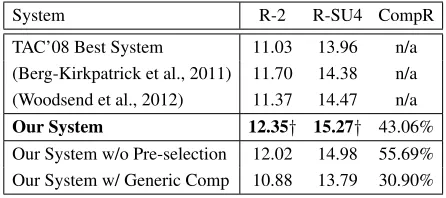
In Table 3 and Table 4, we present the results of our system and the aforementioned summarization stud-ies. We use the ROUGE evaluation metrics (Lin, 2004), with R-2 measuring the bigram overlap be-tween the system and reference summaries and R-SU4 measuring the skip-bigram with the maximum gap length of 4. “Our System” uses the pipeline setting including the three components described in Section 4. We use the SVR-based approach to pre-select a set of sentences from the document set; these sentences are further fed to the guided compression module that produces n-best compressions for each
8
http://www.nist.gov/tac/data/index.html
System R-2 R-SU4 CompR
TAC’08 Best System 11.03 13.96 n/a (Berg-Kirkpatrick et al., 2011) 11.70 14.38 n/a (Woodsend et al., 2012) 11.37 14.47 n/a
Our System 12.35† 15.27† 43.06% Our System w/o Pre-selection 12.02 14.98 55.69% Our System w/ Generic Comp 10.88 13.79 30.90%
Table 3: Results on the TAC 2008 data set. “Our Sys-tem” uses the SVR-based sentence pre-selection + guided compression + ILP-based summary sentence selection. “Our System w/ Generic Comp” uses the pre-selection + generic compression + ILP summary sentence selection setting. “CompR” represents the compression ratio, i.e., percentage of dropped words. †represents our system outperforms the best previous result at the 95% signifi-cance level.
System R-2 R-SU4 CompR
TAC’11 Best System 13.44 16.51 n/a (Ng et al., 2012) 13.93 16.83 n/a
[image:7.612.315.538.57.156.2]Our System 14.40 16.89 39.90% Our System w/o Pre-selection 13.74 16.5 53.81% Our System w/ Generic Comp 13.08 16.23 30.10%
Table 4: Results on the TAC 2011 data set. The systems use the same settings as for the TAC 2008 data set.
sentence; the ILP-based framework is then used to select the summary sentences from these compres-sions.
We can see from the table that in general, our sys-tem achieves considerably better results compared to the state-of-the-art on both the TAC 2008 and 2011 data sets. On the TAC 2008 data set, our system out-performs the best reported result at the 95% signifi-cance level; on the TAC 2011 data set, our system also yields considerable performance gain though not exceed the 95% significance level. In the fol-lowing, we show more detailed analysis to study the effect of different system parameters.
ILP-based summary sentence selection module. We can see that although sentence pre-selection removes some sentences from consideration in the later sum-marization step, it actually significantly improves system performance. In the TAC 2008 data set, each topic contains averagely 210 sentences; while the pre-selection step chooses 13 sentences among them. These numbers are 185 and 12 for the TAC 2011 data set. Table 5 shows the average running time of each topic in TAC 2011 data for the two sys-tems, with or without the pre-selection step. Here we fix the number of compressions to 100 in both cases for fair comparison. We can see the selec-tion step greatly accelerates the system processing. When applying the pre-selection step, fewer sen-tences are used in the compression and summariza-tion, this means we are able to use more compres-sion candidates for each sentence (considering the complexity of ILP module). Using the TAC 2009 as development set, we tuned the number of can-didate compressions generated for each sentence. Without pre-selection, we used the 100-best candi-dates generated from the compression model; with pre-selection, we are able to increase the number to 200-best candidate compressions and still main-tain reasonable computational cost. These are the numbers used in the results in Table 3 and 4. Us-ing more compressions helps improve summariza-tion performance. We also notice that the compres-sion ratios are quite different when using sentence pre-selection vs. not. This suggests that in the im-portant sentences (those are kept after pre-selection), there is more summary related information and thus the compression model keeps more words in them (lower compression ratio).
System Compressed Number of Running Sentences Compressions Time (sec)
w/o Pre-selection 185 100 3.9
w/ Pre-selection 12 100 0.85
Table 5: Average running time of our system, w/ or w/o the sentence pre-selection step. Experiments conducted on the TAC 2011 data set. Running time refers only to the execution time of the ILP module for each topic.
Number of compression candidates. This pa-rameter (denoted asn) also impacts system
perfor-mance. Figure 1 shows the R-2 scores of the two systems (with and without the sentence pre-selection step) when using different number of compressions for each sentence. In general, we find that the R-2 scores do not change much whennis large enough. For example, the ‘with pre-selection’ system can achieve relatively stable R-2 scores on the TAC 2008 data set (ranging from 12.2 to 12.4) when m is greater than 140; similarly, the R-2 scores on the TAC 2011 data is over 14.2 whenmis greater than 100. Without the pre-selection step, the scores are less stable in regard to the changing of themvalue, since the large amount of sentences plus a high vol-ume of the compression candidates may incur huge computational cost to the ILP solver. This is also the reason that in Figure 1, for the system without pre-selection, we only varynfrom 1 to 100. In general, we also notice that given more compression candi-dates, the R-2 score is still improving, as indicated by Figure 1. The improved performance of ‘with pre-selection’ over ‘without pre-selection’ is partly because fewer sentences are used and thus we are able to increase the number of compression candi-dates for these sentences in the ILP sentence extrac-tion module.
Quality of sentence compression training data.
11 11.5 12 12.5 13 13.5 14 14.5 15
0 20 40 60 80 100
ROUGE-2
# Compression Candidates TAC 2011
TAC 2008
11 11.5 12 12.5 13 13.5 14 14.5 15
0 50 100 150 200 250
ROUGE-2
# Compression Candidates TAC 2011 TAC 2008
11 11.5 12 12.5 13 13.5 14 14.5 15
0 20 40 60 80 100
ROUGE-2
# Compression Candidates TAC 2011 TAC 2008
11 11.5 12 12.5 13 13.5 14 14.5 15
0 50 100 150 200 250
ROUGE-2
[image:9.612.116.254.62.327.2]# Compression Candidates TAC 2011 TAC 2008
Figure 1: R-2 scores of the two systems (without and with the sentence pre-selection step) when using differ-ent number of compressions for each sdiffer-entence.
worse than ours, and is also inferior to the TAC best performing system on both data sets, which signi-fies the importance of our proposed summary guided sentence compression approach. We can also see there is a difference in the compression ratio in the system generated compressions when using differ-ent compression corpora to train the compression models. The resulting compression ratio patterns are consistent with those in the training data, that is, us-ing our guided compression corpus our system com-pressed sentences more aggressively.
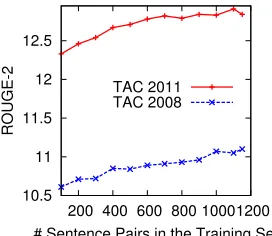
Learning curve of guided compression. Since we use a supervised compression model, we further consider the relationship between the summarization performance and the number of sentence pairs used for training the guided compression model. In to-tal, there are 1150 training sentence pairs in our cor-pus. We incrementally add 100 sentence pairs each time and plot the learning curve in Figure 2. In the compression step, we generate only the 1-best compression candidate in order to remove the
im-pact caused by the downstream summary sentence selection module. As seen from Figure 2, increasing the compression training data generally improves summarization performance, although there are also fluctuations. When adding more training sentence pairs, the system performance is likely to further in-crease.
10.5 11 11.5 12 12.5
200 400 600 800 1000 1200
ROUGE-2
# Sentence Pairs in the Training Set TAC 2011
TAC 2008
Figure 2: ROUGE-2 scores when using different number of sentences to train the guided compression model.
6 Conclusion and Future Work
[image:9.612.355.491.171.289.2]Acknowledgments
Part of this work was done during the first au-thor’s internship in Bosch Research and Technol-ogy Center. The work is also partially supported by NSF award IIS-0845484 and DARPA Contract No. FA8750-13-2-0041. Any opinions, findings, and conclusions or recommendations expressed are those of the author and do not necessarily reflect the views of the funding agencies.
References
Ahmet Aker, Trevor Cohn, and Robert Gaizauskas. 2010. Multi-document summarization using a* search and discriminative training. InProceedings of EMNLP. Miguel B. Almeida and Andre F. T. Martins. 2013. Fast
and robust compressive summarization with dual de-composition and multi-task learning. InProceedings of ACL.
Taylor Berg-Kirkpatrick, Dan Gillick, and Dan Klein. 2011. Jointly learning to extract and compress. In
Proceedings of ACL.
Yllias Chali and Sadid A. Hasan. 2012. On the effective-ness of using sentence compression models for query-focused multi-document summarization. In Proceed-ings of COLING.
James Clarke and Mirella Lapata. 2008. Global infer-ence for sentinfer-ence compression an integer linear pro-gramming approach. Journal of Artificial Intelligence Research.
Hal Daum´e. 2006. Practical structured learning tech-niques for natural language processing. Ph.D. thesis, University of Southern California.
Dimitrios Galanis and Ion Androutsopoulos. 2010. An extractive supervised two-stage method for sentence compression. InHuman Language Technologies: The 2010 Annual Conference of the North American Chap-ter of the Association for Computational Linguistics. Michel Galley. 2006. A skip-chain conditional random
field for ranking meeting utterances by importance. In
Proceedings of EMNLP.
Dan Gillick, Benoit Favre, Dilek Hakkani-Tur, Berndt Bohnet, Yang Liu, and Shasha Xie. 2009. The icsi/utd summarization system at tac 2009. InProceedings of TAC.
Kevin Knight and Daniel Marcu. 2000. Statistics-based summarization - step one: Sentence compression. Julian Kupiec, Jan Pedersen, and Francine Chen. 1995.
A trainable document summarizer. InProceedings of SIGIR.
Chen Li, Xian Qian, and Yang Liu. 2013. Using super-vised bigram-based ilp for extractive summarization. InProceedings of ACL.
Hui Lin and Jeff Bilmes. 2010. Multi-document sum-marization via budgeted maximization of submodular functions. InProceedings of NAACL.
Chin-Yew Lin. 2003. Improving summarization perfor-mance by sentence compression - A pilot study. In
Proceeding of the Sixth International Workshop on In-formation Retrieval with Asian Language.
Chin-Yew Lin. 2004. Rouge: a package for automatic evaluation of summaries. InProceedings of ACL. Fei Liu and Yang Liu. 2009. From extractive to
abstrac-tive meeting summaries: Can it be done by sentence compression? InProceedings of ACL-IJCNLP. Fei Liu and Yang Liu. 2013. Towards abstractive speech
summarization: Exploring unsupervised and super-vised approaches for spoken utterance compression.
IEEE Transactions on Audio, Speech, and Language Processing.
Annie Louis and Ani Nenkova. 2012. Automati-cally assessing machine summary content with a gold-standard. Computational Linguistics.
Andre F. T. Martins and Noah A. Smith. 2009. Summa-rization with a joint model for sentence extraction and compression. In Proceedings of the ACL Workshop on Integer Linear Programming for Natural Language Processing.
Ryan McDonald. 2006. Discriminative sentence com-pression with soft syntactic evidence. InProceedings of EACL.
Ani Nenkova and Kathleen McKeown. 2011. Automatic summarization. Foundations and Trends in Informa-tion Retrieval.
Ani Nenkova, Rebecca Passonneau, and Kathleen McK-eown. 2007. The pyramid method: Incorporating hu-man content selection variation in summarization eval-uation. ACM Transactions on Speech and Language Processing.
Jun-Ping Ng, Praveen Bysani, Ziheng Lin, Min-Yen Kan, and Chew-Lim Tan. 2012. Exploiting category-specific information for multi-document summariza-tion. InProceedings of COLING.
Tadashi Nomoto. 2007. Discriminative sentence com-pression with conditional random fields. Information Processing and Management.
Miles Osborne. 2002. Using maximum entropy for sen-tence extraction. InProceedings of the ACL-02 Work-shop on Automatic Summarization.
Xian Qian and Yang Liu. 2013. Fast joint compression and summarization via graph cuts. InProceedings of EMNLP.
Dragomir R. Radev, Eduard Hovy, and Kathleen McKe-own. 2002. Introduction to the special issue on sum-marization. InComputational Linguistics.
Kapil Thadani and Kathleen McKeown. 2013. Sentence compression with joint structural inference. In Pro-ceedings of CoNLL.
Jenine Turner and Eugene Charniak. 2005. Supervised and unsupervised learning for sentence compression. InProceedings of ACL.
Xiaojun Wan, Jianwu Yang, and Jianguo Xiao. 2007. To-wards an iterative reinforcement approach for simulta-neous document summarization and keyword extrac-tion. InProceedings of ACL.
Lu Wang, Hema Raghavan, Vittorio Castelli, Radu Flo-rian, and Claire Cardie. 2013. A sentence com-pression based framework to query-focused multi-document summarization. InProceedings of ACL. Kristian Woodsend and Mirella Lapata. 2012. Multiple
aspect summarization using integer linear program-ming. InProceedings of EMNLP-CoNLL.
Katsumasa Yoshikawa, Tsutomu Hirao, Ryu Iida, and Manabu Okumura. 2012. Sentence compression with semantic role constraints. InProceedings of ACL. David Zajic, Bonnie J. Dorr, Jimmy Lin, and Richard