QuaSE: Sequence Editing under Quantifiable Guidance
∗Yi Liao13, Lidong Bing2, Piji Li12, Shuming Shi2, Wai Lam1, Tong Zhang2 1The Chinese University of Hong Kong
2Tencent AI Lab
3Noah’s Ark Lab, Huawei Technologies
{yliao, pjli, wlam}@se.cuhk.edu.hk
{lyndonbing, shumingshi, bradymzhang}@tencent.com
Abstract
We propose the task of Quantifiable Sequence Editing (QuaSE): editing an input sequence to generate an output sequence that satisfies a given numerical outcome value measuring a certain property of the sequence, with the requirement of keeping the main content of the input sequence. For example, an input se-quence could be a word sese-quence, such as re-view sentence and advertisement text. For a review sentence, the outcome could be the re-view rating; for an advertisement, the outcome could be the click-through rate. The major challenge in performing QuaSE is how to per-ceive the outcome-related wordings, and only edit them to change the outcome. In this pa-per, the proposed framework contains two la-tent factors, namely, outcome factor and con-tent factor, disentangled from the input sen-tence to allow convenient editing to change the outcome and keep the content. Our frame-work explores the pseudo-parallel sentences by modeling their content similarity and out-come differences to enable a better disentan-glement of the latent factors, which allows generating an output to better satisfy the de-sired outcome and keep the content. The dual reconstruction structure further enhances the capability of generating expected output by exploiting the couplings of latent factors of pseudo-parallel sentences. For evaluation, we prepared a dataset of Yelp review sentences with the ratings as outcome. Extensive exper-imental results are reported and discussed to elaborate the peculiarities of our framework.1
∗
The work described in this paper was done when Yi Liao was an intern at Tencent AI Lab. The work is partially supported by a grant from the Research Grant Council of the Hong Kong Special Administrative Region, China (Project Code: CUHK413510)
1Our code and data are available at https://
bitbucket.org/leoeaton/quase/src/master/
1 Introduction
Typical neural text generation is observed suffer-ing from the problems of repetitions in word n-grams, producing monotonous language, and gen-erating short common sentences (Li et al.,2017). To solve these problems, some researchers branch out into the way of post-editing (could be under some guidance, say sentiment polarity) a given message to generate text of better quality. For example, skeleton-based text generation first out-lines a skeleton in the form of phrases/words, and then starts from the skeleton to generate text (Wang et al., 2017;Xiao et al., 2016). Another line of works conduct editing on an existing sen-tence and expect that the output will serve particu-lar purposes better (Guu et al.,2018). Similarly in conversation, some systems post-edit the retrieval results to generate new sentences as the response (Song et al.,2016). The third type is to perform editing on the input under the guidance of specific style. For example,Shen et al.(2017) take a sen-tence with negative sentiment as input, and edit it to transfer its sentiment polarity into positive.
In this paper, we generalize the third type of post-editing into a more general scenario, named
“3.1” (a neutral sentiment), and “The food is de-licious” under the expected outcome “4.0”. If no outcome target is given, the model could generate “The food is extremely delicious”, by defaulting the best outcome, or “The food is extremely terri-ble”, by defaulting the worst outcome.
Our problem setting is more general than pre-vious works in two major aspects: (1) The out-come here is numerical, and it can be regarded as a generalization of the categorical outcome in (Shen et al., 2017; Hu et al., 2017; Gao et al., 2018). With such numerical outcome, it is impossible to construct two corpora as counterpart of each other as done in (Shen et al., 2017; Gao et al., 2018). (2) The editing operation is under a quantifiable guidance, i.e. the specified outcome or the de-faulted extrema. For example, we can specify a particular target rating, such as 3.1 or 4.0, as the expected outcome. AlthoughMueller et al.(2017) also take outcome-associated sentences for train-ing, their model does not perform such outcome-guided editing for sentence generation.
Considering that the goal of the task is to gen-erate an output that satisfies a specified outcome and keeps the content unchanged, QuaSE is chal-lenging in a few aspects. Firstly, a model should be able to perceive the association between an out-come and its relevant wordings. For the previous example “The food is terrible”, the model needs to figure out that the low rating is indicated by the word “terrible”, instead of “food”. Secondly, when performing editing, the model should keep the content, and only edits the outcome-related wordings. Moreover, the model needs to take a specified outcome into account and generate an output that satisfies the specified outcome value with high probability. Continuing the running ex-ample, given the expected outcome 3.1, “The food is OK” is an appropriate output, but “The food is extremely delicious” and “The service is OK” are not. Thirdly, we do not have readily available data, such as data points like [input sentence: “The food is terrible”, expected outcome: 4.0, output sen-tence: “The food is delicious”] to show the model what the revised output should look like, that meet our need to train models.
We propose a framework to address this task. The fundamental module of our framework is a Variational Autoencoder (VAE) (Kingma and Welling,2013) to encode each input sentence into a latent content factor and a latent outcome
fac-tor, capturing the content and the outcome related wordings respectively. We propose to leverage pseudo-parallel sentence pairs (i.e, the two sen-tences in a pair have the same or very similar con-tent, but different outcome values) to enhance our model’s capability of disentangling the two fac-tors, which allows attributing the wording differ-ence of the sentdiffer-ences in a pair to the outcome factor, and the wording similarity to the content factor. For sentence reconstruction, we employ a Recurrent Neural Network (RNN) based decoder (Sutskever et al.,2014) that takes as input the com-bination of a content factor and an outcome fac-tor. To further enhance the capability of generat-ing expected output, we introduce a dual recon-struction structure which exploits the couplings of latent factors of pseudo-parallel sentences. Specif-ically, it attempts to reconstruct one sentence in a pair from the combination of its outcome fac-tor and the other sentence’s content facfac-tor, based on the intuition that the wording difference in a pair is outcome-related. In the test stage, taking a sentence and a specified outcome target as in-put, our model generates a revised sentence which likely satisfies the specified target, and meanwhile the content is preserved as much as possible.
To evaluate the efficacy of our framework, we prepared a dataset of Yelp review sentences with the ratings as outcome. Compared with state-of-the-art methods handling similar tasks, exper-imental results show that our framework can gen-erate more accurate revisions to satisfy the target outcome and transfer the sentiment polarity, mean-while it keeps the original content better. Ablation studies illustrate the effectiveness of the designed components for enhancing the performance. We have released the prepared dataset and the code of our model to facilitate other researchers to do fur-ther research along this line, refer to Footnote1.
2 Model Description
2.1 Problem Setting and Model Overview
In the task of Quantifiable Sequence Editing (QuaSE), the aim is to edit an input sentenceX0
R
Y
X
Z
y
x
z
y0
x0
z0 f(x, x0)
h(y, y0)
E1 D
F
D E2
E1 E1
E2 E2
Ld−rec
Lsim
[image:3.595.76.292.63.196.2]Ldif f
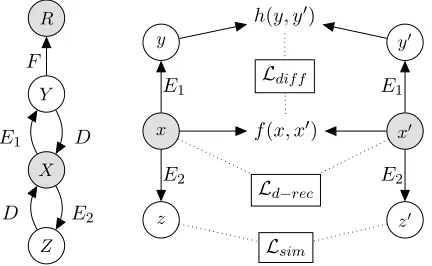
Figure 1: Model Overview.
i.e.E1andE2, to encode a single sentenceXinto
two latent factorsY andZ which capture the out-come and content properties respectively. In con-trast, Mueller et al. (2017) employ a single fac-tor for capturing these two properties, which lim-its the capability of distinguishing one property from the other. As a consequence, when editing a sentence towards a given outcome, the sentence content is likely to be changed, which should be suppressed as much as possible. An RNN-based decoderDtakes the concatenation ofY andZ to reconstruct the inputX. Moreover, a transforma-tion functransforma-tionF predictsRwithY.
The right hand side models pseudo-parallel sentence pairs (automatically generated from the above tuples), so we first introduce the concept of pseudo-parallel sentences as follows. Let (x, x0) denote a pair of pseudo-parallel sentences, x and x0 should describe the same or similar con-tent, but their outcomes are different. Note that we use lowercase letters to denote variables re-lated to sentence pairs for better clarity. For two sentences in a pair, the difference of their outcome factors h(y, y0) is attributed to their wording dif-ference f(x, x0), resulting in the loss Ldif f; the similar contents of two sentences should result in similar content factors, i.e. minimizing the loss
Lsim; moreover, a dual reconstruction lossLd−rec is minimized to enhance the capability of generat-ing expected output.
Overall, the model minimizes the losses from modeling single sentences and sentence pairs. Af-ter the model is trained, a separated component is applied for editing an input sentence to output a revision that satisfies a specified outcome target.
2.2 Modeling Single Sentences
In probabilistic theory, we need to maximize the log-likelihood of observing the training
sentence-outcome tuples (X,R), denoted as follows:
log Z
p(X, R) = log Z
p(X|Y, Z)p(Y, Z)dY dZ
+ log Z
p(R|Y)p(Y)dY
(1)
However, the integration in the first term on the right hand side is intractable. Inspired by the idea of VAE (Kingma and Welling,2013), we al-ternatively maximize the Evidence Lower Bound (ELBO) (Blei et al., 2016) incorporating varia-tional distributions, i.e. q(Y|X) and q(Z|X). Thus, this term is approximated as follows:
log Z
p(X|Y, Z)p(Y, Z)dY dZ ≥ −[Lrec+Lkl]
Lrec =−EY,Z∼q(Y|X),q(Z|X)[logp(X|Y, Z)]
Lkl=KL[q(Y|X)|p(Y)] +KL[q(Z|X)|p(Z)]
(2)
where, the term Lrec denotes the error of re-constructing X. As advocated by (Kingma and Welling, 2013) and (Bowman et al., 2016), the variational distributionsq(Y|X) andq(Z|X)
are modelled as Gaussian distributions, i.e. q(Y|X) = G(µY|X, σY|X), and q(Z|X) =
G(µZ|X, σZ|X). The expectationE(·)can be effi-ciently approximated using one Monte-Carlo sam-ple, for examsam-ple,Y ∼q(Y|X)andZ ∼q(Z|X). In practise, we can alternatively employ Y =
µY|X and Z = µZ|X instead of sampling since they are the means of the Gaussian distributions. We employ two encoder networksE1 and E2 to
generate µY|X and µZ|X respectively from the sentence X, i.e. µY|X = E1(X) and µZ|X = E2(X).p(X|Y, Z)is the probability of observing
the sentenceXgivenY andZ, which is modelled by a decoder networkD. Thus, the reconstruction loss can be rewritten as:
Lrec =H(X, D(E1(X), E2(X))) (3)
whereHis the cross entropy loss for the decoder. The term Lkl in Equation 2 denotes the KL-divergence between the variational posterior dis-tribution and the prior disdis-tribution. Following pre-vious works (Mueller et al.,2017), the priorsp(Y)
andp(Z)are defined as a zero-mean Gaussian dis-tribution, i.e. p(Y) = p(Z) = G(0,I). The loss
The second term in Equation1models the log-likelihood of the outcomes. We adopt the usu-ally used Taylor approximation for the calculation, where this term is approximated by an affine trans-formation from the outcome factorY to the out-come R, denoted as F(Y). Then, we define the loss as the square error betweenRandF(Y):
Lmse= (R−F(Y))2 (4)
Although Mueller et al. (2017) also model in-dividual sentences and their outcomes, in their model, each sentence is only encoded into one la-tent factor to capture both outcome and conla-tent properties. In contrast, we disentangle two la-tent factors from a single sentence to model the outcome and the content separately to provide more flexibility. Moreover, such design allows the incorporation of the pseudo-parallel sentences, which will be described in the next subsection.
2.3 Exploiting Pseudo-Parallel Sentences
As mentioned above, pseudo-parallel sentences are similar in terms of the content but different in terms of the outcome. E.g., Table1shows a pair of pseudo-parallel sentences, where both talk about “the restaurant”, but with different sentiments (i.e. ratings). For the pair (x, x0), let y andy0 denote their outcome factors,zandz0denote their content factors. We design three components to leverage pseudo-parallel sentences to enhance our model’s capabilities of disentangling the two types of fac-tors and generating the desired output sentences.
x I will never come back to the restaurant.
x0 I will definitely come back to the restaurant, recommend!
Table 1: A pair of pseudo-parallel sentences.
2.3.1 Modeling Outcome Difference
We exploit the wording difference f(x, x0) be-tween x and x0. Note that the preparation (dis-cussed in Section 4.1) determines that a pair of pseudo-parallel sentences are very likely to dif-fer in the outcome factors, denoted as h(y, y0). Thus, by aligning the surface wording difference of two sentences in a pair and the difference in their outcome factors, we intend to improve the performance of the encoderE1 for generating the
outcome factor. f(x, x0)andh(y, y0) are defined as follows:
f(x, x0) =inc(x, x0)⊕dec(x, x0)
h(y, y0) =y−y0 =E1(x)−E1(x0)
(5)
where inc(x, x0) and dec(x, x0) are embeddings capturing the wording difference between x and x0. inc(x, x0) denotes the “increment” from x to x0, i.e. the terms that appear in x0 but not in x. dec(x, x0) denotes the “decrement”. If there are multiple terms in the difference, we sample one term forincor dec. For the example in Ta-ble1,dec(x, x0)is the embedding of “never”, and inc(x, x0)could be the embedding of “definitely” or “recommend”. The effect of outliers during sampling anneals since the training data contain sufficient pairs of sentences. The symbol ⊕ de-notes concatenation.h(y, y0)is defined as the sub-traction between the outcome factors.
We employ a regression network U to align f(x, x0)andh(y, y0), and the lossLdif f is:
Ldif f =||h(y, y0)−U[f(x, x0)]||2 (6)
2.3.2 Modeling Content Similarity
Another property of two pseudo-parallel sentences is that they share similar content. To capture it, we design a loss function minimizing the square error between the content factors.
Lsim=||z−z0||2=||E2(x)−E2(x0)||2 (7)
Minimizing Lsim helps the encoder E2 generate
the content factor more accurately.
2.3.3 Dual Reconstruction
The decoderDis not only used in Section2.2 to reconstruct a single training sentence, but also em-ployed for generating output sentences in the test stage (Section 3). To improve the robustness of D, we propose a dual reconstruction component based on the pseudo-parallel sentences. Different from reconstructing an original sentence in Sec-tion 2.2, in the dual reconstruction, given a sen-tencex, we reconstruct its dual sentencex0.
Specifically, we first encodex andx0 into their outcome factors y/y0 and content factors z/z0. Sincexshares similar content withx0, its content factorz, when combined with the outcome factor y0 of x0, should nearly reconstruct x0. For such dual reconstruction, the loss is written as:
Ld−recx0;x =H(x0, D(E1(x0), E2(x)))
=H(x0, D(y0, z)) (8)
The same dual reconstruction process applies to the counterpart ofx0, i.e.x. Thus, the whole dual reconstruction loss is as follows:
Note that the encodersE1/E2 and the decoderD
here refer to exactly the same networks (i.e., the parameters are shared) as used in Section2.2.
The specific design of the networks are as fol-lows. E1/E2: RNNs of GRUs with a fully
con-nected neural network appended to the last state to add some noise, which is a reparameterization alternative for sampling. Their outputs are the out-come and content factors, respectively. D: An RNN of GRU cells. The RNN takes the concate-nation of an outcome factor and a content factor as the initial state for decoding. F: A fully con-nected network. It takes an outcome factor as in-put and outin-puts an outcome value.U: A fully con-nected network. It takes f(x, x0)as input to pre-dicth(y, y0).
2.4 Joint Training
Considering all the aforementioned components, we define a joint loss function as:
Ljoint=λrecLrec+λklLkl+λmseLmse+
λdif fLdif f +λsimLsim+λd−recLd−rec (10)
in which each component is associated with a weight. Following the sigmoid annealing schedule (Bowman et al., 2016), we design the following strategy to tune the weights: (1) Tune the weights λrec andλmseon the validation dataset under the metric MAE (refer to Section4.3), while fixing the other weights to zeros. We setλrec+λmse= 1; (2) Fixed the weights tuned in the first step. For each remaining loss, gradually increase the weight from 0 to 1 during the training, until the reconstruction lossLrec or the outcome prediction lossLmse be-comes worse. The strategy prioritizes Lrec and
Lmse, since they are the core components for gen-erating the revised sentences.
3 Editing under Quantifiable Guidance
In the test, the trained model edits an input sen-tenceX0and outputs a revisionX∗that is likely to
satisfy the specified outcome targetR∗, and mean-while preserves the content as much as possible.
We first encode X0 with E1 andE2 to get Y0
and Z0 respectively. The next step is to modify Y0 to get a new outcome factor Y∗ that is likely
to generate the target outcome R∗. The process to determine a suitableY∗ is as follows. We first assumeY follows the Gaussian distributionY ∼ G(Y0 = E1(X0), σ), the mean of which is Y0.
Then we chooseC ={Y :G(Y|E1(X0), σ)> τ}
as the feasible range forY∗, where τ is a thresh-old. C will expand ifτ is set smaller, and thus al-lowing more revisions. Finally,Y∗ is determined as follows:
Y∗ = arg min
Y∈C
(F(Y)−R∗)2 (11)
Note that in (Mueller et al., 2017), Y∗ is deter-mined asarg maxY∈CF(Y), which does not con-sider an outcome target. The revised sentenceX∗ is generated fromX0andY∗via the decoderD:
X∗ =D(Y∗, Z0) (12)
Thus, the content ofX0 is preserved withZ0, and
the expected outcome is achieved withY∗.
4 Experiments
4.1 Dataset Preparation
Our dataset contains sentences extracted from Yelp reviews 2, where each review is associated with a rating in {1, 2, 3, 4, 5}. Specifically, we employ the sentences with sentiment polarity (i.e. positive or negative) used in (Shen et al.,2017) as the primary portion of our data. After some clean-ing, we obtain about 520K sentences. To add neu-tral sentences, we randomly select 80K sentences from the original reviews with neutral sentiment (i.e. rating 3). To make sure that the neural sen-tences added by us are describing the same do-main, we only pick neural sentences whose tokens are all in the vocabulary of the primary data. The vocabulary size of the dataset is 9,625. In total, our dataset contains 599K sentences, and we ran-domly hold 50K for test, 10K for validation, and the remaining for training.
For training, we need each input sentence be-ing associated with a ratbe-ing value, and for test, we need to measure the rating of a generated sen-tence to check if the generated sensen-tence satisfies the specified outcome target. Therefore, an au-tomatic method is needed for measuring the rat-ing values of trainrat-ing sentences and generated sen-tences. We employ the sentiment analyzer in Stan-ford CoreNLP (Manning et al., 2014) to do so. Specifically, we first invoke CoreNLP to output the probability of each rating in{1, 2, 3, 4, 5}for a sentence, then we take the sum of the probability-multiplied ratings as the sentence rating. Some statistics of the data is given in Table2. Hereafter, we use “rating” and “outcome” interchangeably.
Rating interval [1,2) [2,3) [3,4) [4,5]
Sentence# 34273 231740 165159 167803
Table 2: Numbers of sentences in each rating interval.
One may think that would it be possible to use the original rating given by Yelp users as outcome for training? We did not use it for two reasons: (1) We want the ratings of training sentences and generated sentences are measured with a consis-tent method; (2) In fact, we find that the predicted rating with CoreNLP has a Pearson correlation of 0.85 with the rating given by users. Note that the original Yelp data only has ratings for entire re-views. We derived the sentence ratings by users like this: a sentence takes as its rating the average of the ratings of those reviews where it appears in. Human evaluation in (Shen et al.,2017) shows that a similar method for deriving polarity is basically reasonable as well.
For preparing the pseudo-parallel sentences, we first follow the ideas in (Guu et al.,2018) to gen-erate some initial pairs. Specifically, we first cal-culate the Jaccard Index (JI) for each pair of sen-tences, and keep those with JI values no less then 0.5 as the initial pairs. Note that such initial pairs could contain many false positives (roughly 10% as manually evaluated on the Yelp corpus in (Guu et al.,2018)), because the JI calculation does not distinguish content words and outcome words. To solve this problem, we add another constraint: for an initial pair to be regarded as a pseudo-parallel sentence pair, the difference of the two sentences’ ratings should be no less than 2. Here, the idea is that given the two sentences are similar enough in wordings (JI ≥ 0.5), if their rating scores are dissimilar enough, it looks plausible to conjec-ture that their wording difference is more likely outcome-related and causes the rating difference. In fact, such wording difference is exactly what we want to capture with pseudo-parallel sentence pairs. In total, we obtain about 604K sentence pairs from the single training sentences. For con-ducting the joint training with both single sen-tences and pseudo-parallel pairs, we make each data point composed of a single sentence and a sentence pair. To do so, we couple each sen-tence pair with a single sensen-tence, thus we can use all pairs for training. Note that because we have more sentence pairs, some single sentences are used twice randomly in composing the data points.
4.2 Comparative Methods
Our model is compared with two state-of-the-art models handling similar tasks.
Sequence to Better Sequence (S2BS)(Mueller et al.,2017): For training, S2BS also requires each sentence is associated with an outcome. For test, S2BS only revises a sentence such that the output is associated with a higher outcome, which is not a specified value. For comparison, we adapt our revision method for S2BS, by which their trained model is able to conduct quantifiable sentence re-vision. We tune the parameters for S2BS by fol-lowing the suggestions in their source code.
Text Style Transfer (TST)(Shen et al.,2017): In TST, the sentiment of each sentence is labelled as negative or positive. The model is able to revise a negative sentence into positive, or vice versa. Their task can be treated as a special case of our QuaSE task: we set the outcome target to 1 for the input sentences that are associated with out-comes larger than the neutral rating 3, thus, our task is equal to revising a positive sentence into negative. We follow the suggested parameters re-ported in (Shen et al.,2017).
4.3 Evaluation Metric and Parameter Setting
Considering that our model’s task is to revise a sentence such that its outcome (predicted by Stan-ford CoreNLP) satisfies a specified target, we de-fine the metric as the mean absolute error (MAE) between the specified target outcome and the out-comes of revised sentences.
M AE= 1 |S|
X
Xi∈S
|Ri−R∗| (13)
whereS is the set of revised sentencesXi, R∗ is the target outcome, andRiis the outcome ofXi.
After tuning on the validation set, the deter-mined parameters are: λrec = 0.75, λkl = 0.6, λmse = 0.25,λdif f = 0.2,λsim = 0.2,λd−rec =
0.1, and the dimensions of the two factors are both 50. The parameter τ for revision takes
exp(−100000)for both our model and S2BS.
4.4 Automatic Evaluation
MAE Edit Distance
T=1 T=2 T=3 T=4 T=5 T=1 T=2 T=3 T=4 T=5
Original 2.2182 1.2379 0.8259 0.9279 1.7818 N/A N/A N/A N/A N/A
S2BS 1.6839 0.9444 0.7567 0.7572 1.3024 6.6439 5.342 4.9390 5.005 6.2290 Our Model 1.4162 0.6298 0.7408 0.5377 0.9408 7.9191 4.7 3.4505 4.13 8.0094
Table 3: MAE and Edit Distance for our proposed model and S2BS. T refers to the target outcome.
We evaluate the MAE between the target outcome and the outcome of the revised sentences. Each model is trained for three times and the average results are reported in Table3. “Original” refers to the MAE between the targets and the ratings of in-put sentences. We can observe that the MAE val-ues of both our model and S2BS are smaller than Original. It demonstrates that both models are able to revise the sentences towards the outcome targets. Furthermore, compared with S2BS, our model achieves smaller MAE values. One major reason is that we disentangle a content factor and an outcome factor, and design three components to leverage pseudo-parallel sentences. By mod-eling the wording difference, our model captures the keywords that cause the difference in the out-come. By enforcing the content factors of pseudo-parallel sentences to be similar, the model is capa-ble to generate the content factor more precisely. Moreover, the dual reconstruction can guide the editing procedure with the hints from the paral-lel sentences. In contrast, S2BS only disentangles one factor for capturing both content and outcome properties, and thus it cannot perform the same op-erations on sentence pairs. The MAE for T=5 is smaller than that for T=1. This is partially due to the fact that the outcomes of the test sentences are closer to 5, refer to Table 2. We also report the average Edit Distance between the input sen-tences and the generated sensen-tences to measure the degree of revisions. For T=1 and T=5, our model conducts more editing than S2BS, which brings in better MAE, while for T={2, 3, 4}, our model gen-erates more accurate sentences (i.e. better MAE) with less editing. This observation coincides with the fact that we need more editing to revise a sen-tence towards an extreme target (i.e., 1 and 5), such as including degree adverbs “very” and “ex-tremely”.
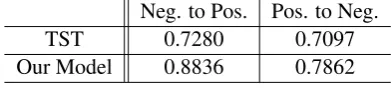
We also compare our model with TST for senti-ment polarity transfer. We employ the same eval-uation metric as used in (Shen et al., 2017): the sentiment accuracy of the transferred sentences.
Neg. to Pos. Pos. to Neg.
TST 0.7280 0.7097
[image:7.595.73.532.62.132.2]Our Model 0.8836 0.7862
Table 4: Accuracy comparison with TST.
Content Preservation Fluency (Range: [0, 2]) (Range: [1, 4])
TST 1.02 2.56
S2BS 0.70 2.53
Our Model 1.38 2.48
Table 5: Manual evaluation.
We define the revised sentences with ratings larger than 3 as positive, smaller than 3 as negative. The results are given in Table4, where two accuracy values are reported: negative to positive, and the reverse. The results show that our model achieves better accuracy than TST in both transfer direc-tions. One reason is that our method models the associations between each sentence and its out-come, and thus captures the sentiment wordings better. Our model is far better for transferring neg-ative sentences into positive, moreover, both mod-els achieve better performance for this transfer di-rection. We can probably attribute the reason to the imbalanced training data: 55% positive sen-tences v.s. 45% negative sensen-tences.
4.5 Manual Evaluation
We hire five workers to manually evaluate the quality of 500 sentences generated by each of our model and the compared models. The result is shown in Table 5. “Content Preservation” mea-sures whether the generated sentence preserves the content of the input sentence. The score range is
[image:7.595.316.512.180.224.2]Generated sentence E.g. 1 this tire center is amazing .
T=1 this tire center is horrible . T=3 this tire center is really good . T=5 this tire center is amazing . E.g. 2 horrible food !
T=1 horrendous
T=3 their food amazing !
T=5 amazing delicious food ! recommend !
E.g. 3 decent food and wine selection , but nothing i will rush back for . T=1 decent food and wine selection , but nothing i will rush for no . T=3 decent food and wine selection , but i will never look back for . T=5 decent food and wine selection , but excellent service, will return ! E.g. 4 our first time and we had a great meal , wonderful service .
T=1 our first time and we had a terrible meal , stale service . T=3 our first time and we had a great meal , we have service . T=5 our first time and we had a great meal , wonderful service . E.g. 5 food is very addiction tasty !
[image:8.595.101.498.62.352.2]T=1 food is just horrible here ? T=3 food is just addiction here ! T=5 food is very yummy addiction !
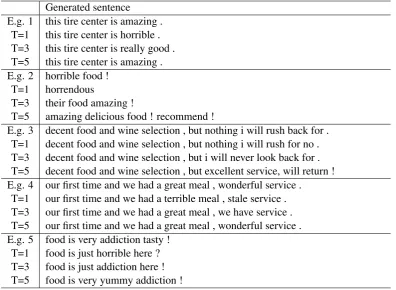
Table 6: Case study.
ranges from 1 (bad) to 4 (good), by following the definition in TST (Shen et al.,2017).
The result shows that our model achieves the best content preservation score. Our editing pro-cedure explicitly fixes the content factor and only modifies the outcome factor, which helps better preserve the content. In contrast, S2BS and TST include only one shared factor for both the content and the outcome, thus fail to distinguish one from the other. For the “Fluency” metric, S2BS and TST are slightly better than our model. Generally speaking, it is because our model introduces more powerful components for modeling the outcome differences between pseudo-parallel sentences, so as to achieve our goal of editing an input sen-tence to satisfy the expected outcome. However, these components do not contribute to the lan-guage quality of generated sentences.
4.6 Case Study
We show some examples produced by our model in Table 6. For each input, we specify three tar-gets: 1, 3, and 5. For the first and the forth exam-ples, the original sentences are not revised when the target rating is set to 5 (i.e., T=5) since the original sentences are already quite positive. For the first example, when T=3, “amazing” is revised
to a relatively less positive phrase “really good”. This case demonstrates that our model is able to capture the subtle difference in word sentiments, so that it can revise sentences reasonably accord-ing to the quantifiable rataccord-ing guidance. Moreover, for the second example, we notice that our model revises the original sentence “horrible food !” to “amazing delicious food ! recommend !” for T=5. This case shows that our model not only changes one word with another having different sentiment, e.g. “horrible” to “amazing delicious”, but also creatively introduces words from a new perspec-tive, e.g. “recommend”.
4.7 Ablation and Tuning Behavior Discussions
T=1 T=3 T=5
S2BS 1.6839 0.7567 1.3024
None 1.6639 0.7684 1.5434
Lsim 1.6090 0.8258 1.5233
Ldif f 1.6793 0.8017 1.3140
Ld−rec 1.5191 0.7784 1.1218
Lsim,Ldif f 1.4991 0.8218 1.3705
Lsim,Ld−rec 1.4101 0.8027 1.1246
Ldif f,Ld−rec 1.3879 0.7786 1.1413
[image:9.595.81.281.61.205.2]ALL 1.4162 0.7408 0.9408
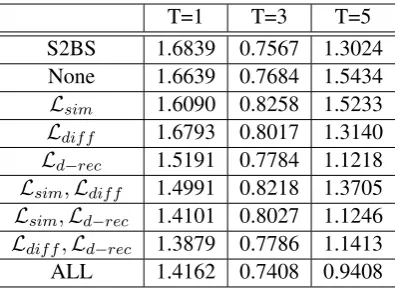
Table 7: Ablation study.
In the weight tuning, the first step only tunes the weights ofLrec andLmse. We observe that solely minimizing Lrec and Lmse also decreases Lsim, because in this process, the encoder E2 becomes
more capable of disentangling the content factor, and thus z and z0 become similar as they come from two similar input sentences, i.e. pseudo-parallel sentences. Another observation is that solely minimizingLrecandLmseincreasesLd−rec after some training epochs. To analyze the reason, let us assume there is a sentencexin the training set. Thus, the loss of reconstructingxfromyandz is included inLrec. Assume thatxis also included in a pseudo-parallel pair, and thus the loss of re-constructingxfromyandz0is included inLd−rec. The only difference between the two losses lies in the content factorszandz0. Given thatzandz0are not enforced to resemble each other whenLsimis excluded from this tuning step, Lrec andLd−rec cannot be minimized simultaneously. Moreover, when we minimize Lsim in the second step with the weights of Lrec and Lmse fixed, we observe thatLd−rec also decreases, which complies with the above analysis.
5 Related Works
Inspired by the task of image style transfer (Gatys et al., 2016; Liu and Tuzel, 2016), researchers proposed the task of text style transfer and ob-tained some encouraging results (Fu et al.,2018;
Hu et al., 2017; Jhamtani et al., 2017; Melnyk et al., 2017; Zhang et al., 2018; Li et al., 2018;
Prabhumoye et al.,2018;Niu and Bansal,2018). Existing studies on text style transfer mainly aim at transferring text from an original style into a tar-get style, e.g., from negative to positive, from male to female, from rude/normal to polite; from mod-ern text to Shakespeare style, etc. In contrast, our
proposed task QuaSE assumes each sentence is as-sociated with an outcome pertaining to continues values, and the editing is under the guidance of a specific target.
To transfer the style of a sentence, the paradigm of most works (Shen et al.,2017;Mueller et al.,
2017; Prabhumoye et al., 2018) first learns the latent representation of the original sentence and then applies a decoder to generate the transferred sentence. A line of works (Shen et al., 2017;
Mueller et al., 2017), including the studied task in this paper, assume that only non-parallel data is available for training. In such settings, VAEs (Kingma and Welling,2013) are employed to learn the latent representations of sentences.Shen et al.
(2017) assume a shared latent content distribution across text corpora belonging to different styles, and leverages the alignment of latent representa-tions from different styles to perform style trans-fer. Mueller et al.(2017) associate the latent rep-resentations with a numerical outcome, which is a measurement of the style. A transferred sen-tence is generated from a modified latent represen-tation. Different from the aforementioned works based on latent representations, Li et al. (2018) propose a simpler method that achieves attribute transfer by changing a few attribute marker words or phrases in the sentence that are indicative of a particular attribute, while leaving the rest of the sentence largely unchanged. The simple method is able to generate better-quality sentences than the aforementioned works. Besides style transfer, sen-tence editing models can be developed for other tasks. For example, Schmaltz et al. (2017) pro-pose neural sequence-labelling models for correct-ing the grammatical errors of sentences.
6 Conclusions
References
David M. Blei, Alp Kucukelbir, and Jon D. McAuliffe. 2016. Variational inference: A review for statisti-cians. arXiv, abs/1601.00670.
Samuel R. Bowman, Luke Vilnis, Oriol Vinyals, An-drew M. Dai, Rafal J´ozefowicz, and Samy Ben-gio. 2016. Generating sentences from a continuous space. InProceedings of the 20th SIGNLL
Confer-ence on Computational Natural Language Learning,
pages 10–21.
Zhenxin Fu, Xiaoye Tan, Nanyun Peng, Dongyan Zhao, and Rui Yan. 2018. Style transfer in text: Ex-ploration and evaluation. InProceedings of the 32nd AAAI Conference on Artificial Intelligence.
Yifan Gao, Jianan Wang, Lidong Bing, Irwin King, and Michael R. Lyu. 2018. Difficulty controllable ques-tion generaques-tion for reading comprehension. CoRR, abs/1807.03586.
Leon A Gatys, Alexander S Ecker, and Matthias Bethge. 2016. Image style transfer using convo-lutional neural networks. In Proceedings of 2016 Conference on Computer Vision and Pattern Recog-nition, pages 2414–2423.
K. Guu, T. B. Hashimoto, Y. Oren, and P. Liang. 2018. Generating sentences by editing prototypes. Trans-actions of the Association for Computational Lin-guistics (TACL).
Zhiting Hu, Zichao Yang, Xiaodan Liang, Ruslan Salakhutdinov, and Eric P. Xing. 2017. Toward con-trolled generation of text. In Proceedings of the 34th International Conference on Machine Learn-ing, pages 1587–1596.
Harsh Jhamtani, Varun Gangal, Eduard H. Hovy, and Eric Nyberg. 2017. Shakespearizing modern lan-guage using copy-enriched sequence-to-sequence models. arXiv, abs/1707.01161.
Diederik P. Kingma and Max Welling. 2013. Auto-encoding variational bayes.arXiv, abs/1312.6114.
Jiwei Li, Will Monroe, Tianlin Shi, S´ebastien Jean, Alan Ritter, and Dan Jurafsky. 2017. Adversarial learning for neural dialogue generation. In Proceed-ings of the 2017 Conference on Empirical Methods
in Natural Language Processing, pages 2157–2169.
Juncen Li, Robin Jia, He He, and Percy Liang. 2018. Delete, retrieve, generate: A simple approach to sen-timent and style transfer. InThe 2018 Conference of the North American Chapter of the Association for Computational Linguistics: Human Language Tech-nologies.
Ming-Yu Liu and Oncel Tuzel. 2016. Coupled gener-ative adversarial networks. In Advances in Neural
Information Processing Systems, pages 469–477.
Christopher D. Manning, Mihai Surdeanu, John Bauer, Jenny Finkel, Steven J. Bethard, and David Mc-Closky. 2014. The Stanford CoreNLP natural lan-guage processing toolkit. InAssociation for
Compu-tational Linguistics (ACL) System Demonstrations,
pages 55–60.
Igor Melnyk, C´ıcero Nogueira dos Santos, Kahini Wadhawan, Inkit Padhi, and Abhishek Kumar. 2017. Improved neural text attribute transfer with non-parallel data. arXiv, abs/1711.09395.
Jonas Mueller, David Gifford, and Tommi Jaakkola. 2017. Sequence to better sequence: Continuous re-vision of combinatorial structures. InProceedings of the 34th International Conference on Machine
Learning, pages 2536–2544.
Tong Niu and Mohit Bansal. 2018. Polite dialogue gen-eration without parallel data.Transactions of the As-sociation for Computational Linguistics (TACL).
Shrimai Prabhumoye, Yulia Tsvetkov, Ruslan Salakhutdinov, and Alan W Black. 2018. Style transfer through back-translation. In Proceedings of the 56th Annual Meeting of the Association for Computational Linguistics.
Allen Schmaltz, Yoon Kim, Alexander M. Rush, and Stuart M. Shieber. 2017. Adapting sequence mod-els for sentence correction. In Proceedings of the 2017 Conference on Empirical Methods in Natural
Language Processing, pages 2807–2813.
Tianxiao Shen, Tao Lei, Regina Barzilay, and Tommi S. Jaakkola. 2017. Style transfer from non-parallel text by cross-alignment. InAdvances in Neural
Informa-tion Processing Systems, pages 6833–6844.
Yiping Song, Rui Yan, Xiang Li, Dongyan Zhao, and Ming Zhang. 2016. Two are better than one: An ensemble of retrieval- and generation-based dialog systems. arXiv, abs/1610.07149.
Ilya Sutskever, Oriol Vinyals, and Quoc V. Le. 2014. Sequence to sequence learning with neural net-works. InAdvances in Neural Information Process-ing Systems, pages 3104–3112.
Yufei Wang, Zhe Lin, Xiaohui Shen, Scott Cohen, and Garrison W. Cottrell. 2017. Skeleton key: Image captioning by skeleton-attribute decomposition. In
Proceedings of 2017 Conference on Computer Vi-sion and Pattern Recognition, pages 7378–7387.
Tong Xiao, Jingbo Zhu, Chunliang Zhang, and Tongran Liu. 2016. Syntactic skeleton-based translation. In
Proceedings of the 30th AAAI Conference on Artifi-cial Intelligence, pages 2856–2862.
Ye Zhang, Nan Ding, and Radu Soricut. 2018. Shaped: Shared-private encoder-decoder for text style adap-tation. InThe 2018 Conference of the North Amer-ican Chapter of the Association for Computational