57
Argument Component Classification for Classroom Discussions
Luca Lugini and Diane Litman
Computer Science Department & Learning Research and Development Center University of Pittsburgh
Pittsburgh, PA 15260
{lul32,dlitman}@pitt.edu
Abstract
This paper focuses on argument component classification for transcribed spoken classroom discussions, with the goal of automatically classifying student utterances into claims, evi-dence, and warrants. We show that an existing method for argument component classification developed for another educationally-oriented domain performs poorly on our dataset. We then show that feature sets from prior work on argument mining for student essays and online dialogues can be used to improve performance considerably. We also provide a comparison between convolutional neural networks and re-current neural networks when trained under different conditions to classify argument com-ponents in classroom discussions. While neu-ral network models are not always able to out-perform a logistic regression model, we were able to gain some useful insights: convolu-tional networks are more robust than recur-rent networks both at the character and at the word level, and specificity information can help boost performance in multi-task training.
1 Introduction
Although there is no universally agreed upon def-inition, argument mining is an area of natural lan-guage processing which aims to extract structured knowledge from free-form unstructured language. In particular, argument mining systems are built with goals such as: detecting what parts of a text express an argument component, known as ment component identification; categorizing argu-ments into different component types (e.g. claim, evidence), known as argument component classifi-cation; understanding if/how different components are connected to form an argumentative structure (e.g. using evidence to support/attack a claim), known as argument relation identification. The de-velopment and release to the public of corpora and annotations in recent years have contributed to the
increasing interest in the area.
One domain in which argument mining is rarely found in the literature is educational discussions. Classroom discussions are a part of students’ daily life, and they are a common pedagogical approach for enhancing student skills. For example, student-centered classroom discussions are an important contributor to the development of students’ read-ing, writread-ing, and reasoning skills in the context of English Language Arts (ELA) classes ( Apple-bee et al.,2003;Reznitskaya and Gregory,2013). This impact is reflected in students’ problem solv-ing and disciplinary skills (Engle and Conant,
2002;Murphy et al.,2009;Elizabeth et al.,2012). With the increasing importance of argumentation in classrooms, especially in the context of student-centered discussions, automatically performing ar-gument component classification is a first step for building tools aimed at helping teachers analyze and better understand student arguments, with the goal of improving students’ learning outcomes.
Many current argument mining systems fo-cus on analyzing argumentation in student essays (Stab and Gurevych, 2014, 2017; Nguyen and Litman, 2015, 2018), online dialogues (Swanson et al., 2015;McLaren et al., 2010; Ghosh et al.,
2014; Lawrence and Reed, 2017), or in the le-gal domain (Ashley and Walker,2013;Palau and Moens, 2009). A key difference between these studies and our work consists in the source of lin-guistic content: although we analyze written tran-scriptions of discussions, the original source for our corpora consists of spoken, multi-party, edu-cational discussions, and the difference in cogni-tive skills and grammatical structure between writ-ten and spoken language (Biber,1988;Chafe and Tannen,1987) introduces additional complexity.
student essays are typically written by an individ-ual student, in classroom discussions arguments are formed collaboratively between multiple par-ties (i.e. multiple students and possibly teachers). While our work shares the multi-party context in which arguments are made with research aimed at argument mining in online dialogues, prior online dialogue studies have not been contextualized in the educational domain.
Given these differences, we believe that argu-ment mining models for student essays and online dialogues will perform poorly when directly ap-plied to educational discussions. However, since similarities between the domains do exist, we ex-pect that features exploited by such argument min-ing models can help us in classifymin-ing argument components in classroom discussions. Moreover, unlike the other two domains, we have access to labels belonging to a different (but related) class, specificity, which we can try to incorporate in ar-gumentation models to boost performance.
Our contributions are as follows. We first exper-imentally evaluate the performance of an existing argument mining system developed for essay scor-ing (named wLDA) when applied off-the-shelf to predict argument component labels for transcribed classroom discussions. We then analyze the per-formance obtained when using the same features as wLDA to train a classifier specifically on our dataset. We combine the wLDA feature set with features used in argument mining in the context of online dialogues and show that they are able to capture some of the similarities between on-line dialogues and our domain, and considerably improve the model. We then evaluate two neu-ral network models in seveneu-ral different scenarios pertaining to their input modality, the inclusion of handcrafted features, and the effect of multi-task learning when including specificity information.
2 Related Work
With respect to the educational domain, previous studies in argument mining were largely aimed at student essays. Persing and Ng (2015) studied ar-gument strength with the ultimate goal of auto-mated essay scoring. Stab and Gurevych (2014) performed argument mining on student essays by first jointly performing argument component iden-tification and classification, then predicting argu-ment component relations. Nguyen and Litman (2015) developed an argument mining system for analyzing student persuasive essays based on
ar-gument words and domain words. While domain words are used only in a specific topic, argument words are used across multiple topics and repre-sent indicators of argumentative content. They later proposed an improved version of the system (2016), which we will refer to as wLDA, by ex-ploiting features able to abstract over specific es-say topics and improve cross-topic performance. While our current work is also aimed at develop-ing argument mindevelop-ing systems in the educational context, we focus on educational discussion in-stead of student essays. Our work also differs in the argument component types used: we analyze claims, evidence, and warrants, while prior stud-ies mostly focused on claims and premises. The inclusion of warrants is particularly important to explicitly understand how students use them to connect evidence to claims. As such, we do not expect prior models to work well on our corpus, although some of the features might still be use-ful. Also, while some of the previously proposed systems address multiple subproblems simultane-ously, e.g. argument component identification and argument component classification, we only focus on argument component classification.
Swanson et al. (2015) developed a model for extracting argumentative portions of text from on-line dialogues, which were later used for sum-marizing the multiple argument facets. Misra et al. (2015) analyzed dyadic online forum discus-sions to detect central propositions and argument facets. Habernal and Gurevych (2017) analyzed user-generated web discourse data from several sources by performing micro-level argumentation mining. While these prior works analyze multi-party discussions, the discussions are neither orig-inally spoken nor in an educational context.
network models, and also experiment with multi-task learning. More detailed comparisons will be given in Section4.
3 Dataset
We collected 73 transcripts of text-based class-room discussions, i.e. discussions centered on a text or literature piece (e.g. play, speech, book), for ELA high school level classes. Some of the transcripts were gathered from published articles and dissertations, while the rest originated from videos which were transcribed by one of our an-notators (see below). While detailed demographic information for students participating in each dis-cussion was not available, our dataset consists of a mix of small group (16 out of 73) versus whole class (57/73) discussions, both teacher-mediated (64/73) versus student only (9/73). Addition-ally, the discussions originated in urban schools (28/73), suburban schools (42/73), and schools lo-cated in small towns (3/73).
The unit of analysis for our work is argument move, which consists of a segment of text contain-ing an argumentative discourse unit (ADU) ( Peld-szus and Stede, 2013). Starting with transcripts broken down into turns at talk, an expert annota-tor segmented turns at talk into multiple argument moves when necessary: turns at talk containing multiple ADUs have been segmented into several argument moves, each consisting of a single ADU. Turn segmentation effectively corresponds to ar-gument component identification, and it is carried out manually. We conducted a reliability study on turn segmentation with two annotators on a subset of the dataset consisting of 53 transcripts. The reliability analysis resulted in Krippendorff
αU = 0.952(Krippendorff, 2004), which shows
that turns at talk can be reliably segmented. After segmentation, the data was manually an-notated to capture two aspects of classroom talk, argument component and specificity, using the ELA classroom-oriented annotation scheme de-veloped by Lugini et al. (2018). The argument component types in this scheme, which is based on the Toulmin model (1958), are: (i)Claim: an arguable statement that presents a particular inter-pretation of a text or topic. (ii) Evidence1: facts, documentation, text reference, or testimony used to support or justify a claim. (iii) Warrant:
rea-1The “evidence” label is equivalent to “data” or “grounds”
used in the original Toulmin model, though we use the label “evidence” to remain consistent with the annotation scheme.
sons explaining how a specific evidence instance supports a specific claim.
Chisholm and Godley (2011) observed how specificity has an impact on the quality of the dis-cussion, while Swanson et al. (2015) noted that a relationship exists between specificity and the quality of arguments in online forum dialogues. For the purpose of investigating whether there ex-ists a relationship between specificity and argu-ment components, we additionally annotated data for specificity following the same coding scheme (Lugini et al.,2018). Specificity labels are directly related to four elements for an argument move: (1) it is specific to one (or a few) character or scene; (2) it makes significant qualifications or elabora-tions; (3) it uses content-specific vocabulary (e.g. quotes from the text); (4) it provides a chain of rea-sons. The specificity annotation scheme by Lugini et al. includes three labels along a linear scale:(i) Low: statement that does not contain any of these elements. (ii) Medium: statement that accom-plishes one of these elements. (iii) High: state-ment that clearly accomplishes at least two speci-ficity elements. Only student turns were consid-ered for annotations; teacher turns at talk were fil-tered out and do not appear in the final dataset. Table1shows a coded excerpt of a transcript from a discussion about the moviePrincess Bride.
The resulting dataset consists of 2047 argument moves from 73 discussions. As we can see from the label distribution shown in Table 2, students produced a high number of claims, while warrant is the minority class. We can also observe a class imbalance for specificity labels, though the ratio between majority and minority classes is lower than that for argument component labels.
We evaluated inter-rater reliability on a subset of our dataset composed of 1049 argument moves from 50 discussions double-coded by two anno-tators. Cohen’s unweighted kappa for argument component labels was 0.629, while quadratic-weighted kappa for specificity labels (since they are ordered) was 0.641, which shows substantial agreement.
Stu Argument Move Arg Comp Spec
S1 Well Fezzik went back to how he was, Claim Low S1 like how he gets lost. Then he goes like he needs to be around other
people. And then finally when he does, he gets himself like relying on himself. But then right at the end, he doesnt know where hes at; he makes a wrong turn.
Evidence Med
S1 cause he tried doing it by himself and he cant. So I think Fezzik went back to his normal ways, like after he changed.
[image:4.595.77.524.59.177.2]Warrant High
Table 1: Coded excerpt of a discussion of the moviePrincess Bride. Student S1 first makes a claim about Fezzik’s behavior, then provides evidence by listing a series of events, then connects such events to his claim using a warrant. As the argument progresses, the specificity level increases.
Argument Component
Claim Warrant Evidence 1034 358 655
Specificity
Low Med High 710 996 341
Table 2: Distribution of class labels for argument component type and specificity in our dataset.
4 Argument Component Classification
In this section we outline an existing argument component classification system that will serve as a baseline for our experiments, then propose sev-eral new models that use features extracted from neural networks and hand-crafted features, as well as models that use multi-task learning.
4.1 Existing Argument Mining System
The wLDA2system was developed for performing argument component identification, classification, and relation extraction from student essays. For the purpose of this study, we only consider the ar-gument component classification subsystem. The model is based on a support vector machine classi-fier which exploits features able to improve cross-topic performance. The feature set consists of four main subsets: lexical features (argument words, verbs, adverbs, presence of modal verbs, discourse connectives, singular first person pronoun); parse features (argumentative subject-verb pairs, tense of the main verb, number of sub-clauses, depth of parse tree); structural features (number of tokens, token ratio, number of punctuation signs, tence position, first/last paragraph, first/last sen-tence of paragraph); context features (number of tokens, number of punctuation signs, number of
2The original name of wLDA+4 stands for “with LDA
supported features and expanded with 4 features sets” com-pared to their previous system. We use wLDA for brevity.
sub-clauses, modal verb in preceding/following sentences) extracted from the sentences before and after the one considered; four additional features for abstracting over essay topics.
Since the model was trained on essays anno-tated for major claim, claim, and premise, but not on warrants, in our evaluation we did not take into account misclassification errors for argument moves in our dataset labeled as warrants. The pre-trained system performs argument component identification using a multiclass classification ap-proach, such that each input will be classified as non argumentative, major claim, claim or premise. Since our goal is to evaluate performance related to the component classification problem, we ig-nored all the argument moves classified as non argumentative by wLDA. Considering the defi-nitions of premise and evidence in the Toulmin model (1958), we made the assumption of the two labels being equivalent for this study, i.e. if the predicted class for an argument move is premise and its gold standard label in our dataset is evi-dence, we consider the prediction correct. In the same way we consider both claim and major claim labels as equivalent to claims in our dataset.
4.2 Neural Network Models
[image:4.595.111.253.232.317.2]net-work models require in general a large amount of training data, while we have a limited size dataset. The CNN model is based on a model proposed by Kim (2014) and already used for argument min-ing in the past (Daxenberger et al.,2017), with a difference in the number of convolutional/pooling layers. In particular, our model uses 3 convolu-tional/max pooling layers instead of 6, and only one fully connected layer after the convolutional ones, followed by a softmax layer used for clas-sification. This choice resulted from observing significant overfitting when increasing the number of convolutional layers due to the increase in the number of model weights and the limited dataset size. Figure 1 shows diagrams for the different neural network setups used in our experiments.
The RNN model consists of a single Long-Short Term Memory (LSTM) network (Hochreiter and Schmidhuber, 1997). After propagating a com-plete argument move through the LSTM network, the resulting hidden state is the feature vector used as input to a softmax layer which outputs the pre-dicted label. Recurrent neural networks have also been used in the context of argument mining ( Dax-enberger et al.,2017;Niculae et al.,2017). We set the size of the hidden state to 75 based on several factors. Following Bengio (Bengio,2012), we de-cided to have an overcomplete network, i.e. one in which the size of the hidden state is bigger than the size of the input. Since the dimensionality of our character-based encoding is 37 and that for word-based embeddings is 50, we chose a hidden state with size greater than 50 (we use the same hid-den state size for both models). Increasing the size introduced overfitting even quicker than the CNN model, given that the number of weights increases more quickly for our LSTM model.
When using text as input to a neural network, we can generally view an argument move as ei-ther a sequence of characters, or as a sequence of words. Unlike previous neural network-based ar-gument mining models, each of our models was evaluated under both conditions: for character-based models we used a one-hot encoding (one-out of n) for each letter and number - special char-acters were filtered since they don’t hold particular meaning in speech, and we cannot be sure of tran-scription conventions; for word-based models we used Global Vectors (GloVe) (Pennington et al.,
2014) with dimensionality of 50. An important as-pect to consider is that, while word-based models have some prior knowledge encoded in the word
embeddings, character-based models do not. Since neural network models usually require a large amount of training data to be effective, and we have relatively fewer number of argument moves compared to number of model weights, we also tested hybrid models in which a neural net-work output is combined with handcrafted fea-tures before the final softmax classification layer, as shown in Figure1 (b) and Figure 1 (d). Both CNN and LSTM models used categorical cross-entropy as loss function, and the number of epochs was automatically selected at training time by monitoring performance on a validation set con-sisting of 10% of the training set for each fold.
4.3 Multi-task Learning
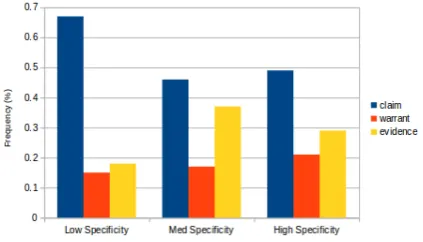
As we can see from Figure 2, the argument la-bel distributions are different for the three speci-ficity levels. This leads us to believe a relationship exists between the specificity and argumentation annotations, therefore we decided to see whether specificity labels can be used to improve the per-formance of our argument mining models.
Multi-task learning for neural network models has shown promising results in the machine learn-ing field (Weston et al.,2012;Andrychowicz et al.,
2016). It has recently been used in argument min-ing: Schulz et al. (2018) proposed a multi-task learning setup in which the primary task consists of jointly performing argument component iden-tification and classification (framed as a sequence tagging problem), while the additional tasks con-sist of the same task applied to different datasets. They showed that the multi-task models achieved better performance than single-task learning es-pecially when limited in-domain training data is available for the primary task.
Figure 1: Neural network models used in this study: neural network only setup (a); model incorporating neural network and handcrafted features (wLDA and online dialogue sets) (b); multi-task setup for neural network only model (c); multi-task setup for model using neural network and handcrafted features (d).
Figure 2: Argument labels by specificity levels.
a second softmax layer that operates on the fi-nal hidden state of the network to predict speci-ficity. In both multi-task models specificity and argumentation are predicted at the same time, the loss function is computed as the sum of the indi-vidual loss functions for both tasks (the loss func-tion for the specificity softmax layer is categorical cross-entropy as well), and gradient updates are backpropagated through the network. This pro-cess results in embeddings trained jointly for the two tasks, which can effectively capture informa-tion relevant to both specificity and argumentainforma-tion.
4.4 Online Dialogue Features
Since our dataset is based on multi-party discus-sion, it shares similarities with prior argumenta-tion work in multi-party online dialogues. There-fore we experiment with features from ( Swan-son et al., 2015), organized into three main sub-sets: semantic-density features (number of pro-nouns, descriptive word-level statistics, number of occurrences of words of different lengths), lexical features (tf-idf feature for each unigram and bi-gram, descriptive argument move-level statistics), and syntactic features (unigrams, bigrams and tri-grams of part of speech tags). The only differ-ence between the original features and the ones
we implemented consists in the use of Speciteller (Li and Nenkova, 2015). As observed by Lug-ini and Litman (Lugini and Litman,2017), apply-ing Speciteller as-is to domains other than news articles results in a considerable drop in perfor-mance. Therefore, instead of including the speci-ficity score obtained by directly applying Speci-ficity to an argument move, we decided to use Spe-citeller’s features.
5 Experiments and Results
This section provides our experimental results. In Section 5.1 we will test our first hypothesis: us-ing an argument minus-ing system trained in a differ-ent domain will result in low performance, which can be improved by re-training on classroom dis-cussions and by adding new features. Section5.2
will be used to test our second hypothesis: neural network models can automatically extract impor-tant features for argument component classifica-tion. Our third hypothesis will be tested in Sec-tion 5.3: adding handcrafted features (i.e. online dialogue features, wLDA features) to the ones au-tomatically extracted by neural networks will re-sult in an increase of performance. Lastly, we will test our fourth hypothesis in Section 5.4: jointly learning to predict argument component type and specificity will result in more robust models and achieve a further performance improvement.
Our experiments evaluate every model using a leave-one-transcript-out cross validation: each fold contains one transcript as test set and the re-maining 72 as training set. Cohen kappa, and un-weighted precision, recall, and f-score were used as evaluation metrics.
[image:6.595.76.288.252.373.2](Abadi et al.,2015), Keras (Chollet et al.,2015), NLTK (Bird et al.,2009).
Given that in our dataset warrants appear much less frequently than claims and evidence, data im-balance is a problem we need to address. If trained naively, the limited amount of training data and the unbalanced class distribution lead the neural network models to specialize towards claims and evidence, with much weaker performance on war-rants. This is also the case for non neural net-work models, although the impact on performance is lower. To combat this phenomenon we decided to use oversampling (Buda et al., 2017) in order to create a balanced dataset, hoping to further re-duce the performance gap between the different classes3. After computing the class frequency dis-tribution on the training set, we randomly sampled moves from the two minority classes and added them to the current training set, repeating the pro-cess until the class distribution was completely balanced (i.e. until the number of argument moves for each class equals the number of moves in the majority class)4, while the test set was unchanged. Table 3 shows the results for all experiments. The statistical significance results in the table use the system in row 3 as the comparison base-line, as wLDA represents a system specifically designed for argument component classification (among other tasks). Additional statistical com-parisons are provided in the text as well.
5.1 Using wLDA Off the Shelf
Since not all the argument moves were considered when computing results for the pre-trained out of the box wLDA model (see Section 4.1), the re-sults in row 2 are not directly comparable to oth-ers. Nonetheless they show the upper bound in performance of the pre-trained model, and we can see that it is comparable to a majority baseline which always predicts the majority class in each fold. This result shows that claims and evidence expressed in written essays and classroom discus-sions have very little in common. This is clearer when we look at improvement obtained training a logistic regression model5 using the same wLDA
3
We also tried setting class weights at training to influence the loss function, though it only improved results marginally.
4In the multi-task models oversampling was carried out
only with respect to argument component labels since that is the primary task.
5We also experimented with random forest, naive Bayes
and support vector machines, but they provided inferior re-sults compared to logistic regression.
features on our dataset (row 3), which outper-forms the pre-trained wLDA in all metrics (row 2), and indicates that the wLDA features are still able to somewhat distinguish between claims and evidence while performing considerably worse on warrants. Additionally, if we add to this model the online dialogue feature set, the resulting model improves all results and obtains the best kappa overall (row 4). This confirms our hypothesis: given the similarity that exists between our domain and online dialogues, features developed for ana-lyzing argumentation in online dialogues are also useful in classroom discussions.
5.2 Neural Network Models Alone
Our second hypothesis is validated by the results in Table 3 by comparing row 3 with rows 7, 11, 15, and 19, where we can see that the CNN mod-els achieve performance comparable to a classifier trained on features specifically developed for argu-ment component classification. This indicates that convolutional neural network models are able to extract useful features. Additionally, when com-paring the best of these models (row 19, with respect to f-score) to the best performing model based only on handcrafted features (row 4), the difference in performance is not statistically sig-nificant for any of the metrics in Table3.
Looking more closely at the results obtained us-ing neural network models alone we can see two different trends. While LSTM models show per-formance comparable to random chance (e.g. row 5, with kappa close to zero and lower than the majority baseline), three of our four CNN mod-els (rows 7, 15, 19) perform as well as or better than the wLDA based model (row 3) (except for precision in row 19 and Fe in row 7). Overall,
bene-Row Models / Features Kappa Precision Recall F-score Fe Fw Fc
1 Majority baseline 0.068 0.265 0.406 0.314 0.109 0.004 0.532 2 Pre-trained wLDA 0.077 0.289 0.350 0.269 0.351 N/A 0.456 3 Logistic Regression
(wLDA features)
0.142 0.412 0.394 0.379 0.390 0.211 0.540
4 Logistic Regression (wLDA features + online dialogue)
0.283 0.508 0.500 0.480 0.479 0.222 0.693
Character level NN models
5 LSTM -0.002 0.062 0.253 0.082 0.007 0.242 0.013 6 LSTM + wLDA +
on-line dialogue
0.034 0.217 0.304 0.150 0.080 0.272‡ 0.090
7 CNN 0.143 0.439 0.423 0.393 0.372 0.218 0.574 8 CNN + wLDA +
on-line dialogue
0.241? 0.482 0.475 0.450 0.449 0.236 0.637
Word level NN models
9 LSTM 0.069 0.408 0.399 0.218 0.161 0.198 0.295 10 LSTM + wLDA +
on-line dialogue
0.181 0.462 0.447 0.391 0.362 0.279‡ 0.522
11 CNN 0.125 0.410 0.404 0.378 0.370 0.231 0.526 12 CNN + wLDA +
on-line dialogue
0.241? 0.492? 0.488 0.455† 0.468 0.276‡ 0.622
Multi-task character level NN models
13 LSTM 0.060 0.408 0.399 0.208 0.134 0.203 0.287 14 LSTM + wLDA +
on-line dialogue
0.117 0.379 0.375 0.287 0.362 0.279‡ 0.522
15 CNN 0.166 0.444 0.437 0.407 0.399 0.220 0.586 16 CNN + wLDA +
on-line dialogue
0.259† 0.506† 0.488 0.468? 0.474 0.262† 0.640
Multi-task word level NN models
17 LSTM 0.093 0.379 0.364 0.276 0.298 0.252 0.378 18 LSTM + wLDA +
on-line dialogue
0.232 0.497† 0.482 0.440 0.419 0.299‡ 0.583
19 CNN 0.164 0.351 0.443 0.441 0.476 0.249 0.598 20 CNN + wLDA +
on-line dialogue
[image:8.595.72.523.124.644.2]0.276‡ 0.521‡ 0.512† 0.485† 0.484 0.312‡ 0.638
fit from word level inputs.
5.3 Adding wLDA Features and Online Dialogue Features
It is clear from Table3that almost all neural net-work models benefit from additional handcrafted features (with the exception of precision and re-call for rows 13 and 14). This is not surprising, given that neural networks require a large amount of data to be trained effectively, and although ran-dom oversampling helped, we still have a lim-ited amount of training data. Even when includ-ing additional features the two architectures show slightly different trends: CNN usually outperform LSTM, however LSTM models benefit more from the additional features. This is at least in part due to LSTMs initially having lower performance without handcrafted features. We analyzed the im-portance of different subsets of the online dialogue features through a feature ablation study. For CNN models, removing any subset of features resulted in a decrease in performance, except for thesyntax
subset in thecharacter level CNN + wLDA + on-line dialoguemodel in both single task and multi-task settings. For LSTM models, all feature sub-sets contributed to increasing performance in the multi-task settings, while that was not always true for the single task models.
5.4 Multi-task Learning
Finally, we analyze the impact of multi-task learn-ing in argument component classification. Our findings are in line with the literature in other do-mains, with results showing that models trained on argumentation and specificity labels almost al-ways outperform the ones trained only on argu-mentation. LSTMs benefit from the multi-task setup more than CNN models: among all com-binations of LSTM models, the only one able to achieve kappa greater than 0.2 and f-score greater than 0.4 is a multi-task one. Additionally, the word-level CNN model using wLDA and online dialogue feature sets and trained using multi-task learning is the only model able to achieve f-score greater than 0.3 for warrants.
It should be noted that although the neural net-work based model at row 20 outperforms the logis-tic regression model at row 4 in terms of precision, recall, and F-score, the difference in performance is not statistically significant, and neither is the re-duction in kappa and Fc.
6 Conclusions and Future Work
In this work we evaluated the performance of an existing argument mining system developed for a different educational application (i.e. student essays) on a corpus composed of spoken class-room discussions. Although the pre-trained sys-tem showed poor performance on our dataset, its features show promising results when used in a model specifically trained on classroom discus-sions. We extracted additional feature sets based on related work in the online dialogue domain, and showed that combining online dialogue and stu-dent essay features achieves the highest kappa on our dataset. We then developed additional mod-els based on two types of neural networks, show-ing that performance can be further improved. We provided an experimental evaluation of the differ-ences between convolutional networks and recur-rent networks, and between character-based and word-based models. Lastly, we showed that ar-gument component classification models can ben-efit from multi-task learning, when adding a sec-ondary task consisting of predicting specificity.
Even though we were able to achieve better per-formance compared to a pre-trained system and a majority baseline, we are far from the performance of argument mining systems in other domains such as student essays or legal texts. Although the wLDA features extract information from previous argument moves, we plan to take advantage of the collaborative nature of our corpus by extending the feature sets in order to exploit contextual informa-tion and develop models that can explicitly take advantage of previous argument moves. Given the performance improvements obtained with multi-task models, we also plan to extend these models and include additional tasks at training time with the hope of further boosting performance. We also plan to add other types of cross validation, since leave-one-transcript-out introduces great variabil-ity in the composition of test sets, possibly attenu-ating the statistical significance for some results.
Acknowledgements
We want to thank Amanda Godley, Christopher Olshefski, Tazin Afrin, Huy Nguyen, and Annika Swallen for their contribution, and all the anony-mous reviewers for their helpful feedback.
References
Mart´ın Abadi, Ashish Agarwal, Paul Barham, Eugene Brevdo, Zhifeng Chen, Craig Citro, Greg S. Cor-rado, Andy Davis, Jeffrey Dean, Matthieu Devin, Sanjay Ghemawat, Ian Goodfellow, Andrew Harp, Geoffrey Irving, Michael Isard, Yangqing Jia, Rafal Jozefowicz, Lukasz Kaiser, Manjunath Kudlur, Josh Levenberg, Dandelion Man´e, Rajat Monga, Sherry Moore, Derek Murray, Chris Olah, Mike Schus-ter, Jonathon Shlens, Benoit Steiner, Ilya Sutskever, Kunal Talwar, Paul Tucker, Vincent Vanhoucke, Vijay Vasudevan, Fernanda Vi´egas, Oriol Vinyals, Pete Warden, Martin Wattenberg, Martin Wicke, Yuan Yu, and Xiaoqiang Zheng. 2015. TensorFlow: Large-scale machine learning on heterogeneous sys-tems. Software available from tensorflow.org.
Marcin Andrychowicz, Misha Denil, Sergio Gomez, Matthew W Hoffman, David Pfau, Tom Schaul, Brendan Shillingford, and Nando De Freitas. 2016. Learning to learn by gradient descent by gradient de-scent. InAdvances in Neural Information Process-ing Systems, pages 3981–3989.
Arthur N Applebee, Judith A Langer, Martin Nystrand, and Adam Gamoran. 2003. Discussion-based ap-proaches to developing understanding: Classroom instruction and student performance in middle and high school english. American Educational Re-search Journal, 40(3):685–730.
Kevin D Ashley and Vern R Walker. 2013. Toward con-structing evidence-based legal arguments using legal decision documents and machine learning. In Pro-ceedings of the Fourteenth International Conference on Artificial Intelligence and Law, pages 176–180. ACM.
Yoshua Bengio. 2012. Practical recommendations for gradient-based training of deep architectures. In
Neural networks: Tricks of the trade, pages 437– 478. Springer.
Douglas Biber. 1988. Variation across speech and writing. Cambridge University Press.
Steven Bird, Ewan Klein, and Edward Loper. 2009.
Natural language processing with Python: analyz-ing text with the natural language toolkit. ” O’Reilly Media, Inc.”.
Mateusz Buda, Atsuto Maki, and Maciej A Mazurowski. 2017. A systematic study of the class imbalance problem in convolutional neural networks. arXiv preprint arXiv:1710.05381.
W. Chafe and D. Tannen. 1987. The relation between written and spoken language. Annual Review of An-thropology, 16(1):383–407.
James S Chisholm and Amanda J Godley. 2011. Learn-ing about language through inquiry-based discus-sion: Three bidialectal high school students talk about dialect variation, identity, and power. Journal of Literacy Research, 43(4):430–468.
Franc¸ois Chollet et al. 2015. Keras. https:// keras.io.
Johannes Daxenberger, Steffen Eger, Ivan Habernal, Christian Stab, and Iryna Gurevych. 2017. What is the essence of a claim? cross-domain claim iden-tification. In Proceedings of the 2017 Conference on Empirical Methods in Natural Language Pro-cessing, pages 2055–2066. Association for Compu-tational Linguistics.
Tracy Elizabeth, Trisha L Ross Anderson, Elana H Snow, and Robert L Selman. 2012. Academic dis-cussions: An analysis of instructional discourse and an argument for an integrative assessment frame-work. American Educational Research Journal, 49(6):1214–1250.
Randi A Engle and Faith R Conant. 2002. Guiding principles for fostering productive disciplinary en-gagement: Explaining an emergent argument in a community of learners classroom. Cognition and Instruction, 20(4):399–483.
Debanjan Ghosh, Smaranda Muresan, Nina Wacholder, Mark Aakhus, and Matthew Mitsui. 2014. Analyz-ing argumentative discourse units in online interac-tions. InProceedings of the First Workshop on Ar-gumentation Mining, pages 39–48.
Ivan Habernal and Iryna Gurevych. 2017. Argumenta-tion mining in user-generated web discourse. Com-putational Linguistics, 43(1):125–179.
Sepp Hochreiter and J¨urgen Schmidhuber. 1997. Long short-term memory. Neural computation, 9(8):1735–1780.
Yoon Kim. 2014. Convolutional neural networks for sentence classification. InProceedings of the 2014 Conference on Empirical Methods in Natural Lan-guage Processing (EMNLP), pages 1746–1751.
Klaus Krippendorff. 2004. Measuring the reliability of qualitative text analysis data. Quality and Quantity, 38:787–800.
John Lawrence and Chris Reed. 2017. Using complex argumentative interactions to reconstruct the argu-mentative structure of large-scale debates. In Pro-ceedings of the 4th Workshop on Argument Mining, pages 108–117.
Junyi Jessy Li and Ani Nenkova. 2015. Fast and accu-rate prediction of sentence specificity. In Proceed-ings of the Twenty-Ninth Conference on Artificial In-telligence (AAAI), pages 2281–2287.
Luca Lugini and Diane Litman. 2017. Predicting speci-ficity in classroom discussion. InProceedings of the 12th Workshop on Innovative Use of NLP for Build-ing Educational Applications, pages 52–61.
of the 13th Workshop on Innovative Use of NLP for Building Educational Applications, pages 110–116.
Bruce M McLaren, Oliver Scheuer, and Jan Mikˇs´atko. 2010. Supporting collaborative learning and e-discussions using artificial intelligence techniques.
International Journal of Artificial Intelligence in Ed-ucation, 20(1):1–46.
Amita Misra, Pranav Anand, Jean Fox Tree, and Mari-lyn Walker. 2015. Using summarization to discover argument facets in dialog. In Proceedings of the 2015 Conference of the North American Chapter of the Association for Computational Linguistics: Hu-man Language Technologies.
P Karen Murphy, Ian AG Wilkinson, Anna O Soter, Maeghan N Hennessey, and John F Alexander. 2009. Examining the effects of classroom discussion on students comprehension of text: A meta-analysis.
Journal of Educational Psychology, 101(3):740.
Huy Nguyen and Diane Litman. 2015. Extracting ar-gument and domain words for identifying arar-gument components in texts. In Proceedings of the 2nd Workshop on Argumentation Mining, pages 22–28.
Huy Nguyen and Diane J Litman. 2016. Improving argument mining in student essays by learning and exploiting argument indicators versus essay topics. InFLAIRS Conference, pages 485–490.
Huy V Nguyen and Diane J Litman. 2018. Argument mining for improving the automated scoring of per-suasive essays. InProceedings of the Thirty-Second AAAI Conference on Artificial Intelligence.
Vlad Niculae, Joonsuk Park, and Claire Cardie. 2017. Argument Mining with Structured SVMs and RNNs. InProceedings of ACL.
Raquel Mochales Palau and Marie-Francine Moens. 2009. Argumentation mining: the detection, clas-sification and structure of arguments in text. In Pro-ceedings of the 12th international conference on ar-tificial intelligence and law, pages 98–107. ACM.
F. Pedregosa, G. Varoquaux, A. Gramfort, V. Michel, B. Thirion, O. Grisel, M. Blondel, P. Pretten-hofer, R. Weiss, V. Dubourg, J. Vanderplas, A. Pas-sos, D. Cournapeau, M. Brucher, M. Perrot, and E. Duchesnay. 2011. Scikit-learn: Machine learning in Python. Journal of Machine Learning Research, 12:2825–2830.
Andreas Peldszus and Manfred Stede. 2013. From ar-gument diagrams to arar-gumentation mining in texts: A survey. International Journal of Cognitive Infor-matics and Natural Intelligence (IJCINI), 7(1):1–31.
Jeffrey Pennington, Richard Socher, and Christopher Manning. 2014. Glove: Global vectors for word representation. InProceedings of the 2014 confer-ence on empirical methods in natural language pro-cessing (EMNLP), pages 1532–1543.
Isaac Persing and Vincent Ng. 2015. Modeling ar-gument strength in student essays. InProceedings of the 53rd Annual Meeting of the Association for Computational Linguistics and the 7th International Joint Conference on Natural Language Processing (Volume 1: Long Papers), volume 1, pages 543–552.
Nils Reimers and Iryna Gurevych. 2017. Argumen-tation mining in user-generated web discourse. In
Proceedings of the 2017 Conference on Empirical Methods in Natural Language Processing, pages 338–348.
Alina Reznitskaya and Maughn Gregory. 2013. Stu-dent thought and classroom language: Examining the mechanisms of change in dialogic teaching. Ed-ucational Psychologist, 48(2):114–133.
Claudia Schulz, Steffen Eger, Johannes Daxenberger, Tobias Kahse, and Iryna Gurevych. 2018. Multi-task learning for argumentation mining in low-resource settings. InProceedings of the 2018 Con-ference of the North American Chapter of the Asso-ciation for Computational Linguistics: Human Lan-guage Technologies, Volume 2 (Short Papers), pages 35–41. Association for Computational Linguistics.
Christian Stab and Iryna Gurevych. 2014. Annotating argument components and relations in persuasive es-says. InProceedings of COLING 2014, the 25th In-ternational Conference on Computational Linguis-tics: Technical Papers, pages 1501–1510.
Christian Stab and Iryna Gurevych. 2017. Parsing ar-gumentation structures in persuasive essays. Com-putational Linguistics, 43(3):619–659.
Reid Swanson, Brian Ecker, and Marilyn Walker. 2015. Argument mining: Extracting arguments from on-line dialogue. In Proceedings of the 16th Annual Meeting of the Special Interest Group on Discourse and Dialogue, pages 217–226.
Stephen Toulmin. 1958. The uses of argument. Cam-bridge: Cambridge University Press.