Learning Disentangled Representations of Texts
with Application to Biomedical Abstracts
Sarthak Jain
Northeastern University
Edward Banner
Northeastern University
Jan-Willem van de Meent
Northeastern University
Iain J. Marshall
King’s College London
Byron C. Wallace
Northeastern University
Abstract
We propose a method for learning disentan-gledrepresentations of texts that code for dis-tinct and complementary aspects, with the aim of affording efficient model transfer and in-terpretability. To induce disentangled embed-dings, we propose an adversarial objective based on the (dis)similarity between triplets of documents with respect to specific as-pects. Our motivating application is embed-ding biomedical abstracts describing clinical trials in a manner that disentangles the pop-ulations, interventions, and outcomes in a given trial. We show that our method learns representations that encode these clinically salient aspects, and that these can be effec-tively used to perform aspect-specific retrieval. We demonstrate that the approach generalizes beyond our motivating application in experi-ments on two multi-aspect review corpora.
1 Introduction
A classic problem that arises in (distributed) rep-resentation learning is that it is difficult to deter-mine what information individual dimensions in an embedding encode. When training a classifier to distinguish between images of people and land-scapes, we do not knowa prioriwhether the model is sensitive to differences in color, contrast, shapes or textures. Analogously, in the case of natural language, when we calculate similarities between document embeddings of user reviews, we cannot know if this similarity primarily reflects user senti-ment, the product discussed, or syntactic patterns. This lack of interpretability makes it difficult to assess whether a learned representations is likely to generalize to a new task or domain, hinder-ing model transferability. Disentangled represen-tations with known semantics could allow more ef-ficient training in settings in which supervision is expensive to obtain (e.g., biomedical NLP).
Thus far in NLP, learned distributed represen-tations have, with few exceptions (Ruder et al.,
2016;He et al.,2017;Zhang et al.,2017), been
en-tangled: they indiscriminately encode all aspects of texts. Rather than representing text via a mono-lithic vector, we propose to estimate multiple em-beddings that capture complementary aspects of texts, drawing inspiration from the ML in vision community (Whitney,2016;Veit et al.,2017a).
As a motivating example we consider docu-ments that describe clinical trials. Such publica-tions constitute the evidence drawn upon to sup-port evidence-based medicine (EBM), in which one formulates precise clinical questions with re-spect to the Populations, Interventions, Compara-tors and Outcomes (PICO elements) of interest
(Sackett et al.,1996).1 Ideally, learned
represen-tations of such articles would factorize into em-beddings for the respective PICO elements. This would enable aspect-specific similarity measures, in turn facilitating retrieval of evidence concern-ing a given condition of interest (i.e., in a spe-cific patient population), regardless of the inter-ventions and outcomes considered. Better repre-sentations may reduce the amount of supervision needed, which is expensive in this domain.
Our work is one of the first efforts to induce dis-entangled representations of texts,2 which we
be-lieve may be broadly useful in NLP. Concretely, our contributions in this paper are as follows:
• We formalize the problem of learning disentan-gled representations of texts, and develop a rela-tively general approach for learning these from aspect-specific similarity judgments expressed as triplets (s, d, o)a, which indicate that
docu-ment d is more similar to document sthan to
documento, with respect to aspecta.
1We collapse I and C because the distinction is arbitrary. 2We review the few recent related works that do exist in
4684
• We perform extensive experiments that provide evidence that our approach yields disentangled representations of texts, both for our motivating task of learning PICO-specific embeddings of biomedical abstracts, and, more generally, for multi-aspect sentiment corpora.
2 Framework and Models
Recent approaches in computer vision have emphasized unsupervised learning of disentan-gled representations by incorporating information-theoretic regularizers into the objective (Chen
et al., 2016; Higgins et al., 2017). These
ap-proaches do not require explicit manual annota-tions, but consequently they require post-hoc man-ual assignment of meaningful interpretations to learned representations. We believe it is more nat-ural to use weak supervision to induce meaningful aspect embeddings.
2.1 Learning from Aspect Triplets
As a general strategy for learning disentangled representations, we propose exploiting aspect-specific document triplets (s, d, o)a: this signals
that s and d are more similar than are d and o,
with respect to aspect a (Karaletsos et al., 2015;
Veit et al., 2017b), i.e., sima(d, s) > sima(d, o),
where simaquantifies similarity w.r.t. aspecta.
We associate with each aspect an encoderenca
(encoders share low-level layer parameters; see Section2.2for architecture details). This is used to obtain text embeddings (eas,ead,eao). To estimate
the parameters of these encoders we adopt a sim-ple objective that seeks to maximize the similarity between(ead,eas)and minimize similarity between (ea
d,eao), via the following maximum margin loss
L(eas,ead,eao) =max{0,1−sim(ead,eas) +sim(ead,eao)} (1)
Where similarity between documentsiandjwith
respect to a particular aspecta,sima(i, j), is
sim-ply the cosine similarity between the aspect em-beddingsea
i andeaj. This allows for the same
doc-uments to be similar with respect to some aspects while dissimilar in terms of others.
The above setup depends on the correlation be-tween aspects in the training data. At one ex-treme, when triplets enforce identical similarities for all aspects, the model cannot distinguish be-tween aspects at all. At the other extreme, triplets are present for only one aspecta, and absent for
o s
d
Aspect a encoder
2 100 101 102 103 104 105 106 107 108 109 110 111 112 113 114 115 116 117 118 119 120 121 122 123 124 125 126 127 128 129 130 131 132 133 134 135 136 137 138 139 140 141 142 143 144 145 146 147 148 149 150 151 152 153 154 155 156 157 158 159 160 161 162 163 164 165 166 167 168 169 170 171 172 173 174 175 176 177 178 179 180 181 182 183 184 185 186 187 188 189 190 191 192 193 194 195 196 197 198 199
NAACL-HLT 2018 Submission ***. Confidential Review Copy. DO NOT DISTRIBUTE.
this work are as follows:
• We formalize the problem of learning dis-entangled representations of texts, and de-velop a relatively general approach for learn-ing these from aspect-specific pairwise simi-larity judgments.
• We provide extensive quantitative and quali-tative results for our motivating task of learn-ing PICO-specific embeddlearn-ings of biomedical abstracts.
• We show that the strategy generalizes to two sentiment (review) corpora.
2 Framework and Models
While a purely unsupervised approach for learning disentangled embeddings of texts would afford the clear advantage of removing the need for explicit annotations, it would also require the practitioner to assign meaningful interpretation to the learned representations. We believe it is more natural to use weak supervision to guide the model to induce meaningful aspect embeddings.
2.1 Learning from Aspect Triplets
As a general strategy for learning disentangled representations, we propose learning from aspect-specific document triplets(s, d, o)wherein items
sanddaremoresimilar and itemsdandoareless
similar, with respect to a particular aspect ( Kar-aletsos et al.,2015;Veit et al.,2016). That is:
sima(d, s)<sima(d, o) (1)
where simaquantifies similarity between two texts
with respect to aspecta.
We associate with each aspect an independent encoderenca(for details regarding the encoder
ar-chitecture used in this work, see Section2.2). This is used to obtain text embeddings (ea
o,eas,ead).
To estimate the parameters of these encoders we adopt a simple objective that seeks to maximize the similarity between(ea
o,eas)and minimize
sim-ilarity between(ea
o,ead)via following maximum
margin loss for a given triplet
L(eao,eas,ead) =max{0,1 sim(eao,eas)
+sim(ea d,eas)}
(2)
Where the similarity between documentsiandj
with respect to a particular aspectais simply the
o s d Aspect encoder es ed eo
L(eo,es,ed) max{0,1 sima(eo,es)+sima(eo,ed)}
L(eo,es,ed) max{0,1 sima(eo,es)+sima(eo,ed)}
Figure 1: Proposed training regime based on instance (document) triplets. For the specific aspect encoder ar-chitecture we use to instantiate this model in the present work, see Figure2.
Figure 2: The gated convolutional .
cosine similarity between the aspect-specific em-beddings:
sima(i, j) =
ea i ·eaj
|ea i||eaj|
(3)
Note that the above setup depends on the corre-lation between various aspects in the training data. At one extreme, if each triplet is satisfied for each of the aspects, then our model cannot disentangle information for any aspect. On the other hand, if certain triplets are satisfied for only one aspect, the objective will force the model to learn the infor-mation present only in the given aspect. In gen-eral, we expect to see a mixture of the two scenar-ios, where some triplets are satisfied for multiple aspects and the negative sampling will allow our model to effectively learn to focus on information pertaining to given aspect.
To instantiate this model we must specify an encoder architecture to induce our aspect-specific distributed representations; we next describe the model for this used in the present work.
2 100 101 102 103 104 105 106 107 108 109 110 111 112 113 114 115 116 117 118 119 120 121 122 123 124 125 126 127 128 129 130 131 132 133 134 135 136 137 138 139 140 141 142 143 144 145 146 147 148 149 150 151 152 153 154 155 156 157 158 159 160 161 162 163 164 165 166 167 168 169 170 171 172 173 174 175 176 177 178 179 180 181 182 183 184 185 186 187 188 189 190 191 192 193 194 195 196 197 198 199
NAACL-HLT 2018 Submission ***. Confidential Review Copy. DO NOT DISTRIBUTE.
this work are as follows:
• We formalize the problem of learning dis-entangled representations of texts, and de-velop a relatively general approach for learn-ing these from aspect-specific pairwise simi-larity judgments.
• We provide extensive quantitative and quali-tative results for our motivating task of learn-ing PICO-specific embeddlearn-ings of biomedical abstracts.
• We show that the strategy generalizes to two sentiment (review) corpora.
2 Framework and Models
While a purely unsupervised approach for learning disentangled embeddings of texts would afford the clear advantage of removing the need for explicit annotations, it would also require the practitioner to assign meaningful interpretation to the learned representations. We believe it is more natural to use weak supervision to guide the model to induce meaningful aspect embeddings.
2.1 Learning from Aspect Triplets
As a general strategy for learning disentangled representations, we propose learning from aspect-specific document triplets(s, d, o)wherein items
sanddaremoresimilar and itemsdandoareless
similar, with respect to a particular aspect ( Kar-aletsos et al.,2015;Veit et al.,2016). That is:
sima(d, s)<sima(d, o) (1)
where simaquantifies similarity between two texts
with respect to aspecta.
We associate with each aspect an independent encoderenca(for details regarding the encoder
ar-chitecture used in this work, see Section2.2). This is used to obtain text embeddings (ea
o,eas,ead).
To estimate the parameters of these encoders we adopt a simple objective that seeks to maximize the similarity between(ea
o,eas)and minimize
sim-ilarity between(ea
o,ead)via following maximum
margin loss for a given triplet
L(eao,eas,ead) =max{0,1 sim(eao,eas)
+sim(ead,eas)}
(2)
Where the similarity between documentsiandj
with respect to a particular aspectais simply the
o s d Aspect encoder es ed eo
L(eo,es,ed) max{0,1 sima(eo,es)+sima(eo,ed)}
L(eo,es,ed) max{0,1 sima(eo,es)+sima(eo,ed)}
Figure 1: Proposed training regime based on instance (document) triplets. For the specific aspect encoder ar-chitecture we use to instantiate this model in the present work, see Figure2.
Figure 2: The gated convolutional .
cosine similarity between the aspect-specific em-beddings:
sima(i, j) =
ea i ·eaj
|ea i||eaj|
(3)
Note that the above setup depends on the corre-lation between various aspects in the training data. At one extreme, if each triplet is satisfied for each of the aspects, then our model cannot disentangle information for any aspect. On the other hand, if certain triplets are satisfied for only one aspect, the objective will force the model to learn the infor-mation present only in the given aspect. In gen-eral, we expect to see a mixture of the two scenar-ios, where some triplets are satisfied for multiple aspects and the negative sampling will allow our model to effectively learn to focus on information pertaining to given aspect.
To instantiate this model we must specify an encoder architecture to induce our aspect-specific distributed representations; we next describe the model for this used in the present work.
2 100 101 102 103 104 105 106 107 108 109 110 111 112 113 114 115 116 117 118 119 120 121 122 123 124 125 126 127 128 129 130 131 132 133 134 135 136 137 138 139 140 141 142 143 144 145 146 147 148 149 150 151 152 153 154 155 156 157 158 159 160 161 162 163 164 165 166 167 168 169 170 171 172 173 174 175 176 177 178 179 180 181 182 183 184 185 186 187 188 189 190 191 192 193 194 195 196 197 198 199 NAACL-HLT 2018 Submission ***. Confidential Review Copy. DO NOT DISTRIBUTE.
this work are as follows:
• We formalize the problem of learning dis-entangled representations of texts, and de-velop a relatively general approach for learn-ing these from aspect-specific pairwise simi-larity judgments.
• We provide extensive quantitative and quali-tative results for our motivating task of learn-ing PICO-specific embeddlearn-ings of biomedical abstracts.
• We show that the strategy generalizes to two sentiment (review) corpora.
2 Framework and Models
While a purely unsupervised approach for learning disentangled embeddings of texts would afford the clear advantage of removing the need for explicit annotations, it would also require the practitioner to assign meaningful interpretation to the learned representations. We believe it is more natural to use weak supervision to guide the model to induce meaningful aspect embeddings.
2.1 Learning from Aspect Triplets
As a general strategy for learning disentangled representations, we propose learning from aspect-specific document triplets(s, d, o)wherein items
sanddaremoresimilar and itemsdandoareless
similar, with respect to a particular aspect ( Kar-aletsos et al.,2015;Veit et al.,2016). That is:
sima(d, s)<sima(d, o) (1) where simaquantifies similarity between two texts with respect to aspecta.
We associate with each aspect an independent encoderenca(for details regarding the encoder ar-chitecture used in this work, see Section2.2). This is used to obtain text embeddings (ea
o,eas,ead). To estimate the parameters of these encoders we adopt a simple objective that seeks to maximize the similarity between(ea
o,eas)and minimize sim-ilarity between(ea
o,ead)via following maximum margin loss for a given triplet
L(eao,eas,ead) =max{0,1 sim(eao,eas)
+sim(ead,eas)} (2)
Where the similarity between documentsiandj
with respect to a particular aspectais simply the
o s d Aspect encoder es ed eo
L(eo,es,ed) max{0,1 sima(eo,es)+sima(eo,ed)}
L(eo,es,ed) max{0,1 sima(eo,es)+sima(eo,ed)}
Figure 1: Proposed training regime based on instance (document) triplets. For the specific aspect encoder ar-chitecture we use to instantiate this model in the present work, see Figure2.
Figure 2: The gated convolutional .
cosine similarity between the aspect-specific em-beddings:
sima(i, j) =
ea i ·eaj
|ea i||eaj|
(3)
Note that the above setup depends on the corre-lation between various aspects in the training data. At one extreme, if each triplet is satisfied for each of the aspects, then our model cannot disentangle information for any aspect. On the other hand, if certain triplets are satisfied for only one aspect, the objective will force the model to learn the infor-mation present only in the given aspect. In gen-eral, we expect to see a mixture of the two scenar-ios, where some triplets are satisfied for multiple aspects and the negative sampling will allow our model to effectively learn to focus on information pertaining to given aspect.
To instantiate this model we must specify an encoder architecture to induce our aspect-specific distributed representations; we next describe the model for this used in the present work.
2 100 101 102 103 104 105 106 107 108 109 110 111 112 113 114 115 116 117 118 119 120 121 122 123 124 125 126 127 128 129 130 131 132 133 134 135 136 137 138 139 140 141 142 143 144 145 146 147 148 149 150 151 152 153 154 155 156 157 158 159 160 161 162 163 164 165 166 167 168 169 170 171 172 173 174 175 176 177 178 179 180 181 182 183 184 185 186 187 188 189 190 191 192 193 194 195 196 197 198 199
NAACL-HLT 2018 Submission ***. Confidential Review Copy. DO NOT DISTRIBUTE.
this work are as follows:
•We formalize the problem of learning disen-tangled representations of texts, and develop a relatively general approach for learning these from aspect-specific similarity judg-ments in form of triplets(s, d, o)awhere the
triplet encode the information that document
sis closer to documentdthan documento
under aspecta.
•We provide extensive quantitative and quali-tative results for our motivating task of learn-ing PICO-specific embeddlearn-ings of biomedical abstracts.
•We show that the strategy generalizes to two sentiment (review) corpora.
2 Framework and Models
While a purely unsupervised approach for learning disentangled embeddings of texts would afford the clear advantage of removing the need for explicit annotations, it would also require the practitioner to assign meaningful interpretation to the learned representations. We believe it is more natural to use weak supervision to guide the model to induce meaningful aspect embeddings.
2.1 Learning from Aspect Triplets
As a general strategy for learning disentangled representations, we propose learning from aspect-specific document triplets(s, d, o)awherein items
sanddaremoresimilar and itemsdandoareless
similar, with respect to a particular aspecta(
Kar-aletsos et al.,2015;Veit et al.,2016). That is:
sima(d, s)<sima(d, o) (1)
where simaquantifies similarity between two texts
with respect to aspecta.
We associate with each aspect an independent encoderenca(for details regarding the encoder
ar-chitecture used in this work, see Section2.2). This is used to obtain text embeddings(eao,eas,ead).
To estimate the parameters of these encoders we adopt a simple objective that seeks to maximize the similarity between(ea
o,eas)and minimize
sim-ilarity between(eao,ead)via following maximum
margin loss for a given triplet
L(eas,ead,eao) =max{0,1 sim(eao,eas)
+sim(ead,eas)}
(2)
o s
d
Aspect a encoder
2 100 101 102 103 104 105 106 107 108 109 110 111 112 113 114 115 116 117 118 119 120 121 122 123 124 125 126 127 128 129 130 131 132 133 134 135 136 137 138 139 140 141 142 143 144 145 146 147 148 149 150 151 152 153 154 155 156 157 158 159 160 161 162 163 164 165 166 167 168 169 170 171 172 173 174 175 176 177 178 179 180 181 182 183 184 185 186 187 188 189 190 191 192 193 194 195 196 197 198 199 NAACL-HLT 2018 Submission ***. Confidential Review Copy. DO NOT DISTRIBUTE.
this work are as follows:
•We formalize the problem of learning dis-entangled representations of texts, and de-velop a relatively general approach for learn-ing these from aspect-specific pairwise simi-larity judgments.
•We provide extensive quantitative and quali-tative results for our motivating task of learn-ing PICO-specific embeddlearn-ings of biomedical abstracts.
•We show that the strategy generalizes to two sentiment (review) corpora.
2 Framework and Models
While a purely unsupervised approach for learning disentangled embeddings of texts would afford the clear advantage of removing the need for explicit annotations, it would also require the practitioner to assign meaningful interpretation to the learned representations. We believe it is more natural to use weak supervision to guide the model to induce meaningful aspect embeddings.
2.1 Learning from Aspect Triplets
As a general strategy for learning disentangled representations, we propose learning from aspect-specific document triplets(s, d, o)wherein items
sanddaremoresimilar and itemsdandoareless
similar, with respect to a particular aspect ( Kar-aletsos et al.,2015;Veit et al.,2016). That is:
sima(d, s)<sima(d, o) (1) where simaquantifies similarity between two texts with respect to aspecta.
We associate with each aspect an independent encoderenca(for details regarding the encoder ar-chitecture used in this work, see Section2.2). This is used to obtain text embeddings(ea
o,eas,ead). To estimate the parameters of these encoders we adopt a simple objective that seeks to maximize the similarity between(ea
o,eas)and minimize sim-ilarity between(ea
o,ead)via following maximum margin loss for a given triplet
L(ea
o,eas,ead) =max{0,1 sim(eao,eas)
+sim(ead,eas)} (2)
Where the similarity between documentsiandj
with respect to a particular aspectais simply the
o s d Aspect encoder es ed eo
L(eo,es,ed) max{0,1 sima(eo,es)+sima(eo,ed)}
L(eo,es,ed) max{0,1 sima(eo,es)+sima(eo,ed)}
Figure 1: Proposed training regime based on instance (document) triplets. For the specific aspect encoder ar-chitecture we use to instantiate this model in the present work, see Figure2.
Figure 2: The gated convolutional .
cosine similarity between the aspect-specific em-beddings:
sima(i, j) =
ea i·eaj
|ea i||eaj|
(3)
Note that the above setup depends on the corre-lation between various aspects in the training data. At one extreme, if each triplet is satisfied for each of the aspects, then our model cannot disentangle information for any aspect. On the other hand, if certain triplets are satisfied for only one aspect, the objective will force the model to learn the infor-mation present only in the given aspect. In gen-eral, we expect to see a mixture of the two scenar-ios, where some triplets are satisfied for multiple aspects and the negative sampling will allow our model to effectively learn to focus on information pertaining to given aspect.
To instantiate this model we must specify an encoder architecture to induce our aspect-specific distributed representations; we next describe the model for this used in the present work.
2 100 101 102 103 104 105 106 107 108 109 110 111 112 113 114 115 116 117 118 119 120 121 122 123 124 125 126 127 128 129 130 131 132 133 134 135 136 137 138 139 140 141 142 143 144 145 146 147 148 149 150 151 152 153 154 155 156 157 158 159 160 161 162 163 164 165 166 167 168 169 170 171 172 173 174 175 176 177 178 179 180 181 182 183 184 185 186 187 188 189 190 191 192 193 194 195 196 197 198 199 NAACL-HLT 2018 Submission ***. Confidential Review Copy. DO NOT DISTRIBUTE.
this work are as follows:
•We formalize the problem of learning dis-entangled representations of texts, and de-velop a relatively general approach for learn-ing these from aspect-specific pairwise simi-larity judgments.
•We provide extensive quantitative and quali-tative results for our motivating task of learn-ing PICO-specific embeddlearn-ings of biomedical abstracts.
•We show that the strategy generalizes to two sentiment (review) corpora.
2 Framework and Models
While a purely unsupervised approach for learning disentangled embeddings of texts would afford the clear advantage of removing the need for explicit annotations, it would also require the practitioner to assign meaningful interpretation to the learned representations. We believe it is more natural to use weak supervision to guide the model to induce meaningful aspect embeddings.
2.1 Learning from Aspect Triplets
As a general strategy for learning disentangled representations, we propose learning from aspect-specific document triplets(s, d, o)wherein items
sanddaremoresimilar and itemsdandoareless
similar, with respect to a particular aspect ( Kar-aletsos et al.,2015;Veit et al.,2016). That is:
sima(d, s)<sima(d, o) (1) where simaquantifies similarity between two texts with respect to aspecta.
We associate with each aspect an independent encoderenca(for details regarding the encoder ar-chitecture used in this work, see Section2.2). This is used to obtain text embeddings(ea
o,eas,ead). To estimate the parameters of these encoders we adopt a simple objective that seeks to maximize the similarity between(ea
o,eas)and minimize sim-ilarity between(ea
o,ead)via following maximum margin loss for a given triplet
L(eao,eas,ead) =max{0,1 sim(eao,eas)
+sim(ea d,eas)}
(2)
Where the similarity between documentsiandj
with respect to a particular aspectais simply the
o s d Aspect encoder es ed eo
L(eo,es,ed) max{0,1 sima(eo,es)+sima(eo,ed)}
L(eo,es,ed) max{0,1 sima(eo,es)+sima(eo,ed)}
Figure 1: Proposed training regime based on instance (document) triplets. For the specific aspect encoder ar-chitecture we use to instantiate this model in the present work, see Figure2.
Figure 2: The gated convolutional .
cosine similarity between the aspect-specific em-beddings:
sima(i, j) =
ea i·eaj
|ea i||eaj|
(3)
Note that the above setup depends on the corre-lation between various aspects in the training data. At one extreme, if each triplet is satisfied for each of the aspects, then our model cannot disentangle information for any aspect. On the other hand, if certain triplets are satisfied for only one aspect, the objective will force the model to learn the infor-mation present only in the given aspect. In gen-eral, we expect to see a mixture of the two scenar-ios, where some triplets are satisfied for multiple aspects and the negative sampling will allow our model to effectively learn to focus on information pertaining to given aspect.
To instantiate this model we must specify an encoder architecture to induce our aspect-specific distributed representations; we next describe the model for this used in the present work.
2 100 101 102 103 104 105 106 107 108 109 110 111 112 113 114 115 116 117 118 119 120 121 122 123 124 125 126 127 128 129 130 131 132 133 134 135 136 137 138 139 140 141 142 143 144 145 146 147 148 149 150 151 152 153 154 155 156 157 158 159 160 161 162 163 164 165 166 167 168 169 170 171 172 173 174 175 176 177 178 179 180 181 182 183 184 185 186 187 188 189 190 191 192 193 194 195 196 197 198 199
NAACL-HLT 2018 Submission ***. Confidential Review Copy. DO NOT DISTRIBUTE.
this work are as follows:
•We formalize the problem of learning dis-entangled representations of texts, and de-velop a relatively general approach for learn-ing these from aspect-specific pairwise simi-larity judgments.
•We provide extensive quantitative and quali-tative results for our motivating task of learn-ing PICO-specific embeddlearn-ings of biomedical abstracts.
•We show that the strategy generalizes to two sentiment (review) corpora.
2 Framework and Models
While a purely unsupervised approach for learning disentangled embeddings of texts would afford the clear advantage of removing the need for explicit annotations, it would also require the practitioner to assign meaningful interpretation to the learned representations. We believe it is more natural to use weak supervision to guide the model to induce meaningful aspect embeddings.
2.1 Learning from Aspect Triplets
As a general strategy for learning disentangled representations, we propose learning from aspect-specific document triplets(s, d, o)wherein items sanddaremoresimilar and itemsdandoareless
similar, with respect to a particular aspect ( Kar-aletsos et al.,2015;Veit et al.,2016). That is:
sima(d, s)<sima(d, o) (1)
where simaquantifies similarity between two texts
with respect to aspecta.
We associate with each aspect an independent encoderenca(for details regarding the encoder
ar-chitecture used in this work, see Section2.2). This is used to obtain text embeddings(ea
o,eas,ead).
To estimate the parameters of these encoders we adopt a simple objective that seeks to maximize the similarity between(ea
o,eas)and minimize
sim-ilarity between(ea
o,ead)via following maximum
margin loss for a given triplet
L(eao,eas,ead) =max{0,1 sim(eao,eas)
+sim(ea d,eas)}
(2)
Where the similarity between documentsiandj with respect to a particular aspectais simply the
o s d Aspect encoder es ed eo
L(eo,es,ed) max{0,1 sima(eo,es)+sima(eo,ed)}
L(eo,es,ed) max{0,1 sima(eo,es)+sima(eo,ed)} Figure 1: Proposed training regime based on instance (document) triplets. For the specific aspect encoder ar-chitecture we use to instantiate this model in the present work, see Figure2.
Figure 2: The gated convolutional .
cosine similarity between the aspect-specific em-beddings:
sima(i, j) = ea
i·eaj
|ea i||eaj|
(3)
Note that the above setup depends on the corre-lation between various aspects in the training data. At one extreme, if each triplet is satisfied for each of the aspects, then our model cannot disentangle information for any aspect. On the other hand, if certain triplets are satisfied for only one aspect, the objective will force the model to learn the infor-mation present only in the given aspect. In gen-eral, we expect to see a mixture of the two scenar-ios, where some triplets are satisfied for multiple aspects and the negative sampling will allow our model to effectively learn to focus on information pertaining to given aspect.
To instantiate this model we must specify an encoder architecture to induce our aspect-specific distributed representations; we next describe the model for this used in the present work.
2 100 101 102 103 104 105 106 107 108 109 110 111 112 113 114 115 116 117 118 119 120 121 122 123 124 125 126 127 128 129 130 131 132 133 134 135 136 137 138 139 140 141 142 143 144 145 146 147 148 149 150 151 152 153 154 155 156 157 158 159 160 161 162 163 164 165 166 167 168 169 170 171 172 173 174 175 176 177 178 179 180 181 182 183 184 185 186 187 188 189 190 191 192 193 194 195 196 197 198 199
NAACL-HLT 2018 Submission ***. Confidential Review Copy. DO NOT DISTRIBUTE.
this work are as follows:
•We formalize the problem of learning dis-entangled representations of texts, and de-velop a relatively general approach for learn-ing these from aspect-specific pairwise simi-larity judgments.
•We provide extensive quantitative and quali-tative results for our motivating task of learn-ing PICO-specific embeddlearn-ings of biomedical abstracts.
•We show that the strategy generalizes to two sentiment (review) corpora.
2 Framework and Models
Whileapurelyunsupervisedapproachforlearning disentangled embeddings of texts would afford the clear advantage of removing the need for explicit annotations, it would also require the practitioner to assign meaningful interpretation to the learned representations. We believe it is more natural to use weak supervision to guide the model to induce meaningful aspect embeddings.
2.1 Learning from Aspect Triplets
As a general strategy for learning disentangled representations, we propose learning from aspect-specific document triplets(s,d,o)wherein items
sanddaremoresimilar and itemsdandoareless
similar, with respect to a particular aspect ( Kar-aletsos et al.,2015;Veit et al.,2016). That is:
sima(d,s)<sima(d,o) (1) where simaquantifies similarity between two texts with respect to aspecta.
We associate with each aspect an independent encoderenca(for details regarding the encoder ar-chitecture used in this work, see Section2.2). This is used to obtain text embeddings(ea
o,eas,ead). To estimate the parameters of these encoders we adopt a simple objective that seeks to maximize the similarity between(ea
o,eas)and minimize sim-ilarity between(ea
o,ead)via following maximum margin loss for a given triplet
L(ea
o,eas,ead) =max{0,1 sim(eao,eas)
+sim(ea d,eas)}
(2)
Where the similarity between documentsiandj
with respect to a particular aspectais simply the
o s d Aspect encoder es ed eo
L(eo,es,ed) max{0,1 sima(eo,es)+sima(eo,ed)}
L(eo,es,ed) max{0,1 sima(eo,es)+sima(eo,ed)}
Figure 1: Proposed training regime based on instance (document) triplets. For the specific aspect encoder ar-chitectureweusetoinstantiatethismodelinthepresent work, see Figure2.
Figure 2: The gated convolutional .
cosine similarity between the aspect-specific em-beddings:
sima(i,j) =
ea i·eaj |ea
i||eaj| (3)
Note that the above setup depends on the corre-lation between various aspects in the training data. At one extreme, if each triplet is satisfied for each of the aspects, then our model cannot disentangle information for any aspect. On the other hand, if certain triplets are satisfied for only one aspect, the objective will force the model to learn the infor-mation present only in the given aspect. In gen-eral, we expect to see a mixture of the two scenar-ios, where some triplets are satisfied for multiple aspects and the negative sampling will allow our model to effectively learn to focus on information pertaining to given aspect.
To instantiate this model we must specify an encoder architecture to induce our aspect-specific distributed representations; we next describe the model for this used in the present work. Figure 1: Proposed training regime. Aspects are
asso-ciated with independent encoders, trained over instance triplets that codify relative similarity.
Similarity between documentsiandjwith respect
to a particular aspectais simply the cosine simi-larity between the aspect-specific embeddings:
sima(i, j) =
ea i·eaj
|ea i||eaj|
. (3)
Obviously, this allows for the same documents to be similar with respect to some aspects while dis-similar in terms of others.
Note that the above setup depends on the corre-lation between various aspects in the training data. At one extreme, if each triplet is satisfied for each of the aspects, then our model cannot disentangle information for any aspect. On the other hand, if certain triplets are satisfied for only one aspect while remaining neutral with respect to all other aspects, the objective will force the model to learn the information present only in the given aspect. In general, we expect to see a mixture of the two sce-narios, where some triplets are satisfied for mul-tiple aspects and the negative sampling will allow our model to effectively learn to focus on informa-tion pertaining to given aspect.
2.2 Encoder Architecture
Instantiating this model requires specifying a suit-able aspect-encoder architecture. One considera-tion here is interpretability; a desirable property for aspect-encoders is the ability to identifyn -grams salient for a given aspect. For this we rely on gated CNNs, which afford introspection via gate activations. Our model builds upon recent work on language modeling with gated CNNs by
Dauphin et al.(2016).
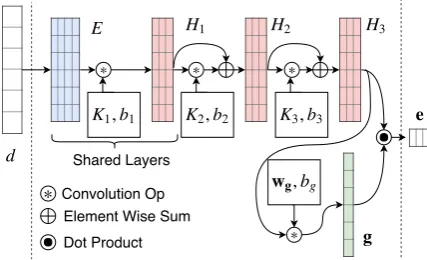
We depict our encoder architecture in Figure
2. The input to our encoder is the sequence of wordsd= (w1, ..., wN)which are mapped tom
-dimensional word embeddingsE= [e1, ...,eN].
These are passed through sequential convolutional
Figure 1: We propose associating aspects with en-coders (low-level parameters are shared across as-pects; this is not shown) and training these with triplets codifying aspect-wise relative similarities. all other aspects a0: In this case the model will
use only the embeddings for aspectato represent
similarities. In general, we expect a compromise between these extremes, and propose using nega-tive sampling to enable the model to learn targeted aspect-specific encodings.
2.2 Encoder Architecture
Designing an aspect-based model requires speci-fying an encoder architecture. One consideration here is interpretability: a desirable property for aspect encoders is the ability to identify salient words for a given aspect. With this in mind, we propose using gated CNNs, which afford intro-spection via the token-wise gate activations.
Figure2 schematizes our encoder architecture. The input is a sequence of word indices d = (w1, ..., wN)which are mapped tom-dimensional
word embeddings and stacked into a matrixE = [e1, ...,eN]. These are passed through sequential
convolutional layersC1, ..., CL, which induce
rep-resentationsHl∈RN×k:
Hl =fe(X∗Kl+bl) (2)
whereX ∈ RN×k is the input to layerCl (either
a set ofn-gram embeddings orHl−1) andkis the
number of feature maps. Kernel Kl ∈ RF×k×k
andbl∈Rkare parameters to be estimated, where F is the size of kernel window.3 An activation
functionfe is applied element-wise to the output
of the convolution operations. We fix the size of
Hl−1 ∈ RN×kby zero-padding where necessary.
Keeping the size of feature maps constant across layers allows us to introduce residual connections; the output of layerlis summed with the outputs of
preceding layers before being passed forward. We multiply the output of the last convolutional layerHL ∈ RN×kwith gatesg ∈RN×1 to yield
3The input toC
∗ , wg bg
g ,
K1 b1 ∗ E
Shared Layers
∗ H1
, K2 b2
H3
∗ H2
,
K3 b3 e
Convolution Op Element Wise Sum
Dot Product
∗ d
[image:3.595.73.287.64.194.2]
Figure 2: Schematic of our encoder architecture. our final embeddinged∈R1×k:
g=σ(HL·wg+bg)
ed=gTHL
(3) wherewg ∈Rk×1 andbg ∈Rare learned
param-eters andσis the sigmoid activation function. We
impose a sparsity-inducing constraint ongvia the `1 norm; this allows the gates to effectively serve
as an attention mechanism over the input. Addi-tionally, to capture potential cross-aspect correla-tion, weights in the embedding and first convolu-tional layers are shared between aspect encoders.
Alternative encoders. To assess the relative im-portance of the specific encoder model architec-ture used, we conduct experiments in which we fine-tune standard document representation mod-els via triplet-based training. Specifically, we con-sider a single-layer MLP with BoW inputs, and a Neural Variational Document Model (NVDM)
(Miao et al., 2016). For the NVDM we take a
weighted sum of the original loss function and the triplet-loss over the learned embeddings, where the weight is a model hyperparameter.
3 Varieties of Supervision
Our approach entails learning from triplets that codify relative similarity judgments with respect to specific aspects. We consider two approaches to acquiring such triplets: the first exploits aspect-specific summaries written for texts, and the sec-ond assumes a more general scenario in which we solicit aspect-wise triplet judgments directly.
3.1 Deriving Triplets from Aspect Summaries
In the case of our motivating example – disentan-gled representations for articles describing clini-cal trials – we have obtained aspect-specific sum-maries from the Cochrane Database of
System-atic Reviews (CDSR). Cochrane is an international organization that creates and curates biomedical
systematic reviews. Briefly, such reviews seek to formally synthesize all relevant articles to answer precise clinical questions, i.e., questions that spec-ify a particular PICO frame. The CDSR consists of a set of reviews {Ri}. Reviews include
mul-tiple articles (studies) {Sij}. Each study S
con-sists of an abstract Aand a set of free text
sum-maries(sP, sI, sO) written by reviewers
describ-ing the respective P, I and O elements inS.
Reviews implicitly specify PICO frames, and thus two studies in any given review may be viewed as equivalent with respect to their PICO aspects. We use this observation to derive docu-ment triplets. Recall that triplets for a given as-pect include two comparatively similar texts (s,d)
and one relatively dissimilar (o). Suppose the as-pect of interest is the trial population. Here we match a given abstract (d) with its matched
popu-lation summary from the CDSR (s); this encour-ages the encoder to yield similar embeddings for the abstract and the population description. The dissimilarois constructed to distinguish the given
abstract from (1) other aspect encodings (of inter-ventions, outcomes), and, (2) abstracts for trials with different populations.
Concretely, to construct a triplet(s, d, o)for the
PICO data, we draw two reviewsR1andR2 from
the CDSR at random, and sample two studies from the first (s1, s01) and one from the second (s2).
In-tuitively, s2 will (very likely) comprise entirely
different PICO elements than (s1, s01), by virtue
of belonging to a different review. To formal-ize the preceding description, our triplet is then:
(s= [s01P], d= [sabstract1 ], o= [s2P|s01I|s01O]), where sabstract1 is the abstract for studys1, and aspect
sum-maries for studies are denoted by superscripts. We include a concrete example of triplet construction in the Appendix, Section D.
3.2 Learning Directly from Aspect-Wise Similarity Judgments
The preceding setup assumes a somewhat unique case in which we have access to aspect-specific summaries written for texts. As a more general setting, we also consider learning directly from triplet-wise supervision concerning relative simi-larity with respect to particular aspects (Amid and
Ukkonen, 2015; Veit et al., 2017a;Wilber et al.,
4686
be solicited directly from annotators, and thus the approach may be applied to arbitrary domains, so long as meaningful aspects can be defined implic-itly via pairwise similarities regarding them.
We do not currently have corpora with such judgments in NLP, so we constructed two datasets using aspect-specific sentiment ratings. Note that this highlights the flexibility of exploiting aspect-wise triplet supervision as a means of learning disentangled representations: existing annotations can often be repurposed into such triplets.
4 Datasets and Experiments
We present a series of experiments on three cor-pora to assess the degree to which the learned rep-resentations are disentangled, and to evaluate the utility of these embeddings in simple downstream retrieval tasks. We are particularly interested in the ability to identify documents similar w.r.t. a target aspect. All parameter settings for baselines are re-ported in the Appendix (along with additional ex-perimental results). The code is available at
https://github.com/successar/neural-nlp.
4.1 PICO (EBM) Domain
We first evaluate embeddings quantitatively with respect to retrieval performance. In particular, we assess whether the induced representations afford improved retrieval of abstracts relevant to a partic-ular systematic review (Cohen et al., 2006;
Wal-lace et al., 2010). We then perform two
evalua-tions that explicitly assess the degree of disentan-glement realized by the learned embeddings.
The PICO dataset comprises 41K abstracts of articles describing clinical trials extracted from the CDSR. Each abstract is associated with a review and three summaries, one per aspect (P/I/O). We keep all words that occur in≥5 documents, con-verting all others tounk. We truncate documents to a fixed length (set to the 95th percentile).
4.1.1 Quantitative Evaluation
Baselines. We compare the proposedP,I andO
embeddings and their concatenation[P|I|O]to the
following. TF-IDF: standard TF-IDF representa-tion of abstracts. RR-TF: concatenated TF-IDF vectors of sentences predicted to describe the re-spective PICO elements, i.e., sentence predictions made using the pre-trained model from (Wallace
et al.,2016) — this model was trained using
dis-tant supervision derived from the CDSR.doc2vec: standard (entangled) distributed representations of
abstracts (Le and Mikolov, 2014). LDA: Latent Dirichlet Allocation.NVDM: A generative model of text where the representation is a vector of log-frequencies that encode a topic (Miao et al.,2016).
ABAE: An autoencoder model that discovers la-tent aspects in sentences (He et al.,2017). We ob-tain document embeddings by summing over con-stituent sentence embeddings. DSSM: A CNN based encoder trained with triplet loss over ab-stracts (Shen et al.,2014).
Hyperparameters and Settings. We use three layers for our CNN-based encoder (with 200 filters in each layer; window size of 5) and the PReLU activation function (He et al.,2015) asfe. We use
200d word embeddings, initialized via pretraining over a corpus of PubMed abstracts (Pyysalo et al.,
2013). We used the Adam optimization function with default parameters (Kingma and Ba, 2014). We imposed`2regularization over all parameters,
the value of which was selected from the range (1e-2, 1e-6) as 1e-5. The `1 regularization
pa-rameter for gates was chosen from the range (1e-2, 1e-8) as1e-6. All model hyperparameters for our models and baselines were chosen via line search over a 10% validation set.
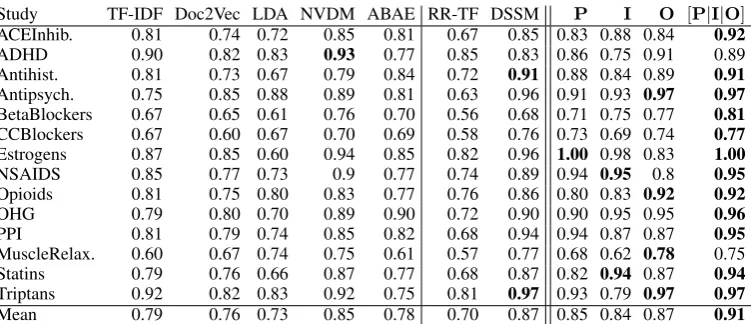
Metric. For this evaluation, we used a held out set of 15 systematic reviews (comprising 2,223 stud-ies) compiled byCohen et al.(2006). The idea is that good representations should map abstracts in the same review (which describe studies with the same PICO frame) relatively near to one another. To compute AUCs over reviews, we first calculate all pairwise study similarities (i.e., over all studies in the Cohen corpus). We can then construct an ROC for a given abstract a from a particular
re-view to calculate its AUC: this measures the prob-ability that a study drawn from the same review will be nearer to athan a study from a different
review. A summary AUC for a review is taken as the mean of the study AUCs in that review.
Results. Table1reports the mean AUCs over in-dividual reviews in theCohen et al.(2006) corpus, and grand means over these (bottom row). In brief: The proposed PICO embeddings (concatenated) obtain an equivalent or higher AUC than base-line strategies on 12/14 reviews, and strictly higher AUCs in 11/14. It is unsurprising that we outper-form unsupervised approaches, but we also best RR-TF, which was trained with the same CDSR corpus (Wallace et al., 2016), and DSSM (Shen
Study TF-IDF Doc2Vec LDA NVDM ABAE RR-TF DSSM P I O [P|I|O]
ACEInhib. 0.81 0.74 0.72 0.85 0.81 0.67 0.85 0.83 0.88 0.84 0.92
ADHD 0.90 0.82 0.83 0.93 0.77 0.85 0.83 0.86 0.75 0.91 0.89 Antihist. 0.81 0.73 0.67 0.79 0.84 0.72 0.91 0.88 0.84 0.89 0.91
Antipsych. 0.75 0.85 0.88 0.89 0.81 0.63 0.96 0.91 0.93 0.97 0.97
BetaBlockers 0.67 0.65 0.61 0.76 0.70 0.56 0.68 0.71 0.75 0.77 0.81
CCBlockers 0.67 0.60 0.67 0.70 0.69 0.58 0.76 0.73 0.69 0.74 0.77
Estrogens 0.87 0.85 0.60 0.94 0.85 0.82 0.96 1.00 0.98 0.83 1.00
NSAIDS 0.85 0.77 0.73 0.9 0.77 0.74 0.89 0.94 0.95 0.8 0.95
Opioids 0.81 0.75 0.80 0.83 0.77 0.76 0.86 0.80 0.83 0.92 0.92
OHG 0.79 0.80 0.70 0.89 0.90 0.72 0.90 0.90 0.95 0.95 0.96
PPI 0.81 0.79 0.74 0.85 0.82 0.68 0.94 0.94 0.87 0.87 0.95
MuscleRelax. 0.60 0.67 0.74 0.75 0.61 0.57 0.77 0.68 0.62 0.78 0.75 Statins 0.79 0.76 0.66 0.87 0.77 0.68 0.87 0.82 0.94 0.87 0.94
Triptans 0.92 0.82 0.83 0.92 0.75 0.81 0.97 0.93 0.79 0.97 0.97
[image:5.595.112.488.60.222.2]Mean 0.79 0.76 0.73 0.85 0.78 0.70 0.87 0.85 0.84 0.87 0.91
Table 1: AUCs achieved using different representations on the Cohen et al. corpus. Models to the right of the|are supervised; those to the right of||constitute the proposed disentangled embeddings.
in a clinical trial mainly involving patients over qqq with coronary heart disease , ramipril reduced mortality while vitamin e had no preventive effect .
in a clinical trial mainly involving patients over qqq with coronary heart disease , ramipril reduced mortality while vitamin e had no preventive effect .
in a clinical trial mainly involving patients over qqq with coronary heart disease , ramipril reduced mortality while vitamin e had no preventive effect .
Table 2: Gate activations for each aspect in a PICO abstract. Note that because gates are calculated at the final convolution layer, activations are not in exact 1-1 correspondence with words.
as our model. We outperform the latter by an aver-age performance gain of 4 points AUC (significant at 95% level using independent 2-sample t-test).
We now turn to the more important questions: are the learned representations actually disentan-gled, and do they encode the target aspects? Ta-ble2shows aspect-wise gate activations for PICO elements over a single abstract; this qualitatively suggests disentanglement, but we next investigate this in greater detail.
4.1.2 Qualitative Evaluation
To assess the degree to which our PICO embed-dings are disentangled – i.e., capture complemen-tary information relevant to the targeted aspects – we performed two qualitative studies.
First, we assembled 87 articles (not seen in training) describing clinical trials from a review on the effectiveness of decision aids (Stacey et al.,
2014) for: women with, at risk for, and geneti-cally at risk for, breast cancer (BCt, BCs and BCg, respectively); type II diabetes (D); menopausal women (MW); pregnant women generally (PW)
and those who have undergone a C-section previ-ously (PWc); people at risk for colon cancer (CC); men with and at risk of prostate cancer (PCt and PCs, respectively) and individuals with atrial fib-rillation (AF). This review is unusual in that it
studies a single intervention (decision aids) across different populations. Thus, if the model is suc-cessful in learning disentangled representations, the corresponding P vectors should roughly clus-ter, while the I/C should not.
Figure3 shows a TSNE-reduced plot of the P, I/C and O embeddings induced by our model for these studies. Abstracts are color-coded to indi-cate the populations enumerated above. As hy-pothesized, P embeddings realize the clearest sep-aration with respect to the populations, while the I and O embeddings of studies do not co-localize to the same degree. This is reflected quantitatively in the AUC values achieved using each aspect em-bedding (listed on the Figure). This result implies disentanglement along the desired axes.
Next we assembled 50 abstracts describing trials involving hip replacement arthroplasty