74
Unsupervised Token-wise Alignment to
Improve Interpretation of Encoder-Decoder Models
Shun Kiyono1∗ Sho Takase2 Jun Suzuki1,2,4
Naoaki Okazaki3 Kentaro Inui1,4 Masaaki Nagata2
1Tohoku University 2 NTT Communication Science Laboratories
3Tokyo Institute of Technology 4RIKEN Center for Advanced Intelligence Project
{kiyono,jun.suzuki,inui}@ecei.tohoku.ac.jp,
{takase.sho, nagata.masaaki}@lab.ntt.co.jp,
Abstract
Developing a method for understanding the in-ner workings of black-box neural methods is an important research endeavor. Convention-ally, many studies have used an attention ma-trix to interpret how Encoder-Decoder-based models translate a given source sentence to the corresponding target sentence. However, re-cent studies have empirically revealed that an attention matrix is not optimal for token-wise translation analyses. We propose a method that explicitly models the token-wise align-ment between the source and target sequences to provide a better analysis. Experiments show that our method can acquire token-wise align-ments that are superior to those of an attention mechanism1.
1 Introduction
The Encoder-Decoder model with an attention mechanism (EncDec) (Sutskever et al.,2014;Cho et al., 2014;Bahdanau et al.,2015;Luong et al.,
2015) has been an epoch-making development that has led to great progress in many natural language generation tasks, such as machine translation ( Bah-danau et al.,2015), dialog generation (Shang et al.,
2015), and headline generation (Rush et al.,2015). An enormous number of studies have attempted to enhance the ability of EncDec.
Furthermore, several intensive studies have also attempted to analyze and interpret the inside of black-box EncDec models, especially how they translate a given source sentence to the correspond-ing target sentence (Ding et al.,2017). One typical approach to this is to visualize an attention matrix, which is a collection of attention vectors (Bahdanau et al.,2015;Luong et al.,2015;Tu et al.,2016).
∗
This work is a product of collaborative research pro-gram of Tohoku University and NTT Communication Science Laboratories.
1Our code for reproducing the experiments is available at https://github.com/butsugiri/UAM
The assumption behind this interpretation is that the attention matrix has a “soft” token-wise align-ment between the source and target sequences, and thus we can use EncDec models to skim which to-kens in the source are converted to which toto-kens in the target.
However, recent studies have empirically re-vealed that an attention model can operate not only for token-wise alignment but also for other func-tionalities, such as reordering (Ghader and Monz,
2017;Liu et al.,2016). In addition,Luong et al.
(2015) reported that the quality of attention matrix-based alignment is quantitatively inferior to that of the Berkeley aligner (Liang et al.,2006). Koehn and Knowles(2017) also reported that attention matrix-based alignment is significantly different from that acquired from an off-the-shelf aligner for English-German language pairs. From these re-cent findings, the goal of this paper is to provide a method that can offer a better interpretation of how EncDec models translate a given source sentence to the corresponding target sentence.
In this paper, we focus exclusively on the head-line generation task, which is categorized as a
lossy-compressiongeneration (lossy-gen) task (Nallapati
et al.,2016). Compared with a machine translation task, which is categorized as aloss-less genera-tion (lossless-gen) task, the headline generation task additionally requires EncDec models to ap-propriately select salient ideas in given source sen-tences (Suzuki and Nagata,2017). Therefore, the
lossy-gentask seems to make modeling by EncDec
much harder. In fact, our preliminary experiments revealed that the attention mechanism in EncDec models largely fails to capture token-wise align-ments, e.g., less than 10 percent accuracy, even if we use one of the current state-of-the-art EncDec models (Table3).
corre-sponding target sentence in the headline generation task, this paper introduces the Unsupervised token-wise Alignment Module (UAM), a novel compo-nent that can be plugged into EncDec models. Un-like a conventional attention model, the proposed UAM explicitly captures token-wise alignments between the source and target sequences on the final hidden layer. One can plug the UAM into a EncDec model during a training phase and easily understand the EncDec model’s behavior by analyz-ing the UAM’s token-wise alignments. Moreover, the UAM does not require any gold alignment data. To demonstrate the effectiveness of the UAM, we evaluate EncDec models with the UAM in the headline generation task (Rush et al., 2015), a widely used benchmark for EncDec models. Our experiments show that (i) EncDec models with a UAM achieve comparable (or even superior) per-formance to the current state-of-the-art headline generation model, and (ii) the produced token-wise alignment is practical regardless of the absence of gold alignment during its training phase.
2 Headline Generation Task
We address the headline generation task introduced inRush et al.(2015). The source (input) is the first sentence of a news article, and the target (output) is the article’s headline. We sayI andJ represent the numbers of tokens in the source and target, respectively. An important assumption in headline generation is that the target must be shorter than the source (I > J).
Here, we denote a source sequence as sequence X of one-hot vectors. Let xi ∈ {0,1}Vs
repre-sent the one-hot vector of the i-th token in X, whereVs represents the number of tokens in the
source-side vocabularyVs. We usex1:I to
repre-sent(x1, . . . ,xI); namely,X = x1:I. Similarly,
letyj ∈ {0,1}Vt represent the one-hot vector of
thej-th token in target sequenceY, whereVtis
the number of tokens in the target-side vocabulary Vt. Here, we defineY as always containing two
additional one-hot vectors of special tokenshbosi fory0andheosiforyJ+1, namely,Y =y0:J+1.
3 Encoder-Decoder Model with
Attention Mechanism (EncDec)
This section briefly describes EncDec as the base model of our method2.
2Our EncDec configuration follows the model described
inLuong et al.(2015).
3.1 Model Definition
EncDec models the following conditional probabil-ity:
p(Y|X) =
J+1
Y
j=1
p(yj|y0:j−1,X). (1)
Encoder EncDec encodes the source one-hot
vector sequencex1:Iand generates the hidden state
sequenceh1:I, wherehi ∈RH for alliandHis the size of the hidden state.
We employ bidirectional RNN (BiRNN) as the encoder of the base model. BiRNN is composed of two separate RNNs for the forward (−−−→RNNsrc) and backward (←−−−RNNsrc) directions. The forward RNN reads the source sequence X from left to right and constructs hidden states(~h1:I). Similarly, the
backward RNN reads the input in the reverse order to obtain another sequence of hidden states(h~ 1:I).
Finally, we take the summation of hidden states in each direction to construct the final representation of the source sequence(h1:I).
Concretely, for a given time stepi, the represen-tationhiis constructed as follows:
~
hi =
−−−→
RNNsrc(Esxi, ~hi−1), (2)
~
hi =
←−−−
RNNsrc(Esxi, ~hi+1), (3)
hi =~hi+h~ i (4)
whereEs∈RD×Vs denotes the word embedding matrix of the source-side andDdenotes the size of word embedding.
Decoder The decoder is the unidirectional RNN
in the input-feeding approach (Luong et al.,2015). Concretely, decoder RNN takes the output of the previous time stepyj−1, decoder hidden statez~j−1 and final hidden state zj−1 to derive the hidden state of current time stepzj:
~
zj =
−−−→
RNNtrg(Etyj−1,zj−1, ~zj−1), (5)
~
z0 =~hI+h~ 1 (6)
whereEt∈RD×Vt denotes the word embedding matrix of the decoder. Here,z0is defined as a zero vector.
Attention Mechanism The attention
architec-ture of the base model is the same as that of the
Global Attentionmodel proposed byLuong et al.
the final hidden statezj from the decoder hidden
statez~j and encoder hidden states(h1:I).
First, the model computes the attention vector αj ∈ RI from the decoder hidden state ~zj and
encoder hidden states(h1:I). From among three
attention scoring functions proposed inLuong et al.
(2015), we employ ageneralfunction. This func-tion calculates the attenfunc-tion score in bilinear form. Specifically, the attention score between thei-th source hidden state and the j-th decoder hidden state is computed by the following equation:
αj[i] =
exp(h>i Wαz~j)
PI
i=1exp(h>i Wαz~j)
(7)
where Wα ∈ RH×H is a parameter matrix, and
αj[i]denotes thei-th element ofαj.
αj is then used for collecting the source-side
information that is relevant for predicting the target token. This is done by taking the weighted sum on the encoder hidden states:
cj = I
X
i=1
αj[i]hi (8)
Next, the source-side information is mixed with the decoder hidden state to derive final hidden state zj. Concretely, the context vectorcj is
concate-nated withz~j to form vectoruj ∈R2H.ujis then
fed into a single fully-connected layer withtanh nonlinearity:
zj = tanh(Wsuj) (9)
whereWs ∈RH×2H is a parameter matrix. Finally, zj is fed into the softmax layer. The
model generates a target-side token based on the probability distributionoj ∈RVt as
oj = softmax(Wozj+bo), (10)
where Wo ∈ RVt×H is a parameter matrix and
bo∈RVtis a bias term.
3.2 Training of EncDec
To train EncDec, let Dbe training data for head-line generation, which consists of source-headhead-line sentence pairs. Letθrepresent all parameters in EncDec. Our goal is to find the optimal param-eter setθˆthat minimizes the following objective functionG0(θ)for the given training dataD:
G0(θ) = 1 |D|
X
(X,Y)∈D
`trg(Y,X, θ),
`trg(Y,X, θ) =−log
p(Y|X, θ). (11)
Target Pred. (𝒐":$)
share prices exchange thursday .
london share <eos> <null> <null>
+ +
+ +
𝒙& 𝒒&
Sentence-wise Loss (Equation 18) ℓ)*+
Final Hidden
(𝒛":$)
Source Pred. (𝒒":$)
Source
(𝑿)
Encoder-Decoder (EncDec) UAM
Computation Alignment
[image:3.595.311.527.66.217.2]Pair
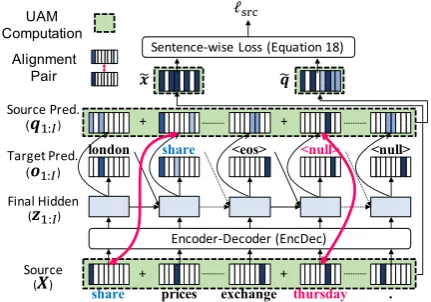
Figure 1: Overview of EncDec with UAM. UAM predicts the probability distribution over the source vocabularyqjat each time stepj. After predicting
all the time steps, the SPM compares the sum of the predictionsq˜with the sum of the source-side tokensx˜as an objective function`src.
Sinceojfor eachjis a vector representation of the
probabilities ofp( ˆy|y0:j−1,X, θ)over the target vocabulariesyˆ∈ Vt, we can calculate`trg as
`trg(Y,X, θ) =−
J+1
X
j=1
yj>·log oj
. (12)
3.3 Inference of EncDec
In the inference step, we use the trained param-eters to search for the best target sequence. We use beam search to find the target sequence that maximizes the product of the conditional proba-bilities as described in Equation1. From among several stopping criteria for beam search (Huang et al., 2017), we adopt the widely used “shrink-ing beam” implemented in RNNsearch (Bahdanau et al.,2015)3.
4 Proposed Method: Unsupervised
Alignment Module (UAM)
Figure1 illustrates the proposed method, UAM. UAM is the module attached on top of the decoder output layer of an EncDec model, and it explicitly represents a token-wise alignment by predicting source tokens simultaneously with target tokens.
Specifically, during the training of EncDec, the decoder estimates the probability distribution over the source-side vocabulary, qj ∈ RVs, simulta-neously with that of the target-side vocabulary,
3https://github.com/lisa-groundhog/
oj ∈RVt, for each time stepj. In Figure1, when the decoder predicts the target-side token “share”, we want to predict its corresponding source-side token “share.” If we can correctly predict the cor-responding source-side token for each target-side token, we can obtain token-wise alignment. As shown below, we can train the model for this pre-diction without gold token-wise alignment signals. This way of representing alignments can be extended to hnulli alignments. We first expand a given target sequence with a se-quence of hnullis so that its length is the same as that of the source sequence (in Figure 1, we extend “london share. . .heosi” to “london share. . .heosihnulli. . .hnulli”). We then train the model so that it can predict a discarded source-side token (e.g., “thursday”) when it predictshnulli for the target-side. Through the task of predicting source-side tokens corresponding to hnullis, we expect the model to effectively learn to identify unimportant information in the source sequence.
4.1 Model Definition
EncDec with UAM jointly estimates the probabil-ity distributions over the source and target vocab-ularies. Specifically, UAM estimates a probability distribution over the source vocabularyqj ∈RVs at each time stepjin the decoding process by:
qj = softmax(Wqzj+bq), (13)
whereWq ∈ RVs×H is a parameter matrix,zj ∈
RH is a decoder’s final hidden layer, andbq∈RVs is a bias term. H is the size of the hidden state. EncDec also calculates a probability distribution over target vocabularyoj from the same vectorzj.
Next, we defineY0as a concatenation of the one-hot vectors of the target-side sequenceY and those of the special tokenhnulliof lengthI −(J + 1). Here, yJ+1 is a one-hot vector of heosi, and yj
for each j ∈ {J + 2, . . . , I} is a one-hot vector ofhnulli. Note that the length ofY0 is always no shorter than that ofY, that is,|Y0| ≥ |Y|because headline generation always assumesI > J.
Based on this setting, we train the model in an un-supervised manner without gold alignment signals. To this end, we consider a sentence-wise loss func-tion instead of token-wise loss. Specifically, we define the sentence-wise loss as the degree of differ-ence between the sum of all one-hot vectors in the source sequence and the sum of UAM predictions. Namely, we take the difference ofx˜ = PI
i=1xi
and q˜ = PI
j=1qj. Note thatx˜ is a vector
rep-resentation of the occurrences (or bag-of-words representation) of the source-side tokens. To min-imize sentence-wise loss, the model must predict the bag-of-words representation. Through this opti-mization, the model is expected to eventually find the token-wise alignment.
EncDec with UAM models the following condi-tional probability:
p(Y0,x˜|X) =p( ˜x|Y0,X)p(Y0|X). (14)
We definep(Y0|X)as follows:
p(Y0|X) =
I
Y
j=1
p(yj|y0:j−1,X), (15)
which is identical to the conditional probability modeled by the base EncDec, except for consid-ering hnullias part of the probability. Next, we definep( ˜x|Y0,X)as follows:
p( ˜x|Y0,X) = 1
Z exp
−k
˜
q−x˜k2 2
C
, (16)
whereZis a normalization term andCis a hyper-parameter that controls the sensitivity of the distri-bution.
4.2 Training of UAM
We optimize the UAM combined with EncDec by minimizing the negative log-likelihood of Equation
14as a loss function. Letγrepresent the parameter set of SPM Then, we define the UAM loss`srcas follows;
`src( ˜x,X,Y0, γ, θ) =−log(p( ˜x|Y0,X, γ, θ)) (17)
From Equation16, we can derive`srcas
`src( ˜x,X,Y0,γ, θ) = 1
Ckq˜−x˜k
2
2+ log(Z). (18)
We can discardlog(Z)from the RHS, since it is independent ofγandθ.
Here, we regard the sum of `src and`trg as an objective loss function of multi-task training. For-mally, we train EncDec with the UAM by minimiz-ing the followminimiz-ing objective functionG1:
G1(θ, γ) = 1 |D|
X
(X,Y)∈D
`trg(Y0,X, θ)
+`src( ˜x,X,Y0, γ, θ)
, (19)
4.3 Inference of UAM
In the inference time, the goal is only to search for the best target sequence. Thus, we do not need to compute the UAM during the inference. Similarly, it is unnecessary to producehnulliafter generating heosi. Thus, we can utilize the beam search proce-dure described in Section3.3, and as a result the actual computation cost for the inference remains unchanged from the base EncDec.
5 Experiment
5.1 Dataset
The origin of the headline generation dataset used in our experiments is identical to that used inRush et al.(2015). The dataset consists of pairs of the first sentence of each article and its headline from the annotated English Gigaword corpus (Napoles et al.,2012). Rush et al.(2015) defined the train-ing, validation and test splits, which contain ap-proximately 3.8M, 200K and 400K source-headline pairs, respectively
We used the entire training split for training as in the previous studies. We randomly sampled 8K instances as validation data and 10K instances as test data from the validation split. Moreover, we experimented on the test data provided byZhou et al.(2017) andToutanova et al.(2016) for com-parison with the reported state-of-the-art perfor-mance (Zhou et al.,2017). We refer to those test data sets as Test (Ours), Test (Zhou), and ATC respectively. Among these test sets, MSR-ATC is the only dataset created by a human worker.
5.2 Implementation Details
In the experiment, we selected the hyper-parameter settings commonly used in previous studies e.g., (Rush et al., 2015; Nallapati et al., 2016;
Suzuki and Nagata,2017) We constructed the vo-cabulary set using byte pair encoding4(BPE) ( Sen-nrich et al.,2016) to handle low-frequency words, since this is now a common practice in the field of neural machine translation. The BPE merge oper-ations are jointly learned from the source and the target. We set the number of BPE merge operations at5,000.
4https://github.com/rsennrich/
subword-nmt
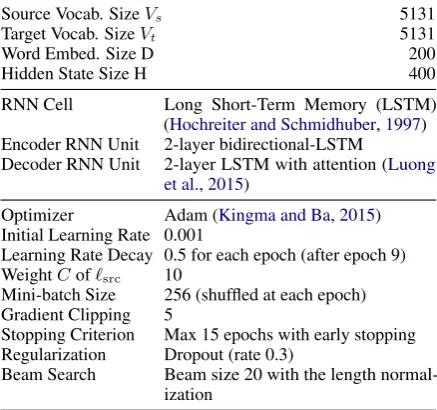
Source Vocab. SizeVs 5131
Target Vocab. SizeVt 5131
Word Embed. Size D 200
Hidden State Size H 400
RNN Cell Long Short-Term Memory (LSTM) (Hochreiter and Schmidhuber,1997) Encoder RNN Unit 2-layer bidirectional-LSTM
Decoder RNN Unit 2-layer LSTM with attention (Luong et al.,2015)
Optimizer Adam (Kingma and Ba,2015) Initial Learning Rate 0.001
Learning Rate Decay 0.5 for each epoch (after epoch 9) WeightCof`src 10
Mini-batch Size 256 (shuffled at each epoch) Gradient Clipping 5
Stopping Criterion Max 15 epochs with early stopping Regularization Dropout (rate 0.3)
[image:5.595.307.526.64.269.2]Beam Search Beam size 20 with the length normal-ization
Table 1: Configurations used in our experiments
5.3 Evaluation Metric
We evaluated the performance by ROUGE-1 (RG-1), ROUGE-2 (RG-2) and ROUGE-L (RG-L)5. We report the F1 value as given in a previous study6. We computed the ROUGE scores using the official ROUGE script (version 1.5.5).
5.4 Results
To investigate the effectiveness of the UAM quantitatively, we chose a very strong baseline, SEASS (Zhou et al., 2017), which is the cur-rent state-of-the-art model. We reimplemented SEASS, hereafter EncDec+sGate, and compared EncDec+sGate with the model incorporating UAM into EncDec+sGate.
Table 2 summarizes ROUGE-F1 results
for all test data. The table shows that EncDec+sGate+UAM achieved a huge gain particularly for MSR-ATC and a performance comparable to EncDec+sGate in Test (Ours) and Test (Zhou). Considering that the MSR-ATC dataset was created by a human worker, we believe that the improvement in MSR-ATC is the most remarkable result among the three test sets, since it indicates that our model most closely fits the human-generated summary.
6 Discussion
We investigated whether the UAM improves token-wise alignment between the source and target
se-5
We restored sub-words to the standard token split for the evaluation.
Test (Ours) Test (Zhou) MSR-ATC
Model RG-1 RG-2 RG-L RG-1 RG-2 RG-L RG-1 RG-2 RG-L
EncDec+sGate 46.80 24.48 43.74 46.79 24.75 43.62 29.73 15.45 27.30 EncDec+sGate+UAM† 46.91 24.86 43.87 46.89 24.93 43.68 32.32 17.02 29.76
[image:6.595.97.500.63.135.2]SEASS (Zhou et al.,2017) - - - 46.86 24.58 43.53 25.75 10.63 22.90
Table 2: Full-length ROUGE F1 evaluation results.†is the proposed model.
quences. We compared the alignments acquired by the UAM and the attention model, since attention has been implicitly considered as alignment ( Bah-danau et al., 2015;Luong et al., 2015;Tu et al.,
2016).
6.1 Visualizing UAM and Attention
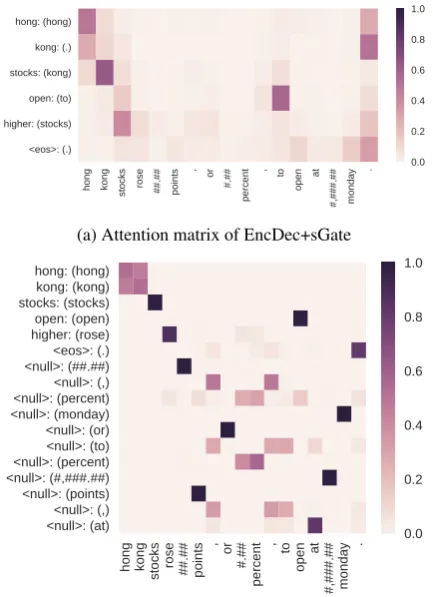
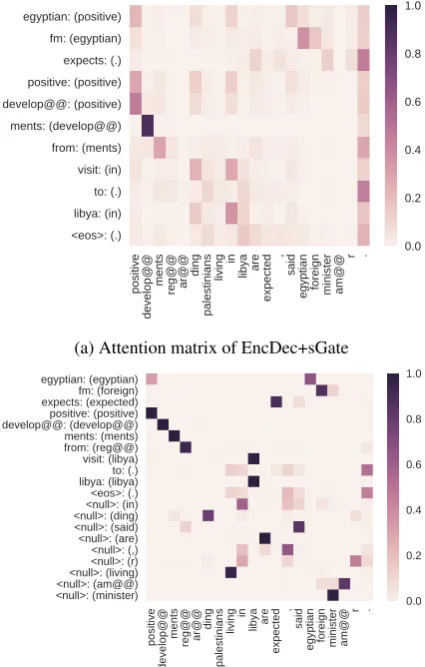
We visualized UAM prediction and the attention matrix to see the acquired token-wise alignment be-tween the source and target. Specifically, we fed the source-target pair(X,Y)to EncDec+sGate and EncDec+sGate+UAM, and then collected UAM predictions (q1:I) of EncDec+sGate+UAM and the
attention vectors (α1:J) of EncDec+sGate. We
computed the attention vectors using Equation7. For UAM prediction, we extracted the probability of each tokenxi∈X fromq1:I.
Figure2and3show an example of the heat map. We used Test (Ours) as the input. The brackets in the y-axis represent the source-side tokens that are aligned with target-side tokens. We obtained the aligned tokens as follows: For attention (Fig-ure 2a, 3a), we select the token with the largest attention value. For the UAM (Figure2b,3b), we select the token with the largest probability over the vocabularyVs.
Figure2aindicates that attention provides poor token-wise alignment. For example, the target-side token “kong” is incorrectly aligned with the source-side sentence period. In contrast, Fig-ure 2bshows that the UAM captures reasonable alignments. Here, the source-side token “rose” is aligned with the target-side token “higher.” UAM also correctly aligned unimportant tokens such as “##.##” withhnulli.
In Figure3a, the attention model repeatedly pays attention to the source-side token “positive.” As a result, the attention model aligned the target-side token “egyptian” to “positive.” On the other hand, in3b, the UAM correctly aligns “egyptian.” In addi-tion, the UAM aligned source-side token “foreign” with target-side token “fm.”
hong kong stocks rose ##.## points , or #.##
percent
, to open at
#,###.## monday
.
<eos>: (.) higher: (stocks) open: (to) stocks: (kong) kong: (.) hong: (hong)
0.0 0.2 0.4 0.6 0.8 1.0
(a) Attention matrix of EncDec+sGate
hong kong stocks rose ##.## points , or #.## percent , to open at #,###.## monday
.
<null>: (at)<null>: (,) <null>: (points) <null>: (#,###.##)<null>: (percent) <null>: (to) <null>: (or) <null>: (monday)<null>: (percent) <null>: (,) <null>: (##.##)<eos>: (.) higher: (rose)open: (open) stocks: (stocks)kong: (kong) hong: (hong)
0.0 0.2 0.4 0.6 0.8 1.0
(b) UAM prediction of EncDec+sGate+UAM
Figure 2: Visualization of models. The x-axis and y-axis correspond to the source and the target se-quence respectively. Tokens in the brackets are source-side tokens aligned at that time step.
6.2 Alignment Accuracy
In order to quantitatively investigate the quality of the alignment, we evaluated the alignment accuracy of both EncDec+sGate and EncDec+sGate+UAM. We randomly sampled 40, 30 and 30 instances from Test (Ours), Test (Zhou) and MSR-ATC re-spectively. We acquired the alignment of the data by applying the UAM and the attention model, in the same manner as described in Section6.1. A single annotator then evaluated the accuracy of the alignment by hand.
[image:6.595.309.526.181.480.2]Model Test (Ours) Test (Zhou) MSR-ATC Overall
EncDec+sGate 8.60 5.97 6.11 6.71
[image:7.595.75.288.152.486.2]EncDec+sGate+UAM 52.52 50.91 51.07 51.41
Table 3: Alignment Macro Accuracy (%)
positive
develop@@
ments reg@@ ar@@ ding
palestinians
living in libya are
expected
,
said
egyptian foreign minister am@@ r . <eos>: (.)
libya: (in) to: (.) visit: (in) from: (ments) ments: (develop@@) develop@@: (positive) positive: (positive) expects: (.) fm: (egyptian) egyptian: (positive)
0.0 0.2 0.4 0.6 0.8 1.0
(a) Attention matrix of EncDec+sGate
positive
develop@@
ments reg@@ ar@@ ding
palestinians
living in libya are
expected
,
said
egyptian foreign minister am@@ r . <null>: (minister)<null>: (am@@)
<null>: (living)<null>: (r) <null>: (,) <null>: (are) <null>: (said) <null>: (ding)<null>: (in) <eos>: (.) libya: (libya)to: (.) visit: (libya) from: (reg@@) ments: (ments) develop@@: (develop@@)positive: (positive) expects: (expected)fm: (foreign) egyptian: (egyptian)
0.0 0.2 0.4 0.6 0.8 1.0
(b) UAM prediction of EncDec+sGate+UAM
Figure 3: Visualization of models. The x-axis and y-axis correspond to the source and the target se-quence respectively. Tokens in the brackets are source-side tokens aligned at that time step.
that of the attention model. This result is consis-tent with the empirical results reported byKoehn and Knowles(2017) andLuong et al.(2015). The attention alignment mistakes are mostly due to pay-ing attention to either the sentence period or to the token decoded in the previous time step. It is note-worthy that the accuracy of the UAM alignment exceeds 50% even though we trained the model in an unsupervised manner. The fact that the UAM prediction acquires reasonable alignment suggests that the UAM has the potential to provide us a better understanding of the model’s behavior.
7 Conclusion
In this paper, we introduced the Unsupervised token-wise Alignment Module (UAM), which learns to predict the token-wise alignment of to-kens in the source and the target. Experiments on the headline generation task showed that the UAM can achieve comparable performance to the current state-of-the-art sGate model. In addition, the UAM obtained token-wise alignment that is superior to that of the attention model. This finding suggests we can use the UAM as an alternative to the atten-tion matrix to attain a better understanding of the token-wise alignment of EncDec-based model.
Acknowledgment
We are grateful to anonymous reviewers for their insightful comments. We thank Sosuke Kobayashi for providing helpful comments. We also thank Qingyu Zhou for providing a dataset and informa-tion for a fair comparison.
References
Dzmitry Bahdanau, Kyunghyun Cho, and Yoshua Ben-gio. 2015. Neural Machine Translation by Jointly Learning to Align and Translate. InProceedings of the 3rd International Conference on Learning Rep-resentations (ICLR 2015).
Kyunghyun Cho, Bart van Merrienboer, Caglar Gul-cehre, Dzmitry Bahdanau, Fethi Bougares, Hol-ger Schwenk, and Yoshua Bengio. 2014. Learn-ing Phrase Representations usLearn-ing RNN Encoder– Decoder for Statistical Machine Translation. In
Proceedings of the 2014 Conference on Empirical Methods in Natural Language Processing (EMNLP 2014), pages 1724–1734.
Yanzhuo Ding, Yang Liu, Huanbo Luan, and Maosong Sun. 2017. Visualizing and Understanding Neural Machine Translation. InProceedings of the 55th An-nual Meeting of the Association for Computational Linguistics (ACL 2017), pages 1150–1159.
Sepp Hochreiter and J¨urgen Schmidhuber. 1997. Long Short-Term Memory. Neural Computation, 9(8):1735–1780.
Liang Huang, Kai Zhao, and Mingbo Ma. 2017. When to Finish? Optimal Beam Search for Neural Text Generation (modulo beam size). InProceedings of the 2017 Conference on Empirical Methods in Nat-ural Language Processing (EMNLP 2017), pages 2124–2129.
Diederik Kingma and Jimmy Ba. 2015. Adam: A Method for Stochastic Optimization. In Proceed-ings of the 3rd International Conference on Learn-ing Representations (ICLR 2015).
Philipp Koehn and Rebecca Knowles. 2017. Six Chal-lenges for Neural Machine Translation. In Proceed-ings of the First Workshop on Neural Machine Trans-lation, pages 28–39.
Percy Liang, Ben Taskar, and Dan Klein. 2006. Align-ment by AgreeAlign-ment. In Proceedings of the 2006 Conference of the North American Chapter of the Association for Computational Linguistics (NAACL 2006), pages 104–111.
Lemao Liu, Masao Utiyama, Andrew Finch, and Ei-ichiro Sumita. 2016. Neural Machine Translation with Supervised Attention. InProceedings of COL-ING 2016, the 26th International Conference on Computational Linguistics, pages 3093–3102.
Thang Luong, Hieu Pham, and Christopher D. Man-ning. 2015. Effective Approaches to Attention-based Neural Machine Translation. In Proceed-ings of the 2015 Conference on Empirical Methods in Natural Language Processing (EMNLP 2015), pages 1412–1421.
Ramesh Nallapati, Bowen Zhou, Cicero dos Santos, Caglar Gulcehre, and Bing Xiang. 2016. Ab-stractive Text Summarization Using Sequence-to-Sequence RNNs and Beyond. InProceedings of The 20th SIGNLL Conference on Computational Natural Language Learning, pages 280–290.
Courtney Napoles, Matthew Gormley, and Benjamin Van Durme. 2012. Annotated Gigaword. In Pro-ceedings of the Joint Workshop on Automatic Knowl-edge Base Construction and Web-scale KnowlKnowl-edge Extraction, AKBC-WEKEX ’12, pages 95–100.
Alexander M. Rush, Sumit Chopra, and Jason Weston. 2015. A Neural Attention Model for Abstractive Sentence Summarization. In Proceedings of the 2015 Conference on Empirical Methods in Natural Language Processing (EMNLP 2015), pages 379– 389.
Rico Sennrich, Barry Haddow, and Alexandra Birch. 2016. Neural Machine Translation of Rare Words with Subword Units. InProceedings of the 54th An-nual Meeting of the Association for Computational Linguistics (ACL 2016), pages 1715–1725.
Lifeng Shang, Zhengdong Lu, and Hang Li. 2015. Neu-ral Responding Machine for Short-Text Conversa-tion. InProceedings of the 53rd Annual Meeting of the Association for Computational Linguistics and the 7th International Joint Conference on Natural Language Processing (ACL & IJCNLP 2015), pages 1577–1586.
Ilya Sutskever, Oriol Vinyals, and Quoc V. Le. 2014. Sequence to Sequence Learning with Neural Net-works. InAdvances in Neural Information Process-ing Systems 27 (NIPS 2014), pages 3104–3112.
Jun Suzuki and Masaaki Nagata. 2017. Cutting-off Re-dundant Repeating Generations for Neural Abstrac-tive Summarization. InProceedings of the 15th Con-ference of the European Chapter of the Association for Computational Linguistics (EACL 2017), pages 291–297.
Kristina Toutanova, Chris Brockett, Ke M. Tran, and Saleema Amershi. 2016. A Dataset and Evaluation Metrics for Abstractive Compression of Sentences and Short Paragraphs. InProceedings of the 2016 Conference on Empirical Methods in Natural Lan-guage Processing (EMNLP 2016), pages 340–350.
Zhaopeng Tu, Zhengdong Lu, Yang Liu, Xiaohua Liu, and Hang Li. 2016. Modeling Coverage for Neural Machine Translation. InProceedings of the 54th An-nual Meeting of the Association for Computational Linguistics (ACL 2016), pages 76–85.