156
QED: A Fact Verification System for the
FEVERShared Task
Jackson Luken
Department of Computer Science The Ohio State University
Nanjiang Jiang, Marie-Catherine de Marneffe Department of Linguistics
The Ohio State University
jiang.1879,[email protected]
Abstract
This paper describes our system submission to the 2018 Fact Extraction and VERifica-tion (FEVER) shared task. The system uses a heuristics-based approach for evidence extrac-tion and a modified version of the inference model by Parikh et al. (2016) for classifica-tion. Our process is broken down into three modules: potentially relevant documents are gathered based on key phrases in the claim, then any possible evidence sentences inside those documents are extracted, and finally our classifier discards any evidence deemed irrel-evant and uses the remaining to classify the claim’s veracity. Our system beats the shared task baseline by 12% and is successful at find-ing correct evidence (evidence retrieval F1 of 62.5% on the development set).
1 Introduction
The FEVERshared task (Thorne et al.,2018) sets out with the goal of creating a system which can take a factual claim and either verify or refute it based on a database of Wikipedia articles. The system is evaluated on the correct labeling of the claims as “Supports,” “Refutes,” or “Not Enough Info” (NEI) as well as on valid evidence to support the label (except in the case of “NEI”). Each claim can have multiple evidence sets, but only one set needs to be found so long as the correct label is ap-plied. Figure1gives an example of a claim along with the evidence sets that support it, as well as a claim and the evidence that refutes it.
We split the task into three distinct modules, with each module building on the data of the pre-vious one. The first module is a document finder finding key terms in the claim which correspond to the titles of the Wikipedia articles, and return-ing those articles. The second module takes each document found and finds all sentences which are close enough to the claim to be considered
evi-“Supports” Claim: Ann Richards was profes-sionally involved in politics.
Evidence set 1: Dorothy Ann Willis Richards (September 1, 1933 September 13, 2006) was an American politician and 45th Governor of Texas.
Evidence set 2: A Democrat, she first came to national attention as the Texas State Treasurer, when she delivered the keynote address at the 1988 Democratic National Convention.
“Refutes” Claim: Andrew Kevin Walker is only Chinese.
Evidence set: Andrew Kevin Walker (born Au-gust 14, 1964) is an American BAFTA-nominated screenwriter.
Figure 1: Claim/evidence examples from the FEVER
data.
dence. Finally, all sentences retrieved for a given claim are classified using an inference system as supporting or refuting the claim, or as “NEI”. In the following sections, we detail each module, providing results on the FEVER development set which consists of 19,998 claims (6,666 in each class). Our system focuses on finding evidence sets composed of only one sentence. Of the 13,332 verifiable (“Supports” or “Refutes”) claims in the development set, only 9% cannot be satisfied with an evidence set consisting of only one sentence. The code for our system is available athttps: //github.com/jluken/FEVER.
2 Document Finder
rel-evant evidence to assess the claim’s veracity.
2.1 Wiki Database Preprocessing
We created three maps of the Wikipedia article ti-tles to deal with unpredictable capitalization and pages with a supplemental descriptor in the title via parenthesis (e.g., “Tool (band)” for the mu-sic group vs. the phymu-sical item.) The first map is simply a case-sensitive map of the document text mapped to its title. The second is titles mapped to lowercase. The third is a list of every title with a parenthesis description mapped to its root title without parenthesis. These are used as “backup” documents to be searched if no evidence is found in documents returned with the two other maps.
2.2 Key Phrase Identification
The key phrases aim at capturing the “topic” of the claim. We used capitalization, named en-tity, phrasal and part-of-speech tags, and depen-dency from the CoreNLP system (Manning et al.,
2014) to identify key phrases. Subject, direct ob-ject, and their modifier/complement dependencies are marked as “topics”. Noun phrases contain-ing those topic words are considered key phrases. Consecutive capitalized terms, allowing for lower-case words not capitalized in titles such as prepo-sitions and determiners, are also considered key phrases. For instance, the key phrases for the claims in Figure1are:Ann Richards,politics; An-drew Kevin Walker.
Once all possible key phrases in a claim are found, each key phrase is checked against the maps of Wikipedia titles: if there is a full match between a key phrase and a title, the correspond-ing article is returned. If the article found is a dis-ambiguation page, each article listed on the page is returned. If the disambiguation page is empty, the results from the parenthesis map are returned.
2.3 Results and Analysis
On the development set, when only consider-ing documents found usconsider-ing the case-(in)sensitive maps, we achieve 19.1% precision and 84.8% re-call where at least one of the correct documents are found. However when the backup documents are also taken into consideration, recall raises to 94.2% while precision drops to 7.5%. The drop in precision is largely due to disambiguation pages, for which every document listed on the page gets returned. At this stage, we focus on recall, extract-ing as many relevant documents as possible (7.64
on average per claim), which will be filtered out in later stages.
Most of the 5.8% claims for which the system does not find any correct document involve noun phrases which CoreNLP fails to recognize (such as the song titleIn the End) as well as number mis-match between the claim and the Wikipedia article title (e.g., the system does not retrieve the page “calcaneal spur” for the claim “Calcaneal spurs are unable to be detected in any situation.”) Work-ing on lemma could alleviate the latter issue.
3 Sentence Finder
Once all potential documents are collected by the Document Finder, each sentence within each doc-ument is compared against the claim to see if it is similar enough to be considered relevant evidence.
3.1 Claim Processing
The claim is processed to find information to check each document sentence against. We use the root of the claim and a list of all nouns and named entities in the claim. However, nouns and named entities included in the document’s title are discarded from the list. This is done under the as-sumption that every sentence in a document per-tains to the topic of that document (e.g., the second evidence in the “Supports” claim of Figure1from the document “Ann Richards” refers to the subject without explicitly stating so.)
3.2 Extracting Evidence from Documents
A sentence is deemed potential evidence if it con-tains the root of the claim when the root is a verb other than forms ofbeandhave.
We also retrieve sentences whose words suffi-ciently match the claim’s list of nouns and named entities:
- If two or more are missing, the sentence is discarded.
- If all items in the noun and named entity list can be found in the document sentence, the sentence is added as evidence.
- If there is only one missing named entity, it can be swapped out with a named en-tity of the same label type. This allows to capture evidence for refuting a claim, such as mismatch in nationality (e.g., swapping out “American” for “Chinese” in the Andrew Walker example in Figure 1.) However, if a claim is centered around an action, deter-mined by its root being a verb, an entity can be swapped only if the document sentence contains that same verb (or a synonym of the verb).
When the claim contains reference to either a birth or a death, the document sentence needs only to have a date encompassed within a set of paren-thesis to be considered a valid piece of evidence.
3.3 Results and Analysis
Given a hypothetical perfect Document Finder (PDF), the Sentence Finder achieves a 51.9% pre-cision and 50.3% recall on the development set. When using our existing Document Finder, preci-sion drops to 24.0% and recall to 46.6%. However, we found that a number of sentences we retrieve are not part of the gold standard when they are in fact valid evidence for the claim. One such ex-ample is the sentence “As Somalia’s capital city, many important national institutions are based in Mogadishu” to support the claim “There is a capi-tal called Mogadishu.” It is unclear how many ex-amples of this there are.
If we evaluate the Sentence Finder on retriev-ing at least one accurate evidence for the verifi-able claims, it achieves an accuracy of 66.2% with PDF, and 61.2% with ours. The Sentence Finder performs better on “Support” claims (70.73% with PDF) than on “Refutes” claims (61.58%).
On average using PDF, 1.14 sentences are re-turned for every claim for which evidence is found (51.9% of these being in the gold standard.) For 24.5% of the verifiable claims, the system fails to return any evidence (20.4% of “Supports” claims, 28.5% of “Refutes” claims.) Two of the most common causes of failure to retrieve evidence are mis-classification of named entity labels or part-of-speech tags by the CoreNLP pipeline, as well as an unseen correlation of key phrases between the claim and evidence based on context. For in-stance, our system fails to retrieve any of the evi-dence for the claim in Figure1, missing the con-textual connection betweenpoliticsandGovernor
orDemocrat.
4 Inference
Once evidence sentences are retrieved, we used one of the state-of-the-art inference systems to assess whether the sentences verify the claim or not. We chose the decomposable attention model of (Parikh et al., 2016) because it is one of the highest-scored systems on the Stanford Natu-ral Language Inference (SNLI) corpus (Bowman et al., 2015) that has a lightweight architecture with relatively few parameters.
4.1 Preprocessing
Most of the evidence sentences are often in the middle of a paragraph in the document, and the entity the document is about is referred to with a pronoun or a definite description. For instance, The Southwest Golf Classic, in its Wikipedia ar-ticle, is referred to with the pronounitor the noun phrasethe event. We thus made the simplifying as-sumption that each pronoun is used to refer to the entity the page is about, and perform a determin-istic coreference resolution by replacing the first pronoun in the sentence with the name of the page. We ran a named entity recognizer trained on OntoNotes (Hovy et al., 2006) on claim and evi-dence sentences to extracted all the named entities and their types. The named entities concatenated with the sentence are fed into the word embedding layers whereas the named entity types are fed into the entity embedding layers, as described below.
4.2 Embedding
We used GloVe word embeddings (Pennington et al.,2014) with 300 dimensions pre-trained us-ing CommonCrawl to get a vector representation of the evidence sentence. We also experimented training GloVe word embeddings using the pro-vided Wikipedia data, but found that they did not perform as well as the pre-trained vectors. The word embeddings were normalized to 200 dimen-sions as described in (Parikh et al.,2016). For en-tity types, we trained an enen-tity type embedding of 200 dimensions. The word embeddings and entity embeddings are concatenated together and used as the input to the network.
4.3 Training
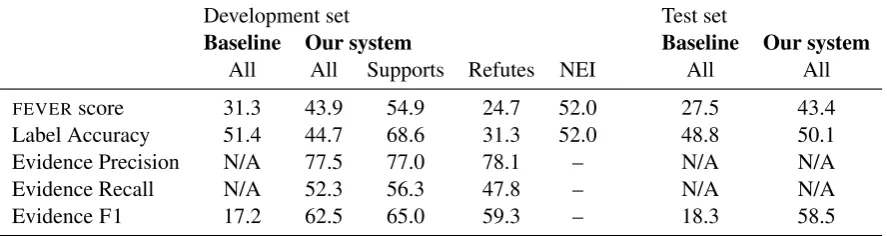
Development set Test set
Baseline Our system Baseline Our system
All All Supports Refutes NEI All All
FEVERscore 31.3 43.9 54.9 24.7 52.0 27.5 43.4
Label Accuracy 51.4 44.7 68.6 31.3 52.0 48.8 50.1
Evidence Precision N/A 77.5 77.0 78.1 – N/A N/A
Evidence Recall N/A 52.3 56.3 47.8 – N/A N/A
[image:4.595.78.522.65.183.2]Evidence F1 17.2 62.5 65.0 59.3 – 18.3 58.5
Table 1: Scores on theFEVERdevelopment and test sets. Baseline is the system from (Thorne et al.,2018). The results are prior to human evaluation of the evidence.
Since the “NEI” class does not have evidence as-sociated with it, we used the evidence found by our Sentence Finder for training the “NEI” class. If our Sentence Finder did not return any evidence for a “NEI” claim, we randomly sampled five sen-tences from the sensen-tences in the Wiki database and use them as evidence.1
The network is trained using the Adam opti-mizer with a learning rate 0.002 with a batch size of 140 and dropout ratio of 0.2. The net-work weights are repeatedly saved and we used the model performing best on theFEVER
develop-ment set.
4.4 Assigning Class Labels
The network outputs a probability distribution for whether the evidence/claim pair has label “Sup-ports”, “Refutes”, or “NEI”. For a given claim, we examine the labels assigned for all evidence sentences returned for that claim. First, we dis-card the evidence labeled as “NEI”. If there are no evidence left, we mark the claim as “NEI”. Oth-erwise, we add together the remaining prediction distribution and use the highest scored label as la-bel for the claim. We return the five highest-scored evidences, including those marked “NEI”.
4.5 Results and Analysis
The resulting scores on the development and test sets are in Table 1(prior to human evaluation of the evidence retrieved by the system.) TheFEVER
score is the percentage of claims such that a com-plete set of evidence is found and is classified with the correct label. Precision, Recall, and F1 are the metrics for evaluating evidence retrieval (evidence
1We could try the N
EARESTP sampling method described in (Thorne et al.,2018), which achieves better performance with a decomposable attention model for inference than ran-dom sampling.
a a
a a
a a
aa
Gold
Labeled as
Supports Refutes NEI
Supports 68.59 2.87 28.55
Refutes 31.13 31.26 37.61
NEI 42.29 5.75 51.97
Table 2: Contingency matrix (percentage) in the devel-opment set.
retrieval is not evaluated for the “NEI” class.) Table 2 shows the percentage of claims being labeled as each class in the development set. We see that both “Refutes” and “NEI” are often mis-labeled as “Supports”, whereas the “Supports” are often mislabeled as “NEI”.
Upon closer look at the classification errors, we see that some fine-grained lexical semantics and world knowledge are required to predict the cor-rect label, which the model was not able to cap-ture. For example, the claim “Gin is a drink” is supported by the sentence “Gin is a spirit which derives its predominant flavour from ju-niper berries (Juju-niperus communis)”, but our sys-tem classified the pair as “Refutes”.
The network also seemed to pick up on some lexical features present in the annotations. The claim “The Wallace mentions people that never existed” has gold label “NEI”, but is labeled as “Refutes” with high probability using three differ-ent evidence sdiffer-entences we retrieved, even though some of the sentences are not relevant at all. This is probably because the word “never” is highly in-dicative of the “Refutes” class, as we shall see in the next section.
5 Discussion
score (43.9% vs. 31.3%) for the development set. On the test set, prior to human evaluation of the evidence, our system ranked 7th out of 23 teams with a FEVER score of 43.4%. For evidence re-trieval F1, we ranked 2nd with a score of 58.5%.
Gururangan et al. (2018) pointed out that natu-ral language inference datasets often contain an-notation artifacts. They found that many lexi-cal/syntactic features are highly predictive of en-tailment classes in most natural language infer-ence datasets. We performed the same analysis on theFEVERtraining set to see whether a similar pat-tern holds. We calculated the probability distribu-tion of the length of the claims by tokens for each class. Contrary to Gururangan et al’s results, all classes have similar mean and standard deviation sentence length. We also calculated the pointwise mutual information (PMI) between each word and class. We found that negation words such asnot, never,neither, andnor, have higher PMI value for the “Refutes” class than for the other classes. This is similar to Gururangan et al.’s observation that negation words are strong indicators of contradic-tion in the SNLI dataset. The “Refutes” claims in the FEVERtraining data indeed show a high per-centage of negation words2 (13.9% vs. 0.1% for “Supports” and 1.3% for “NEI”).
Another source of bias comes from the way evidence annotation in the gold standard has been created with humans manually verifying the claims in Wikipedia. As pointed out in Sec-tion 3.3, evidence automatically retrieved can be correct even though not present in the gold stan-dard. The way a human fact-checks might be dif-ferent from what a computer can achieve. It would be interesting to analyze the evidence correctly re-trieved by the systems participating in the shared task but not present in the gold standard, to see whether some patterns emerge.
References
Samuel R. Bowman, Gabor Angeli, Christopher Potts, and Christopher D. Manning. 2015. A large anno-tated corpus for learning natural language inference.
In Proceedings of the 2015 Conference on
Empiri-cal Methods in Natural Language Processing, pages
632–642.
Mark Alan Finlayson. 2014. Java libraries for access-ing the princeton wordNet: Comparison and
evalua-2We used thenegdependency tag as the criterion for a
negation word.
tion. InProceedings of the 7th International Global WordNet Conference, pages 78–85. H. Orav, C. Fell-baum, & P. Vossen (Eds.).
Suchin Gururangan, Swabha Swayamdipta, Omer Levy, Roy Schwartz, Samuel R. Bowman, and Noah A. Smith. 2018. Annotation artifacts in natural language inference data. InProceedings of
NAACL-HLT 2018, pages 107–112.
Eduard Hovy, Mitchell Marcus, Martha Palmer, Lance Ramshaw, and Ralph Weischedel. 2006. OntoNotes: The 90% solution. In Proceedings of the Human
Language Technology Conference of the NAACL,
pages 57–60.
Christopher D. Manning, Mihai Surdeanu, John Bauer, Jenny Finkel, Steven J. Bethard, and David Mc-Closky. 2014. The Stanford CoreNLP natural lan-guage processing toolkit. InAssociation for
Compu-tational Linguistics (ACL) System Demonstrations,
pages 55–60.
Ankur P. Parikh, Oscar T¨ackstr¨om, Dipanjan Das, and Jakob Uszkoreit. 2016. A decomposable attention model for natural language inference. In Proceed-ings of the 2016 Conference on Empirical Methods
in Natural Language Processing, pages 2249–2255.
Jeffrey Pennington, Richard Socher, and Christo-pher D. Manning. 2014. GloVe: Global vectors for word representation. InEmpirical Methods in
Nat-ural Language Processing (EMNLP), pages 1532–
1543.