Dependency Parsing for Weibo:
An Efficient Probabilistic Logic Programming Approach
William Yang Wang, Lingpeng Kong, Kathryn Mazaitis, William W. Cohen
Language Technologies Institute & Machine Learning Department Carnegie Mellon University
Pittsburgh, PA 15213, USA.
{yww,lingpenk,krivard,wcohen}@cs.cmu.edu
Abstract
Dependency parsing is a core task in NLP, and it is widely used by many applica-tions such as information extraction, ques-tion answering, and machine translaques-tion. In the era of social media, a big chal-lenge is that parsers trained on traditional newswire corpora typically suffer from the domain mismatch issue, and thus perform poorly on social media data. We present a new GFL/FUDG-annotated Chinese tree-bank with more than 18K tokens from Sina Weibo (the Chinese equivalent of Twit-ter). We formulate the dependency pars-ing problem as many small and paralleliz-able arc prediction tasks: for each task, we use a programmable probabilistic first-order logic to infer the dependency arc of a token in the sentence. In experiments, we show that the proposed model outperforms an off-the-shelf Stanford Chinese parser, as well as a strong MaltParser baseline that is trained on the same in-domain data.
1 Introduction
Weibo, in particular Sina Weibo1, has attracted
more than 30% of Internet users (Yang et al., 2012), making it one of the most popular social media services in the world. While Weibo posts are abundantly available, NLP techniques for ana-lyzing Weibo posts have not been well-studied in the past.
Syntactic analysis of Weibo is made difficult for three reasons: first, in the last few decades, Computational Linguistics researchers have pri-marily focused on building resources and tools us-ing standard English newswire corpora2, and thus,
1http://en.wikipedia.org/wiki/Sina Weibo
2For example, Wall Street Journal articles are used for
building the Penn Treebank (Marcus et al., 1993).
there are fewer resources in other languages in general. Second, microblog posts are typically short, noisy (Gimpel et al., 2011), and can be considered as a “dialect”, which is very differ-ent from news data. Due to the differences in genre, part-of-speech taggers and parsers trained on newswire corpora typically fail on social media texts. Third, most existing parsers use language-independent standard features (McDonald et al., 2005), and these features may not be optimal for Chinese (Martins, 2012). To most of the applica-tion developers, the parser is more like a blackbox, which is not directly programmable. Therefore, it is non-trivial to adapt these generic parsers to language-specific social media text.
In this paper, we present a new probabilistic de-pendency parsing approach for Weibo, with the following contributions:
• We present a freely available Chinese Weibo dependency treebank3, manually annotated
with more than 18,000 tokens;
• We introduce a novel probabilistic logic programming approach for dependency arc prediction, making the parser directly pro-grammable for theory engineering;
• We show that the proposed approach outper-forms an off-the-shelf dependency parser, as well as a strong baseline trained on the same in-domain data.
In the next section, we describe existing work on dependency parsing for Chinese. In Section 3, we present the new Chinese Weibo Treebank to the research community. In Section 4, we intro-duce the proposed efficient probabilistic program-ming approach for parsing Weibo. We show the experimental results in Section 5, and conclude in Section 6.
3http://www.cs.cmu.edu/˜yww/data/WeiboTreebank.zip
2 Related Work
Chinese dependency parsing has attracted many interests in the last fifteen years. Bikel and Chi-ang (2000; 2002) are among the first to use Penn Chinese Tree Bank for dependency parsing, where they adapted Xia’s head rules (Xia, 1999). An im-portant milestone for Chinese dependency pars-ing is that, a few years later, the CoNLL shared task launched a track for multilingual dependency parsing, which also included Chinese (Buchholz and Marsi, 2006; Nilsson et al., 2007). These shared tasks soon popularized Chinese depen-dency parsing by making datasets available, and there has been growing amount of literature since then (Zhang and Clark, 2008; Nivre et al., 2007; Sagae and Tsujii, 2007; Che et al., 2010; Carreras, 2007; Duan et al., 2007).
Besides the CoNLL shared tasks, there are also many interesting studies on Chinese dependency parsing. For example, researchers have studied case (Yu et al., 2008) and morphological (Li and Zhou, 2012) structures for learning a Chinese de-pendency parser. Another direction is to perform joint learning and inference for POS tagging and dependency parsing (Li et al., 2011; Hatori et al., 2011; Li et al., 2011; Ma et al., 2012). In recent years, there has been growing interests in depen-dency arc prediction in Chinese (Che et al., 2014), and researchers have also investigated character-level Chinese dependency parsing (Zhang et al., 2014). However, even though the above methods all have merits, the results are reported only on standard newswire based Chinese Treebank (e.g. from People’s Daily (Liu et al., 2006)), and it is unclear how they would perform on Weibo data.
To the best of our knowledge, together with the recent study on parsing tweets (Kong et al., 2014), we are among the first to study the problem of de-pendency parsing for social media text.
3 The Chinese Weibo Treebank
We use the publicly availableµtopia dataset (Ling et al., 2013) for dependency annotation. An in-teresting aspect of this Weibo dataset is that, be-sides the Chinese posts, it also includes a copy of the English translations. This allows us to observe some interesting phenomena that mark the differ-ences of the two languages. For example:
• Function words are more frequently used in English than in Chinese. When
examin-Figure 1: An example of pro-drop phenomenon from the Weibo data.
ing this English version of the Weibo cor-pus for the total counts of the word “the”, there are 2,084 occurrences in 2,003 sen-tences. Whereas in Chinese, there are only 52 occurrences of the word “the” out of the 2,003 sentences.
• The other interesting thing is the position of the head. In English, the head of the tree occurs more frequent on the left-to-middle of the sentence, while the distribution of the head is more complicated in Chinese. This is also verified from the parallel Weibo data.
• Another well-known issue in Chinese is that Chinese is a pro-drop topical language. This is extremely prominent in the short text, which clearly creates a problem for parsing. For example, in the Chinese Weibo data, we have observed the sentence in Figure 1.
treebank is 82.31%.
Fragmentary Unlabeled Dependency Grammar (FUDG) is a newly proposed flexible framework that offers a relative easy way to annotate the syn-tactic structure of text. Beyond the traditional tree view of dependency syntax in which the tokens of a sentence form nodes in a tree, FUDG also allows the annotation of additional lexical items such as multiword expressions. It provides special devices for coordination and coreference; and fa-cilitates underspecified (partial) annotations where producing a complete parse would be difficult. Graph Fragment Language (GFL) is an implemen-tation of unlabeled dependency annoimplemen-tations in the FUDG framework, which fully supports Chinese, English and other languages. The training set of our Chinese Weibo Treebank4includes 14,774
to-kens, while the development and test sets include 1,846 and 1,857 tokens respectively.
4 A Programmable Parser with Personalized PageRank Inference A key problem in multilingual dependency parsing is that generic feature templates may not work well for every language. For example, Martins (2012) shows that for Chinese dependency parsing, when adding the generic grandparents and siblings fea-tures, the performance was worse than using the standard bilexical, unilexical, and part-of-speech features. Unfortunately, for many parsers such as Stanford Chinese Parser (Levy and Manning, 2003) and MaltParser (Nivre et al., 2007), it is very difficult for programmers to specify the fea-ture templates and inference rules for dependency arc prediction.
In this work, we present a Chinese dependency parsing method for Weibo, based on efficient prob-abilistic first-order logic programming (Wang et al., 2013). The advantage of probabilistic pro-gramming for parsing is that, software engineers can simply conduct theory engineering, and op-timize the performance of the parser for a spe-cific genre of the target language. Recently, proba-bilistic programming approaches (Goodman et al., 2012; Wang et al., 2013; Lloyd et al., 2014) have demonstrated its efficiency and effectiveness in many areas such as information extraction (Wang et al., 2014), entity linking, and text classifica-tion (Wang et al., 2013).
4The corpus is freely available for download at the URL
specified in Section 1.
Algorithm 1A Dependency Arc Inference Algo-rithm for Parsing Weibo
Given:
(1) a sentence with tokensTi, whereiis the
in-dex, andLis the length;
(2) a databaseDof token relations from the cor-pus;
(3) first-order logic inference rule setR.
fori= 1→Ltokensdo
S←ConstructSearchSpace(Ti, R, D);
~Pi ←InferP arentUsingP roP P R(Ti,S);
end for
Greedy Global Inference fori= 1→Ltokensdo
Yi = arg max~Pi;
end for
4.1 Problem Formulation
We formulate the dependency parsing prob-lem as many small dependency arc prediction problems. For each token, we form the par-ent inference problem of a token Ti as solving a
query edge(Ti,?)using stochastic theorem
prov-ing on a search graph. Our approach relies on a database Dof inter-token relations. To construct the database, we automatically extract the token relations from the text data. For example, to de-note the adjacency of two tokens T1 andT2, we
store the entry adjacent(T1, T2) in D. One can
also store the part-of-speech tag of a token in the form haspos(T1, DT). There is no limitations
on the arity and the types of the predicates in the database.
Given the database of token relations, one then needs to construct the first-order logic inference theoryRfor predicting dependency arcs. For ex-ample, to construct simple bilexical and bi-POS inference rules to model the dependency of an ad-jacent head and a modifier, one can write first-order clauses such as:
edge(V1,V2)
:-adjacent(V1,V2),hasword(V1,W1),
hasword(V2,W2),keyword(W1,W2) #adjWord.
edge(V1,V2)
:-adjacent(V1,V2),haspos(V1,W1), haspos(V2,W2),keypos(W1,W2) #adjPos.
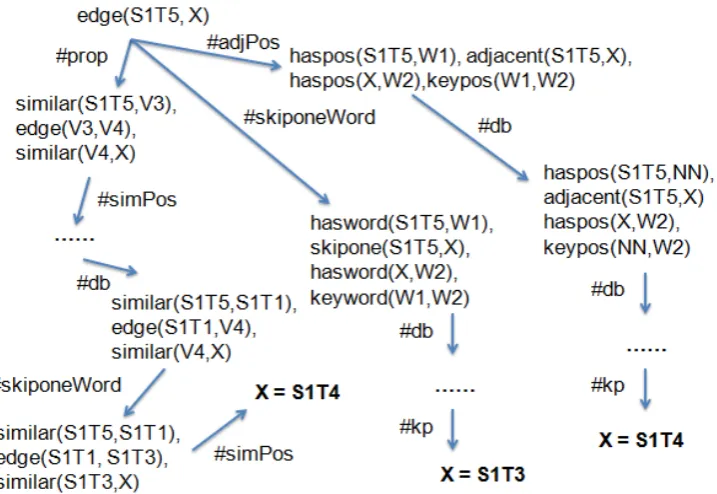
Figure 2: After mapping the databaseDto theoryR, here is an example of search space for dependency arc inference. The query isedge(S1T5, X), and there exists one correct and multiple incorrect solutions
(highlighted inbold).
Here, we associate a feature vectorφcwith each
clause, which is annotated using the # symbol af-ter each clause in the theory set. Note that the last two (keywordandkeypos) clauses are feature tem-plates that allow us to learn the specific bi-POS tags and bilexical words from the data. In order for one to solve the query edge(Ti,?), we first
need to map the entities fromDtoRto construct the search space. The details for constructing and searching in the graph can be found in previous studies on probabilistic first-order logic (Wang et al., 2013) and stochastic logic programs (Cussens, 2001). An example search space is illustrated in Figure 2. Note that now the edges in the search graph correspond to the feature vectorφcinR.
The overall dependency arc inference algorithm can be found in Algorithm 1. For each of the par-ent inference subtask, we use ProPPR (Wang et al., 2013) to perform efficient personalized PageRank inference. Note that to ensure the validity of the dependency tree, we break the loops in the final parse graph into a parse tree using the maximum personalized PageRank score criteria. When mul-tiple roots are predicted, we also select the most likely root by comparing the personalized PageR-ank solution scores.
To learn the more plausible theories, one needs
to upweight weights for relevant features, so that they have higher transition probabilities on the corresponding edges. To do this, we use stochastic gradient descent to learn from training queries, where the correct and incorrect solutions are known. The details of the learning algorithm are described in the last part of this section.
4.2 Personalized PageRank Inference
For the inference of the parent of each token, we utilize ProPPR (Wang et al., 2013). ProPPR al-lows a fast approximate proof procedure, in which only a small subset of the full proof graph is generated. In particular, if α upper-bounds the reset probability, and d upperbounds the degree of nodes in the graph, then one can efficiently find a subgraph withO(α1) nodes which approx-imates the weight for every node within an er-ror of d (Wang et al., 2013), using a variant of the PageRank-Nibble algorithm of Andersenet al (2008).
4.3 Parameter Estimation
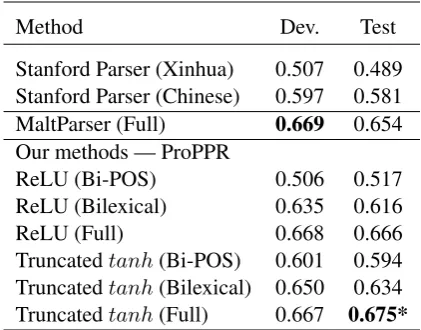
Method Dev. Test Stanford Parser (Xinhua) 0.507 0.489 Stanford Parser (Chinese) 0.597 0.581 MaltParser (Full) 0.669 0.654 Our methods — ProPPR
ReLU (Bi-POS) 0.506 0.517 ReLU (Bilexical) 0.635 0.616
ReLU (Full) 0.668 0.666
[image:5.595.75.286.64.229.2]Truncatedtanh(Bi-POS) 0.601 0.594 Truncatedtanh(Bilexical) 0.650 0.634 Truncatedtanh(Full) 0.667 0.675*
Table 1: Comparing our Weibo parser to other baselines (UAS). The off-the-shelf Stanford parser uses its attached Xinhua and Chinese factored models, which are trained on external Chinese treebank of newswire data. MaltParser was trained on the same in-domain data as our proposed ap-proach. * indicates p < .001 comparing to the MaltParser.
Leskovec, 2011). The idea is that, given the training queries, we perform a random walk with restart process, and upweight the edges that are more likely to end up with a known correct parent. We learn the transition probability from two nodes
(u, v) in the search graph using: Prw(v|u) =
1
Zf(w,Φcrestart), where we use two popular
non-linear parameter learning functions from the deep learning community:
• Rectified Linear Unit (ReLU) (Nair and Hin-ton, 2010):max(0, x);
• The Hyperbolic Function (Glorot and Ben-gio, 2010):tanh(x).
as the f in this study. ReLU is a desirable non-linear function, because it does not have the vanishing gradient problem, and produces sparse weights. For the weights learned fromtanh(x), we truncate the negative weights on the edges, since the default weight on the feature edges is w= 1.0(existence), andw = 0.0means that the edge does not exist in the inference stage.
5 Experiments
In this experiment, we compare the proposed parser with two well-known baselines. First, we compare with an off-the-shelf Stanford Chi-nese Parser (Levy and Manning, 2003). Second,
we compare with the MaltParser (Nivre et al., 2007) that is trained on the same in-domain Weibo dataset. The train, development, and test splits are described in Section 3. We tune the regulariza-tion hyperparameters of the models on the dev. set, and report Unlabeled Attachment Score (UAS) re-sults for both the dev. set and the hold-out test set. We experiment with the bilexical and bi-POS first-order logic theory separately, as well as a com-bined full model with directional and distance fea-tures.
The results are shown in Table 1. We see that both of the two attached pre-trained models from the Stanford parser do not perform very well on this Weibo dataset, probably because of the mis-matched training and test data. MaltParser is widely considered as one of the most popular de-pendency parsers, not only because of its speed, but also the acclaimed accuracy. We see that when using the full model, the UAS results between our methods and MaltParser are very similar on the de-velopment set, but both of our approaches outper-form the Maltparser in the holdout test set. The truncatedtanhvariant of ProPPR obtains the best UAS score of 0.675.
6 Conclusion
In this paper, we present a novel Chinese de-pendency treebank, annotated using Weibo data. We introduce a probabilistic programming depdency arc prediction approach, where theory en-gineering is made easy. In experiments, we show that our methods outperform an off-the-shelf Stan-ford Chinese Parser, as well a strong MaltParser that is trained on the same in-domain data. The Chinese Weibo Treebank is made freely available to the research community. In the future, we plan to apply the proposed approaches to dependency and semantic parsing of other languages.
Acknowledgements
References
Reid Andersen, Fan R. K. Chung, and Kevin J. Lang. 2008. Local partitioning for directed graphs using pagerank.Internet Mathematics, 5(1):3–22.
Lars Backstrom and Jure Leskovec. 2011. Supervised random walks: predicting and recommending links in social networks. In Proceedings of the fourth ACM international conference on Web search and data mining, pages 635–644. ACM.
Daniel M Bikel and David Chiang. 2000. Two statis-tical parsing models applied to the chinese treebank. InProceedings of the second workshop on Chinese language processing: held in conjunction with the 38th Annual Meeting of the Association for Compu-tational Linguistics-Volume 12, pages 1–6. Associa-tion for ComputaAssocia-tional Linguistics.
Sabine Buchholz and Erwin Marsi. 2006. Conll-x shared task on multilingual dependency parsing. In Proceedings of the Tenth Conference on Computa-tional Natural Language Learning, pages 149–164. Association for Computational Linguistics.
Xavier Carreras. 2007. Experiments with a higher-order projective dependency parser. In EMNLP-CoNLL, pages 957–961.
Pi-Chuan Chang, Huihsin Tseng, Dan Jurafsky, and Christopher D Manning. 2009. Discriminative reordering with chinese grammatical relations fea-tures. InProceedings of the Third Workshop on Syn-tax and Structure in Statistical Translation, pages 51–59. Association for Computational Linguistics. Wanxiang Che, Zhenghua Li, and Ting Liu. 2010. Ltp:
A chinese language technology platform. In Pro-ceedings of the 23rd International Conference on Computational Linguistics: Demonstrations, pages 13–16. Association for Computational Linguistics.
Wanxiang Che, Jiang Guo, and Ting Liu. 2014. Re-liable dependency arc recognition. Expert Systems with Applications, 41(4):1716–1722.
David Chiang and Daniel M. Bikel. 2002. Recover-ing latent information in treebanks. InProceedings of the 19th International Conference on Computa-tional Linguistics - Volume 1, COLING ’02, pages 1–7, Stroudsburg, PA, USA. Association for Com-putational Linguistics.
James Cussens. 2001. Parameter estimation in stochastic logic programs. Machine Learning, 44(3):245–271.
Xiangyu Duan, Jun Zhao, and Bo Xu. 2007. Proba-bilistic parsing action models for multi-lingual de-pendency parsing. InEMNLP-CoNLL, pages 940– 946.
Kevin Gimpel, Nathan Schneider, Brendan O’Connor, Dipanjan Das, Daniel Mills, Jacob Eisenstein,
Michael Heilman, Dani Yogatama, Jeffrey Flani-gan, and Noah A Smith. 2011. Part-of-speech tag-ging for twitter: Annotation, features, and experi-ments. In Proceedings of the 49th Annual Meet-ing of the Association for Computational LMeet-inguis- Linguis-tics: Human Language Technologies: short papers-Volume 2, pages 42–47. Association for Computa-tional Linguistics.
Xavier Glorot and Yoshua Bengio. 2010. Understand-ing the difficulty of trainUnderstand-ing deep feedforward neural networks. InInternational Conference on Artificial Intelligence and Statistics, pages 249–256.
Noah Goodman, Vikash Mansinghka, Daniel Roy, Keith Bonawitz, and Daniel Tarlow. 2012. Church: a language for generative models. arXiv preprint arXiv:1206.3255.
Jun Hatori, Takuya Matsuzaki, Yusuke Miyao, and Jun’ichi Tsujii. 2011. Incremental joint pos tag-ging and dependency parsing in chinese. In IJC-NLP, pages 1216–1224.
Lingpeng Kong, Nathan Schneider, Swabha Swayamdipta, Archna Bhatia, Chris Dyer, and Noah A. Smith. 2014. A dependency parser for tweets. InProceedings of the 2014 Conference on Empirical Methods in Natural Language Processing (EMNLP 2014), Doha, Qatar, October. ACL.
Roger Levy and Christopher Manning. 2003. Is it harder to parse chinese, or the chinese treebank? In Proceedings of the 41st Annual Meeting on As-sociation for Computational Linguistics-Volume 1, pages 439–446. Association for Computational Lin-guistics.
Zhongguo Li and Guodong Zhou. 2012. Unified de-pendency parsing of chinese morphological and syn-tactic structures. InProceedings of the 2012 Joint Conference on Empirical Methods in Natural guage Processing and Computational Natural Lan-guage Learning, pages 1445–1454. Association for Computational Linguistics.
Zhenghua Li, Min Zhang, Wanxiang Che, Ting Liu, Wenliang Chen, and Haizhou Li. 2011. Joint mod-els for chinese pos tagging and dependency pars-ing. InProceedings of the Conference on Empiri-cal Methods in Natural Language Processing, pages 1180–1191. Association for Computational Linguis-tics.
Wang Ling, Guang Xiang, Chris Dyer, Alan Black, and Isabel Trancoso. 2013. Microblogs as parallel cor-pora. In Proceedings of the 51st Annual Meeting on Association for Computational Linguistics, ACL ’13. Association for Computational Linguistics.
James Robert Lloyd, David Duvenaud, Roger Grosse, Joshua B Tenenbaum, and Zoubin Ghahramani. 2014. Automatic construction and natural-language description of nonparametric regression models. arXiv preprint arXiv:1402.4304.
Ji Ma, Tong Xiao, Jingbo Zhu, and Feiliang Ren. 2012. Easy-first chinese pos tagging and dependency pars-ing. InCOLING, pages 1731–1746.
Mitchell P Marcus, Mary Ann Marcinkiewicz, and Beatrice Santorini. 1993. Building a large anno-tated corpus of english: The penn treebank. Compu-tational linguistics, 19(2):313–330.
Andr´e Filipe Torres Martins. 2012. The Geometry of Constrained Structured Prediction: Applications to Inference and Learning of Natural Language Syn-tax. Ph.D. thesis, Columbia University.
Ryan McDonald, Koby Crammer, and Fernando Pereira. 2005. Online large-margin training of dependency parsers. In Proceedings of the 43rd Annual Meeting on Association for Computational Linguistics, pages 91–98. Association for Computa-tional Linguistics.
Michael T. Mordowanec, Nathan Schneider, Chris Dyer, and Noah A. Smith. 2014. Simplified de-pendency annotations with gfl-web. InProceedings of the 52nd Annual Meeting of the Association for Computational Linguistics: System Demonstrations. ACL.
Vinod Nair and Geoffrey E Hinton. 2010. Rectified linear units improve restricted boltzmann machines. InProceedings of the 27th International Conference on Machine Learning (ICML-10), pages 807–814. Jens Nilsson, Sebastian Riedel, and Deniz Yuret. 2007.
The conll 2007 shared task on dependency parsing. InProceedings of the CoNLL Shared Task Session of EMNLP-CoNLL, pages 915–932. sn.
Joakim Nivre, Johan Hall, Jens Nilsson, Atanas Chanev, G¨ulsen Eryigit, Sandra K¨ubler, Svetoslav Marinov, and Erwin Marsi. 2007. Maltparser: A language-independent system for data-driven de-pendency parsing. Natural Language Engineering, 13(2):95–135.
Kenji Sagae and Jun’ichi Tsujii. 2007. Depen-dency parsing and domain adaptation with lr models and parser ensembles. InEMNLP-CoNLL, volume 2007, pages 1044–1050.
Nathan Schneider, Brendan O’Connor, Naomi Saphra, David Bamman, Manaal Faruqui, Noah A Smith, Chris Dyer, and Jason Baldridge. 2013. A framework for (under) specifying dependency syn-tax without overloading annotators. arXiv preprint arXiv:1306.2091.
Kristina Toutanova and Christopher D Manning. 2000. Enriching the knowledge sources used in a maxi-mum entropy part-of-speech tagger. InProceedings
of the 2000 Joint SIGDAT conference on Empirical methods in natural language processing and very large corpora: held in conjunction with the 38th An-nual Meeting of the Association for Computational Linguistics-Volume 13, pages 63–70. Association for Computational Linguistics.
Huihsin Tseng, Pichuan Chang, Galen Andrew, Daniel Jurafsky, and Christopher Manning. 2005. A condi-tional random field word segmenter for sighan bake-off 2005. In Proceedings of the Fourth SIGHAN Workshop on Chinese Language Processing, volume 171.
William Yang Wang, Kathryn Mazaitis, and William W Cohen. 2013. Programming with personalized pagerank: a locally groundable first-order proba-bilistic logic. InProceedings of the 22nd ACM in-ternational conference on Conference on informa-tion & knowledge management, pages 2129–2138. ACM.
William Yang Wang, Kathryn Mazaitis, Ni Lao, Tom Mitchell, and William W Cohen. 2014. Effi-cient inference and learning in a large knowledge base: Reasoning with extracted information using a locally groundable first-order probabilistic logic. arXiv preprint arXiv:1404.3301.
Fei Xia. 1999. Extracting tree adjoining grammars from bracketed corpora. InProceedings of the 5th Natural Language Processing Pacific Rim Sympo-sium (NLPRS-99), pages 398–403.
Fan Yang, Yang Liu, Xiaohui Yu, and Min Yang. 2012. Automatic detection of rumor on sina weibo. In Pro-ceedings of the ACM SIGKDD Workshop on Mining Data Semantics, page 13. ACM.
Kun Yu, Daisuke Kawahara, and Sadao Kurohashi. 2008. Chinese dependency parsing with large scale automatically constructed case structures. In Pro-ceedings of the 22nd International Conference on Computational Linguistics-Volume 1, pages 1049– 1056. Association for Computational Linguistics. Yue Zhang and Stephen Clark. 2008. A tale of
two parsers: investigating and combining graph-based and transition-graph-based dependency parsing us-ing beam-search. InProceedings of the Conference on Empirical Methods in Natural Language Pro-cessing, pages 562–571. Association for Computa-tional Linguistics.