Multi-Resolution Language Grounding with Weak Supervision
R. Koncel-Kedziorski, Hannaneh Hajishirzi, and Ali Farhadi
University of Washington
{kedzior,hannaneh,farhadi}@washington.edu
Abstract
Language is given meaning through its correspondence with a world representa-tion. This correspondence can be at mul-tiple levels of granularity or resolutions. In this paper, we introduce an approach to multi-resolution language grounding in the extremely challenging domain of pro-fessional soccer commentaries. We define and optimize a factored objective function that allows us to leverage discourse struc-ture and the compositional nastruc-ture of both language and game events. We show that finer resolution grounding helps coarser resolution grounding, and vice versa. Our method results in an F1 improvement of more than 48% versus the previous state of the art for fine-resolution grounding1.
1 Introduction
Language is inextricable from its context. A hu-man language user interprets an utterance in the context of, among other things, their perception of the world. Grounded language acquisition algo-rithms imitate this setup: language is given mean-ing through its correspondence with a rich world representation. A solution to the acquisition prob-lem must resolve several ambiguities: the seg-mentation of the text into meaningful units (spans of words that refer to events); determining which events are being referenced; and finding the proper alignment of events to these units.
Historically, language grounding was only pos-sible over simple controlled domains and rigidly structured language. Current research in grounded
[image:1.595.311.523.250.339.2]1Source code and data are available athttp://ssli. ee.washington.edu/tial/projects/multires/
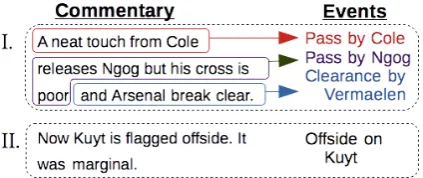
Figure 1: An example of the multiple resolutions at which soccer commentaries refer to events: The utterance level alignments are shown in the black dashed boxes. The first utterance can be further broken into the fragment-level align-ments shown; the second cannot be decomposed further.
language acquisition is moving into real-world en-vironments (Yu and Siskind, 2013). Grounding sports commentaries in game events is a specific instance of this problem that has attracted attention (Liang et al., 2009; Snyder and Barzilay, 2007; Hajishirzi et al., 2012), in part because of the com-plexity of both the language and the world repre-sentation involved.
The language employed in soccer commentaries is difficult to ground due to its dense informa-tion structure, novel vocabulary and word senses, and colorful, non-traditional syntax. These chal-lenges conspire to foil most language processing techniques including automated parsers and word-sense disambiguation systems.
In addition to the structural problems presented by the language of soccer commentaries, the prob-lem of reference is further complicated by the fact that for game events (and other real-world phe-nomena) there is no standardized meaningful lin-guistic unit. Utterances ranging from a single word to multiple sentences can be used to refer to a single event. For example, in Figure 1 the first four words of commentary (I) refer to a single event, as does the entirety of (II).
Figure 2:An example of the different levels of granularity present in the soccer data. The dashed boxes on the left denote ut-terancesmade by the commentators. Solid boxes denote fragments that cannot be decomposed into finer resolution alignments. The table on the right is a portion of the detailed listing of game events.
Turning our attention to Figure 2, sometimes a fragment refers to a combination of events and no further decomposition is available, such as the first fragment of commentary (I). Moreover, it is some-times desirable to construct a complex of events by determining all the events corresponding to a particular collection of words. For instance, we would want to be able to align the whole of (I) with all the events in the corresponding dashed box. This suggests studying language grounding at multiple levels of granularity (resolutions).
We useresolutionto describe the continuum of meaningful units which exist in human language2.
These resolutions interact in a complicated way, with clues from different resolutions sometimes combining to produce an effect and sometimes negating one another. With enough training data, one could hope to learn the details of the interac-tions of various resoluinterac-tions. However, the expense of producing or obtaining supervised training data at multiple resolutions is prohibitive.
To address all these complications, we in-troduce weakly-supervised multi-resolution lan-guage grounding. Our method makes use of a factorized objective function which allows us to model the complex interplay of resolutions. Our language model takes advantage of the discourse structure of the commentaries, making it robust enough to handle the unique language of the soc-cer domain. Finally, our method relies only on
2Though it is tempting to discritize meaning in text, Chafe
(1988) shows that readers imbue text with meaningful intona-tional patterns drawn from the potentially continuous space of auditory signals.
loose temporal co-occurrence of events and utter-ances as supervision and does not require expen-sive annotated training data.
To test our method we augment the Profes-sional Soccer Commentary Dataset (Hajishirzi et al., 2012) with fragment-level event alignment an-notations. This dataset is composed of commen-taries for soccer matches paired with event logs produced by Opta Sportsdata and includes human annotated gold alignments3. We achieve an F1
im-provement of over 48% on fragment-level align-ment versus a previous state-of-the-art. We are also able to leverage the interplay of fragment- and utterance- level alignments to improve the previ-ous state-of-the-art utterance-alignment system.
2 Challenges
Syntactic Limitations: Syntax is used to struc-ture the information provided by an utterance, and so it seems intuitive that syntactic relations could be leveraged in this task. For example, consider utterance (III) in Figure 2. The multi-resolution grounding of (III) would provide a segmentation of the utterance – or a division of the utterance into the fragments which refer to separate events. In (III), there is an obvious syntactic correlate to the correct segmentation: each verb phrase within the conjunction headed by “and” identifies a separate event. Parsing (III) to an event-based semantics like that of Davidson (1967), one could associate each verb in an utterance with a game event and achieve the desired segmentation.
Unfortunately, there is a preponderance of ex-amples such as (II) in Figure 2, where 4 verbs are used to describe a single “miss” event. (II) il-lustrates just one of the many difficulties of using syntactic information – elsewhere, events are ref-erenced without an explicit verb whatsoever (such as the use of the phrase “into the books” to refer to a foul event). What is needed instead is a language model that is powerful enough to proscribe some structure yet robust enough to allow the world rep-resentation to determine which pieces of language are referring to which referent or set of referents.
Complex Interplay between Resolutions:
Language refers at a variety of resolutions, and the relationship between nested reference scopes is complex. A single or few words can indicate entities or properties; full phrases are often needed to denote an action; complex events like a missed shot may take up to several phrases of narration to properly describe. A soccer commentator does not encode every detail necessary for proper alignment and segmentation into their utterances, but rather only enough to make clear to another with similar world knowledge what is meant. A language grounding method is at a severe disadvantage when faced with such implicit information.
Instead, a successful method can make heavy use of the limited lexical, phrasal, and discourse structural cues provided in an utterance, as the dif-ferent resolutions rely on these difdif-ferent contex-tual clues to meaning. At finer resolutions one can rely more on the lexical meanings of the words; at medium resolutions, compositionality can be leveraged; at coarser resolutions, discourse fea-tures come into play. These cues interact in a com-plicated way, providing additional challenge.
Consider again Figure 2. In (III), the tempo-ral discourse marker “and” marks the division be-tween the fragments referring to each event. In (I) the same word (used again as a temporal dis-course marker) is used to elaborate on the single “foul” event being described in the second frag-ment. A human (with sufficient understanding of soccer) knows that, despite being separated by the discourse marker, the phrases “bring him down” and “set piece” both refer to the foul. A language grounding algorithm that can model the interac-tion between such word-level and utterance-level cues can successfully segment both (I) and (III).
Supervision: For language grounding generally, and multi-resolution grounding specifically, su-pervised training data is expensive to produce. Also, the various grounding domains of interest are highly independent of one another (Liang et al., 2009). In the face of these issues, the ideal correspondence between language and world rep-resentation would be learned with as little supervi-sion as possible.
3 Problem Definition
We define the problem of multi-resolution lan-guage grounding as follows: Given a temporal evolution of a world state (a sequence of events) and an overlapping natural language text (a se-quence of utterances), we want to learn the best correspondences between the language and the world at different levels of granularity (Figure 2).
To set up notations, for each utterance repre-sented as a set of wordsW ={w1, w2, . . . , wn},
we want a segmentation which expresses the re-lationship of the words to the events which they describe.
LetSdenote a set of all possible segmentations ofW. ThenS = {S|Sis a segmentation ofW}. A segmentation S is in turn a set of non-overlapping fragments (S = {si}), where each
fragment is a consecutive sequence of words from the utteranceW. For example, for utterance (III) from Figure 2, one possible (incorrect) segmenta-tion isS = {s1, s2, s3}fors1 ={Chamakh rises highest},s2={and aims a header}, ands3 ={ to-wards goal which is narrowly wide}.
An alignment consists of a segmentationS and a mappingEfrom fragments ofSto the set of all eventsE. For example, the segmentationS could be mapped as E = {hs1, e2i,hs2, e3i,hs3, e1i}, with e1 being an Aerial Challenge, e2 being a missed attempt on goal, and e3 being an out of bounds penalty. Let E = S ×E denote the set of all possible alignments.
As we show in Figure 2, events are composed of the various attributesTime, Type, Pass Events, Outcome, and Player. For example, the aerial event in Figure 2 has the attributes and values type:aerial, outcome:successful, pass events:head pass,andplayer:Chamakh.
Finally, we denote the values for the attributes of eachej aseaj, wherearanges over the different
into Eas the best segmentation S and alignment
Ethat maximize the joint probability distribution:
arg max
S∈S,E∈EP(S, E|W) (1)
This optimization4 can be accomplished
through the use of supervised learning. However, training data is expensive and tedious to produce for the grounding problem, especially at multiple resolutions. Additionally, the complexity of the language in this domain would result in very sparse associations.
Yet if we knew some of the correct fine-resolution alignments, we could use that informa-tion to produce good coarse resoluinforma-tion alignments, and vice versa. Therefore, we formulate a fac-torized form of the above objective which allows us to learn features specific to aligning at the ut-terance, fragment, and attribute resolutions. Our method can be optimized with only weak super-vision (loose temporal alignments between utter-ances and a set of events occurring within a win-dow of the utterance time).
We can evaluate such a correspondence in sev-eral ways. For each utterance, can we predict the correct events to which this utterance refers? This is the problem of utterance-level alignment.
We can also evaluate based on events: for each event, can we identify the minimal text span(s) which refers to this event? We want a tight corre-spondence because loose, overlapping alignments are not semantically satisfying. However, we do not want to under associate: human language makes reference at a variety of levels (the word level, the phrase level, the utterance level, and be-yond). It is important to correctly identify all and only the words which correspond to a given event. This is the fragment-level alignment problem. We show that good fragment-level alignments will im-prove utterance-level alignment, and vice versa.
Since events are composed of their attributes, we can imagine a very fine resolution grounding of individual words to individual attributes. In fact, our solution involves producing such a grounding and composing the fragment- and utterance-level alignments therefrom.
W
S
E
w1 w2 w3 w4 w5
Chamakh raises highest and aims …
S1 S2 Sn
E1 E2 E3 E4
{w3,w4,{ww52}} {w1}
{w3,w4,w5}
{w1,w2}
{w4,w5}
{w1,w2,w3}
[image:4.595.308.534.64.172.2]pass aerial miss out
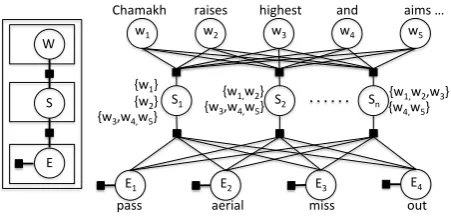
Figure 3:Factor graph forP(S, E|W). Here thewiare the
words of utteranceW,Sjare the possible segmentations of
W, andEkare different events.
4 Our Method
We have formulated the grounding problem as an optimization of the joint probability distribution
P(S, E|W), which returns the best segmentation and accompanying event alignments given an ut-terance W. Optimizing this function in the do-main of real world language, however, is a diffi-cult problem. Utterances are long here, and there are many events which could be grounded to each. Furthermore, the cardinality of the set of possible segmentations is combinatorially large.
Therefore we decompose Equation 1 using the factor graph depicted in Figure 3. We write the joint probability distribution as a product of the following two potential functions:
P(S, E|W)def= 1
Z Y
s∈S
Ψalign(E, s)∗Φseg(s, W)
(2) where Ψalign is a function for scoring the
align-mentE for fragmentsandΦsegscores how good
a fragmentsis for the utteranceW, andZ is for normalization.
To optimize Equation 2 it is not practical to search the space of possible S, E combinations (this space is combinatorially large). However, we can optimize the factored form using dynamic pro-gramming. We first describe how to find values for each of the potentials in sections 4.1 and 4.2. In section 4.3 we describe the dynamic program-ming approach to optimization.
4.1 Event Alignments Given Segmentation
The potential functionΨalign(E, s)takes as inputs
a fragmentsfrom segmentationSand a candidate alignmentE forSand returns a score forEwith
4As this and future equations are conditioned on the set
regards tos. It is here that we produce the multi-resolution alignments; s can vary in size from a single word to a whole utterance. ψalign
decom-poses as the following:
Ψalign(E, s) = Ψprior(E)∗Ψaffinity(s, E) (3)
where the priors (Ψprior) are confidence scores for
an alignmentEwith the whole utterance as given by Hajishirzi et al. (2012), which fits an exemplar SVM to each utterance/event pair. An exemplar SVM is an SVM fit with one positive and many negative instances, allowing us to define an ex-ample by what it is not (Malisiewicz et al., 2011; Shrivastava et al., 2011).
Ψaffinity scores the affinity between a fragment
sand the eventej to which it is aligned. We use
the term affinity as a measure of the goodness of an alignment. Intuitively, a fragmentswill have a higher affinity for an eventej ifsdescribes that
event well. Formally, the affinity betweensandej
amounts to a product of the affinity between each wordwi ∈sandej. Sinceej is defined by a
col-lection of attributes, we can compose a score for
wi withej from the affinity betweenwi and each
attributeaofej.
Ψaffinity(s, E) = Y
wi∈s,ej∈E
ψatr.(w
i, ej)
= Y
wi∈s,ej∈E
max
a ψ(wi, eaj) (4)
whereejis the event to whichsis aligned in
align-mentE,ψatr.(wi, ej)is the affinity betweenwiand
eventej, andψ(wi, eaj)is the affinity betweenwi
and attributeaofej.
In order to determine the affinity of a word and an event attribute, we createattribute:value clas-sifiers– one for eachattribute:value pairthat oc-curs in any event. For example, for goals we create atype:goalclassifier, and for unsuccessful events we create anoutcome:unsuccessfulclassifier.
For the categorical attributes Type, Outcome, andPass Events, we fit a linear SVM (Fan et al., 2008) using the utterance-level alignments pro-vided by Ψprior (the exemplar SVMs) to
deter-mine the positive and negative examples. For in-stance, we use all the utterances which are aligned with an event whosetypevalue is “pass” as posi-tive examples for our type:passclassifier, and all other utterances as negative examples.
The weight assigned to each dimension in a linear SVM describes the relative importance of that dimension in the classification process. The dimensions of our attribute:value SVMs are the words of the corpus, normalized for case and mi-nus punctuation and stop words. Therefore, the affinity of a wordwi and theattribute:valueeaj is
the weight of the dimension corresponding to wi
in theea
j attribute:valueclassifier. Following
oth-ers (Liang et al., 2009; Kate and Mooney, 2007), we use string matches to determine the affinity be-tween a word and thePlayerattribute.
In order to make comparisons between the im-portance of a word in the decision process for dif-ferent classifiers, we normalize the weight vectors for each. Theseattribute:valueclassifiers produce our finest resolution alignments, allowing us to de-fine a correspondence between a single word and a single attribute of any event.
By considering ej in terms of its attributes, we
are able to compose a score forej with fragment s. This is a kind of double-sided compositional semantics, where both the meaningful signs (s) and their extensions (ej) are composed of
finer-resolution atomic parts (wiandeaj, respectively).
4.2 Segmentations Given Utterances
The potential functionΦseg(s, W)from Equation
2 returns a score for a fragment within an utter-ance. A segmentation can be thought of as the collection of bigrams hwi, wi+1i wherewi is the
last word of a fragment which is being used to de-scribe one event and wi+1 is the first word of a fragment being used to describe a different event. We will refer to such bigrams assplitpoints.
The function Φseg should favor fragments that
begin and end at goodsplitpointand whose inter-mediate bigrams are badsplitpoints. We formalize this as follows:
Φseg(s, W)∝ φ(wkQ−1, wk)∗φ(wk+m, wk+m+1)
m−1
j=0 φ(wk+j, wk+j+1)
where fragmentsis a span ofmconsecutive words
{wk, ..., wk+m}fromW, andφis a score for how
good of a splitpointhwi, wi+1i would make (ex-plained below).
to work. Instead, we employ linguistic knowledge to create a proxy of labels. We will use this proxy to train a classifier to discover the features of good splitpoints which can be generalized and produce a more robust system.
The proxy labeling scheme we developed is based on conservative components common to a variety of theories of discourse. Discourse theo-ries aim to model the relationships which exist be-tween adjacent utterances in a coherent discourse. Since we consider a sports commentary to be a co-herent discourse, we can leverage results from dis-course theory in producing our proxy labels.
Temporal Discourse: Events in a soccer match occur in a temporal sequence, and so it is reason-able to assume that the language used to describe them will employ temporal discourse relations to distinguish fragments describing separate events. Pitler et al. (2008) have constructed a list of dis-course relations which can be easily automatically identified, including temporal discourse relations. These are indicated by the presence of discourse markers— alternately known as cue phrases. We hypothesize that cue phrases can be used to iden-tify splitpoints and use them in our proxy labeling scheme. This method is not restricted to tempo-rally related discourse: some contingency, expan-sion, and comparison relations are also analyzed as “easily identifiable”. As such, our segmentation process can also be used to ground language into a world state where these relations would hold.
Prosodic Discourse: We also make use of prosodic discourse cues. Pierrehumbert and Hirschberg (1990) claim that intonational phrases play an important role in discourse segmentation. Therefore, we hypothesize that the edges of in-tonational phrases are very likely to correspond with correct splitpoints. Viewing the commen-tary transcriptions as a noisy channel of the ac-tual speech signal, we can identify the intona-tional phrase boundaries with the punctuation in-serted in the transcription process. Chafe (1988) confirms that punctuation in written language has a strong correspondence with intonational phrase boundaries, and an assumption like ours has been successfully implemented in speech synthesis sys-tems (Black and Lenzo, 2000). Thus, we include bigrams containing punctuation as splitpoints in our proxy labels.
Feature Description forsplitpointclassifier Iswi/wi+1a discourse marker?
Iswi/wi+1punctuation?
Iswi/wi+1a player name?
Part of speech ofwi/wi+1
Is one ofwi/wi+1a dependent of the other?
Arewiandwi+1dependents of the same governor?
Dependency relations that hold across splitpoint Height ofwi/wi+1in the dependency tree
Difference in height ofwi/wi+1in dependency tree
ψ(wi, ej)of all words left versus right of splitpoint
Symmetric difference of best affinity scores forwi/wi+1
[image:6.595.311.522.231.352.2]Are best affinity scores from the same event?
Table 1:Feature description for splitpoint classifier
w1 w2 w3 Chamakh rises highest …
ψ(w1,e1) ψ(w2,e1) ψ(w3,e1)
φ(w1,w2) E1:
Unsuccessful Cross Pass
E2: Successful Aerial Head Pass
E3: Missed Head Pass
1 /φ(w1,w2)
ψ(w3,e2)
ψ(w3,e3)
ψ(w2,e2)
ψ(w2,e3)
ψ(w1,e2)
ψ(w1,e3)
φ(w1,w2)
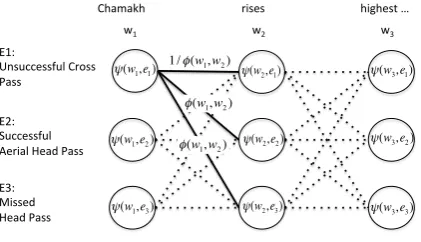
Figure 4:We use a trellis to allow for dynamic programming optimization of the objective function
Splitpoint Classifier: All other bigrams besides those above are labeled as negative examples, and a linear SVM is fit to the data. The features for the classifier include structural, discourse, and statis-tical features. We make use of dependency parse information from the Stanford dependency parser (De Marneffe and Manning, 2008). The full fea-tures list is explained in Table 1.
4.3 Optimization
We want to maximize the function in Equation 1, and we have explained that we can approximate this by maximizing the factored form in Equation 2. By the above methods, we can produce values for the functionsΨalignandΦseg. What remains is
to optimize Equation 2.
We take advantage of the factorization by using a dynamic programming approach to optimiza-tion. Figure 4 illustrates the setup. For each word
wi of the utterance, we create a column of nodes
in our trellis, with one row for each eventej ∈E.
The nodes represent the affinity of a given wordwi
with eventej. The weights on these nodes come
fromψatr.(wi, ej)described in section 4.2.
The nodes in column wi are connected to the
Method Precision Recall F1 Liang et al. (2009) 0.513 0.393 0.445 Our approach 0.603 0.481 0.535
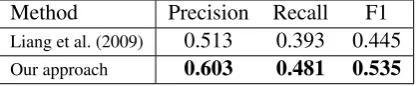
Table 2: Fragment-level alignments starting from gold utterance-level alignments
Method Precision Recall F1 Liang et al. (2009) 0.211 0.135 0.165 Our approach 0.235 0.255 0.245
Table 3:Fragment-level alignments starting from raw data
are drawn from the splitpoint classifier response
φ(wi, wi+1). We label the edges between adja-cent nodes corresponding to different events with the responses from the splitpoint classifier, and the inverse of these responses for edges connecting nodes corresponding to the same event.
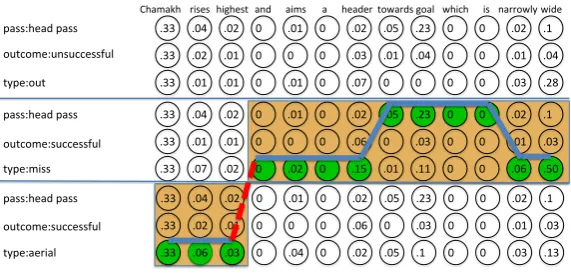
We then use the Viterbi algorithm (Viterbi, 1967) to find the maximum scoring path through this trellis. The maximum scoring path optimizes Equation 2, and serves as our approximation of the optimization of Equation 1. We choose the top k diverse paths through the trellis and use the associ-ations therein as our alignments. See Figure 5 for a detailed example of how our Viterbi path coin-cides with the responses from theattribute:value classifiers.
5 Experiments
One justification for multi-resolution language grounding would be if finer-resolution grounding improves coarser-resolution grounding and vice versa. If so, we expect that better utterance-level alignments will improve fragment-level ments, and that in turn those fragment-level align-ments will improve utterance-level alignalign-ments. We evaluate both of these hypotheses.
5.1 Experimental Setup
Dataset: We use the publicly available Profes-sional Soccer Commentary (PSC) dataset intro-duced in Hajishirzi et al. (2012). This dataset is composed of professional commentaries from the 2010-2011 season of the English Premier League, along with a human-annotated data feed produced for each game by Opta Sportsdata (Opta, 2012) which describes all events occurring around the ball. Events include passes, shots, misses, cards,
Method Precision Recall F1 Liang et al. (2009) 0.327 0.418 0.367 Hajishirzi et al. (2012) 0.355 0.576 0.439
[image:7.595.311.532.63.120.2]Our approach 0.407 0.520 0.457
Table 4:Utterance-level alignment results
tackles, and other relevant game details. Each event category is defined precisely and the feed is annotated by professionals according to strict event description guidelines.
The PSC also provides ground truth alignment of full utterances to events in the data feed, and for this work we have augmented it with ground truth fragment-level annotations5.
We use data from 7 games of the PSC. These games consist of 778 utterances totaling 13,692 words. There are 12,275 events. This data is la-beled with ground truth utterance- and fragment-alignments.
Metric: There are 1,295 correct utterance-to-event alignments. For evaluation we use precision, recall, and F1 of our utterance-level alignments.
The evaluation of fragment-level alignments is less straight forward. This is due to the two fea-tures of a correct fragment alignment: picking the correct fragment boundaries and associating the fragment with the correct event. We evaluate fragment-level alignment on a per word basis. We consider precision in this task to be the number of correct word to event alignments versus the total number of alignments produced by a system. Re-call is the number of correct word to event ments versus the total gold word to event align-ments, of which there are 18,147.
Comparisons: We compare to two previous works: Liang et al. (2009), which produces both segmentation and alignment results; and Ha-jishirzi et al. (2012), which produces state-of-the-art alignments. When evaluating segmentation, we compare how well the systems perform start-ing from the raw dataset, and startstart-ing from gold utterance-level alignments. This allows us to iso-late the segmentation process from the overall sys-tem architectures. It also gives us some insight into the effect of event priors on the segmentation and alignment processes.
Chamakh rises highest and aims a header towards goal which is narrowly wide pass:head pass
outcome:unsuccessful
type:out
pass:head pass
outcome:successful type:miss
pass:head pass
outcome:successful
type:aerial
.01 0 .02 .05 .23 0 0 .02 .1 .33 .04 .02 0
0 0 .03 .01 .04 0 0 .01 .04 .33 .02 .01 0
.01 0 .07 0 0 0 0 .03 .28 .33 .01 .01
0
.01 0 .02 .05 .23 0 0 .02 .1 .33 .04 .02 0
0 0 .06 0 .03 0 0 .01 .03 .33 .01 .01 0
.02 0 .15 .01 .11 0 0 .06 .50 .33 .07 .02 0
.01 0 .02 .05 .23 0 0 .02 .1 .33 .04 .02 0
0 0 .06 0 .03 0 0 .01 .03 .33 .02 .01 0
[image:8.595.77.363.63.200.2].04 0 .02 .05 .1 0 0 .03 .13 .33 .06 .03 0
Figure 5:A successful grounding at multiple resolutions. Thin blue lines separate theattribute:valuepairs corresponding to the three events. Values ofψ(wi, ej)
are shown on each node. The shaded bands indicate the gold fragment-level align-ments. Thick line connecting the green nodes indicates the classifier responses used in the Viterbi best path through our trellis. The red dashed edge indicates a high response from the splitpoint classifier. This figure is best viewed in color.
Method Precision Recall F1 Ours 0.235 0.255 0.245
-Ψaffinity 0.213 0.133 0.164
-Φseg 0.205 0.232 0.218
Table 5:Ablation studies for fragment-level alignments by removing Ψaffinity and Φseg
from our model by replacing them with uni-form function.
Method Precision Recall F1 Ours 0.407 0.520 0.457
-Ψaffinity 0.446 0.189 0.265
-Φseg 0.376 0.563 0.451
Table 6:Ablation studies for utterance-level alignments by removing Ψaffinity and Φseg
from our model by replacing them with uni-form function.
5.2 Results
We evaluate our method on its alignments at the fragment-level and at the utterance-level. The re-sults are as follows:
Fragment-level:Our results for segmentation can be seen in Tables 2 and 3. Table 2 shows the results achieved on the fragment-level alignment task us-ing human-labeled utterance to event alignments. In this setting, all and only the correct events for each utterance are present. Still, there are sev-eral ambiguities in the data. Some fragments are aligned in the gold data with multiple events, and some are aligned to no event. Our method out-performs the previous by a large margin in terms of both precision and recall. We show below how this is due to our system’s accommodation of dis-course structure when making segmentation deci-sions and the factored form of our optimization.
Table 3 shows the results for fragment-level alignment by applying each system starting from the raw data. Here, in addition to the ambiguities mentioned above, the problem is further compli-cated by the fact that some correct events are miss-ing from the alignments produced by each system and some incorrect events are included in these alignments (see Error Analysis below for details). Still our method achieves a significant improve-ment, with a 48% increase in F1 versus prior work. Table 5 shows ablation results for the effect of the factors used in our optimization for fragment-level alignments. These results demonstrate the value of each factor in the fragment-level align-ment process. We cannot ascribe the benefit of this method to one factor or another alone – it is their
concert that improves performance.
Utterance-level:We have posited that good finer-resolution alignments will improve the coarser-resolution utterance to event alignments. Our re-sults confirm this hypothesis. Table 4 shows our results on these alignments. We are able to im-prove F1 versus a state-of-the-art system which is tuned to maximize its F1 score. The major-ity of our improvement comes from the increased precision of our system, due to the influence of the finer-resolution fragment-level alignments on these coarser, utterance-level alignments. We pro-vide a detailed example of this below. Ablation results are shown in Table 6.
5.3 Qualitative Analysis
A qualitative analysis of our system reveals the power of our factored objective, double-sided compositional approach, and leveraging of dis-course structure. Figure 5 shows the best path through the trellis of the example sentence used in the introduction. For explanatory purposes, we have split every event into its three compo-nent attributes. This allows us to see how the attribute:value classifiers combine to produce an alignment.
Discourse Structure: The fragment-level align-ment we have produced for this utterance is per-fect: it correctly identifies the singlesplitpointand correctly identifies each fragment with the associ-ated event.
[image:8.595.377.534.65.111.2]in our trellis between different events are weighted higher than edges between the same event in the edges between the nodes for “highest” and “and”, encouraging the Viterbi path to change events at this point.
Compositionality: We can see effect of the com-positional approach we have taken – composing
ψaffinity(s, e
j) from the attribute:value classifier
scores of eachψ(wi, eaj) – by looking at how the
best path makes use of different attributes of the same event. For the “miss” event aligned with the second part of the sentence, we can see that the best path makes use of both values from the type:missandpass event:head passclassifiers.
Affinities: A few interesting associations are worth pointing out. First, we note that the word “header” has a stronger affinity for the type:miss attribute than it does for thepass events:head pass attribute. On first blush, this seems like a mistake in our classifier. However, we can see that even in this single trellis all three events have thepass events:head pass attribute. The utterance-level alignment uses this association already, align-ing utterances containalign-ing the word “header” with events that have apass events:head passattribute. At a finer-resolution, it is necessary to make a different distinction between events. Our method finds that the presence of the word “header” is a stronger indicator of an event with atype:miss at-tribute, and thus this association is made.
Words that are better for the coarser-resolution association with the pass events:head pass at-tribute are “towards” and “goal”. Out of the 10 utterances containing the word “towards” in the dataset, 3 of these are aligned with at least 1pass events:head passevent, making this strong asso-ciation a correct one. The word “goal” also has an affinity for thepass events:head passattribute due to the fact that many events with this attribute are attempts on goal. This correlates with domain knowledge about soccer, because, although there may be other uses of their head by a player in the game, shots on goal are events which will nearly always be commented upon by an announcer.
Factorization: We have shown that finer-resolution fragment-level alignments can improve utterance-level alignments. From the exemplar SVMs, we are given an utterance-level alignment of the three events shown in the trellis with the utterance. This alignment is incorrect: the gold
utterance alignment only includes the bottom two events. But by building an utterance-level ment from the results of our fragment level align-ment, we are left with only the two correct events. We prune the topmost event due to its failure to participate in a finer-resolution alignment.
5.4 Error Analysis
The majority of the errors made on our fragment-level alignments come in one of two flavors: Firstly, we sometimes erroneously identify a frag-ment as referring to an event when in truth it refers to no event. Commentators often describe facts about players or the weather or previous games which have no extension in the current game. However, our system cannot distinguish such lan-guage from the lanlan-guage referring to this game. This is a good avenue for future exploration.
The second set of errors we make in fragmen-tation are caused by bad event priors. Our current setup cannot increase recall: we can only improve the precision of the utterance-level alignments we are given. Therefore, if an event is overlooked in the first-pass of utterance-level alignments, we cannot reintroduce it through a fragment align-ment. This is a direction for future work as well.
6 Related Work
lex-ical cues. The NFL Recap dataset (Snyder and Barzilay, 2007) is also laden with numerical fact matching, and does not include the fragment-level segmentation annotation that the PSC dataset pro-vides.
Impressive advances have been made grounding language in instructions. Branavan et al. (2009) and Vogel and Jurafsky (2010) work in the do-main of computer technical support instructions, mapping language to actions using reinforcement learning. Matuszek et al. (2012b) parses sim-ple language to robot control instructions. Our work focuses on dealing with a richer space, both in terms of the language used and the world-representation into which it is grounded, and lever-aging the multiple resolutions of reference.
An exciting direction of research, closer to our own, aims to ground natural language in visual perception systems. Matuszek et al. (2012a) at-tempts to learn a joint model of language and ob-ject characteristics of a workplace environment. Yu and Siskind (2013) grounds moderately rich language in automatically annotated video clips. Again, the contribution of our work versus the above is in the complexity of the language with which we deal and our multi-resolution model.
7 Conclusion
The problem of grounding complex natural hu-man language such as soccer commentaries is extremely difficult at all resolutions, and it is most challenging at finer resolutions where data is sparsest and small errors cannot be as easily nor-malized. Our work will help open new avenues of research into this difficult and exciting problem.
This paper presents a new method for the multi-resolution grounding of complex natural language in a detailed world representation. Our factor graph allows us to decompose the grounding prob-lem into the more tractable subprobprob-lems of seg-menting the language into fragments and aligning the fragments with the world representation. In the segmentation phase, we make use of linguis-tic theories of discourse to create a proxy of labels from which we learn statistical and structural fea-tures of good splitpoints. In the alignment phase, we bootstrap the learning of finer-grained corre-spondences between the language and the world representation with rough alignments from a state-of-the-art system. We combine these phases in a dynamic programming setup which allows us to
efficiently optimize our objective.
We have shown that factoring the acquisition problem into separate alignment and segmentation phases improves performance on several evalua-tion metrics. We achieve considerable improve-ments over the previous state of the art on finer-resolution alignments in the domain of profes-sional soccer commentaries, and we show that we can leverage groundings at one resolution to im-prove alignments in another.
Several extensions of this work are possible. We would like to annotate more games to improve our dataset. We could improve our model by en-coding the dynamics of the environment. We did not attempt to learn this information in our pro-cess, but it is likely that modeling the event tran-sition probabilities could provide better results. A larger future work would extend the method out-lined herein to produce templates for automated commentary generation.
Acknowledgments
This research was supported in part by a grant from the NSF (IIS-1352249), and the Royalty Re-search Fund (RRF) at the University of Washing-ton. The authors also wish to thank Gina-Anne Levow, Yoav Artzi, Ben Hixon, and the anony-mous reviewers for their valuable feedback on this work.
References
Yoav Artzi and Luke Zettlemoyer. 2013. Weakly su-pervised learning of semantic parsers for mapping instructions to actions. Transactions of the Associa-tion for ComputaAssocia-tional Linguistics, 1(1):49–62. Alan Black and Kevin Lenzo. 2000. Building voices
in the festival speech synthesis system.
Antoine Bordes, Nicolas Usunier, and Jason Weston. 2010. Label ranking under ambiguous supervision for learning semantic correspondences. In Proceed-ings of The 27th International Conference on Ma-chine Learning, pages 103–110.
S. R. K. Branavan, Harr Chen, Luke Zettlemoyer, and Regina Barzilay. 2009. Reinforcement learning for mapping instructions to actions. InProceedings of the Joint Conference of the 47th Annual Meeting of the Association for Computational Linguistics and 4th International Joint Conference on Natural Lan-guage Processing of the AFNLP, pages 82–90. Wallace Chafe. 1988. Punctuation and the prosody
David L. Chen and Raymond J. Mooney. 2008. Learn-ing to sportscast: a test of grounded language ac-quisition. In Proceedings of the 25th International Conference on Machine Learning, pages 128–135. David L. Chen, Joohyun Kim, and Raymond J.
Mooney. 2010. Training a multilingual sportscaster: Using perceptual context to learn language.Journal of Artificial Intelligence Research (JAIR), 37:397– 435.
Donald Davidson. 1967. The logical form of action sentences. The logic of Decision and Action. Marie-Catherine De Marneffe and Christopher D
Man-ning. 2008. Stanford typed dependencies manual. URL http://nlp. stanford. edu/software/dependencies manual. pdf.
Rong-En Fan, Kai-Wei Chang, Cho-Jui Hsieh, Xiang-Rui Wang, and Chih-Jen Lin. 2008. LIBLINEAR: A library for large linear classification. Journal of Machine Learning Research, 9:1871–1874.
Ruifang Ge and Raymond J. Mooney. 2006. Discrim-inative reranking for semantic parsing. In Proceed-ings of the 44th Annual Meeting of the Association for Computational Linguistics.
Hannaneh Hajishirzi, Julia Hockenmaier, Erik T. Mueller, and Eyal Amir. 2011. Reasoning about robocup soccer narratives. In Proceedings of the 27th conference on Uncertainty in Artificial Intelli-gence, pages 291–300.
Hannaneh Hajishirzi, Mohammad Rastegari, Ali Farhadi, and Jessica K Hodgins. 2012. Semantic understanding of professional soccer commentaries. In Proceedings of the 28th conference on Uncer-tainty in Artificial Intelligence.
Rohit J. Kate and Raymond J. Mooney. 2007. Learn-ing language semantics from ambiguous supervi-sion. In Proceedings of the Twenty-Second AAAI Conference on Artificial Intelligence, pages 895– 900.
Percy Liang, Michael I. Jordan, and Dan Klein. 2009. Learning semantic correspondences with less super-vision. InProceedings of the Joint Conference of the 47th Annual Meeting of the Association for Com-putational Linguistics and 4th International Joint Conference on Natural Language Processing of the AFNLP, pages 91–99.
Tomasz Malisiewicz, Abhinav Gupta, and Alexei A. Efros. 2011. Ensemble of exemplar-svms for object detection and beyond. In Proceedings of the 13th International Conference on Computer Vision. Cynthia Matuszek, Nicholas FitzGerald, Luke
Zettle-moyer, Liefeng Bo, and Dieter Fox. 2012a. A Joint Model of Language and Perception for Grounded Attribute Learning. In Proc. of the 2012 Interna-tional Conference on Machine Learning, Edinburgh, Scotland, June.
Cynthia Matuszek, Evan Herbst, Luke Zettlemoyer, and Dieter Fox. 2012b. Learning to parse natural language commands to a robot control system. In Proc. of the 13th International Symposium on Ex-perimental Robotics (ISER), June.
Opta. 2012. http://www.optasports.com.
Janet Pierrehumbert and Julia Hirschberg. 1990. The meaning of intonational contours in the interpreta-tion of discourse. Intentions in Communication, 271.
Emily Pitler, Mridhula Raghupathy, Hena Mehta, Ani Nenkova, Alan Lee, and Aravind K Joshi. 2008. Easily identifiable discourse relations. Technical Reports (CIS), page 884.
Hoifung Poon and Pedro Domingos. 2009. Unsuper-vised semantic parsing. InProceedings of the 2009 Conference on Empirical Methods in Natural Lan-guage Processing, pages 1–10.
Hoifung Poon. 2013. Grounded unsupervised seman-tic parsing. InProceedings of the 51st Annual Meet-ing of the Association for Computational LMeet-inguis- Linguis-tics.
Abhinav Shrivastava, Tomasz Malisiewicz, Abhinav Gupta, and Alexei A. Efros. 2011. Data-driven visual similarity for cross-domain image matching. ACM Transaction of Graphics (TOG) (Proceedings of ACM SIGGRAPH ASIA), 30(6).
Benjamin Snyder and Regina Barzilay. 2007. Database-text alignment via structured multilabel classification. In Proceedings of the 20th Inter-national Joint Conference on Artificial Intelligence, pages 1713–1718.
Andrew J Viterbi. 1967. Error bounds for convolu-tional codes and an asymptotically optimum decod-ing algorithm. Information Theory, IEEE Transac-tions on, 13(2):260–269.
Adam Vogel and Daniel Jurafsky. 2010. Learning to follow navigational directions. InProceedings of the 48th Annual Meeting of the Association for Compu-tational Linguistics, pages 806–814.
Haonan Yu and Jeffrey Mark Siskind. 2013. Grounded language learning from video described with sen-tences. In Proceedings of the 51st Annual Meet-ing of the Association for Computational LMeet-inguis- Linguis-tics, volume 1, pages 53–63.