Learning Abstract Concept Embeddings from Multi-Modal Data:
Since You Probably Can’t See What I Mean
Felix Hill Computer Laboratory University of Cambridge
Anna Korhonen Computer Laboratory University of Cambridge
Abstract
Models that acquire semantic represen-tations from both linguistic and percep-tual input are of interest to researchers in NLP because of the obvious parallels with human language learning. Perfor-mance advantages of the multi-modal ap-proach over language-only models have been clearly established when models are required to learn concrete noun concepts. However, such concepts are comparatively rare in everyday language. In this work, we present a new means of extending the scope of multi-modal models to more commonly-occurring abstract lexical con-cepts via an approach that learns multi-modal embeddings. Our architecture out-performs previous approaches in combin-ing input from distinct modalities, and propagates perceptual information on con-crete concepts to abstract concepts more effectively than alternatives. We discuss the implications of our results both for op-timizing the performance of multi-modal models and for theories of abstract con-ceptual representation.
1 Introduction
Multi-modal models that learn semantic represen-tations from both language and information about the perceptible properties of concepts were orig-inally motivated by parallels with human word learning (Andrews et al., 2009) and evidence that many concepts are grounded in perception (Barsa-lou and Wiemer-Hastings, 2005). The perceptual information in such models is generally mined di-rectly from images (Feng and Lapata, 2010; Bruni et al., 2012) or from data collected in psychologi-cal studies (Silberer and Lapata, 2012; Roller and Schulte im Walde, 2013).
By exploiting the additional information en-coded in perceptual input, multi-modal models can outperform language-only models on a range of semantic NLP tasks, including modelling sim-ilarity (Bruni et al., 2014; Kiela et al., 2014) and free association (Silberer and Lapata, 2012), pre-dicting compositionality (Roller and Schulte im Walde, 2013) and concept categorization (Silberer and Lapata, 2014). However, to date, these pre-vious approaches to multi-modal concept learning
focus on concrete words such ascatordog, rather
than abstract concepts, such ascuriosityorloyalty.
However, differences between abstract and con-crete processing and representation (Paivio, 1991; Hill et al., 2013; Kiela et al., 2014) suggest that conclusions about concrete concept learning may not necessarily hold in the general case. In this pa-per, we therefore focus on multi-modal models for learning both abstract and concrete concepts.
Although concrete concepts might seem more basic or fundamental, the vast majority of open-class, meaning-bearing words in everyday lan-guage are in fact abstract. 72% of the noun or verb tokens in the British National Corpus (Leech
et al., 1994) are rated by human judges1 as more
abstract than the noun war, for instance, a
con-cept many would already consider to be quite abstract. Moreover, abstract concepts by defi-nition encode higher-level (more general) princi-ples than concrete concepts, which typically re-side naturally in a single semantic category or do-main (Crutch and Warrington, 2005). It is there-fore likely that abstract representations may prove highly applicable for multi-task, multi-domain or transfer learning models, which aim to acquire ‘general-purpose’ conceptual knowledge without reference to a specific objective or task (Collobert and Weston, 2008; Mesnil et al., 2012).
In a recent paper, Hill et al. (2014) investigate whether the multi-modal models cited above are
1Contributors to the USF dataset (Nelson et al., 2004).
effective for learning concepts other than concrete nouns. They observe that representations of cer-tain abstract concepts can indeed be enhanced in multi-modal models by combining perceptual and
linguistic input with an information propagation
step. Hill et al. (2014) propose ridge regression as an alternative to the nearest-neighbour averaging proposed by Johns and Jones (2012) for such prop-agation, and show that it is more robust to changes in the type of concept to be learned. However, both methods are somewhat inelegant, in that they learn separate linguistic and ‘pseudo-perceptual’ repre-sentations, which must be combined via a separate
information combinationstep. Moreover, for the majority of abstract concepts, the best performing multi-modal model employing these techniques remains less effective than conventional text-only representation learning model.
Motivated by these observations, we introduce an architecture for learning both abstract and con-crete representations that generalizes the skipgram model of Mikolov et al. (2013) from text-based to multi-modal learning. Aspects of the model de-sign are influenced by considering the process of human language learning. The model moderates the training input to include more perceptual infor-mation about commonly-occurring concrete con-cepts and less information about rarer concon-cepts. Moreover, it integrates the processes of combin-ing perceptual and lcombin-inguistic input and propagat-ing information from concrete to abstract concepts into a single representation update process based on back-propagation.
We train our model on running-text language and two sources of perceptual descriptors for con-crete nouns: the ESPGame dataset of annotated images (Von Ahn and Dabbish, 2004) and the CSLB set of concept property norms (Devereux et al., 2013). We find that our model combines in-formation from the different modalities more ef-fectively than previous methods, resulting in an improved ability to model the USF free associa-tion gold standard (Nelson et al., 2004) for con-crete nouns. In addition, the architecture propa-gates the extra-linguistic input for concrete nouns to improve representations of abstract concepts more effectively than alternative methods. While this propagation can effectively extend the advan-tage of the multi-modal approach to many more concepts than simple concrete nouns, we observe that the benefit of adding perceptual input appears
to decrease as target concepts become more ab-stract. Indeed, for the most abstract concepts of all, language-only models still provide the most effective learning mechanism.
Finally, we investigate the optimum quantity and type of perceptual input for such models. Be-tween the most concrete concepts, which can be effectively represented directly in the perceptual modality, and the most abstract concepts, which cannot, we identify a set of concepts that cannot be represented effectively directly in the percep-tual modality, but still benefit from perceppercep-tual in-put propagated in the model via concrete concepts. The motivation in designing our model and ex-periments is both practical and theoretical. Taken together, the empirical observations we present are potentially important for optimizing the learning of representations of concrete and abstract con-cepts in multi-modal models. In addition, they of-fer a degree of insight into the poorly understood issue of how abstract concepts may be encoded in human memory.
2 Model Design
Before describing how our multi-modal architec-ture encodes and integrates perceptual informa-tion, we first describe the underlying corpus-based representation learning model.
Language-only Model Our multi-modal archi-tecture builds on the continuous log-linear skip-gram language model proposed by Mikolov et al. (2013). This model learns lexical representa-tions in a similar way to neural-probabilistic lan-guage models (NPLM) but without a non-linear hidden layer, a simplification that facilitates the efficient learning of large vocabularies of dense
representations, generally referred to as
embed-dings (Turian et al., 2010). Embeddings learned by the model achieve state-of-the-art performance on several evaluations including sentence comple-tion and analogy modelling (Mikolov et al., 2013).
For each word typewin the vocabularyV, the
model learns both a ‘target-embedding’rw ∈ Rd
and a ‘context-embedding’ rˆw ∈ Rd such that,
given a target word, its ability to predict nearby context words is maximized. The probability of
seeing context wordcgiven targetwis defined as:
p(c|w) = P erˆc·rw
wn
Target Representation
Score: p(c|w)
Context Representations Information Source
wn+2
pw n+2
wn+1
pw n+1
wn-1
pw n-1
wn-2
pw n-2
Linguistic
Text8 Corpus
Perceptual
P ESP PCSBL
Figure 1: Our multi-modal model architecture. Light boxes are elements of the original Mikolov et
al. (2013) model. For target wordswn in the domain ofP(concrete concepts), the model updates its
representations based on corpus context wordswn±i, then on wordspwn±iin perceptual pseudo-sentences.
Forwnnot in the domain ofP(abstract concepts), updates are based solely on thewn±i.
The model learns from a set of target-word, context-word pairs, extracted from a corpus of
sentences as follows. In a given sentence S (of
length N), for each position n ≤ N, each word
wn is treated in turn as a target word. An
inte-gert(n)is then sampled from a uniform
distribu-tion on {1, . . . k}, where k > 0 is a predefined
maximum context-window parameter. The pair
to-kens{(wn, wn+j) :−t(n) ≤ j ≤ t(n), wi ∈ S}
are then appended to the training data. Thus, tar-get/context training pairs are such that (i) only
words within ak-window of the target are selected
as context words for that target, and (ii) words closer to the target are more likely to be selected than those further away.
The training objective is then to maximize the
sum of the log probabilities T across of all such
examples from S and across all sentences in the
corpus, whereT is defined as follows:
T = N1 XN
n=1
X
−t(n)≤j≤t(n),j6=0
log(p(wn+j|wn))
The model free parameters (target-embeddings
and context-embeddings of dimensiondfor each
word in the corpus with frequency above a certain
threshold f) are updated according to stochastic
gradient descent and backpropation, with learning rate controlled by Adagrad (Duchi et al., 2011). For efficiency, the output layer is encoded as a hierarchical softmax function based on a binary Huffman tree (Morin and Bengio, 2005).
As with other distributional architectures, the model captures conceptual semantics by exploit-ing the fact that words appearexploit-ing in similar lin-guistic contexts are likely to have similar mean-ings. Informally, the model adjusts its embeddings
to increase the ‘probability’ of seeing the language in the training corpus. Since this probability
in-creases with thep(c|w), and the p(c|w) increase
with the dot productrˆc·rw, the updates have the
effect of moving each target-embedding incremen-tally ‘closer’ to the context-embeddings of its col-locates. In the target-embedding space, this results in embeddings of concept words that regularly oc-cur in similar contexts moving closer together.
Multi-modal Extension We extend the Mikolov et al. (2013) architecture via a simple means of in-troducing perceptual information that aligns with human language learning. Based on the assump-tion that frequency in domain-general linguistic corpora correlates with the likelihood of ‘experi-encing’ a concept in the world (Bybee and Hop-per, 2001; Chater and Manning, 2006), perceptual information is introduced to the model whenever designated concrete concepts are encountered in the running-text linguistic input. This has the ef-fect of introducing more perceptual input for com-monly experienced concrete concepts and less in-put for rarer concrete concepts.
To implement this process, perceptual informa-tion is extracted from external sources and
en-coded in an associative arrayP, which maps
(typ-ically concrete) wordswto bags of perceptual
fea-turesb(w). The construction of this array depends
on the perceptual information source; the process for our chosen sources is detailed in Section 2.1.
Training our model begins as before on
running-text. When a sentenceSm containing a wordwin
the domain ofPis encountered, the model finishes
training on Sm and begins learning from a
per-ceptual pseudo-sentence Sˆm(w). Sˆm(w) is
fea-ˆ
S(crocodile) =Crocodilelegscrocodileteethcrocodile teethcrocodilescalescrocodilegreencrocodile.
ˆ
S(screwdriver) = Screwdriver handlescrewdriverflat screwdriverlongscrewdriverhandlescrewdriverhead.
Figure 2: Example pseudo-sentences generated by our model.
ture sampled at random from b(w) until Sˆm(w)
is the same length asSm (see Figure 2). Because
we want the ensuing perceptual learning process
to focus on how wrelates to its perceptual
prop-erties (rather than how those propprop-erties relate to
each other), we insert multiple instances ofwinto
ˆ
Sm(w). This ensures that the majority of
train-ing cases derived fromSˆm(w)are instances of (w,
feature) rather than (feature, feature) pairs. Once
training onSˆm(w)is complete, the model reverts
to the next ‘genuine’ (linguistic) sentence Sm+1,
and the process continues. Thus, when a concrete concept is encountered in the corpus, its embed-ding is first updated based on language (moved in-crementally closer to concepts appearing in sim-ilar linguistic contexts), and then on perception (moved incrementally closer to concepts with the same or similar perceptual features).
For greater flexibility, we introduce a parameter
α reflecting the raw quantity of perceptual
infor-mation relative to linguistic input. Whenα = 2,
two pseudo-sentences are generated and inserted for every corpus occurrence of a token from the
domain of P. For non-integral α, the number of
sentences inserted isbαc, and a further sentence is
added with probabilityα− bαc.
In all experiments reported in the following
sec-tions we set the window size parameterk= 5and
the minimum frequency parameter f = 3, which
guarantees that the model learns embeddings for all concepts in our evaluation sets. While the model learns both target and context-embeddings for each word in the vocabulary, we conduct our experiments with the target embeddings only. We
set the dimension parameterd= 300as this
pro-duces high quality embeddings in the language-only case (Mikolov et al., 2013).
2.1 Information Sources
We construct the associative array of perceptual
information Pfrom two sources typical of those
used for multi-modal semantic models.
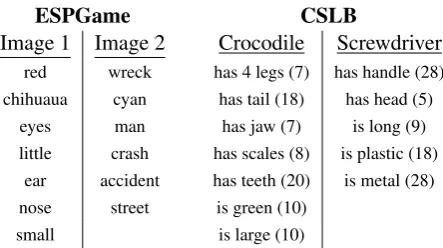
ESPGame Dataset The ESP-Game dataset (ESP) (Von Ahn and Dabbish, 2004) consists of 100,000 images, each annotated with a list of lex-ical concepts that appear in that image.
For any concept w identified in an ESP
im-age, we construct a corresponding bag of features
b(w). For each ESP imageI that containsw, we
append the other concept tokens identified inI to
b(w). Thus, the more frequently a concept
co-occurs withwin images, the more its
correspond-ing lexical token occurs inb(w). The arrayPESP
in this case then consists of the(w,b(w))pairs.
CSLB Property Norms The Centre for Speech, Language and the Brain norms (CSLB) (Devereux et al., 2013) is a recently-released dataset contain-ing semantic properties for 638 concrete concepts produced by human annotators. The CSLB dataset was compiled in the same way as the McRae et al. (2005) property norms used widely in multi-modal models (Silberer and Lapata, 2012; Roller and Schulte im Walde, 2013); we use CSLB be-cause it contains more concepts. For each concept, the proportion of the 30 annotators that produced a given feature can also be employed as a measure of the strength of that feature.
When encoding the CSLB data in P, we first
map properties to lexical forms (e.g. is green
becomes green). By directly identifying
percep-tual features and linguistic forms in this way, we treat features observed in the perceptual data as (sub)concepts to be acquired via the same multi-modal input streams and stored in the same domain-general memory as the evaluation con-cepts. This design decision in fact corresponds to a view of cognition that is sometimes disputed (Fodor, 1983). In future studies we hope to com-pare the present approach to architectures with domain-specific conceptual memories.
For each concept w in CSLB, we then
con-struct a feature bag b(w) by appending lexical
forms to b(w) such that the count of each
fea-ture word is equal to the strength of that feafea-ture
for w. Thus, when features are sampled from
b(w)to create pseudo-sentences (as detailed
pre-viously) the probability of a feature word occur-ring in a sentence reflects feature strength. The
arrayPCSLBthen consists of all(w,b(w))pairs.
Linguistic Input The linguistic input to all
models is the 400m word Text8 Corpus2 of
ESPGame CSLB
Image 1 Image 2 Crocodile Screwdriver
red wreck has 4 legs (7) has handle (28) chihuaua cyan has tail (18) has head (5)
eyes man has jaw (7) is long (9) little crash has scales (8) is plastic (18)
ear accident has teeth (20) is metal (28) nose street is green (10)
[image:5.595.78.300.62.186.2]small is large (10)
Table 1: Concepts identified in images in the ESP Game (left) and features produced for concepts by human annotators in the CSLB dataset (with fea-ture strength, max=30).
Concept 1 Concept 2 Assoc.
abdomen (6.83) stomach (6.04) 0.566
throw (4.05) ball (6.08) 0.234
hope (1.18) glory (3.53) 0.192
egg (5.79) milk (6.66) 0.012
Table 2: Example concept pairs (with mean con-creteness rating) and free-association scores from the USF dataset.
Wikipedia text, split into sentences and with punc-tuation removed.
2.2 Evaluation
We evaluate the quality of representations by how
well they reflect free association scores, an
em-pirical measure of cognitive conceptual
proxim-ity. The University of South Florida Norms
(USF) (Nelson et al., 2004) contain free associa-tion scores for over 40,000 concept pairs, and have been widely used in NLP to evaluate semantic rep-resentations (Andrews et al., 2009; Feng and La-pata, 2010; Silberer and LaLa-pata, 2012; Roller and Schulte im Walde, 2013). Each concept that we extract from the USF database has also been rated for conceptual concreteness on a Likert scale of 1-7 by at least 10 human annotators. Following previous studies (Huang et al., 2012; Silberer and
Lapata, 2012), we measure the (Spearmanρ)
cor-relation between association scores and the cosine similarity of vector representations.
We create separate abstract and concrete con-cept lists by ranking the USF concon-cepts accord-ing to concreteness and samplaccord-ing at random from the first and fourth quartiles respectively. We also introduce a complementary noun/verb dichotomy,
Concept Type List Pairs Examples
concrete nouns 541 1418 yacht, cup
abstract nouns 100 295 fear, respect
all nouns 666 1815 fear, cup
concrete verbs 50 66 kiss, launch
abstract verbs 50 127 differ, obey
[image:5.595.84.281.265.336.2]all verbs 100 221 kiss, obey
Table 3: Details the subsets of USF data used in our evaluations, downloadable from our website.
on the intuition that information propagation may occur differently from noun to noun or from noun to verb (because of their distinct structural rela-tionships in sentences). POS-tags are not assigned as part of the USF data, so we draw the noun/verb distinction based on the majority POS-tag of USF concepts in the lemmatized British National Cor-pus (Leech et al., 1994). The abstract/concrete and noun/verb dichotomies yield four distinct con-cept lists. For consistency, the concrete noun list
is filtered so that each concrete noun concept w
has a perceptual representationb(w) in bothPESP
andPCSLB. For the four resulting concept lists
C (concrete/abstract, noun/verb), a
correspond-ing set of evaluation pairs {(w1, w2) ∈ USF :
w1, w2∈C}is extracted (see Table 3 for details).
3 Results and Discussion
Our experiments were designed to answer four questions, outlined in the following subsec-tions: (1) Which model architectures perform best at combining information pertinent to multiple modalities when such information exists explicitly (as common for concrete concepts)? (2) Which model architectures best propagate perceptual in-formation to concepts for which it does not exist explicitly (as is common for abstract concepts)? (3) Is it preferable to include all of the perceptual input that can be obtained from a given source, or to filter this input stream in some way? (4) How much perceptual vs. linguistic input is optimal for learning various concept types?
3.1 Combining information sources
by the Mikolov et al. (2013) model on the Text8
Corpus. In the second alternative (proposed
for multi-modal models by Silberer and Lapata
(2012)), canonical correlation analysis (CCA)
(Hardoon et al., 2004) was applied to the vec-tors of both modalities. CCA yields reduced-dimensionality representations that preserve un-derlying inter-modal correlations, which are then concatenated. The final alternative, proposed by Bruni et al. (2014) involves applying Singular Value Decomposition (SVD) to the matrix of con-catenated multi-modal representations, yielding
smoothed representations.3
When implementing the concatenation, CCA and SVD methods, we first encoded the percep-tual input directly into sparse feature vectors, with coordinates for each of the 2726 features in CSLB and for each of the 100,000 images in ESP. This sparse encoding matches the approach taken by Silberer and Lapata (2012), for CCA and concate-nation, and by Hill et al. (2014) for the ridge re-gression method of propagation (see below).
We compare these alternatives to our proposed
model withα= 1. In The CSLB and ESP models,
all training pseudo-sentences are generated from
the arraysPCSLB andPESPrespectively. In the
models classed as CSLB&ESP, a random choice
between PCSLB and PESP is made every time
perceptual input is included (so that the overall quantity of perceptual information is the same).
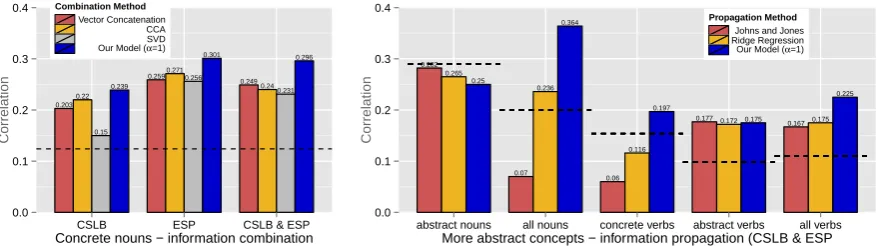
As shown in Figure 2 (left side), the embed-dings learned by our model achieve a higher cor-relation with the USF data than simple concatena-tion, CCA and SVD regardless of perceptual input source. With the optimal perceptual source (ESP only), for instance, the correlation is 11% higher that the next best alternative method, CCA.
One possible factor behind this improvement is that, in our model, the learned representations fully integrate the two modalities, whereas for both CCA and the concatenation method each rep-resentation feature (whether of reduced dimension or not) corresponds to a particular modality. This deeper integration may help our architecture to overcome the challenges inherent in information combination such as inter-modality differences in information content and representation sparsity. It is also important to note that Bruni et al. (2014)
ap-3CCA was implemented using the CCA package in
R. SVD was implemented using SVDLIBC (http://
tedlab.mit.edu/˜dr/SVDLIBC/), with truncation
factork= 1024as per (Bruni et al., 2014).
plied their SVD method with comparatively dense perceptual representations extracted from images, whereas our dataset-based perceptual vectors were sparsely-encoded.
3.2 Propagating input to abstract concepts
To test the process of information propagation in our model, we evaluated the learned embeddings of more abstract concepts. We compared our approach with two recently-proposed alternative methods for inferring perceptual features when ex-plicit perceptual information is unavailable.
Johns and Jones In the method of Johns and Jones (2012), pseudo-perceptual representations for target concepts without a perceptual repre-sentations (uni-modal concepts) are inferred as a weighted average of the perceptual representations of concepts that do have such a representation (bi-modal concepts).
In the first step of their two-step method, for
each uni-modal conceptk, a quasi-perceptual
rep-resentation is computed as an average of the perceptual representations of bi-modal concepts, weighted by the proximity between each of these
concepts andk
kp =X
c∈C¯
S(kl,cl)λ·cp
whereC¯is the set of bi-modal concepts,cpandkp
are the perceptual representations forcandk
re-spectively, andclandklthe linguistic
representa-tions. The exponent parameterλreflects the
learn-ing rate.
In step two, the initial quasi-perceptual repre-sentations are inferred for a second time, but with the weighted average calculated over the percep-tual or initial quasi-perceppercep-tual representations of all other words, not just those that were originally bi-modal. As with Johns and Jones (2012), we set
the learning rate parameter λ to be 3 in the first
step and 13 in the second.
Ridge Regression An alternative, proposed for
the present purpose by Hill et al. (2014), usesridge
regression (Myers, 1990). Ridge regression is a variant of least squares regression in which a reg-ularization term is added to the training objective to favor solutions with certain properties.
For bi-modal concepts of dimensionnp, we
fi : Rnl → R that map the linguistic
represen-tations (of dimension nl) to a particular
percep-tual feature i. These functions are then applied
together to map the linguistic representations of uni-modal concepts to full quasi-perceptual repre-sentations.
Following Hill et al. (2014), we take the
Euclid-ianl2norm of the inferred parameter vector as the
regularization term. This ensures that the regres-sion favors lower coefficients and a smoother so-lution function, which should provide better gen-eralization performance than simple linear
regres-sion. The objective for learning the fi is then to
minimize
kaX−Yik22+kak22
whereais the vector of regression coefficients,X
is a matrix of linguistic representations and Yi a
vector of the perceptual featureifor the set of
bi-modal concepts.
Comparisons We applied the Johns and Jones method and ridge regression starting from linguis-tic embeddings acquired by the Mikolov et al. (2013) model on the Text8 Corpus, and concate-nated the resulting pseudo-perceptual and linguis-tic representations. As with the implementation of our model, the perceptual input for these alter-native models was limited to concrete nouns (i.e. concrete nouns were the only bi-modal concepts in the models).
Figure 3 (right side) shows the propagation per-formance of the three models. While the corre-lations overall may seem somewhat low, this is a consequence of the difficulty of modelling the USF data. In fact, the performance of both the language-only model and our multi-modal exten-sion across the concept types (from 0.18 to 0.36) is equal to or higher than previous models evaluated on the same data (Feng and Lapata, 2010; Silberer and Lapata, 2012; Silberer et al., 2013).
For learning representations of concrete verbs, our approach achieves a 69% increase in mance over the next best alternative. The perfor-mance of the model on abstract verbs is marginally inferior to Johns and Jones’ method. Neverthe-less, the clear advantage for concrete verbs makes our model the best choice for learning represen-tations of verbs in general, as shown by
perfor-mance on the set all verbs, which also includes
mixed abstract-concrete pairs.
Our model is also marginally inferior to alterna-tive approaches in learning representations of
ab-stract nouns. However, in this case, no method improves on the linguistic-only baseline. It is possible that perceptual information is simply so removed from the core semantics of these con-cepts that they are best acquired via the linguis-tic medium alone, regardless of learning mecha-nism. The moderately inferior performance of our method in such cases is likely caused by its greater inherent inter-modal dependence compared with methods that simply concatenate uni-modal rep-resentations. When the perceptual signal is of low quality, this greater inter-modal dependence allows the linguistic signal to be obscured.
The trade-off, however, is generally higher-quality representations when the perceptual signal is stronger, exemplified by the fact that our pro-posed approach outperforms alternatives on pairs generated from both abstract and concrete nouns (all nouns). Indeed, the low performance of the
Johns and Jones method on all nouns is
strik-ing given that: (a) It performs best on abstract
nouns (ρ = .282), and (b) For concrete nouns it reverts to simple concatenation, which also
per-forms comparatively well (ρ = .249). The poor
performance of the Jobns and Jones method on
all nouns must therefore derive its comparisons of mixed abstract-concrete or concrete-abstract pairs. This suggests that the pseudo-perceptual representations inferred by this method for ab-stract concepts method may not be compatible with the directly-encoded perceptual representa-tions of concrete concepts, rendering the compar-ison computation between items of differing con-creteness inaccurate.
3.3 Direct representation vs. propagation
Although property norm datasets such as the CSLB data typically consist of perceptual fea-ture information for concrete nouns only, image-based datasets such as ESP do contain informa-tion on more abstract concepts, which was omit-ted from the previous experiments. Indeed, im-age banks such as Google Imim-ages contain millions of photographs portraying quite abstract concepts,
such as love orwar. On the other hand,
0.203 0.22
0.15 0.239
0.2590.2710.256 0.301
0.2490.24 0.231
0.296
0.0 0.1 0.2 0.3 0.4
CSLB ESP CSLB & ESP Concrete nouns − information combination
Correlation
Combination Method
Vector Concatenation CCA SVD Our Model (α=1)
0.282 0.265
0.25
0.07 0.236
0.364
0.06 0.116
0.197
0.1770.172 0.175 0.1670.175 0.225
0.0 0.1 0.2 0.3 0.4
abstract nouns all nouns concrete verbs abstract verbs all verbs More abstract concepts − information propagation (CSLB & ESP
Correlation
Propagation Method
[image:8.595.79.518.67.190.2]Johns and Jones Ridge Regression Our Model (α=1)
Figure 3: The proposed approach compared with other methods of information combination (left) and propagation. Dashed lines indicate language-only model baseline. For brevity we include both perceptual input sources ESP and CSLB when comparing means of propagation; results with individual information sources were similar.
to concrete nouns as previously.
Of our evaluation sets, it was possible to
con-struct from ESP (and add to PESP)
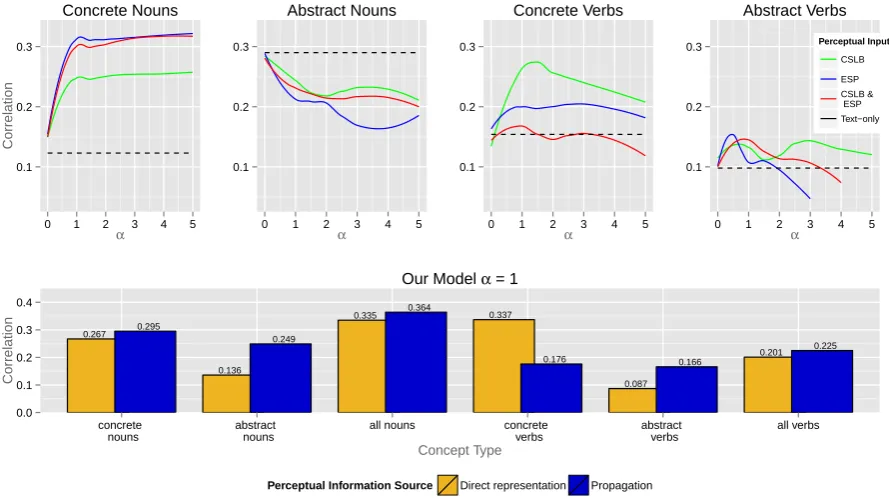
representa-tions for all of the concrete verbs, and for ap-proximately half of the abstract verbs and abstract nouns. Figure 4 (top), shows the performance of a our model trained on all available perceptual in-put versus the model in which the perceptual inin-put was restricted to concrete nouns.
The results reflect a clear manifestation of the abstract/concrete distinction. Concrete verbs be-have similarly to concrete nouns, in that they can be effectively represented directly from perceptual information sources. The information encoded in these representations is beneficial to the model and increases performance. In contrast, constructing ‘perceptual’ representations of abstract verbs and abstract nouns directly from perceptual informa-tion sources is clearly counter-productive (to the extent that performance also degrades on the
com-bined sets all nounsandall verbs). It appears in
these cases that the perceptual input acts to ob-scure or contradict the otherwise useful signal in-ferred from the corpus.
As shown in the previous section, the inclusion of any form of perceptual input inhibits the learn-ing of abstract nouns. However, this is not the case for abstract verbs. Our model learns higher qual-ity representations of abstract verbs if perceptual input is restricted to concrete nouns than if no
per-ceptual input is included at all andwhen
percep-tual input is included for both concrete nouns and abstract verbs. This supports the idea of a grad-ual scale of concreteness: The most concrete con-cepts can be effectively represented directly in the
perceptual modality; somewhat more abstract con-cepts cannot be represented directly in the percep-tual modality, but have representations that are im-proved by propagating perceptual input from con-crete concepts via language; and the most abstract concepts are best acquired via language alone.
3.4 Source and quantity of perceptual input
For different concept types, we tested the effect of varying the proportion of perceptual to linguistic
input (the parameterα). Perceptual input was
re-stricted to concrete nouns as in Sections 3.1-3.2. As shown in Figure 4, performance on concrete nouns improves (albeit to a decreasing degree) as
α increases. When learning concrete noun
rep-resentations, linguistic input is apparently redun-dant if perceptual input is of sufficient quality and quantity. For the other concept types, in each case
there is an optimal value forα in the range .5–2,
above which perceptual input obscures the linguis-tic signal and performance degrades. The prox-imity of these optima to 1 suggests that for op-timal learning, when a concrete concept is experi-enced approximately equal weight should be given to available perceptual and linguistic information.
4 Conclusions
0.1 0.2 0.3
0 1 2 3 4 5
α
Correlation
Concrete Nouns
0.1 0.2 0.3
0 1 2 3 4 5
α
Abstract Nouns
0.1 0.2 0.3
0 1 2 3 4 5
α
Concrete Verbs
0.1 0.2 0.3
0 1 2 3 4 5
α
Perceptual Input
CSLB
ESP CSLB & ESP Text−only
Abstract Verbs
0.267 0.295
0.136 0.249
0.335 0.364 0.337
0.176
0.087 0.166
0.201 0.225
0.0 0.1 0.2 0.3 0.4
concrete nouns
abstract nouns
all nouns concrete verbs
abstract verbs
all verbs
Concept Type
Correlation
[image:9.595.77.522.71.320.2]Perceptual Information Source Direct representation Propagation Our Model α = 1
Figure 4: Top: Comparing the strategy of directly representing abstract concepts from perceptual in-formation where available (yellow bars) vs. propagating via concrete concepts. Bottom: The effect of
increasingαon correlation with USF pairs (Spearmanρ) for each concept type. Horizontal dashed lines
indicate language-only model baseline.
concept from linguistic and perceptual input. While neuro-probabilistic language models have been applied to the problem of multi-modal representation learning previously (Srivastava and Salakhutdinov, 2012; Wu et al., 2013; Silberer and Lapata, 2014) our model and experiments develop this work in several important ways. First, we ad-dress the problem of learning abstract concepts. By isolating concepts of different concreteness and part-of-speech in our evaluation sets, and sep-arating the processes of information combination and propagation, we demonstrate that the multi-modal approach is indeed effective for some, but perhaps not all, abstract concepts. In addition, our model introduces a clear parallel with human lan-guage learning. Perceptual input is introduced pre-cisely when concrete concepts are ‘experienced’ by the model in the corpus text, much like a lan-guage learner experiencing concrete entities via sensory perception.
Taken together, our findings indicate the utility of distinguishing three concept types when learn-ing representations in the multi-modal settlearn-ing.
Type I Concepts that can be effectively repre-sented directly in the perceptual modality. For
such concepts, generally concrete nouns or con-crete verbs, our proposed approach provides a sim-ple means of combining perceptual and linguistic input. The resulting multi-modal representations are of higher quality than those learned via other approaches, resulting in a performance improve-ment of over 10% in modelling free association.
Type II Concepts, including abstract verbs, that cannot be effectively represented directly in the perceptual modality, but whose representations can be improved by joint learning from linguis-tic input and perceptual information about related concepts. Our model can effectively propagate perceptual input (exploiting the relations inferred from the linguistic input) from Type I concepts to enhance the representations of Type II concepts above the language-only baseline. Because of the frequency of abstract concepts, such propagation extends the benefit of the multi-modal approach to a far wider range of language than models based solely in the concrete domain.
our proposed approach nor alternative propagation methods achieve an improvement in representa-tion quality for these concepts over the language-only baseline. Of course, it is an empirical ques-tion whether a multi-modal approach could ever enhance the representation learning of these con-cepts, one with potential implications for cognitive theories of grounding (a topic of much debate in psychology (Grafton, 2009; Barsalou, 2010)).
Additionally, we investigated the optimum type and quantity of perceptual input for learning con-cepts of different types. We showed that too much perceptual input can result in degraded represen-tations. For concepts of type I and II, the
op-timal quantity resulted from setting α = 1; i.e.
whenever a concrete concept was encountered, the model learned from an equal number of language-based and perception-language-based examples. While we make no formal claims here, such observations may ultimately provide insight into human lan-guage learning and semantic memory.
In future we will address the question of whether Type III concepts can ever be enhanced via modal learning, and investigate multi-modal models that optimally learn concepts of each type. This may involve filtering the percep-tual input stream for concepts according to con-creteness, and possibly more elaborate model ar-chitectures that facilitate distinct representational frameworks for abstract and concrete concepts.
Acknowledgements
Thanks to the Royal Society and St John’s College for supporting this research, and to Yoshua Bengio and Diarmuid ´O S´eaghdha for helpful discussions.
References
Mark Andrews, Gabriella Vigliocco, and David Vin-son. 2009. Integrating experiential and distribu-tional data to learn semantic representations. Psy-chological Review, 116(3):463.
Lawrence W Barsalou and Katja Wiemer-Hastings. 2005. Situating abstract concepts. Grounding Cog-nition: The Role of Perception and Action in Mem-ory, Language, and Thought, pages 129–163. Lawrence W Barsalou. 2010. Grounded cognition:
past, present, and future. Topics in Cognitive Sci-ence, 2(4):716–724.
Elia Bruni, Gemma Boleda, Marco Baroni, and Nam-Khanh Tran. 2012. Distributional semantics in tech-nicolor. In Proceedings of the 50th Annual
Meet-ing of the Association for Computational LMeet-inguis- Linguis-tics: Long Papers-Volume 1, pages 136–145. Asso-ciation for Computational Linguistics.
Elia Bruni, Nam Khanh Tran, and Marco Baroni. 2014. Multimodal distributional semantics. Journal of Ar-tificial Intelligence Research, 49:1–47.
Joan L Bybee and Paul J Hopper. 2001.Frequency and the Emergence of Linguistic Structure, volume 45. John Benjamins Publishing.
Nick Chater and Christopher D Manning. 2006. Prob-abilistic models of language processing and acquisi-tion. Trends in Cognitive Sciences, 10(7):335–344.
Ronan Collobert and Jason Weston. 2008. A unified architecture for natural language processing: Deep neural networks with multitask learning. In Pro-ceedings of the 25th International Conference on Machine Learning, pages 160–167. ACM.
Sebastian J Crutch and Elizabeth K Warrington. 2005. Abstract and concrete concepts have structurally different representational frameworks. Brain, 128(3):615–627.
Barry J Devereux, Lorraine K Tyler, Jeroen Geertzen, and Billi Randall. 2013. The centre for speech, lan-guage and the brain (cslb) concept property norms. Behavior Research Methods, pages 1–9.
John Duchi, Elad Hazan, and Yoram Singer. 2011. Adaptive subgradient methods for online learning and stochastic optimization. The Journal of Ma-chine Learning Research, 12:2121–2159.
Yansong Feng and Mirella Lapata. 2010. Visual infor-mation in semantic representation. InHuman Lan-guage Technologies: The 2010 Annual Conference of the North American Chapter of the Association for Computational Linguistics, pages 91–99. Asso-ciation for Computational Linguistics.
Jerry A Fodor. 1983. The modularity of mind: An essay on faculty psychology. MIT press.
Scott T Grafton. 2009. Embodied cognition and the simulation of action to understand others.Annals of the New York Academy of Sciences, 1156(1):97–117.
David R Hardoon, Sandor Szedmak, and John Shawe-Taylor. 2004. Canonical correlation analysis: An overview with application to learning methods. Neural Computation, 16(12):2639–2664.
Felix Hill, Anna Korhonen, and Christian Bentz. 2013. A quantitative empirical analysis of the ab-stract/concrete distinction.Cognitive Science.
Eric H Huang, Richard Socher, Christopher D Man-ning, and Andrew Y Ng. 2012. Improving word representations via global context and multiple word prototypes. InProceedings of the 50th Annual Meet-ing of the Association for Computational LMeet-inguis- Linguis-tics: Long Papers-Volume 1, pages 873–882. Asso-ciation for Computational Linguistics.
Brendan T Johns and Michael N Jones. 2012. Per-ceptual inference through global lexical similarity. Topics in Cognitive Science, 4(1):103–120.
Douwe Kiela, Felix Hill, Anna Korhonen, and Stephen Clark. 2014. Improving multi-modal representa-tions using image dispersion: Why less is sometimes more. InProceedings of the annual meeting of the Association for Computational Linguistics. ACL. Geoffrey Leech, Roger Garside, and Michael Bryant.
1994. Claws4: the tagging of the British National Corpus. In Proceedings of the 15th conference on Computational linguistics-Volume 1, pages 622– 628. Association for Computational Linguistics. Ken McRae, George S Cree, Mark S Seidenberg, and
Chris McNorgan. 2005. Semantic feature pro-duction norms for a large set of living and nonliv-ing thnonliv-ings. Behavior Research Methods, 37(4):547– 559.
Gr´egoire Mesnil, Yann Dauphin, Xavier Glorot, Salah Rifai, Yoshua Bengio, Ian J Goodfellow, Erick Lavoie, Xavier Muller, Guillaume Desjardins, David Warde-Farley, et al. 2012. Unsupervised and trans-fer learning challenge: a deep learning approach. Journal of Machine Learning Research-Proceedings Track, 27:97–110.
Tomas Mikolov, Kai Chen, Greg Corrado, and Jeffrey Dean. 2013. Efficient estimation of word repre-sentations in vector space. InProceedings of Inter-national Conference of Learning Representations, Scottsdale, Arizona, USA.
Frederic Morin and Yoshua Bengio. 2005. Hierarchi-cal probabilistic neural network language model. In Proceedings of the international Workshop on Arti-ficial Intelligence and Statistics, pages 246–252. Raymond H Myers. 1990. Classical and Modern
Regression with Applications, volume 2. Duxbury Press Belmont, CA.
Douglas L Nelson, Cathy L McEvoy, and Thomas A Schreiber. 2004. The University of South Florida free association, rhyme, and word fragment norms. Behavior Research Methods, Instruments, & Com-puters, 36(3):402–407.
Allan Paivio. 1991. Dual coding theory: Retrospect and current status. Canadian Journal of Psychology, 45(3):255.
Stephen Roller and Sabine Schulte im Walde. 2013. A multimodal LDA model integrating textual, cog-nitive and visual modalities. InProceedings of the
2013 Conference on Empirical Methods in Natu-ral Language Processing, pages 1146–1157, Seattle, Washington, USA, October. Association for Compu-tational Linguistics.
Carina Silberer and Mirella Lapata. 2012. Grounded models of semantic representation. InProceedings of the 2012 Joint Conference on Empirical Methods in Natural Language Processing and Computational Natural Language Learning, pages 1423–1433. As-sociation for Computational Linguistics.
Carina Silberer and Mirella Lapata. 2014. Learn-ing grounded meanLearn-ing representations with autoen-coders. InProceedings of the annual meeting of the Association for Computational Linguistics. Associ-ation for ComputAssoci-ational Linguistics.
Carina Silberer, Vittorio Ferrari, and Mirella Lapata. 2013. Models of semantic representation with vi-sual attributes. In Proceedings of the 51th Annual Meeting of the Association for Computational Lin-guistics, Sofia, Bulgaria, August.
Nitish Srivastava and Ruslan Salakhutdinov. 2012. Multimodal learning with deep boltzmann ma-chines. InNIPS, pages 2231–2239.
Joseph Turian, Lev Ratinov, and Yoshua Bengio. 2010. Word representations: a simple and general method for semi-supervised learning. InProceedings of the 48th Annual Meeting of the Association for Compu-tational Linguistics, pages 384–394. Association for Computational Linguistics.
Luis Von Ahn and Laura Dabbish. 2004. Labeling images with a computer game. InProceedings of the SIGCHI conference on human factors in computing systems, pages 319–326. ACM.
Katja Wiemer-Hastings and Xu Xu. 2005. Content differences for abstract and concrete concepts. Cog-nitive Science, 29(5):719–736.