Abstract— In this paper a study about human error optimization is presented. A discussion about the maintenance or operation management is done. The models of human error were made using a well known technique named Technique for Human Error Rate Prediction (THERP), wisely used in the nuclear area. These models were included in the Probabilistic Safety Analysis (PSA) to evaluate the impact of human error on the frequency of a damage plant states. This paper shows how the optimization of maintenance management is only possible with a global approach and it is not feasible focusing on each task in a particular way.
Index Terms—human error, maintenance, management, optimization.
I. INTRODUCTION
In general the human error could be classified in Error of Omission (EOO) and Error of Commission (EOC) [1]. The first implies the lost of one or more steps in a procedure. The last is when a different procedure was made. The difference may be one or more steps. The main issue in both of them is that the human is unconscious of the error. The personnel believe that the procedure is complete (in EOO) or better than the original procedure (in EOC).
During the design stage of an industrial facility, the importance of the maintenance management is considered negligible or very important. Then, the organization of maintenance and operation management will be poor or overwhelming. A balanced design [2] is only possible when a global model of the facility includes human errors and global optimization is done. Several works in this area support the previous sentence [3-8]
In nuclear area, the regulation in many countries around the world includes the development of a Probabilistic Safety Assessment (PSA) [9-10] for the construction and operation license. This study includes models for the external events, components and systems failures, accident sequences and human error. But this powerful tool is not used to optimize the human intervention.
In this work will see like a PSA support a human error optimization and the special aspects to model it.
Manuscript received March 23, 2009. This work was supported in part by the CONICET (Consejo Nacional de Investigaciones Científicas y Técnicas) and SeCTyP (Secretaría de Ciencia, Tecnolgía y Posgrado) of the Universidad Nacional de Cuyo, Argentina.
J.E. Núñez Mc Leod is with CONICET and Engineering Faculty of the Universidad Nacional de Cuyo, Mendoza, CO KFA5502, Argentina (phone: +54 261 4135000 ext. 2135; fax: +54 261 4380120; email: [email protected]).
S.S. Rivera is with Engineering Faculty of the Universidad Nacional de Cuyo, Mendoza, CO KFA5502, Argentina (phone: +54 261 4135000 ext. 2135; fax: +54 261 4380120; email: [email protected]).
II. MODEL HUMAN ERROR WITH THERP
“THERP is a method to predict human error probabilities and to evaluate the degradation of a man-machine system likely to be caused by human errors alone or in connection with equipment functioning, operational procedures and practices, or other system and human characteristics that influence system behavior” [1].
This method uses conventional reliability technology with adaptations to the uncertainties and interdependencies of human performance. The basics steps to follow are:
1) Define the system failures of interest.
2) List and analyze the related human operations (task analysis).
3) Estimate the error probabilities.
4) Estimate the effects of human errors on the system failure events.
The previous steps are used during design stage for assessment and for obtain the construction license. If possible to add a step to remark changes and then recalculate the error probabilities during design or redesign tasks.
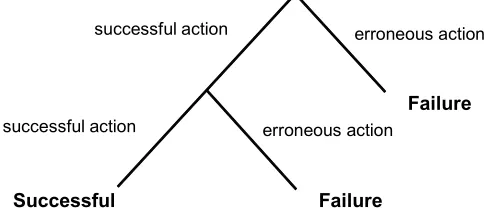
[image:1.595.306.548.490.599.2]THERP is not a model in the usual way, is a Boolean representation of the human behavior. The basic tool of THERP is called Human Event Tree. The Fig. 1 shows an example.
Figure 1. Example of Human Event Tree
The right branches represent the erroneous actions and the left branches the successful action. All probabilities, except those in the first branching, are conditional probabilities.
The other well known technique to model human error is named Fault Tree [11]. This technique has the negative aspect that is difficult to represent dependencies among human actions. Due to this in this work we use THERP.
In the failure branch a successful intervention of a supervisor can drive to a recovery action and the successful path is taken again. That is recovery actions are represented as dash lines.
Failure
Successful Failure
erroneous action successful action
successful action erroneous action
Human Error Management Optimization in
CAREM NPP
III. HUMAN ERROR MANAGEMENT
Human Error Management in the facilities is a complex set of organizational, qualification and control aspects [12-14]. In a simple way several decisions must be taken by the managers.
1) Is need it the administrative control on written procedures use?
2) Is need it the supervisor for a specific task?
3) Is need it to use a written procedure to follow a task? 4) Is need it a special qualification for a task?
The answers are not clear at first. Because the answers depend on component complexity, component relevancy, time availability, personnel availability, etc.
The right answer represents a right combination of administrative control, supervision and qualification for each component or system.
Five models will be taken into account for this work. 1) Technician. The technician work alone, without
supervision nor administrative control for written procedure use.
2) Technician and supervision. The technician works with a supervisor but without administrative control for written procedure use. In this case the written procedures are available but not used.
3) Technician, supervision with written procedures. 4) Technician and administrative control. The technician
work alone with administrative control for written procedure use.
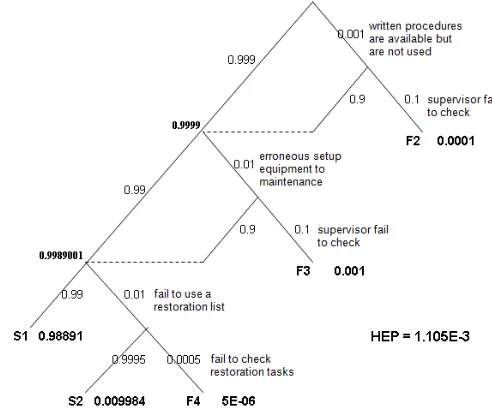
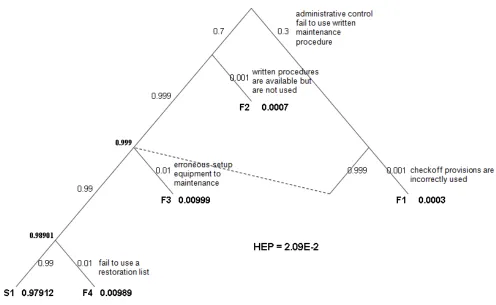
5) Technician, supervision and administrative control. In Figs. 2-6 the models for each alternative are shown. Figs. show the probability of each branches beside them. The probability of each branch identified like S (successful) or F (Fail). Each branch has their probability and the total human error probability (HEP) for each model is shown too.
These alternatives represent only some of actual schedule for organize and control the work of technician. The models are valid for operators and maintenance personnel.
[image:2.595.309.543.62.214.2]For simplicity the models for maintenance personnel and their probabilities are shown. Table I resumes the used data.
Table I. Human error probabilities
Description Probability
Erroneous setup equipment to maintenance 0.01 Fail to restore (previous condition) 0.5
Supervisor fail to check 0.1
Fail to check restoration tasks 0.2 Written procedures are available but are no
used
0.001 Fail to use a restoration list 0.01 Administrative control fail to use written
maintenance procedure
0.3 Checkoff provisions are incorrectly used 0.001 The data were selected from [1].
Fig. 2. Model for technician work alone.
Fig. 3. Model for technician with supervision but without use of written procedures
[image:2.595.303.549.470.677.2] [image:2.595.41.300.536.678.2]Fig. 5. Technician works with written procedures and without supervision.
IV. EVENT TREE
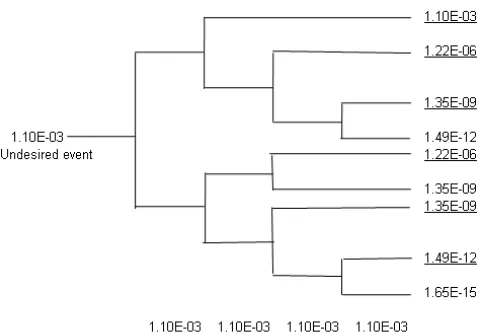
[image:4.595.50.289.175.341.2]When the undesired event succeeds the accident begin. The sequence may be represent graphically by mean the Event Trees [15]. This tool allows follow the safety action intervention in a graphical way step by step. The Fig. 7 shows the original Event Tree built with information from CAREM 25 Project [16-17].
Fig. 7. Event tree original built from CAREM 25 Project. The sequences were built simplifying the headers to show only the human error intervention. The undesired event comes from a human error and the header is another human errors.
At first, the model is the model number 5. Technician works with supervision and administrative control for use of written procedures. The all headers with the same complexity level of management.
At the left is located the undesired event and ordered by column the human interventions. The up branch is a successful intervention and the down branch is a wrong intervention. On the right hand are quantified the final plant states (PS). Successful PS are underlined.
For unsuccessful PS a frequency of 1E-7 to 1E-9 is reasonable value. Then any value lower than 1E-9 represent higher cost for the facility.
According to models seen previously, it is possible select the right model to a specific header in the event tree. A different model will modify the frequency of the PS (with a higher frequency) and diminish the operational cost.
The modified unsuccessful PS frequencies must accomplish with the nuclear regulatory to be valid.
V. SOLVER
Genetic Algorithms [18-19] are a branch of the Evolutive Computation based on the Charles Darwin theory [20]. Several works in nuclear area with this tool show their advantages [21-27].
A specific Hybrid Genetic Algorithms (HGA) was designed to face up with this type of problem.
The main issue to solve is the chromosome structure. The genetic information forms a chain named chromosome (by their similarity with the biological chromosome). In this work, the chromosome contain information about the
schedules of maintenance and test activities. The first information will modify the Event Tree Headers and it will produce changes in the PSA. From other point of view, the space searching can be reduced using integer numbers and not real numbers (i.e. HEPs). This is a trivial change. For this reason, the process in the HGA must handle this characteristic. Alternatives will be obtained faster, and any infeasible solution will be avoided. This scheme allows avoiding infeasible chromosomes treating routines, accelerating the search process.
It is important to clarify the relationship between the human error models and the model used. A gen (a place in the chromosome) will be assigned to each model. Besides, each gen will have assigned a range of values to represent the whole models. For example, a specific component gen may have a range from 1 to 3, that is, solutions may appear where this models may be the models 1), 2) or 3).
So defined, the generation of the initial population is a trivial work, where the possibility to generate non-feasible individuals does not exist.
This algorithm use the Darwin’s natural selection concept starting with several and random (but feasible designs and maintenance models) alternatives that obtain the best alternative, by using recombination and mutation operators. The recombination operator generates offspring (a new alternative) by genetic information cross and constitutes an individual. The mutation operator changes one gene information, allowing skipping a local optimum and searching in the existing search space. For both operators special gene probabilities were calculated. This approach allowed adequately weighting each maintenance and testing group.
The main task before generating the next offspring is to make the ‘parents’ selection. This task selects the individuals that will be crossbred. To do this, a new sampling method was implemented. The method is named Stochastic Stratified Tournament Sampling (SSTS). This method obtains a sample that allows to adequately handling the genetic diversity (alternative diversity). This is an important issue on the searching for the best alternative.
The goal of the SSTS technique is to maintain a high diversity of alternatives as long as possible, by the apportation of portions of relevant information to the new generations, as a faster way to obtain the quasi optimum of the solutions.
VI. RESULTS
Several type of constraints were done (e.g. low and high bound for PS frequencies, type of models allowed for each header, special constraint to avoid common cause failure from human error, etc.).
Then, a specific case was analyzed.
The upper bounds to unsuccessful PS frequencies were 1E-5. These constraints are related to the nuclear regulation.
The lower bounds to unsuccessful PS frequencies were 1E-10. These constraints are related with an extra cost for the facility.
The first header was fixed to model 5.
control for use of written procedures. For the second and third intervention the model included a technician working with supervision but without written procedures. And finally a technician working alone (without supervision nor administrative control for use of written procedures).
[image:5.595.48.290.161.331.2]The Fig. 8 shows a new balanced design on the right hand. The unsuccessful PS frequencies are bounded in a totally feasible region with 3 order of magnitude of size.
Fig. 8. Event tree modified
VII. CONCLUSION
This work show the possibility of applies management strategies for operation or maintenance tasks based on PSA. The strong basement (i.e. PSA) allows accomplish with the nuclear regulatory and diminish the cost in a reasonable way. The concept of this work is valid for others facilities different than Nuclear Power Plants. Optimizing the human error allows take in focus the real important tasks. Separate important tasks from the others is not a trivial work in large facilities. This work resolve this problem.
REFERENCES
[1] A. Swain and H. Guttman, Handbook on Human Reliability Analysis with Emphasis on nuclear Power Plant Applications. UREG/CR-1278, ed. N.R. Commission. 1983, Washington, USA.
[2] P. Kafka, “Probabilistic safety assessment: quantitative process to balance design, manufacturing and operation for safety of plant structures and systems,” uclear Engineering and Design, 1996, 165: p. 333-350.
[3] R. Luus, “Optimization of System Reliability by a New Nonlinear Integer Programming Procedure,” IEEE Transactions on Reliability, 1975, 24(1): p. 14-16.
[4] A.K.Dhingra, “Optimal Apportionment of Reliability & Redundancy in Series Systems Under Multiple Objectives,” IEEE Transactions on Reliability, 1992, 41(4): p. 576-582.
[5] Z.Xu, W. Kuo, and H.-H. Lin, “Optimization limits in improving system reliability,” IEEE Transactions on Reliability, 1990. 39(1): p. 51-60.
[6] R.Dekker, “Applications of maintenance optimization models: a review and analysis,” Reliability Engineering and System Safety, 1996(51): p. 229-240.
[7] M. Harunuzzaman and T. Aldemir, “Optimization of standby safety system maintenance schedules in nuclear power plants,” uclear
Technology, 1996, 113: p. 354-367.
[8] C.M.F. Lapa, C.M.N.A. Pereira, and A.C.d.A. Mol, “Maximization of a nuclear system availability through maintenance scheduling optimization using a genetic algorithm,” uclear Engineering and
Design, 2000, 196: p. 219-231.
[9] Nuclear Regulatory Commission, PRA Procedures Guide: A guide to the performance of probabilistic risk assessments for nuclear power
plants review. NUREG/CR 2300, ed. NRC. 1983, Washington: NRC.
[10] M. Richner and S. Zimmermann. “Applications of simplified and of detailed PSA models,” Probabilistic Safety Assessment and
Management, 1998, Springer Verlag.
[11] W. Vesely, et al., Fault Tree Handbook, NUREG-0492, ed. NRC. 1981, Washington.
[12] J. Barón,, J. Núñez Mc Leod, and S. Rivera “Human reliability analysis to consider common cause failures for a research reactor during its design phase,” Probabilistic Safety Assessment and Management, Vol. 1, 2002, Ed. USA: Elsevier, pp 47-52
[13] S.S. Rivera & J.E. Núñez Mc Leod, “Human errors in biofuels plant accidents,” Proceedings of the World Congress on Engineering 2008, pp 1214-1219.
[14] S.S. Rivera & J.E. Núñez Mc Leod, “Human error of commission modeled with Theory of Games,” Proceedings of the World Congress
on Engineering 2007, 2, pp 1117-1122.
[15] R.R. Fullwood, Probabilistic Safety Assessment in the Chemical and
uclear Industries, 2000, Boston, USA: Butterworth-Heinemann.
[16] Barón, J. Núñez Mc Leod, J. & Rivera, S. unpubl.. Análisis Probabilístico de Seguridad de la Central CAREM-25. IN-VAP. [17] Barón, J. Núñez Mc Leod, J. & Rivera, S. 2001. Risk-Oriented Safety
Evaluation of the CAREM-25 Prototype Reactor. Nuclear Technology 134(2): 97-109.
[18] Goldberg, D., Genetic Algorithms in Search, Optimization & Machine Learning. 1989, Reading, Massachusetts, USA: Addison-Wesley Co. [19] Bäck, T., U. Hammel, and H.-P. Schwefel, Evolutionary computation:
comments on the history and current state. IEEE Transactions on Evolutionary Computation, 1997. 1(1): p. 3-17.
[20] Darwin, C., On the origin of species by means of natural selection, or the preservation of favoured races in the struggle for life. 1859: England.
[21] D.W. Coitand A.E. Smith, “Reliability optimization of series-parallel systems using a genetic algorithm,” IEEE Transactions on Reliability, 1996, 45(2): p. 254-260.
[22] M.Cantoni, M. Marseguerra, and E. Zio, “Genetic algorithms and Monte Carlo simulation for optimal plant design,” Reliability
Engineering and System Safety, 2000(68): p. 29-38.
[23] M. Marseguerra and E. Zio, “Optimizing maintenance and repair policies via a combination of genetic algorithms and Monte Carlo simulation,” Reliability Engineering and System Safety, 2000(68): p. 69-83.
[24] S. Martorell, et al., “Constrained optimization of test intervals using a steady-state genetic algorithm,” Reliability Engineering and System
Safety, 2000(67): p. 215-232.
[25] C.M. Rocco, et al., “Sensitivity and uncertainty analysis in optimization programs using an evolutionary approach: a maintenance application,” Reliability Engineering and System Safety, 2000(67): p. 249-256.
[26] Y.-T. Tsai, K.-S. Wang, and H.-Y. Teng, “Optimizing preventive maintenance for mechanical components using genetic algorithms,”
Reliability Engineering and System Safety, 2001(74): p. 89-97.
[27] J.E. Núñez Mc Leod, S.S. Rivera & J.H. Barón, “Optimizing Designs based on Risk Approach,” Proceedings of the World Congress on