Crouching Dirichlet, Hidden Markov Model:
Unsupervised POS Tagging with Context Local Tag Generation
Taesun Moon, Katrin Erk, and Jason Baldridge
Department of Linguistics University of Texas at Austin
1 University Station B5100 Austin, TX 78712-0198 USA
{tsmoon,katrin.erk,jbaldrid}@mail.utexas.edu
Abstract
We define the crouching Dirichlet, hidden Markov model (CDHMM), an HMM for part-of-speech tagging which draws state prior dis-tributions for each local document context. This simple modification of the HMM takes advantage of the dichotomy in natural lan-guage between content and function words. In contrast, a standard HMM draws all prior dis-tributions once over all states and it is known to perform poorly in unsupervised and semi-supervised POS tagging. This modification significantly improves unsupervised POS tag-ging performance across several measures on five data sets for four languages. We also show that simply using different hyperparameter values for content and function word states in a standard HMM (which we call HMM+) is surprisingly effective.
1 Introduction
Hidden Markov Models (HMMs) are simple, ver-satile, and widely-used generative sequence models. They have been applied to part-of-speech (POS) tag-ging in supervised (Brants, 2000), semi-supervised (Goldwater and Griffiths, 2007; Ravi and Knight, 2009) and unsupervised (Johnson, 2007) training scenarios. Though discriminative models achieve better performance in both semi-supervised (Smith and Eisner, 2005) and supervised (Toutanova et al., 2003) learning, there has been only limited work on unsupervised discriminative sequence models (e.g., on synthetic data and protein sequences (Xu et al., 2006)), and none to POS tagging.
The tagging accuracy of purely unsupervised HMMs is far below that of supervised and semi-supervised HMMs; this is unsurprising as it is still
not well understood what kind of structure is being found by an unconstrained HMM (Headden III et al., 2008). However, HMMs are fairly simple directed graphical models, and it is straightforward to ex-tend them to define alternative generative processes. This also applies to linguistically motivated HMMs for recovering states and sequences that correspond more closely to those implicitly defined by linguists when they label sentences with parts-of-speech.
One way in which a basic HMM’s structure is a poor model for POS tagging is that there is no inher-ent distinction between (open-class) continher-ent words and (closed-class) function words. Here, we propose two extensions to the HMM. The first, HMM+, is a very simple modification where two different hyper-parameters are posited for content states and func-tion states, respectively. The other is the
crouch-ing Dirichlet, hidden Markov model (CDHMM), an
extended HMM that captures this dichotomy based on the statistical evidence that comes from context. Content states display greater variance across lo-cal context (e.g. sentences, paragraphs, documents), and we capture this variance by adding a component to the model for content states that is based on la-tent Dirichlet allocation (Blei et al., 2003). This ex-tension is in some ways similar to the LDAHMM of Griffiths et al. (2005). Both models are compos-ite in that two distributions do not mix with each other. Unlike the LDAHMM, the generation of con-tent states is folded into the CDHMM process.
We compare the HMM+ and CDHMM against a basic HMM and LDAHMM on POS tagging on a more extensive and diverse set of languages than previous work in monolingual unsupervised POS tagging: four languages from three families
(Ger-manic: English and German; Romance: Portuguese;
and Mayan: Uspanteko). The CDHMM easily out-performs all other models, including HMM+, across three measures (accuracy, F-score, and variation of information) for unsupervised POS tagging on most data sets. However, the HMM+ is surpris-ingly competitive, outperforming the basic HMM and LDAHMM, and rivaling or even passing the CDHMM on some measures and data sets.
2 Background
The Bayesian formulation for a basic HMM (Gold-water and Griffiths, 2007) is:
ψt|ξ ∼ Dir(ξ)
δt|γ ∼ Dir(γ)
wi|ti=t ∼ Mult(ψt)
ti|ti−1 =t ∼ Mult(δt)
Dir is the conjugate Dirichlet prior to Mult (a multi-nomial distribution). The state transitions are gen-erated by Mult(δt) whose prior δt is generated by Dir(γ)with a symmetric (i.e. uniform) hyperparam-eter γ. Emissions are generated by Mult(ψt) with a prior ψt generated by Dir(ξ) with a symmetric hyperparameter ξ. Hyperparameter values smaller than one encourage posteriors that are peaked, with smaller values increasing this concentration. It is not necessary that the hyperparameters be symmet-ric, but this is a common approach when one wants to be na¨ıve about the data. This is particularly ap-propriate in unsupervised POS tagging with regard to novel data since there won’t be a priori grounds for favoring certain distributions over others.
There is considerable work on extensions to HMM-based unsupervised POS tagging (see §6), but here we concentrate on the LDAHMM (Grif-fiths et al., 2005), which models topics and state sequences jointly. The model is a composite of a probabilistic topic model and an HMM in which a single state is allocated for words generated from the topic model. A strength of this model is that it is able to use less supervision than previous topic models since it does not require a stopword list. While the topic model component still uses the bags-of-words assumption, the joint model infers which words are more likely to carry topical content and which words are more likely to contribute to the local sequence. This model is competitive with a
standard topic model, and its output is also compet-itive when compared with a standard HMM. How-ever, Griffiths et al. (2005) note that the topic model component inevitably loses some finer distinctions with respect to parts-of-speech. Though many con-tent states such as adjectives, verbs, and nouns can vary a great deal across documents, the topic state groups these words together. This leads to assign-ment of word tokens to clusters that are a poorer fit for POS tagging. This paper shows that a model that conflates the LDAHMM topics with content states can significantly improve POS tagging.
3 Models
We aim to model the fact that in many languages words can generally be grouped into function words and content words and that these groups often have significantly different distributions. There are few function words and they appear frequently, while there are many content words appearing infre-quently. Another difference in distribution is often implied in information retrieval by the use of stop-word filters and tf-idf values to remove or reduce the influence of words which occur frequently but have low variance (i.e. their global probability is similar to their local probability in a document).
A difference in distribution is also revealed when the parts-of-speech are known. When no smoothing parameters are added, the joint probability of a word that is not ‘the’ or ‘a’ occurring with a DTtag (in the Penn Treebank) is almost always zero. Similarly peaked distributions are observed for other function categories such asMD and CC. On the other hand, the joint probability of any word occurring withNN is much less likely to be zero and the distribution is much less likely to be peaked.
We attempt to account for these two distributional properties—that certain words have higher variance across contexts (e.g. a document) and that certain tags have more peaked emission distributions—in a sequence model. To do this, we define the crouching
Dirichlet, hidden Markov model1 (CDHMM). This model, like LDAHMM, captures items of high vari-ance across contexts, but it does so without losing
1We call our model a “crouching Dirichlet” model since it
wi
θ
α
δ
γ ti
· · · ·
φ β
[image:3.612.123.247.57.238.2]ψ ξ
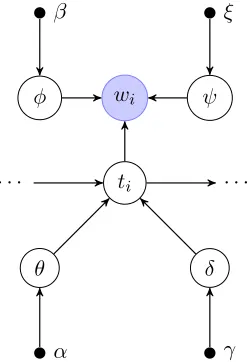
Figure 1: Graphical representation of relevant vari-ables and dependencies at a given time stepi. Ob-served word wi is dependent on hidden state ti. Edges to priorsθ, φ, ψmay or may not be activated depending on the value ofti. The edge to transition priorδ is always activated. Hyperparameters to pri-ors are represented by dots. See§3.1 for details.
sequence distinctions, namely, a given word’s lo-cal function via its part-of-speech. We also define the HMM+, a simple adaptation of a basic HMM which accounts for the latter property by using dif-ferent priors for emissions from content and function states.
3.1 CDHMM
The CDHMM incorporates an LDA-like module to its graphical structure in order to capture words and tags which have high variance across contexts. Such tags correspond to content states. Like the LDAHMM, the model is composite in that distribu-tions over a single random variable are composed of several different distribution functions which de-pend on the value of the underlying variable.
We posit the following model (see fig. 1 for a dia-gram of dependencies and all variables involved at a single time step). We observe a sequence of tokens
w=(w1, . . . , wN) that we assume is generated by
an underlying state sequencet=(t1, . . . , tN)over a
state alphabetT with first order Markov dependen-cies. T is a union of disjoint content statesC and function statesF. In this composite model, the pri-ors for the emission and transition for each step in
the sequence depend on whether statetat step iis t∈C ort∈F. Ift∈C, the word emission is depen-dent onφ(the content word prior) and the state tran-sition is dependent onθ(the “topic” prior) andδ(the transition prior). Ift∈F, the word emission proba-bility is dependent on ψ (the function word prior) and the state transition on δ (again, the transition prior). Therefore, ift∈F, the transition and emis-sion structure is identical to the standard Bayesian HMM.
To elaborate, three prior distributions are defined globally for this model: (1) δt, the transition prior such thatp(ˆt|t, δt) = δˆt|t (2)ψt, the function word prior such thatp(w|t, ψt) =ψw|t(3)φt, the content word prior such thatp(w|t, φt) = φw|t. Locally for each context d(documents in our case), we define θd, the topic prior such thatp(t|θd) =θt|dfort∈C.
The generative story is as follows:
1. For each statet∈T
(a) Draw a distribution over states δt ∼ Dir(γ)
(b) If t∈C, draw a distribution over words φt∼Dir(β)
(c) If t∈F, draw a distribution over words ψt∼Dir(ξ)
2. For each contextd
(a) Draw a distribution θd ∼ Dir(α) over statest∈C
(b) For each wordwiind i. drawtifromδti−1◦θd
ii. if ti∈C, then draw wi from φti, else drawwifromψti
For each context d, we draw a prior distribution θd—formally identical to the LDA topic prior—that is defined only for the statest∈C. This prior is then used to weight the draws for states at each word, fromδti−1 ◦θd, where we have defined the vector
valued operation◦as follows:
(δti−1◦θd)ti =
(1
Zδti|ti−1 ·θti|d ti∈C
1
Zδti|ti−1 ti∈F
where(δti−1 ◦θd)ti is the element corresponding to statetiin the vectorδti−1 ◦θd.Z is a normalization
p(ti|t−i,w)∝
Nwi|ti+β Nti+W β
Nti|di+α Ndi+Cα
“
Nti|ti−1+γ
”“
Nti+1|ti+I[ti−1=ti=ti+1]+γ
”
Nti+T γ+I[ti=ti−1] ti ∈C
Nwi|ti+ξ Nti+W ξ
“
Nti|ti−1+γ
”“
Nti+1|ti+I[ti−1=ti=ti+1]+γ
”
[image:4.612.118.492.66.118.2]Nti+T γ+I[ti=ti−1] ti ∈F
Figure 2: Conditional distribution fortiin the CDHMM.
The important thing to note is that the draw for states at each word is proportional to a composite of (a) the product of the individual elements of the topic and transition priors when ti∈C and (b) the transition priors when ti∈F. The draw is propor-tional to the product of topic and transition priors whenti∈C because we have made a product of ex-perts (PoE) factorization assumption (Hinton, 2002) for tractability and to reduce the size of our model. Without such an assumption, the transition parame-ters would lie in a partitioned space of sizeO(|C|4)
as opposed toO(|T|2)for the current model. Fur-thermore, this combination of a composite hidden state space with a product of experts assumption al-lows us to capture high variance for certain states.
To summarize, the CDHMM is a composite model where both the observed token and the hidden state variable are composite distributions. For the hidden state, this means that there is a “topical” ele-ment with high variance across contexts that is em-bedded in the state sequence for a subset of events. We embed this element through a PoE assumption where transitions into content states are modeled as a product of the transition probability and the local probability of the content state.
Inference. We use a Gibbs sampler (Gao and
Johnson, 2008) to learn the parameters of this and all other models under consideration. In this infer-ence regime, two distributions are of particular in-terest. One is the posterior density and the other is the conditional distribution, neither of which can be learned in closed form.
LettingΛ = (θ, δ, φ, ψ)andh = (α, β, γ, ξ), the posterior density is given as
p(Λ|w,t;h) ∝p(w,t|Λ)p(Λ;h)
Note thatp(w,t|Λ)is equal to
D
Y
d Nd
Y
i
φwi|tiθti|dδti|ti−1
I[ti∈C]
ψwi|tiδti|ti−1
I[ti∈F]
(1)
where I[·]is the indicator function,Dis the number of documents in the corpus andNdis the number of tokens in documentd.
Another important measure is the conditional dis-tribution which is conditioned on all the random variables except the hidden state variable of interest and which is derived by integrating out the priors:
p(ti|t−i,w;h) ∝p(ti|t−i;h)p(wi|t,w−i;h) (2)
wheret−i is the joint random variable t withoutti
andw−iiswwithoutwi.
There are two well-known approaches to conduct-ing Gibbs samplconduct-ing for HMMs. The default method is to sampleΛ based on the posterior, then sample each ti based on the conditional distribution. An-other approach is to sample directly from the con-ditional distribution without sampling from the pos-terior since the conditional distribution incorporates the posterior through integration. This is called a collapsed Gibbs sampler, which is the method em-ployed for the models in this study.
that C and T here refer to the size of the alphabet. W is the size of the vocabulary. Notation such as Nti|ti−1 refers to the counts of the events indicated
by the subscript, minus the current token and tag un-der consiun-deration. Nti|ti−1 is the number of timesti
has occurred afterti−1 minus the tag forwi. Nwi|ti is the number of timeswihas occurred withtiminus the current value.Nti andNdi are the counts for the given tag and document minus the current value.
In its broad outline, the CDHMM is not much more complicated than an HMM since the decompo-sition (eqn. 1) is nearly identical to that of an HMM with the exception that conditional probabilities for a subset of the states—the content states—are local. An inference algorithm can be derived that involves no more than adding a single term to the standard MCMC algorithm for HMMs (see Figure 2).
3.2 HMM+
The CDHMM explicitly posits two different types of states: function states and content states. Hav-ing made this distinction, there is a very simple way to capture the difference in emission distributions for function and content states within an otherwise standard HMM: posit different hyperparameters for the two types. One type has a small hyperparame-ter to model a sparse distribution for function words and the other has a relatively large hyperparameter to model a distribution with broader support. This extension, which we refer to as HMM+, provides an important benchmark to compare with the CDHMM to see how much is gained by its additional ability to model the fact that function words occur frequently but have low variance across contexts.
As with the CDHMM, we use Gibbs sampling to estimate the model parameters while holding the two different hyperparameters fixed. The conditional distribution for tag transitions for this model is iden-tical to that in fig. 2 except that it does not have the second term NNti|di+α
di+Cα in the first case whereti∈C. We are not aware of a published instance of such an extension to the HMM—which our results show to be surprisingly effective. Goldwater and Griffiths (2007) posits different hyperparameters for individ-ual states, but not for different groups of states.
corpus tokens docs avg. tags
WSJ 974254 1801 541 43
Brown 797328 343 2325 80
Tiger 447079 1090 410 58
Floresta 197422 1956 101 19
[image:5.612.326.530.53.142.2]Uspanteko 70125 29 2418 83
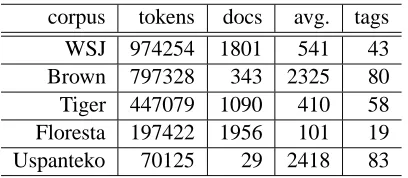
Table 2: Number of tokens, documents, average to-kens per document and total tag types for each cor-pus.
4 Data and Experiments
Data. We use five datasets from four languages
(English, German, Portuguese, Uspanteko) for eval-uating POS tagging performance.
• English: the Brown corpus (Francis et al., 1982)
and the Wall Street Journal portion of the Penn Treebank (Marcus et al., 1994).
• German: the Tiger corpus (Brants et al., 2002). • Portuguese: the full Bosque subset of the Floresta
corpus (Afonso et al., 2002).
• Uspanteko (an endangered Mayan language of
Guatemala): morpheme-segmented and POS-tagged texts collected and annotated by the OKMA language documentation project (Pixabaj et al., 2007); we use the cleaned-up version de-scribed in Palmer et al. (2009).
Table 2 provides the statistics for these corpora. We lowercase all words, do not remove any punc-tuation or hapax legomena, and we do not replace numerals with a single identifier. Due to the nature of the models, document boundaries are retained.
Evaluation We report values for three evaluation
metrics on all five corpora, using their full tagsets.
• Accuracy: We use a greedy search algorithm to
Model Accuracy Pairwise P/R Scores VI
1-to-1 M-to-1 P R F
W
S
J
(5
0
) HMM 0.34 (0.01) 0.49 (0.03) 0.51 (0.03) 0.19 (0.01) 0.28 (0.01) 3.72 (0.08)
LDAHMM 0.30 (0.04) 0.45 (0.04) 0.25 (0.07) 0.27 (0.03) 0.26 (0.04) 3.64 (0.14)
HMM+ 0.42 (0.04) 0.46 (0.05) 0.24 (0.03) 0.49 (0.03) 0.32 (0.03) 2.65 (0.15)
CDHMM 0.44 (0.01) 0.58 (0.02) 0.31 (0.01) 0.43 (0.03) 0.36 (0.02) 2.73 (0.08)
B
ro
w
n
(5
0
) HMM 0.32 (0.01) 0.50 (0.02) 0.60 (0.02) 0.18 (0.00) 0.28 (0.01) 3.82 (0.05)
LDAHMM 0.28 (0.06) 0.41 (0.08) 0.25 (0.10) 0.28 (0.05) 0.25 (0.05) 3.71 (0.21)
HMM+ 0.43 (0.06) 0.48 (0.07) 0.29 (0.05) 0.50 (0.04) 0.37 (0.05) 2.63 (0.19)
CDHMM 0.48 (0.02) 0.62 (0.02) 0.32 (0.03) 0.54 (0.04) 0.40 (0.03) 2.48 (0.06)
T
ig
er
(5
0
) HMM 0.29 (0.02) 0.49 (0.02) 0.49 (0.04) 0.14 (0.01) 0.22 (0.02) 3.91 (0.06)
LDAHMM 0.31 (0.04) 0.50 (0.04) 0.26 (0.07) 0.24 (0.02) 0.25 (0.04) 3.51 (0.11)
HMM+ 0.41 (0.08) 0.44 (0.05) 0.25 (0.05) 0.58 (0.10) 0.35 (0.06) 2.70 (0.25)
CDHMM 0.47 (0.01) 0.61 (0.02) 0.45 (0.01) 0.58 (0.03) 0.50 (0.02) 2.72 (0.04)
U
sp
.
(5
0
) HMM 0.36 (0.01) 0.49 (0.02) 0.39 (0.01) 0.18 (0.00) 0.25 (0.00) 3.63 (0.04)
LDAHMM 0.35 (0.02) 0.47 (0.02) 0.26 (0.04) 0.23 (0.03) 0.24 (0.02) 3.52 (0.09)
HMM+ 0.32 (0.02) 0.35 (0.03) 0.12 (0.02) 0.52 (0.05) 0.20 (0.02) 3.13 (0.06)
CDHMM 0.39 (0.02) 0.50 (0.02) 0.16 (0.02) 0.39 (0.03) 0.23 (0.02) 3.00 (0.06)
F
lo
r.
(5
0
) HMM 0.30 (0.01) 0.58 (0.03) 0.62 (0.05) 0.18 (0.01) 0.28 (0.01) 3.51 (0.06)
LDAHMM 0.36 (0.06) 0.59 (0.04) 0.55 (0.10) 0.29 (0.07) 0.38 (0.08) 3.22 (0.15)
HMM+ 0.35 (0.04) 0.52 (0.02) 0.28 (0.04) 0.43 (0.06) 0.34 (0.04) 2.58 (0.07)
[image:6.612.115.499.53.308.2]CDHMM 0.36 (0.01) 0.64 (0.02) 0.37 (0.02) 0.27 (0.01) 0.31 (0.01) 2.73 (0.05)
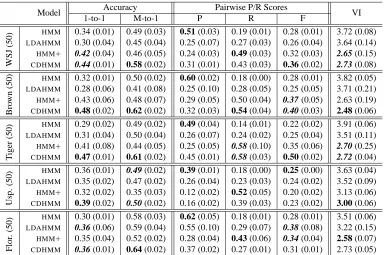
Table 1: Evaluation on WSJ, Brown, Tiger, Floresta and Uspanteko for models with 50 states. For VI, lower is better
gold part-of-speech tags. In particular, they tend to form semantically coherent sub-classes of gold parts of speech.
• Pairwise Precision and Recall: Viewing tagging
as a clustering task over tokens, we evaluate pair-wise precision (P) and recall (R) between the model tag sequence (M) and gold tag sequence (G) by counting the true positives (tp), false pos-itives (f p) and false negatives (f n) between the two and setting P = tp/(tp +f p) and R =
tp/(tp+f n).tpis the number of token pairs that share a tag inMas well as inG,f pis the number token pairs that share the same tag inM but have different tags in G, and f nis the number token pairs assigned a different tag inM but the same inG(Meila, 2007). We also provide the f-score which is the harmonic mean ofP andR.
• Variation of Information (VI): The variation of
information is an information theoretic metric that measures the amount of information lost and gained in going from tag sequenceMtoG(Meila, 2007). It is defined asV I(M, G) = H(M) +
H(G)−2I(M, G)whereHdenotes entropy and I mutual information. Goldwater and Griffiths
(2007) noted that this measure can point out mod-els that have more consistent errors in the form of lower VI, even when accuracy figures are the same.
We also report learning curves on M-to-1 with ge-ometrically increasing training set sizes of 8, 16, 32, 64, 128, 256, 512, 1024, and all documents, or as many as possible given the corpus.
5 Experiments
In this section we discuss our parameter settings and experimental results.
5.1 Models and Parameters
We compare four different models:
• HMM: a standard HMM
• HMM+: an HMM in which the hyperparameters for the word emissions are asymmetric, such that content states have different word emission priors compared to function states.
• LDAHMM: an HMM with a distinguished state
WSJ Brown Tiger Floresta Uspanteko 20 30 40 50
HMM+
acc
0.0
0.1
0.2
0.3
0.4
0.5
0.6
WSJ Brown Tiger Floresta Uspanteko
LDAHMM
acc
0.0
0.1
0.2
0.3
0.4
0.5
0.6
WSJ Brown Tiger Floresta Uspanteko
CDHMM
acc
0.0
0.1
0.2
0.3
0.4
0.5
[image:7.612.85.522.69.206.2]0.6
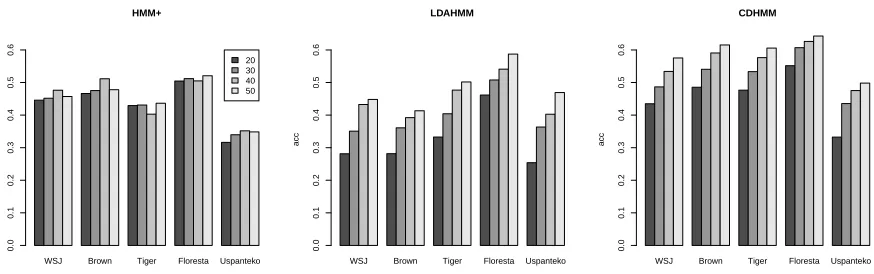
Figure 3: Averaged many-to-one accuracy on the full tagset for the models HMM+, LDAHMM, CDHMM
when the number of states is set at 20, 30, 40 and 50 states.
• CDHMM: our HMM with context-based
emis-sions, where the context used is the document
We implemented all of these models, ensuring per-formance differences are due to the models them-selves rather than implementation details.
For all models, the transition hyperparameters γ are set to0.1. For theLDAHMMand HMMall emis-sion hyperparameters are set to 0.0001. These fig-ures are the MCMC settings that provided the best results in Johnson (2007). For the models that distin-guish content and function states (HMM+,CDHMM), we fixed the number of content states at 5 and set the function state emission hyperparametersξ = 0.0001
and the content state emission hyperparametersβ= 0.1. For the models with an LDA or LDA-like com-ponent (LDAHMM, CDHMM), we set the topic or content-state hyperparameterα = 1.
For decoding, we use maximum posterior decod-ing to obtain a sdecod-ingle sample after the required burn-in, as has been done in other unsupervised HMM experiments. We use this sample for evaluation.
5.2 Results
Results for all models on the full tagset are provided in table 1.2 Each number is the mean accuracy of ten randomly initialized samples after a single chain burn-in of 1000 iterations. The model with a sta-tistically significant (p < 0.05) best score for each measure and data set is given in plain bold. In cases
2
Similar results are obtained with reduced tagsets, as is com-monly done in other work on unsupervised POS-tagging.
where the differences for the best models are not sig-nificantly different from each other, but are signifi-cantly better from the others, the top model scores are given in bold italic.
CDHMMis extremely strong on the accuracy
met-ric: it wins or ties for all datasets for both 1-to-1 and M-to-1 measures. For pairwise f-score, it obtains the best score for two datasets (WSJ and Tiger), and ties withHMM+ on Brown (we return to Uspanteko and Floresta below in an experiment that varies the number of states). For VI,HMM+ andCDHMMboth
easily outperform the other models, with CDHMM
winning Brown and Uspanteko andHMM+ winning Floresta.
In the case of Uspanteko, the absolute difference in mean performance between models is smaller overall but still significant. This is due to the reduced variance between samples for all models. This is striking because the non-CDHMMmodels have much higher standard deviation on other corpora but have sharply reduced standard deviation only for teko. The most likely explanation is that the Uspan-teko corpus is much smaller than the other corpora.3 Nonetheless, CDHMMcomes out strongest on most measures.
A simple baseline for accuracy is to choose the most frequent tag for all tokens; this gives accura-cies of 0.14 (WSJ), 0.14 (Brown), 0.21 (Tiger), 0.20
3
Model Accuracy P/R Scores VI
1-to-1 M-to-1 P R F
U
sp
.
(1
0
0
) HMM 0.36 (0.01) 0.58 (0.01) 0.56 (0.02) 0.16 (0.00) 0.25 (0.01) 3.53 (0.04)
LDAHMM 0.35 (0.01) 0.58 (0.02) 0.45 (0.04) 0.17 (0.01) 0.24 (0.01) 3.46 (0.06)
HMM+ 0.35 (0.02) 0.41 (0.02) 0.18 (0.01) 0.36 (0.03) 0.24 (0.01) 3.25 (0.08)
CDHMM 0.40 (0.01) 0.59 (0.01) 0.25 (0.02) 0.27 (0.02) 0.26 (0.01) 3.05 (0.03)
F
lo
r.
(2
0
) HMM 0.31 (0.02) 0.48 (0.03) 0.40 (0.03) 0.21 (0.01) 0.28 (0.02) 3.54 (0.10)
LDAHMM 0.35 (0.06) 0.46 (0.06) 0.27 (0.07) 0.45 (0.08) 0.33 (0.05) 3.10 (0.10)
HMM+ 0.37 (0.04) 0.50 (0.03) 0.30 (0.02) 0.45 (0.06) 0.36 (0.03) 2.62 (0.06)
[image:8.612.114.501.55.172.2]CDHMM 0.44 (0.02) 0.55 (0.02) 0.30 (0.01) 0.53 (0.03) 0.39 (0.02) 2.39 (0.07)
Table 3: Evaluation for Uspanteko and Floresta. Experiments in this table use state sizes that correspond more closely to the size of the tag sets in the respective corpora.
(Floresta), and 0.11 (Uspanteko). Clearly, all of the models easily outperform this baseline.
Number of states. Figure 3 shows the change in
accuracy for the different models for different cor-pora when the overall number of states is varied between 20 and 50. The figure shows results for
M-to-1. All models with the exception of HMM+
show improvements as the number of states is in-creased. This brings up the valid concern (Clark, 2003; Johnson, 2007) that a model could posit a very large number of states and obtain high M-to-1 scores. However, it is neither the case here nor in any of the studies we cite. Furthermore, as is strongly suggested withHMM+, it does not seem as if all models will benefit from assuming a large num-ber of states.
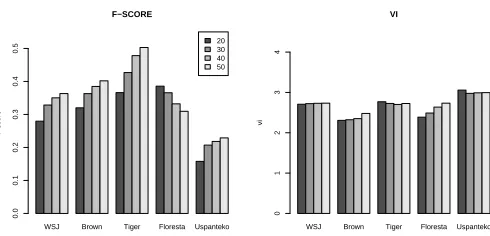
Looking at the results by number of states on VI and f-score for CDHMM(Figure 5), it is clear that Floresta displays the reverse pattern of all other data sets where performance monotonically deteriorates as state sizes are increased. Though the exact reason is unknown, we believe it is partially due to the fact that Floresta has 19 tags. We therefore wondered whether positing a state size that more closely ap-proximated the size of the gold tag set performs bet-ter. Since the discrepancy is greatest for Uspanteko and Floresta, we present tabulated results for exper-iments with state settings of 100 and 20 states re-spectively (table 3). With the exception of VI (where lower is better) for Uspanteko, the scores generally improve when the model state size is closer to the gold size. M-to-1 goes down for Floresta when 20 states are posited, but this is to be expected since this score is defined, to a certain extent, to do better with
WSJ Brown Tiger Floresta Uspanteko
20 30 40 50 F−SCORE
f−score
0.0
0.1
0.2
0.3
0.4
0.5
WSJ Brown Tiger Floresta Uspanteko
VI
vi
0
1
2
3
4
Figure 5:f-score and VI forCDHMMby number of
states
larger models.
Variance. As we average performance figures
over ten runs for each model, it is also instructive to consider standard deviation across runs. Standard deviation is lowest for the CDHMM models and the vanillaHMM. Standard deviation is high forHMM+
andLDAHMM. This is not surprising forLDAHMM,
since it has fifty topic parameters in addition to the number of states posited, and random initial condi-tions would have greater effect on the outcome than for the other models. It is unexpected, however, that
HMM+ has high variance over different chains. The
[image:8.612.317.562.244.362.2]0 1 2 3 4 5 6
0.
3
0.4
0.5
0.6
Brown WSJ Tiger
Uspanteko Floresta
0 1 2 3 4 5 6 7 8
0.3
0.4
0.5
0.6
0 1 2 3 4 5 6 7 8
0.3
0.4
0.5
0.6
0 1 2 3 4 5 6 7 8
0.
3
0.
4
0.
5
0.6
0 1 2
0.
3
0.
4
0.
5
0.6
[image:9.612.104.521.71.276.2]hmm hmm+ ldahmm
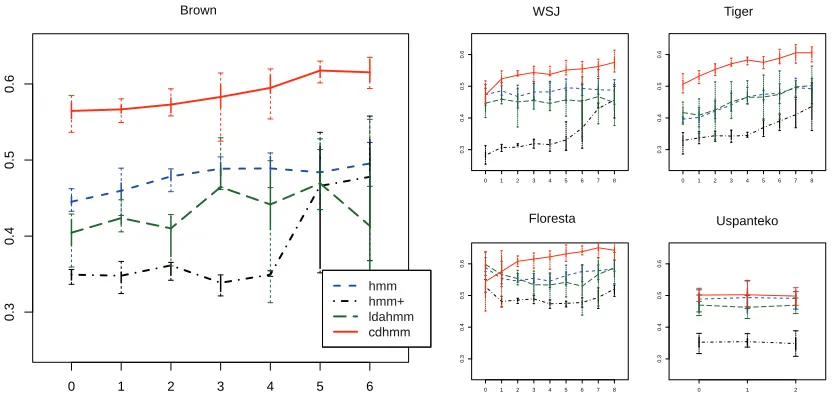
Figure 4: Learning curves on M-to-1 evaluation. The staples at each point represent two standard deviations.
Learning curves We present learning curves on
different sizes of subcorpora in Figure 4. The graphs are box plots of the full M-1 accuracy figures on 10 randomly initialized training runs for seven sub-corpora in Brown, nine in WSJ, Tiger, Floresta and three in Uspanteko.
Comparing the graphs, the performance ofHMM+ shows the strongest improvement for English and German data as the amount of training data in-creases. Also, it is evident that CDHMMposts con-sistent performance gains across data sets as it trains on more data. This stands in opposition toHMMand
LDAHMMwhich do not seem able to take advantage
of more information for WSJ and Floresta. This suggests that performance for CDHMM and HMM+
could improve if the training corpora were aug-mented with out-of-corpus raw data. One exception to the consistent improvement over increased data is the performance of the models on Uspanteko, which uniformly flatline. One reason might be that the tags are labeled over segmented morphemes instead of words like the other corpora. Another could be that Uspanteko has a relatively large number of tags in a very small corpus.
6 Related work
Unsupervised POS tagging is an active area of re-search. Most recent work has involved HMMs. Given that an unconstrained HMM is not well under-stood in POS tagging, much work has been done on examining the mechanism and the properties of the HMM as applied to natural language data (Johnson, 2007; Gao and Johnson, 2008; Headden III et al., 2008). Conversely, there has also been work focused on improving the HMM as an inference procedure that looked at POS tagging as an example (Graca et al., 2009; Liang and Klein, 2009). Nonparametric HMMs for unsupervised POS tag induction (Snyder et al., 2008; Van Gael et al., 2009) have seen partic-ular activity due to the fact that model size assump-tions are unnecessary and it lets the data “speak for itself.”
There is also work on alternative unsupervised models that are not HMMs (Sch¨utze, 1993; Abend et al., 2010; Reichart et al., 2010b) as well as re-search on improving evaluation of unsupervised tag-gers (Frank et al., 2009; Reichart et al., 2010a).
has initial capital, etc.; the features themselves are from Smith and Eisner (2005)) to learn parameters in an undirected graphical model which was the equivalent of an HMM in directed models. It was also the first study to posit the one-to-one evalua-tion criterion which has been repeated extensively since (Johnson, 2007; Headden III et al., 2008; Graca et al., 2009).
Finkel et al. (2007) is an interesting variant of un-supervised POS tagging where a parse tree is as-sumed and POS tags are induced from this structure non-parametrically. It is the converse of unsuper-vised parsing which assumes access to a tagged cor-pus and induces a parsing model.
Other models more directly influenced or closely parallel our work. Griffiths et al. (2005) is the work that inspired the current approach where a set of states is designated to capture variance across con-texts. The primary goal of that model was to induce a topic model given data that had not been filtered of noise in the form of function words. As such, distinguishing between topic states such that they model different syntactic states was not attempted, and we have seen in sec. 3 that such an extension is not entirely straightforward.4 Boyd-Graber and Blei (2009) has some parallels to our model in that a hid-den variable over topics is distributed according to a normalized product between a context prior and a syntactic prior. However, it assumes a much greater amount of information than we do in that a parse tree as well as (possibly) POS tags are taken as observed. The model has a very different goal from ours as well, which is to infer a syntactically informed topic model. Teichert and Daum´e III (2010) is another study with close similarities to our own. This study models distinctions between closed class words and open class words within a modified HMM. It is un-clear from their formulation how the distinction be-tween open class and closed class words is learned.
There is also extensive literature on learning se-quence structure from unlabeled text (Smith and Eisner, 2005; Goldberg et al., 2008; Ravi and Knight, 2009) which assume access to a tag dic-tionary. Goldwater and Griffiths (2007) deserves mention for examining a semi-supervised model
4
We tested a variant ofLDAHMMin which more than one
state can generate topics. It did not achieve good results.
that sampled emission hyperparameters for each state rather than a single symmetric hyperparame-ter. They showed that this outperformed a symmet-ric model. An interesting heuristic model is Zhao and Marcus (2009) that uses a seed set of closed class words to classify open class words.
7 Conclusion
We have shown that a hidden Markov model that allocates a subset of the states to have distribu-tions conditioned on localized domains can signif-icantly improve performance in unsupervised part-of-speech tagging. We have also demonstrated that significant performance gains are possible simply by setting a different emission hyperparameter for a subgroup of the states. It is encouraging that these results hold for both models not just on the WSJ but across a diverse set of languages and measures.
We believe our proposed extensions to the HMM are a significant contribution to the general HMM and unsupervised POS tagging literature in that both can be implemented with minimum modification of existing MCMC inferred HMMs, have (nearly) equivalent run times, produce output that is easy to interpret since they are based on a generative frame-work, and bring about considerable performance im-provements at the same time.
Acknowledgments
The authors would like to thank Elias Ponvert and the anonymous reviewers. This work was supported by a grant from the Morris Memorial Trust Fund of the New York Community Trust.
References
O. Abend, R. Reichart, and A. Rappoport. 2010. Im-proved unsupervised POS induction through prototype discovery. In Proceedings of ACL, pages 1298–1307.
S. Afonso, E. Bick, R. Haber, and D. Santos. 2002. Flo-resta sint´a(c)tica”: a treebank for Portuguese. In Pro-ceedings of LREC, pages 1698–1703.
D. M. Blei, A. Y. Ng, and M. I. Jordan. 2003. Latent Dirichlet allocation. The Journal of Machine Learning Research, 3:993–1022.
S. Brants, S. Dipper, S. Hansen, W. Lezius, and G. Smith. 2002. The TIGER treebank. In Proceedings of the Workshop on Treebanks and Linguistic Theories. T. Brants. 2000. TnT: a statistical part-of-speech
tag-ger. In Proceedings of conference on Applied natural language processing, pages 224–231.
A. Clark. 2003. Combining distributional and morpho-logical information for part of speech induction. In Proceedings of EACL, pages 59–66.
J. R. Finkel, T. Grenager, and C. D. Manning. 2007. The infinite tree. In Proceedings of ACL, pages 272–279. W.N. Francis, H. Kuˇcera, and A.W. Mackie. 1982.
Fre-quency analysis of English usage: Lexicon and gram-mar. Houghton Mifflin Harcourt.
S. Frank, S. Goldwater, and F. Keller. 2009. Evaluating models of syntactic category acquisition without using a gold standard. In Proceedings of CogSci.
J. Gao and M. Johnson. 2008. A comparison of Bayesian estimators for unsupervised Hidden Markov Model POS taggers. In Proceedings of EMNLP, pages 344– 352.
Y. Goldberg, M. Adler, and M. Elhadad. 2008. EM can find pretty good HMM POS-taggers (when given a good start). In Proceedings of ACL, pages 746–754. S. Goldwater and T. L. Griffiths. 2007. A fully Bayesian approach to unsupervised part-of-speech tagging. In Proceedings of ACL, pages 744–751.
J. Graca, K. Ganchev, B. Taskar, and F. Pereira. 2009. Posterior vs parameter sparsity in latent variable mod-els. In Proceedings of NIPS, pages 664–672.
T. L. Griffiths, M. Steyvers, D. M. Blei, and J. M. Tenen-baum. 2005. Integrating topics and syntax. In Pro-ceedings of NIPS, pages 537–544.
A. Haghighi and D. Klein. 2006. Prototype-driven learning for sequence models. In Proceedings of HLT/NAACL, pages 320–327.
W. P. Headden III, D. McClosky, and E. Charniak. 2008. Evaluating unsupervised part-of-speech tagging for grammar induction. In Proceedings of COLING, pages 329–336.
G.E. Hinton. 2002. Training products of experts by min-imizing contrastive divergence. Neural Computation, 14(8):1771–1800.
M. Johnson. 2007. Why doesn’t EM find good HMM POS-taggers. In Proceedings of EMNLP-CoNLL, pages 296–305.
P. Liang and D. Klein. 2009. Online EM for unsuper-vised models. In Proceedings of HLT/NAACL, pages 611–619.
M.P. Marcus, B. Santorini, and M.A. Marcinkiewicz. 1994. Building a large annotated corpus of English: The Penn Treebank. Comp. ling., 19(2):313–330.
M. Meila. 2007. Comparing clusterings—an informa-tion based distance. Journal of Multivariate Analysis, 98(5):873–895.
A. Palmer, T. Moon, and J. Baldridge. 2009. Evaluat-ing automation strategies in language documentation. In Proceedings of the NAACL-HLT 2009 Workshop on Active Learning for Natural Language Processing, pages 36–44.
T. C. Pixabaj, M. A. Vicente M´endez, M. Vicente M´endez, and O. A. Dami´an. 2007. Text Collections in Four Mayan Languages. Archived in The Archive of the Indigenous Languages of Latin America.
S. Ravi and K. Knight. 2009. Minimized models for unsupervised part-of-speech tagging. In Proceedings of ACL and AFNLP, pages 504–512.
R. Reichart, O. Abend, and A. Rappoport. 2010a. Type level clustering evaluation: New measures and a POS induction case study. In Proceedings of CoNLL, pages 77–87.
R. Reichart, R. Fattal, and A. Rappoport. 2010b. Im-proved unsupervised POS induction using intrinsic clustering quality and a Zipfian constraint. In Proceed-ings of CoNLL, pages 57–66.
H. Sch ¨utze. 1993. Part-of-speech induction from scratch. In Proceedings of ACL, pages 251–258.
N.A. Smith and J. Eisner. 2005. Contrastive estimation: Training log-linear models on unlabeled data. In Pro-ceedings of ACL, pages 354–362.
B. Snyder, T. Naseem, J. Eisenstein, and R. Barzilay. 2008. Unsupervised multilingual learning for POS tagging. In Proceedings of EMNLP, pages 1041– 1050.
A.R. Teichert and H. Daum´e III. 2010. Unsupervised Part of Speech Tagging Without a Lexicon. In NIPS Workshop on Grammar Induction, Representation of Language and Language Learning 2010.
K. Toutanova, D. Klein, C. Manning, and Y. Singer. 2003. Feature-rich part-of-speech tagging with a cyclic dependency network. In Proceedings of NAACL, pages 173–180.
J. Van Gael, A. Vlachos, and Z. Ghahramani. 2009. The infinite HMM for unsupervised PoS tagging. In Pro-ceedings of EMNLP, pages 678–687.
L. Xu, D. Wilkinson, F. Southey, and D. Schuurmans. 2006. Discriminative unsupervised learning of struc-tured predictors. In Proceedings of ICML, pages 1057–1064.