Classifying Dialogue Acts in One-on-one Live Chats
Su Nam Kim,♠Lawrence Cavedon♥and Timothy Baldwin♠
♠Dept of Computer Science and Software Engineering, University of Melbourne ♥School of Computer Science and IT, RMIT University
[email protected], [email protected], [email protected]
Abstract
We explore the task of automatically classify-ing dialogue acts in 1-on-1 online chat forums, an increasingly popular means of providing customer service. In particular, we investi-gate the effectiveness of various features and machine learners for this task. While a sim-ple bag-of-words approach provides a solid baseline, we find that adding information from dialogue structure and inter-utterance depen-dency provides some increase in performance; learners that account for sequential dependen-cies (CRFs) show the best performance. We report our results from testing using a corpus of chat dialogues derived from online shop-ping customer-feedback data.
1 Introduction
Recently, live chats have received attention due to the growing popularity of chat services and the in-creasing body of applications. For example, large organizations are increasingly providing support or information services through live chat. One advan-tage of chat-based customer service over conven-tional telephone-based customer service is that it becomes possible to semi-automate aspects of the interaction (e.g. conventional openings or canned responses to standard questions) without the cus-tomer being aware of it taking place, something that is not possible with speech-based dialogue systems (as synthesised speech is still easily distinguishable from natural speech). Potentially huge savings can be made by organisations providing customer help services if we can increase the degree of automation of live chat.
Given the increasing impact of live chat services, there is surprisingly little published computational
linguistic research on the topic. There has been sub-stantially more work done on dialogue and dialogue corpora, mostly in spoken dialogue (e.g. Stolcke et al. (2000)) but also multimodal dialogue systems in application areas such as telephone support service (Bangalore et al., 2006) and tutoring systems (Lit-man and Silli(Lit-man, 2004). Spoken dialogue analysis introduces many complications related to the error inherent in current speech recognition technologies. As an instance of written dialogue, an advantage of live chats is that recognition errors are not such an is-sue, although the nature of language used in chat is typically ill-formed and turn-taking is complicated by the semi-asynchronous nature of the interaction (e.g. Werry (1996)).
In this paper, we investigate the task of automatic classification ofdialogue acts in 1-on-1 live chats, focusing on “information delivery” chats since these are proving increasingly popular as part of enter-prise customer-service solutions. Our main chal-lenge is to develop effective features and classifiers for classifying aspects of 1-on-1 live chat. Much of the work on analysing dialogue acts in spoken di-alogues has relied on non-lexical features, such as prosody and acoustic features (Stolcke et al., 2000; Julia and Iftekharuddin, 2008; Sridhar et al., 2009), which are not available for written dialogues. Pre-vious dialogue-act detection for chat systems has used bags-of-words (hereafter, BoW) as features for dialogue-act detection; this simple approach has shown some promise (e.g. Bangalore et al. (2006), Louwerse and Crossley (2006) and Ivanovic (2008)). Other features such as keywords/ontologies (Purver et al., 2005; Forsyth, 2007) and lexical cues (Ang et al., 2005) have also been used for dialogue act classification.
In this paper, we first re-examine BoW features for dialogue act classification. As a baseline, we use the work of Ivanovic (2008), which explored 1-grams and 2-1-grams with Boolean values in 1-on-1 live chats in the MSN Online Shopping domain (this dataset is described in Section 5). Although this work achieved reasonably high performance (up to a micro-averaged F-score of around 80%), we be-lieve that there is still room for improvement using BoW only. We extend this work by using ideas from related research such as text categorization (Debole and Sebastiani, 2003), and explore variants of BoW based on analysis of live chats, along with feature weighting. Finally, our main aim is to explore new features based on dialogue structure and dependen-cies between utterances1that can enhance the use of BoW for dialogue act classification. Our hypothesis is that, for task-oriented 1-on-1 live chats, the struc-ture and interactions among utterances are useful in predicting future dialogue acts: for example, conver-sations typically start with a greeting, and questions and answers typically appear as adjacency pairs in a conversation. Therefore, we propose new features based on structural and dependency information de-rived from utterances (Sections 4.2 and 4.3).
2 Related Work
While there has been significant work on classify-ing dialogue acts, the bulk of this has been for spo-ken dialogue. Most such work has considered: (1) defining taxonomies of dialogue acts; (2) discover-ing useful features for the classification task; and (3) experimenting with different machine learning tech-niques. We focus here on (2) and (3); we return to (1) in Section 3.
For classifying dialogue acts in spoken dialogue, various features such as dialogue cues, speech char-acteristics, and n-grams have been proposed. For example, Samuel et al. (1998) utilized the charac-teristics of spoken dialogues and examined speaker direction, punctuation marks, cue phrases and n -grams for classifying spoken dialogues. Jurafsky et al. (1998) used prosodic, lexical and syntactic fea-tures for spoken dialogue classification. More re-cently, Julia and Iftekharuddin (2008) and Sridhar et
1
Anutteranceis the smallest unit to deliver a participant’s message(s) in a turn.
al. (2009) achieved high performance using acous-tic and prosodic features. Louwerse and Cross-ley (2006), on the other hand, used variousn-gram features—which could be adapted to both spoken and written dialogue—and tested them using the Map Task Corpus (Anderson et al., 1991). Extend-ing the discourse model used in previous work, Ban-galore et al. (2006) usedn-grams from the previous 1–3 utterances in order to classify dialogue acts for the target utterance.
There has been substantially less effort on clas-sifying dialogue acts in written dialogue: Wu et al. (2002) and Forsyth (2007) have used keyword-based approaches for classifying online chats; Ivanovic (2008) tested the use ofn-gram features for 1-on-1 live chats with MSN Online Shopping assistants.
Various machine learning techniques have been investigated for the dialogue classification task. Samuel et al. (1998) used transformation-based learning to classify spoken dialogues, incorporat-ing Monte Carlo samplincorporat-ing for trainincorporat-ing efficiency. Stolcke et al. (2000) used Hidden Markov Mod-els (HMMs) to account for the structure of spo-ken dialogues, while Wu et al. (2002) also used transformation- and rule-based approaches plus HMMs for written dialogues. Other researchers have used Bayesian based approaches, such as naive Bayes (e.g. (Grau et al., 2004; Forsyth, 2007; Ivanovic, 2008)) and Bayesian networks (e.g. (Keizer, 2001; Forsyth, 2007)). Maximum entropy (e.g. (Ivanovic, 2008)), support vector machines (e.g. (Ivanovic, 2008)), and hidden Markov models (e.g. (Bui, 2003)) have also all been applied to auto-matic dialogue act classification.
3 Dialogue Acts
(Ander-son et al., 1991) defines a set of 128 dialogue acts to model task-based spoken conversations.
For casual online chat dialogues, Wu et al. (2002) define 15 dialogue act tags based on previously-defined dialogue act sets (Samuel et al., 1998; Shriberg et al., 1998; Jurafsky et al., 1998; Stolcke et al., 2000). Forsyth (2007) defines 15 dialogue acts for casual online conversations, based on 16 conver-sations with 10,567 utterances. Ivanovic (2008) pro-poses 12 dialogue acts based on DAMSL for 1-on-1 online customer service chats.
Ivanovic’s set of dialogue acts for chat dia-logues has significant overlap with the dialogue act sets of Wu et al. (2002) and Forsyth (2007) (e.g. GREETING, EMOTION/EXPRESSION, STATEMENT, QUESTION). In our work, we re-use the set of dia-logue acts proposed in Ivanovic (2008), due to our targeting the same task of 1-on-1 IM chats, and in-deed experimenting over the same dataset. The def-initions of the dialogue acts are provided in Table 1, along with examples.
4 Feature Selection
In this section, we describe our initial dialogue-act classification experiments using simple BoW tures, and then introduce two groups of new fea-tures based on structural information and dependen-cies between utterances.
4.1 Bag-of-Words
n-gram-based BoW features are simple yet effec-tive for identifying similarities between two utter-ances, and have been used widely in previous work on dialogue act classification for online chat di-alogues (Louwerse and Crossley, 2006; Ivanovic, 2008). However, chats containing large amounts of noise such as typos and emoticons pose a greater challenge for simple BoW approaches. On the other hand, keyword-based features (Forsyth, 2007) have achieved high performance; however, keyword-based approaches are more domain-dependent. In this work, we chose to start with a BoW approach based on our observation that commercial live chat services contain relatively less noise; in particular, the commercial agent tends to use well-formed, for-mulaic prose.
Previously, Ivanovic (2008) explored Boolean
1-gram and 2-1-gram features to classify MSN Online Shopping live chats, where a user requests assis-tance in purchasing an item, in response to which the commercial agent asks the customer questions and makes suggestions. Ivanovic (2008) achieved solid performance over this data (around 80% F-score). While 1-grams performed well (as live chat utter-ances are generally shorter than, e.g., sentences in news articles), we expect 2- and 3-grams are needed to detect formulaic expressions, such asNo problem
andYou are welcome. We would also expect a pos-itive effect from combiningn-grams due to increas-ing the coverage of feature words. We thus test 1-, 2- and 3-grams individually, as well as the combi-nation of 1- and 2-grams together (i.e. 1+2-grams) and 1-, 2- and 3-grams (i.e. 1+2+3-grams); this re-sults in five BoW sets. Also, unlike Ivanovic (2008), we test both raw words and lemmas; we expect the use of lemmas to perform better than raw words as our data is less noisy. As the feature weight, in addi-tion to simple Boolean, we also experiment withTF,
TF·IDFandInformation Gain (IG).
4.2 Structural Information
Our motivation for using structural information as a feature is that the location of an utterance can be a strong predictor of the dialogue act. That is, dia-logues are sequenced, comprising turns (i.e. a given user is sending text), each of which is made up of one or more messages (i.e. strings sent by the user). Structured classification methods which make use of this sequential information have been applied to re-lated tasks such as tagging semantic labels of key sentences in biomedical domains (Chung, 2009) and post labels in web forums (Kim et al., 2010).
Dialogue Act, Definition and Examples
CONVENTIONAL CLOSING: Various ways of ending a conversation e.g.Bye Bye
CONVENTIONAL OPENING: Greeting and other ways of starting a conversation e.g.Hello Customer DOWNPLAYER: A backwards-linking label often used after THANKSto down play the contribution e.g.You are welcome, my pleasure
EXPRESSIVE: An acknowledgement of a previous utterance or an indication of the speaker’s mood. e.g.haha,:−)wow
NO ANSWER: A backward-linking label in the form of a negative response to a YESNO-QUESTIONe.g.no, nope OPEN QUESTION: A question that cannot be answered with only ayesorno. The answer is usually
some form of explanation or statement. e.g.how do I use the international version?
REQUEST: Used to express a speaker’s desire that the learner do something – either performing some action or simply waiting. e.g.Please let me know how I can assist you on MSN Shopping today.
RESPONSE ACK: A backward-linking acknowledgement of the previous utterance. Used to confirm that the previous utterance was received/accepted. e.g.Sure
STATEMENT: Used for assertions that may state a belief or commit the speaker to doing something e.g.I am sending you the page which will pop up in a new window on your screen.
THANKS: Conventional thanks e.g.Thank you for contacting us.
YES ANSWER: A backward-linking label in the form of an affirmative response to a YESNO-QUESTIONe.g.yes, yeah YESNO QUESTION: A closed question which can be answered in the affirmative or negative.
e.g.Did you receive the page, Customer?
Table 1: The set of dialogue acts used in this research, taken from Ivanovic (2008)
the same turn. We also noticed that identifying the utterance author can help classify the dialogue act (previously used in Ivanovic (2008)).
Based on these observations, we tested the follow-ing four structural features:
• Author information,
• Relative position in the chat,
• Author + Relative position,
• Author + Turn-relative position among utter-ances in a given turn.
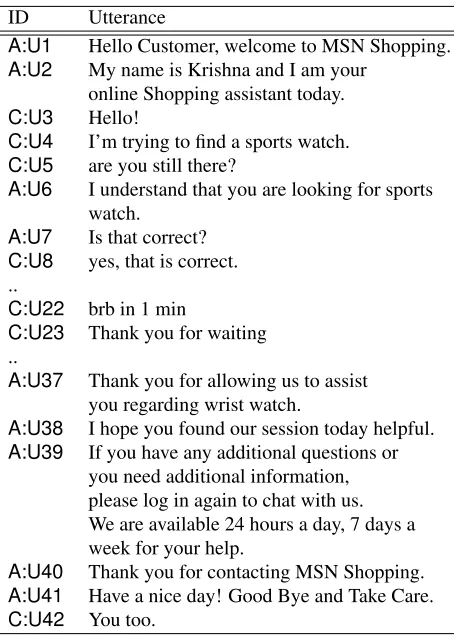
We illustrate our structural features in Table 2, which shows an example of a 1-on-1 live chat. The participants are the agent (A) and customer (C);Uxx
indicates an utterance (U) with ID number xx. This conversation has 42 utterances in total. The relative position is calculated by dividing the utterance num-ber by the total numnum-ber of utterances in the dialogue; the turn-relative position is calculated by dividing the utterance position by the number of utterances in that turn. For example, for utterance 4 (U4), the relative position is424, while its turn-relative position is 23 sinceU4is the second utterance amongU3,4,5
that the customer makes in a single turn.
4.3 Utterance Dependency
In recent work, Kim et al. (2010) demonstrated the importance of dependencies between post labels in web forums. The authors introduced series of fea-tures based on structural dependencies among posts. They used relative position, author information and automatically predicted labels from previous post(s) as dependency features for assigning a semantic la-bel to the current target post.
Similarly, by examining our chat corpus, we ob-served significant dependencies between utterances. First, 1-on-1 (i.e. agent-to-user) dialogues often con-tain dependencies between adjacent utterances by different authors. For example, in Table 2, when the agent asks Is that correct?, the expected response from the user is a Yes or No. Another example is that when the agent makes a greeting, such asHave a nice day, then the customer will typically respond with a greeting or closing remark, and not aYesor
ID Utterance
A:U1 Hello Customer, welcome to MSN Shopping.
A:U2 My name is Krishna and I am your online Shopping assistant today.
C:U3 Hello!
C:U4 I’m trying to find a sports watch.
C:U5 are you still there?
A:U6 I understand that you are looking for sports watch.
A:U7 Is that correct?
C:U8 yes, that is correct. ..
C:U22 brb in 1 min
C:U23 Thank you for waiting ..
A:U37 Thank you for allowing us to assist you regarding wrist watch.
A:U38 I hope you found our session today helpful.
A:U39 If you have any additional questions or you need additional information, please log in again to chat with us. We are available 24 hours a day, 7 days a week for your help.
A:U40 Thank you for contacting MSN Shopping.
A:U41 Have a nice day! Good Bye and Take Care.
[image:5.612.74.301.53.374.2]C:U42 You too.
Table 2: An example of a 1-on-1 live chat, with turn and utterance structure
the agent and user repeatedly question and answer. With these observations, we checked the likelihood of dialogue act pairings between two adjacent utter-ances, as well as between two adjacent utterances made by the same author. Overall, we found strong co-occurrence (as measured by number of occur-rences of labels across adjacency pairs) between cer-tain pairs of dialogue acts (e.g. (YESNO QUESTION
→YES ANSWER/NO ANSWER) and (REQUEST
→YES ANSWER)). STATEMENT, on the other hand, can associate with most other dialogue acts.
Based on this, we designed the following five ut-terance dependency features; by combining these, we obtain 31 feature sets.
1. Dependency of utterances regardless of author
(a) Dialogue act of previous utterance (b) Accumulated dialogue act(s) of previous
utterances
(c) Accumulated dialogue acts of previous
ut-terances in a given turn
2. Dependency of utterances made by a single au-thor
(a) Dialogue act of previous utterance by same author; a dialogue act can be in the same turn or in the previous turn (b) Accumulated dialogue acts of previous
utterances by same author; dialogue acts can be in the same turn or in the previous turn
To capture utterance dependency, Bangalore et al. (2006) previously usedn-gram BoW features from the previous 1–3 utterances. In contrast, instead of using utterances which indirectly encode dialogue acts, we directly use the dialogue act classifications, as done in Stolcke et al. (2000). The motivation is that, due to the high performance of simple BoW features, using dialogue acts directly would cap-ture the dependency better than indirect information from utterances, despite introducing some noise. We do not build a probabilistic model of dialogue tran-sitions the way Stolcke et al. (2000) does, but follow an approach similar to that used in Kim et al. (2010) in using predicted dialogue act(s) labels learned in previous step(s) as a feature.
5 Experiment Setup
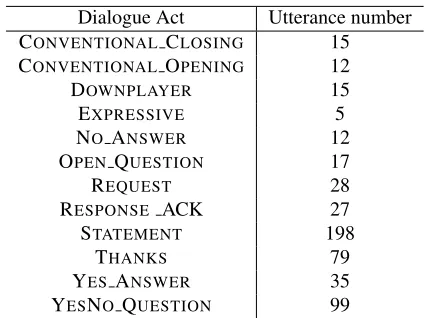
As stated earlier, we use the data set from Ivanovic (2008) for our experiments; it contains 1-on-1 live chats from an information delivery task. This dataset contains 8 live chats, including 542 manually-segmented utterances. The maximum and minimum number of utterances in a dialogue are 84 and 42, respectively; the maximum number of utterances in a turn is 14. The live chats were manually tagged with the 12 dialogue acts described in Section 3. The utterance distribution over the dialogue acts is described in Table 3.
For our experiments, we calculated TF, TF·IDF and IG (Information Gain) over the utterances, which were optionally lemmatized with themorph tool (Minnen et al., 2000). We then built a dialogue act classifier using three different machine
learn-ers: SVM-HMM (Joachims, 1998),2 naive Bayes
Dialogue Act Utterance number CONVENTIONAL CLOSING 15 CONVENTIONAL OPENING 12
DOWNPLAYER 15
EXPRESSIVE 5
NOANSWER 12
OPEN QUESTION 17
REQUEST 28
RESPONSE ACK 27
STATEMENT 198
THANKS 79
YESANSWER 35
[image:6.612.78.293.52.211.2]YESNO QUESTION 99
Table 3: Dialogue act distribution in the corpus
Index Learner Ours Ivanovic Feature Acc. Feature Acc.
Word SVM 1+2+3/B .790 1/B .751
NB 1/B .673 1/B .673
CRF 1/IG .839 1/B .825
Lemma SVM 1+2+3/IG .777 N/A N/A
NB 1/B .672 N/A N/A
CRF 1/B .862 N/A N/A
Table 4: Best accuracy achieved by the different learn-ers over different feature sets and weighting methods (1 = 1-gram; 1+2+3 = 1/2/3-grams; B = Boolean; IG = in-formation gain)
from the WEKA machine learning toolkit (Wit-ten and Frank, 2005), and Conditional Random
Fields (CRF) using CRF++.3 Note that we chose
to testCRFandSVM-HMMas previous work (e.g. (Samuel et al., 1998; Stolcke et al., 2000; Chung, 2009)) has shown the effectiveness of structured classification models on sequential dependencies. Thus, we expect similar effects with CRF and SVM-HMM. Finally, we ran 8-fold cross-validation using the feature sets described above (partitioning across the 8 sessions). All results are presented in terms of classification accuracy. The accuracy of a zero-R (i.e. majority vote) baseline is0.36.
6 Evaluation
6.1 Testing Bag-of-Words Features
Table 4 shows the best accuracy achieved by the dif-ferent learners, in combination with BoW
represen-3http://crfpp.sourceforge.net/
n-gram Boolean TF TF·IDF IG
1 .731 .511 .517 .766
2 .603 .530 .601 .614
3 .474 .463 .472 .482
1+2 .756 .511 .522 .777
[image:6.612.324.527.54.139.2]1+2+3 .773 .511 .528 .777
Table 5: Accuracy of different feature representations and weighting methods for SVM-HMM
tations and feature weighting methods. Note that the CRF learner ran using 1-grams only, as CRF++ does not accept large numbers of features. As a bench-mark, we also tested the method in Ivanovic (2008) and present the best performance over words (rather than lemmas). Overall, we found using just 1-grams produced the best performance for all learners, al-though SVM achieved the best performance when using all threen-gram orders (i.e. 1+2+3). Since the utterances are very short, 2-grams or 3-grams alone are too sparse to be effective. Among the feature weighting methods, Boolean and IG achieved higher accuracy than TF and TF·IDF. Likewise, due to the short utterances, simple Boolean values were often the most effective. However, as IG was computed using the training data, it also achieved high perfor-mance. When comparing the learners, we found that
CRFproduced the best performance, due to its abil-ity to capture inter-utterance dependencies. Finally, we confirmed that using lemmas results in higher ac-curacy.
Table 5 shows the accuracy over all feature sets; for brevity, we show this for SVM only since the pattern is similar across all learners.
6.2 Using Structural Information
In this section, we describe experiments using struc-tural information—i.e. author and/or position—with BoWs. As with the base BoW technique, we used 1-gram lemmas with Boolean values, based on the results from Section 6.1. Table 6 shows the results:
Posindicates the relative position of an utterance in the whole dialogue, Author means author informa-tion, and Posturn indicates the relative position of
Feature Learners
CRF SVM NB
BoW .862 .731 .672
BoW+Author .860 .655 .649
BoW+Pos .862 .721 .655
BoW+Posabsolute .863 .631 .524
BoW+Author+Pos .875 .700 .642
[image:7.612.312.570.51.481.2]BoW+Author+Posturn .871 .651 .631
Table 6: Accuracy with structural information
level of statistical significance (based on randomised estimation,p <0.05) are boldfaced.
Overall, using CRFs with Author and Position in-formation produced better performance than using BoW alone. Clearly, the ability of CRFs to natively optimise over structural dependencies provides an advantage over other learners.
Relative position cannot of course be measured directly in an actual online application; hence Ta-ble 6 also includes the use of “absolute position” as a feature. We see that, forCRF, the absolute posi-tion feature shows an insignificant drop in accuracy as compared to the use of relative position. (How-ever, we do see a significant drop in performance when using this feature withSVMandNB.)
6.3 Using Utterance Dependency
[image:7.612.79.293.53.167.2]We next combined the inter-utterance dependency features with the BoW features. Since we use the dialogue acts directly in utterance dependency, we first experimented using gold-standard dialogue act labels. We also tested using the dialogue acts which were automatically learned in previous steps.
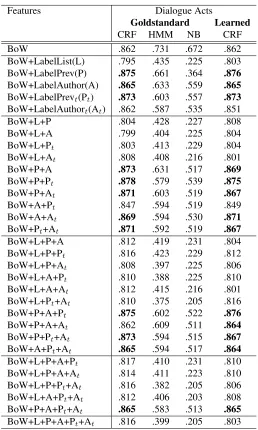
Table 7 shows performance using both the gold-standard and learned dialogue acts. The differ-ent features listed are as follows: LabelList/L in-dicates those corresponding to all utterances in a dialogue preceding the target utterance; Label-Prev/P indicates a dialogue act from a previous utterance; LabelAuthor/A indicates a dialogue act from a previous utterance by the same author; and LabelPrevt/LabelAuthort indicates the
previ-ous utterance(s) and previprevi-ously same-authored ut-terance(s) in a turn, respectively. Since the accuracy forSVM andNBusing learned labels is similar to that using gold standard labels, for brevity we report
Features Dialogue Acts
Goldstandard Learned
CRF HMM NB CRF
BoW .862 .731 .672 .862
BoW+LabelList(L) .795 .435 .225 .803 BoW+LabelPrev(P) .875 .661 .364 .876
BoW+LabelAuthor(A) .865 .633 .559 .865
BoW+LabelPrevt(Pt) .873 .603 .557 .873
BoW+LabelAuthort(At) .862 .587 .535 .851
BoW+L+P .804 .428 .227 .808
BoW+L+A .799 .404 .225 .804
BoW+L+Pt .803 .413 .229 .804
BoW+L+At .808 .408 .216 .801
BoW+P+A .873 .631 .517 .869
BoW+P+Pt .878 .579 .539 .875
BoW+P+At .871 .603 .519 .867
BoW+A+Pt .847 .594 .519 .849
BoW+A+At .869 .594 .530 .871
BoW+Pt+At .871 .592 .519 .867
BoW+L+P+A .812 .419 .231 .804
BoW+L+P+Pt .816 .423 .229 .812
BoW+L+P+At .808 .397 .225 .806
BoW+L+A+Pt .810 .388 .225 .810
BoW+L+A+At .812 .415 .216 .801
BoW+L+Pt+At .810 .375 .205 .816
BoW+P+A+Pt .875 .602 .522 .876
BoW+P+A+At .862 .609 .511 .864
BoW+P+Pt+At .873 .594 .515 .867
BoW+A+Pt+At .865 .594 .517 .864
BoW+L+P+A+Pt .817 .410 .231 .810
BoW+L+P+A+At .814 .411 .223 .810
BoW+L+P+Pt+At .816 .382 .205 .806
BoW+L+A+Pt+At .812 .406 .203 .808
BoW+P+A+Pt+At .865 .583 .513 .865
BoW+L+P+A+Pt+At .816 .399 .205 .803
Table 7: Accuracy for the different learners with depen-dency features
the performance forCRFusing learned labels only. Results that exceed the BoW accuracy at a level of statistical significance (p <0.05) are boldfaced.
Utterance dependency features worked well in combination withCRFonly. Individually,Prevand
Prevt(i.e. BoW+P+Pt) helped to achieve higher
[image:7.612.313.569.60.482.2]Feature CRF SVM NB
C+LabelList .9557 .4613 .2565 C+LabelPrev .9649 .6365 .5720 C+LabelAuthor .9686 .6310 .5424 C+LabelPrevt .9686 .5738 .5738
[image:8.612.95.277.54.129.2]C+LabelAuthort .9561 .6125 .5332
Table 8: Accuracy with Structural and Dependency Infor-mation:Cmeans lemmatized Unigram+Position+Author
achieve high performance on dialogue act classifi-cation even with interactively-learned dialogue acts. We believe this demonstrates the robustness of the proposed techniques.
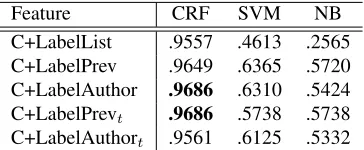
Finally, we tested the combination of features from structural and dependency information. That is, we used a base feature (unigrams with Boolean value), relative position, author information, com-bined with each of the different dependency features – LabelList, LabelPrev, LabelAuthor, LabelPrevt
and LabelAuthort.
Table 8 shows the performance when using these combinations, for each dependency feature. As we would expect, CRFs performed well with the com-bined features since CRFs can incorporate the struc-tural and dependency information; the achieved the highest accuracy of96.86%.
6.4 Error Analysis and Future Work
Finally, we analyzed the errors of
the best-performing feature set (i.e.
BoW+Position+Author+LabelAuthor). In Ta-ble 9, we present a confusion matrix of errors, for CONVENTIONAL CLOSING (Cl), CON -VENTIONAL OPENING (Op), DOWNPLAYER (Dp), EXPRESSIVE (Ex), NO ANSWER (No), OPEN QUESTION (Qu), REQUEST (Rq), RE -SPONSE ACK (Ack), STATEMENT (St), THANKS (Ta), YES ANSWER(Yes), and YESNO QUESTION (YN). Rows indicate the correct dialogue acts and columns indicate misclassified dialogue acts.
Looking over the data, STATEMENTis a common source of misclassification, as it is the majority class in the data. In particularly, a large number of RE -QUESTand RESPONSE ACKutterances were tagged as STATEMENT. We did not include punctuation such as question marks in our feature sets; includ-ing this would likely improve results further.
In future work, we plan to investigate methods for automatically cleansing the data to remove typos, and taking account of temporal gaps that can some-times arise in online chats (e.g. in Table 2, there is a time gap betweenC:U22brb in 1 minandC:U23 Thank you for waiting).
7 Conclusion
We have explored an automated approach for classi-fying dialogue acts in 1-on-1 live chats in the shop-ping domain, using bag-of-words (BoW), structural information and utterance dependency features. We found that the BoW features perform remarkably well, with slight improvements when using lemmas rather than words. Including structural and inter-utterance dependency information further improved performance. Of the learners we experimented with, CRFs performed best, due to their ability to natively capture sequential dialogue act dependencies.
Acknowledgements
This research was supported in part by funding from Microsoft Research Asia.
References
J.Allen and M.Core. Draft of DAMSL: Dialog Act Markup in Several Layers. The Multiparty Dis-course Group. University of Rochester, Rochester, USA. 1997.
A. Anderson, M. Bader, E. Bard, E. Boyle G.M. Do-herty, S. Garrod, S. Isard, J. Kowtko, J. McAllister, J. Miller, C. Sotillo, H.S. Thompson, R. and Weinert. The HCRC Map Task Corpus. Language and Speech. 1991, 34, pp. 351–366.
J. Ang, Y. Liu and E. Shriberg. Automatic Dialog Act Segmentation and Classification in Multiparty Meet-ings. IEEE International Conference on Acoustics, Speech, and Signal Processing. 2005, pp, 1061–1064. S. Bangalore, G. Di Fabbrizio and A. Stent. Learning the Structure of Task-Driven Human-Human Dialogs. Proceedings of the 21st COLING and 44th ACL. 2006, pp. 201–208.
H. H. Bui. A general model for online probabilistic plan recognition.IJCAI. 2003, pp. 1309–1318.
G.Y Chung. Sentence retrieval for abstracts of random-ized controlled trials. BMC Medical Informatics and Decision Making. 2009, 9(10), pp. 1–13.
Cl Op Dp Ex No Qu Rq Ack St Ta Yes YN
Op 0 0 0 0 0 0 0 0 0 0 0 2
Cl 0 0 0 0 0 0 0 0 1 1 0 0
Dp 0 0 0 0 0 0 0 0 0 0 0 0
Ex 0 0 0 0 0 0 0 0 0 0 0 0
No 0 0 0 0 0 0 0 0 0 0 0 0
Qu 0 0 0 0 0 0 0 0 0 0 0 0
Rq 0 0 0 0 0 0 0 0 3 0 0 0
Ack 0 0 1 0 1 0 0 0 5 0 0 0
St 0 0 0 0 0 0 1 0 0 0 0 0
Ta 1 0 0 0 0 0 0 0 0 0 0 0
Yes 0 0 0 0 0 0 0 0 0 0 0 0
YN 0 1 0 0 0 0 0 0 0 0 0 0
Table 9: Confusion matrix for errors from theCRFwithBoW+Position+Author+LabelAuthor(rows = correct clas-sification; columns = misclasclas-sification; CONVENTIONAL CLOSING= Cl; CONVENTIONAL OPENING= Op; DOWN
-PLAYER= Dp; EXPRESSIVE= Ex; NOANSWER= No; OPEN QUESTION= Qu; REQUEST= Rq; RESPONSE ACK
= Ack; STATEMENT= St; THANKS= Ta; YES ANSWER= Yes; and YESNO QUESTION= YN)
E. N. Forsyth. Improving Automated Lexical and Dis-course Analysis of Online Chat Dialog. Master’s the-sis. Naval Postgraduate School, 2007.
J. Godfrey and E. Holliman and J. McDaniel. SWITCH-BOARD: Telephone speech corpus for research and development. Proceedings of IEEE International Conference on Acoustics, Speech, and Signal Process-ing. 1992, pp. 517–520.
S. Grau, E. Sanchis, M. Jose and D. Vilar. Dialogue act classification using a Bayesian approach. Proceedings of the 9th Conference on Speech and Computer. 2004. P. A. Heeman and J. Allen. The Trains 93 Dialogues. Trains Technical Note 94-2. Computer Science Dept., University of Rochester, March 1995.
T. Joachims. Text categorization with support vector ma-chines: Learning with many relevant features. Pro-ceedings of European Conference on Machine Learn-ing. 1998, pp. 137–142.
M. Johnston, S. Bangalore, G. Vasireddy, A. Stent, P. Ehlen, M. Walker, S. Whittaker and P. Maloor. MATCH: An Architecture for Multimodal Dialogue Systems. Proceedings of 40th ACL. 2002, pp. 376– 383.
F. N. Julia and K. M. Iftekharuddin. Dialog Act clas-sification using acoustic and discourse information of MapTask Data. Proceedings of the International Joint Conference on Neural Networks. 2008, pp. 1472– 1479.
D. Jurafsky, E. Shriberg, B Fox and T. Curl. Lexical, Prosodic, and Syntactic Cues for Dialog Acts. Pro-ceedings of ACL/COLING-98 Workshop on Discourse Relations and Discourse Markers. 1998, pp. 114–120.
E. Ivanovic. Automatic instant messaging dialogue us-ing statistical models and dialogue acts. Master’s The-sis. The University of Melbourne. 2008.
S. Keizer. A Bayesian Approach to Dialogue Act Clas-sification. 5th Workshop on Formal Semantics and Pragmatics of Dialogue. 2001, pp. 210–218.
S.N. Kim and L. Wang and T. Baldwin. Tagging and Linking Web Forum Posts. Fourteenth Conference on Computational Natural Language Learning. 2010. J. Lafferty, A. McCallum and F. Pereira. Conditional
random fields: Probabilistic models for segmenting and labeling sequence data. Proceedings of ICML. 2001, pp. 282–289.
D. J. Litman and S. Silliman. ITSPOKE: An Intelligent Tutoring Spoken Dialogue SYstem. Proceedings of the HLT/NAACL. 2004.
M. M. Louwerse and S. Crossley. Dialog Act Classifica-tion UsingN-Gram Algorithms.FLAIRS Conference, 2006, pp. 758–763.
G. Minnen, J. Carroll and D. Pearce. Applied morpho-logical processing of EnglishNatural Language Engi-neering2000, 7(3), pp. 77–80.
M. Purver, J. Niekrasz and S. Peters. Ontology-Based Discourse Understanding for a Persistent Meeting As-sistant. Proc. CHI 2005 Workshop on The Virtuality Continuum Revisited. 2005.
K. Samuel, Sandra Carberry and K. Vijay-Shanker. Dia-logue Act Tagging with Transformation-Based Learn-ing. Proceedings of COLING/ACL 1998. 1998, pp. 1150-1156.
Ess-Dykema. Can Prosody Aid the Automatic Clas-sification of Dialog Acts in Conversational Speech?. Language and Speech. 1998, 41(3-4), pp. 439–487. V. R. Sridhar, S. Bangalore and S. Narayanan.
Combin-ing lexical, syntactic and prosodic cues for improved online dialog act tagging. Computer Speech and Lan-guage. 2009, 23(4), pp. 407–422.
A. Stolcke, K. Ries, N. Coccaro, E. Shriberg, R. Bates, D. Jurafsky, P. Taylor, R. Martin, C. Van Ess-Dykema and M. Meteer. Dialogue Act Modeling for Automatic Tagging and Recognition of Conversational Speech. Computational Linguistics. 2000, 26(3), pp. 339–373. A. Stolcke and E. Shriberg. Markovian Combination of Language and Prosodic Models for better Speech Un-derstanding and Recognition . Invited talk at the IEEE Workshop on Speech Recognition and Understanding, Madonna di Campiglio, Italy, December 2001 2001, C. C. Werry. Linguistic and interactional features of
In-ternet Relay Chat. In S. C. Herring (ed.). Computer-Mediated Communication. Benjamins, 1996.
I. Witten and E. Frank. Data Mining: Practical Machine Learning Tools and Techniques. Morgan Kaufmann, 2005.