Parser Adaptation and Projection
with Quasi-Synchronous Grammar Features
∗ David A. SmithDepartment of Computer Science University of Massachusetts Amherst
Amherst, MA 01003, USA [email protected]
Jason Eisner
Department of Computer Science Johns Hopkins University Baltimore, MD 21218, USA
Abstract
We connect two scenarios in structured learning: adapting a parser trained on one corpus to another annotation style, and
projectingsyntactic annotations from one language to another. We propose quasi-synchronous grammar(QG) features for these structured learning tasks. That is, we score a aligned pair of source and target trees based on local features of the trees and the alignment. Our quasi-synchronous model assigns positive probability to any alignment of any trees, in contrast to a syn-chronous grammar, which would insist on some form of structural parallelism.
In monolingual dependency parser adap-tation, we achieve high accuracy in trans-lating among multiple annotation styles for the same sentence. On the more difficult problem of cross-lingual parser projection, we learn a dependency parser for a target language by using bilin-gual text, an English parser, and auto-matic word alignments. Our experiments show that unsupervised QG projection im-proves on parses trained using only high-precision projected annotations and far outperforms, by more than 35% absolute dependency accuracy, learning an unsu-pervised parser from raw target-language text alone. When a few target-language parse trees are available, projection gives a boost equivalent to doubling the number of target-language trees.
∗
The first author would like to thank the Center for Intel-ligent Information Retrieval at UMass Amherst. We would also like to thank Noah Smith and Rebecca Hwa for helpful discussions and the anonymous reviewers for their sugges-tions for improving the paper.
1 Introduction 1.1 Parser Adaptation
Consider the problem of learning a dependency parser, which must produce a directed tree whose vertices are the words of a given sentence. There are many differing conventions for representing syntactic relations in dependency trees. Say that we wish to output parses in the Prague style and so have annotated a small target corpus—e.g., 100 sentences—with those conventions. A parser trained on those hundred sentences will achieve mediocre dependency accuracy (the proportion of words that attach to their correct parent).
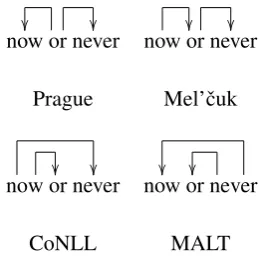
But what if we also had a large number of trees in the CoNLL style (the source corpus)? Ide-ally they should help train our parser. But unfor-tunately, a parser that learned to produce perfect CoNLL-style trees would, for example, get both links “wrong” when its coordination constructions were evaluated against a Prague-style gold stan-dard (Figure 1).
If it were just a matter of this one construction, the obvious solution would be to write a few rules by hand to transform the large source training cor-pus into the target style. Suppose, however, that there were many more ways that our corpora dif-fered. Then we would like to learn a statistical model to transform one style of tree into another.
We may not possess hand-annotated training data for this tree-to-tree transformation task. That would require the two corpora to annotate some of thesamesentences in different styles.
But fortunately, we can automatically obtain a noisy form of the necessary paired-tree training data. A parser trained on the source corpus can parse the sentences in our target corpus, yielding trees (or more generally, probability distributions over trees) in the source style. We will then learn a tree transformation model relating these noisy source trees to our known trees in the target style.
now o rnever now or never
Prague Mel’ˇcuk
nowor never now or ne ver
CoNLL MALT
Figure 1: Four of the five logically possible schemes for annotating coordination show up in human-produced depen-dency treebanks. (The other possibility is a reverse Mel’ˇcuk scheme.) These treebanks also differ on other conventions.
This model should enable us to convert the orig-inal large source corpus to target style, giving us additional training data in the target style.
1.2 Parser Projection
For many target languages, however, we do not have the luxury of a large parsed “source cor-pus” in the language, even one in a different style or domain as above. Thus, we may seek other forms of data to augment our small target corpus. One option would be to leverage unannotated text (McClosky et al., 2006; Smith and Eisner, 2007). But we can also try to transfer syntactic informa-tion from a parsed source corpusin another lan-guage. This is an extreme case of out-of-domain data. This leads to the second task of this paper:
learning a statistical model to transform a syntac-tic analysis of a sentence in one language into an analysis of its translation.
Tree transformations are often modeled with
synchronousgrammars. Suppose we are given a sentencew0in the “source” language and its
trans-lation w into the “target” language. Their syn-tactic parsest0 andtare presumably not
indepen-dent, but will tend to have some parallel or at least correlated structure. So we could jointly model the parsest0, tand the alignmentabetween them,
with a model of the formp(t, a, t0 |w, w0).
Such a joint model captures how t, a, t0
mu-tually constrain each other, so that even partial knowledge of some of these three variables can help us to recover the others when training or de-coding on bilingual text. This idea underlies a number of recent papers on syntax-based align-ment (usingtandt0 to better recovera), grammar
induction from bitext (usingato better recovert
andt0), parser projection (usingt0 andato better
Figure 2: With the English tree and alignment provided by a parser and aligner at test time, the Chinese parser finds the correct dependencies (see§6). A monolingual parser’s incor-rect edges are shown with dashed lines.
recovert), as well as full joint parsing (Smith and Smith, 2004; Burkett and Klein, 2008).
In this paper, we condition on the 1-best source tree t0. As for the alignment a, our models
ei-ther condition on the 1-best alignment or integrate the alignment out. Our models are thus of the formp(t | w, w0, t0, a)or, in the generative case, p(w, t, a|w0, t0). We intend to consider other
for-mulations in future work.
So far, this is very similar to the monolingual parser adaptation scenario, but there are a few key differences. Since the source and target sentences in the bitext are in different languages, there is no longer a trivial alignment between the words of the source and target trees. Given word align-ments, we could simply try to project dependency links in the source tree onto the target text. A link-by-link projection, however, could result in invalid trees on the target side, with cycles or dis-connected words. Instead, our models learn the necessary transformations that align and transform a source tree into a target tree by means of quasi-synchronous grammar (QG) features.
[image:2.595.115.245.59.188.2] [image:2.595.312.529.65.191.2]phrase that confused the undertrained monolin-gual parser. Although, due to the auxiliary verb, “China” and “begun” are siblingsin English and not in direct dependency, the QG features still leverage this indirect projection.
1.3 Plan of the Paper
We start by describing the features we use to augment conditional and generative parsers when scoring pairs of trees (§2). Then we discuss in turn monolingual (§3) and cross-lingual (§4) parser adaptation. Finally, we present experiments on cross-lingual parser projection in conditions when no target language trees are available for training (§5) and when some trees are available (§6).
2 Form of the Model
What should our model of source and target trees look like? In our view, traditional approaches based on synchronous grammar are problematic both computationally and linguistically. Full in-ference takesO(n6)time or worse (depending on
the grammar formalism). Yet synchronous mod-els only consider a limited hypothesis space: e.g., parses must be projective, and alignments must de-compose according to the recursive parse struc-ture. (For example, two nodes can be aligned only if their respective parents are also aligned.) The synchronous model’s probability mass func-tion is also restricted to decompose in this way, so it makes certain conditional independence as-sumptions; put another way, it can evaluate only certain properties of the triple(t, a, t0).
We instead model(t, a, t0)as anarbitrary graph
that includes dependency links among the words of each sentence as well as arbitrary alignment links between the words of the two sentences. This permits non-synchronous and many-to-many alignments. The only hard constraint we impose is that the dependency links within each sentence must constitute a valid monolingual parse—a di-rected projective spanning tree.1
Given the two sentences w, w0, our
probabil-ity distribution over possible graphs considers lo-cal features of the parses, the alignment, and both jointly. Thus, we learn what local syntactic con-figurations tend to occur in each language and how they correspond across languages. As a result, we might learn that parses are “mostly synchronous,” but that there are some systematic cross-linguistic
1Non-projective parsing would also be possible.
divergences and some instances of sloppy (non-parallel or inexact) translation. Our model is thus a form of quasi-synchronous grammar (QG) (Smith and Eisner, 2006a). In that paper, QG was applied to word alignment and has since found applica-tions in question answering (Wang et al., 2007), paraphrase detection (Das and Smith, 2009), and machine translation (Gimpel and Smith, 2009).
All the models in this paper are conditioned on the source tree t0. Conditionally-trained models
of adaptation and projection also condition on the target stringwand its alignmentatow0 and thus
have the formp(t|w, w0, t0, a); the unsupervised,
generative projection models in§5 have the form
p(w, t, a|w0, t0).
The scoresof a given tuple of trees, words, and alignment can thus be written as a dot product of weightswwith featuresf andg:
s(t, t0, a, w, w0) =X
i
wifi(t, w)
+X
j
wjgj(t, t0, a, w, w0)
The features f look only at target words and de-pendencies. In the conditional models of §3 and
§6, these features are those of an edge-factored dependency parser (McDonald et al., 2005). In the generative models of§5, f has the form of a dependency model with valence (Klein and Man-ning, 2004). All models, for instance, have a fea-ture template that considers the parts of speech of a potential parent-child relation.
In order to benefit from the source language, we also need to include bilingual features g. When scoring a candidate target dependency link from wordx → y, these features consider the relation-ship of their corresponding source words x0 and y0. (The correspondences are determined by the
alignmenta.) For instance, the source treet0 may
contain the linkx0 →y0, which would cause a
fea-ture formonotonicprojection to fire for thex→y
edge. If, on the other hand, y0 → x0 ∈ t0, a head-swapping feature fires. If x0 = y0, i.e. x
andyalign to the same word, thesame-word fea-ture fires. Similar feafea-tures fire whenx0 andy0are
configuration features with the part of speech and coarse part of speech of one or both of the source and target words, i.e. the feature template has from one to four tags.
In conditional training, the exponentiated scores s are normalized by a constant: Z = P
texp[s(t, t0, a, w, w0)]. For the generative model, the locally normalized generative process is explained in§5.3.4.
Previous researchers have written fix-up rules to massage the projected links after the fact and learned a parser from the resulting trees (Hwa et al., 2005). Instead, our models learn the necessary transformations that align and transform a source tree into a target tree. Other researchers have tack-led the interesting task of learning parsers from unparsed bitext alone (Kuhn, 2004; Snyder et al., 2009); our methods take advantage of investments in high-resource languages such as English. In work most closely related to this paper, Ganchev et al. (2009) constrain the posterior distribution over target-language dependencies to align to source dependencies some “reasonable” proportion of the time (≈ 70%, cf. Table 2 in this paper). This approach performs well but cannot directly learn regular cross-language non-isomorphisms; for in-stance, some fixup rules for auxiliary verbs need to be introduced. Finally, Huang et al. (2009) use features, somewhat like QG configurations, on the shift-reduce actions in a monolingual, target-language parser.
3 Adaptation
As discussed in §1, the adaptation scenario is a special case of parser projection where the word alignments are one-to-one and observed. To test our handling of QG features, we performed ex-periments in which training saw the correct parse trees in both source and target domains, and the mapping between them was simple and regular. We also performed experiments where the source trees were replaced by the noisy output of a trained parser, making the mapping more complex and harder to learn.
We used the subset of the Penn Treebank from the CoNLL 2007 shared task and converted it to dependency representation while varying two pa-rameters: (1) CoNLL vs. Prague coordination style (Figure 1), and (2) preposition the head vs. the child of its nominal object.
We trained an edge-factored dependency parser
(McDonald et al., 2005) on “source” domain data that followed one set of dependency conventions. We then trained an edge-factored parser with QG features on a small amount of “target” domain data. The source parser outputs were produced for all target data, both training and test, so that fea-tures for the target parser could refer to them.
In this task, we know what the gold-standard source language parses are for any given text, since we can produce them from the original Penn Treebank. We can thus measure the contribution of adaptation loss alone, and the combined loss of imperfect source-domain parsing with adapta-tion (Table 1). When no target domain trees are available, we simply have the performance of the source domain parser on this out-of-domain data. Training a target-domain parser on as few as 10 sentences shows substantial improvements in ac-curacy. In the “gold” conditions, where the target parser starts with perfect source trees, accuracy approaches 100%; in the realistic “parse” condi-tions, where the target-domain parser gets noisy source-domain parses, the improvements are quite significant but approach a lower ceiling imposed by the performance of the source parser.2
The adaptation problem in this section is a sim-ple proof of concept of the QG approach; however, more complex and realistic adaptation problems exist. Monolingual adaptation is perhaps most ob-viously useful when the source parser is a black-box or rule-based system or is trained on unavail-able data. One might still want to use such a parser in some new context, which might require new data or a new annotation standard.
We are also interested in scenarios where we want to avoid expensive retraining on large rean-notated treebanks. We would like a linguist to be able to annotate a few trees according to a hy-pothesized theory and then quickly use QG adap-tation to get a parser for that theory. One example would be adapting a constituency parser to pro-duce dependency parses. We have concentrated here on adapting between two dependency parse styles, in order to line up with the cross-lingual tasks to which we now turn.
2In the diagonal cells, source and target styles match, so
% Dependency Accuracy on Target
CoNLL-PrepHead CoNLL-PrepChild Prague-PrepHead Prague-PrepChild
Source 0 10 100 0 10 100 0 10 100 0 10 100
Gold CoNLL-PrepHead 100 99.6 99.6 79.5 96.9 97.8 90.5 95.0 98.1 71.0 92.7 95.4
Parse CoNLL-PrepHead 89.5 88.9 89.0 71.4 85.9 87.9 82.5 84.3 87.8 65.2 82.2 86.1
Gold CoNLL-PrepChild 79.5 96.6 97.3 100 99.6 99.6 71.0 91.3 95.5 89.9 94.5 97.9
Parse CoNLL-PrepChild 71.0 84.2 86.8 88.1 87.5 88.0 64.9 80.7 84.9 80.9 83.5 86.1
Gold Prague-PrepHead 90.5 95.5 96.7 71.0 92.0 94.2 100 99.6 99.6 79.6 97.4 98.1
Parse Prague-PrepHead 83.0 87.1 87.4 65.6 84.2 85.9 88.5 88.3 88.0 70.7 86.4 86.8
Gold Prague-PrepChild 71.0 91.6 93.8 89.9 95.6 96.4 79.6 96.0 97.1 100 99.6 99.6
Parse Prague-PrepChild 65.3 81.7 84.6 81.2 84.5 86.1 70.4 83.2 85.3 86.9 86.1 86.8
Table 1: Adapting a parser to a new annotation style. We learn to parse in a “target” style (wide column label) given some number (narrow column label) of supervised target-style training sentences. As a font of additional features,all training and test sentenceshave already been augmented with parses in some “source” style (row label): either gold-standard parses (an oracle experiment) or else the output of a parser trained on 18k source trees (more realistic). If we have 0 training sentences, we simply output the source-style parse. But with 10 or 100 target-style training sentences, each off-diagonal block learns to adapt, mostly closing the gap with the diagonal block in the same column. In the diagonal blocks, source and target styles match, and the QG parser degrades performance when acting as a “stacked” parser.
4 Cross-Lingual Projection: Background
As in the adaptation scenario above, many syn-tactic structures can be transferred from one lan-guage to another. In this section, we evaluate the extent of this direct projection on a small hand-annotated corpus. In§5, we will use a QG genera-tive model to learn dependency parsers from bitext when there are no annotations in the target lan-guage. Finally, in §6,we show how QG features can augment a target-language parser trained on a small set of labeled trees.
For syntactic annotation projection to work at all, we must hypothesize, or observe, that at least some syntactic structures are preserved in transla-tion. Hwa et al. (2005) have called this intuition the Direct Correspondence Assumption(DCA, with slight notational changes):
Given a pair of sentenceswandw0 that
are translations of each other with syn-tactic structuretandt0, if nodes x0 and y0oft0are aligned with nodesxandyof t, respectively, and if syntactic relation-ship R(x0, y0) holds in t0, then R(x, y)
holds int.
The validity of this assumption clearly depends on the node-to-node alignment of the two trees. We again work in a dependency framework, where syntactic nodes are simply lexical items. This al-lows us to use existing work on word alignment.
Hwa et al. (2005) tested the DCA under ialized conditions by obtaining hand-corrected de-pendency parse trees of a few hundred sentences of Spanish-English and Chinese-English bitext. They also used human-produced word alignments.
Corpus Prec.[%] Rec.[%]
Spanish 64.3 28.4
(no punc.) 72.0 30.8
Chinese 65.1 11.1
[image:5.595.81.517.60.176.2](no punc.) 68.2 11.5
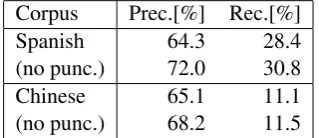
Table 2: Precision and recall of direct dependency projection via one-to-one links alone.
Since their word alignments could be many-to-many, they gave a heuristic Direct Projection Al-gorithm (DPA) for resolving them into component dependency relations. It should be noted that this process introduced empty words into the projected target language tree and left words that are un-aligned to English detached from the tree; as a re-sult, they measured performance in dependency F-score rather than accuracy. With manual English parses and word alignments, this DPA achieved 36.8% F-score in Spanish and 38.1% in Chinese. With Collins-model English parses and GIZA++ word alignments, F-score was 33.9% for Spanish and 26.3% for Chinese. Compare this to the Span-ish attach-left baseline of 31.0% and the Chinese attach-right baselines of 35.9%. These discour-agingly low numbers led them to write language-specific transformation rules to fix up the projected trees. After these rules were applied to the pro-jections of automatic English parses, F-score was 65.7% for English and 52.4% for Chinese.
[image:5.595.337.497.280.349.2]Us-ing Hwa et al.’s data, we calculated that the preci-sion of projection to Spanish and Chinese via these one-to-one links was≈ 65%(Table 2). There is clearly more information in these direct links than one would think from the F-scores. To exploit this information, however, we need to overcome the problems of (1) learning from partial trees, when not all target words are attached, and (2) learning in the presence of the still considerable noise in the projected one-to-one dependencies—e.g., at least 28% error for Spanish non-punctuation dependen-cies.
What does this noise consist of? Some errors reflect fairly arbitrary annotation conventions in treebanks, e.g. should the auxiliary verb gov-ern the main verb or vice versa. (Examples like this suggest that the projection problem contains the adaptation problem above.) Other errors arise from divergences in the complements required of certain head words. In the German-English trans-lation pair, with co-indexed words aligned,
[an [den Libanon1]] denken2 ↔ remember2Lebanon1
we would prefer that the preposition an attach to denken, even though the preposition’s object
Libanon aligns to a direct child of remember. In other words, we would like the grandparent-parent-child chain of denken → an → Libanon
to align to the parent-child pair of remember →
Lebanon. Finally, naturally occurring bitexts con-tain some number of free or erroneous transla-tions. Machine translation researchers often seek to strike these examples from their training cor-pora; “free” translations are not usually welcome from an MT system.
5 Unsupervised Cross-Lingual Projection
First, we consider the problem of parser projection when there are zero target-language trees avail-able. As in much other work on unsupervised parsing, we try to learn a generative model that can predict target-language sentences. Our novel contribution is tocondition the probabilities of the generative actions on the dependency parse of a source-language translation. Thus, our generative model is a quasi-synchronous grammar, exactly as in (Smith and Eisner, 2006a).3
When training on target sentences w, there-fore, we tune the model parameters to maxi-mize notPtp(t, w)as in ordinary EM, but rather
3Our task here is new; they used it for alignment.
P
tp(t, w, a | t0, w0). We hope that this
condi-tional EMtraining will drive the model to posit ap-propriate syntactic relationships in the latent vari-ablet, because—thanks to the structure of the QG model—that is the easiest way for it to exploit the extra information int0, w0 to help predictw.4 At
test time,t0, w0 are not made available, so we just
use the trained model to find argmaxtp(t | w), backing off from the conditioning on t0, w0 and
summing overa.
Below, we present the specific generative model (§5.1) and some details of training (§5.2). We will then compare three approaches (§5.3):
§5.3.2 a straight EM baseline (which does not condition ont0, w0at all)
§5.3.3 a “hard” projection baseline (which naively projectst0, w0 to derive direct supervision in
the target language)
§5.3.4 our conditional EM approach above (which makest0, w0available to the learner for “soft”
indirect supervision via QG)
5.1 Generative Models
Our base models of target-language syntax are generative dependency models that have achieved state-of-the art results in unsupervised dependency structure induction. The simplest version, called Dependency Model with Valence (DMV), has been used in isolation and in combination with other models (Klein and Manning, 2004; Smith and Eis-ner, 2006b). The DMV generates the right chil-dren, and then independently the left chilchil-dren, for each node in the dependency tree. Nodes corre-spond to words, which are represented by their part-of-speech tags. At each step of generation, the DMV stochastically chooses whether to stop generating, conditioned on the currently generat-ing head; whether it is generatgenerat-ing to the right or left; and whether it has yet generated any chil-dren on that side. If it chooses to continue, it then
4The contrastive estimation of Smith and Eisner (2005)
stochastically generates the tag of a new child, conditioned on the head. The parameters of the model are thus of the form
p(stop|head, dir, adj) (1)
p(child|head, dir) (2) where head and child are part-of-speech tags,
dir∈ {left,right}, andadj, stop∈ {true,false}.
ROOTis stipulated to generate a single right child. Bilingual configurations that condition ont0, w0
(§2) are incorporated into the generative process as in Smith and Eisner (2006a). When the model is generating a new child for wordx, aligned tox0,
it first chooses a configuration and then chooses a source wordy0in that configuration. The childyis
then generated, conditioned on its parentx, most recent siblinga, and its source analoguey0. 5.2 Details of EM Training
As in previous work on grammar induction, we learn the DMVfrom part-of-speech-tagged target-language text. We use expectation maximization (EM) to maximize the likelihood of the data. Since the likelihood function is nonconvex in the unsu-pervised case, our choice of initial parameters can have a significant effect on the outcome. Although we could also try many random starting points, the initializer in Klein and Manning (2004) performs quite well.
The base dependency parser generates the right dependents of a head separately from the left de-pendents, which allowsO(n3)dynamic
program-ming for ann-word target sentence. Since the QG annotates nonterminals of the grammar with sin-gle nodes of t0, and we consider two nodes oft0
when evaluating the above dependency configura-tions, QG parsing runs inO(n3m2)for anm-word
source sentence. If, however, we restrict candidate senses for a target child c to come from links in an IBM Model 4 Viterbi alignment, we achieve
O(n3k2), where k is the maximum number of
possible words aligned to a given target language word. In practice,k m, and parsing is not ap-preciably slower than in the monolingual setting.
If all configurations were equiprobable, the source sentence would provide no information to the target. In our QG experiments, therefore, we started with a bias towards direct parent–child links and a very small probability for breakages of locality. The values of other configuration pa-rameters seem, experimentally, less important for insuring accurate learning.
5.3 Experiments
Our experiments compare learning on target lan-guage text to learning on parallel text. In the lat-ter case, we compare learning from high-precision one-to-one alignments alone, to learning from all alignments using a QG.
5.3.1 Corpora
Our development and test data were drawn from the German TIGER and Spanish Cast3LB tree-banks as converted to projective dependencies for the CoNLL 2007 Shared Task (Brants et al., 2002; Civit Torruella and Mart´ı Anton´ın, 2002).5
Our training data were subsets of the 2006 Statistical Machine Translation Workshop Shared Task, in particular from the German-English and Spanish-English Europarl parallel corpora (Koehn, 2002). The Shared Task provided pre-built automatic GIZA++ word alignments, which we used to facilitate replicability. Since these word alignments do not contain posterior proba-bilities or null links, nor do they distinguish which links are in the IBM Model intersection, we treated all links as equally likely when learning the QG. Target language words unaligned to any source language words were the only nodes allowed to align toNULLin QG derivations.
We parsed the English side of the bitext with the projective dependency parser described by Mc-Donald et al. (2005) trained on the Penn Treebank
§§2–20. Much previous work on unsupervised grammar induction has used gold-standard part-of-speech tags (Smith and Eisner, 2006b; Klein and Manning, 2004; Klein and Manning, 2002). While there are no gold-standard tags for the Eu-roparl bitext, we did train a conditional Markov
5We made one change to the annotation conventions in
German: in the dependencies provided, words in a noun phrase governed by a preposition were all attached to that preposition. This meant that in the phrase das Kind(“the child”) in, say, subject position,daswas the child ofKind; but, inf¨ur das Kind(“for the child”),daswas the child of
Dependency accuracy [%]
Baselines German Spanish
Modify prev. 18.2 28.5
Modify next 27.5 21.4
EM 30.2 25.6
Hard proj. 66.2 59.1
Hard proj. w/EM 58.6 53.0
[image:8.595.74.289.62.173.2]QG w/EM 68.5 64.8
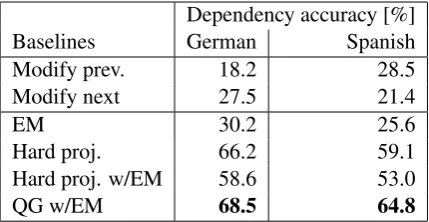
Table 3: Test accuracy with unsupervised training methods
model tagger on a few thousand tagged sentences. This is the only supervised data we used in the tar-get. We created versions of each training corpus with the first thousand, ten thousand, and hundred thousand sentence pairs, each a prefix of the next. Since the target-language-only baseline converged much more slowly, we used a version of the cor-pora with sentences 15 target words or fewer.
5.3.2 Fully Unsupervised EM
Using the target side of the bitext as training data, we initialized our model parameters as described in§5.2 and ran EM. We checked convergence on a development set and measured unlabeled depen-dency accuracy on held-out test data. We com-pare performance to simple attach-right and at-tach left baselines (Table 3). For mostly head-final German, the “modify next” baseline is bet-ter; for mostly head-initial Spanish, “modify pre-vious” wins. Even after several hundred iterations, performance was slightly, but not significantly bet-ter than the baseline for German. EM training did not beat the baseline for Spanish.6
5.3.3 Hard Projection, Semi-Supervised EM
The simplest approach to using the high-precision one-to-one word alignments is labeled “hard pro-jection” in the table. We filtered the training cor-pus to find sentences where enough links were projected to completely determine a target lan-guage tree. Of course, we needed to filter more than 1000 sentences of bitext to output 1000 training sentences in this way. We simply per-form supervised training with this subset, which is still quite noisy (§4), and performance quickly
6While these results are worse than those obtained
previ-ously for this model, the experiments in Klein and Manning (2004) and only used sentences of 10 words or fewer, without punctuation, and with gold-standard tags. Punctuation in par-ticular seems to trip up the initializer: since a sentence-final periods appear in most sentences, EM often decides to make it the head.
plateaus. Still, this method substantially improves over the baselines and unsupervised EM.
Restricting ourselves to fully projected trees seems a waste of information. We can also sim-ply take all one-to-one projected links, impute ex-pected counts for the remaining dependencies with EM, and update our models. This approach (“hard projection with EM”), however, performed worse than using only the fully projected trees. In fact, only the first iteration of EM with this method made any improvement; afterwards, EM degraded accuracy further from the numbers in Table 3.
5.3.4 Soft Projection: QG & Conditional EM
The quasi-synchronous model used all of the alignments in re-estimating its parameters and per-formed significantly better than hard projection. Unlike EM on the target language alone, the QG’s performance does not depend on a clever initial-izer for initial model weights—all parameters of the generative model except for the QG configura-tion features were initialized to zero. Setting the prior to prefer direct correspondence provides the necessary bias to initialize learning.
Error analysis showed that certain types of de-pendencies eluded the QG’s ability to learn from bitext. The Spanish treebank treats some verbal complements as the heads of main verbs and aux-iliary verbs as the children of participles; the QG, following the English, learned the opposite de-pendency direction. Spanish treebank conventions for punctuation were also a common source of er-rors. In both German and Spanish, coordinations (a common bugbear for dependency grammars) were often mishandled: both treebanks attach the later coordinands and any conjunctions to the first coordinand; the reverse is true in English. Finally, in both German and Spanish, preposition attach-ments often led to errors, which is not surprising given the unlexicalized target-language grammars. Rather than trying to adjudicate which dependen-cies are “mere” annotation conventions, it would be useful to test learned dependency models on some extrinsic task such as relation extraction or machine translation.
6 Supervised Cross-Lingual Projection
tree given the target sentence, using the monolin-gual and bilinmonolin-gual QG features, including config-urations conjoined with tags, outlined above (§2).
For these experiments, we used the LDC’s English-Chinese Parallel Treebank (ECTB). Since manual word alignments also exist for a part of this corpus, we were able to measure the loss in accuracy (if any) from the use of an automatic English parser and word aligner. The source-language English dependency parser was trained on the Wall Street Journal, where it achieved 91% dependency accuracy on development data. How-ever, it was only 80.3% accurate when applied to our task, the English side of the ECTB.7
After parsing the source side of the bitext, we train a parser on the annotated target side, using QG features described above (§2). Both the mono-lingual target-language parser and the projected parsers are trained to optimize conditional likeli-hood of the target trees t0 with ten iterations of
stochastic gradient ascent.
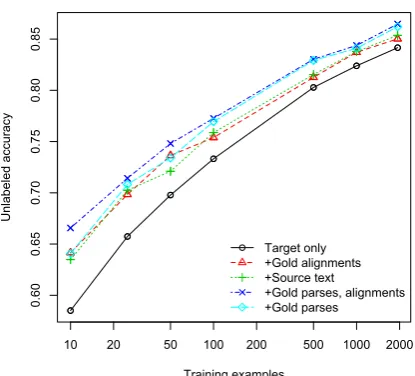
In Figure 3, we plot the performance of the target-language parser on held-out bitext. Al-though projection performance is, not surprisingly, better if we know the true source trees at training and test time, even with the 1-best output of the source parser, QG features help produce a parser as accurate asq one trained on twice the amount of monolingual data. In ablation experiments, we included bilingual features only for directly pro-jected links, with no features for head-swapping, grandparents, etc. When using 1-best English parses, parsers trained only with direct-projection and monolingual features performed worse; when using gold English parses, parsers with direct-projection-only features performed better when trained with more Chinese trees.
7 Discussion
The two related problems of parser adaptation and projection are often approached in different ways. Many adaptation methods operate by simple aug-mentations of the target feature space, as we have done here (Daume III, 2007). Parser projection, on the other hand, often uses a multi-stage pipeline
7It would be useful to explore whether the techniques of
§3 above could be used to improve English accuracy by do-main adaptation. In theory a model with QG features trained to perform well on Chinese should not suffer from an inaccu-rate, but consistent, English parser, but the results in Figure 3 indicate a significant benefit to be had from better English parsing or from joint Chinese-English inference.
10 20 50 100 200 500 1000 2000
0.60
0.65
0.70
0.75
0.80
0.85
Training examples
Unlabeled accuracy
Target only
+Gold alignments +Source text
+Gold parses, alignments
[image:9.595.309.517.61.249.2]+Gold parses
Figure 3: Parser projection with target trees. Using the true or 1-best parse trees in the source language is equivalent to having twice as much data in the target language. Note that the penalty for using automatic alignments instead of gold alignments is negligible; in fact, usingSource textalone is often higher than+Gold alignments. Using gold source trees, however, significantly outperforms using 1-best source trees.
(Hwa et al., 2005). The methods presented here move parser projection much closer in efficiency and simplicity to monolingual parsing.
We showed that augmenting a target parser with quasi-synchronous features can lead to significant improvements—first in experiments with adapt-ing to different dependency representations in En-glish, and then in cross-language parser projec-tion. As with many domain adaptation problems, it is quite helpful to have some annotated tar-get data, especially when annotation styles vary (Dredze et al., 2007). Our experiments show that unsupervised QG projection improves on parsers trained using only high-precision projected anno-tations and far outperforms, by more than 35% absolute dependency accuracy, unsupervised EM. When a small number of target-language parse trees is available, projection gives a boost equiv-alent to doubling the number of target trees.
The loss in performance from conditioning only on noisy 1-best source parses points to some nat-ural avenues for improvement. We are explor-ing methods that incorporate a packed parse for-est on the source side and similar representations of uncertainty about alignments. Building on our recent belief propagation work (Smith and Eis-ner, 2008), we can jointly infer two dependency trees and their alignment, under a joint distribu-tionp(t, a, t0 |w, w0)that evaluates the full graph
References
S. Brants, S. Dipper, S. Hansen, W. Lezius, and G. Smith. 2002. The TIGER treebank. InTLT. David Burkett and Dan Klein. 2008. Two
lan-guages are better than one (for syntactic parsing). In EMNLP.
M. Civit Torruella and M. A. Mart´ı Anton´ın. 2002. Design principles for a Spanish treebank. InTLT. Dipanjan Das and Noah A. Smith. 2009. Paraphrase
identification as probabilistic quasi-synchronous recognition. InACL-IJCNLP.
Hal Daume III. 2007. Frustratingly easy domain adap-tation. InACL, pages 256–263.
Mark Dredze, John Blitzer, Partha Pratim Taluk-dar, Kuzman Ganchev, Jo˜ao Graca, and Fernando Pereira. 2007. Frustratingly hard domain adap-tation for dependency parsing. In Proceedings of the CoNLL Shared Task Session of EMNLP-CoNLL 2007, pages 1051–1055.
Kuzman Ganchev, Jennifer Gillenwater, and Ben Taskar. 2009. Dependency grammar induction via bitext projection constraints. InACL-IJCNLP. Kevin Gimpel and Noah A. Smith. 2009. Feature-rich
translation by quasi-synchronous lattice parsing. In EMNLP.
Liang Huang, Wenbin Jiang, and Qun Liu. 2009. Bilingually-constrained (monolingual) shift-reduce parsing. InEMNLP.
Rebecca Hwa, Philip Resnik, Amy Weinberg, Clara Cabezas, and Okan Kolak. 2005. Bootstrapping parsers via syntactic projection across parallel texts. Natural Language Engineering, 11:311–325. Dan Klein and Christopher D. Manning. 2002. A
generative constituent-context model for improved grammar induction. InACL, pages 128–135. Dan Klein and Christopher D. Manning. 2004.
Corpus-based induction of syntactic structure: Mod-els of dependency and constituency. InACL, pages 479–486.
Philipp Koehn. 2002. Europarl: A multilingual corpus for evaluation of machine translation. http://www.iccs.informatics.ed.ac.uk/˜pkoehn/-publications/europarl.ps.
Jonas Kuhn. 2004. Experiments in parallel-text based grammar induction. InACL, pages 470–477. Andr´e F. T. Martins, Dipanjan Das, Noah A. Smith, and
Eric P. Xing. 2008. Stacking dependency parsers.
InEMNLP.
David McClosky, Eugene Charniak, and Mark John-son. 2006. Reranking and self-training for parser adaptation. InACL, pages 337–344.
Ryan McDonald, Koby Crammer, and Fernando Pereira. 2005. Online large-margin training of de-pendency parsers. InACL, pages 91–98.
Noah A. Smith and Jason Eisner. 2005. Guiding unsu-pervised grammar induction using contrastive esti-mation. InInternational Joint Conference on Artifi-cial Intelligence (IJCAI) Workshop on Grammatical Inference Applications, Edinburgh, July.
David A. Smith and Jason Eisner. 2006a. Quasi-synchronous grammars: Alignment by soft projec-tion of syntactic dependencies. In Proceedings of the HLT-NAACL Workshop on Statistical Machine Translation, pages 23–30.
Noah A. Smith and Jason Eisner. 2006b. Annealing structural bias in multilingual weighted grammar in-duction. InACL-COLING, pages 569–576.
David A. Smith and Jason Eisner. 2007. Bootstrap-ping feature-rich dependency parsers with entropic priors. InEMNLP-CoNLL, pages 667–677.
David A. Smith and Jason Eisner. 2008. Dependency parsing by belief propagation. In EMNLP, pages 145–156.
David A. Smith and Noah A. Smith. 2004. Bilingual parsing with factored estimation: Using English to parse Korean. InEMNLP, pages 49–56.
Benjamin Snyder, Tahira Naseem, and Regina Barzi-lay. 2009. Unsupervised multilingual grammar in-duction. InACL-IJCNLP.