Proceedings of the 2011 Conference on Empirical Methods in Natural Language Processing, pages 1535–1545,
Identifying Relations for Open Information Extraction
Anthony Fader, Stephen Soderland, and Oren Etzioni
University of Washington, Seattle
{afader,soderlan,etzioni}@cs.washington.edu
Abstract
Open Information Extraction (IE) is the task of extracting assertions from massive corpora without requiring a pre-specified vocabulary. This paper shows that the output of state-of-the-art Open IE systems is rife with uninfor-mative and incoherent extractions. To over-come these problems, we introduce two sim-ple syntactic and lexical constraints on bi-nary relations expressed by verbs. We im-plemented the constraints in the REVERB
Open IE system, which more than doubles the area under the precision-recall curve relative to previous extractors such as TEXTRUNNER
andWOEpos. More than30% of REVERB’s
extractions are at precision 0.8 or higher— compared to virtually none for earlier systems. The paper concludes with a detailed analysis of REVERB’s errors, suggesting directions for
future work.1
1 Introduction and Motivation
Typically, Information Extraction (IE) systems learn an extractor for each target relation from la-beled training examples (Kim and Moldovan, 1993; Riloff, 1996; Soderland, 1999). This approach to IE does not scale to corpora where the number of target relations is very large, or where the target relations cannot be specified in advance. Open IE solves this problem by identifying relation phrases—phrases that denote relations in English sentences (Banko et al., 2007). The automatic identification of rela-1The source code for REVERB is available at http://
reverb.cs.washington.edu/
tion phrases enables the extraction ofarbitrary re-lations from sentences, obviating the restriction to a pre-specified vocabulary.
Open IE systems have achieved a notable measure of success on massive, open-domain corpora drawn from the Web, Wikipedia, and elsewhere. (Banko et al., 2007; Wu and Weld, 2010; Zhu et al., 2009). The output of Open IE systems has been used to support tasks like learning selectional preferences (Ritter et al., 2010), acquiring common sense knowledge (Lin et al., 2010), and recognizing entailment (Schoen-mackers et al., 2010; Berant et al., 2011). In ad-dition, Open IE extractions have been mapped onto existing ontologies (Soderland et al., 2010).
We have observed that two types of errors are fre-quent in the output of Open IE systems such as TEX-TRUNNERandWOE:incoherent extractionsand
un-informative extractions.
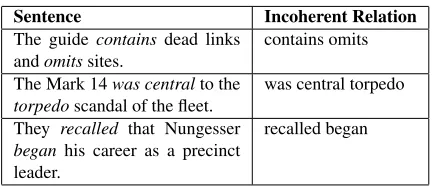
Incoherent extractions are cases where the ex-tracted relation phrase has no meaningful interpre-tation (see Table 1 for examples). Incoherent ex-tractions arise because the learned extractor makes a sequence of decisions about whether to include each word in the relation phrase, often resulting in incom-prehensible predictions. To solve this problem, we introduce a syntactic constraint: every multi-word relation phrase must begin with a verb, end with a preposition, and be a contiguous sequence of words in the sentence. Thus, the identification of a relation phrase is made in one fell swoop instead of on the basis of multiple, word-by-word decisions.
ous Open IE systems return the uninformative
(Faust, made, a deal)
instead of
(Faust, made a deal with, the devil).
This type of error is caused by improper handling of relation phrases that are expressed by a combi-nation of a verb with a noun, such as light verb constructions (LVCs). An LVC is a multi-word ex-pression composed of a verb and a noun, with the noun carrying the semantic content of the predi-cate (Grefenstette and Teufel, 1995; Stevenson et al., 2004; Allerton, 2002). Table 2 illustrates the wide range of relations expressed this way, which are not captured by existing open extractors. Our syntactic constraint leads the extractor to include nouns in the relation phrase, solving this problem.
Although the syntactic constraint significantly re-duces incoherent and uninformative extractions, it allows overly-specific relation phrases such asis of-fering only modest greenhouse gas reduction targets at. To avoid overly-specific relation phrases, we in-troduce an intuitive lexical constraint: a binary rela-tion phrase ought to appear with at least a minimal number of distinct argument pairs in a large corpus. In summary, this paper articulates two simple but surprisingly powerful constraints on how binary re-lationships are expressed via verbs in English sen-tences, and implements them in the REVERBOpen IE system. We release REVERBand the data used in our experiments to the research community.
The rest of the paper is organized as follows. Sec-tion 2 analyzes previous work. SecSec-tion 3 defines our constraints precisely. Section 4 describes REVERB, our implementation of the constraints. Section 5 re-ports on our experimental results. Section 6 con-cludes with a summary and discussion of future work.
2 Previous Work
Open IE systems like TEXTRUNNER (Banko et al., 2007),WOEpos, andWOEparse(Wu and Weld, 2010) focus on extracting binary relations of the form (arg1, relation phrase, arg2) from text. These sys-tems all use the following three-step method:
1. Label: Sentences are automatically labeled with extractions using heuristics or distant su-pervision.
Sentence Incoherent Relation
The guide containsdead links
andomitssites. contains omits The Mark 14was centralto the
torpedoscandal of the fleet.
was central torpedo
They recalled that Nungesser began his career as a precinct leader.
recalled began
Table 1: Examples of incoherent extractions. In-coherent extractions make up approximately 13% of TEXTRUNNER’s output, 15% of WOEpos’s output, and
30%ofWOEparse’s output.
is is an album by, is the author of, is a city in has has a population of, has a Ph.D. in, has a cameo in made made a deal with, made a promise to
took took place in, took control over, took advantage of gave gave birth to, gave a talk at, gave new meaning to got got tickets to, got a deal on, got funding from
Table 2: Examples of uninformative relations (left) and their completions (right). Uninformative relations oc-cur in approximately4% of WOEparse’s output, 6% of WOEpos’s output, and7%of TEXTRUNNER’s output.
2. Learn: A relation phrase extractor is learned using a sequence-labeling graphical model (e.g., CRF).
3. Extract: the system takes a sentence as in-put, identifies a candidate pair of NP arguments (arg1, arg2) from the sentence, and then uses the learned extractor to label each word be-tween the two arguments as part of the relation phrase or not.
The extractor is applied to the successive sentences in the corpus, and the resulting extractions are col-lected.
[image:2.612.319.535.69.162.2]chooses an extraction’s arguments heuristically, and cannot backtrack over this choice. This is problem-atic when a word that belongs in the relation phrase is chosen as an argument (for example, deal from the “made a deal with” sentence).
Because of the feature sets utilized in previous work, the learned extractors ignore both “holistic” aspects of the relation phrase (e.g., is it contiguous?) as well as lexical aspects (e.g., how many instances of this relation are there?). Thus, as we show in Sec-tion 5, systems such as TEXTRUNNER are unable to learn the constraints embedded in REVERB. Of course, a learning system, utilizing a different hy-pothesis space, and an appropriate set of training ex-amples, could potentially learn and refine the con-straints in REVERB. This is a topic for future work, which we consider in Section 6.
The first Open IE system was TEXTRUNNER (Banko et al., 2007), which used a Naive Bayes model with unlexicalized POS and NP-chunk fea-tures, trained using examples heuristically generated from the Penn Treebank. Subsequent work showed that utilizing a linear-chain CRF (Banko and Et-zioni, 2008) or Markov Logic Network (Zhu et al., 2009) can lead to improved extraction. The WOE systems introduced by Wu and Weld make use of Wikipedia as a source of training data for their ex-tractors, which leads to further improvements over TEXTRUNNER(Wu and Weld, 2010). Wu and Weld also show that dependency parse features result in a dramatic increase in precision and recall over shal-low linguistic features, but at the cost of extraction speed.
Other approaches to large-scale IE have included Preemptive IE (Shinyama and Sekine, 2006), On-Demand IE (Sekine, 2006), and weak supervision for IE (Mintz et al., 2009; Hoffmann et al., 2010). Preemptive IE and On-Demand IE avoid relation-specific extractors, but rely on document and en-tity clustering, which is too costly for Web-scale IE. Weakly supervised methods use an existing ontol-ogy to generate training data for learning relation-specific extractors. While this allows for learn-ing relation-specific extractors at a larger scale than what was previously possible, the extractions are still restricted to a specific ontology.
Many systems have used syntactic patterns based on verbs to extract relation phrases, usually
rely-ing on a full dependency parse of the input sentence (Lin and Pantel, 2001; Stevenson, 2004; Specia and Motta, 2006; Kathrin Eichler and Neumann, 2008). Our work differs from these approaches by focus-ing on relation phrase patterns expressed in terms of POS tags and NP chunks, instead of full parse trees. Banko and Etzioni (Banko and Etzioni, 2008) showed that a small set of POS-tag patterns cover a large fraction of relationships in English, but never incorporated the patterns into an extractor. This pa-per reports on a substantially improved model of bi-nary relation phrases, which increases the recall of the Banko-Etzioni model (see Section 3.3). Further, while previous work in Open IE has mainly focused on syntactic patterns for relation extraction, we in-troduce a lexical constraint that boosts precision and recall.
Finally, Open IE is closely related to semantic role labeling (SRL) (Punyakanok et al., 2008; Toutanova et al., 2008) in that both tasks extract relations and arguments from sentences. However, SRL systems traditionally rely on syntactic parsers, which makes them susceptible to parser errors and substantially slower than Open IE systems such as REVERB. This difference is particularly important when operating on the Web corpus due to its size and heterogeneity. Finally, SRL requires hand-constructed semantic re-sources like Propbank and Framenet (Martha and Palmer, 2002; Baker et al., 1998) as input. In con-trast, Open IE systems require no relation-specific training data. ReVerb, in particular, relies on its ex-plicit lexical and syntactic constraints, which have no correlate in SRL systems. For a more detailed comparison of SRL and Open IE, see (Christensen et al., 2010).
3 Constraints on Relation Phrases
In this section we introduce two constraints on re-lation phrases: a syntactic constraint and a lexical constraint.
3.1 Syntactic Constraint
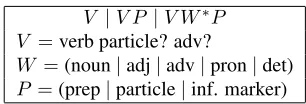
V |V P |V W∗P
V =verb particle? adv?
W =(noun|adj|adv|pron|det)
[image:4.612.108.261.69.121.2]P =(prep|particle|inf. marker)
Figure 1: A simple part-of-speech-based regular expres-sion reduces the number of incoherent extractions like
was central torpedo and covers relations expressed via light verb constructions likegave a talk at.
The syntactic constraint requires the relation phrase to match the POS tag pattern shown in Fig-ure 1. The pattern limits relation phrases to be either a verb (e.g.,invented), a verb followed immediately by a preposition (e.g.,located in), or a verb followed by nouns, adjectives, or adverbs ending in a preposi-tion (e.g.,has atomic weight of). If there are multiple possible matches in a sentence for a single verb, the longest possible match is chosen. Finally, if the pat-tern matches multiple adjacent sequences, we merge them into a single relation phrase (e.g.,wants to ex-tend). This refinement enables the model to readily handle relation phrases containing multiple verbs. A consequence of this pattern is that the relation phrase must be a contiguous span of words in the sentence. The syntactic constraint eliminates the incoherent relation phrases returned by existing systems. For example, given the sentence
Extendicare agreed to buy Arbor Health Care for about US$432million in cash and assumed debt.
TEXTRUNNERreturns the extraction (Arbor Health Care, for assumed, debt).
The phrasefor assumed is clearly not a valid rela-tion phrase: it begins with a preposirela-tion and splices together two distant words in the sentence. The syn-tactic constraint prevents this type of error by sim-ply restricting relation phrases to match the pattern in Figure 1.
The syntactic constraint reduces uninformative extractions by capturing relation phrases expressed via LVCs. For example, the POS pattern matched against the sentence “Faust made a deal with the Devil,” would result in the relation phrase made a
deal with, instead of the uninformativemade.
Finally, we require the relation phrase to appear between its two arguments in the sentence. This is a common constraint that has been implicitly enforced in other open extractors.
3.2 Lexical Constraint
While the syntactic constraint greatly reduces unin-formative extractions, it can sometimes match rela-tion phrases that are so specific that they have only a few possible instances, even in a Web-scale corpus. Consider the sentence:
The Obama administration is offering only modest greenhouse gas reduction targets at the conference.
The POS pattern will match the phrase:
is offering only modest greenhouse gas reduction targets at (1) Thus, there are phrases that satisfy the syntactic con-straint, but are not relational.
To overcome this limitation, we introduce a lexi-cal constraint that is used to separate valid relation phrases from overspecified relation phrases, like the example in (1). The constraint is based on the in-tuition that a valid relation phrase should take many distinct arguments in a large corpus. The phrase in (1) is specific to the argument pair(Obama
admin-istration, conference), so it is unlikely to represent a
bona fiderelation. We describe the implementation
details of the lexical constraint in Section 4.
3.3 Limitations
Our constraints represent an idealized model of re-lation phrases in English. This raises the question: How much recall is lost due to the constraints?
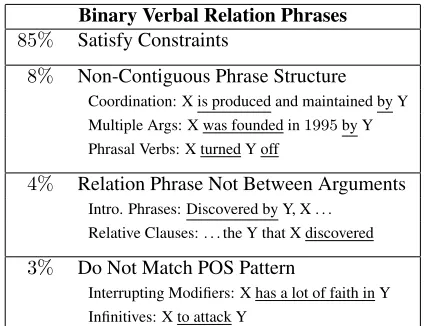
To address this question, we analyzed Wu and Weld’s set of 300 sentences from a set of random Web pages, manually identifying all verb-based re-lationships between noun phrase pairs. This resulted in a set of 327 relation phrases. For each rela-tion phrase, we checked whether it satisfies our con-straints. We found that85%of the relation phrases do satisfy the constraints. Of the remaining 15%, we identified some of the common cases where the constraints were violated, summarized in Table 3.
Binary Verbal Relation Phrases 85% Satisfy Constraints
8% Non-Contiguous Phrase Structure
Coordination: X is produced and maintained by Y Multiple Args: X was founded in1995by Y Phrasal Verbs: X turned Y off
4% Relation Phrase Not Between Arguments
Intro. Phrases: Discovered by Y, X . . . Relative Clauses: . . . the Y that X discovered
3% Do Not Match POS Pattern
[image:5.612.79.291.70.233.2]Interrupting Modifiers: X has a lot of faith in Y Infinitives: X to attack Y
Table 3: Approximately85%of the binary verbal relation phrases in a sample of Web sentences satisfy our con-straints.
terms of dependency parse features that would cap-ture the non-contiguous relation phrases in Table 3. Previous work has shown that dependency paths do indeed boost the recall of relation extraction systems (Wu and Weld, 2010; Mintz et al., 2009). While us-ing dependency path features allows for a more flex-ible model of relations, it significantly increases pro-cessing time, which is problematic for Web-scale ex-traction. Further, we have found that this increased recall comes at the cost of lower precision on Web text (see Section 5).
The results in Table 3 are similar to Banko and Et-zioni’s findings that a set of eight POS patterns cover a large fraction of binary verbal relation phrases. However, their analysis was based on a set of sen-tences known to contain either a company acquisi-tion or birthplace relaacquisi-tionship, while our results are on a random sample of Web sentences. We applied Banko and Etzioni’s verbal patterns to our random sample of300Web sentences, and found that they cover approximately69%of the relation phrases in the corpus. The gap in recall between this and the 85%shown in Table 3 is largely due to LVC relation phrases (made a deal with) and phrases containing multiple verbs (refuses to return to), which their pat-terns do not cover.
In sum, our model is by no means complete. However, we have empirically shown that the ma-jority of binary verbal relation phrases in a sample of Web sentences are captured by our model. By focusing on this subset of language, our model can
be used to perform Open IE at significantly higher precision than before.
4 REVERB
This section introduces REVERB, a novel open ex-tractor based on the constraints defined in the previ-ous section. REVERBfirst identifies relation phrases that satisfy the syntactic and lexical constraints, and then finds a pair of NP arguments for each identified relation phrase. The resulting extractions are then assigned a confidence score using a logistic regres-sion classifier.
This algorithm differs in three important ways from previous methods (Section 2). First, the re-lation phrase is identified “holistically” rather than word-by-word. Second, potential phrases are fil-tered based on statistics over a large corpus (the implementation of our lexical constraint). Finally, REVERB is “relation first” rather than “arguments first”, which enables it to avoid a common error made by previous methods—confusing a noun in the relation phrase for an argument,e.g.the noundealin
made a deal with.
4.1 Extraction Algorithm
REVERB takes as input a POS-tagged and NP-chunked sentence and returns a set of (x, r, y) extraction triples.2 Given an input sentence s,
REVERBuses the following extraction algorithm: 1. Relation Extraction: For each verb v in s,
find the longest sequence of wordsrvsuch that (1)rv starts atv, (2)rv satisfies the syntactic constraint, and (3)rv satisfies the lexical con-straint. If any pair of matches are adjacent or overlap ins, merge them into a single match. 2. Argument Extraction: For each relation
phraser identified in Step 1, find the nearest noun phrasexto the left ofrinssuch thatxis not a relative pronoun, WHO-adverb, or exis-tential “there”. Find the nearest noun phrasey to the right ofrins. If such an(x, y)pair could be found, return(x, r, y)as an extraction. We check whether a candidate relation phrase rv satisfies the syntactic constraint by matching it against the regular expression in Figure 1.
To determine whetherrvsatisfies the lexical con-straint, we use a large dictionary D of relation phrases that are known to take many distinct argu-ments. In an offline step, we construct Dby find-ing all matches of the POS pattern in a corpus of 500million Web sentences. For each matching re-lation phrase, we heuristically identify its arguments (as in Step 2 above). We set Dto be the set of all relation phrases that take at leastkdistinct argument pairs in the set of extractions. In order to allow for minor variations in relation phrases, we normalize each relation phrase by removing inflection, auxil-iary verbs, adjectives, and adverbs. Based on ex-periments on a held-out set of sentences, we found that a value of k = 20works well for filtering out overspecified relations. This results in a set of ap-proximately1.7million distinct normalized relation phrases, which are stored in memory at extraction time.
As an example of the extraction algorithm in ac-tion, consider the following input sentence:
Hudson was born in Hampstead, which is a suburb of London.
Step 1 of the algorithm identifies three relation phrases that satisfy the syntactic and lexical con-straints: was, born in, andis a suburb of. The first two phrases are adjacent in the sentence, so they are merged into the single relation phrasewas born in. Step 2 then finds an argument pair for each relation phrase. Forwas born in, the nearest NPs are
(Hud-son, Hampstead). Foris a suburb of, the extractor
skips over the NPwhichand chooses the argument
pair(Hampstead, London). The final output is
e1:(Hudson, was born in, Hampstead)
e2:(Hampstead, is a suburb of, London). 4.2 Confidence Function
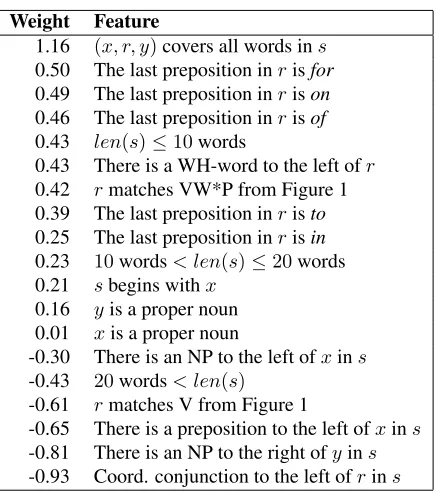
The extraction algorithm in the previous section has high recall, but low precision. Like with previous open extractors, we want way to trade recall for pre-cision by tuning a confidence threshold. We use a logistic regression classifier to assign a confidence score to each extraction, which uses the features shown in Table 4. All of these features are efficiently computable and relation independent. We trained the confidence function by manually labeling the ex-tractions from a set of1,000sentences from the Web and Wikipedia as correct or incorrect.
Weight Feature
1.16 (x, r, y)covers all words ins
0.50 The last preposition inrisfor
0.49 The last preposition inrison
0.46 The last preposition inrisof
0.43 len(s)≤10words
0.43 There is a WH-word to the left ofr
0.42 rmatches VW*P from Figure 1
0.39 The last preposition inristo
0.25 The last preposition inrisin
0.23 10words< len(s)≤20words 0.21 sbegins withx
0.16 yis a proper noun
0.01 xis a proper noun
-0.30 There is an NP to the left ofxins
-0.43 20words< len(s) -0.61 rmatches V from Figure 1
-0.65 There is a preposition to the left ofxins
-0.81 There is an NP to the right ofyins
[image:6.612.319.538.67.313.2]-0.93 Coord. conjunction to the left ofrins
Table 4: REVERBuses these features to assign a
confi-dence score to an extraction(x, r, y)from a sentences
using a logistic regression classifier.
Previous open extractors require labeled training data to learn a model of relations, which is then used to extract relation phrases from text. In contrast, REVERBuses a specified model of relations for ex-traction, and requires labeled data only for assigning confidence scores to its extractions. Learning a con-fidence function is a much simpler task than learning a full model of relations, using two orders of magni-tude fewer training examples than TEXTRUNNERor WOE.
4.3 TEXTRUNNER-R
The model of relation phrases used by REVERB is specified, but could a TEXTRUNNER-like sys-tem learn this model from training data? While it is difficult to answer such a question for all possible permutations of features sets, training ex-amples, and learning biases, we demonstrate that TEXTRUNNERitself cannot learn REVERB’s model even when re-trained using the output of REVERB as labeled training data. The resulting system, TEXTRUNNER-R, uses the same feature representa-tion as TEXTRUNNER, but different parameters, and a different set of training examples.
on the Penn Treebank, which is the same dataset that TEXTRUNNER is trained on. To generate neg-ative instances from a sentence, we took each noun phrase pair in the sentence that does not appear as arguments in a REVERB extraction. This process resulted in a set of 67,562 positive instances, and 356,834negative instances. We then passed these labeled examples to TEXTRUNNER’s training proce-dure, which learns a linear-chain CRF using closed-class features like POS tags, capitalization, punctu-ation, etc.TEXTRUNNER-R uses the argument-first extraction algorithm described in Section 2.
5 Experiments
We compare REVERBto the following systems:
• REVERB¬lex- The REVERBsystem described in the previous section, but without the lexical constraint. REVERB¬lex uses the same confi-dence function as REVERB.
• TEXTRUNNER- Banko and Etzioni’s 2008
ex-tractor, which uses a second order linear-chain CRF trained on extractions heuristically gener-ated from the Penn Treebank. TEXTRUNNER uses shallow linguistic features in its CRF, which come from the same POS tagger and NP-chunker that REVERBuses.
• TEXTRUNNER-R - Our modification to TEXTRUNNER, which uses the same extrac-tion code, but with a model of relaextrac-tions trained on REVERBextractions.
• WOEpos - Wu and Weld’s modification to TEXTRUNNER, which uses a model of re-lations learned from extractions heuristically generated from Wikipedia.
• WOEparse - Wu and Weld’s parser-based ex-tractor, which uses a large dictionary of depen-dency path patterns learned from heuristic ex-tractions generated from Wikipedia.
Each system is given a set of sentences as input, and returns a set of binary extractions as output. We created a test set of500sentences sampled from the Web, using Yahoo’s random link service.3After
run-3http://random.yahoo.com/bin/ryl
REVERB REVERB WOE TEXT- WOE TEXT
-0.0 0.1 0.2 0.3 0.4 0.5
Area
Under
PR
Curve
¬lex parse RUNNER-R pos RUNNER REVERB REVERB WOE TEXT- WOE TEXT
-0.0 0.1 0.2 0.3 0.4 0.5
Area
Under
PR
Curve
¬lex parse RUNNER-R pos RUNNER
Figure 2: REVERB outperforms state-of-the-art open
extractors, with an AUC more than twice that of TEXTRUNNER or WOEpos, and 38% higher than WOEparse.
0.0 0.1 0.2 0.3 0.4 0.5 0.6
Recall
0.0 0.2 0.4 0.6 0.8 1.0
Precision
Comparison of REVERB-Based Systems
REVERB REVERB¬lex TEXTRUNNER-R
0.0 0.1 0.2 0.3 0.4 0.5 0.6
Recall
0.0 0.2 0.4 0.6 0.8 1.0
Precision
Comparison of REVERB-Based Systems
REVERB REVERB¬lex TEXTRUNNER-R
Figure 3: The lexical constraint gives REVERB
a boost in precision and recall over REVERB¬lex.
TEXTRUNNER-R is unable to learn the model used by
REVERB, which results in lower precision and recall.
ning each extractor over the input sentences, two hu-man judges independently evaluated each extraction as correct or incorrect. The judges reached agree-ment on86%of the extractions, with an agreement score ofκ = 0.68. We report results on the subset of the data where the two judges concur.
The judges labeled uninformative extractions con-servatively. That is, if critical information was dropped from the relation phrase but included in the second argument, it is labeled correct. For example, both the extractions(Ackerman, is a professor of,
bi-ology)and(Ackerman, is, a professor of biology)are
considered correct.
[image:7.612.316.542.238.401.2]0.0 0.1 0.2 0.3 0.4 0.5 0.6 0.7
Recall
0.0 0.2 0.4 0.6 0.8 1.0
Precision
Extractions
REVERB WOEparse WOEpos TEXTRUNNER
0.0 0.1 0.2 0.3 0.4 0.5 0.6 0.7
Recall
0.0 0.2 0.4 0.6 0.8 1.0
Precision
Extractions
[image:8.612.316.535.73.236.2]REVERB WOEparse WOEpos TEXTRUNNER
Figure 4: REVERB achieves significantly higher
preci-sion than state-of-the-art Open IE systems, and compara-ble recall toWOEparse.
the corpus that are returned. We use the total num-ber of extractions labeled as correct by the judges as our measure of recall for the corpus. In order to avoid double-counting, we treat extractions that dif-fer superficially (e.g., different punctuation or drop-ping inessential modifiers) as a single extraction. We compute a precision-recall curve by varying the con-fidence threshold, and then compute the area under the curve (AUC).
5.1 Results
Figure 2 shows the AUC of each system. REVERB achieves an AUC that is30%higher thanWOEparse and is more than double the AUC of WOEpos or TEXTRUNNER. The lexical constraint provides a significant boost in performance, with REVERB achieving an AUC 23% higher than REVERB¬lex. REVERB proves to be a useful source of train-ing data, with TEXTRUNNER-R havtrain-ing an AUC 71% higher than TEXTRUNNER and performing on par with WOEpos. From the training data, TEXTRUNNER-R was able to learn a model that predicts contiguous relation phrases, but still re-turned incoherent relation phrases (e.g., starting with a preposition) and overspecified relation phrases. These errors are due to TEXTRUNNER-R overfitting the training data and not having access to the lexical constraint.
Figure 3 shows the precision-recall curves of the systems introduced in this paper. TEXTRUNNER-R has much lower precision than REVERB and
0.0 0.1 0.2 0.3 0.4 0.5 0.6 0.7
Recall
0.0 0.2 0.4 0.6 0.8 1.0
Precision
Relations Only
REVERB WOEparse WOEpos TEXTRUNNER
0.0 0.1 0.2 0.3 0.4 0.5 0.6 0.7
Recall
0.0 0.2 0.4 0.6 0.8 1.0
Precision
Relations Only
REVERB WOEparse WOEpos TEXTRUNNER
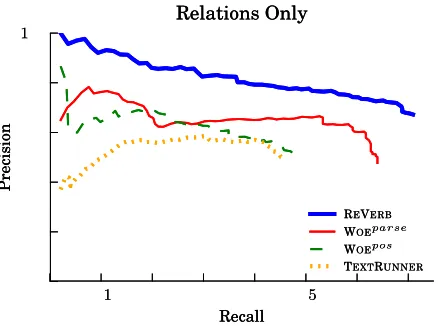
Figure 5: On the subtask of identifying relations phrases, REVERBis able to achieve even higher precision and
re-call than other systems.
REVERB¬lex at all levels of recall. The lexi-cal constraint gives REVERB a boost in precision over REVERB¬lex, reducing overspecified extrac-tions from 20%of REVERB¬lex’s output to1%of REVERB’s. The lexical constraint also boosts recall over REVERB¬lex, since REVERB is able to find a correct relation phrase where REVERB¬lexfinds an overspecified one.
Figure 4 shows the precision-recall curves of REVERB and the external systems. REVERB has much higher precision than the other systems at nearly all levels of recall. In particular, more than 30% of REVERB’s extractions are at precision 0.8 or higher, compared to virtually none for the other systems. WOEparseachieves a slightly higher recall than REVERB (0.62versus0.64), but at the cost of lower precision.
In order to highlight the role of the relational model of each system, we also evaluate their per-formance on the subtask of extracting just the rela-tion phrases from the input text. Figure 5 shows the precision-recall curves for each system on the rela-tion phrase-only evaluarela-tion. In this case, REVERB has both higher precision and recall than the other systems.
[image:8.612.74.294.76.236.2]REVERB- Incorrect Extractions
65% Correct relation phrase, incorrect arguments 16% N-ary relation
8% Non-contiguous relation phrase 2% Imperative verb
2% Overspecified relation phrase
7% Other, including POS/chunking errors
Table 5: The majority of the incorrect extractions re-turned by REVERBare due to errors in argument
extrac-tion.
extractions had a smaller effect on other systems’ precision, accounting for4%ofWOEparse’s extrac-tions,5%ofWOEpos’s, and7%of TEXTRUNNER’s, while only appearing in 1% of REVERB’s tions. REVERB’s reduction in uninformative extrac-tions resulted in a boost in recall, capturing many LVC relation phrases missed by other systems (like those shown in Table 2).
To test the systems’ speed, we ran each extrac-tor on a set of 100,000 sentences using a Pen-tium 4 machine with 4GB of RAM. The process-ing times were 16 minutes for REVERB, 21 min-utes for TEXTRUNNER,21minutes forWOEpos, and 11 hours for WOEparse. The times for REVERB, TEXTRUNNER, and WOEpos are all approximately the same, since they all use the same POS-tagging and NP-chunking software. WOEparse processes each sentence with a dependency parser, resulting in much longer processing time.
5.2 REVERBError Analysis
To better understand the limitations of REVERB, we performed a detailed analysis of its errors in pre-cision (incorrect extractions returned by REVERB) and its errors in recall (correct extractions that REVERBmissed).
Table 5 summarizes the types of incorrect extrac-tions that REVERB returns. We found that65% of the incorrect extractions returned by REVERBwere cases where a relation phrase was correctly identi-fied, but the argument-finding heuristics failed. The remaining errors were cases where REVERB ex-tracted an incorrect relation phrase. One common mistake that REVERB made was extracting a rela-tion phrase that expresses an n-ary relarela-tionship via a ditransitive verb. For example, given the sentence
REVERB- Missed Extractions
52% Could not identify correct arguments 23% Relation filtered out by lexical constraint 17% Identified a more specific relation
8% POS/chunking error
Table 6: The majority of extractions that were missed by REVERB were cases where the correct relation phrase was found, but the arguments were not correctly identi-fied.
“I gave him15 photographs,” REVERB extracts(I,
gave, him). These errors are due to the fact that
REVERBonly models binary relations.
Table 6 summarizes the correct extractions that were extracted by other systems and were not tracted by REVERB. As with the false positive ex-tractions, the majority of false negatives (52%) were due to the argument-finding heuristics choosing the wrong arguments, or failing to extract all possible ar-guments (in the case of coordinating conjunctions). Other sources of failure were due to the lexical con-straint either failing to filter out an overspecified re-lation phrase or filtering out a valid rere-lation phrase. These errors hurt both precision and recall, since each case results in the extractor overlooking a cor-rect relation phrase and choosing another.
5.3 Evaluation At Scale
Section 5.1 shows that REVERB outperforms ex-isting Open IE systems when evaluated on a sam-ple of sentences. Previous work has shown that the frequency of an extraction in a large corpus is useful for assessing the correctness of extractions (Downey et al., 2005). Thus, it is possible a pri-orithat REVERB’s gains over previous systems will diminish when extraction frequency is taken into ac-count.
In fact, we found that REVERB’s advantage over TEXTRUNNER when run at scale is qualitatively similar to its advantage on single sentences. We ran both REVERBand TEXTRUNNERon Banko and Et-zioni’s corpus of500million Web sentences and ex-amined the effect of redundancy on precision.
TEXTRUNNER at all frequency thresholds. In fact, REVERB’s frequency 1 extractions had a precision of 0.75, which TEXTRUNNER could not approach even with frequency 10 extractions, which had a precision of0.34. Thus, REVERBis able to return more correct extractions at a higher precision than TEXTRUNNER, even when redundancy is taken into account.
6 Conclusions and Future Work The paper’s contributions are as follows:
• We have identified and analyzed the problems
of incoherent and uninformative extractions for Open IE systems, and shown their prevalence for systems such as TEXTRUNNERandWOE.
• We articulated general, easy-to-enforce
con-straints on binary, verb-based relation phrases in English that ameliorate these problems and yield richer and more informative relations (see, for example, Table 2).
• Based on these constraints, we designed, im-plemented, and evaluated the REVERB extrac-tor, which substantially outperforms previous Open IE systems in both recall and precision.
• We make REVERB and the data used in our experiments available to the research commu-nity.4
In future work, we plan to explore utilizing our constraints to improve the performance of learned CRF models. Rothet al.have shown how to incor-porate constraints into CRF learners (Roth and Yih, 2005). It is natural, then, to consider whether the combination of heuristically labeled training exam-ples, CRF learning, and our constraints will result in superior performance. The error analysis in Sec-tion 5.2 also suggests natural direcSec-tions for future work. For instance, since many of REVERB’s errors are due to incorrect arguments, improved methods for argument extraction are in order.
Acknowledgments
We would like to thank Mausam, Dan Weld, Yoav Artzi, Luke Zettlemoyer, members of the KnowItAll
4http://reverb.cs.washington.edu
group, and the anonymous reviewers for their help-ful comments. This research was supported in part by NSF grant IIS-0803481, ONR grant N00014-08-1-0431, and DARPA contract FA8750-09-C-0179, and carried out at the University of Washington’s Turing Center.
References
David J. Allerton. 2002.Stretched Verb Constructions in English. Routledge Studies in Germanic Linguistics. Routledge (Taylor and Francis), New York.
Collin F. Baker, Charles J. Fillmore, and John B. Lowe. 1998. The berkeley framenet project. InProceedings of the 17th international conference on Computational linguistics, pages 86–90.
Michele Banko and Oren Etzioni. 2008. The tradeoffs between open and traditional relation extraction. In
Proceedings of ACL-08: HLT, pages 28–36, Colum-bus, Ohio, June. Association for Computational Lin-guistics.
Michele Banko, Michael J. Cafarella, Stephen Soderland, Matt Broadhead, and Oren Etzioni. 2007. Open infor-mation extraction from the web. InIn the Proceedings of the 20th International Joint Conference on Artificial Intelligence, pages 2670–2676, January.
Jonathan Berant, Ido Dagan, and Jacob Goldberger. 2011. Global learning of typed entailment rules. In
Proceedings of ACL, Portland, OR.
Janara Christensen, Mausam, Stephen Soderland, and Oren Etzioni. 2010. Semantic role labeling for open information extraction. In Proceedings of the NAACL HLT 2010 First International Workshop on Formalisms and Methodology for Learning by Read-ing, FAM-LbR ’10, pages 52–60, Stroudsburg, PA, USA. Association for Computational Linguistics. Doug Downey, Oren Etzioni, and Stephen Soderland.
2005. A probabilistic model of redundancy in infor-mation extraction. InIJCAI, pages 1034–1041. Gregory Grefenstette and Simone Teufel. 1995.
Corpus-based method for automatic identification of support verbs for nominalizations. InProceedings of the sev-enth conference on European chapter of the Associa-tion for ComputaAssocia-tional Linguistics, pages 98–103, San Francisco, CA, USA. Morgan Kaufmann Publishers Inc.
Holmer Hemsen Kathrin Eichler and Gnter Neu-mann. 2008. Unsupervised relation extraction from web documents. In LREC. http://www.lrec-conf.org/proceedings/lrec2008/.
J. Kim and D. Moldovan. 1993. Acquisition of semantic patterns for information extraction from corpora. In
Procs. of Ninth IEEE Conference on Artificial Intelli-gence for Applications, pages 171–176.
Dekang Lin and Patrick Pantel. 2001. DIRT-Discovery of Inference Rules from Text. In Proceedings of ACM Conference on Knowledge Discovery and Data Mining(KDD-01), pages pp. 323–328.
Thomas Lin, Mausam, and Oren Etzioni. 2010. Identify-ing Functional Relations in Web Text. InProceedings of the 2010 Conference on Empirical Methods in Nat-ural Language Processing, pages 1266–1276, Cam-bridge, MA, October. Association for Computational Linguistics.
Paul Kingsbury Martha and Martha Palmer. 2002. From treebank to propbank. In In Proceedings of LREC-2002.
Mike Mintz, Steven Bills, Rion Snow, and Dan Jurafsky. 2009. Distant supervision for relation extraction with-out labeled data. In ACL-IJCNLP ’09: Proceedings of the Joint Conference of the 47th Annual Meeting of the ACL and the 4th International Joint Conference on Natural Language Processing of the AFNLP: Volume 2, pages 1003–1011, Morristown, NJ, USA. Associa-tion for ComputaAssocia-tional Linguistics.
V. Punyakanok, D. Roth, and W. Yih. 2008. The impor-tance of syntactic parsing and inference in semantic role labeling. Computational Linguistics, 34(2). E. Riloff. 1996. Automatically constructing extraction
patterns from untagged text. In Procs. of the Thir-teenth National Conference on Artificial Intelligence (AAAI-96), pages 1044–1049.
Alan Ritter, Mausam, and Oren Etzioni. 2010. A La-tent Dirichlet Allocation Method for Selectional Pref-erences. InACL.
Dan Roth and Wen-tau Yih. 2005. Integer linear pro-gramming inference for conditional random fields. In
Proceedings of the 22nd international conference on Machine learning, ICML ’05, pages 736–743, New York, NY, USA. ACM.
Stefan Schoenmackers, Oren Etzioni, Daniel S. Weld, and Jesse Davis. 2010. Learning first-order horn clauses from web text. In Proceedings of the 2010 Conference on Empirical Methods in Natural Lan-guage Processing, EMNLP ’10, pages 1088–1098, Stroudsburg, PA, USA. Association for Computational Linguistics.
Satoshi Sekine. 2006. On-demand information extrac-tion. In Proceedings of the COLING/ACL on Main
conference poster sessions, pages 731–738, Morris-town, NJ, USA. Association for Computational Lin-guistics.
Yusuke Shinyama and Satoshi Sekine. 2006. Preemp-tive Information Extraction using Unrestricted Rela-tion Discovery. In Proceedings of the Human Lan-guage Technology Conference of the NAACL, Main Conference, pages 304–311, New York City, USA, June. Association for Computational Linguistics. Stephen Soderland, Brendan Roof, Bo Qin, Shi Xu,
Mausam, and Oren Etzioni. 2010. Adapting open in-formation extraction to domain-specific relations. AI Magazine, 31(3):93–102.
S. Soderland. 1999. Learning Information Extraction Rules for Semi-Structured and Free Text. Machine Learning, 34(1-3):233–272.
Lucia Specia and Enrico Motta. 2006. M.: A hybrid approach for extracting semantic relations from texts. InIn. Proceedings of the 2 nd Workshop on Ontology Learning and Population, pages 57–64.
Suzanne Stevenson, Afsaneh Fazly, and Ryan North. 2004. Statistical measures of the semi-productivity of light verb constructions. In2nd ACL Workshop on Multiword Expressions, pages 1–8.
M. Stevenson. 2004. An unsupervised WordNet-based algorithm for relation extraction. In Proceedings of the “Beyond Named Entity” workshop at the Fourth International Conference on Language Resources and Evalutaion (LREC’04).
Kristina Toutanova, Aria Haghighi, and Christopher D. Manning. 2008. A global joint model for semantic role labeling. Computational Linguistics, 34(2):161– 191.
Fei Wu and Daniel S. Weld. 2010. Open information ex-traction using Wikipedia. InProceedings of the 48th Annual Meeting of the Association for Computational Linguistics, ACL ’10, pages 118–127, Morristown, NJ, USA. Association for Computational Linguistics. Jun Zhu, Zaiqing Nie, Xiaojiang Liu, Bo Zhang, and