Proceedings of NAACL-HLT 2019, pages 1041–1051 1041
Word-Node2Vec: Improving Word Embedding with Document-Level
Non-Local Word Co-occurrences
Procheta Sen1
Debasis Ganguly2 [email protected]
Gareth J.F. Jones1 [email protected]
1 ADAPT Centre, School of Computing, Dublin City University, Dublin, Ireland 2 IBM Research, Dublin, Ireland
Abstract
Standard word embedding algorithms, such as word2vec and Glove, make a restric-tive assumption that words are likely to be semantically related only if they co-occur lo-cally within a window of fixed size. How-ever, this restrictive assumption may not cap-ture the semantic association between words that co-occur frequently but non-locally within
documents. To alleviate this restriction, in
this paper, we propose a graph-based word embedding method, named ‘word-node2vec’. By relaxing the strong constraint of local-ity, our method is able to capture both
lo-cal and non-lolo-cal co-occurrences.
Word-node2vec constructs a weighted graph, where each node represents a word and the weight of an edge between two nodes represents a
com-bination of both local (e.g. word2vec) and
document-level co-occurrences. Our experi-ments show that word-node2vec outperforms word2vec and glove on a range of different tasks, such as word-pair similarity prediction, word analogy and concept categorization.
1 Introduction
Word embedding, the process of obtaining vec-tor representations of words, is a first step towards addressing language semantics, in which discrete entities, such as words, are embedded as vectors over a continuous space of reals. This not only facilitates to obtain semantic similarities between words to improve tasks such as semantic search (Ganguly et al.,2015;Roy et al.,2016), but is also useful in a number of down-stream NLP tasks in-cluding concept categorization (Jastrzebski et al., 2017), information retrieval (Guo et al., 2016), sentence similarity prediction (Mueller and Thya-garajan,2016), sentiment analysis (Faruqui et al., 2015) and POS tagging (Tsvetkov et al.,2016) etc. Word embedding approaches such as
word2vec (Mikolov et al., 2013a) and Glove
(Pennington et al.,2014) rely on a large corpus to learn the association between words. The archi-tecture of existing word embedding approaches mimics the process of human cognition of word association by learning the representation of each word with an objective of maximizing the likelihood of predicting the words around itslocal
context (defined by a fixed length word window). A limitation of existing word embedding ap-proaches, such as word2vec and glove, is that they use a strong constraint that words are likely to be semantically related to each other only if one occurs within a local context of the another, where the local context is given by a word window of specified length.
On the other hand, non-local or document-level co-occurrences between words have been widely used to estimate semantic similarities between words. More specifically, the latent semantic anal-ysis (LSA) method proposed byDeerwester et al. (1990) uses a spectral analysis (method of prin-cipal component analysis) of the term-document matrix of a collection to obtain the most informa-tive concepts (word classes), and then expresses each document as a linear combination of these principal components. Blei et al. (2003) esti-mate a generative model from a given collec-tion by assuming that documents are mixtures of a preset number of topics, where each topic represents a word distribution over the vocabu-lary. This is largely similar to decomposing a term-document matrix as a product of matrices with non-negative components, a process com-monly known as non-negative matrix factorization (NMF) (Gaussier and Goutte,2005). The underly-ing common idea among all these approaches is to make use of the frequent document-level word co-occurrences to identify likely semantic association between words.
lit-erature on document-level (non-local) word co-occurrences, word embedding approaches do not utilize this information to derive the word repre-sentations. In this paper, we propose to augment the document-level non-local word co-occurrence information with the local co-occurrence informa-tion that methods such as word2vec and glove use. More specifically, we propose a graph-based word embedding method, named word-node2vec, that by relaxing the strong constraint of locality, is able to capture both the local and non-local co-occurrences. To represent the local dependen-cies, each node, representative of a word (hence the name ‘word-node’), is initialized with a vector representation obtained with a standard method, e.g. word2vec. We then define the weight of the edge between a pair of word-nodes to reflect their likelihood of non-local co-occurrence, computed with the help of the global term-document matrix for the whole collection.
The rest of the paper is organized as follows. In Section 2, we survey existing literature on word embedding. In Section3, we revisit the skip-gram approach and propose a graph-based view of the skip-gram objective as a pre-cursor to developing our model. In Section4, we extend the skip-gram graph model with non-local document-level co-occurrence information. Section 5 describes our experimental setup. Section 6 reports the results of our new embedding approach against a number of baselines. Finally, Section7concludes the pa-per with directions for future work.
2 Related Work
The word2vec (Mikolov et al.,2013a) embedding model shifts a window of a predefined size (a pa-rameter) across the text of a collection of docu-ments in order to train a linear classifier for each word to predict itself given its context (continu-ous bag-of-words), or its context given the word (skip-gram). The parameter vector transforming a word to its context (or vice-versa) gives its em-bedded representation. In addition to making use of the words in the context as positive samples, word2vec also relies on the use of words randomly sampled from the collection (outside the current context) as negative examples. Levy and Gold-berg (2014) showed that the negative sampling based skip-gram (SGNS) objective function of
word2vec is mathematically equivalent to fac-torizing a positive point-wise mutual information
gain (PPMI) matrix shifted bylog(k), wherekis the number of negative samples.
The key idea behind the glove algorithm pro-posed in (Pennington et al.,2014) is to make use of the ratio of the co-occurrence probabilities be-tween word pairs to better distinguish semanti-cally related words from non-related ones. The study ultimately shows that factorizing the log of the co-occurrence matrix leads to effective embed-ded representation of words. The co-occurrences in both word2vec and glove are essentially local in nature. In contrast, our proposed algorithm lever-ages both local and non-local co-occurrences.
More recently, Peters et al. (2018) proposed
ELMO, a deep contextualized word representation with layers of stacked bi-directional LSTMs to model both a) complex characteristics of word use (e.g., syntax and semantics), and b) their diver-sity across various linguistic contexts. A limita-tion of ELMO is that a word representalimita-tion may effectively be learned mainly in the presence of an associated context, as a result of which the method is likely to find applications mostly in downstream tasks, e.g. question answering and sentiment anal-ysis. However, in contrast, our proposed method can learn the representation of a word in isolation, which means that, similar to word2vec and Glove, word vectors obtained using our method can be ap-plied directly to (and is also likely to work well for) word similarity and word analogy tasks. We included ELMO as of our baseline approaches in our experiments.
3 Generalized Word Embedding
In this section, we propose a general word embed-ding framework based on the skip-gram objective function of word2vec. Our proposed method relies on a general construction of thecontext around a word. We modify the skip-gram objective function of word2vec to take into account this general con-text of words. Before describing our proposed ap-proach, we revisit the objective function of nega-tive sampling based skip-gram word2vec (SGNS).
Skip-gram. In word2vec, the context of a word comprises words occurring within a window of a fixed size (say k) pivoted at a particular instance of w in the collection. More formally, letΛ(w)
denote the set of indexes where the wordwoccurs in a collectionC ={t1, . . . , tT},T denoting the
total number of tokens in the collectionC, i.e.
Λ(w) ={i:ti=w}. (1)
We then construct the contextc(w)of a word as
c(w) =∪i∈Λ(w)∪kj=−k
j6=0
ti+j (2)
LetΩdenote the set of all observed word-context pairs(w, c(w)), i.e.
Ω+ =∪w∈V{w, c(w)}, (3)
whereV denotes the vocabulary set, andΩ− de-note the set of negative samples of word-context pairs, i.e.
Ω−=∪w∈V{w,∪{v:v∼(V −c(w))}}, (4)
where wordsv’s in the negative context set are ran-domly sampled from the complement setc(w).
Letybe an indicator random variable denoting semantic relatedness of a word with its context. For a wordw and its contextc(w) (as defined in Equation 2, the SGNS algorithm seeks to maxi-mize the objective function
J(θ) = X w,c(w)∈Ω+
p(y= 1|w,cw)+
X
w,c(w)∈Ω−
p(y= 0|w,cw)), (5)
wherep(.)is the log-likelihood function, andθ∈ Rd×|V|represents the trainable matrix of parame-ters, eachddimensional column vector of the ma-trixθ denoting the vector representation of word
w, i.e. w = θw. Note that the vector for a set of
context wordsc(w)is obtained by some aggrega-tion funcaggrega-tion (sum or average) over the constituent words, i.e.
c(w) = X
u∈c(w)
u. (6)
In order to optimize J(θ), the word2vec ap-proach shifts a window of size k pivoted around a word w = ti (token positioned at offset i in
the corpus), and applies stochastic gradient de-scent (SGD) to update the parameters for the cor-responding wordwand its context vectorc(w).
A Graph Formulation of SGNS. We now pro-pose a general framework that allows contexts to be defined in a more general way. The solution re-lies on defining a graphG = (V,E), where each node corresponds to a word from the vocabulary of the given collection, i.e.
V ={xw :w∈V}. (7)
In general, an edge (xu, xv) ∈ E represents a
relation between two words u and v of weight
w(xu, xv) ∈ R. For example, in order to define
the context of SGNS (Equation2), the edge set is defined as
E ={(xw, xu) :u∈ ∪i∈Λ(w)∪kj=−k j6=0
ti+j}. (8)
Learning the vector representations for each node of the graph G leads to learning the vec-tor representation for each word, because there is a one-one mapping between the set of nodes V and the set of wordsV (henceforth we refer to a node of this general class of graphs, defined as per Equation 7, as a word-node). The objective of the embedding is to learn vector representations of nodes such that two nodes are close in the em-bedded space if, as per the edge relations of the graph, these nodes are within aκ-adjacency neigh-borhood of each other. Theκ-adjacency neighbor-hood of a graph is the set
Nκ(xw) ={xu∈ V :h(xw, xu)≤κ}, (9)
whereh(u, v)denotes the hop-count or adjacency number between nodesuandv. In the general for-mulation, the set of Nκ(xw), constituting the set
of nodes reachable from paths of length at mostk
embedding of nodexw. This is because these
pos-itive examples seek to make the vector representa-tion ofxw similar to the vector representations of
nodes inNκ(xw). More formally,
Ω+=∪xw∈V{xw, Nκ(xw)},
Ω−=∪xw∈V{xw,∪{xu:u∼ V −Nκ(xw)}}. (10)
Instead of iterating over the words in a corpus, the SGNS equivalent is then achieved by iterating over the set of nodes and maximizing the same objective function of Equation 5 using the defi-nitions of the positive and negative example sets from Equation10. Note that to achieve the SGNS objective the value ofκ is set to 1 in the defini-tion ofΩ+ in Equation10, i.e. the set of context for a word-node comprises one-hop neighbours as defined by the edge relations of Equation8.
4 Extending the Graph Model for Non-Local Co-occurrences
The graph based approach of Section3allows al-ternative ways to define the context and learn the objective function to obtain word-node representa-tions. In this section, we describe how to augment the non-local document-level co-occurrence infor-mation in the graph-based framework.
Co-occurrence Weights. The first step to in-clude non-local co-occurrences is to modify the edge relations of SGNS (Equation 8) to accom-modate weighted document-level co-occurrences. Instead of considering the collection C =
{t1, . . . , tT}as a stream of words, we considerC
as a set ofM documents{Di}Mi=1.
First, we make provision to include weighted edges of the form(xw, xu, ω(xw, xu))in the edge
construction process of Equation 8. The weight
ω(xw, xu) between word-nodes xw andxu is
in-tended to represent a measure of association be-tween these words.
Next, we describe how to compute the non-local co-occurrence weight between a pair of words. First, we compute the co-occurrence probability of two wordswanduas
P(w, u) =
PM
i=1I(w, u, Di) PM
i=1I(w, Di)PMi=1I(u, Di)
, (11)
where the numerator denotes the total number of times that the words w and u co-occur in the
collection of all documents, and the denomina-tor denotes the number of times each occur in-dependently. In our approach, we use a gener-alized form of Equation 11, where analogous to the Jelinek-Mercer smoothing method (Ponte and Croft,1998), we take into account the informative-ness of the co-occurrences by linearly combining the frequencies with the global statistics of inverse collection frequency. More specifically,
Pα(w, u) =αP(w, u) +
(1−α)T2
|Λ(w)||Λ(u)|, (12)
where P(w, u) represents the maximum likeli-hood estimate computed by Equation 11 and the denominator denotes the product of the collection frequencies of the terms (as per the notation of Equation 1). It can be seen that Equation 12 al-lows relative weighting of the term frequency and the informativeness components.
Combination with Local Co-occurrences. The next step in our word-node2vec method is to augment the non-local co-occurrence information computed as per Equation 12 with the local co-occurrence of SGNS as defined in Equation8. For this, analogous to (Pennington et al., 2014), we compute the probability of co-occurrence between a word pair restricted within a window of sizek
over the whole collection. More formally,
Pk(w, u) = 1
|Λ(w)|
X
i∈Λ(w)
I(ti+j =u)kj=−k
(13) Next, we assign weight to an edge by combining the local and non-local co-occurrence probabilities estimated from Equations13and12respectively. Formally speaking,
ω(xw, xu) =Pα(w, u)Pk(w, u). (14)
Context with Weighted Edges. Constructing the context of a node xw (Section 3), requires a
modification aimed to take into account the edge weights while selecting the neighboring nodes of
xw. Instead of defining the context as the entire
set ofκ-neighborhood Nκ(xw)of a nodexw, we
define a κ-neighbourhood of length (hop-count),
l, which is a subset of l samples drawn from the overall neighbourhood.
The likelihood of sampling a nodexu from the
defining the context allows the algorithm to make use of the edge weights (local and non-local co-occurrences) in learning the node representations, i.e. assigning more importance to associations with higher weights in seeking to embed the cur-rent word-node close to them.
Our idea, in general, is to use stratified sam-pling, where each stratum corresponds to a neigh-bourhood of particular length. The priors as-signed to the strata in increasing sequence of ad-jacency length form a decreasing sequence, which means that the most emphasis is put on direct co-occurrence evidence (i.e. the 1-adjacent neighbor-hood), than to the 2-adjacent nodes and so on.
Stratified sampling requires the strata to be mu-tually disjoint of each other. This means that the
κ-neighbourhood of Equation9needs to be rede-fined to ensure that any node belongs to exactly one of the partitions (defined by its hop-count). To state this formally, we define the set of nodes of (not up to) hop-countjas
Hj(xw) =∪{xu:h(xw, xu) =j} (15)
Theκ-neighbourhood is then defined as
Nκ(xw) =∪κj=1(Hj(xw)− ∪jj−10=1Hj0(xw)). (16) A subset of sizel, comprised of stratified samples from Nκ(xw), is then sampled with decreasing
priors β1, . . . , βκ, i.e., βj < βj−1∀j = 2, . . . , κ
andPκ
j=1βj = 1.
Putting things together, the probability of sam-pling a node from the setNκ(xw) defined as per
Equation16is then given by
P(xu|Nκ(xw))=βjP(xu|Hj(xw))=βj
ω(xw, xu)
ω(xw, .)
,
(17) whereω(xw, xu)are edge weights computed with
Equation14andω(xw, .)denotes the sum of edges
emanating from nodexw.
As a point of note, for our experiments, we ob-tained optimal results by using κ = 2. Conse-quently, to simplify the description of our exper-iments, we name the parameterβ1 asβ (the
pa-rameterβ2 is then identical to1−β). We would
also mention at this point that our proposed way of constructing the context by sampling neighbor-ing nodes is different from the one proposed in (Grover and Leskovec,2016), which uses a combi-nation of breadth-first (BFS) and depth-first (DFS) traversals, with parameters p and q respectively.
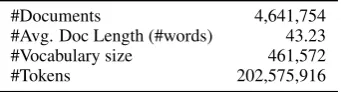
[image:5.595.332.503.63.109.2]#Documents 4,641,754 #Avg. Doc Length (#words) 43.23 #Vocabulary size 461,572 #Tokens 202,575,916
Table 1: Dataset characteristics of DBPedia-2014.
Our experiments reveal that our sampling strategy outperforms that ofGrover and Leskovec (2016) (treated as a baseline).
5 Experimental Setup
In this section, we describe our experimental setup to evaluate our new word embedding method.
5.1 Dataset
A word embedding algorithm requires a collec-tion to learn word representacollec-tions. To compare the various word embedding approaches (i.e. our method and the baselines), we use the DBPedia (2014) corpus, which is a collection of abstracts of Wikipedia pages crawled in 20141. Dataset char-acteristics are outlined in Table1. As part of pre-processing, we removed words with collection fre-quency less than10and also removed stopwords2.
5.2 Baselines and Implementation
The objective of our experiments is two-fold. First, to show that a combination of local and global approaches is likely to yield effective em-bedded representations of word vectors, and sec-ond that our proposed graph-based formalism is likely to work better than a trivial black-box way of combining the two sources of information.
Local Co-occurrence approaches. As ap-proaches that use local co-occurrence infor-mation, we use three state-of-the-art embedding approaches namely skip-gram word2vec with neg-ative sampling (SGNS) (Mikolov et al., 2013a), Glove (Pennington et al., 2014) and Fasttext (Joulin et al.,2016). All these methods rely only on co-occurrences (at the level of words for the first two and at the level of character n-grams for the last one) within a word or character n-gram window of specified lengthk(acting as a param-eter). Fasttext learns the vector representation of each word by aggregating (vector sum) the vector representations of its constituent n-grams.
1
http://downloads.dbpedia.org/2014/en/ long_abstracts_en.ttl.bz2
Additionally, we also employ a more recent approach, namely ELMO (Peters et al., 2018), which relies on a pre-trained model (comprised of stacked bidirectional LSTMs) to infer vectors for a given context (typically a sequence of words). For our experiments,
Document-level Co-occurrence approaches. Although not an embedding approach, the LDA topic modeling algorithm outputs two matrices, namely θ ∈ RM×dandφ ∈
Rd×V, representing the document-topic and topic-words distribu-tion respectively (Blei et al., 2003). LDA uses document-level word co-occurrences to estimate both these matrices. In principle, one can then use theφmatrix as a substitute for the word em-bedding parameter matrix of SGNS (see Equation 5). This gives d dimensional vectors for each word purely with a global co-occurrence based approach.
Although it is possible to choose other non-local co-occurrence approaches as baselines, e.g. PLSA (Hofmann, 1999) or LSA, (Deerwester et al., 1990), it was shown in (Blei et al.,2003) that LDA outperforms each of these. Consequently, we use the stronger baseline of LDA in our experiments.
Combination of Local and Non-local Co-occurrences. To empirically demonstrate the ef-fectiveness of our proposed graph-based word-node embedding, we employ an additional base-line that is a base-linear combination of the word vec-tors obtained individually with the local and non-local approaches. More formally, the vector of each wordwis given as
w=λwLocal+ (1−λ)wLDA, (18)
wherewLocalis the vector representation of word
wobtained by a local co-occurrence baseline, i.e. SGNS and Glove, whereas wLDA represents the
vector for the wordwobtained with LDA. Additionally, we employ the node2vec ap-proach as a baseline. In particular, we use node2vec to learn the word-node representations of the graph constructed as per Section 4. The purpose of this baseline is to show that our way of defining the contexts around word-nodes is more suitable for our task of word embedding than a general-purpose graph node embedding approach.
5.3 Evaluation Tasks and Datasets
To compare the relative performance of word-node2vec with the baselines, we use a number of
Dataset Composition Example
MSR Syntactic good:better rough:X Google Syntactic and Semantic Athens:Greece Berlin:X SemEval Syntactic and Semantic dog:bone bird:X
Table 2: Word analogy datasets overview.
datasets, each corresponding to one of the follow-ing three evaluation tasks.
Word Similarity. A standard way to measure the effectiveness of embedded words is to measure how well the similarity between a pair of words correlates with human judgments. Two such stan-dard datasets that we use for our experiments are the WSIM-353 (Finkelstein et al., 2014) and the MEN (Bruni et al., 2014) datasets. Both com-prise a list of word pairs, with an associated hu-man judged similarity value. This similarity value is expected to be high for semantically similar words, such as ‘morning’ and ‘sunrise’ (human as-signed score of 49 out of 50), and low for seman-tically unrelated words, such as ‘angel’ and ‘gaso-line’ (score of 1 out of 50), both examples being taken from the MEN dataset.
Word Analogy. The word analogy task consists of templates of the form “A:B as C:X”, where A, B, and C are given words, whereas X is unknown. Using a vector representation of words this anal-ogy task is solved by retrieving the vector most similar to that ofB+C−A. A word embedding is considered effective if it finds a greater number of correct answers (resulting in higher accuracy).
We employed three different analogy datasets, namely, the Google Analogy (Mikolov et al., 2013a), the MSR Analogy (Mikolov et al.,2013b) and the SemEval-2012 task 2 (Jurgens et al., 2012) datasets. The MSR dataset contains syntac-tic questions only involving morphological varia-tions. The Google dataset on the other hand con-tains both syntactic and semantic questions.
Given an analogy ‘A:B as C:D’, the Semeval-2012 task requires prediction of the degree to which the semantic relations between A and B are similar to those between C and D. In our experi-ments, we treat the given entity D as unknown and seek to predict D, similar to the MSR and Google analogy datasets. Table2provides an overview of examples from these datasets.
a concept type derived from an ontology. For this task, we employ the AP (Almuhareb and Poe-sio,2005), BLESS (Baroni and Lenci,2011) and ESSL2b(Marco Baroni and Lenci,2008) datasets.
The AP dataset contains 402 nouns from 21
WordNet classes, e.g., nouns such as ‘ceremony’, ‘feast’, and ‘graduation’ belong to the class ‘So-cial Occasion’. The BLESS dataset, designed for the evaluation of distributional semantic models, contains 200 distinct English concrete nouns as target concepts. These nouns are categorized into
17broad classes.
Evaluation Metrics and Pipeline. The word similarity prediction effectiveness is measured with the help of Spearman’s rank correlation co-efficient ρ. This measures the rank correlation (higher is better) between the list of word pairs sorted in decreasing order of inter-similarity val-ues as predicted by a word embedding algorithm and the reference list of human judged word pairs. For the analogy and the concept categorization tasks, we report the accuracy in predicting the ref-erence word and that of the class, respectively.
Parameters and Settings. In our experiments, for all the methods, except ELMO, we set the number of dimensions to200. To find optimal set-tings for each method (except ELMO), we use the MEN dataset as a development set for tuning the parameters of each method. Each method with the optimal parameter settings is then applied for the rest of the datasets and tasks.
Since we used a pre-trained model for ELMO, the number of dimensions corresponds to the size of the output layer of the network, the value of which in the default configuration of the Python implementation3is1024.
The parameters of SGNS are window size (k) and the number of negative samples (NS). For the baseline approach SGNS, we varied k from 5 to
40 in steps of 5 and found that the best results are obtained when k = 10 andN S = 5. Simi-larly, for Glove we chose the optimal settings by varying k within the same range of [5,40] and found that the optimal ρ for the MEN dataset is obtained for k = 20. We obtain the LDA re-sults by setting the number of topics to 200 (so as to match with the dimensionality). As LDA hyper-parameters, we use settings as prescribed in
3https://github.com/allenai/allennlp/ blob/master/tutorials/how_to/elmo.md
Method Spearman’sρ
MEN WSIM
SGNS (k= 10,N S= 5) 0.7432 0.6977 Glove (k= 20) 0.7066 0.6706 FastText 0.7307 0.6518
ELMO 0.4225 0.4631
LDA 0.4933 0.4074
SGNS-LDA (λ= 0.9) 0.7367 0.6548 Node2vec (p= 0.5, q= 0.5, l= 40) 0.7440 0.6988 Word-node2vec (α= 0.5, β= 0.7, l= 20) 0.7491 0.7032
Table 3: Word similarity prediction results.
(Griffiths and Steyvers, 2004), i.e.,β = 0.1 and
α= 0.25(50/(#topics= 200)).
Since we found that SGNS performed signifi-cantly better than Glove, we use SGNS vectors for the linear combination method (Equation 1), which we callSGNS-LDAfrom hereon. The pa-rameterλwas varied within a range of[0.1,0.9]in steps of0.1(λ = 0andλ= 1degenerate to that of LDA and SGNS respectively). We found that the best results are obtained forλ= 0.9.
For node2vec baseline approach of word-node embedding, we varied the parameters p and q
(BFS and DFS parameters) within a range of
[0.1,5]and found that the best results on the MEN dataset are given forp= 1andq = 1(Grover and Leskovec,2016). Another parameter in node2vec is the random walk length,l, for which the optimal value was found to be80.
For word-node2vec, in addition to window size (k) and number of negative samples (N S), three more parameters are: i) α, i.e., the importance of the presence of a term relative to its informa-tiveness (Equation 12, ii) β, the prior assigned to sampling from the 1-adjacent neighborhood, and iii) the size of the context sampled from the neighborhood, l(this is analogous to the random walk length parameter of node2vec). Instead of separately optimizing the parameters common to SGNS, we directly use the optimal values ofk = 10andN S = 5for word-node2vec. The optimal results of the additional parameters, tuned on the MEN dataset, are shown in Table3.
6 Results
0.685 0.690 0.695 0.700 0.705 0.710
0.1 0.2 0.3 0.4 0.5 0.6 0.7 0.8 0.9 1 ρ
α
♦ ♦
♦ ♦ ♦ ♦ ♦ ♦
♦ ♦
0.663 0.673 0.683 0.693 0.703 0.713
0.1 0.2 0.3 0.4 0.5 0.6 0.7 0.8 0.9 1 ρ
β
♦ ♦ ♦
♦ ♦
♦ ♦ ♦ ♦
♦
0.270 0.275 0.280 0.285 0.290
0.1 0.2 0.3 0.4 0.5 0.6 0.7 0.8 0.9 1 P@1
α
♦ ♦
♦ ♦
♦ ♦
♦ ♦
♦ ♦
0.265 0.270 0.275 0.280 0.285 0.290
0.1 0.2 0.3 0.4 0.5 0.6 0.7 0.8 0.9 1 P@1
β
♦ ♦ ♦
♦ ♦
♦ ♦
♦
♦
[image:8.595.123.469.75.268.2]♦
Figure 1: Parameter sensitivity of word-node2vec on word prediction (left column) and word analogy (right col-umn) tasks using WSIM (top row) and MSR (bottom row) datasets.
Method Accuracy (P@1)
Google MSR SemEval’12
SGNS 0.5615 0.2777 0.1460 Glove 0.4841 0.2485 0.1419 FastText 0.4930 0.2607 0.1592
ELMO 0.5986 0.2789 0.1439
[image:8.595.81.282.325.442.2]LDA 0.0578 0.0158 0.0596 SGNS-LDA 0.5491 0.2776 0.1413 Node2vec 0.5588 0.2785 0.1427 Word-node2vec 0.5627 0.2890 0.1464
Table 4: Word analogy results.
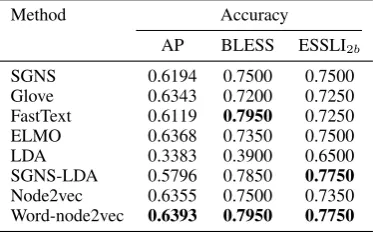
Method Accuracy
AP BLESS ESSLI2b
SGNS 0.6194 0.7500 0.7500 Glove 0.6343 0.7200 0.7250 FastText 0.6119 0.7950 0.7250 ELMO 0.6368 0.7350 0.7500 LDA 0.3383 0.3900 0.6500 SGNS-LDA 0.5796 0.7850 0.7750
Node2vec 0.6355 0.7500 0.7350 Word-node2vec 0.6393 0.7950 0.7750
Table 5: Concept categorization results.
as compared to human judgments. SGNS per-forms significantly better and the settings trained on MEN dataset generalize well on the WSIM-353 dataset as well. LDA performs rather poorly in-dicating that only global co-occurrences can lead to noisy representations of words. FastText per-forms worse as compared to SGNS. It is worth mentioning that the performance of ELMO is dis-appointing on this task of semantic similarity
pre-diction, because of the most likely reason that it better learns vector representations of word in the presence of a context.
A linear combination of SGNS and LDA (Equa-tion1withλ= 0.9) does not perform better than SGNS, which means that a simple way of combin-ing the embedded representations obtained indi-vidually with local and non-local approaches does not work well.
The node2vec approach of embedding nodes of the word-nodes graph constructed as per the de-scription of Section 4 relies on a random walk based construction of the context of a word node. This random walk based context construction is only able to improve the SGNS results slightly, in-dicating that random walks can introduce noise in the contexts of word-nodes.
The word-node based graph construction (in-corporating local and non-local co-occurrences in a principled way) works particularly well in con-junction with the stratified sampling based ap-proach of selecting context words from the κ -neighborhood. The optimal value ofα = 0.5 sug-gests that document-level co-occurrences should be computed by assigning equal importance to term presence and informativeness. A value of
β = 0.7 confirms the hypothesis that more em-phasis should be put on direct co-occurrences.
[image:8.595.88.275.481.597.2]improve-Rank SGNS word-node2vec
1 albums 0.929 albums 0.926 2 selftitled 0.885 selftitled 0.883 3 rerecorded 0.868 rerecorded 0.863 4 promotional 0.815 released 0.852 5 reissue 0.790 song 0.810
Table 6: Nearest neighbors of the word ‘album’ ob-tained by SGNS and word-node2vec.
ments with word-node2vec are noted for the MSR analogy task (comprised of syntactic categories). Among the baseline approaches, both node2vec and SGNS-LDA work well on the concept catego-rization task. However, the performance improve-ments are inconsistent across datasets, e.g. SGNS-LDA performs well on ESSLI2b and poorly on
AP. Our proposed method configured on the MEN dataset works consistently well across all datasets, which indicates that word-node2vec can general-ize well for different tasks.
As a side observation, we note that ELMO per-forms well for the analogy and concept categoriza-tion tasks (yielding the best results in particular on the Google analogy dataset). Although the re-sults are not directly comparable because of dif-ferences in the dimensionality of the vectors and also in the collection of documents used in the pre-trained ELMO vectors (Billion word benchmark as against DBPedia in our case), it could possibly be reasoned that the additional contextual infor-mation of the ELMO vectors turns out to be useful for in the analogy task.
Embedding Examples. Table6shows an exam-ple of the change in the neighbourhood of a samexam-ple word in the embedded space obtained by SGNS and word-node2vec. It can be seen from the ta-ble that word-node2vec is ata-ble to push relevant words, such as ‘released’ and ‘song’ within the top 5-NN of the word ‘album’. Although the words ‘promotional’ and ‘reissue’ are related to ‘album’, the semantic association of ‘released’ and ‘song’ with ‘album’ is apparently higher. We found that the word ‘song’ occurs in the local context of the word ‘album’ only133,494number of times out of a total number of177,487instances of the word ‘album’. This means that a significant percentage of times (almost25%), ‘song’ co-occurs with ‘al-bum’ at a document-level. Our embedding algo-rithm is able to leverage this information by mak-ing the vector for ‘song’ closer to ‘album’.
Sensitivity Analysis. Tables 3-5 show word-node2vec results with optimal parameter settings. We now investigate the effect of varying these pa-rameters on each individual evaluation task. We observe that both term presence and term infor-mativeness are important to model document-level co-occurrences as seen from the fact that theρand accuracy values decrease as α gets close to 0 or 1 (the 1st and 3rd plots from the left of Figure 1). Similarly, it can be seen that the results tend to improve with higher values of β, which con-firms that direct associations between words in the word-node graph are more important than transi-tive ones (2nd plot from the left and the rightmost plot of Figure 1). However, second-order transi-tive associations are still important because the re-sults tend to decrease forβclose to 1.
7 Conclusions and Future work
We proposed a word embedding approach that leverages document-level non-local co-occurrences, in addition to the window-based lo-cal co-occurrences. We proposed a graph-based framework, in which words are represented as nodes and the edges between a pair of words re-flect the degree of association between them. This association is a function of both the local and the document-level co-occurrences, which enables our approach to achieve ‘the best of both worlds’ in word embedding. Experiments show that our proposed method outperforms local approaches, namely word2vec, Glove and FastText, on a num-ber of different tasks. Our approach also outper-forms a naive black-box combination of embed-dings obtained separately by local and document-level approaches. This proves the importance of addressing both these sources of information jointly in an embedding objective.
In future, we would like to explore ways of ap-plying a similar graph based formalism for learn-ing vectors for documents.
Acknowledgements
References
Abdulrahman Almuhareb and Massimo Poesio. 2005. Concept learning and categorization from the web. InProc. of COGSCI, pages 103–108.
Marco Baroni and Alessandro Lenci. 2011. How we
blessed distributional semantic evaluation. InProc.
of the GEMS 2011 Workshop on GEometrical Mod-els of Natural Language Semantics, pages 1–10.
David M. Blei, Andrew Y. Ng, and Michael I. Jordan.
2003. Latent dirichlet allocation. J. Mach. Learn.
Res., 3:993–1022.
Elia Bruni, Nam Khanh Tran, and Marco Baroni. 2014.
Multimodal distributional semantics. J. Artif. Int.
Res., 49:1–47.
Scott Deerwester, Susan T. Dumais, George W. Fur-nas, Thomas K. Landauer, and Richard Harshman.
1990. Indexing by latent semantic analysis.
Jour-nal of the American Society for Information Science, 41(6):391–407.
Manaal Faruqui, Jesse Dodge, Sujay Kumar Jauhar, Chris Dyer, Eduard H. Hovy, and Noah A. Smith. 2015. Retrofitting word vectors to semantic
lexi-cons. InProc. of NAACL HLT, pages 1606–1615.
Lev Finkelstein, Evgeniy Gabrilovich, Yossi Matias, Ehud Rivlin, Zach Solan, Gadi Wolfman, and Ey-tan Ruppin. 2014. Placing search in context: The
concept revisited. In Proc. of WWW 2014, pages
406–414.
Debasis Ganguly, Dwaipayan Roy, Mandar Mitra,
and Gareth J. F. Jones. 2015. Word embedding
based generalized language model for information
retrieval. InProc. of SIGIR’15, pages 795–798.
Eric Gaussier and Cyril Goutte. 2005. Relation
be-tween plsa and nmf and implications. In
Proceed-ings of the 28th Annual International ACM SIGIR Conference on Research and Development in Infor-mation Retrieval, SIGIR ’05, pages 601–602.
T. L. Griffiths and M. Steyvers. 2004. Finding
scien-tific topics. Proceedings of the National Academy of
Sciences, 101(Suppl. 1):5228–5235.
Aditya Grover and Jure Leskovec. 2016. Node2vec:
Scalable feature learning for networks. InProc. of
the 22Nd ACM SIGKDD 2016, pages 855–864.
Jiafeng Guo, Yixing Fan, Qingyao Ai, and W. Bruce Croft. 2016. A deep relevance matching model for
ad-hoc retrieval. InProc. of CIKM ’16, pages 55–
64.
Thomas Hofmann. 1999. Probabilistic latent semantic
analysis. InProceedings of the Fifteenth Conference
on Uncertainty in Artificial Intelligence, UAI’99, pages 289–296. Morgan Kaufmann Publishers Inc.
Stanislaw Jastrzebski, Damian Lesniak, and
Woj-ciech Marian Czarnecki. 2017. How to
evalu-ate word embeddings? on importance of data efficiency and simple supervised tasks. CoRR, abs/1702.02170.
Armand Joulin, Edouard Grave, Piotr Bojanowski, Matthijs Douze, H´erve J´egou, and Tomas Mikolov. 2016. Fasttext.zip: Compressing text classification
models. arXiv preprint arXiv:1612.03651.
David A. Jurgens, Peter D. Turney, Saif M. Moham-mad, and Keith J. Holyoak. 2012. Semeval-2012 task 2: Measuring degrees of relational similarity. InProc. of the First Joint Conference on Lexical and Computational Semantics - Volume 1: Proc. of the Main Conference and the Shared Task, and Volume 2: Proc. of the Sixth International Workshop on Se-mantic Evaluation, SemEval ’12, pages 356–364.
Omer Levy and Yoav Goldberg. 2014. Neural word
embedding as implicit matrix factorization. In
Ad-vances in Neural Information Processing Systems
27, pages 2177–2185.
Stefan Evert. Marco Baroni and Alessandro Lenci. 2008. Esslli workshop on distributional lexical
se-mantics. ESSLLI Workshop on Distributional
Lexi-cal Semantics, 101:1–70.
Tomas Mikolov, Ilya Sutskever, Kai Chen, Gregory S. Corrado, and Jeffrey Dean. 2013a. Distributed rep-resentations of words and phrases and their
com-positionality. InProc. of NIPS 2013, pages 3111–
3119.
Tomas Mikolov, Wen-tau Yih, and Geoffrey Zweig. 2013b. Linguistic regularities in continuous space
word representations. In Proc. of NAACL 2013,
pages 746–751.
Jonas Mueller and Aditya Thyagarajan. 2016. Siamese recurrent architectures for learning sentence
similar-ity. InProc. of AAAI’16, pages 2786–2792.
Jeffrey Pennington, Richard Socher, and Christopher D
Manning. 2014. Glove: Global vectors for word
representation. In Proc. of EMNLP 2014, pages
1532–1543.
Matthew E. Peters, Mark Neumann, Mohit Iyyer, Matt Gardner, Christopher Clark, Kenton Lee, and Luke Zettlemoyer. 2018. Deep contextualized word
rep-resentations. InProc. of NAACL 2018.
Jay M. Ponte and W. Bruce Croft. 1998. A language
modeling approach to information retrieval. In
Pro-ceedings of the 21st Annual International ACM SI-GIR Conference on Research and Development in Information Retrieval, SIGIR ’98, pages 275–281. ACM.
Dwaipayan Roy, Debasis Ganguly, Mandar Mitra, and Gareth J. F. Jones. 2016. Word vector composition-ality based relevance feedback using kernel density
estimation. InProc. of CIKM’16, pages 1281–1290.
Yulia Tsvetkov, Manaal Faruqui, Wang Ling, Brian
MacWhinney, and Chris Dyer. 2016. Learning
the curriculum with bayesian optimization for
task-specific word representation learning. In Proc. of