460
Aligning Vector-spaces with Noisy Supervised Lexicons
Noa Yehezkel Lubin†1 Jacob Goldberger‡2 Yoav Goldberg†∗3
†Computer Science Department, Bar Ilan University, Ramat Gan, Israel
‡Electrical Engineering Department, Bar Ilan University, Ramat Gan, Israel
∗Allen Institute for Artificial Intelligence
1[email protected] 2[email protected]
Abstract
The problem of learning to translate between two vector spaces given a set of aligned points arises in several application areas of NLP. Cur-rent solutions assume that the lexicon which defines the alignment pairs is noise-free. We consider the case where the set of aligned points is allowed to contain an amount of noise, in the form of incorrect lexicon pairs and show that this arises in practice by ana-lyzing the edited dictionaries after the cleaning process. We demonstrate that such noise sub-stantially degrades the accuracy of the learned translation when using current methods. We propose a model that accounts for noisy pairs. This is achieved by introducing a generative model with a compatible iterative EM algo-rithm. The algorithm jointly learns the noise level in the lexicon, finds the set of noisy pairs, and learns the mapping between the spaces. We demonstrate the effectiveness of our proposed algorithm on two alignment problems: bilingual word embedding transla-tion, and mapping between diachronic embed-ding spaces for recovering the semantic shifts of words across time periods.
1 Introduction
We consider the problem of mapping between points in different vector spaces. This problem has prominent applications in natural language pro-cessing (NLP). Some examples are creating bilin-gual word lexicons (Mikolov et al., 2013), ma-chine translation (Artetxe et al., 2016, 2017a,b,
2018a,b; Conneau et al., 2017), hypernym gen-eration (Yamane et al.,2016), diachronic embed-dings alignment (Hamilton et al., 2016) and do-main adaptation (Barnes et al.,2018). In all these examples one is given word embeddings in two different vector spaces, and needs to learn a map-ping from one to the other.
The problem is traditionally posed as a super-vised learning problem, in which we are given two sets of vectors (e.g.: word-vectors in Italian and in English) and alexiconmapping the points between the two sets (known word-translation pairs). Our goal is to learn a mapping that will correctly map the vectors in one space (e.g.: English word em-beddings) to their known corresponding vectors in the other (e.g.: Italian word embeddings). The mapping will then be used to translate vectors for which the correspondence is unknown. This setup was popularized byMikolov et al.(2013).
The supervised setup assumes a perfect lexicon. Here, we consider what happens in the presence of
training noise, where some of the lexicon’s entries are incorrect in the sense that they don’t reflect an optimal correspondence between the word vectors.
2 Background
2.1 The Supervised Translation Problem
We are given two datasets, X = x1, ..., xm
andY = y1, ..., yn, coming from d-dimensional
spacesX andY. We assume that the spaces are related, in the sense that there is a functionf(x)
mapping points in spaceX to points in space Y. In this work, we focus on linear mappings, i.e. a
d×dmatrixQmapping points viayi=Qxi. The
goal of the learning is to find the translation ma-trixQ. In the supervised setting,m = nand we assume that ∀i f(xi) ≈ yi. We refer to the sets
XandY as thesupervision. The goal is to learn a matrixQˆ such the Frobenius norm is minimized:
ˆ
Q= arg min Q
kQX−Yk2F. (1)
2.2 Existing Solution Methods
pairs(xi, yi), as done byMikolov et al.(2013) and Dinu and Baroni(2014).
Orthogonal Procrustes (OP) Artetxe et al.
(2016) andSmith et al.(2017) argued and proved that a linear mapping between sub-spaces must be orthogonal. This leads to the modified objective:
ˆ
Q= arg min Q,s.t:QTQ=I
kQX−Yk2F (2)
Objective (2) is known as theOrthogonal Pro-crustes Problem. It can be solved algebraically by using a singular value decomposition (SVD).
Schnemann (1966) proved that the solution to 2
is: Qˆ =U VT s.t. UΣVT is the SVD ofY XT. The OP method is used in Xing et al. (2015);
Artetxe et al.(2016,2017a,b,2018a,b);Hamilton et al. (2016);Conneau et al. (2017); Ruder et al.
(2018).
2.3 The Unsupervised Translation Problem
The supervised alignment problem can be ex-pended to the semi-supervised (Artetxe et al.,
2017b; Lample et al., 2017; Ruder et al., 2018) or unsupervised (Zhang et al., 2017; Conneau et al.,2017;Artetxe et al.,2018b;Xu et al.,2018;
Alvarez-Melis and Jaakkola,2018) case, where a very small lexicon or none at all is given. In it-erative methods, the lexicon is expended and used to learn the alignment, later the alignment is used to predict the lexicon for the next iteration and so on. In adversarial methods, a final iterative step is used after the lexicon is built to refine the result. We will focus on the supervised stage in the un-supervised setting, meaning estimating the align-ment once a lexicon is induced.
3 The Effect of Noise
The previous methods assume the supervision set
X, Y is perfectly correct. However, this is often not the case in practice. We consider the case where a percentage pof the pairs in the supervi-sion set are “noisy”: applying the gold transfor-mation to a noisy pointxj will not result in a
vec-tor close to yj. The importance of the quality of
word-pairs selection was previously analyzed by
Vuli´c and Korhonen(2016). Here, we equate “bad pairs” to noise, and explore the performance in the presence of noise by conducting a series of syn-thetic experiments. We take a set of pointsX, a random transformationQand a gold setY =QX. We defineerroraskY −Yˆk2
[image:2.595.308.515.67.282.2]F whereYˆ = ˆQX is
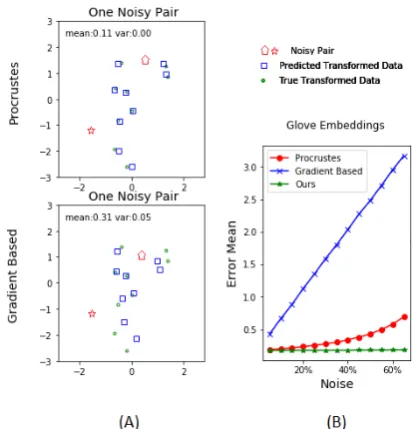
Figure 1: Noise influence. (A): the effect of a noisy pair on 2D alignment. (B) mean error over non-noisy pairs as a function of noise level.
the prediction according to the learned transform
ˆ
Q. Following the claim that linear transformations between word vector spaces are orthogonal, we fo-cus here on orthogonal transformations.
Low Dimensional Synthetic Data We begin by inspecting a case of few 2-dimensional points, which can be easily visualized. We compare a noise-free training to the case of a single noisy point. We construct X by samplingn= 10points of dimension d = 2 from a normal distribution. We take nine points and transformed them via an orthogonal random transform Q. We then add a single noisy pair which is generated by sampling two normally distributed random points and treat-ing them as a pair. The error is measured only on the nine aligned pairs.
High Dimensional Embeddings The experi-ment setup is as before, but instead of a normal distribution we use (6B, 300d) English Glove Em-beddings (Pennington et al.,2014) with lexicon of sizen= 5000. We report the mean error for var-ious noise levels on an unseen aligned test set of size 1500.
In Figure 1(B) we can see that both methods are effected by noise. As expected, as the amount of noise increases the error on the test set increases. We can again see that the effect is worse with gradient-based methods.
4 Noise-aware Model
Having verified that noise in the supervision severely influences the solution of both methods, we turn to proposing a noise-aware model.
The proposed model jointly identifies noisy pairs in the supervision set and learns a translation which ignores the noisy points. Identifying the point helps to clean the underlying lexicon (dic-tionary) that created the supervision. In addition, by removing those points our model learns a better translation matrix.
Generative Model We are givenx∈Rdand we
sample a correspondingy ∈Rdby first sampling
a Bernoulli random variable with probabilityα:
z∼Bernoulli(α)
y∼ (
N(µy, σ2yI) z= 0(‘noise’)
N(Qx, σ2I) z= 1(‘aligned’)
The density functiony is a mixture of two Gaus-sians:
f(y|x) = (1−α)N(µy, σy2I) +αN(Qx, σ2I).
The likelihood function is:
L(Q, σ, µy, σy) =
X
t
logf(yt|xt)
EM Algorithm We apply the EM algorithm (Dempster et al.,1977) to maximize the objective in the presence of latent variables. The algorithm has both soft and hard decision variants. We used the hard decision one which we find more natural, and note that the posterior probability of zt was
close to 0 or 1 also in the soft-decision case. It is important to properly initialize the EM al-gorithm to avoid convergence to a local optima. We initializeQby applying OP on the entire lex-icon (not just the clean pairs). We initialize the
variance,σ, by calculatingσ2 = n1·dP
t=1kQxt−
ytk2. We initialize,µy,σyby taking the mean and
variance of the entire dataset. Finally, we initialize
αto0.5.
The (hard version) EM algorithm is shown in Algorithm box 1. The runtime of each iteration is dominated by the OP algorithm (matrix multipli-cation and SVD on ad×dmatrix). Each iteration contains an additional matrix multiplication and few simple vector operations. Figure1(B) shows it obtains perfect results on the simulated noisy data.
Algorithm 1Noise-aware Alignment
Data:List of paired vectors:(x1, y1), ...,(xn, yn)
Result:Q,σ,µy,σy
while|αcurr−αprev|> do
E step:
wt=p(zt= 1|xt, yt) = αN(Qxt,σ 2I) f(yt|xt)
ht= 1(wt>0.5)
n1 =Ptht
M step:
Apply OP on the subset{t|ht= 1}to find Q.
σ2 = d·1n 1
P
t|ht=1kQxt−ytk2
µy = (n−1n1)Pt|ht=0yt
σ2y = d(n−1n 1)
P
t|ht=0kµy−ytk2
αprev=αcurr
αcurr= nn1
end
5 Experiments
5.1 Bilingual Word Embedding
Method En→It En→De En→Fi En→Es
best avg iters best avg iters best avg iters best avg iters
Artetxe et al.,2018b 48.53 48.13 573 48.47 48.19 773 33.50 32.63 988 37.60 37.33 808
[image:4.595.71.527.62.112.2]Noise-aware Alignment 48.53 48.20 471 49.67 48.89 568 33.98 33.68 502 38.40 37.79 551
Table 1: Bilingual Experiment P@1. Numbers are based on 10 runs of each method. The En→De, En→Fi and En→Es improvements are significant atp <0.05according to ANOVA on the different runs.
Experiment Results In Table 1 we report the best and average precision@1 scores and the aver-age number of iterations among 10 experiments, for different language translations. Our model improves the results in the translation tasks. In most setups our average case is better than the for-mer best case. In addition, the noise-aware model is more stable and therefore requires fewer iter-ations to converge. The accuracy improvements are small but consistent, and we note that we con-sider them as a lower-bound on the actual im-provements as the current test set comes from the same distribution of the training set, and also con-tains similarly noisy pairs. Using the soft-EM ver-sion results in similar results, but takes roughly 15% more iterations to converge.
Table 2 lists examples of pairs that were kept and discarded in En-It dictionary. The algorithm learned the pair (dog→dog) is an error. Another example is the translation (good→ santo) which is a less-popular word-sense than (good→buon / buona). When analyzing the En-It cleaned dictio-nary we see the percentage of potentially mislead-ing pairs (same strmislead-ing, numbers and special char-acters) is reduced from 12.1% to 4.6%.
English Italian Latent Variable
dog cane Aligned dog cani Aligned dog dog Noise good buon Aligned good buona Aligned good santo Noise new new Noise new york Noise new nuove Aligned
Table 2: A sample of decisions from the noise-aware alignment on the English→Italian dataset.
5.2 Diachronic (Historical) Word Embedding
Experiment Setup The goal is to align English word-embedding derived from texts from
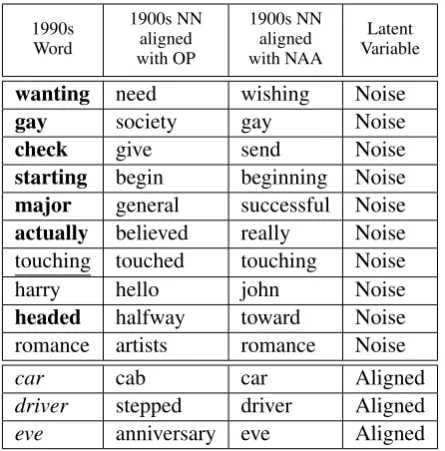
differ-ent time periods, in order to iddiffer-entify which words changed meaning over time. The assumption is that most words remained stable, and hence the supervision is derived by aligning each word to it-self. This problem contains noise in the lexicon by definition. We follow the exact setup fully de-scribed inHamilton et al. (2016), but replace the OP algorithm with our Noise-aware version1. We project 1900s embeddings to 1990s embeddings vector-space. The top 10 distant word embeddings after alignment are analyzed by linguistic experts for semantic shift.
Experiment Results 45.5% of the input pairs were identified as noise. After the post process-ing of removprocess-ing the non-frequent words as de-scribed in the experiment setup we end up with 121 noisy words. Our algorithm successfully iden-tifiesallthe top-changing words inHamilton et al.
(2016) as noise, and learns to ignore them in the alignment. In addition, we argue our method pro-vides better alignment. Table 3 shows the Near-est Neighbor (NN) of a 1990s word, in the 1900s vector-space after projection. We look at the top 10 changed words inHamilton et al.(2016) and 3 unchanged words. We compare the alignment of the OP projection to the Noise-aware Alignment (NAA). For example, with our solution the word
actuallywhose meaning shifted from ”in fact” to express emphasize or surprise, is correctly mapped toreallyinstead ofbelieved. The wordgayshifted fromcheerfultohomosexual, yet is still mapped to
gaywith NAA. This happens because the related embeddings (homosexual, lesbian and so on) are empty embeddings in 1900s, leaving gay as the next-best candidate, which we argue is better than OP’s society. The wordscar, driver, eve whose meaning didn’t change, were incorrectly aligned with OP tocab, stepped, anniversaryinstead of to themselves.
1990s Word
1900s NN aligned with OP
1900s NN aligned with NAA
Latent Variable
wanting need wishing Noise
gay society gay Noise
check give send Noise starting begin beginning Noise major general successful Noise actually believed really Noise touching touched touching Noise
harry hello john Noise
headed halfway toward Noise romance artists romance Noise
car cab car Aligned
driver stepped driver Aligned
eve anniversary eve Aligned
Table 3: Diachronic Semantic Change Experiment. Upper-part: noisy pairs. Bold: real semantic shifts. Underlined: global genre/discourse shifts. Unmarked: corpus artifacts. Bottom-part: clean pairs: Italics: un-changed words, no semantic shift.
6 Conclusion
We introduced the problem of embedding space projection with noisy lexicons, and showed that existing projection methods are sensitive in the presence of noise. We proposed an EM algorithm that jointly learns the projection and identifies the noisy pairs. The algorithm can be used as a drop-in replacement for the OP algorithm, and was demonstrated to im-prove results on two NLP tasks. We provide code at https://github.com/NoaKel/Noise-Aware-Alignment.
Acknowledgments
The work was supported by The Israeli Science Foundation (grant number 1555/15), and by the Is-raeli ministry of Science, Technology and Space through the Israeli-French Maimonide Coopera-tion program. We also, thank Roee Aharoni for helpful discussions and suggestions.
References
David Alvarez-Melis and Tommi S Jaakkola. 2018. Gromov-wasserstein alignment of word embedding spaces.arXiv preprint arXiv:1809.00013.
Mikel Artetxe, Gorka Labaka, and Eneko Agirre. 2016. Learning principled bilingual mappings of word
em-beddings while preserving monolingual invariance. In Proceedings of the 2016 Conference on Empiri-cal Methods in Natural Language Processing, pages 2289–2294.
Mikel Artetxe, Gorka Labaka, and Eneko Agirre. 2017a. Learning bilingual word embeddings with (almost) no bilingual data. InProceedings of the 55th Annual Meeting of the Association for Compu-tational Linguistics (Volume 1: Long Papers), pages 451–462, Vancouver, Canada. Association for Com-putational Linguistics.
Mikel Artetxe, Gorka Labaka, and Eneko Agirre. 2018a. Generalizing and improving bilingual word embedding mappings with a multi-step framework of linear transformations. In Proceedings of the Thirty-Second AAAI Conference on Artificial Intel-ligence (AAAI-18).
Mikel Artetxe, Gorka Labaka, and Eneko Agirre. 2018b. A robust self-learning method for fully un-supervised cross-lingual mappings of word embed-dings. arXiv preprint arXiv:1805.06297.
Mikel Artetxe, Gorka Labaka, Eneko Agirre, and Kyunghyun Cho. 2017b. Unsupervised neural ma-chine translation. arXiv preprint arXiv:1710.11041.
Jeremy Barnes, Roman Klinger, and Sabine Schulte im Walde. 2018. Projecting embeddings for domain adaption: Joint modeling of sentiment analysis in di-verse domains. arXiv preprint arXiv:1806.04381.
Alexis Conneau, Guillaume Lample, Marc’Aurelio Ranzato, Ludovic Denoyer, and Herv´e J´egou. 2017. Word translation without parallel data. arXiv preprint arXiv:1710.04087.
Arthur P Dempster, Nan M Laird, and Donald B Rubin. 1977. Maximum likelihood from incomplete data via the em algorithm. Journal of the royal statistical society. Series B (methodological), pages 1–38.
Georgiana Dinu and Marco Baroni. 2014. Improving zero-shot learning by mitigating the hubness prob-lem.CoRR, abs/1412.6568.
William L Hamilton, Jure Leskovec, and Dan Juraf-sky. 2016. Diachronic word embeddings reveal sta-tistical laws of semantic change. arXiv preprint arXiv:1605.09096.
Guillaume Lample, Ludovic Denoyer, and Marc’Aurelio Ranzato. 2017. Unsupervised machine translation using monolingual corpora only. arXiv preprint arXiv:1711.00043.
Tomas Mikolov, Quoc V Le, and Ilya Sutskever. 2013. Exploiting similarities among languages for ma-chine translation. arXiv preprint arXiv:1309.4168.
[image:5.595.71.294.61.287.2]Sebastian Ruder, Ryan Cotterell, Yova Kementched-jhieva, and Anders Søgaard. 2018. A discrimina-tive latent-variable model for bilingual lexicon in-duction.arXiv preprint arXiv:1808.09334.
Peter Schnemann. 1966. A generalized solution of the orthogonal procrustes problem. Psychometrika, 31(1):1–10.
Samuel L. Smith, David H. P. Turban, Steven Hamblin, and Nils Y. Hammerla. 2017. Offline bilingual word vectors, orthogonal transformations and the inverted softmax.CoRR, abs/1702.03859.
Ivan Vuli´c and Anna Korhonen. 2016. On the role of seed lexicons in learning bilingual word embed-dings. InProceedings of the 54th Annual Meeting of the Association for Computational Linguistics (Vol-ume 1: Long Papers), volume 1, pages 247–257.
Chao Xing, Dong Wang, Chao Liu, and Yiye Lin. 2015. Normalized word embedding and orthogonal trans-form for bilingual word translation. In Proceed-ings of the 2015 Conference of the North Ameri-can Chapter of the Association for Computational Linguistics: Human Language Technologies, pages 1006–1011.
Ruochen Xu, Yiming Yang, Naoki Otani, and Yuexin Wu. 2018. Unsupervised cross-lingual trans-fer of word embedding spaces. arXiv preprint arXiv:1809.03633.
Josuke Yamane, Tomoya Takatani, Hitoshi Yamada, Makoto Miwa, and Yutaka Sasaki. 2016. Distribu-tional hypernym generation by jointly learning clus-ters and projections. In Proceedings of COLING 2016, the 26th International Conference on Compu-tational Linguistics: Technical Papers, pages 1871– 1879.