Proceedings of NAACL-HLT 2019, pages 872–881 872
Incorporating Context and External Knowledge
for Pronoun Coreference Resolution
Hongming Zhang♣∗, Yan Song♠, and Yangqiu Song♣
♣Department of CSE, The Hong Kong University of Science and Technology
♠Tencent AI Lab
[email protected], [email protected], [email protected]
Abstract
Linking pronominal expressions to the correct references requires, in many cases, better anal-ysis of the contextual information and exter-nal knowledge. In this paper, we propose a two-layer model for pronoun coreference res-olution that leverages both context and exter-nal knowledge, where a knowledge attention mechanism is designed to ensure the model leveraging the appropriate source of external knowledge based on different context. Experi-mental results demonstrate the validity and ef-fectiveness of our model, where it outperforms state-of-the-art models by a large margin.
1 Introduction
The question of how human beings resolve pro-nouns has long been of interest to both linguistics and natural language processing (NLP) communi-ties, for the reason that pronoun itself has weak semantic meaning (Ehrlich,1981) and brings chal-lenges in natural language understanding. To ex-plore solutions for that question, pronoun coref-erence resolution (Hobbs, 1978) was proposed. As an important yet vital sub-task of the gen-eral coreference resolution task, pronoun coref-erence resolution is to find the correct refcoref-erence for a given pronominal anaphor in the context and has been shown to be crucial for a series of downstream tasks (Mitkov, 2014), including machine translation (Mitkov et al., 1995), sum-marization (Steinberger et al., 2007), information extraction (Edens et al., 2003), and dialog sys-tems (Strube and M¨uller,2003).
Conventionally, people design rules (Hobbs,
1978;Nasukawa,1994;Mitkov,1998) or use fea-tures (Ng, 2005; Charniak and Elsner, 2009; Li et al.,2011) to resolve the pronoun coreferences.
∗
This work was done during the internship of the first author in Tencent AI Lab.
Figure 1: Pronoun coreference examples, where each example requires different knowledge for its resolution. Blue bold font refers to the target pronoun, where the correct noun reference and other candidates are marked by green underline and brackets, respectively.
These methods heavily rely on the coverage and quality of the manually defined rules and features. Until recently, end-to-end solution (Lee et al.,
2017) was proposed towards solving the general coreference problem, where deep learning mod-els were used to better capture contextual informa-tion. However, training such models on annotated corpora can be biased and normally does not con-sider external knowledge.
Despite the great efforts made in this area in the past few decades (Hobbs,1978;Mitkov,1998;Ng,
2005; Rahman and Ng, 2009), pronoun corefer-ence resolution remains challenging. The reason behind is that the correct resolution of pronouns can be influenced by many factors (Ehrlich,1981); many resolution decisions require reasoning upon different contextual and external knowledge ( Rah-man and Ng,2011), which is also proved in other NLP tasks (Song et al., 2017,2018;Zhang et al.,
only refer to a female person (girl); Example C requires a more general type of knowledge1 that ‘cats can climb trees but a dog normally does not’. All of these knowledge are difficult to be learned from training data. Considering the importance of both contextual information and external hu-man knowledge, how to jointly leverage them be-comes an important question for pronoun corefer-ence resolution.
In this paper, we propose a two-layer model to address the question while solving two challenges of incorporating external knowledge into deep models for pronoun coreference resolution, where the challenges include: first, different cases have their knowledge preference, i.e., some knowledge is exclusively important for certain cases, which requires the model to be flexible in selecting ap-propriate knowledge per case; second, the avail-ability of knowledge resources is limited and such resources normally contain noise, which requires the model to be robust in learning from them.
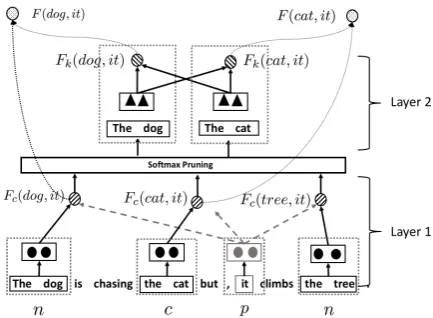
Consequently, in our model, the first layer pre-dicts the relations between candidate noun phrases and the target pronoun based on the contextual in-formation learned by neural networks. The sec-ond layer compares the candidates pair-wisely, in which we propose a knowledge attention module to focus on appropriate knowledge based on the given context. Moreover, a softmax pruning is placed in between the two layers to select high confident candidates. The architecture ensures the model being able to leverage both context and external knowledge. Especially, compared with conventional approaches that simply treat exter-nal knowledge as rules or features, our model is not only more flexible and effective but also in-terpretable as it reflects which knowledge source has the higher weight in order to make the deci-sion. Experiments are conducted on a widely used evaluation dataset, where the results prove that the proposed model outperforms all baseline models by a great margin.2
Above all, to summarize, this paper makes the following contributions:
1. We propose a two-layer neural model to combine contextual information and external
1This is normally as selectional preference (SP) (Hobbs,
1978), which is defined as given a predicate (verb), a human has the preference for its argument (subject in this example).
2All code and data are available at:https://github.
[image:2.595.307.524.62.221.2]com/HKUST-KnowComp/Pronoun-Coref.
Figure 2: The architecture of the two-layer model for pronoun coreference resolution. The first layer encodes the contextual information for computingFc. The
sec-ond layer leverages external knowledge to scoreFk. A
pruning layer is applied in between the two layers to control computational complexity. The dashed boxes in the first and second layer refer to span representa-tion and knowledge scoring, respectively.
knowledge for the pronoun coreference resolu-tion task.
2. We propose a knowledge attention mechanism that allows the model to select salient knowl-edge for different context, which predicts more precisely and can be interpretable through the learned attention scores.
3. With our proposed model, the performance of pronoun coreference resolution is boosted by a great margin over the state-of-the-art models.
2 The Task
Following the conventional setting (Hobbs,1978), the task of pronoun coreference resolution is de-fined as: for a pronoun p and a candidate noun phrase set N, the goal is to identify the correct non-pronominal references set3C. the objective is to maximize the following objective function:
J =
P
c∈CeF(c,p)
P
n∈NeF(n,p)
, (1)
where c is the correct reference and n the can-didate noun phrase. F(·) refers to the overall coreference scoring function for eachnregarding
p. Following (Mitkov,1998), all non-pronominal noun phrases in the recent three sentences of the pronounpare selected to formN.
Particularly in our setting, we want to leverage both the local contextual information and external
knowledge in this task, thus for eachnandp,F(.)
is decomposed into two components:
F(n, p) =Fc(n, p) +Fk(n, p), (2)
whereFc(n, p)is the scoring function that predicts the relation betweennandpbased on the contex-tual information; Fk(n, p)is the scoring function
that predicts the relation between nand p based on the external knowledge. There could be multi-ple ways to computeFcandFk, where a solution
proposed in this paper is described as follows.
3 The Model
The architecture of our model is shown in Fig-ure 2, where we use two layers to incorporate contextual information and external knowledge. Specifically, the first layer takes the representa-tions of differentnand the pas input and predict the relationship between each pair ofnandp, so as to computeFc. The second layer leverages the
external knowledge to computeFk, which consists
of pair-wise knowledge scorefkamong all
candi-daten. To enhance the efficiency of the model, a softmax pruning module is applied to select high confident candidates into the second layer. The details of the aforementioned components are de-scribed in the following subsections.
3.1 Encoding Contextual Information
BeforeFcis computed, the contextual information
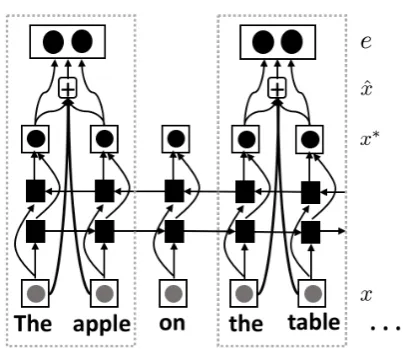
is encoded through a span4 representation (SR) module in the first layer of the model. Following
Lee et al.(2017), we adopt the standard bidirec-tional LSTM (biLSTM) (Hochreiter and Schmid-huber, 1997) and the attention mechanism ( Bah-danau et al.,2015) to generate the span represen-tation, as shown in Figure3. Given that the initial word representations in a spanniarex1, ...,xT,
we denote their representations x∗1, ...,x∗T af-ter encoded by the biLSTM. Then we obtain the inner-span attention by
at= eαt
PT
k=1eαk
, (3)
whereαtis computed via a standard feed-forward
neural network5 αt = N Nα(x∗t). Thus, we have
4
Both noun phrases and the pronoun are treated as spans.
5We use N N to present feed-forward neural networks
[image:3.595.316.518.63.240.2]throughout this paper.
Figure 3: The structure of span representation. Bidirec-tional LSTM and inner-span attention mechanism are employed to capture the contextual information.
the weighted embedding of each spanxˆithrough
ˆ
xi= T
X
k=1
ak·xk. (4)
Afterwards, we concatenate the starting (x∗start) and ending (x∗end) embedding of each span, as well as its weighted embedding (xˆi) and the length
fea-ture (φ(i)) to form its final representatione:
ei= [x∗start,x∗end,xˆi, φ(i)]. (5)
Once the span representation of n ∈ N andp
are obtained, we compute Fc for each n with a
standard feed-forward neural network:
Fc(n, p) =N Nc([en,ep,enep]), (6)
whereis the element-wise multiplication.
3.2 Processing External Knowledge
In the second layer of our model, external knowl-edge is leveraged to evaluate all candidatenso as to give them reasonableFk scores. In doing so,
each candidate is represented as a group of fea-tures from different knowledge sources, e.g., ‘the cat’ can be represented as a singular noun, un-known gender creature, and a regular subject of the predicate verb ‘climb’. For each candidate, we conduct a series of pair-wise comparisons be-tween it and all other ones to result in itsFkscore.
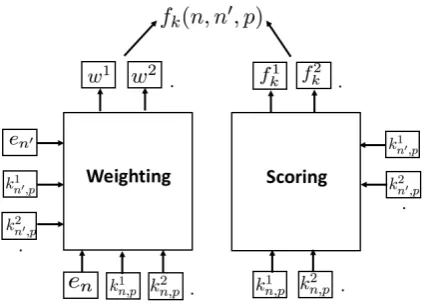
Figure 4: The structure of the knowledge attention module. For each featurekifrom knowledge sourcei,
the the weighting component predict its weightwiand
the scoring component computes its knowledge score fi
k. Then a weighted sum is obtained forfk.
generated, such attention mechanism ensures that, for each candidate, reliable and useful knowledge is utilized rather than ineffective ones. The details of the knowledge attention module and the overall scoring are described as follows.
Knowledge Attention Figure 4 demonstrates the structure of the knowledge attention module, where there are two components: (1) weight-ing: assigning weights to different knowledge fea-tures regarding their importance in the compari-son; (2) scoring: valuing a candidate against an-other one based on their features from different knowledge sources. Assuming that there are m
knowledge sources input to our model, each can-didate can be represented bymdifferent features, which are encoded as embeddings. Therefore, two candidatesnandn0 regardingphave their knowl-edge feature embeddings k1n,p,k2n,p, ...,kmn,p and
k1n0,p,k2n0,p, ...,kmn0,p, respectively. The weighting component receives all featureskfornandn0, and the span representationsenanden0as input, where
en anden0 help selecting appropriate knowledge based on the context. As a result, for a candidate pair (n,n0) and a knowledge source i, its knowl-edge attention score is computed via
βi(n, n0, p) =N Nka([oin,p,oin0,p,oin,poin0,p]), (7) where oin,p = [en,kin,p] andoin0,p = [en0,ki
n0,p] are the concatenation of span representation and external knowledge embedding for candidate n
andn0 respectively. The weight for features from
different knowledge sources is thus computed via
wi = eβi
Pm
j=1eβj
. (8)
Similar to the weighting component, for each feature i, we compute its score fki(n, n0, p) forn
againstn0in the scoring component through
fki(n, n0, p) =N Nks([kin,p,kin0,p,kin,pkin0,p]). (9) where it is worth noting that we excludeein this component for the reason that, in practice, the di-mension ofeis normally much higher thank. As a result, it could dominate the computation ifeand
kis concatenated.6
Once the weights and scores are obtained, we have a weighted knowledge score fornagainstn0:
fk(n, n0, p) = m
X
i=1
wi·fki(n, n
0, p).
(10)
Overall Knowledge Score After all pairs ofnand
n0are processed by the attention module, the over-all knowledge score fornis computed through the averagedfk(n, n0, p)over alln0:
Fk(n, p) =
P
n0∈Nofk(n, n0, p)
|No| , (11)
whereNo =N −nfor eachn.
3.3 Softmax Pruning
Normally, there could be many noun phrases that serve as the candidates for the target pronoun. One potential obstacle in the pair-wise compari-son of candidate noun phrases in our model is the squared complexity O(|N |2) with respect to the
size of N. To filter out low confident candidates so as to make the model more efficient, we use a softmax-pruning module between the two layers in our model to select candidates for the next step. The module takes Fc as input for each n, uses a
softmax computation:
ˆ
Fc(n, p) =
eFc(n,p)
P
ni∈Ne
Fc(ni,p). (12)
where candidates with higher Fˆc are kept, based
on a threshold t predefined as the pruning stan-dard. Therefore, if candidates have similar Fc
6We do not have this concern for the weighting
type train dev test all Third Personal 21,828 2,518 3,530 27,876 Possessive 7,749 1,007 1,037 9,793 All 29,577 3,525 4,567 37,669
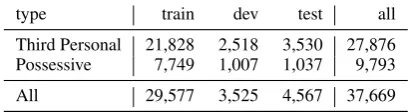
Table 1: Statistics of the evaluation dataset. Number of selected pronouns are reported.
scores, the module allow more of them to proceed to the second layer. Compared with other conven-tional pruning methods (Lee et al., 2017, 2018) that generally keep a fixed number of candidates, our pruning strategy is more efficient and flexible.
4 Experiment Settings
4.1 Data
The CoNLL-2012 shared task (Pradhan et al.,
2012) corpus is used as the evaluation dataset, which is selected from the Ontonotes 5.07. Fol-lowing conventional approaches (Ng, 2005; Li et al.,2011), for each pronoun in the document, we consider candidate nfrom the previous two sen-tences and the current sentence. For pronouns, we consider two types of them following Ng(2005), i.e., third personal pronoun (she, her, he, him,
them, they, it) and possessive pronoun (his,hers,
its,their,theirs). Table1reports the number of the two type pronouns and the overall statistics for the experimental dataset. According to our selection range of candidate n, on average, each pronoun has 4.6 candidates and 1.3 correct references.
4.2 Knowledge Types
In this study, we use two types of knowledge in our experiments. The first type is linguistic fea-tures, i.e., plurality and animacy & gender. We employ the Stanford parser8, which generates plu-rality, animacy, and gender markups for all the noun phrases, to annotate our data. Specifically, the plurality feature denotes eachnandpto be sin-gular or plural. For each candidaten, if its plural-ity status is the same as the target pronoun, we la-bel it 1, otherwise 0. The animacy & gender (AG) feature denotes whether anorpis a living object, and being male, female, or neutral if it is alive. For each candidaten, if its AG feature matches the tar-get pronoun’s, we label it 1, otherwise 0.
The second type is the selectional preference (SP) knowledge. For this knowledge, we create
7
https://catalog.ldc.upenn.edu/LDC2013T19
8https://stanfordnlp.github.io/CoreNLP/
a knowledge base by counting how many times a predicate-argument tuple appears in a corpus and use the resulted number to represent the prefer-ence strength. Specifically, we use the English Wikipedia9 as the base corpus for such counting. Then we parse the entire corpus through the Stan-ford parser and record all dependency edges in the format of(predicate, argument, relation, num-ber), where predicate is the governor and argu-ment the dependent in the original parsed depen-dency edge10. Later for sentences in the training and test data, we firstly parse each sentence and find out the dependency edge linkingpand its cor-responding predicate. Then for each candidate11
nin a sentence, we check the previously created SP knowledge base and find out how many times it appears as the argument of different predicates with the same dependency relation (i.e.,nsubjand
dobj). The resulted frequency is grouped into the following buckets [1, 2, 3, 4, 5-7, 8-15, 16-31, 32-63, 64+] and we use the bucket id as the final SP knowledge. Thus in the previous example:
The dogis chasingthe catbutitclimbsthe tree.
Its parsing result indicates that ‘it’ is the subject of the verb ‘climb’. Then for ‘the dog’, ‘the cat’, and ‘the tree’, we check their associations with ‘climb’ in the knowledge base and group them in the buck-ets to form the SP knowledge features.
4.3 Baselines
Several baselines are compared in this work. The first two are conventional unsupervised ones:
• Recent Candidate, which simply selects the most recent noun phrase that appears in front of the target pronoun.
• Deterministic model (Raghunathan et al.,
2010), which proposes one multi-pass seive model with human designed rules for the coref-erence resolution task.
Besides the unsupervised models, we also com-pare with three representative supervised ones:
• Statisticalmodel, proposed byClark and Man-ning (2015), uses human-designed entity-level
9
https://dumps.wikimedia.org/enwiki/
10In Stanford parser results, when a verb is a linking verb
(e.g., am, is), an ’nsubj’ edge is created between its predica-tive and subject. Thus for this case the predicapredica-tive is treated as the predicate for the subject (argument) in our study.
11If a noun phrase contains multiple words, we use the
Model Third Personal Pronoun Possessive Pronoun All
P R F1 P R F1 P R F1
Recent Candidate 50.7 40.0 44.7 64.1 45.5 53.2 54.4 41.6 47.2 Deterministic (Raghunathan et al.,2010) 68.7 59.4 63.7 51.8 64.8 57.6 62.3 61.0 61.7 Statistical (Clark and Manning,2015) 69.1 62.6 65.7 58.0 65.3 61.5 65.3 63.4 64.3 Deep-RL (Clark and Manning,2016) 72.1 68.5 70.3 62.9 74.5 68.2 68.9 70.3 69.6 End2end (Lee et al.,2018) 75.1 83.7 79.2 73.9 82.1 77.8 74.8 83.2 78.8 Feature Concatenation 73.5 88.3 80.2 72.5 87.3 79.2 73.2 87.9 79.9 The Complete Model 75.4 87.9 81.2 74.9 87.2 80.6 75.2 87.7 81.0
Table 2: Pronoun coreference resolution performance of different models on the evaluation dataset. Precision (P), recall (R), and F1 score are reported, with the best one in each F1 column marked bold.
features between clusters and mentions for coreference resolution.
• Deep-RLmodel, proposed by Clark and Man-ning(2016), a reinforcement learning method to directly optimize the coreference matrix instead of the traditional loss function.
• End2endis the current state-of-the-art corefer-ence model (Lee et al.,2018), which performs in an end-to-end manner and leverages both the contextual information and a pre-trained lan-guage model (Peters et al.,2018).
Note that the Deterministic, Statistical, and Deep-RL models are included in the Stanford CoreNLP toolkit12, and experiments are con-ducted with their provided code. For End2end, we use their released code13 and replace its mention detection component with gold mentions for the fair comparison.
To clearly show the effectiveness of the pro-posed model, we also present a variation of our model as an extra baseline to illustrate the effect of different knowledge incorporation manner:
• Feature Concatenation, a simplified version of the complete model that removes the second knowledge processing layer, but directly treats all external knowledge embeddings as features and concatenates them to span representations.
4.4 Implementation
Following previous work (Lee et al., 2018), we use the concatenation of the 300d GloVe embed-dings (Pennington et al.,2014) and the ELMo ( Pe-ters et al., 2018) embeddings as the initial word representations. Out-of-vocabulary words are ini-tialized with zero vectors. Hyper-parameters are
12
https://stanfordnlp.github.io/CoreNLP/coref.html
13https://github.com/kentonl/e2e-coref
set as follows. The hidden state of the LSTM mod-ule is set to 200, and all the feed-forward networks in our model have two 150-dimension hidden lay-ers. The default pruning thresholdt for softmax pruning is set to10−7. All linguistic features
(plu-rality and AG) and external knowledge (SP) are encoded as 20-dimension embeddings.
For model training, we use cross-entropy as the loss function and Adam (Kingma and Ba, 2015) as the optimizer. All the aforementioned hyper-parameters are initialized randomly, and we apply dropout rate 0.2 to all hidden layers in the model. Our model treats a candidate as the correct refer-ence if its predicted overall scoreF(n, p)is larger than 0. The model training is performed with up to 100 epochs, and the best one is selected based on its performance on the development set.
5 Experimental Results
Table 2 compares the performance of our model with all baselines. Overall, our model performs the best with respect to all evaluation metrics. Sev-eral findings are also observed from the results. First, manually defined knowledge and features are not enough to cover rich contextual informa-tion. Deep learning models (e.g., End2end and our proposed models), which leverage text representa-tions for context, outperform other approaches by a great margin, especially on the recall. Second, external knowledge is highly helpful in this task, which is supported by that our model outperforms the End2end model significantly.
Figure 5: Effect of different thresholds on candidate numbers. Max and Average number of candidates after pruning are represented with solid lines in blue and or-ange, respectively. Two dashed lines indicate the max and the average number of candidates before pruning.
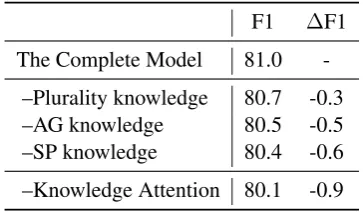
F1 ∆F1
The Complete Model 81.0
-–Plurality knowledge 80.7 -0.3 –AG knowledge 80.5 -0.5 –SP knowledge 80.4 -0.6
[image:7.595.310.522.65.220.2]–Knowledge Attention 80.1 -0.9
Table 3: Performance of our model with removing dif-ferent knowledge sources and knowledge attention.
behind this result is mainly from the noise in the knowledge source, e.g., parsing error, incorrectly identified relations, etc. For example, the plurality of 17% noun phrases are wrongly labeled in the test data. As a comparison, our knowledge atten-tion might contribute to alleviate such noise when incorporating all knowledge sources.
Effect of Different Knowledge To illustrate the importance of different knowledge sources and the knowledge attention mechanism, we ablate vari-ous components of our model and report the corre-sponding F1 scores on the test data. The results are shown in Table3, which clearly show the necessity of the knowledge. Interestingly, AG contributes the most among all knowledge types, which indi-cates that potentially more cases in the evaluation dataset demand on the AG knowledge than oth-ers. More importantly, the results also prove the effectiveness of the knowledge attention module, which contributes to the performance gap between our model and the Feature Concatenation one.
Figure 6: Effect of different pruning thresholds on model performance. With the threshold increasing, the precision increases while the recall and F1 drop.
Effect of Different Pruning ThresholdsWe try different thresholds t for the softmax pruning in selecting reliable candidates. The effects of differ-ent thresholds on reducing candidates and overall performance are shown in Figure5and6 respec-tively. Along with the increase oft, both the max and the average number of pruned candidates drop quickly, so that the space complexity of the model can be reduced accordingly. Particularly, there are as much as 80% candidates can be filtered out when t = 10−1. Meanwhile, when referring to Figure 6, it is observed that the model performs stable with the decreasing of candidate numbers. Not surprisingly, the precision rises when reducing candidate numbers, yet the recall drops dramati-cally, eventually results in the drop of F1. With the above observations, the reason we set t = 10−7
as the default threshold is straightforward: on this value, one-third candidates are pruned with almost no influence on the model performance in terms of precision, recall, and the F1 score.
6 Case Study
[image:7.595.90.272.311.417.2]dis-Example A Example B Sentences ... (A large group of people) met
(Jesus). (A man in the group) shouted to him: “(Teacher), please come and look at(my son). Heis the only child I have” ...
... (My neighbor) told me that there was(an accident), and ev-eryone else was intact, except (his father), who was in (hospital) for fractures. I comforted him first and asked (my friend) to rush me to (the hospital). (My neighbor) showed me the police re-port at (the hospital), which indicateditwas all my neighbor’s fault. ...
Pronoun He it
Candidate NPs A large group of people, Jesus, A man in the group, Teacher, my son.
My friend, an accident, his father, hospital, my friend, the hos-pital, My neighbor, the hospital.
[image:8.595.74.527.65.213.2]End2end Jesus, A man in the group,my son None Our Model my son an accident
Table 4: The comparison of End2end and our model on two examples drawn from the test data. Pronouns are marked as blue bold font. Correct references are indicated in green underline font and other candidates are indicated with brackets. ‘None’ refers to that none of the candidates is predicated as the correct reference.
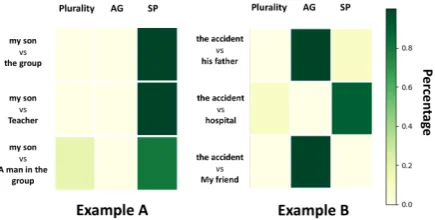
Figure 7: Heatmaps of knowledge attention for two examples, where in each example the knowledge at-tention weights of the correct references against other candidates are illustrated. Darker color refers to higher weight on the corresponding knowledge type.
tinguishing them. In Example B, the distance be-tween ‘an accident’ and the pronoun ‘it’ is too far. As a result, the ‘None’ result from the End2end model indicates that the contextual information is not enough to make the decision. As a compari-son, in our model, integrating external knowledge can help to solve such challenges, e.g., for Exam-ple A, SP knowledge helps when Plurality and AG cannot distinguish all candidates.
To clearly illustrate how our model leverages the external knowledge, we visualize the knowl-edge attention of the correct reference against other candidates14 via heatmaps in Figure7. Two interesting observations are drawn from the visu-alization. First, given two candidates, if they are significantly different in one feature, our model tends to pay more attention to that feature. Take AG as an example, in Example A, the AG features of all candidates consistently match the pronoun
14Only candidates entered the second layer are considered.
‘he’ (all male/neutral). Thus the comparison be-tween ‘my son’ and all candidates pay no attention to the AG feature. While in Example B, the tar-get pronoun ‘it’ cannot describe human, thus ’fa-ther’ and ‘friend’ are 0 on the AG feature while ‘hospital’ and ‘accident’ are 1. As a result, the attention module emphasizes AG more than other knowledge types. Second, The importance of SP is clearly shown in these examples. In example A, Plurality and AG features cannot help, the atten-tion module weights higher on SP because ‘son’ appears 100 times as the argument of the parsed predicate ‘child’ in the SP knowledge base, while other candidates appear much less at that position. In example B, as mentioned above, once AG helps filtering ’hospital’ and ’accident’, SP plays an im-portant role in distinguishing them because ‘acci-dent’ appears 26 times in the SP knowledge base as the argument of the ‘fault’ from the results of the parser, while ‘hospital’ never appears at that position.
7 Related Work
[image:8.595.73.291.278.388.2]1978;Rahman and Ng,2011;Emami et al.,2018). In previous work, external knowledge including manually defined rules (Hobbs, 1978;Ng,2005), such as number/gender requirement of different pronouns, and world knowledge (Rahman and Ng,2011), such as selectional preference (Wilks,
1975;Zhang and Song,2018), have been proved to be helpful for pronoun coreference resolution. Recently, with the development of deep learning,
Lee et al. (2017) proposed an end-to-end model that learns contextual information with an LSTM module and proved that such knowledge is help-ful for coreference resolution when the context is properly encoded. The aforementioned two types of knowledge have their own advantages: the con-textual information covers diverse text expressions that are difficult to be predefined while the external knowledge is usually more precisely constructed and able to provide extra information beyond the training data. Different from previous work, we explore the possibility of joining the two types of knowledge for pronoun coreference resolution rather than use only one of them. To the best of our knowledge, this is the first attempt that uses deep learning model to incorporate contextual informa-tion and external knowledge for pronoun corefer-ence resolution.
8 Conclusion
In this paper, we proposed a two-layer model for pronoun coreference resolution, where the first layer encodes contextual information and the sec-ond layer leverages external knowledge. Partic-ularly, a knowledge attention mechanism is pro-posed to selectively leverage features from differ-ent knowledge sources. As an enhancemdiffer-ent to ex-isting methods, the proposed model combines the advantage of conventional feature-based models and deep learning models, so that context and ex-ternal knowledge can be synchronously and effec-tively used for this task. Experimental results and case studies demonstrate the superiority of the pro-posed model to state-of-the-art baselines. Since the proposed model adopted an extensible struc-ture, one possible future work is to explore the best way to enhance it with more complicated knowl-edge resources such as knowlknowl-edge graphs.
Acknowledgements
This paper was partially supported by the Early Career Scheme (ECS, No.26206717) from
Re-search Grants Council in Hong Kong. In addition, Hongming Zhang has been supported by the Hong Kong Ph.D. Fellowship and the Tencent Rhino-Bird Elite Training Program. We also thank the anonymous reviewers for their valuable comments and suggestions that help improving the quality of this paper.
References
Dzmitry Bahdanau, Kyunghyun Cho, and Yoshua Ben-gio. 2015. Neural machine translation by jointly learning to align and translate. In Proceedings of ICLR 2015.
Eugene Charniak and Micha Elsner. 2009. Em works for pronoun anaphora resolution. InProceedings of EACL 2009, pages 148–156.
Kevin Clark and Christopher D Manning. 2015. Entity-centric coreference resolution with model stacking. In Proceedings of ACL-IJCNLP 2015, volume 1, pages 1405–1415.
Kevin Clark and Christopher D. Manning. 2016. Deep reinforcement learning for mention-ranking coref-erence models. In Proceedings of EMNLP 2016, pages 2256–2262.
Richard J Edens, Helen L Gaylard, Gareth JF Jones, and Adenike M Lam-Adesina. 2003. An investiga-tion of broad coverage automatic pronoun resoluinvestiga-tion for information retrieval. InProceedings of SIGIR 2003, pages 381–382. ACM.
Kate Ehrlich. 1981. Search and inference strategies in pronoun resolution: An experimental study. In Pro-ceedings of ACL 1981, pages 89–93.
Ali Emami, Paul Trichelair, Adam Trischler, Ka-heer Suleman, Hannes Schulz, and Jackie Chi Kit Cheung. 2018. The hard-core coreference cor-pus: Removing gender and number cues for diffi-cult pronominal anaphora resolution. arXiv preprint arXiv:1811.01747.
Jerry R Hobbs. 1978. Resolving pronoun references. Lingua, 44(4):311–338.
Sepp Hochreiter and J¨urgen Schmidhuber. 1997. Long short-term memory. Neural computation, 9(8):1735–1780.
Diederik P. Kingma and Jimmy Ba. 2015. Adam: A method for stochastic optimization. InProceedings of ICLR 2015.
Kenton Lee, Luheng He, and Luke Zettlemoyer. 2018. Higher-order coreference resolution with coarse-to-fine inference. InProceedings of NAACL-HLT 2018, pages 687–692.
Dingcheng Li, Tim Miller, and William Schuler. 2011. A pronoun anaphora resolution system based on fac-torial hidden markov models. In Proceedings of ACL 2011, pages 1169–1178.
Ruslan Mitkov. 1998. Robust pronoun resolution with limited knowledge. In Proceedings of ACL 1998, pages 869–875.
Ruslan Mitkov. 2014. Anaphora resolution. Rout-ledge.
Ruslan Mitkov et al. 1995. Anaphora resolution in ma-chine translation. In Proceedings of the Sixth In-ternational conference on Theoretical and Method-ological issues in Machine Translation. Citeseer.
Testuya Nasukawa. 1994. Robust method of pronoun resolution using full-text information. In Proceed-ings of CCL 1994, pages 1157–1163.
Vincent Ng. 2005. Supervised ranking for pronoun res-olution: Some recent improvements. InProceedings of EMNLP 2005, volume 20, page 1081.
Jeffrey Pennington, Richard Socher, and Christopher Manning. 2014. Glove: Global vectors for word representation. In Proceedings of EMNLP 2014, pages 1532–1543.
Matthew E. Peters, Mark Neumann, Mohit Iyyer, Matt Gardner, Christopher Clark, Kenton Lee, and Luke Zettlemoyer. 2018. Deep contextualized word rep-resentations. InProceedings of NAACL-HLT 2018, pages 2227–2237.
Sameer Pradhan, Alessandro Moschitti, Nianwen Xue, Olga Uryupina, and Yuchen Zhang. 2012. Conll-2012 shared task: Modeling multilingual unre-stricted coreference in ontonotes. InProceedings of EMNLP 2012, pages 1–40.
Karthik Raghunathan, Heeyoung Lee, Sudarshan Ran-garajan, Nathanael Chambers, Mihai Surdeanu, Dan Jurafsky, and Christopher Manning. 2010. A multi-pass sieve for coreference resolution. In Proceed-ings of EMNLP 2010, pages 492–501.
Altaf Rahman and Vincent Ng. 2009. Supervised mod-els for coreference resolution. In Proceedings of EMNLP 2009, pages 968–977.
Altaf Rahman and Vincent Ng. 2011. Coreference res-olution with world knowledge. In Proceedings of ACL 2011, pages 814–824.
Yan Song, Chia-Jung Lee, and Fei Xia. 2017. Learning word representations with regularization from prior knowledge. InProceedings of CoNLL 2017, pages 143–152.
Yan Song, Shuming Shi, Jing Li, and Haisong Zhang. 2018. Directional skip-gram: Explicitly distinguish-ing left and right context for word embedddistinguish-ings. In Proceedings of NAACL-HLT 2018, pages 175–180.
Josef Steinberger, Massimo Poesio, Mijail A Kabadjov, and Karel Jevzek. 2007. Two uses of anaphora reso-lution in summarization. Information Processing & Management, 43(6):1663–1680.
Michael Strube and Christoph M¨uller. 2003. A ma-chine learning approach to pronoun resolution in spoken dialogue. In Proceedings of ACL 2003, pages 168–175.
Yorick Wilks. 1975. A preferential, pattern-seeking, semantics for natural language inference. Artificial intelligence, 6(1):53–74.
Hongming Zhang and Yangqiu Song. 2018. A dis-tributed solution for winograd schema challenge. In Proceedings of ICMLC 2018, pages 322–326.