1309
Cross-Corpora Evaluation and Analysis of Grammatical Error
Correction Models — Is Single-Corpus Evaluation Enough?
Masato Mita1,2,Tomoya Mizumoto1, Masahiro Kaneko3,1, Ryo Nagata4,1, Kentaro Inui2,1 1RIKEN AIP,2Tohoku University,3Tokyo Metropolitan University,4Konan University
{masato.mita, tomoya.mizumoto}@riken.jp,
[email protected],[email protected]., [email protected]
Abstract
This study explores the necessity of perform-ing cross-corpora evaluation for grammati-cal error correction (GEC) models. GEC models have been previously evaluated based on a single commonly applied corpus: the CoNLL-2014 benchmark. However, the eval-uation remains incomplete because the task difficulty varies depending on the test cor-pus and conditions such as the proficiency levels of the writers and essay topics. To overcome this limitation, we evaluate the per-formance of several GEC models, including NMT-based (LSTM, CNN, and transformer) and an SMT-based model, against various learner corpora (CoNLL-2013, CoNLL-2014, FCE, JFLEG, ICNALE, and KJ). Evaluation results reveal that the models’ rankings consid-erably vary depending on the corpus, indicat-ing that sindicat-ingle-corpus evaluation is insufficient for GEC models.
1 Introduction
Grammatical error correction (GEC) is the task of correcting various grammatical errors in a given text, which is typically written by non-native speakers. Previous studies focused on typical er-rors such as those in the use of articles (Han et al.,
2006), prepositions (Felice and Pulman, 2008), and noun numbers (Nagata et al.,2006). Machine translation approaches are being presently ap-plied for GEC (Junczys-Dowmunt et al., 2018;
Chollampatt and Ng, 2018; Ge et al., 2018;
Junczys-Dowmunt and Grundkiewicz, 2016). In these approaches, GEC is treated as a translation problem from the erroneous text to the correct text (Mizumoto et al., 2012; Felice et al., 2014;
Junczys-Dowmunt and Grundkiewicz,2014). However, the evaluation of GEC performance is unfortunately not complete because researchers tend to evaluate their models on a single corpus.
The CoNLL-2014 shared task dataset (Ng et al.,
2014) has been recently used for such evaluation. Single-corpus evaluation may be insufficient in cases wherein a GEC model generally aims to robustly correct grammatical errors in any writ-ten text partly because the task difficulty varies depending on proficiency levels and essay top-ics. Although a model outperforms a baseline in one corpus, the model in another corpus may per-form better, leading to different conclusions from what we know. This study explores the necessity of performing cross-corpora evaluation for GEC models. The performance of four recent models, namely three neural machine translation (NMT)-based models (LSTM, CNN, and transformer) and a statistical machine translation (SMT)-based model is evaluated against six learner corpora (CoNLL-2014, CoNLL-2013 (Ng et al.,
2013), FCE (Yannakoudakis et al., 2011), JF-LEG (Napoles et al., 2017), KJ (Nagata et al.,
2011), and ICNLAE (Ishikawa, 2013)). Evalua-tion results show that the models’ rankings con-siderably vary depending on the corpus. Empirical results reveal that models must be evaluated using multiple corpora from different perspectives.
The contributions of this study are as follows:
• We first explore the necessity of performing cross-corpora evaluation for GEC models.
• We empirically show that the single-corpus evaluation may be unreliable.
• Our source code is published for cross-corpora evaluation so that researchers in the community can adequately and easily evalu-ate their models based on multiple corpora.1
2 Related Work
We are motivated by the issue of robustness in the parsing community. This field
viously focused on improving parsing accu-racy on Penn Treebank (Marcus et al., 1993). However, robustness was largely improved by evaluation using multiple corpora including Ontonotes (Hovy et al., 2006) and Google Web Treebank (Petrov and McDonald, 2012). A situ-ation similar to this might also occur in GEC. In other words, evaluation in GEC has relied heav-ily on the CoNLL-2014 benchmark, which implies that the field is overdeveloping on this dataset.
Other corpora are used for evaluation, such as KJ (Mizumoto et al., 2012) and JFLEG (Sakaguchi et al., 2017; Junczys-Dowmunt et al.,
2018;Chollampatt and Ng,2018;Ge et al.,2018;
Xie et al.,2018). However, these corpora still de-pend on one or at most two corpora.
3 Experimental Setup
3.1 Corpora for Evaluation
Cross-corpora evaluation is discussed herein us-ing six corpora, namely 2014, CoNLL-2013, FCE, JFLEG, KJ, and ICNALE. The fol-lowing conditions were considered when selecting corpora:
• The corpus must be used at least once in the GEC community.
• Based on the hypothesis that writers’ profi-ciency affects the error distribution of any given text, we add a corpus with relatively low proficiency (KJ) compared to CoNLL-2014.
We explicitly describe each learner corpus as follows:
CoNLL-2014 (Ng et al., 2014), the official dataset of CoNLL-2014 shared task, is a collec-tion of essays written by students at the Nacollec-tional University of Singapore and is commonly used as test data for the CoNLL-2014 benchmark. This dataset contains only two essay topics.
CoNLL-2013 (Ng et al., 2013), the official dataset of CoNLL-2013 shared tasks, is com-monly used as the development data for the CoNLL-2014 benchmark and contains only two essay topics.
Cambridge ESOL First Certificate in English (FCE) (Yannakoudakis et al., 2011)is a dataset containing 1,244 examination scripts of the Cam-bridge FCE examination. Topics and first lan-guages (L1s) in the dataset are diversified because
it contains essays for 10 topics written by non-native speakers from various countries.
JHU FLuency-Extended GUG Corpus (JF-LEG) (Napoles et al., 2017) contains approxi-mately 1,500 sentences from an English profi-ciency test. It contains sentences written by learn-ers of the English language having various L1s and proficiency levels.
Konan-JIEM Learner Corpus
(KJ) (Nagata et al., 2011) contains 233 essays written on 10 topics by students of a Japanese college, which are manually error-tagged and shallow-parsed.
International Corpus Network of Asian Learners of English, Written Essays (IC-NALE) (Ishikawa,2013)contains essays written by college and graduate students from ten Asian countries/regions (China, Hong Kong, Indonesia, Japan, Korea, Pakistan, the Philippines, Sin-gapore, Taiwan, and Thailand). The original ICNALE is not error annotated. Therefore, we sampled a total number of 1,736 sentences, which are manually annotated with grammatical errors based on KJ ’s annotation scheme.
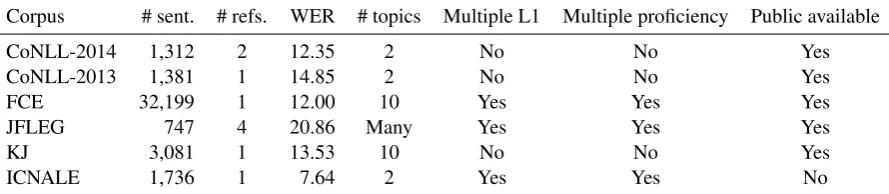
Table1summarizes the properties of these cor-pora. Let N and M denote the total number of source words and sentences in a corpus, respec-tively. Word error rate (WER) is defined as fol-lows:
WER=
∑M
m∑=1d(Xm, Ym)
M m=1Nm
where Xm denotes each source sentence, Ym denotes each corrected sentence, andd(Xm, Ym) denotes the edit distance betweenXmandYm us-ing dynamic programmus-ing.
The following conclusions are derived: (1) CoNLL-2014 has narrow coverage of topics, pro-ficiency and L1s compared with other corporas such as JFLEG and FCE. (2) Several learner cor-pora are available for the evaluation of GEC mod-els. These corpora can help investigate the perfor-mance of GEC models under different conditions.
3.2 Models
The following factors are considered while select-ing our model.
Corpus # sent. # refs. WER # topics Multiple L1 Multiple proficiency Public available
CoNLL-2014 1,312 2 12.35 2 No No Yes
CoNLL-2013 1,381 1 14.85 2 No No Yes
FCE 32,199 1 12.00 10 Yes Yes Yes
JFLEG 747 4 20.86 Many Yes Yes Yes
KJ 3,081 1 13.53 10 No No Yes
[image:3.595.77.522.64.161.2]ICNALE 1,736 1 7.64 2 Yes Yes No
Table 1: Properties of evaluation corpora. Yes/No indicates whether the corpus exhibits each property in terms of multiple L1, multiple proficiency and public available.
• Each model must be implemented to have a competitive performance on CoNLL-2014.
We employed the following models based on the aforementioned factors:
LSTM: We use a bi-directional LSTM in the en-coder and an LSTM with an attention mechanism in the decoder. Both the encoder and the decoder comprise two layers. The LSTM hidden state and word embedding sizes are set to be 500.
CNN: We follow the previous study (Chollampatt and Ng, 2018), namely a fully convolutional encoder–decoder architecture with seven convolutional layers. The hyperparam-eters used in a previous study are used herein (Chollampatt and Ng,2018).
Transformer: Transformer is the self-attention-based model proposed by Vaswani et al. (2017). Six layers are used for both the encoder and de-coder along with eight attention heads. The word embedding size is set to 1024 dimensions, and the size of position-wise feed-forward networks is set to 4096 dimensions at each inner layer.
SMT: We essentially follow the idea used in a previous study (Junczys-Dowmunt and Grundkiewicz, 2016), with some key differences. Specifically, we only use English Wikipedia for language model training and only the NUS Corpus of Learner En-glish (NUCLE) and the Lang-8 Learner Corpora (Lang-8) for translation model training to make the experimental settings equal in all models.
3.3 Experimental Settings
We use two public datasets, namely Lang-8 (Mizumoto et al., 2011) and NUCLE (Dahlmeier et al., 2013), for training. Our pre-processing and experimental setup is similar to that reported previously (Chollampatt and Ng,
2018). In particular, a subset of NUCLE (5.4K)
is utilized as the development data for select-ing the model; the remainselect-ing subset (1.3M) is utilized as the training data. All the models are trained, tuned, and tested in the same way. The models are tested on each test data shown in Table 1. As an evaluation metric, we use F0.5 score computed by applying the MaxMatch scorer (Dahlmeier and Ng, 2012) and GLEU (Napoles et al.,2015). We determine the average F0.5and average GLEU scores of the four models, which are trained with different random initializa-tions, following a previously reported approach (Chollampatt and Ng,2018).
4 Cross-Corpora Evaluation
Figure 1 shows the performance of each model sorted from best to worst based on theirF0.5score, revealing that the performance substantially varies depending on the corpus. For example, the perfor-mance of the transformer ranges from the score of F0.5, which is as low as 36.20 on CoNLL-2013, to as high as 60.06 on JFLEG. Notably, their rank-ings also considerably vary. Transformer performs best on CoNLL-2014. However, it exhibits third-best performance among FCE, KJ, and ICNALE; LSTM outperforms the other models by a large margin of up to 5.3 F0.5 points. Some exam-ples of the model outputs are presented in Table
2 and Table 3. Some situations are successfully corrected using transformer (Table 2), whereas it failed to perform in other situations (Table3). The reason for difference in the model rankings can-not be generally stated because it is influenced by various factors such as the learner’s proficiency, essay topic, and L1. The experimental results show, however, that discussions based on the per-formance on CoNLL-2014 may only hold under certain conditions.
Figure 1: AverageF0.5of the four models (trained with different random initializations), ranked best to worst.
Figure 2: Average GLEU of the four models (trained with different random initializations), ranked best to worst.
rankings on FCE show different trends in Figure
1 and Figure 2. This is partly because F0.5 and GLEU evaluate different perspectives of the mod-els. Furthermore, evaluation data and metric must be appropriately set depending on the factors that need to be evaluated in the model.
5 Discussion
5.1 Is Diverse Single-Corpus Evaluation Sufficient?
Experimental results indicate that the benchmark single-corpus evaluation is not robust; however, more diverse corpora remain undetermined. Both JFLEG and FCE can be diverse corpora because they contain examination scripts written by lan-guage learners from all over the world. JFLEG is particularly designed to contain more diverse corpus for developing and evaluating GEC models (Napoles et al., 2017). If a diverse single-corpus evaluation suffices, the rankings of the models will remain the same. However, experimental results have shown that the model rankings on both JF-LEG and FCE are different (Figure 1). Thus, single-corpus evaluation is deemed weak regard-less of its diversity.
5.2 Advantage of Cross-Corpora Evaluation
This study discusses the importance of evaluat-ing GEC models from various perspectives us-ing multiple corpora. Multi-perspective evaluation does not necessarily mean using multiple corpora. Many aspects in a corpus can be used for analysis, such as the proficiency of the writers, essay topics, and the writer ’s native language. As a case study, we evaluate and analyze the models regarding the
essay WER. Table 4 shows the performance (in precision, recall, andF0.5) of all the models when WER is the lowest (7.64 % for ICNALE) and the highest (20.86 % for JFLEG). Transformer and LSTM outperform all the other models in the highest and the lowest error-rated corpora, respec-tively. Experimental results show that LSTM and transformer may be more precision-oriented and recall-oriented, respectively. Further, precision-oriented models have an advantage over recall-oriented models when a given text contains sev-eral errors, and vice versa. This knowledge en-ables choosing a model based on the task that has to be completed.
6 Conclusion
[image:4.595.73.523.169.244.2]Sentence
Source Hence , someseenit as being considerate in keeping the genetic risk of getting the diseaseinconfidential .
Reference Hence , some seeit as being considerate in keeping the genetic risk of getting the disease[DEL]confidential .
1. Transformer Hence , some seeit as being considerate in keeping the genetic risk of getting the disease[DEL]confidential .
2. LSTM Hence , some seen it as being considerate in keeping the genetic risk of getting the disease inconfidentiality.
3. CNN Hence , some seen it as being considerate in keeping the genetic risk of getting the disease inconfidentiality.
Table 2: Examples of model outputs on CoNLL-2014.
Sentence
[image:5.595.70.531.62.218.2]Source Inthat day , the time I left school was about eleven p.m . Reference Onthat day , the time I left school was about eleven p.m . 1. LSTM Onthat day , the time I left school was about eleven p.m . 2. CNN Onthat day , the time I left school was about eleven p.m . 3. Transformer Thatday , the time I left school was about eleven p.m .
Table 3: Examples of model outputs on KJ.
WER (%) Low (7.64) High (20.86)
P R F0.5 P R F0.5
Transformer 37.69 37.67 37.72 67.27 42.05 60.06
LSTM 48.68 29.37 43.02 72.97 31.09 57.47
CNN 44.35 30.87 40.78 70.85 32.77 57.49 SMT 40.73 18.60 32.91 67.95 16.89 42.35
Table 4: Performance in precision, recall, andF0.5of
all models on the corpora when the WER is lowest and highest.
Acknowledgments
We are grateful to the members of the Tohoku Uni-versity Natural Language Processing Laboratory as well as the anonymous reviewers for their in-sightful comments and suggestions.
References
Shamil Chollampatt and Hwee Tou Ng. 2018. A Mul-tilayer Convolutional Encoder-Decoder Neural Net-work for Grammatical Error Correction. In Pro-ceedings of AAAI, pages 5755–5762.
Daniel Dahlmeier and Hwee Tou Ng. 2012. Better Evaluation for Grammatical Error Correction. In
Proceedings of NAACL, pages 568–572.
Daniel Dahlmeier, Hwee Tou Ng, and Siew Mei Wu. 2013. Building a Large Annotated Corpus of
Learner English: The NUS Corpus of Learner En-glish. InProceedings of BEA, pages 22–31.
Mariano Felice, Zheng Yuan, Øistein E. Andersen, He-len Yannakoudakis, and Ekaterina Kochmar. 2014. Grammatical error correction using hybrid systems and type filtering. InProceedings of CoNLL 2014 Shared Task, pages 15–24.
Rachele De Felice and Stephen G. Pulman. 2008. A Classifier-Based Approach to Preposition and Deter-miner Error Correction in L2 English. In Proceed-ings of COLING, pages 169–176.
Tao Ge, Furu Wei, and Ming Zhou. 2018. Reaching Human-level Performance in Automatic Grammati-cal Error Correction: An EmpiriGrammati-cal Study. arXiv.
Na-Rae Han, Martin Chodorow, and Claudia Leacock. 2006. Detecting Errors in English Article Usage by Non-Native Speakers. Natural Language Engineer-ing, 12(2):115–129.
Eduard Hovy, Mitchell Marcus, Martha Palmer, Lance Ramshaw, and Ralph Weischedel. 2006. OntoNotes: The 90% Solution. InProceedings of NAACL, pages 57–60.
Shin’ichro Ishikawa. 2013. The ICNALE and Sophis-ticated Contrastive Interlanguage Analysis of Asian learners of English. Learner Corpus Studies in Asia and the World, 1:91–118.
[image:5.595.73.532.250.338.2]Data-Intensive and Feature-Rich Statistical Machine Translation. InProceedings of CoNLL 2014 Shared Task, pages 25–33.
Marcin Junczys-Dowmunt and Roman Grundkiewicz. 2016. Phrase-based Machine Translation is State-of-the-Art for Automatic Grammatical Error Correc-tion. InProceedings of EMNLP, pages 1546–1556.
Marcin Junczys-Dowmunt, Roman Grundkiewicz, Shubha Guha, and Kenneth Heafield. 2018. Ap-proaching Neural Grammatical Error Correction as a Low-Resource Machine Translation Task. In Pro-ceedings of NAACL, pages 595–606.
Mitchell P. Marcus, Mary Ann Marcinkiewicz, and Beatrice Santorini. 1993. Building a Large Anno-tated Corpus of English: The Penn Treebank. Com-putational Linguistics, 19(2):313–330.
Tomoya Mizumoto, Yuta Hayashibe, Mamoru Ko-machi, Masaaki Nagata, and Yuji Matsumoto. 2012. The Effect of Learner Corpus Size in Grammatical Error Correction of ESL Writings. InProceedings of COLING, pages 863–872.
Tomoya Mizumoto, Mamoru Komachi, Masaaki Na-gata, and Yuji Matsumoto. 2011. Mining Revi-sion Log of Language Learning SNS for Auto-mated Japanese Error Correction of Second Lan-guage Learners. InProceedings of IJCNLP, pages 147–155.
Ryo Nagata, Atsuo Kawai, Koichiro Morihiro, and Naoki Isu. 2006. A Feedback-Augmented Method for Detecting Errors in the Writing of Learners of English. In Proceedings of COLING-ACL, pages 241–248.
Ryo Nagata, Edward Whittaker, and Vera Shein-man. 2011. Creating a manually error-tagged and shallow-parsed corpus. In Proceedings of ACL, pages 1210–1219.
Courtney Napoles, Keisuke Sakaguchi, Matt Post, and Joel Tetreault. 2015. Ground Truth for Grammatical Error Correction Metrics. InProceedings of ACL, pages 588–593.
Courtney Napoles, Keisuke Sakaguchi, and Joel Tetreault. 2017. JFLEG: A Fluency Corpus and Benchmark for Grammatical Error Correction. In
Proceedings of EACL, pages 229–234.
Hwee Tou Ng, Siew Mei Wu, Ted Briscoe, Christian Hadiwinoto, Raymond Hendy Susanto, and Christo-pher Bryant. 2014. The CoNLL-2014 Shared Task on Grammatical Error Correction. InProceedings of CoNLL 2014 Shared Task, pages 1–14.
Hwee Tou Ng, Siew Mei Wu, Yuanbin Wu, Christian Hadiwinoto, and Joel Tetreault. 2013. The CoNLL-2013 Shared Task on Grammatical Error Correction. InProceedings of CoNLL 2013 Shared Task, pages 1–12.
Slav Petrov and Ryan McDonald. 2012. Overview of the 2012 Shared Task on Parsing the Web. InNotes of the First Workshop on Syntactic Analysis of Non-Canonical Language.
Keisuke Sakaguchi, Matt Post, and Van Benjamin Durme. 2017. Grammatical Error Correction with Neural Reinforcement Learning. InProceedings of IJCNLP, pages 366–372.
Ashish Vaswani, Noam Shazeer, Parmar Niki, Jakob Uszkoreit, Llion Jones, Aidan N Gomez, Łukasz Kaiser, and Illia Polosukhin. 2017. Attention Is All You Need. In Proceedings of NIPS, pages 5998– 6008.
Ziang Xie, Guillaume Genthial, Andrew Y. Ng, and Dan Jurafsky. 2018. Noising and Denoising Natu-ral Language: Diverse Backtranslation for Grammar Correction. InProceedings of NAACL, pages 619– 628.