2793
Relation Classification Using Segment-Level Attention-based CNN and
Dependency-based RNN
Van-Hien Tran1,Van-Thuy Phi1,Hiroyuki Shindo1,2, andYuji Matsumoto1,2
1Nara Institute of Science and Technology 2RIKEN Center for Advanced Intelligence Project (AIP)
1{tran.van hien.ts1,phi.thuy.ph8,shindo,matsu}@is.naist.jp
Abstract
Recently, relation classification has gained much success by exploiting deep neural net-works. In this paper, we propose a new model effectively combining Segment-level Attention-based Convolutional Neural Net-works (SACNNs) and Dependency-based Re-current Neural Networks (DepRNNs). While SACNNs allow the model to selectively focus on the important information segment from the raw sequence, DepRNNs help to handle the long-distance relations from the shortest de-pendency path of the related entities. Exper-iments on the SemEval-2010 Task 8 dataset show that our model is comparable to the state-of-the-art without using any external lexical features.
1 Introduction
Relation classification (RC) is a fundamental task in Natural Language Processing (NLP) that aims to identify semantic relations between pairs of marked entities in given sentences (instances). It has attracted much research effort as it plays a vital role in many NLP applications such as Informa-tion ExtracInforma-tion and QuesInforma-tion Answering (Nguyen and Grishman, 2015). Traditional approaches (Kambhatla,2004;Zhang et al.,2006) usually rely heavily on hand-crafted features and lexical re-sources, or elaborately designed kernels, which are time-consuming and challenging to adapt to novel domains. Recently, neural network (NN) models have dominated the work on RC since they can effectively learn meaningful hidden features without human intervention.
However, most previous NN models only ex-ploit one of the following structures to represent relation instances: raw word sequences (Zhou et al., 2016;Wang et al., 2016) and dependency trees (Wen,2017;Le et al.,2018). While raw se-quences can provide all the information of
rela-tion instances, they also add noise to the models from redundant information. While dependency tree structures help the models focus on the con-cise information captured by the shortest depen-dency path (SDP) between two entities, they lose some supplementary context in the raw sequence. It is clear that the raw sequence and SDP highly complement each other. We, therefore, combine them to be more effective in determining the rela-tion without losing any informarela-tion.
While CNNs are able to learn short patterns (local features) (LeCun et al., 1995), RNNs have been effective in learning word sequence informa-tion (long-distance features) (Chung et al.,2014). In this paper, we present a new model combining both CNNs and RNNs, exploiting the information from both the raw sequence and the SDP.
Our contributions are summarized as follows: (a) We combine Entity Tag Feature (ETF) (Qin et al., 2016) and Tree-based Position Feature (TPF) (Yang et al., 2016) to improve the seman-tic information between the marked entities in the raw input sentences.
(b) We propose Segment-Level Attention-based Convolutional Neural Networks (SACNNs) which automatically pay special attention to the impor-tant text segments from the raw sentence for RC.
(c) We build Dependency-based Recurrent Neu-ral Networks (DepRNNs) on the SDP to gain long-distance features. Then, we combine the SACNN and the DepRNN to preserve the full relational information. Our proposed model achieves new state-of-the-art results on SemEval-2010 Task 8, compared with other complex models.
2 Related Work
Traditional supervised approaches can be di-vided into feature-based methods and kernel meth-ods. Feature-based methods focus on extract-ing and combinextract-ing relevant features. Rink and Harabagiu (2010) leveraged useful features to achieve the best performance on SemEval-2010 Task 8. Meanwhile, kernel methods measure the structural similarity between two data samples, based on carefully designed kernels.Wang(2008) combined convolutional kernel and syntactic fea-tures to gain benefits for relation extraction.
Nowadays, deep neural networks are widely uti-lized in RC. Zeng et al. (2014) exploited a CNN to extract lexical and sentence features. Qin et al.
(2016) used ETF to specify target entities in in-put sentences and fed them to a CNN. Vu et al.
(2016) combined CNN and RNN to improve per-formance. Some recent work leveraged SDP for RC.Yang et al.(2016) proposed a position encod-ing CNN based on dependency parse trees, while
Wen(2017) presented a model that learns repre-sentations from SDP, using both CNN and RNN.
3 Our Method
Given a sentence S with an annotated pair of enti-ties (e1,e2), we aim to identify the semantic rela-tion between them. Since the set of target relarela-tions is pre-defined, RC can be treated as a multi-class classification problem. In this section, we describe our model in detail for resolving this problem.
3.1 Input Representation
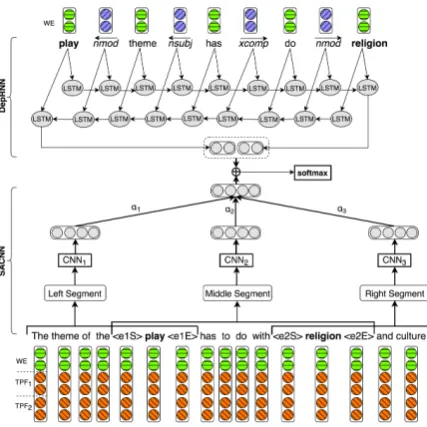
In Figure 1, Entity Tag Feature (ETF) is firstly used to annotate two entities in each raw sentence. Then, each word is represented by the concate-nation of two parts: Word Embedding (WE) and Tree-based Position Features (TPFs). The repre-sentation sequence is then fed to the SACNN.
Entity Information. As the pairs of entities (e1, e2) are previously known, it is important to provide their information to the NNs. Following the work of Qin et al. (2016), we also use ETF which involves adding four tokens:he1Si,he1Ei,
he2Siandhe2Eito each input sentence.
Word Embedding. Distributed representations of words in a vector space have helped learning algorithms to achieve better performance in NLP tasks (Mikolov et al.,2013). Following most pre-vious work, we also use pre-trained word embed-dings to initialize input word tokens in our model.
Tree-based Position Features. Yang et al.
(2016) proposed TPFs for encoding relative dis-tances of the current word to marked entities in dependency trees. The relative distance refers to the length of the SDP between the current word and the target entity. Then, each integer num-ber is represented by a randomly initialized vector. Since TPFs help the neural network focus on cru-cial words and phrases in a sentence (Yang et al.,
2016), we therefore utilize TPFs in our model. In Figure 1, TPF1and TPF2are relative distance fea-tures of each word toe1ande2, respectively. For the four tokens: he1Si,he1Ei,he2Siandhe2Ei, which do not belong to the dependency tree, we simply pad zero vectors for their TPFs.
SDP. For the input of the DepRNN, we merely use the SDP between two marked entities from the original sentence as in Figure 1. Each nor-mal word in the SDP is represented by a vector from pre-trained word embeddings. Meanwhile, following Le et al. (2018), we also consider de-pendency relations between words in the SDP and represent each dependency relationdi as a vector Di that is the concatenation of two vectors as fol-lows:
Di =Dtypi⊕Ddiri,
where Dtyp is the undirected dependency vector (i.e.,nmod), andDdiris the orientation of the de-pendency vector (i.e.,left-to-right or vice versa). BothDtypandDdirare initialized randomly.
3.2 Framework
The architecture of our model is illustrated in Fig-ure 1. The example sentence with two entitiese1 (play) and e2 (religion) is labeled by the direc-tional relation “Message-Topic(e1;e2)”. While the raw sequence is passed to the SACNN, the SDP betweene1ande2is used in the DepRNN.
Segment Attention-based CNN. In the SACNN, each raw sentence is divided into three segments according to two entities: the left seg-ment, the middle segseg-ment, and the right segment. The repetitions of e1 and e2 in these segments help the semantic meaning of each segment to be more clear. Intuitively, the middle segment is often more important to reflect the semantic relation. Qin et al. (2016) only used the middle segment with a CNN for RC, while Vu et al.
(2016) proposed an extended middle context to pay special attention to the middle part.
Figure 1: Our model for relation classification.
it is not always true for all. For example, in the sentence “All otherhe1Sibloodhe1Ei he2Si
products he2Ei are derived from whole blood.” with the relation label “Entity-Origin(e2;e1)”, the right segment is more important to reflect the re-lation type. Besides, the left and right segments might also provide the necessary information to RC. We therefore proceed three segments inde-pendently through three separate CNNs, which al-low the model to automatically identify segments containing important information. Each CNN includes one convolutional layer and one max-pooling layer.
LetM be a matrix consisting of output vectors of three CNNs: M = [m1, m2, m3], where mi
is the output of CN Ni. The final representation
r1 of the raw sentence generated by SACNN is
formed by a weighted sum of output vectors inM:
zi =tanh(mi),
αi =
exp(wTzi+b) P3
i=1exp(wTzi+b)
,
r1 = 3 X
i=1
αimi,
wherewis a weight vector,wT is its transforma-tion, andbis a bias parameter.
Dependency-based RNN. While SACNN can learn local features, it cannot handle long-distance dependency between two entities. This disadvan-tage causes difficulty in correctly assigning sub-ject and obsub-ject roles of two entities when capturing
the directional relation. Meanwhile, RNN could tackle the problem of long-distance pattern learn-ing (Zhang and Wang, 2015). Besides, the SDP naturally offers the relative positions of subjects and objects through the path directions (Xu et al.,
2015). We, therefore, exploit SDP based on RNN to gain the information in the directional relation.
An shown in Figure 1, we use Bidirectional Long Short-Term Memory (BLSTM) on the SDP between two entities. Due to its ability to cap-ture long term memory, the BLSTM accumulates increasingly richer information as it goes through the SDP from both two forward and backward di-rections (Palangi et al.,2016). When it reaches the last two words, the last two hidden states are ex-pected to provide the full semantic meaning of the whole SDP. Additionally, since the length of the SDP is often not so long, we concatenate two out-put vectors of the last two hidden states as the final representationr2of the SDP by DepRNN.
Combination of SACNN and DepRNN. Fi-nally, we combine both SACNN and DepRNN models to exploit fully their own distinct advan-tages. While SACNN can focus on important seg-ments and gain local features, DepRNN helps to handle long-distance dependency between two en-tities based on the SDP as well as provide subject and object roles of two entities for the directional relation. Therefore, the final representation r of the relation instance is concatenated by two output vectors (r1,r2) of SACNN and DepRNN, which
is then fed to a softmax classifier.
4 Experiments
4.1 Datasets and Settings
We evaluate our model on the SemEval2010 Task 8 which contains 8,000 training sentences and 2,717test sentences, with19relations (9directed relations and an undirected Other class). There-fore, the relation classification task is treated as a multi-class classification problem. Following pre-vious work, the official macro-averaged F1-score, which excludes theOtherrelation, is used for eval-uation.
We randomly held out 10% of the training set for validation. The Stanford Parser is also used to convert sentences to dependency trees.
pre-SACNN F1 WE, ETF 83.9 WE, TPF 84.5 WE, ETF, TPF 85.1
Table 1: Comparison of different features in SACNN. WE, ETF, and TPF stand for Word Embedding, Entity Tag Feature, and Tree-based Position Feature.
[image:4.595.148.217.63.104.2]Model Input F1 CNN Original Sentence 83.5 CNN Middle Segment 84.1 SACNN Three Segments 85.1
Table 2: Effectiveness of the segment-level attention.
trained embedding sets. The above pre-trained embedding set is selected since it embeds depen-dency context to provide valuable syntactic in-formation. Four tokens: he1Si, he1Ei, he2Si,
he2Eiand out-of-vocabulary words are initialized by sampling from a uniform distribution (Kim,
2014). TPF is15-dimensional and initialized ran-domly. Thus, the representation of each word has a dimensionality of330in the raw sentence.
Hyper-parameters in our model are as follows: 100 filters for each window size [3, 4, 5] and ReLU as the activation function for each CNN in SACNN. In DepRNN, the dimension of each to-ken is300, thetanhactivation function is applied to the last two hidden states, the dimension of each hidden state vector is150. Other parameters in-clude: L2 regularization with a weight of10−4, a mini-batch size of 64, a dropout rate at the final layer p =0.5before a softmax classifier.
4.2 Results and Analysis
Impact of SACNN and DepRNN. We consider the performance of each model by feeding sepa-rately their output vector to a softmax classifier.
In Table 1, we see the effect of different features to SACNN’s performance. Combining ETF and TPF significantly enhances theF1score by0.6%. It proves that ETF and TPF complement each other to more fully provide information about the marked entities and important words to SACNN.
We also examine the segment-level attention mechanism of SACNN. In Table 2, with the same input features (WE, ETF, TPF), the segment-level attention mechanism makes a great contribution by increasing theF1score by1%.
To check the effect of combining SACNN and DepRNN, in Table 3, we compare the performance of each model to our combined model. First,
Model F1 DepRNN 83.8 SACNN 85.1 Combined 85.8
Table 3: Evaluation of our combined model.
Model Features F1
SVM
(Rink and Harabagiu,2010) Rich features 82.2 BLSTM+Attention
(Zhou et al.,2016) WE, ETF 84.0 PECNN
(Yang et al.,2016)
WE, DT, TPF, POS, NER, WordNet 84.6 CNN+BLSTM
(Wang et al.,2017)
WE, DT, PF,POS, GR, NER, WordNet 84.7 SR-BRCNN
(Wen,2017)
WE, DT,
POS, NER, WordNet 85.1 CNN+BLSTM
(Zhang et al.,2018) WE, PF 83.7 CNN+BLSTM+Attention
Our model WE, DT, TPF, ETF 85.8
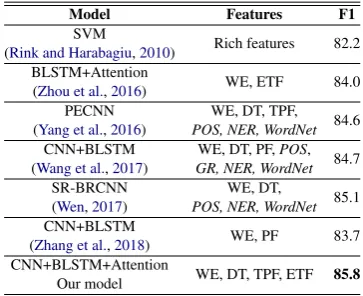
Table 4: Comparison of different classification models. DT, PF stand for Dependency Tree, Position Feature. Theitalicfeatures are external lexical features used.
the SACNN’s performance is superior to the De-pRNN. One possible reason is that while SACNN selectively focuses on the important segments as well as gains local features from the raw sen-tences, DepRNN based on the SDP, which is short in the SemEval2010 Task 8, can only provide ef-fectively the entities role. Then, by combining SACNN and DepRNN, our model can exploit the fully necessary information and achieve the best performance.
Comparisons with the State of the Art. We compare our model to some recent work on RC in Table 4. Most previous work exploited some ex-ternal lexical features (WordNet, NER) and com-bine NNs to improve the performance (Yang et al.,
2016;Wang et al.,2017). Wang et al.(2017) and
Wen(2017) proposed complex structures for inte-grating the CNN and the LSTM, and achieved an
F1of84.7% and85.1% respectively.Zhang et al.
(2018) combined CNN and BLSTM, and reached anF1 of83.7% using only WE, PF features.
[image:4.595.326.508.140.288.2] [image:4.595.128.238.164.205.2]5 Conclusion
This work presents a new model that combines the SACNN and the DepRNN for RC. Combin-ing ETF and TPF provides entity and semantic information of the input sentences to the model effectively. We also propose the SACNN which automatically focus on the essential segments and gains local features. Besides, the DepRNN helps to exploit long-distance dependency between two entities and their roles. Finally, combining the SACNN and the DepRNN brings the best perfor-mance since they highly complement each other. Our model achieved a notable performance on the SemEval2010 Task 8 without using any external lexical resources.
Acknowledgments
This work was partly supported by JST CREST Grant Number JPMJCR1513, Japan. We are grate-ful to the members of the Computational Linguis-tics Laboratory, NAIST and the anonymous re-viewers for their insightful comments.
References
Junyoung Chung, Caglar Gulcehre, KyungHyun Cho, and Yoshua Bengio. 2014. Empirical evaluation of gated recurrent neural networks on sequence model-ing. arXiv preprint arXiv:1412.3555.
Nanda Kambhatla. 2004. Combining lexical, syntactic, and semantic features with maximum entropy mod-els for extracting relations. In Proceedings of the ACL 2004 on Interactive poster and demonstration sessions, page 22. Association for Computational Linguistics.
Yoon Kim. 2014. Convolutional neural net-works for sentence classification. arXiv preprint arXiv:1408.5882.
Alexandros Komninos and Suresh Manandhar. 2016. Dependency based embeddings for sentence classi-fication tasks. InProceedings of the 2016 Confer-ence of the North American Chapter of the Associ-ation for ComputAssoci-ational Linguistics: Human Lan-guage Technologies, pages 1490–1500.
Hoang-Quynh Le, Duy-Cat Can, Sinh T. Vu, Thanh Hai Dang, Mohammad Taher Pilehvar, and Nigel Col-lier. 2018. Large-scale exploration of neural rela-tion classificarela-tion architectures. InProceedings of the 2018 Conference on Empirical Methods in Nat-ural Language Processing, pages 2266–2277, Brus-sels, Belgium. Association for Computational Lin-guistics.
Yann LeCun, Yoshua Bengio, et al. 1995. Convolu-tional networks for images, speech, and time series.
The handbook of brain theory and neural networks, 3361(10):1995.
Tomas Mikolov, Kai Chen, Greg Corrado, and Jef-frey Dean. 2013. Efficient estimation of word representations in vector space. arXiv preprint arXiv:1301.3781.
Thien Huu Nguyen and Ralph Grishman. 2015. Rela-tion extracRela-tion: Perspective from convoluRela-tional neu-ral networks. InProceedings of the 1st Workshop on Vector Space Modeling for Natural Language Pro-cessing, pages 39–48.
Hamid Palangi, Li Deng, Yelong Shen, Jianfeng Gao, Xiaodong He, Jianshu Chen, Xinying Song, and Rabab Ward. 2016. Deep sentence embedding using long short-term memory networks: Analysis and ap-plication to information retrieval. IEEE/ACM Trans-actions on Audio, Speech and Language Processing (TASLP), 24(4):694–707.
Pengda Qin, Weiran Xu, and Jun Guo. 2016. An em-pirical convolutional neural network approach for semantic relation classification. Neurocomputing, 190:1–9.
Bryan Rink and Sanda Harabagiu. 2010. Utd: Clas-sifying semantic relations by combining lexical and semantic resources. InProceedings of the 5th Inter-national Workshop on Semantic Evaluation, pages 256–259. Association for Computational Linguis-tics.
Ngoc Thang Vu, Heike Adel, Pankaj Gupta, and Hin-rich Sch¨utze. 2016. Combining recurrent and convo-lutional neural networks for relation classification.
arXiv preprint arXiv:1605.07333.
Linlin Wang, Zhu Cao, Gerard de Melo, and Zhiyuan Liu. 2016. Relation classification via multi-level at-tention cnns.
Mengqiu Wang. 2008. A re-examination of depen-dency path kernels for relation extraction. In Pro-ceedings of the Third International Joint Conference on Natural Language Processing: Volume-II.
Pengfei Wang, Zhipeng Xie, and Junfeng Hu. 2017. Relation classification via cnn, segmented max-pooling, and sdp-blstm. InInternational Conference on Neural Information Processing, pages 144–154. Springer.
Ji Wen. 2017. Structure regularized bidirectional recur-rent convolutional neural network for relation clas-sification.arXiv preprint arXiv:1711.02509.
Yunlun Yang, Yunhai Tong, Shulei Ma, and Zhi-Hong Deng. 2016. A position encoding convolutional neural network based on dependency tree for rela-tion classificarela-tion. InProceedings of the 2016 Con-ference on Empirical Methods in Natural Language Processing, pages 65–74.
Daojian Zeng, Kang Liu, Siwei Lai, Guangyou Zhou, and Jun Zhao. 2014. Relation classification via con-volutional deep neural network. In Proceedings of COLING 2014, the 25th International Conference on Computational Linguistics: Technical Papers, pages 2335–2344.
Dongxu Zhang and Dong Wang. 2015. Relation classi-fication via recurrent neural network.arXiv preprint arXiv:1508.01006.
Min Zhang, Jie Zhang, Jian Su, and Guodong Zhou. 2006. A composite kernel to extract relations be-tween entities with both flat and structured features. InProceedings of the 21st International Conference on Computational Linguistics and the 44th annual meeting of the Association for Computational Lin-guistics, pages 825–832. Association for Computa-tional Linguistics.
Xiaobin Zhang, Fucai Chen, and Ruiyang Huang. 2018. A combination of rnn and cnn for attention-based relation classification. Procedia computer sci-ence, 131:911–917.