Proceedings of NAACL-HLT 2019, pages 4010–4015 4010
Using Natural Language Relations between Answer Choices
for Machine Comprehension
Rajkumar Pujari
Department of Computer Science Purdue University
Dan Goldwasser
Department of Computer Science Purdue University
Abstract
When evaluating an answer choice for Read-ing Comprehension task, other answer choices available for the question and the answers of related questions about the same paragraph of-ten provide valuable information. In this pa-per, we propose a method to leverage the nat-ural language relations between the answer choices, such as entailment and contradiction, to improve the performance of machine com-prehension. We use a stand-alone question an-swering (QA) system to perform QA task and a Natural Language Inference (NLI) system to identify the relations between the choice pairs. Then we perform inference using an Integer Linear Programming (ILP)-based rela-tional framework to re-evaluate the decisions made by the standalone QA system in light of the relations identified by the NLI system. We also propose a multitask learning model that learns both the tasks jointly.
1 Introduction
Given an input text and a set of related questions with multiple answer choices, the reading com-prehension (RC) task evaluates the correctness of each answer choice. Current approaches to the RC task quantify the relationship between each ques-tion and answer choice independently and pick the highest scoring option. In this paper, we fol-low the observation that when humans approach such RC tasks, they tend to take a holistic view ensuring that their answers are consistent across the given questions and answer choices. In this work we attempt to model these pragmatic infer-ences, by leveraging theentailmentand contradic-tion relations between the answer choices to im-prove machine comprehension. To help clarify these concepts, consider the following examples:
How can the military benefit from the existence of the CIA?
c1: They can use them
c2: These agencies are keenly attentive to the military’s strategic and tactical requirements(7) c3: The CIA knows what intelligence the mili-tary requires and has the resources to obtain that intelligence(3)
The above example contains multiple correct answer choices, some are easier to capture than others. For example, identifying that c3 is true might be easier than c2 based on its alignment with the input text. However, capturing that c3 entailsc2allows us to predictc2correctly as well. Classification of the answer in red (marked 7) could be corrected using the blue (marked 3) answer choice.
Q1: When were the eggs added to the pan to make the omelette?
c11: When they turned on the stove
c1
2: When the pan was the right temperature(3)
Q2:Why did they use stove to cook omelette? c21: They didn’t use the stove but a microwave c2
2: Because they needed to heat up the pan(7) Similarly, answering Q1 correctly helps in an-swering Q2. Our goal is to leverage such infer-ences for machine comprehension.
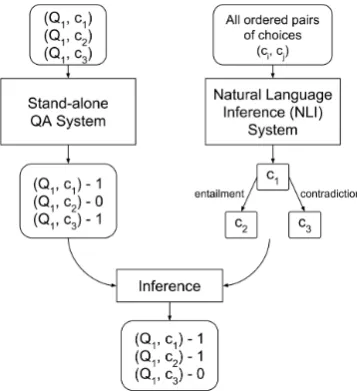
Our approach contains three steps. First, we use a stand-alone QA system to classify the answer choices as true/false. Then, we classify the rela-tion between each pair of choices for a given ques-tion as entailment, contradiction or neutral. Fi-nally, we re-evaluate the labels assigned to choices using an Integer Linear Programming based infer-ence procedure. We discuss different training pro-tocols and representation choices for the combined decision problem. An overview is in figure1.
SemEval-2018 task-11 (Ostermann et al., 2018) and show that it improves machine comprehension in both.
Figure 1: Proposed Approach
2 Related Work
Recently, several QA datasets have been pro-posed to test machine comprehension ( Richard-son, 2013;Weston et al., 2015; Rajpurkar et al.,
2016;Trischler et al.,2016a;Nguyen et al.,2016).
Yatskar (2018) showed that a high performance on these datasets could be achieved without nec-essarily achieving the capability of making com-monsense inferences.Trischler et al.(2016b), Ku-mar et al.(2016),Liu and Perez(2017),Min et al.
(2018) andXiong et al.(2016) proposed success-ful models on those datasets. To address this is-sue, new QA datasets which require commonsense reasoning have been proposed (Khashabi et al.,
2018; Ostermann et al., 2018; Mihaylov et al.,
2018). Using common sense inferences in Ma-chine Comprehension is a far from solved prob-lem. There have been several attempts in litera-ture to use inferences to answer questions. Most of the previous works either attempt to infer the answer from the given text (Sachan and Xing,
2016; Sun et al., 2018) or an external common-sense knowledge base (Das et al.,2017;Mihaylov and Frank,2018;Bauer et al.,2018;Weissenborn et al.,2017).
While neural models can capture some depen-dencies between choices through shared repre-sentations, to the best of our knowledge, infer-ences capturing the dependencies between answer choices or different questions have been not ex-plicitly modeled.
3 Model
Formally, the task of machine comprehension can be defined as: given text P and a set of n re-lated questionsQ = {q1, q2, . . . , qn} each having
mchoicesC ={ci1, ci2, . . . , cim}∀qi ∈ Q, the task
is to assign true/false value for each choicecij.
3.1 Model Architecture
Our model consists of three separate systems, one for each step, namely, the stand-alone question an-swering (QA) system, the Natural Language Infer-ence (NLI) system and the inferInfer-ence framework connecting the two. First, we assign a true/false label to each question-choice pair using the stand-alone QA system along with an associated confi-dence scores1. Consequently, we identify the nat-ural language relation (entailment, contradiction or neutral) between each ordered pair of choices for a given question, along with an associated con-fidence scores2. Then, we use a relational frame-work to perform inference using the information obtained from the stand-alone QA and the NLI systems. Each of the components is described in detail in the following sub-sections.
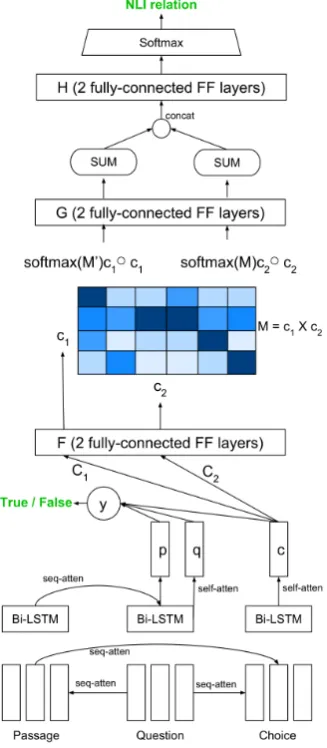
We further propose a joint model whose param-eters are trained jointly on both the tasks. The joint model uses the answer choice representation gen-erated by the stand-alone QA system as input to the NLI detection system. The architecture of our joint model is shown in figure2.
3.1.1 Stand-alone QA system
We use the TriAN-single model proposed by
Wang et al. (2018) for SemEval-2018 task-11 as our stand-alone QA system. We use the imple-mentation1provided byWang et al.(2018) for our experiments. The system is a tri-attention model that takes passage-question-choice triplet as input and produces the probability of the choice being true as its output.
3.2 NLI System
Our NLI system is inspired from decomposable-attention model proposed byParikh et al. (2016). We modified the architecture proposed in Parikh et al.(2016) to accommodate the question-choice pairs as opposed to sentence pairs in the original model. We added an additional sequence-attention layer for the question-choice pairs to allow for the
1https://github.com/intfloat/
Figure 2: Architecture of the Joint Model
representation of both the answer choice and the question. Sequence-attention is defined in Wang et al.(2018) as:
Attseq(u,{vi}ni=1) =
n
X
i=1 αivi
αi=sof tmaxi(f(W1u)Tf(W1vi))
(1)
whereuandviare word embeddings,W1is the as-sociated weight parameter and f is non-linearity. Self-attention isAttseq of a vector onto itself.
The embedding of each word in the answer choice is attended to by the sequence of ques-tion word embeddings. We use pre-trained GloVe (Pennington et al.,2014) embeddings to represent the words. The question-attended choices are then passed through the decomposable-attention layer proposed inParikh et al.(2016).
3.2.1 Inference using DRAIL
We use Deep Relational Learning (DRaiL) frame-work proposed byZhang et al. (2016) to perform
the final inference. The framework allows for dec-laration of predicate logic rules to perform rela-tional inference. The rules are scored by the con-fidence scores obtained from the stand-alone QA and the NLI systems. DRaiL uses an Integer Lin-ear Programming (ILP) based inference procedure to output binary prediction for each of the choices. We use the following constraints for our inference:
1. ciis true &cientailscj =⇒ cjis true.
2. ciis true &cicontradictscj =⇒ cjis false.
On the MultiRC dataset, we use the dependen-cies between the answer choices for a given ques-tion. On SemEval dataset, we use the dependen-cies between different questions about the same paragraph.
3.3 Joint Model
The design of our joint model is motivated by the two objectives: 1) to obtain a better representa-tion for the quesrepresenta-tion-choice pair for NLI detecrepresenta-tion and 2) to leverage the benefit of multitask learn-ing. Hence, in the joint model, choice represen-tation from stand-alone QA system is input to the decomposable-attention layer of the NLI system.
The joint model takes two triplets (p,qi,ci) and
(p,qj,cj) as input. It outputs atrue/falsefor
each choice and an NLI relation (entailment, con-tradiction or neutral) between the choices. The representations for passage, question and choice are obtained using Bi-LSTMs. The hidden states of the Bi-LSTM are concatenated to generate the representation. This part of the model is similar to TriAN model proposed inWang et al. (2018). The choice representations ofciandcj are passed
as input to the decomposable attention layer pro-posed inParikh et al.(2016). The architecture of the joint model is shown in figure2.
3.4 Training
We train the stand-alone QA system using the MultiRC and SemEval datasets for respective ex-periments. We experiment with2 different train-ing setttrain-ings for the NLI system. In the first set-ting, we use SNLI dataset (Bowman et al.,2015) to train the NLI system. The sequence-attention layer is left untrained during this phase. Hence, we only use the answer choice and do not consider the question for NLI detection.
sys-tem. Self-training examples for the NLI system were obtained using the following procedure: if the SNLI-trained NLI model predicted entailment and the gold labels of the ordered choice pair were true-true, then the choice pair is labeled as entailment. Similarly, if the SNLI-trained NLI model predicted contradiction and the gold labels of the ordered choice pair were true-false, then the choice pair is labeled as contradiction. This is noisy labelling as the labels do not directly indicate the presence of NLI relations between the choices. The NLI model was additionally trained using this data.
Model Entailment Contradiction Overall
N LISN LI 40.80 74.25 55.11
N LIM ultiRC 57.30 69.22 66.31
Table 1:Accuracy of entailment and contradiction detection on the development set of self-training data for NLI model trained on SNLI data (N LISN LI) vs training set of self-training data (N LIM ultiRC)
To train the joint model we use ordered choice pairs, labeled asentailment if the gold labels are true-true and labeled as contradiction if the gold labels aretrue-false. This data was also used to test the effectiveness of the self-training procedure. The results on the development set of MultiRC dataset are in table1.
The NLI model trained on SNLI dataset achieves 55.11% accuracy. Training the N LI model on the data from MultiRC data increases the overall accuracy to 66.31%. Further discus-sion about self-training is provided in section5.
4 Experiments
We perform experiments in four phases. In the first phase, we evaluate the stand-alone QA sys-tem. In the second phase, we train the NLI system on SNLI data and evaluate the approach shown in figure1. In the third phase, we train the NLI system using the self-training data. In the fourth phase, we evaluate the proposed joint model. We evaluate all models on MultiRC dataset. The re-sults are shown in table2. We evaluate the joint model on SemEval dataset, shown in table3.
4.1 Datasets
We use two datasets for our experiments, MultiRC dataset2 and the SemEval 2018 task 11 dataset3.
2
http://cogcomp.org/multirc/
3https://competitions.codalab.org/
competitions/17184
MultiRC dataset consisted of a training and devel-opment set with a hidden test set. We split the given training set into training and development sets and use the given development set as test set.
Each question in the MultiRC dataset has ap-proximately 5 choices on average. Multiple of them may be true for a given question. The training split of MultiRC consisted of 433 para-graphs and 4,853 questions with25,818answer choices. The development split has23paragraphs and 275 questions with 1,410 answer choices. Test set has83paragraphs and953questions with 4,848answer choices.
SemEval dataset has 2 choices for each ques-tion, exactly one of them is true. The training set consists of1,470paragraphs with9,731 ques-tions. The development set has 219 paragraphs with 1,411 questions. And the test set has 430 paragraphs with2,797questions.
4.2 Evaluation Metrics
For MultiRC dataset, we use two metrics for eval-uating our approach, namely EM0 and EM1. EM0 refers to the percentage of questions for which all the choices have been correctly classi-fied. EM1 is the the percentage of questions for which at most one choice is wrongly classified. For the SemEval dataset, we useaccuracymetric.
4.3 Results
Results of our experiments are summarized in ta-bles 2 & 3. EM0 on MC task improves from 18.15% to 19.41% when we use the NLI model trained over SNLI data and it further improves to 21.62% when we use MultiRC self-training data. Joint model achieves 20.36% on EM0 but achieves the highest EM1 of 57.08%. Human EM0is56.56%.
Method EM0 EM1
Stand-alone QA 18.15 52.99
QA +N LISN LI 19.41 56.13
QA +N LIM ultiRC 21.62 55.72
Joint Model 20.36 57.08
[image:4.595.329.506.584.669.2]Human 56.56 83.84
Table 2: Summary of the results on MultiRC dataset.
EM0is the percentage of questions for which all the choices are correct.EM1is the the percentage of ques-tions for which at most one choice is wrong.
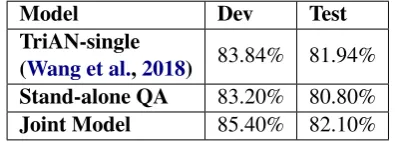
re-ported in (Wang et al.,2018). The results we ob-tained using their implementation are stand-alone QA results. With the same setting, joint model got 85.4%on dev set and82.1%on test set. The dif-ference in performance of the models in tables2
and3is statistically significant according to Mc-Nemar’s chi-squared test.
Model Dev Test
TriAN-single
(Wang et al.,2018) 83.84% 81.94%
Stand-alone QA 83.20% 80.80%
[image:5.595.82.280.167.238.2]Joint Model 85.40% 82.10%
Table 3: Accuracy of various models on SemEval’18 task-11 dataset
5 Discussion
We have shown that capturing the relationship be-tween various answer choices or subsequent ques-tions helps in answering quesques-tions better. Our ex-perimental results, shown in tables2&3, are only a first step towards leveraging this relationship to help construct better machine reading systems. We suggest two possible extensions to our model, that would help realize the potential of these rela-tions.
1. Improving the performance of entailment and contradiction detection.
2. Using the information given in the text to identify the relations between choices better.
As shown in table 1, identification of entail-ment/contradiction is far from perfect. Entailment detection is particularly worse because often the system returnsentailmentwhen there is a high lex-ical overlap. Moreover, the presence of a strong negation word (not) causes the NLI system to pre-dictcontradictioneven forentailmentandneutral cases. This issue impedes the performance of our model on SemEval’18 dataset as roughly 40%of the questions have yes/no answers. Naik et al.
(2018) show that this is a common issue with state-of-the-art NLI detection models.
Self-training (table1) results suggest that there are other types of relationships present among an-swer choice pairs that do not come under the strict definitions ofentailment or contradiction. Upon investigating, we found that although some answer hypotheses do not directly have an inference rela-tion between them, they might be related in con-text of the given con-text. For example, consider the
sentence, ‘I snack when I shop’ and the answer choices: c1: ‘She went shopping this extended weekend’ andc2: ‘She ate a lot of junk food re-cently’. Although the sentences don’t have an ex-plicit relationship when considered in isolation, the text suggests that c1 might entailc2. Captur-ing these kinds of relationships could potentially improve MC further.
6 Conclusion
In this paper we take a first step towards model-ing an accumulative knowledge state for machine comprehension, ensuring consistency between the model’s answers. We show that by adapting NLI to the MC task using self-training, performance over multiple tasks improves.
In the future, we intend to generalize our model to other relationships beyond strict entailment and contradiction relations.
Acknowledgements
We would like to thank the reviewers for their in-sightful comments. This work was partially sup-ported by the NSF through grant NSF-1814105.
References
Lisa Bauer, Yicheng Wang, and Mohit Bansal. 2018. Commonsense for generative multi-hop question an-swering tasks. InProceedings of the 2018 Confer-ence on Empirical Methods in Natural Language Processing, pages 4220–4230, Brussels, Belgium. Association for Computational Linguistics.
Samuel R. Bowman, Gabor Angeli, Christopher Potts, and Christopher D. Manning. 2015. A large anno-tated corpus for learning natural language inference. In Proceedings of the 2015 Conference on Empiri-cal Methods in Natural Language Processing, pages 632–642. Association for Computational Linguis-tics.
Rajarshi Das, Manzil Zaheer, Siva Reddy, and Andrew McCallum. 2017. Question answering on knowl-edge bases and text using universal schema and memory networks. CoRR, abs/1704.08384.
Daniel Khashabi, Snigdha Chaturvedi, Michael Roth, Shyam Upadhyay, and Dan Roth. 2018. Looking beyond the surface: A challenge set for reading com-prehension over multiple sentences. InNAACL.
Fei Liu and Julien Perez. 2017. Gated end-to-end memory networks. InProceedings of the 15th Con-ference of the European Chapter of the Association for Computational Linguistics: Volume 1, Long Pa-pers, volume 1, pages 1–10.
Todor Mihaylov, Peter Clark, Tushar Khot, and Ashish Sabharwal. 2018. Can a suit of armor conduct elec-tricity? a new dataset for open book question an-swering. arXiv preprint arXiv:1809.02789.
Todor Mihaylov and Anette Frank. 2018. Knowledge-able reader: Enhancing cloze-style reading com-prehension with external commonsense knowledge. In Proceedings of the 56th Annual Meeting of the Association for Computational Linguistics (Volume 1: Long Papers), pages 821–832, Melbourne, Aus-tralia. Association for Computational Linguistics.
Sewon Min, Victor Zhong, Richard Socher, and Caim-ing Xiong. 2018. Efficient and robust question answering from minimal context over documents.
CoRR, abs/1805.08092.
Aakanksha Naik, Abhilasha Ravichander, Norman Sadeh, Carolyn Rose, and Graham Neubig. 2018. Stress test evaluation for natural language inference. InProceedings of the 27th International Conference on Computational Linguistics, pages 2340–2353, Santa Fe, New Mexico, USA. Association for Com-putational Linguistics.
Tri Nguyen, Mir Rosenberg, Xia Song, Jianfeng Gao, Saurabh Tiwary, Rangan Majumder, and Li Deng. 2016. MS MARCO: A human generated ma-chine reading comprehension dataset. CoRR, abs/1611.09268.
Simon Ostermann, Michael Roth, Ashutosh Modi, Ste-fan Thater, and Manfred Pinkal. 2018. Semeval-2018 task 11: Machine comprehension using com-monsense knowledge. InProceedings of The 12th International Workshop on Semantic Evaluation, pages 747–757. Association for Computational Lin-guistics.
Ankur Parikh, Oscar T¨ackstr¨om, Dipanjan Das, and Jakob Uszkoreit. 2016. A decomposable attention model for natural language inference. In Proceed-ings of the 2016 Conference on Empirical Methods in Natural Language Processing, pages 2249–2255, Austin, Texas. Association for Computational Lin-guistics.
Jeffrey Pennington, Richard Socher, and Christopher Manning. 2014. Glove: Global vectors for word representation. In Proceedings of the 2014 Con-ference on Empirical Methods in Natural Language Processing (EMNLP), pages 1532–1543, Doha, Qatar. Association for Computational Linguistics.
Pranav Rajpurkar, Jian Zhang, Konstantin Lopyrev, and Percy Liang. 2016. Squad: 100, 000+ ques-tions for machine comprehension of text. CoRR, abs/1606.05250.
Matthew Richardson. 2013. Mctest: A challenge dataset for the open-domain machine comprehen-sion of text.
Mrinmaya Sachan and Eric Xing. 2016. Machine com-prehension using rich semantic representations. In
Proceedings of the 54th Annual Meeting of the As-sociation for Computational Linguistics (Volume 2: Short Papers), volume 2, pages 486–492.
Yawei Sun, Gong Cheng, and Yuzhong Qu. 2018. Reading comprehension with graph-based temporal-casual reasoning. InProceedings of the 27th Inter-national Conference on Computational Linguistics, pages 806–817. Association for Computational Lin-guistics.
Adam Trischler, Tong Wang, Xingdi Yuan, Justin Har-ris, Alessandro Sordoni, Philip Bachman, and Ka-heer Suleman. 2016a. Newsqa: A machine compre-hension dataset.CoRR, abs/1611.09830.
Adam Trischler, Zheng Ye, Xingdi Yuan, Jing He, Phillip Bachman, and Kaheer Suleman. 2016b. A parallel-hierarchical model for machine comprehen-sion on sparse data.CoRR, abs/1603.08884.
Liang Wang, Meng Sun, Wei Zhao, Kewei Shen, and Liu Jingming. 2018. Yuanfudao at semeval-2018 task 11: Three-way attention and relational knowledge for commonsense machine comprehen-sion.CoRR, abs/1803.00191.
Dirk Weissenborn, Tomas Kocisky, and Chris Dyer. 2017. Reading twice for natural language under-standing.CoRR, abs/1706.02596.
Jason Weston, Antoine Bordes, Sumit Chopra, and Tomas Mikolov. 2015. Towards ai-complete ques-tion answering: A set of prerequisite toy tasks.
CoRR, abs/1502.05698.
Caiming Xiong, Victor Zhong, and Richard Socher. 2016. Dynamic coattention networks for question answering. arXiv preprint arXiv:1611.01604.
Mark Yatskar. 2018. A qualitative comparison of coqa, squad 2.0 and quac. arXiv preprint arXiv:1809.10735.