A Computational Model of Human Preferences for Pronoun Resolution
Olga Seminck
LLF (CNRS)
8 Place Paul-Ricoeur, 75013 Paris Universit´e Paris Diderot, Paris 7 5 rue Thomas Mann, 75013 Paris [email protected]
Pascal Amsili
LLF (CNRS)
8 Place Paul-Ricoeur, 75013 Paris Universit´e Paris Diderot, Paris 7 5 rue Thomas Mann, 75013 Paris pascal.amsili@linguist .univ-paris-diderot.fr
Abstract
We present a cognitive computational model of pronoun resolution that repro-duces the human interpretation prefer-ences of the Subject Assignment Strat-egy and the Parallel Function StratStrat-egy. Our model relies on a probabilistic pro-noun resolution system trained on corpus data. Factors influencing pronoun resolu-tion are represented as features weighted by their relative importance. The impor-tance the model gives to the preferences is in line with psycholinguistic studies. We demonstrate the cognitive plausibility of the model by running it on experimen-tal items and simulating antecedent choice and reading times of human participants. Our model can be used as a new means to study pronoun resolution, because it cap-tures the interaction of preferences.
1 Introduction
Pronoun resolution has been studied in the frame of theories of formal grammar, corpus studies, ex-perimental psycholinguistic studies and NLP sys-tems.1 But much of the findings made about the phenomenon are not shared between these disci-plines. This paper takes a step towards more in-terdisciplinarity between the fields of NLP and psycholinguistics by building a cognitive compu-tational model of pronoun resolution. As Keller (2010) argues convincingly, both the domains of NLP and psycholinguistics can benefit from such models. On the one hand, there is a very rich psy-cholinguistic literature of which researchers in the domain of NLP are often not aware. NLP tech-niques might improve if this literature is taken into
1In the latter domain nowadays mostly in the form of the coreference resolution task, of which proper pronoun resolu-tion is only a part.
account. On the other hand, cognitive computa-tional models are a new means to perform psy-cholinguistic research: by implementing different models that represent different theories, a compar-ison can be made by looking at the behavior of the models on actual experimental human data.
On the topic of pronoun resolution some cogni-tive computational models have already been pro-posed. Frank et al. (2007) proposed a model that resolves ambiguous pronouns based on human in-terpretation biases (preferences) — such as the first mention bias2— and world knowledge. They used a so-calledmicro-world: a collection of very detailed world knowledge for a small set of events. Their model was able to simulate reading times, but it remains an open question to what extent the model can be scaled up (Frank et al., 2007).
Kehler and Rohde (2013) proposed a probabilis-tic model to predict human interpretation biases. Their model, based on world knowledge and in-formation structure, predicts the probability that a given referent is mentioned next. They tested the model on human data from completion tasks3and showed that the model could accurately predict the human data.
Dubey et al. (2013) developed a model based on surprisal. Surprisal is a measure that is high when infrequent, or unexpected, events happen. Accord-ing to Surprisal Theory (Hale, 2001), the surprisal of syntactic structures reflects their cognitive pro-cessing cost. That is to say that infrequent syn-tactic structures are more difficult to process for humans than frequent ones. Demberg and Keller (2008) showed that syntactic surprisal is a relevant factor to model reading times on corpus. In the model of Dubey et al. (2013) syntactic surprisal
2A character that is named first in the sentence is the pre-ferred interpretation of ambiguous pronouns.
3In a completion task participants have to complete a text of which only the beginning is given.
is enriched by surprisal coming from coreference. Surprisal is higher when a new referent is intro-duced and lower when an old one is re-mentioned. Dubey et al. (2013) show that their enriched mea-sure of surprisal is better in explaining the vari-ance in reading times recorded on corpus than a standard measure of only syntactic surprisal.
Inspired by Dubey et al. (2013), we aim for a model of pronoun resolution that can run on nat-ural texts and explain reading times. A second aim for our model is that it can account for hu-man preferences discovered in the psycholinguis-tic literature. Based on these criteria, we build a model inspired by NLP pronoun resolution sys-tems (Soon et al., 2001). The factors of influence on pronoun resolution are represented as weighted features. This provides a way to assess their rela-tive importance and allows to study their interac-tion.
In this paper we demonstrate our model by running it on items used in psycholinguistic ex-periments about human preferences. We first show that the strength of human preferences corre-sponds to the weights our model associates to dif-ferent factors influencing pronoun resolution. Sec-ond, we study how the model chooses antecedents for pronouns and see that it makes choices similar to humans. Finally, we simulate reading times by formulating a metric of processing cost based on our model.
2 Preferences Modeled in This Work
We chose to model two preferences that operate in English in this work: the Subject Assignment Strategy and the Parallel Function Strategy. We made this choice because of the feasibility of the implementation: both preferences rely only on syntactic mechanisms, so no semantic representa-tion needed to be implemented.
The Subject Assignment Strategy states that, if a pronoun is ambiguous (i.e.has more than one an-tecedent candidate compatible in gender and num-ber), it will be resolved to the antecedent candi-date that is in the subject position (Crawley et al., 1990). So for both of the following examples the Subject Assignment Strategy predicts that the an-tecedent of the pronoun isJohn.
(1) a. John hit Fred and [he]resolvekicked Ellen. b. John hit Fred and Ellen kicked [him]resolve. According to the Parallel Function Strategy, an
ambiguous pronoun is resolved to the antecedent candidate that has the same syntactic function (Smyth, 1994). So according to this second strat-egy, in example (1-a)hewill be resolved toJohn, whereas in (1-b)himwill be resolved toFred.
Evidence for both the Subject Assignment Strategy and the Parallel Function Strategy is not new and comes from early studies from the 1970’s (Hobbs, 1976; Sheldon, 1974, among others). However, the interaction between both strategies was investigated more recently by Crawley et al. (1990). They performed two experiments with stimuli like the one in (2), where an ambiguous pronoun in the direct or indirect object position had to be resolved to either a character in the sub-ject position (Brenda) or a character in the ob-ject position (Harriet). They chose not to study pronouns occupying the subject position, because both the Subject Assignment Strategy and the Par-allel Function Strategy make the same predictions for these pronouns. Instead, they studied resolu-tion of ambiguous pronouns in the direct and in-direct object function to see the influence of both the Subject Assignment Strategy and the Parallel Function Strategy.
(2) Brenda and Harriet were starring in the local musi-cal. Bill was in it too and none of them were very sure of their lines or the dance steps. Brenda copied Harriet and Bill watched [her]resolve.
They found that only the Subject Assignment Strategy was used in pronoun resolution. How-ever, different studies that followed up their paper, such as Smyth (1994) and Stevenson et al. (1995), found strong evidence for the existence of the Par-allel Function Strategy alongside the Subject As-signment Strategy. They criticized the fact that many items used by Crawley et al. (1990) weren’t exactly parallel: in many items none of the po-tential antecedents occupied exactly the same syn-tactic function as the pronoun. For example in item (3) there is no antecedent candidate in the di-rect object position (Monicais in an indirect object position).
if it can be applied.
In our study we build a model of pronoun reso-lution that can account for some of the findings of Crawley et al. (1990) and of Smyth (1994). More precisely, we run our model on the items of Craw-ley’s experiment and of Smyth’s second experi-ment.4
3 Model of Pronoun Resolution
We used a classifier that proceeds according to a probabilistic version of the pair-wise algorithm (Soon et al., 2001). We only account for third per-son singular perper-sonal pronoun resolution in order to approach the psycholinguistic domain where pronoun resolution is most often restricted to these type of pronouns. The third person pronouns can be viewed as different from the first and the second as the latter are deictic rather than anaphorical.
3.1 Resolver
The pairwise resolver is a logistic regression clas-sifier that gives the probability that a pair of a pro-noun and an antecedent candidate are coreferent. We chose it for its straightforward interpretation of feature weights, indicating the influence of fac-tors in pronoun resolution. We trained it on exam-ples of pairs of coreferent and non-coreferent men-tions. We used the method of Soon et al. (2001) to sample training examples: to get positive train-ing examples (coreferent pairs), each pronoun is coupled to its closest antecedent. To get nega-tive training examples, the pronoun forms a pair with every mention occurring between its closest antecedent and itself.
3.2 Corpus
We trained the resolver on the English newswire part of the Ontonotes 5.0 corpus (Pradhan et al., 2011). This genre approximated the psycholin-guistic items the best among the available gen-res in Ontonotes. A particularity of the corpus is that singleton mentions (referential expressions that are only mentioned once) are not annotated. We resolved this problem by simply considering as a singleton mention every maximal noun phrase that did not overlap with an annotated mention and that was not a pronoun. Moreover, since
4We chose these experiments because in the remaining ex-periments of Smyth (1994), and also in the exex-periments of Stevenson et al. (1995), a different definition of the Parallel Function Strategy has been used.
Ontonotes is not annotated for number nor gen-der, we had to add (automatically) an annotation for number and gender to the mentions in the cor-pus.5
3.3 Features
The aim of our model is to have interpretable fea-tures and not to have the best score on a pronoun resolution task. We proceeded in three steps to es-tablish the features of our classifier. First, we de-fined a list of standard features for pronoun reso-lution — inspired by coreference resoreso-lution liter-ature (Denis and Baldridge, 2007; Recasens and Hovy, 2009; Soon et al., 2001; Yang et al., 2004) — that we could retrieve in our corpus.6 It is im-portant to point out that, although we made up our feature list by looking at literature from Natural Language Processing, the features in the list are also discussed in psycholinguistic literature. For example, distance features and part of speech fea-tures are discussed in literature about antecedent saliency(Ariel, 1991).
Among all the features, we made sure we in-cluded the features necessary to test the two pref-erences investigated in this paper. For the Sub-ject Assignment Strategy, we used a feature that checks whether the antecedent candidate is in the subject position. We implemented the Parallel Function Strategy by a boolean feature of syntac-tic path match that states whether the antecedent candidate and the pronoun have the same path in the syntactic parse tree from the node where the mention is attached to the root of the tree. A sim-ple illustration of this is given in Figure 1 where the syntactic paths of two mentions are given.
S
VP NP [Mary] V
loves SUBJ
NP N dog] D
[image:3.595.310.500.549.663.2][The
Figure 1: A syntactic tree with two mentions: the dogandMary. Syntactic path forthe dog: [SUBJ, S]. Syntactic path forMary: [VP, S].
5The procedure of gender/number annotation we chose is explained in section B of the supplementary materials.
The second step of defining our features con-sisted in eliminating features too sparsely repre-sented in our training corpus to be adequately learned. As a rule of the thumb we decided to ex-clude features with a frequency smaller than 0.5%, meaning that every feature should be attested at least 36 times in the training data.
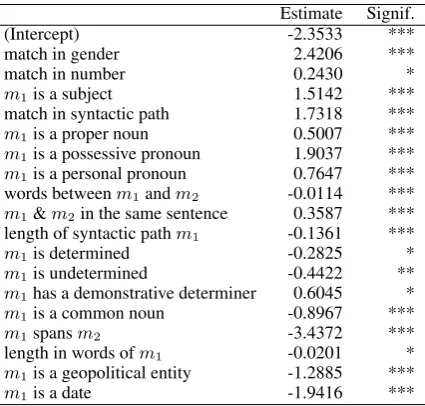
As a last step we checked the significance of our features and removed features that were not significant, because their interpretation is difficult. The model with the features we selected can be found in Table 1.
Estimate Signif.
(Intercept) -2.3533 ***
match in gender 2.4206 ***
match in number 0.2430 *
m1is a subject 1.5142 ***
match in syntactic path 1.7318 ***
m1is a proper noun 0.5007 ***
m1is a possessive pronoun 1.9037 ***
m1is a personal pronoun 0.7647 ***
words betweenm1andm2 -0.0114 ***
m1&m2in the same sentence 0.3587 ***
length of syntactic pathm1 -0.1361 ***
m1is determined -0.2825 *
m1is undetermined -0.4422 **
m1has a demonstrative determiner 0.6045 *
m1is a common noun -0.8967 ***
m1spansm2 -3.4372 ***
length in words ofm1 -0.0201 *
m1is a geopolitical entity -1.2885 ***
m1is a date -1.9416 ***
Table 1: The selected model of the pronoun re-solver. Each factor influencing pronoun resolu-tion has an estimated weight associated that in-dicates its influence. m1 refers to the antecedent
candidate,m2to the pronoun. Significance codes:
‘***’ 0.001 ‘**’ 0.01 ‘*’ 0.05 ‘.’ 0.1.
3.4 Evaluation
We divided the corpus into a training set, a devel-opment set and a test set. We tested the model’s performance on all three of the sets by measuring the accuracy of the identification of antecedents of the third person singular personal pronouns in the corpus. The accuracy and size for each subcorpus can be found in Table 2.
An important question is whether these results are satisfactory. Our results are difficult to com-pare against state-of-the-art work in coreference resolution, because we concentrate on third per-son perper-sonal singular pronouns only. This means that our system does not form coreference chains and that its performance cannot be measured
us-Sub-Corpus Nb. Texts Nb. Pronouns Accuracy
Training 476 (60%) 1756 61.15
Development 158 (20%) 558 65.41
[image:4.595.76.289.235.438.2]Test 158 (20%) 617 61.26
Table 2: The accuracy of the resolver for finding the correct antecedent of the pronoun on the train-ing, development and test set.
ing standard coreference evaluation metrics, such asMUC,B3, or CEAF(Luo, 2005). A second
dif-ference with a more standard approach is that we do not have a module of mention detection. In-stead, we use the gold mention annotation and the singleton mentions we extracted (see section 3.2). This said, we still want to have an indication about the performance of our classifier. The study of Yang et al. (2004) is the most comparable we found to ours, although they used a module for mention detection. Yang et al. (2004) trained dif-ferent types of systems to perform third person pronoun resolution and reported accuracy, in their paper indicated by the metric of success. When they tested on the MUC-6 corpus this metric was
between 70.0 and 74.7 for the different systems they developed. When tested on the MUC-7
cor-pus the metric laid between 53.8 and 62.5. We es-timate that, given these numbers, the performance of our model is slightly worse, or comparable.
An error analysis we conducted indicated that most of the errors made by the resolver concerned the pronoun ‘it’ (about half of the errors). We observed that if we excluded ‘it’ from resolution the pronoun resolver’s accuracy increased by≈16 points. Our error analysis also indicated that a part of the errors comes from our automatic gender an-notation: it seems that many coreference chains contain mentions of several genders at once. Nev-ertheless, we think that the performance on mascu-line and feminine pronouns of our system is good enough for the purpose of our experiments that in-clude only masculine and feminine pronouns.
3.5 Interpretation of the Model
impact than the subject position of the antecedent. From this data we can hypothesize that the Subject Assignment Strategy exists alongside the Parallel Function Strategy, and that the Parallel Function Strategy, if applicable, has a stronger influence that can overrule the Subject Assignment Strategy.
4 Antecedent Choice for Pronouns
To test the cognitive plausibility of our model, we ran it on the experimental items of Crawley et al. (1990) and the items of the second experiment of Smyth (1994) and looked if it chose the same antecedents as humans did. That is to say that we compared the model’s frequencies of assign-ing pronouns to subjects and objects with human frequencies.
4.1 Items
For each type of item we give two examples to illustrate the type of experimental items used. Be-fore running the model, we manually annotated the items with coreference and named entity in-formation. For the syntactic annotation we first ran the Stanford Parser (Klein and Manning, 2003) and then corrected the parses manually.
4.1.1 Crawley’s Ambiguous Items
From the experiment of Crawley et al. (1990) we have 40 ambiguous items. Ambiguity is produced by gender. The pronoun that has to be resolved is presented in the last sentence in the direct or indirect object position.
1. John and Sammy were playing in the garden. One of their classmates, Evelyn, tried to join in their game. John pushed Sammy and Evelyn kicked him.
2. Mary and Julie were about to go into town when they realized the car had a puncture. Their next door neigh-bour, Peter, was working in the garden. Mary helped Julie change the wheel and Peter talked to her.
4.1.2 Crawley’s Unambiguous Items with Subject Antecedent
The ambiguous items have unambiguous versions: there is only one possible antecedent that matches in gender. All 40 ambiguous items (see section 4.1.1) have an unambiguous version in which the antecedent of the pronoun is the subject of the sen-tence in which the pronoun appears. Note that the pronoun is still always in the direct or indirect ob-ject position.
1. John and Mary were playing in the garden. One of their classmates, Evelyn, tried to join in their game. John pushed Mary and Evelyn kicked him.
2. Mary and Tim were about to go into town when they realised the car had a puncture. Their next door neigh-bour, Peter, was working in the garden. Mary helped Tim change the wheel and Peter talked to her.
4.1.3 Crawley’s Unambiguous Items with Object Antecedent
All 40 ambiguous items from section 4.1.1 also have an ambiguous version in which the pronoun’s antecedent appears at the direct or indirect object position.
1. Mary and John were playing in the garden. One of their classmates, Evelyn, tried to join in their game. Mary pushed John and Evelyn kicked him.
2. Tim and Mary were about to go into town when they realised the car had a puncture. Their next door neigh-bour, Peter, was working in the garden. Tim helped Mary change the wheel and Peter talked to her.
4.1.4 Smyth’s Ambiguous Pronouns in Subject Position
In Smyth (1994)’s second experiment, there are ten ambiguous items with a pronoun in the subject position. A full parallelism can be found between the subject of the item and the pronoun.
1. Mary helped Julie change the tire and then she helped Peter change the oil.
2. Shirley wrote to Carol about a meeting and then she wrote to Martin about a party.
4.1.5 Smyth’s Ambiguous Pronouns in Object Position
Smyth (1994) also presents ten items with a pro-noun in the direct or indirect object position. For all ten items a full parallelism can be found be-tween the pronoun and a character in the direct or indirect object position.
1. John pushed Sammy and then Evelyn kicked him. 2. Sarah visited Cathy at home and then Charles phoned
her at work.
4.2 Results
Human Model
Experiment % Sub. % Obj. % Sub. % Obj.
[image:6.595.74.491.61.135.2]Crawley, ambiguous items, pronoun in the object position (4.1.1) 60% 40% 72.5% 27.5% Crawley, unambiguous items, antecedent in the subject position (4.1.2) n.a. n.a. 100% 0% Crawley, unambiguous items, antecedent in the object position (4.1.3) n.a. n.a. 0% 85% Smyth exp. 2, ambiguous items, pronoun in the subject position (4.1.4) 100% 0% 100% 0% Smyth exp. 2, ambiguous items, pronoun in the object position (4.1.5) 12% 88% 30% 70%
Table 3: Human pronoun assignment versus the model’s predictions on Crawley et al. (1990)’s items and Smyth (1994)’s items from experiment 2. For each item set examples can be found in section 4.1. For Crawley et al. (1990)’s unambiguous items, no human results were reported. Note that for the unambiguous items with pronouns in the object position, the model sometimes did not assign any antecedent to the pronoun.
15% of the cases the model could not attribute a score high enough to choose it as the antecedent and responded None7. For the items of Smyth (1994)’s experiment, we observed — just like him — that the Parallel Function Strategy is the pre-ferred strategy.
4.3 Discussion
We have shown that our model is able to mirror quite accurately pronoun resolution preferences. As our model is trained on real corpus data, this means that such preferences are somehow statis-tically presented in the language. Our model is in line with the claim that the Parallel Function Strategy and the Subject Assignment Strategy ex-ist alongside each other and that the former can overrule the latter. Our model embodies the idea Smyth (1994) has about pronoun resolution:
“Pronoun resolution is a feature-match process whereby the best antecedent is that which shares the most features with the pronoun.”
It also captures Smyth (1994)’s idea that not ev-ery feature has the same impact and that for ex-ample gender matchis more important than par-allel roles. Based on the results our model ob-tains on the experimental items, we conclude that the weights it learned from corpus are cognitively plausible.
5 Simulation of Reading Times
We use our model to simulate reading times recorded in pronoun resolution experiments. An
7Among all antecedent candidates the correct antecedent got still the highest score, but it was lower than 50%, so the resolver responded that it did not find the antecedent. This behavior of the system can been seen as the result of training it on the Ontonotes corpus, where the bias towards classifying negative must be high, to prevent it from linking pronouns to wrong antecedents.
important question is: how can our model account for those reading times? It is commonly assumed that reading time is determined by the difficulty of language processing: more difficulty will result in a longer reading time. Therefore, we need a mea-sure of ‘difficulty’ from our model to simulate it. We call this measure a cost metric. In the follow-ing subsection we explain how our model can out-put a cost metric for pronoun resolution. We then compare our metric to reading times recorded in Crawley et al. (1990)’s experiment.8
5.1 Cost Metric for Pronoun Resolution
To formulate a cost metric, we have to determine first what would cause cost in pronoun resolution. We hypothesize that the difficulty of finding the antecedent is determined by the number of com-patible candidates and their degree of compatibil-ity. A higher number of compatible candidates and a higher degree of compatibility will create more competition and therefore more processing cost.
Our model is able to measure compatibility of antecedents by giving a probability score to the antecedent candidates. Nevertheless, these scores do not reflect directly the competition amongst the candidates, because the resolver makes no statements about the relation between the differ-ent scores. Therefore, to measure competition, we use the notion of entropy from Information Theory (Shannon and Weaver, 1949). Entropy is a prop-erty of a random variable and captures how much uncertainty plays a role in it. The formula of en-tropy — in whichXis a random variable that can take the values ofi— is:
H(X) =−X i∈X
p(X=i)·log2(p(X=i)) (1)
By defining our cost metric as the entropy over the probability distribution of antecedent candi-dates, we can capture the idea of competition. But a problem is that a probability distribution over an-tecedent candidates does not follow naturally from our model. Hence, we decided to form a probabil-ity distribution from the scores we have by using techniques inspired by Luo et al. (2004), who in-vestigated how to form a probability distribution on entities (coreference chains) by using a prob-abilistic mention-pair classifier, similar to our re-solver. To calculate the processing cost for a pro-noun, we used the following steps:
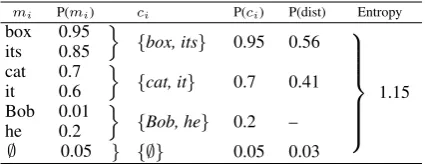
We first get from our resolver the coreference scores between every preceding mention in the text and the pronoun to be resolved. We then group the preceding mentions by their coreference chain. Because our resolution system does not build coreference chains, this information is taken from the corpus annotation.9 As in the work of Luo et al. (2004), each chain gets the score of its highest scoring mention. Then, among the an-tecedent candidates, we consider all the chains that obtain a score >0.5 10 together with an ‘empty’ candidate (i.e.the pronoun has no antecedent) in the case that the pronoun is not anaphoric, but cat-aphoric.11 We also followed Luo et al. (2004) in the assignment of probability to the empty candi-date: it is given a probability equal to 1 minus the score of the highest scored mention. Next, to form a probability distribution over the mentions, we used the technique described in Luo et al. (2004): a probability distribution over the chains is formed by dividing the probability for each chain by the probability mass of all the chains in the distribu-tion. Finally, the entropy is calculated on this dis-tribution. This procedure is illustrated in Table 4.
5.2 Results
Our cost metric can mirror reading times attested in the self-paced reading experiments of Crawley
9We make the strong assumption that recovering the coreference chains in the psycholinguistic items is rather easy and does not cause much processing cost.
10We do not consider mentions having scores<0.5, be-cause it would mean that mentions that are classified ‘neg-ative’ (probability less than 50%) could be of much as an influence as candidates being classed positive. We consider that negatively classified mentions do not add much to the competition there is between antecedent candidates.
11Note that the pronoun cannot be expletive (i.e. non-referential), because this type of pronoun is not annotated as a mention in the corpus and thus not considered by the system.
mi P(mi) ci P(ci) P(dist) Entropy
box 0.95 its 0.85
o
{box, its} 0.95 0.56
1.15 cat 0.7
it 0.6
o
{cat, it} 0.7 0.41 Bob 0.01
he 0.2
o
{Bob, he} 0.2 –
[image:7.595.307.520.62.144.2]∅ 0.05 } {∅} 0.05 0.03
Table 4: Imagine that in a text the pronounit has to be resolved and that all preceding mentions in the text are reported undermi. FirstP(mi)is
out-putted by the resolver and indicates the probability thatmiis coreferent withit. The empty candidate
gets the score of 1 minus the highest scoring men-tion (hereunder: 1 - 0.95 = 0.05). Second, each mention is associated to its corefference chainci.
Each chain gets the probability of its highest scor-ing mention, reported under P(ci). Third, a
prob-ability distribution is forged from all candidates having a P(ci) > 0.5 and the empty candidate.
This is done by dividing the scores underP(ci)by
the total probability mass of the maintained candi-dates (hereunder: 0.95 + 0.7 + 0.05). The result is a probability distribution, reported asP(dist). En-tropy is calculated on this distribution.
et al. (1990) who reported the reading time of the last sentence of the experimental items. A signifi-cant difference was reported between the ambigu-ous and the unambiguambigu-ous condition in an overall variance analysis of the data.12 The model also shows this difference. When we effected an anal-ysis of variance on a by-item basis, the factor of ambiguity was highly significant (F = 299.5,df = 1, 39,p < .001). In Figure 2 the predictions of the model and the actual experimental reading times are plotted against each other.
Crawley et al. (1990) also compared reading times between the subject and the object assign-ment in the ambiguous and the unambiguous con-dition. They found faster reading times for subject assignment in the ambiguous condition, but this effect only showed in an analysis by participants and not by items (F1 = 8.52, df = 1,47, p >0.1;
F2<1). They did not find significant effects in the
unambiguous condition, nor in the analysis by par-ticipants, nor in the analysis by items (F1 = 1.55,
df= 1,47,p >0.5;F2= 1.08,df= 1,39,p >0.5).
Like Crawley et al. (1990), our model also showed a significant difference between subject and object
Figure 2: The model’s prediction of processing cost against the reading times per word recorded by Crawley et al. (1990) for the ambiguous and the unambiguous condition of experiment 1. For the cost predicted by the model 95% confidence in-tervals are given. Significance codes: ‘***’ 0.001 ‘**’ 0.01 ‘*’ 0.05 ‘.’ 0.1.
assignment in the ambiguous condition (F = 4.23,
[image:8.595.307.507.64.458.2]df = 1, 38, p < .05), but in an by-item analy-sis. For the unambiguous condition however, our results do not match Crawley et al. (1990)’s: we found a highly significant effect for the by-item analysis13 (F = 24.43, df = 1, 33, p < .001). In Figure 3 the results for the subject and object as-signment are plotted.
5.3 Discussion
Our cost metric is capable of mirroring the read-ing times of ambiguous versus unambiguous items and the reading times of items with subject and object antecedents in the ambiguous condition. However, in the unambiguous condition we found an effect that was not observed in the human data. We think that this can be explained by the strength of the gender and number features in our system. As the automatic gender and number feature as-signment introduced some noise in our data, we think our model estimated these features lower than they should be, preventing them from eras-ing the influence of the Parallel Function Strategy and the Subject Assignment Strategy.
13In this analysis, items for which the resolver responded
Nonewere treated as missing values.
(a) Ambiguous Condition
(b) Unambiguous Condition
Figure 3: The model’s prediction of processing cost against the reading times per word recorded by Crawley et al. (1990) for subject and object as-signment in the ambiguous and the unambiguous condition of experiment 1. For the cost predicted by the model 95% confidence intervals are given.
6 General Discussion
The contribution of our model is its ability to quantify the strength of the factors of influence and its simple architecture that allows to incorpo-rate easily new factors. The model also has the potential to explain human processing cost, be-cause we were able to formulate a metric based on it that mirrored reading times recorded in the experiments of Crawley et al. (1990). Our results confirmed our idea that the competition between antecedent candidates can cause processing cost.
the implementation of the model, many questions about how the features should be implemented arose. For example, implementing the parallel function turned out to be less straightforward than initially expected. We had to choose if we imple-mented it as a binary feature (the parallel function can only operate if the syntactic paths of both men-tions are exactly the same), or a continuous feature (the similarity between the syntactic functions of the two mentions is what is relevant). Choices of this kind are very important when the modeling is done and inevitable. Of course, they are also rel-evant at the time of the design of the experimen-tal items, but they can be overlooked more eas-ily. The model also points out that in spite of the efforts of the experimenters to keep the items in one condition as similar as possible, many factors not included in the experimental design can still have an influence on the computational model and likely on the human participants as well. Let’s take for example the items of Crawley et al. (1990): some items used proper nouns for the characters, whereas others contained only definite descrip-tions. This is likely to have an influence on the experienced difficulty, as suggested by the weights in Table 1, but also by theories such as the Acces-sibility Theory (Ariel, 1991) that states that dif-ferent kinds of redif-ferential expressions are more or less accessible in memory for pronoun resolution. By detecting such things, we show that computa-tional models can be a complementary means for psycholinguistic research.
As a future direction for our work, we plan to enhance our model, so that it would give a prob-ability distribution over antecedent candidates in a more direct way. For the moment, as explained in section 5.1, we have to forge scores outputted by the resolver into a probability distribution, but it would be more elegant if this distribution came directly from the resolver.
We also plan to investigate further the way we define the cost metric. The idea to use entropy as a measure of uncertainty, or competition, is inspired by cost metrics for syntactic structure based on probability distribution, such as surprisal theory (Hale, 2001; Levy, 2008), predicting higher cost for unexpected syntactic structures, or the entropy reduction hypothesis (Hale, 2003; Hale, 2006), giving high cost at points where a lot of disam-biguation is done. For the moment we only ap-plied the notion of entropy, but we want to
inves-tigate if a notion of surprisal is applicable as well. Finally, we plan to extend our model to other types of preferences. We would like for exam-ple to integrate discourse relations — that have been shown to have a great influence on pronoun resolution (Kehler and Rohde, 2013) — into our model. An even bigger challenge is to also inte-grate semantic information into the model. An-other type of extension of our model is to get out of the experimental items and test our model on cor-pus data. We plan for example to test if our model can contribute to explain word by word reading times recorded on corpus — such as the Dundee eye-tracking corpus (Kennedy et al., 2003) — by adding it as a factor to a model including other fac-tors explaining reading time, such as surprisal and word length.
7 Conclusion
In this paper we showed how a computational model can mirror human preferences in pronoun resolution and reading times with a cost metric based on the notion of entropy. We can see that the weights of the features learned on corpus cor-respond quite accurately to the influence of pref-erences in human pronoun resolution. We argue that our model will also be able to mirror other human preferences, provided we can learn the ad-equate features on corpus. A direction of future work is to enhance our multifactor model by more of these kinds of preferences, so that it will ac-count for more and more preferences in pronoun resolution. We plan to ultimately test this model on reading times recorded on corpus.
Acknowledgments
References
Mira Ariel. 1991. The function of accessibility
in a theory of grammar. Journal of Pragmatics,
16(5):443–463.
Shane Bergsma and Dekang Lin. 2006. Bootstrapping
path-based pronoun resolution. In Proceedings of
the 21st International Conference on Computational Linguistics and the 44th annual meeting of the Asso-ciation for Computational Linguistics, pages 33–40. Association for Computational Linguistics.
Rosalind A. Crawley, Rosemary J. Stevenson, and David Kleinman. 1990. The use of heuristic
strate-gies in the interpretation of pronouns. Journal of
Psycholinguistic Research, 19(4):245–264.
Vera Demberg and Frank Keller. 2008. Data from eye-tracking corpora as evidence for theories of syntactic
processing complexity. Cognition, 109(2):193–210.
Pascal Denis and Jason Baldridge. 2007. A ranking
approach to pronoun resolution. In IJCAI, pages
1588–1593.
Amit Dubey, Frank Keller, and Patrick Sturt. 2013. Probabilistic modeling of discourse-aware sentence
processing. Topics in cognitive science, 5(3):425–
451.
Stefan L. Frank, Mathieu Koppen, Leo G. M. Noord-man, and Wietske Vonk. 2007. Coherence-driven resolution of referential ambiguity: A computational
model. Memory & cognition, 35(6):1307–1322.
John Hale. 2001. A probabilistic earley parser as
a psycholinguistic model. In Proceedings of the
second meeting of the North American Chapter of the Association for Computational Linguistics on Language technologies, pages 1–8. Association for Computational Linguistics.
John Hale. 2003. The information conveyed by words
in sentences. Journal of Psycholinguistic Research,
32(2):101–123.
John Hale. 2006. Uncertainty about the rest of the
sentence. Cognitive Science, 30(4):643–672.
Jerry R. Hobbs. 1976. Pronoun resolution. research report76-1. new york: Department of computer
sci-ence. City University of New York.
Andrew Kehler and Hannah Rohde. 2013. A
probabilistic reconciliation of coherence-driven and centering-driven theories of pronoun interpretation. Theoretical Linguistics, 39(1-2):1–37.
Frank Keller. 2010. Cognitively plausible models of
human language processing. InProceedings of the
ACL 2010 Conference Short Papers, pages 60–67. Association for Computational Linguistics.
Alan Kennedy, Robin Hill, and Jo¨el Pynte. 2003. The
dundee corpus. InProceedings of the 12th European
conference on eye movement.
Dan Klein and Christopher D. Manning. 2003.
Ac-curate unlexicalized parsing. InProceedings of the
41st Annual Meeting on Association for Computa-tional Linguistics-Volume 1, pages 423–430. Asso-ciation for Computational Linguistics.
Roger Levy. 2008. Expectation-based syntactic
com-prehension. Cognition, 106(3):1126–1177.
Xiaoqiang Luo, Abe Ittycheriah, Hongyan Jing, Nanda Kambhatla, and Salim Roukos. 2004. A mention-synchronous coreference resolution algorithm based
on the bell tree. InProceedings of the 42nd Annual
Meeting on Association for Computational
Linguis-tics, pages 135–143. Association for Computational
Linguistics.
Xiaoqiang Luo. 2005. On coreference resolution
performance metrics. In Proceedings of Human
Language Technology Conference and Conference on Empirical Methods in Natural Language Pro-cessing, pages 25–32, Vancouver, British Columbia, Canada, October. Association for Computational Linguistics.
Christopher D. Manning, Mihai Surdeanu, John Bauer, Jenny Rose Finkel, Steven Bethard, and David Mc-Closky. 2014. The stanford corenlp natural
lan-guage processing toolkit. In ACL (System
Demon-strations), pages 55–60.
Sameer Pradhan, Lance Ramshaw, Mitchell Marcus, Martha Palmer, Ralph Weischedel, and Nianwen Xue. 2011. Conll-2011 shared task: Modeling
un-restricted coreference in ontonotes. InProceedings
of the Fifteenth Conference on Computational Nat-ural Language Learning: Shared Task, pages 1–27. Association for Computational Linguistics.
Marta Recasens and Eduard Hovy. 2009. A deeper look into features for coreference resolution. In Discourse Anaphora and Anaphor Resolution Col-loquium, pages 29–42. Springer.
Claude E. Shannon and Warren Weaver. 1949. The
mathematical theory of communication. University of Illinois Press.
Amy Sheldon. 1974. The role of parallel function in
the acquisition of relative clauses in english. Journal
of verbal learning and verbal behavior, 13(3):272– 281.
Ron Smyth. 1994. Grammatical determinants of
am-biguous pronoun resolution. Journal of
Psycholin-guistic Research, 23(3):197–229.
Wee Meng Soon, Hwee Tou Ng, and Daniel Chung Yong Lim. 2001. A machine learning ap-proach to coreference resolution of noun phrases. Computational linguistics, 27(4):521–544.
Rosemary J. Stevenson, Alexander WR Nelson, and Keith Stenning. 1995. The role of parallelism in
strategies of pronoun comprehension. Language
Xiaofeng Yang, Jian Su, Guodong Zhou, and Chew Lim Tan. 2004. An np-cluster based approach
to coreference resolution. InProceedings of the 20th
international conference on Computational
Linguis-tics, page 226. Association for Computational
Lin-guistics.
A All features that were considered before model selection
Feature Decision
match in gender keep
match in number keep
m1is a subject keep
match in syntactic path keep
m1is a common noun keep
m1is a proper name keep
m1is a possessive pronoun keep
m1is a personal pronoun keep
mentions betweenm1andm2 not significant
words betweenm1andm2 keep
m1&m2in the same sentence keep
length of syntactic pathm1 keep
m1is determined keep
m1is undetermined keep
m1has a demonstrative determiner keep
m1spansm2 keep
length of words ofm1 keep
number of occurrences ofm1in the text not significant
m1is a location not significant
m1is a work of art not enough data
m1is a geopolitical entity keep
m1is an organization not enough data
m1is a date keep
m1is a product not enough data
m1is aNORP14 not enough data
m1is a language not enough data
m1is money not enough data
m1is a person not significant
m1is a law not enough data
m1is an event not enough data
m1is a quantity not enough data
B Gender and Number Annotation
We used the Bergsma and Lin (2006) gender infor-mation, that provides counts of word forms occur-ring as respectively male, female and neuter gen-der on the web, to annotate the mentions in our corpus. More precisely, we took the three lists of unigrams (one for each gender) from the Stanford Core NLP Toolkit (Manning et al., 2014) that was compiled from the Bergsma and Lin (2006) gender information to annotate each token of a mention in our corpus with gender if it occurred in one of the lists. Then we propagated the gender of the head token to the entire mention. Finding the head of a mention was done using a heuristic: the head is the last word of the mention, except if there is a prepositional phrase inside the mention, in the lat-ter case the head of the mention is the word before any prepositional phrase.
The number annotation was only done for to-kens that were common nouns and proper names.
14nationalities, organizations, religions, and political par-ties
![Figure 1: A syntactic tree with two mentions: thedog and Mary. Syntactic path for the dog: [SUBJ,S]](https://thumb-us.123doks.com/thumbv2/123dok_us/1318330.662199/3.595.310.500.549.663/figure-syntactic-tree-mentions-thedog-mary-syntactic-subj.webp)