Multimodal Topic Labelling
Ionut Sorodoc1, Jey Han Lau1,2, Nikolaos Aletras3and Timothy Baldwin1
1Computing and Information Systems, The University of Melbourne 2IBM Research
3Amazon.com
{ionutsorodoc,jeyhan.lau,nikos.aletras}@gmail.com
Abstract
Topics generated by topic models are typi-cally presented as a list of topic terms. Au-tomatic topic labelling is the task of gener-ating a succinct label that summarises the theme or subject of a topic, with the in-tention of reducing the cognitive load of end-users when interpreting these topics. Traditionally, topic label systems focus on a single label modality, e.g. textual labels. In this work we propose a multimodal ap-proach to topic labelling using a simple feedforward neural network. Given a topic and a candidate image or textual label, our method automatically generates a rating for the label, relative to the topic. Ex-periments show that this multimodal ap-proach outperforms single-modality topic labelling systems.
1 Introduction
LDA-style topic models (Blei et al., 2003) are a popular approach to document clustering, with the “topics” (in the form of multinominal distri-butions over words) and topic allocations per doc-ument (in the form of a multinomial distribution over the topics) providing a powerful document collection visualisation, gisting and navigational aid (Griffiths et al., 2007; Newman et al., 2010a; Chaney and Blei, 2012; Sievert and Shirley, 2014; Poursabzi-Sangdeh et al., 2016).
Given its internal structure, an obvious way of presenting a topic t is as a ranked list of the highest-probability terms wi based on Pr(wi|t),
often simply based on a fixed “cardinality” (i.e. number of topic words) such as 10. However, this has a number of disadvantages: (a) there is a cog-nitive load in forming an impression of what con-cept the topic represents from its topic words
(Ale-tras et al., 2014; Ale(Ale-tras et al., 2017); (b) there is a potential bias in presenting the topic based on a fixed cardinality (Lau and Baldwin, 2016); and (c) it can be hard to interpret mixed or incoherent topics (Newman et al., 2010b). Automatic topic labelling methods have been proposed to assist with topic interpretation, e.g. based on text (Lau et al., 2011; Bhatia et al., 2016) or images (Aletras and Stevenson, 2013; Aletras and Mittal, 2017), with recent work showing that the optimal modal-ity (i.e. text or image) for topic labelling varies across topics (Aletras and Mittal, 2017).
The focus of this paper is the automatic rating of a textual or image label for a given topic. Our contributions are as follows:
1. we develop and release a novel topic labelling dataset with manually-scored image and text labels for a diverse set of topics; one particu-lar point of divergence from other text–image datasets is that text and image labels are rated on a common scale, and the optimal modality (text vs. image) for a given topic input must be selected as part of the output; and
2. we propose two deep learning approaches to automatically rate multimodal topic label candidates, which we show to outperform single-modality topic labelling benchmarks. The code and dataset associated with this pa-per are available at: https://github.com/ sorodoc/multimodal_topic_label.
2 Related work
Topic labelling methods usually involve two main steps: (1) the generation of candidate labels (e.g. text or images) for a given topic; and (2) the rank-ing of candidate labels by relevance to the topic. Textual labels have been sourced from in a number of different ways, including noun chunks from a reference corpus (Mei et al., 2007), Wikipedia
ticle titles (Lau et al., 2011; Aletras and Stevenson, 2014; Bhatia et al., 2016), or short text summaries (Cano Basave et al., 2014; Wan and Wang, 2016). Images are often selected from Wikipedia or the web based on querying with topic words (Aletras and Stevenson, 2013; Aletras and Mittal, 2017). Recent work on topic labelling has shown that text or image embeddings can improve candidate label generation and ranking (Bhatia et al., 2016; Ale-tras and Mittal, 2017).
Bhatia et al. (2016) useword2vec (Mikolov et al., 2013) and doc2vec (Le and Mikolov, 2014) to represent topics and candidate textual labels in the same latent semantic space. The most rele-vant textual labels for a topic are selected from Wikipedia article titles using the cosine similarity between the topic and article title embeddings. Fi-nally, top labels are re-ranked in a supervised fash-ion using various features such as the PageRank score of the article in Wikipedia (Brin and Page, 1998), trigram letter ranking (Kou et al., 2015), topic word overlap, and word length of the label.
Aletras and Mittal (2017) use pre-computed dependency-based word embeddings (Levy and Goldberg, 2014) to represent the topics and the caption of the images, as well as image embed-dings using the output layer of VGG-net (Si-monyan and Zisserman, 2014) pretrained on Im-ageNet (Deng et al., 2009). A concatenation of these three vectors is the input to a simple deep neural network with four hidden layers and a sig-moid output layer to predict the relevance score.
Textual or visual modalities for labelling topics have been studied extensively, although indepen-dently from one another. Our work differs from the single-modality methods described above in that it uses a joint model to predict the continuous-valued rating for both textual and image labels. This is, to the best of our knowledge, the first at-tempt at joint multimodal topic labelling.
3 Dataset
Several annotated datasets have been developed in previous work for topic labelling, although they have been based on a particular label modality (i.e. text or images). For example, Aletras and Steven-son (2013) used topics generated from New York Times articles and collected image labels with hu-man ratings, while Bhatia et al. (2016) extended the work of Lau et al. (2011) and annotated textual labels for topics generated from four distinct
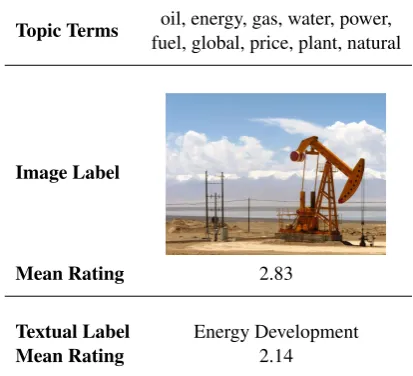
do-Topic Terms fuel, global, price, plant, naturaloil, energy, gas, water, power,
Image Label
Mean Rating 2.83
Textual Label Energy Development
[image:2.595.312.519.59.247.2]Mean Rating 2.14
Table 1: Example of a topic and its textual and image labels.
mains. The topics of these different datasets do not overlap, and as such have little utility for our mul-timodal method. To this end, we develop a new dataset which contains human-assigned ratings for two topic label modalities (textual and image) for the same set of topics.
We build on the dataset of Bhatia et al. (2016), which has ratings for textual labels. This dataset contains 228 topics generated from 4 different do-mains: BLOGS, BOOKS, NEWS and PUBMED.1 Each topic has 19 textual labels which were rated by human judges on a scale of 0–3, where 0 rep-resents a poor label and 3 indicates a perfect la-bel. We chose this dataset due to the diversity of sources represented in the topics.
We use the 228 topics and generate image labels for each topic following the method of Aletras and Stevenson (2013).2 We follow the annotation ap-proach of Bhatia et al. (2016), collecting ratings based on an ordinal scale of 0–3. We use Amazon Mechanical Turk to crowdsource the ratings, and have each image labelled by 8 workers. To aggre-gate the ratings for a label, we compute its mean rating.
For quality control, we embedded a bad label into the HIT for each topic by sampling a la-bel candidate for a topic from a different domain, under the assumption that an out-of-domain la-bel is highly unlikely to be appropriate. Work-ers who rate these control labels greater than 1 are 1To clarify, the original topics were generated by Lau et
al. (2011); Bhatia et al. (2016) collected human ratings for textual labels on these topics using their methodology.
1600
dimensions dimensions256 128 dimensions
64 dimensions
32 dimensions
score prediction
1200 dimensions
128 dimensions Topic
embedding word2vec + doc2vec Image embedding :
Vgg
Topic embedding word2vec + doc2vec Textual label embedding : word2vec + doc2vec
ReLU + Linear ReLU + Linear
s
256 dimensions
ReLU + Linear + LinearReLU
ReLU + Linear
ReLU + Linear
ReLU
+ Linear + LinearReLU Sigmoid
Page rank score
128 dimensions
+
Sigmoid
512 dimensions
512 dimensions
Trigram letter score
[image:3.595.312.522.65.119.2]ReLU + Linear ReLU + Linear
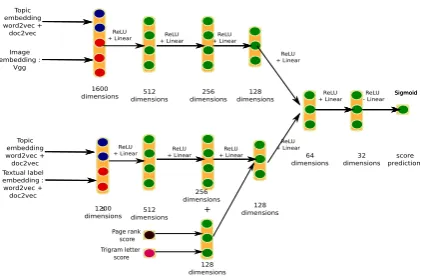
Figure 1: Multimodal model for topic labelling (joint-NN)
recorded, and those who fail more than 50% of control labels are filtered out of the dataset.
In total, 353 turkers participated in the image labelling task, at an average error percentage of 16% (based on the control images). A total of 42 turkers were filtered out, on the basis of having an error rate of more than 50%.
An example of a topic and its image and tex-tual labels, and their associated mean ratings, is presented in Table 1. The mean rating for the tex-tual labels is 1.57 with a variance of 0.29, while the mean rating for the image labels is 1.84 with a variance of 0.51. That is, the image labels are, on average, better quality, but there is equally more variability among the image labels.
To summarise, our final dataset consists of 4560 images and 4332 textual labels for 228 topics (20 images and 19 textual labels for each topic). To the best of our knowledge, it is the first dataset which has ratings for two topic label modalities. In addition to benefiting topic labelling research, it has potential applications in other language and vision tasks such as image captioning.
4 Models
Our baseline model (baseline) combines the two methodologies of Aletras and Mittal (2017) and Bhatia et al. (2016). That is, we generate and rank textual and image labels based on Bhatia et al. (2016) and Aletras and Mittal (2017) respectively, and then generate a combined ranking based on the predicted ratings.3 The baseline model views 3Bhatia et al. (2016) originally used SVR to rank textual
labels. We re-ran their model using the same features and SVR to predict label ratings, allowing us to combine both
Evaluation baseline disjoint-NN joint-NN UpperBound
Multimodal 2.07 2.02 2.08 2.74
[image:3.595.74.285.74.214.2]Visual-Only 1.95 1.98 1.99 2.67 Textual-Only 2.01 1.87 2.01 2.48
Table 2: Top-1 average rating performance. Bold-face indicates the best performance for each type of evaluation.
the two modalities (image and textual labelling) as two distinct tasks and does not leverage potential complementarity between them.
We propose a simple feed-forward neural that jointly re-ranks the two topic label modalities (joint-NN). In joint-NN, we first generate the candidate image labels and textual labels using the methodologies of Aletras and Mittal (2017) and Bhatia et al. (2016), respectively. However, unlike baselinewhere the labels are ranked separately, joint-NN feeds both label modalities into a sin-gle network to predict their ratings. The network architecture is depicted in Figure 1.
Each input modality is fed into two dense layers that are unconnected. The hidden representation at the 4th layer of the networks is then passed to a joint/shared hidden layer before the final output layer. All connections between layers are dense connections and the final output layer has a sig-moid activation, while all other hidden layers have ReLU activations. The first four layers are kept separate to allow the network to transform the em-beddings from the two different modalities to a common hidden representation. The shared layers leverage potential complementarity between the two label modalities to predict the final label rat-ing.
We generate the textual labels following the label generation methodology of Bhatia et al. (2016), as part of which, the labels and topic terms each have representations based ondoc2vec andword2vecembeddings, respectively. We con-catenate all four embeddings and use them as the input for the network.4 Bhatia et al. (2016) found that letter trigram features and PageRank features were strong features when re-ranking the labels. We borrow this idea, and incorporate these two features into the network by mapping the
2-textual and image labels and rank them using their predicted ratings.
4Each type of embedding has300dimensions; the
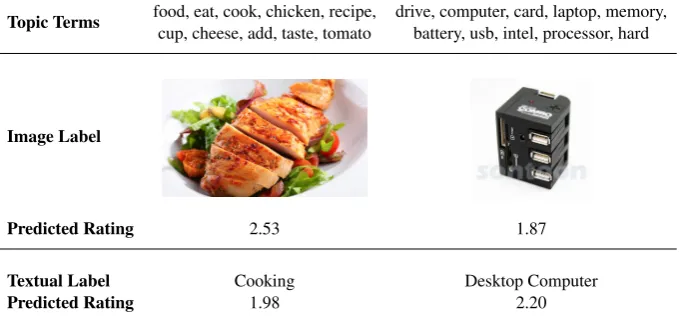
Topic Terms food, eat, cook, chicken, recipe, drive, computer, card, laptop, memory,cup, cheese, add, taste, tomato battery, usb, intel, processor, hard
Image Label
Predicted Rating 2.53 1.87
Textual Label Cooking Desktop Computer
[image:4.595.130.471.62.221.2]Predicted Rating 1.98 2.20
Table 3: Example of two topics and their generated textual and image labels and predicted ratings.
dimensional input (representing the letter trigram and PageRank features) into a128-dimension vec-tor and concatenating it with the 256-dimension hidden representation at the third layer (thus yield-ing a384-dimension vector).5
For the visual labels, the topic terms use the samedoc2vecandword2vecembeddings. For the image labels, we use the representation of the last layer of the VGG Neural Network (Simonyan and Zisserman, 2014). As before, the vectors for the topic terms and image labels are concatenated and fed as input to the network.6
As a control to test whether the sharing of weights helps with the prediction of label ratings, we experiment with another network (disjoint-NN) that has the same architecture as joint-NN, except that the final few layers are not shared and the two networks are trained indepen-dently.
5 Experiments and results
Following standard practice in topic labelling eval-uation (Lau et al., 2011; Aletras and Stevenson, 2013; Bhatia et al., 2016), we use “top-1 average rating” as the evaluation metric. It computes the mean rating of the top-ranked label generated by the system, and provides an assessment of the ab-solute utility of the labels. For example, if the top-ranked label predicted by the system has an aver-age rating of 3.0, that means the system are gener-ating perfect topic labels.7
5We explored incorporating the additional features at
dif-ferent layers, but saw little difference in task performance.
6VGG vectors have1000 dimensions and thedoc2vec
and word2vecembeddings each have300dimensions; the concatenated input is thus a1600-dimension vector.
7Note that, unlike previous work, we don’t evaluate based
on nDCG as the candidate set and ratings for each of the
indi-We present the results of all systems (baseline, joint-NN and disjoint-NN) in Table 2. Each model is trained using 10-fold cross-validation for 10 epochs. Presented results are an average over 20 runs. We display three types of evaluation: (1) “multimodal”, where we pool both label modal-ities together and evaluate jointly; (2) “visual-only”, where we evaluate only the visual labels; and (3) “textual-only”, where we evaluate only the textual labels. In addition to the 3 systems, for each topic we determine the rating of the best label and compute its mean over all topics, as the upper bound for the task (labelled “upper bound”).
Encouragingly,joint-NN— which exploits in-formation from both input modalities — achieves the best performance. The improvement compared to disjoint-NN is substantial, and much of the improvement is in the textual labels. However, when compared tobaseline, most of the gain is in the visual labels. These observations seem a lit-tle unintuitive; to better understand them we first look atbaselineanddisjoint-NN.
In terms of methodology, the difference be-tween baseline and disjoint-NN is their re-rankers. Both the image label re-rankers of baselineanddisjoint-NNare driven by neural networks, but the re-ranker of disjoint-NN has an additional layer (5 vs. 4).8 The improvement of results for the visual labels could thus be attributed to the additional hidden layer.
On the other hand, the performance differ-ence for the textual labels between baseline
vidual label modalities and the combined labels differ, mean-ing that the nDCG numbers are not directly comparable.
8The re-ranker ofdisjoint-NNalso does not use caption
and disjoint-NN is attributed to the classifiers (baseline = SVR; disjoint-NN = neural net-work), since they both share the same features. These results suggest that SVR is the superior classifier in this case.
However, when we share the latent representa-tions for the last few layers (joint-NN), we see that results improve substantially. In particularly, textual label performance is on par withbaseline, suggesting the addition of image label data helps learn the latent representations of textual labels. As a whole, this suggests there is strong comple-mentarity between the two different modalities of labels and highlights the strength of a multimodal network.
Lastly, it is worth mentioning that the multi-modal evaluation yields the highest rating across all systems. This suggests that, consistent with the findings of Aletras and Mittal (2017), different topics may have different optimal label represen-tations (image or textual), and that the best perfor-mance is achieved when we allow the model to dy-namically select between modalities. We present a sample of generated textual and image label for a topic in Table 3.
Looking at the upper bound, we see there is considerable room for further improvement. The models we have experimented with are based on simple feed-forward architectures, and the input representation is pre-computed, and thus not up-dated in the network. An immediate direction for future work would be designing end-to-end archi-tectures that take the input as raw features (e.g. us-ing the image pixels for the image labels).
6 Conclusions
In this paper, we have proposed a multimodal ap-proach to automatic topic labelling, based on a deep neural network. Compared to benchmark systems, our joint model achieves the best perfor-mance, demonstrating the strength of modelling different label modalities jointly.
Another contribution of the paper is the devel-opment of a multimodal dataset which we have re-leased publicly. The dataset, which contains an-notations for image and textual labels, could have applications for other multimodal NLP tasks.
Acknowledgements
This research was supported in part by the European Union, through the LCT
Masters Erasmus Mundus programme
(https://lct-master.org/), and in part by the Australian Research Council.
References
Nikolaos Aletras and Arpit Mittal. 2017. Labeling top-ics with images using neural networks. In Proceed-ings of the 39th European Conference on Informa-tion Retrieval (ECIR 2017), Aberdeen, UK.
Nikolaos Aletras and Mark Stevenson. 2013. Repre-senting topics using images. InProceedings of the 2013 Conference of the North American Chapter of the Association for Computational Linguistics: Hu-man Language Technologies (NAACL HLT 2013), pages 158–167, Atlanta, USA.
Nikolaos Aletras and Mark Stevenson. 2014. La-belling topics using unsupervised graph-based meth-ods. InProceedings of the 52nd Annual Meeting of the Association for Computational Linguistics (Vol-ume 2: Short Papers), pages 631–636, Baltimore, USA.
Nikolaos Aletras, Timothy Baldwin, Jey Han Lau, and Mark Stevenson. 2014. Representing topics labels for exploring digital libraries. In Proceedings of Digital Libraries 2014, London, UK.
Nikolaos Aletras, Timothy Baldwin, Jey Han Lau, and Mark Stevenson. 2017. Evaluating topic represen-tations for exploring document collections. Journal of the Association for Information Science and Tech-nology, 68(1):154–167.
Shraey Bhatia, Jey Han Lau, and Timothy Baldwin. 2016. Automatic labelling of topics with neural em-beddings. InProceedings of the 26th International Conference on Computational Linguistics (COLING 2016), pages 953–963, Osaka, Japan.
David M. Blei, Andrew Y. Ng, and Michael I. Jordan. 2003. Latent Dirichlet allocation. Journal of Ma-chine Learning Research, 3:993–1022.
Sergei Brin and Larry Page. 1998. The anatomy of a large-scale hypertextual web search engine. In
Proceedings of the Seventh World Wide Web Con-ference, pages 107–117, Brisbane, Australia.
Amparo Elizabeth Cano Basave, Yulan He, and Ruifeng Xu. 2014. Automatic labelling of topic models learned from twitter by summarisation. In
Proceedings of the 52nd Annual Meeting of the As-sociation for Computational Linguistics (Volume 2: Short Papers), pages 618–624, Baltimore, USA. Allison June-Barlow Chaney and David M. Blei. 2012.
Jia Deng, Wei Dong, Richard Socher, Li-Jia Li, Kai Li, and Li Fei-Fei. 2009. Imagenet: A large-scale hierarchical image database. InProceedings of the IEEE Conference on Computer Vision and Pattern Recognition (CVPR 2009), pages 248–255, Miami, USA.
Thomas L. Griffiths, Mark Steyvers, and Joshua B. Tenenbaum. 2007. Topics in semantic representa-tion. Psychological Review, 114(2):211–244.
Wanqiu Kou, Li Fang, and Timothy Baldwin. 2015. Automatic labelling of topic models using word vec-tors and letter trigram vecvec-tors. InProceedings of the 11th Asian Information Retrieval Societies Confer-ence (AIRS 2015), pages 229–240, Brisbane, Aus-tralia.
Jey Han Lau and Timothy Baldwin. 2016. The sen-sitivity of topic coherence evaluation to topic car-dinality. In Proceedings of the 2016 Conference of the North American Chapter of the Association for Computational Linguistics — Human Language Technologies (NAACL HLT 2016), pages 483–487, San Diego, USA.
Jey Han Lau, Karl Grieser, David Newman, and Tim-othy Baldwin. 2011. Automatic labelling of topic models. InProceedings of the 49th Annual Meeting of the Association for Computational Linguistics: Human Language Technologies-Volume 1, pages 1536–1545, Portland, USA.
Quoc V. Le and Tomas Mikolov. 2014. Distributed representations of sentences and documents. In Pro-ceedings of the 31st International Conference on Machine Learning (ICML 2014), pages 1188–1196, Beijing, China.
Omer Levy and Yoav Goldberg. 2014. Dependency-based word embeddings. InProceedings of the 52nd Annual Meeting of the Association for Computa-tional Linguistics (Volume 2: Short Papers), pages 302–308, Baltimore, USA.
Qiaozhu Mei, Xuehua Shen, and ChengXiang Zhai. 2007. Automatic labeling of multinomial topic models. InProceedings of the 13th ACM SIGKDD International Conference on Knowledge Discovery and Data Mining, pages 490–499, San Jose, USA.
Tomas Mikolov, Ilya Sutskever, Kai Chen, Greg S. Cor-rado, and Jeff Dean. 2013. Distributed representa-tions of words and phrases and their compositional-ity. InAdvances in Neural Information Processing Systems (NIPS-13), pages 3111–3119, Lake Tahoe, USA.
David Newman, Timothy Baldwin, Lawrence Cave-don, Sarvnaz Karimi, David Martinez, and Justin Zobel. 2010a. Visualizing document collections and search results using topic mapping. Journal of Web Semantics, 8(2–3):169–175.
David Newman, Youn Noh, Edmund Talley, Sarvnaz Karimi, and Timothy Baldwin. 2010b. Evaluating topic models for digital libraries. In Proceedings of the 2010 Joint Conference on Digital Libraries (JCDL), pages 215–224, Gold Coast, Australia. Forough Poursabzi-Sangdeh, Jordan Boyd-Graber,
Leah Findlater, and Kevin Seppi. 2016. Alto: Ac-tive learning with topic overviews for speeding la-bel induction and document lala-beling. In Proceed-ings of the 54th Annual Meeting of the Association for Computational Linguistics (Volume 1: Long Pa-pers), pages 1158–1169, Berlin, Germany.
Carson Sievert and Kenneth E. Shirley. 2014. LDAvis: A method for visualizing and interpreting topics. In
Proceedings of the ACL 2014 Workshop on active Language Learning, Visualization, and Inter-faces, pages 63–70, Baltimore, USA.
Karen Simonyan and Andrew Zisserman. 2014. Very deep convolutional networks for large-scale image recognition.arXiv preprint arXiv:1409.1556. Xiaojun Wan and Tianming Wang. 2016. Automatic
labeling of topic models using text summaries. In