Abstract—A service robot for inspecting exterior gas pipes of high rise buildings is reported in this paper. The principle of the wall climbing capability of the robot is based on vacuum suction force generated by an ordinary vacuum cleaner motor. The robot maneuverability is facilitated by four independent driving motors and a control console. There are two operation modes namely manual and automatic operation. During the manual operation, the robot motion is control by operator with joystick. In the automatic mode, the robot path tracking is done by two ferric-type proximity sensor while gas leakage of pipe is detected by a gas sensor.
Index Terms—Service robot, climbing capability, path tracking
I. INTRODUCTION
Gas is a main source of energy in Hong Kong for cooking and heating. However, in a metropolitan city like Hong Kong, majority of the residual buildings are high rise buildings over 100 meters tall. As such, gas is being transported to individual home through galvanized mild steel pipes installed on the exterior walls of buildings. In order to ensure the safety of these pipes, frequent inspection of gas leakage is needed. Traditionally, these pipes are being inspected manually by technicians from the gas supply company. The technician is required to enter into individual home and put a gas detector, which is attached to the end of a long stick, through a near-by window to the gas pipes to check for gas leakages. This is often labour-intensive and time-consuming. In addition, some of gas pipes are actually very difficult for the technician to access since the pipes are too far from any windows. Figure 1 shows two of such pipe installations and they are almost impossible for the technician to check for gas leakage. It is because the pipes are installed at a right angle away from any windows as shown in the photographs. In the past, this type of problems can be solved by setting up scaffolding and carry out a full scale inspection and maintenance every 10-15 years. However, with the effect of pollution and acid rain, the steel pipes are corroded much faster than the expected life span. In view of this problem, a more efficient and safe method is needed for carrying out more frequent inspection. One possible solution is to develop a climbing service robot which can carry cameras and gas
Manuscript received April 7, 2009. The work was fully supported by a grant provided by City University of Hong Kong Project No. 9610024-630: ITRG006-06.
K. P. Liu, B. L. Luk and Y. T. Chan are with Department of Manufacturing Engineering and Engineering Management, City University of Hong Kong, Kowloon, Hong Kong (e-mail: [email protected],
[email protected] and [email protected])
cameras and gas detector to climb on the outer surface of the pipe. However, the gas supply company worries that the pipe mounting brackets may not be strong enough to support the weight of the robot. As a result, direct climbing on the pipe itself was not a preferred method. Fortunately, there are always some spaces next to the pipes that are reserved for maintenance purpose and do not normally have any obstacles. As such, the more preferred way was for the robot to climb along and make use of these spaces to access the pipe to check for corrosion and gas leakage.
In the past, a number of climbing robots have been developed to carry out glass curtain wall cleaning [1-2], bridge inspections [3], ship hull inspections [4], painting of large buildings [5] and inspection of nuclear reactor pressure vessels [6-7]. Most all of these robots used either magnetic grippers or vacuum grippers for climbing the buildings or large structures. Magnetic grippers [4] can only be used on ferromagnetic materials such as iron or mild steel ship hull and is not suitable for climbing concrete structure. Vacuum grippers on the other hand can be used to climb wide variety of structures.
For commercially available vacuum grippers which are commonly used in the automatic pick-and-place or palletizing machines, due to the large frictional forces, they cannot be moved or relocated to a different location once they have stuck down firmly onto an object. To use these vacuum grippers for climbing structure, several robots such as Cleanbot 1[1], NERO series of robots [7] and SADIE robot [7] adopted the sliding frame mechanism as the main means for locomotion on vertical wall surfaces. This mechanism is one of the simplest climbing mechanisms and can also step over small obstacles. Luk et al [6] developed a 4-legged robot which mimics a spider with articulated legs for negotiating unstructured environments, climbing over large obstacles and performing floor-to-wall transfer. Krosuri et al [8] developed a biped climbing robot, RAMR, for reconnaissance operations in urban environment. The robot was capable of transferring between orthogonal surfaces. However, all the aforementioned robots can only provide discontinuous movement. For inspecting gas pipes, continuous smooth movement is much preferred. Tso et al [2] developed a climbing robot, using chain-track mechanism with many suction cups attached to the chain as the locomotive mechanism. The robot could provide smooth movements. However, it was mainly designed for moving up and down a straight line path and has a very large turning radius. As such, it is very difficult to maneuver in tight space or between pipes. In this paper, we present a new gas pipe inspection robot, GPIR, which can provide smooth continuous movement for various industrial applications, especially for gas pipe inspection.
Service Robot for Inspecting Exterior Gas Pipes
of High Rise Buildings
design gas pipe inspection robot.
II. CONCEPTUAL DESIGN OF THE SERVICE ROBOT FOR
INSPECTING GAS PIPE
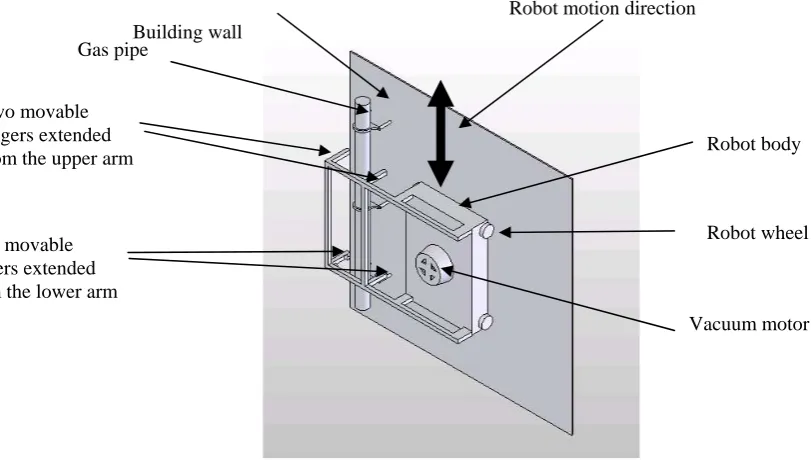
As shown in Figure 1, the pipe installation will always allow some spaces next to the pipes that do not have any obstacles so the design concept of the robot can rely on the usage of the clear spaces for accessing the pipes.
Experimental Setup
The gas pipe inspection robot is basically a light weight wall climbing robot using a large vacuum gripper for attaching onto vertical wall surfaces. Wheels are used for providing the upward, downward and turning movements. It is operated like a remote-controlled four-wheeled vehicle on vertical walls. The robot is designed to move on large flat surfaces including tile walls but it is also capable of crossing small obstacles with height less than 8mm (The height of obstacles which the robot can handle depends on the size of the wheel and the height of the air seals used on the robot). The main advantages of the robot are that it is relatively fast, low cost and easy to maneuver. In addition, it can provide smooth continuous motion. In order to make it easier for users to carry out the inspection process, the robot motion will be guided by a sophisticated servo control system, which is equipped with two proximity sensors to check the pipe segment position. This arrangement would make it possible to drive the robot moving parallel to and keeping apart from the gas pipe as shown in Figure 2. In order to carry sensors, gas detector and cameras, two fixed arms (one is called upper and the other is called lower) are installed onto the climbing robot and each arm has two moveable fingers extended from the arm. Two cameras are installed respectively to the two fingers belonging to either the upper or the lower arm as shown in Figure 3. The two camera positions relative to the pipe can be pre-adjusted or controlled remotely by an operator. There are two more cameras firmly mounted to the upper or the lower fixed arm. With this camera placement arrangement, the three principal sides around the gas pipe are visually monitored. A gas leakage detector can be mounted to the robot body for detecting leakage. A typical sensor mounting method is shown in Figure 4.
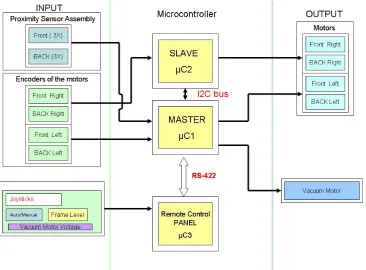
The electronic and computer control system of the service robot is described by the symmetric diagram shown in Figure 5. There are Input and Output parts. For the Input part, the first component is the Proximity Sensor Assembly, which determines the gas pipe position related to the robot and input the position value to the Master Microcontroller. The second component is the motor encoders, which monitor the four driving wheels angular positions and feedback to the Master and Slave Microcontrollers for parallel processing to reduce calculation time while the Master and Slave are communicating by I2C bus. The last Input component is the control console, which receives operator instruction through Joysticks, Auto/Manual selection switch, Proximty Sensor Frame level value and Vacuum Motor Voltage. This operator inputs are collected by the Remote Control Panel
III. PROTOTYPE OF THE SERVICE ROBOT
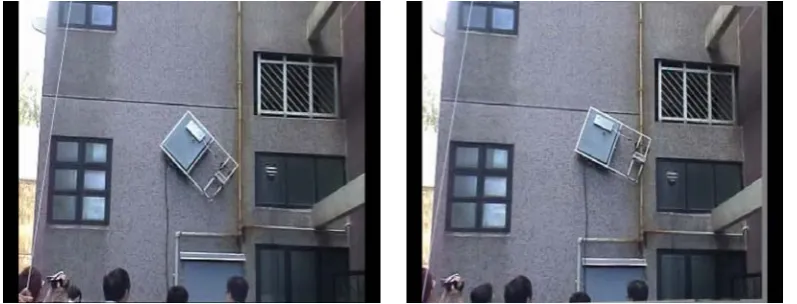
According to the conceptual design as mentioned in the previous section, a full scale prototype of the robot is built and shown in Figure 6. A number of trails and demonstrations have done in the university staff quarters. The photographs shown in Figure 6 illustrate the trial and demonstration.
IV. CONCLUSION
The design and demonstration of the novel service robot for inspecting gas pipe is discussed. In term of cost to build such kind of robot, it is around twelve thousand US dollars. The present version of the robot is tele-wire control. Theoretically, it is not difficulty to convert it to wireless control. However, in order to provide a secure power supply to the 1KW vacuum motor, it is desirable to have wire connected to the robot to guarantee long time power supply to the robot.
ACKNOWLEDGMENT
We would like to extend our thanks to Prof Y.Y. Hung and Prof. S. K. Tos for their support to the success of this project.
REFERENCES
[1] Tso SK, Fung YH, Chow WL, Zong GH, Liu R. Design and implementation of a glass-wall cleaning robot for high-rise buildings. In: Proceedings of the World Automation Congress Eighth
International Symposium on Robotics with Applications 2000; paper ID: ISORA123.
[2] Tso SK, Zhu J, Luk BL. Prototype design of a light-weight climbing robot capable of continuous motion. In: Proceedings of the 8th IEEE Conference on Mechatrinics and Machine Vision in Practice 2001: 235-238
[3] Hillenbrand C, Berns K, Weise F, Koehnen J. Development of a climbing robot system for non-destructive testing of bridges. In: Proceedings of the 8th IEEE Conference on Mechatrinics and Machine Vision in Practice 2001: 399-403.
[4] Sattar TP, Alaoui M, Chen S, Bridge B. A magnetically adhering wall climbing robot to perform continuous welding of long seams and non-destructively test the welds on the hull of a container ship. In: Proceedings of the 8th IEEE Conference on Mechatrinics and Machine Vision in Practice 2001:408-414.
[5] Wang Y, Shao H. Wall climbing robot for cleaning and painting. In: Proceedings of the 2nd International Conference on Climbing and Walking Robots, 1999.
[6] Luk BL, Cooke DS, Galt S, Collie AA, Chen S. Intelligent legged climbing service robot for remote maintenance applications in hazardous environments. Journal of Robotics and Autonomous Systems 2005; 53(2): 142-152.
[7] Luk BL, Liu KP, Collie AA, Cooke DS, Chen S. Tele-operated Climbing and Mobile Service robots for Remote Inspection and Maintenance in Nuclear Industry. Industrial Robot 2006; 33(3):194-204.
(a) There is no window near by the gas pipe (b) Window is right-angle away from the gas pipe
Figure 1 Two typical cases of pipe installations that are almost impossible for manual gas leakage checking
[image:3.595.87.493.323.553.2]
Figure 2. The conceptual design of the gas pipe inspection robot
Figure 3. The camera placement scheme for visual inspection of the gas pipe Gas pipe
Two movable fingers extended from the upper arm
Robot motion direction
Robot body
Vacuum motor Robot wheel Two movable
fingers extended from the lower arm
Building wall
Moveable finger
[image:3.595.54.536.606.755.2]Figure 4. A typical mounting method of gas leakage detection sensor
[image:4.595.109.476.463.733.2]
(a) The two cameras and the two proximity sensors (b) The operator control console
( c) Manual control of the robot to approach to pipe (d) Manual align the robot to the pipe
[image:5.595.101.500.260.412.2]
(e) It started automatic mode and tracked the (f) The robot stopped when reaching the end gas pipe, and detect gas leakage from the of the gas pipe and waited for the instruction installed gas leakage sensor. to come back.
Figure 6 Site demonstration of the prototype service robot for gas pipe inspection Gas leakage