System Combination for Machine Translation through Paraphrasing
Wei-Yun Ma
Institute of Information science
Academia Sinica
Taipei 115, Taiwan
[email protected]
Kathleen McKeown
Department of Computer Science
Columbia University
New York, NY 10027, USA
[email protected]
Abstract
In this paper, we propose a paraphrasing model to address the task of system com-bination for machine translation. We dy-namically learn hierarchical paraphrases from target hypotheses and form a syn-chronous context-free grammar to guide a series of transformations of target hy-potheses into fused translations. The model is able to exploit phrasal and struc-tural system-weighted consensus and also to utilize existing information about word ordering present in the target hypotheses. In addition, to consider a diverse set of plausible fused translations, we develop a hybrid combination architecture, where we paraphrase every target hypothesis us-ing different fusus-ing techniques to obtain fused translations for each target, and then make the final selection among all fused translations. Our experimental re-sults show that our approach can achieve a significant improvement over combina-tion baselines.
1
Introduction
In the past several years, many machine transla-tion (MT) combinatransla-tion approaches have been developed. Word-level combination approaches, such as the confusion network decoding model, have been quite successful (Matusov et al., 2006; Rosti et al., 2007a; He et al. 2008; Karakos et al. 2008; Chen et al. 2009a; Narsale 2010; Leusch 2011; Freitag et al. 2014).
In addition to word-level combination proaches, some phrase-level combination ap-proaches have also recently been developed; the goal is to retain coherence and consistency
be-tween the words in a phrase. The most common phrase-level combination approaches are re-decoding methods: by constructing a new phrase table from each MT system’s source-to-target phrase alignments, the source sentence can also be re-decoded using the new translation table (Rosti et al., 2007b; Huang and Papineni, 2007; Chen et al., 2007; Chen et al., 2009b). One prob-lem with these approaches is that, just with a new phrase table, existing information about word ordering present in the target hypotheses is not utilized; thus the approaches are likely to make new mistakes of word reordering which do not appear in the target hypotheses of MT engines. Huang and Papineni (2007) attacked this issue through a reordering cost function that encour-ages search along with decoding paths from all MT engines’ decoders.
Another phrase-level combination approach relies on a lattice decoding model to carry out the combination (Feng et al 2009; Du and Way 2010; Ma and McKeown 2012). In a lattice, each edge is associated with a phrase (a single word or a sequence of words) rather than a single word. The construction of the lattice is based on the extraction of phrase pairs from word alignments between a selected best MT system hypothesis (the backbone) and the other translation hypothe-ses. One challenge of the lattice decoding model is that it is difficult to consider structural consen-sus among target hypotheses from multiple MT engines, i.e, the consensus among occurrences of discontinuous words.
In this paper, we propose another phrase-level combination approach – a paraphrasing model using hierarchical paraphrases (paraphrases con-tain subparaphrases), to fuse target hypotheses. We dynamically learn hierarchical paraphrases from target hypotheses without any syntactic an-notations and form a synchronous context-free grammar (SCFG) (Aho and Ullman 1969) to
guide a series of transformations of target hy-potheses into fused translations. Through these structural transformations, the paraphrasing model is able to exploit phrasal and structural system-weighted consensus and also able to uti-lize existing information about word ordering present in the target hypotheses. In addition, to consider a diverse set of plausible fused transla-tions, we develop a hybrid combination architec-ture, where we paraphrase every target hypothe-sis using different fusing techniques to obtain fused translations for each target, and then make the final selection among all fused translations through a sentence-level selection-based model.
In short, compared with other related work, our approach features the following advantages:
1. It can consider structural system-weighted
consensus among target hypotheses from multiple MT engines through its hierar-chical paraphrases, which non-hierarhierar-chical paraphrases are not able to do.
2. It can utilize existing information about
word ordering present in the target hy-potheses.
3. It can retain coherence and consistency
between the words in a phrase.
4. The hybrid combination architecture
ena-bles us to consider a diverse set of plausi-ble fused translations produced by differ-ent fusing techniques.
2
Hybrid Combination Architecture
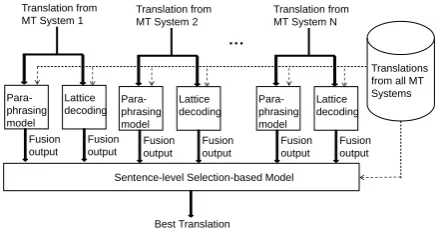
[image:2.595.306.526.72.186.2]In the context of system combination, discrimi-native reranking or post editing, MT researchers (Rosti et al., 2007a; Huang and Papineni, 2007; Devlin and Matsoukas, 2012, Matusov et al., 2008; Gimpel et al., 2013) have recently shown many positive results if more diverse translations are considered. Inspired by them, we develop a hybrid combination architecture in order to con-sider more diverse fused translations. We para-phrase every target hypothesis to obtain the cor-responding fused translation, and then make the final selection among all fused translations through a sentence-level selection-based model, shown in Figure 1. In the architecture, different fusing techniques can be used to generate fused translations for the further sentence-level selec-tion, enabling us to exploit more sophisticated information of the whole sentence.
Figure 1. An example of hybrid combination architecture
3
Paraphrasing Model
In this section, we introduce our paraphrasing model. For each single target hypothesis, we ex-tract a set of hierarchical paraphrases from mon-olingual word alignments between the hypothesis and other hypotheses. Each set of hierarchical paraphrases forms a synchronous context-free grammar to guide a series of transformations of that target hypothesis into a fused translation.
Any monolingual word aligner can be used to produce the monolingual word alignments. In our system, we adopt TERp (Snover et al. 2009), one of the state-of-the-art alignment tools, to serve this purpose. TERp is an extension of TER (Snover et al. 2006). Both TERp and TER are automatic evaluation metrics for MT, based on measuring the ratio of the number of edit opera-tions between the reference sentence and the MT system hypothesis. The edit operations of TERp include TER’s Matches, Insertions, Deletions, Substitutions and Shifts—as well as three new edit operations: Stem Matches, Synonym Match-es and ParaphrasMatch-es. A valuable side product of TERp is the monolingual word alignment. A constructed example is shown in Figure 2.
3.1 Hierarchical Paraphrase Extraction
We first introduce our notation. For a given
sen-tence i, we use i
h
E to denote the target
hypothe-sis from MT system h, use i
h
EP to denote i
h
E
attached with related word positions, use i
h
e to
denote a phrase within i
h
E , and use i
h
ep to denote
i h
e attached with related word positions. For
in-stance, If i
h
E is “you buy the book”, then i
h
EP
would be “you1 buy2 the3 book4”. If i
h
e is “the
book”, then i
h
ep is “the3 book4”.
For a given sentence i, a MT system h and a
MT system k, we use a SCFG denoted by i
k h Q, to represent the set of hierarchical paraphrases
learned from i
h
EP and i
k
EP . Adapting (Chiang
Translation from MT System 1
…
Fusion output
Fusion output
Para-phrasing model
Lattice decoding
Translation from MT System 2
Fusion output
Fusion output
Para-phrasing model
Lattice decoding
Translation from MT System N
Fusion output
Fusion output
Para-phrasing model
Lattice decoding
Sentence-level Selection-based Model
Best Translation
2007), we design the following rules to obtain
i k h
Q, , based on the monolingual word alignment,
obtained by a aligner, such as TERp.
If i
k i h ep
ep , is consistent1 with the
mono-lingual word alignment, then i
k i h e ep
X ,
is added to i
k h
Q, .
If X, is inQhi,k, and
i k i h ep ep , is
consistent with monolingual word alignment
such that 1 i2
h
ep
and 1 i2 k
e
, then
1Xa2 ,1Xa2
X is added to i
k h
Q, , where
a is an index.
Please note that for each extracted hierarchical
paraphrase - X, ,
would includeinformation of word positions while
would not.For a certain target hypothesis - i
h
EP , our goal
is to paraphrase it to get the fusion output by us-ing a set of hierarchical paraphrases, denoted by
i h
Q . Thus we create the union of all related
hier-archical paraphrases learned from i
h
EP and other
target hypotheses. Two special “glue” rules -
S1X2,S1X2
S and SX1,X1 are also added
to i
h
Q . The process can be represented formally in
the following:
{ 1X2, 1X2 , X1,X1 }1 , S S S S Q Q N k i k h i h
where N is the total number of MT systems.
[image:3.595.301.523.136.305.2]3.1.1 An Example
Figure 2. A constructed example of a sentence - “你買的書
(the book that you bought)” and its translations from three MT systems – i
E1,
i
E2 and
i
E3, and word alignments
be-tween i
E2 and
i
E1 , and between
i
E2 and
i
E3 , obtained through TERp.
We use a Chinese-to-English example in Figure 2 to illustrate the extraction process. The
1 This means that words in a legal paraphrase are not
aligned to words outside of the paraphrase, and should include at least one pair of words aligned with each other.
ed hierarchical paraphrases to paraphrase i
EP2 -
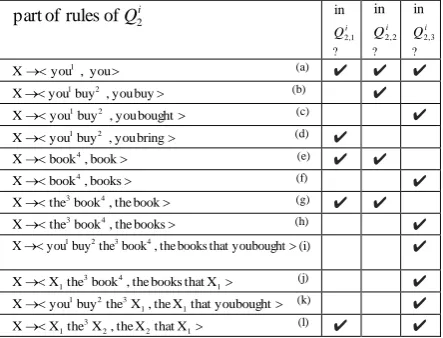
“you1 buy2 the3 book4” are shown in Table 1.
Because of limited space, only part of the
para-phrases, i.e, part of the rules ofQi
2, are shown.
i Q2 of rules of part i
Q2,1
in
? i
Q2,2
in
? i
Q2,3
in
?
you , you
X 1 (a) ✔ ✔ ✔
youbuy , youbuy
X 1 2 (b) ✔
youbuy , youbought
X 1 2 (c) ✔
youbuy , youbring
X 1 2 (d) ✔
book ,book
X 4 (e) ✔ ✔
book ,books
X 4 (f) ✔
the book , thebook
X 3 4 (g)
✔ ✔
thebook , thebooks
X 3 4 (h) ✔ (i) bought that you books the , book the buy you
X 1 2 3 4 ✔
1
4 3
1 the book , thebooks that X X
X (j) ✔
youbuy the X , theX that youbought
X 1 1
3 2
1 (k) ✔
2 2 1
3
1 the X , theX that X X
X (l) ✔ ✔
Table 1. Part of extracted hierarchical paraphrases to para-phrase i
EP2, i.e, part of the rules of
i
Q2.
Note that, in Table 1, the rules (j), (k) and (l) can be regarded as structural paraphrases, and they utilize existing information about word or-dering present in the target hypotheses. Since
rule (l) is included in both Qi
1 ,
2 and
i
Q2,3, we can
say that rule (l) has more structural consensus than rule (j) and (k). And rule (l) also models the word reordering through reversing the order of
X1 and X2. By the example, we can see the
rea-son why our model is able to exploit structural consensus and also to utilize existing information about word ordering present in the target hypoth-eses.
3.2 Decoding
Given a certain target hypothesis - i
h
EP , and its
set of hierarchical paraphrases - i
h
Q , the decoder
aims to paraphrase i
h
EP using Qhiby performing a
search for the single most probable derivation via the CKY algorithm with a Viterbi approximation. The derivation is the paraphrased result, i.e, the fusion result indicated in Figure 1. The single most probable derivation can be represented as
otherwise 0 if 1 ) , ( , , , i k h j i h j i h Q q k q f
the books that you bought you buy the book
:
:
:
[image:3.595.71.238.509.590.2]where ij h
q, is the jth paraphrase in Qhi used to
generateEih, J is the number of paraphrases used
to generate Eih. N is the total number of MT
sys-tems. kis the weight of MT system k, in charge
of the system-weighted consensus.p is phrase
penalty. l is the LM weight and w is word
penalty. All weights are trained discriminatively for Bleu score using Minimum Error Rate Train-ing (MERT) procedure (Och 2004).
The ideal result of paraphrasing i
EP2 is shown
in the following, which is supposed to be gener-ated with a higher chance if, regardless of system weights. That is because of the use of the rules with higher degree of structural consensus, such as (l) and (e).
4
Sentence-Level Selection-based Model
For a given sentence i and its M multiple fusion
outputs - i
f
E ,1f M generated by the
para-phrasing model or the lattice decoding model, the goal here is to select the best one among them, as shown in Figure 1 (For the case shown in the
figure, M is 2N). The idea is to compare
system-weighted consensus among all fusion outputs and translations from all MT systems, and then select the one with the highest consensus. We adopt Minimum Bayes Risk (MBR) decoding (Kumar and Byrne, 2004; Sim et al., 2007) to serve our purpose and develop the following TER-based MBR:
where TER is Translation Tdit Ratio. mis the
fusion weight specific to a certain MT system
and a certain fusion model, k is the weight of
MT system k and l is the LM weight. All
weights are trained discriminatively for Bleu score using MERT.
5
Experiments
Our experiments are conducted and reported on three datasets: The first dataset includes
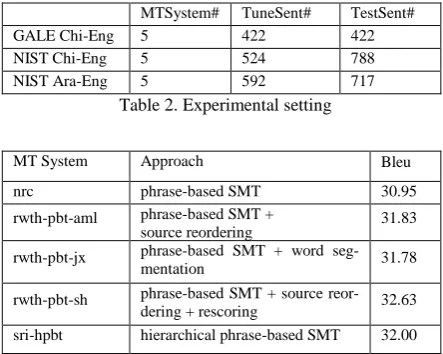
Chinese-English system translations and reference trans-lations from DARPA GALE 2008 (GALE Chi-Eng). The second dataset includes Chinese-English system translations and reference trans-lations and from NIST 2008 (NIST Chi-Eng). And the third dataset includes Arabic-English system translations and reference translations and from NIST 2008 (NIST Ara-Eng).
[image:4.595.305.527.180.357.2]MTSystem# TuneSent# TestSent# GALE Chi-Eng 5 422 422 NIST Chi-Eng 5 524 788 NIST Ara-Eng 5 592 717
Table 2. Experimental setting
MT System Approach Bleu
nrc phrase-based SMT 30.95 rwth-pbt-aml phrase-based SMT +
source reordering
+ source reordering
31.83
rwth-pbt-jx phrase-based SMT + word
seg-mentation 31.78
rwth-pbt-sh phrase-based SMT + source
reor-dering + rescoring 32.63 sri-hpbt hierarchical phrase-based SMT 32.00
Table 3: Techniques of top five MT of GALE Chi-Eng Da-taset
Table 3 lists distinguishing machine transla-tion approaches of top five MT of GALE Chi-Eng Dataset. And “rwth-pbt-sh” performs the best in Bleu score.
Two combination baselines are implemented for comparison: one is an implementation based on confusion network decoding, and the other is Lattice Decoding from (Ma and McKeown 2012), both of which are using TERp to obtain word alignments between a selected backbone hypoth-esis and other target hypotheses. The former uses these word alignments to construct a confusion network while the latter extracts phrases which are consistent with these word alignments to construct a lattice. For both baselines, backbone hypotheses are selected sentence by sentence based on system-weighted consensus among translation of all MT systems.
5.1 Results
In Table 4, CN represents confusion network; LD represents Lattice Decoding (Ma and McKe-own 2012); PARA represents paraphrasing mod-el proposed in this paper; Backbone_* represents that * is carried out on selected backbones, in contrast with the hybrid combination architecture. Arch_LD represents that only lattice decoding is carried out using hybrid combination architecture. Arch_PARA represents that only paraphrasing model is carried out using hybrid combination
(e) rule using bought you book that the , book the buy you
(c) rule using bought that you X the , X the buy you
(l) rule using X that X the , X the X
rule glue using X , X S
4 3 2 1
4 4 3 2 1
3 4 4 3 3
2 2 1
N
k
i k i
f k
M
m
i m i
f m
i f l
f i
f f
E E TER E
E TER
E LM E
p
1 1
)) , ( 1 log( * ))
, ( 1 log( *
)) ( log( * max arg ) ( log max arg
architecture. Arch_LD_PARA represents that LD and PARA are both carried out using hybrid combination architecture, which is the example shown in Figure 2.
GALE
Chi-Eng
NIST
Chi-Eng
NIST
Ara-Eng
Best MT system
32.63 30.16 48.40 Backbone_CN (baseline)
33.04 31.21 48.56 Backbone_LD (baseline) 33.16 32.65 49.33
Backbone_PARA
33.09 32.59 49.46 Arch_LD 33.24 32.66 50.48
Arch_PARA 33.32 32.90 50.20
[image:5.595.308.525.180.251.2]Arch_LD_PARA 33.72 33.42 50.44
Table 4. Experimental results in Bleu score
From Table 4, we can first observe that, for the three datasets, Backbone_PARA and Back-bone_LD outperform Backbone_CN, which shows the advantage of using phrases over words in combination. However, Backbone_PARA does not show improvement over Backbone_LD. The reason could be that selected backbones al-ready have a high level of quality and fewer words need to be replaced or re-ordered in con-trast with other target hypotheses.
We find that Arch_PARA performs better than Backbone_PARA, and Arch_LD performs better than Backbone_LD. This observation supports our claim that it is beneficial to consider more diverse sets of plausible fused translations.
Arch_LD_PARA achieves the best perfor-mance among all techniques used in this paper. It not only supports our claim, but also brings a conclusion that the paraphrasing model and lat-tice decoding can compensate for the weaknesses of the other in our architecture.
Since the paraphrasing model uses hierarchical paraphrases to carry out the fusion, it is able to make a bigger degree of word-reordering or structural change on the input hypothesis in comparison with lattice decoding. We suppose that when more word-reordering and structural changes are needed, paraphrasing model can bring more benefits than lattice decoding. Be-cause the quality of a given translation hypothe-sis is highly related to word reordering and struc-tural change, it can be expected that when a poorly translated hypothesis is paraphrased, par-aphrasing model can bring more benefits than lattice decoding. In order to obtain the evidence to support this hypothesis, we carried out the fol-lowing experiment on NIST Chi-Eng Dataset.
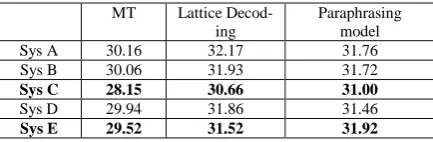
For each MT system from the selected top 5 system A-E, we paraphrase its translations using the paraphrasing model and lattice decoding sep-arately, aiming to compare the performances of the two models on each MT system. In other words, we do not first do backbone selection. Every MT system’s translation is regarded as a backbone. The results are shown in Table 5.
MT Lattice Decod-ing
Paraphrasing model Sys A 30.16 32.17 31.76 Sys B 30.06 31.93 31.72
Sys C 28.15 30.66 31.00
Sys D 29.94 31.86 31.46
Sys E 29.52 31.52 31.92
Table 5. The Bleu score of each MT system, the Bleu score of paraphrasing each MT system using lattice decod-ing and the Bleu score of paraphrasdecod-ing each MT system using paraphrasing model.
Among the five MT systems, “Sys C” and “Sys D” perform poorer than the other three MT systems. When we paraphrase the two systems, we find that paraphrasing model outperforms lattice decoding. These results support our hy-pothesis that when more word-reordering and structural changes are needed, paraphrasing model can bring more benefits than lattice de-coding.
6
Conclusion
We view MT combination as a paraphrasing pro-cess using a set of hierarchical paraphrases, in which more complicated paraphrasing phenome-na are able to be modeled, such as phrasal and structural consensus. Existing information about word ordering present in the target hypotheses are also considered. The experimental results show that our approach can achieve a significant improvement over combination baselines.
There are many possibilities for enriching the simple framework. Many ideas from recent translation developments can be borrowed and modified for combination. Our future work aims to incorporate syntactic or semantic information into our paraphrasing framework.
Acknowledgments
Reference
A. V. Aho and J. D. Ullman. 1969. Syntax directed translations and the pushdown assembler. Journal of Com-puter and System Sciences, 3:37–56.
Yu Chen, Andreas Eisele, Christian Federmann, Eva Hasler, Michael Jellinghaus, and Silke Theison. 2007. Multi-engine machine translation with an open-source SMT decoder. In Proceedings of WMT07
Boxing Chen, Min Zhang and Aiti Aw. 2009a. A Comparative Study of Hypothesis Alignment and its Improvement for Machine Translation System Combination. In: Proceedings of ACL-IJCNLP. pp. 1067-1074. Singapore. August.
Yu Chen, Michael Jellinghaus, Andreas Eisele, Yi Zhang, Sabine Hunsicker, Silke Theison, Christian Federmann, Hans Uszkoreit. 2009b. Combining Multi-Engine Translations with Moses. In Proceed-ings of the Fourth Workshop on Statistical Ma-chine Translation
David Chiang. Hierarchical phrase-based translation. 2007. Computational Linguistics, 33(2):201–228.
J. Devlin and S. Matsoukas. 2012. Trait-based hy-pothesis selection for machine translation. In Proc. of NAACL
Jinhua Du and Andy Way. 2010. Using TERp to Augment the System Combination for SMT. In Proceedings of the Ninth Conference of the Asso-ciation for Machine Translation (AMTA2010)
Yang Feng, Yang Liu, Haitao Mi, Qun Liu, and Yajuan Lu. 2009 Lattice-based System Combina-tion for Statistical Machine TranslaCombina-tion. In Pro-ceedings of ACL
Markus Freitag, Matthias Huck, and Hermann Ney. 2014. Jane: Open source machine translation sys-tem combination. In Conference of the European Chapter of the Association for Computational Lin-guistics, pages 29–32, Gothenburg, Sweden, April. Association for Computational Linguistics.
Kevin Gimpel, Dhruv Batra, Chris Dyer, and Gregory Shakhnarovich. 2013. A Systematic Exploration of Diversity in Machine Translation. In Proc. of EMNLP
Xiaodong He, Mei Yang, Jianfeng Gao, Patrick Ngu-yen, and Robert Moore. 2008. Indirect-hmm-based hypothesis alignment for computing outputs from machine translation systems. In Proceedings of EMNLP
Fei Huang and Kishore Papineni. 2007. Hierarchical System Combination for Machine Translation. In Proceed-ings of EMNLP-CoNLL
Damianos Karakos, Jason Eisner, Sanjeev Khudanpur, and Markus Dreyer. 2008. Machine translation
sys-tem combination using ITG-based alignments. In Proceedings of ACL-HLT
S. Kumar and W. Byrne. 2004. Minimum Bayes-risk decoding for statistical machine translation. In Pro-ceedings of HLT
Wei-Yun Ma and Kathleen McKeown. 2012. Phrase-level System Combination for Machine Translation Based on Target-to-Target Decoding. In Proceed-ings of the 10th Biennial Conference of the Asso-ciation for Ma-chine Translation in the Americas (AMTA), San Diego, CA.
Gregor Leusch, Markus Freitag, and Hermann Ney. The RWTH System Combination System for WMT 2011. 2011. In Proceedings of the Sixth Workshop on Statistical Machine Translation
Evgeny Matusov, Nicola Ueffing, and Hermann Ney 2006. Computing consensus translation from mul-tiple machine translation systems using enhanced hypotheses alignment. In Proceedings of EACL
E. Matusov, G. Leusch, R. E. Banchs, N. Bertoldi, D. Dechelotte, M. Federico, M. Kolss, Y. S. Lee, J. B. Marino, M. Paulik, S. Roukos, H. Schwenk, and H. Ney. 2008. System combination for machine trans-lation of spoken and written language. IEEE Transactions on Audio, Speech and Language Pro-cessing, 16(7):1222–1237, September.
Sushant Narsale. JHU System Combination Scheme for WMT 2010. 2010. In Proceedings of the Fifth Workshop on Statistical Machine Translation
Franz Josef Och. 2004. Minimum Error Rate Training in Statistical Machine Translation. In Proceedings of ACL
Antti-Veikko I. Rosti, Spyros Matsoukas, and Richard Schwartz. 2007a. Improved word-level system combination for machine translation. In Proceed-ings of ACL
Antti-Veikko I. Rosti, Necip F. Ayan, Bing Xiang, Spyros Matsoukas, Richard Schwartz, and Bonnie J. Dorr. 2007b. Combining outputs from multiple machine translation systems. In Proceedings of NAACL-HLT
Khe Chai Sim, William J. Byrne, Mark J.F. Gales, Hichem Sahbi, and Phil C. Woodland. 2007. Con-sensus network decoding for statistical machine translation system combination. In Proceedings of ICASSP
M. Snover, B. Dorr, R. Schwartz, L. Micciulla, and J. Makhoul. 2006. A Study of Translation Edit Rate with Targeted Human Annotation. In Proceedings of AMTA.