The Development of Transactive Memory Systems in
Collaborative Educational Virtual Worlds
NISIOTIS, Louis <http://orcid.org/0000-0002-8018-1352>, KLEANTHOUS
LOIZOU, Styliani, BEER, Martin <http://orcid.org/0000-0001-5368-6550> and
URUCHURTU, Elizabeth <http://orcid.org/0000-0003-1385-9060>
Available from Sheffield Hallam University Research Archive (SHURA) at:
http://shura.shu.ac.uk/15605/
This document is the author deposited version. You are advised to consult the
publisher's version if you wish to cite from it.
Published version
NISIOTIS, Louis, KLEANTHOUS LOIZOU, Styliani, BEER, Martin and
URUCHURTU, Elizabeth (2017). The Development of Transactive Memory Systems
in Collaborative Educational Virtual Worlds. In: Proceedings of Immersive Learning
Research Network (iLRN) Conference, 26-29 June 2017, Coimbra, Portugal.
Communications in Computer and Information Science (725). Springer, 35-46.
Copyright and re-use policy
See
http://shura.shu.ac.uk/information.html
Sheffield Hallam University Research Archive
The Development of Transactive Memory Systems in
Collaborative Educational Virtual Worlds
Louis Nisiotis1*, Styliani Kleanthous Loizou2,3, Martin Beer1, Elizabeth Uruchurtu1
1Sheffield Hallam University, United Kingdom 2 University of Cyprus, Cyprus 3University of Nicosia, Cyprus
Abstract. The use of 3D virtual worlds in the form of cyber campuses has been introduced in higher education over the past decade to support and enhance stu-dents’ online learning experiences. Considering that students learn in socially constructed ways and through peer collaboration, the development of Transac-tive Memory System - the collecTransac-tive awareness of the group’s specialization, coordination, and credibility - is found to be beneficial for educational purpos-es. This paper presents the results of a study investigating the extent to which a TMS can be developed within a 3D virtual world educational setting.
Keywords. Virtual Worlds: Cyber Campuses: Transactive Management Sys-tems: Online Learning
1
Introduction
through an understanding of the manner in which group processes and structures information” [7].
Following the above definitions, this study is set up to investigate the development of TMS within a cyber campus environment, built to facilitate group activities in a blended learning approach. In the following sections, we will provide a literature review related to cyber campuses and TMS (Section 2). Section 3 will give an over-view of the methodology followed and the settings of the study, while the results and discussion are provided in Section 4. Limitations and Future work will conclude the paper (Section 5).
2
Background
In this section, we will provide background on the thematic areas involved in this research and also position our work within the existing literature.
2.1 Cyber Campuses
Many scholars have been investigating virtual world and virtual reality environ-ment practices since the 80’s, to provide innovative learning experiences to their stu-dents [9, 10]. The use of virtual worlds in the form of cyber campus environments has been utilised from many higher education institutions to support teaching and learning for over a decade. [11]. These environments can enable educators to replicate peda-gogical activities that happen in the real world classroom [12], and provide opportuni-ties to support experiential learning, in which students can engage in problem based solving activities [13, 14, 15]. Cyber campuses also have the potential to effectively support participation in online learning activities for all students, even those experi-encing barriers hindering access to education [16]. A cyber campus can provide ac-cess and synchronous participation in immersive online learning activities character-ised by social interactions [17], making learning more interesting [18], and engaging students in educational activities [19]. In virtual worlds anything is possible [12] and cyber campuses allow experiencing situations or conducting activities that can be difficult, expensive, hazardous, or even impossible to perform or experience in the real world [20, 21].
Around mid 2000, there was a strong hype around the use of virtual worlds and cyber campus environments, and a belief that such environments would have been the future of online learning. However, these high expectations have never been met to the extent that many virtual worlds enthusiasts were hoping of, and their popularity has been decreased [11, 22], similar to the hype of web-based education [23]. Never-theless, cyber campuses are still of interest for tutors who are looking to expand and experiment with their ways of teaching, as these environments provide a range of possibilities to support and enhance learning that cannot be found in other online learning support tools [24].
flexible learning environments [10, 15, 26]. The educational efficacy of cyber cam-puses to support online educational activities has been previously evaluated with very positive results [16, 17, 27, 28, 29, 30, 31]. These environments provide a number of unique characteristics that can contribute to the student’s online learning experience [32]. Some of these characteristics are based on the user’s immersive feeling of pres-ence in the virtual world, communication and sociability between students and learn-ing teams, and awareness of the existence and actions of others [29]. In addition, the ability to provide realistic and/or abstract experiences, student anonymity, and syn-chronicity in learning are also found to be contributing to the environment’s educa-tional efficacy [16]. These unique characteristics can be exploited to enrich, enhance and make learning more engaging and enjoyable [16]. Based on the unique character-istics of virtual worlds, they considered as media for engagement and learning [33]. The educational community can utilise these environments to develop effective and innovative approaches to teaching and learning [26]; however, careful planning and design is required and furthermore, the virtual environments are not suited for all disciplines [12].
2.2 Transactive Memory System
The notion of Transactive Memory (TM) and the development of a TMS have proven to be very promising for the functioning of teams and groups at several con-texts in face-to-face and online communication, supported usually by repository tools [7, 8, 34, 35]. TM deals with the relationship between the memory system of individ-uals and the communication that occurs between them [7, 36]. The focus is on encod-ing, storage and retrieval of information. Therefore, a TMS can provide the option to recall previously visited areas and subjects, and to identify relevant knowledge [7, 8]. Furthermore, TM helps group members to be aware of one another’s expertise and to divide responsibilities with reference to different knowledge areas.
The key element behind the ability of a TMS to function is for the divergent infor-mation held in members’ head to be known by the other members. To illustrate this we assume that member A’s memory can act as an extension of member B’s memory. If B is aware of what A knows, he/she should be able to get access to A’s knowledge and the information possessed by A.
Teams can benefit from a TMS since members will become aware of the knowledge held by other members. Furthermore, the promotion of TM creates aware-ness on who is knowledgeable in what and facilitates the identification of comple-mentary knowledge. To this effect, the opportunities for collaboration among team members are potentially enhanced and the result is of better quality.
ii) communication quality and iii) technical achievement of the team provides a better understanding of the aspects that affect the development of a TMS [42]. Although, there is a huge body of work that investigated TMS development in collocated and virtual teams, TMS within teams in 3D virtual worlds has not attracted much atten-tion, with the exception of the work of Kahn and Williams [43] who studied TMS relating to virtual teams in 3D virtual games and Kleanthous et.al. [44] who pilot-studied TMS in small task-oriented teams.
In their work Kleanthous et al. hypothesized that bringing together people with di-verse-expertise and providing them with the necessary communication mediums of a 3D virtual world, within a task specially designed for this purpose, will allow them to develop a TMS within their teams [44]. The results of this initial pilot study with 14 participants revealed that diverse knowledge helped members through brainstorming ideas on how to approach a task. Similarly, holding unique information and skills helped team members to feel valuable to their team for completing the task. The strat-egies they followed in their teams, through the virtual world, for resolving these prob-lems helped them to coordinate the execution of the task better. This is an indication that the knowledge and skill diversity of the team members allowed them to develop a sense of credibility as persons in the team and also the actual role assignment session added positively to the overall coordination of the team. Regarding the communica-tion tools available to the members, the results are implying that chat discussions (the only medium that was available for communication) are adequate for communicating and coordinating a virtual team and the 3D virtual environment along with the avatar and gestures are empowering the development of credibility and trust within the team. Building upon the work of Kleanthous et al. [44], and given the gap in the litera-ture in investigating TMS in collaborative settings in 3D virtual environments, this study aims to further examine the development of TMS within a 3D virtual world in a blended learning scenario in self-created teams.
3
Methodology
The study described in this paper is advancing the work of Kleanthous et al. [44] in that it involves more participants and a number of different carefully designed group learning tasks. To conduct this investigation the following research question has been set up:
To what extend the three parameters of TMS i) specialization, ii) coordination and iii) credibility can be developed among students, through long term collaborative task execution within a 3D virtual world?
Consequently, the following objectives were set:
1. Develop and set-up a cyber campus environment to support the module learning outcomes
2. Design group learning activities that would promote collaboration and commu-nication among students
3.1 VirtualSHU
To conduct this investigation, the VirtualSHU cyber campus has been developed using Opensim1. The design is based on the cyber campus design suggestions
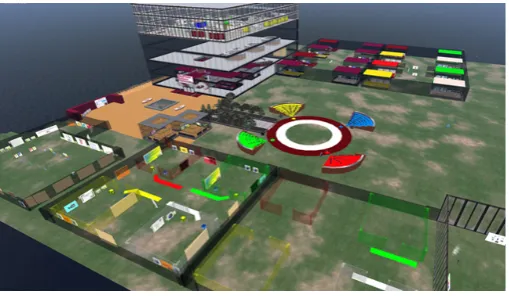
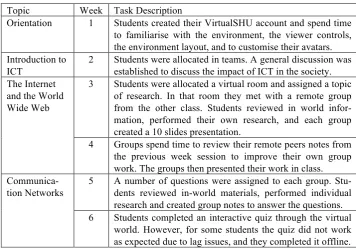
[image:6.595.171.426.364.512.2]pro-posed by Nisiotis [31], other examples and suggestions from the literature [29, 45, 46]. The environment has a realistic look with recognisable facilities and surround-ings to provide consistencies between the experiences in real and the virtual world (Figure 1). The layout of VirtualSHU includes the main campus, indoor and outdoor lecture rooms, and collaborative zones varying in size. Each collaborative zone is an activity area for each of the topic discussed during the semester (Table 1). An orienta-tion area is also provided to allow students to orientate and learn the basic funcorienta-tionali- functionali-ty of the environment. A courfunctionali-tyard to act as the main meeting point for the students to meet before setting off for tasks, and recreational areas for socialisation are also pro-vided. Furthermore, a sandbox and fantasy area in which the content design and flying restrictions of the environment are lifted are also available, together with a quiet area in which students who are away from their keyboard but remain connected is also provided. Access to the environment for students was provided from both on and off campus.
Fig. 1. The VirtualSHU cyber campus
3.2 Context and Procedures
An experiment was conducted for a period of 10 teaching weeks. The participants of the experiment were the Business and Enterprise course first year students at Shef-field Hallam University (United Kingdom) undertaking the Introduction to ICT mod-ule. Students have experienced the VirtualSHU for conducting collaborative learning activities during the tutorial sessions, and as a mean of information repository. There was a session that lasted 60 minutes each week. There were 4 tutorial classes with approximately 20 students each. Each 2 tutorial classes were running concurrently, and students were meeting within the virtual world. Students were allocated in groups
of 3 and 4 students, and collaborated through the virtual world conducting a series of learning tasks (See Table 1). Each student had a computer at his/her disposal. The teaching approach was focussed on a blended learning mode that included face-to-face and interaction through the virtual world to improve and enhance the students learning experience. Tutors and students used the Nearby Chat and Instant Messages to communicate with their remote peers and tutors. Students were encouraged to cre-ate group chats for communication and note taking. Information was provided through PowerPoint slides, informational signs, websites and YouTube videos in the virtual world. Students were also able to connect to the VirtualSHU from home for materials reviewing and to prepare for their end of semester exam.
To collect empirical data for this study, the Transactive Memory System Scale proposed by Lewis [42] has been used. This survey investigates the factors of special-isation, credibility and coordination, which are measured by 5 items each. The statis-tical interpretation of the scale suggests that when a TMS exists, it causes specialised knowledge, trust in each other’s knowledge and coordination in tasks processing. This is a Likert scale survey ranging from 1 (Strongly Disagree) to 5 (Strongly Agree). In addition, we have collected data based on students’ expertise with computers, the Internet, and their previous experience with virtual worlds. The survey was adminis-tered online, over a 3 weeks data collection period. From the total number of 87 regis-tered 1st year Business and Enterprise students who have experienced VirtualSHU as
[image:7.595.118.475.437.689.2]part of the Introduction to ICT module, 46 have agreed to participate in the data col-lection.
Table 1. Learning Activities
Topic Week Task Description
Orientation 1 Students created their VirtualSHU account and spend time to familiarise with the environment, the viewer controls, the environment layout, and to customise their avatars. Introduction to
ICT
2 Students were allocated in teams. A general discussion was established to discuss the impact of ICT in the society. The Internet
and the World Wide Web
3 Students were allocated a virtual room and assigned a topic of research. In that room they met with a remote group from the other class. Students reviewed in world infor-mation, performed their own research, and each group created a 10 slides presentation.
4 Groups spend time to review their remote peers notes from the previous week session to improve their own group work. The groups then presented their work in class.
Communica-tion Networks
5 A number of questions were assigned to each group. Stu-dents reviewed in-world materials, performed individual research and created group notes to answer the questions. 6 Students completed an interactive quiz through the virtual
Classroom discussion
7 Similar to week 3, students were assigned a topic of re-search, and created a shared cloud document to keep notes. 8 Similar to week 4, students presented their notes in class.
Note that two sessions were delivered entirely through VirtualSHU as a tutor was absent due to sickness, but the students attended the tutorial session under supervision. The Internet of
Things
9 Similar to week 5, students reviewed in-world information and performed individual research.
[image:8.595.121.480.147.462.2]10 In-world and classroom discussion to discuss the assigned topics of each group.
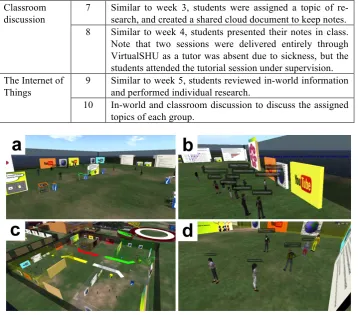
Fig. 2. Examples of activities in VirtualSHU
[image:8.595.124.474.496.677.2]4
Results and Discussion
In total 46 students, 12 females and 34 males, replied to the questionnaire examin-ing TMS buildexamin-ing within participants. Initially we run descriptive and frequency sta-tistics to better understand the participants. 56.6 percent of the participants stated to be experts in computer usage while 17.4 percent consider themselves as non-experts. Similarly, the majority of the participants (82.6 percent) stated experts in Internet usage, while 45.7 percent had previous experience in 3D virtual worlds prior to the study.
The analysis of the TMS questionnaire followed the method described in [42] for extracting a score for each of the three parameters: specialization, coordination, and credibility and for the overall TMS, for each participant in our study. We have also tested the reliability of the scale using the Cronbach's alpha reliability test, revealing high internal consistency between the items comprising the scale. The data were also passed the Shapiro-Wilk test for normality, thus the collected data for specialization, credibility, coordination, are normally distributed.
With regard to the TMS scale on the three parameters, the results denote develop-ment of overall TMS (Mean: 11.04, Std. Dev: 1.54). Individual parameters were also extracted: Specialization (Mean: 3.56, Std. Dev: 0.58), Credibility (Mean: 3.70, Std. Dev: 0.62) and Coordination (Mean: 3.78, Std. Dev: 0.65). We can see that the virtual campus employed in this study, along with the learning tasks that were implemented through the virtual campus, support the development of TMS; actively encourages the utilization of specialized knowledge of individuals; supports the coordination of activ-ities within group learning tasks; and promotes the building of trust and credibility of individual group members by their peers. Consistent with previous work [44] that investigated the development of TMS in small teams with few participants (14 adults) within a virtual world in a single task, in our study we also observed and statistically captured the development of TMS involving more participants in diverse types of tasks. Having efficient coordination within a team allowed members to effectively and efficiently distribute tasks and sub-tasks among members, resolve conflicts and communicate information. Similarly, the development of credibility for each member encouraged trust to build and members to value the knowledge, opinion and decision of other team members. Specialized knowledge that members possessed affected the collaboration within the team. Distinct knowledge is beneficial to other members especially when the task requires it, and allows the member who possess this knowledge to feel valuable to the team and develop a sense of importance to the oth-ers. These results can be considered significant in the context of collaborative learning where participants are active learners in a running course and the implemented tasks were part of their learning experience.
This outcome indicates that being computer literate helps in utilizing the tools within the cyber campus to coordinate group activities and thus improving the overall TMS of a person. No correlation is found between any elements of TMS or TMS and the experience participants have on Internet usage or previous experience with virtual worlds.
The above results add to the previous study [44] performed by the authors in exam-ining TMS building within a 3D virtual world. The previous work examined the de-velopment of TMS in a completely virtual setting while this work used a blended approach. In addition, the teams investigated in [44] were diverse knowledge teams in contrast to the teams investigated in this study that were randomly created. However, the results obtained regarding the development of TMS in this paper are consisted with the results described in [44].
5
Conclusion, Limitations and Future Work
The study described in this paper has been performed in real settings, with a signif-icant number of participants (46) and in a long period of time (10 teaching weeks). The development of TMS has been facilitated through the VirtualSHU through care-fully designed group tasks that required members to become aware of each other’s expertise and skills, build trust within their teams and the knowledge that their team members’ possessed, and to use the communication and other tools provided within the Virtual SHU to coordinate their actions and complete their activities. Based on the observations and experience we have developed during this project, we are suggesting the following recommendations to aid virtual worlds practitioners:
i) When tutors prepare group activities, it is suggested to design them in such ways that will require multiple tasks to be accomplished, so that students can delegate them according to their specialized areas or areas they feel confident performing. ii) Activi-ties should be simple but yet intellectually challenging to execute, to ensure that there will be no confusion or misunderstandings between group members, or having to frequently restart, as these could cause frustration. iii) Students need to be encouraged to communicate and socialize while performing activities; to start valuing each other’s input to improve the credibility of the information shared across the group.
We acknowledge that there are limitations that need to be taken into account in fu-ture work. For example, the students were conducting co-located activities, in addi-tion to activities through the virtual world. However, this was a conscious approach, as we aimed to facilitate a blended collaborative learning approach.
Another limitation of this research project is the fact that we were not aware of students' previous specialisation areas. Students were 1st year, we have never met
them before; we did not know their skills and previous knowledge, as well as their tendency to get involved with activities. Thus, we were not able to put them in groups based on their skills and experiences, and we have randomly allocated them instead, and this prevented us from intentionally creating diverse expertise teams.
the long-term development of TMS. Future work is on its way to further investigate TMS development in the cyber campus and among students using qualitative results. Furthermore, we are in the process of collecting data based on additional attributes of the environment such as presence, collaboration and socialisation, to further investi-gate potential correlations with the development of TMS in such environments.
Acknowledgements
We would like to thank the 1st year Business and Enterprise students from
Shef-field Hallam University who participated in this research project.
References
1. Bartle, R.A. 2004. Designing Virtual Worlds, New Riders Publishing.
2. Bell, M. 2008. Toward a Definition of “Virtual Worlds”. Journal of Virtual Worlds Research, 1, (1).
3. Dickey, M.D. 2005. Three-Dimensional Virtual Worlds and Distance Learning: Two Case Studies of Active Worlds as a Medium for Distance Education. British Journal of Educational Technology, 36, (3), 439–451.
4. Nowak, K.L. 2004. The Influence of Anthropomorphism and Agency on Social Judgment in Virtual Environments. Journal of Computer-Mediated Communication, 9, (2).
5. Minocha, S., Hardy, C. 2016. Navigation and Wayfinding in Learning Spaces in 3d Virtual Worlds. Learning in Virtual Worlds: Research and Applications. 6. Prasolova-Førland, E., Sourin, A., Sourina, O. 2006. Cybercampuses: Design
Issues and Future Directions. The Visual Computer, 22, (12), 1015-1028.
7. Wegner, D.M. 1987. Transactive Memory: A Contemporary Analysis of the Group Mind. Theories of Group Behavior. 185-208. Springer.
8. Mohammed, S., Dumville, B.C. 2001. Team Mental Models in a Team Knowledge Framework: Expanding Theory and Measurement across Disciplinary Boundaries. Journal of organizational Behavior, 22, (2), 89-106.
9. De Freitas, S. 2008. Serious Virtual Worlds. A Scoping Guide. JISC E-Learning Programme, The Joint Information Systems Committee, UK.
10. Merchant, Z., Goetz, E.T., Cifuentes, L., Keeney-Kennicutt, W., Davis, T.J. 2014. Effectiveness of Virtual Reality-Based Instruction on Students' Learning Outcomes in K-12 and Higher Education: A Meta-Analysis. Computers & Education, 70, 29-40.
11. Gregory, S., Scutter, S., Jacka, L., McDonald, M., Farley, H., Newman, C. 2015. Barriers and Enablers to the Use of Virtual Worlds in Higher Education: An Exploration of Educator Perceptions, Attitudes and Experiences. Educational Technology & Society, 18, (1), 3-12.
13. Cremorne, L. 2009. Interview—Denise Wood, University of South Australia. Metaverse Journal—Virtual World News.
14. Jarmon, L., Traphagan, T., Mayrath, M., Trivedi, A. 2009. Virtual World Teaching, Experiential Learning, and Assessment: An Interdisciplinary Communication Course in Second Life. Computers & Education, 53, (1), 169-182. 15. Duncan, I., Miller, A., Jiang, S. 2012. A Taxonomy of Virtual Worlds Usage in
Education. British Journal of Educational Technology, 43, (6), 949-964.
16. Nisiotis, L., Beer, M., Uruchurtu, E. 2016. The Use of Cyber Campuses to Support Online Learning for Students Experiencing Barriers Accessing Education. (EAI) Endorsed Transactions Future Intelligent Educational Environments, 2, (6). 17. Nisiotis, L., Beer, M., Uruchurtu, E. 2015. The Evaluation of a Cyber Campus to
Support Distance Learning Activities. In: M. Gardner, G. Christian, P. Johanna, and R. Jonathon, eds. Workshop, Short Paper and Poster Proceedings from the inaugural Immersive Learning Research Network Conference, Prague, CZ. 18. Kamvisi, M., Kleanthous, S., Nisiotis, L. 2015. Experiences of Collaborating and
Learning through Collab3dworld. In: M. Gardner, G. Christian, P. Johanna, and R. Jonathon, eds. Workshop, Short Paper and Poster Proceedings from the inaugural Immersive Learning Research Network Conference, Prague, CZ.
19. Chou, C.C., Hart, R.K. 2012. The Pedagogical Considerations in the Design of Virtual Worlds for Organization Learning. Handbook of research on practices and outcomes in virtual worlds and environments, 551-569.
20. Dieterle, E., Clarke, J. 2007. Multi-User Virtual Environments for Teaching and Learning. Encyclopedia of multimedia technology and networking, 2, 1033-44. 21. Adams, R.J., Klowden, D., Hannaford, B. 2001. Virtual Training for a Manual
Assembly Task.
22. Gregory, S., Butler, D., de Freitas, S., Jacka, L., Crowther, P., Reiners, T., Grant, S. 2014. Rhetoric and Reality: Critical Perspectives on Education in a 3d Virtual World. Proceedings of the 31st Annual Ascilite Conference. ascilite, 279-289. 23. Allison, C., Miller, A., Oliver, I., Michaelson, R., Tiropanis, T. 2012. The Web in
Education. Computer Networks, 56, (18), 3811-3824.
24. Warburton, S., García, M.P. 2016. Analyzing Teaching Practices in Second Life. Learning in Virtual Worlds: Research and Applications.
25. János, O., ZSolt, K. 2013. Learning, Teaching and Developing in Virtual
Education. Teaching - Education - Information Society, 6-89.
26. Ghanbarzadeh, R., Ghapanchi, A.H. 2016. Investigating Various Application Areas of Three‐Dimensional Virtual Worlds for Higher Education. British Journal of Educational Technology.
27. Nisiotis, L., Beer, M., Uruchurtu, E. 2011. The Shu3ded Cyber Campus Prototype. IEEE Learning Technology Newsletter, 13, (4), 14-17.
28. Nisiotis, L., Beer, M., Uruchurtu, E. 2014. The Evaluation of Shu3ded Cyber Campus - a Pilot Study. The 14th International Conference on Advanced Learning Technologies. IEEE, 688-690.
30. Griol, D., Molina, J.M., de Miguel, A.S., Callejas, Z. 2012. A Proposal to Create Learning Environments in Virtual Worlds Integrating Advanced Educative Resources. Journal of Universal Computer Science, 18, (18), 2516-2541.
31. Nisiotis, L. 2015. A Cyber Campus to Support Students Experiencing Barriers Accessing Education. Doctoral Dissertation, Sheffield Hallam University.
32. Dalgarno, B., Lee, M.J.W. 2010. What Are the Learning Affordances of 3d Virtual Environments? British Journal of Educational Technology, 41, (1), 10-32. 33. Gregory, S., Lee, M.J., Dalgarno, B., Tynan, B. 2016. Learning in Virtual Worlds:
Research and Applications, Athabasca University Press.
34. Hollingshead, A.B. 2000. Perceptions of Expertise and Transactive Memory in Work Relationships. Group Processes & Intergroup Relations, 3, (3), 257-267. 35. Hollingshead, A.B., Brandon, D.P. 2003. Potential Benefits of Communication in
Transactive Memory Systems. Human communication research, 29, (4), 607-615. 36. Hollingshead, A.B. 1998. Communication, Learning, and Retrieval in Transactive
Memory Systems. Journal of experimental social psychology, 34, (5), 423-442. 37. Yoo, Y., Kanawattanachai, P. 2001. Developments of Transactive Memory
Systems and Collective Mind in Virtual Teams. The International Journal of Organizational Analysis, 9, (2), 187-208.
38. De Leoz, G., Khazanchi, D. 2015. Exploring the Influence of Trust in the Development of Transactive Memory Systems in Virtual Project Teams. Proceedings of MWAIS.
39. Kotlarsky, J., van den Hooff, B., Houtman, L. 2015. Are We on the Same Page? Knowledge Boundaries and Transactive Memory System Development in Cross-Functional Teams. Communication research, 42, (3), 319-344.
40. Choi, S.Y., Lee, H., Yoo, Y. 2010. The Impact of Information Technology and Transactive Memory Systems on Knowledge Sharing, Application, and Team Performance: A Field Study. MIS quarterly, 855-870.
41. Kleanthous Loizou, S., Dimitrova, V. 2013. Adaptive Notifications to Support Knowledge Sharing in Close-Knit Virtual Communities. User Modeling and User-Adapted Interaction, 1-57.
42. Lewis, K. 2003. Measuring Transactive Memory Systems in the Field: Scale Development and Validation. Journal of Applied Psychology, 88, (4), 587-603. 43. Kahn, A.S., Williams, D. 2016. We’re All in This (Game) Together: Transactive
Memory Systems, Social Presence, and Team Structure in Multiplayer Online Battle Arenas. Communication Research, 43, (4), 487-517.
44. Kleanthous, S., Michael, M., Samaras, G., Christodoulou, E. 2016. Transactive Memory in Task-Driven 3d Virtual World Teams. Proceedings of the 9th Nordic Conference on Human-Computer Interaction (ACM). 93.
45. Minocha, S., Reeves, A.J. 2010. Design of Learning Spaces in 3d Virtual Worlds: An Empirical Investigation of Second Life. Learning, Media and Technology, 35, (2), 111-137.