
The development of numerical cognition in children and
artificial systems: a review of the current knowledge and
proposals for multi-disciplinary research
DI NUOVO, Alessandro <http://orcid.org/0000-0003-2677-2650> and JAY, Tim
Available from Sheffield Hallam University Research Archive (SHURA) at:
http://shura.shu.ac.uk/23767/
This document is the author deposited version. You are advised to consult the
publisher's version if you wish to cite from it.
Published version
DI NUOVO, Alessandro and JAY, Tim (2019). The development of numerical
cognition in children and artificial systems: a review of the current knowledge and
proposals for multi-disciplinary research. Cognitive Computation and Systems.
Copyright and re-use policy
See
http://shura.shu.ac.uk/information.html
Cognitive Computation and Systems
Review Article
Development of numerical cognition in
children and artificial systems: a review of the
current knowledge and proposals for
multi-disciplinary research
eISSN 2517-7567
Received on 28th September 2018 Revised 10th December 2018 Accepted on 2nd January 2019 doi: 10.1049/ccs.2018.0004 www.ietdl.org
Alessandro Di Nuovo
1, Tim Jay
21Sheffield Robotics, Department of Computing, Sheffield Hallam University, Howard Street, Sheffield, UK 2Sheffield Institute of Education, Sheffield Hallam University, Howard Street, Sheffield, UK
E-mail: [email protected]
Abstract: Numerical cognition is a distinctive component of human intelligence such that the observation of its practice provides a window in high-level brain function. The modelling of numerical abilities in artificial cognitive systems can help to confirm existing child development hypotheses and define new ones by means of computational simulations. Meanwhile, new research will help to discover innovative principles for the design of artificial agents with advanced reasoning capabilities and clarify the underlying algorithms (e.g. deep learning) that can be highly effective but difficult to understand for humans. This study promotes new investigation by providing a common resource for researchers with different backgrounds, including computer science, robotics, neuroscience, psychology, and education, who are interested in pursuing scientific collaboration on mutually stimulating research on this topic. The study emphasises the fundamental role of embodiment in the initial development of numerical cognition in children. This strong relationship with the body motivates the cognitive developmental robotics (CDR) approach for new research that can (among others) help standardise data collection and provide open databases for benchmarking computational models. Furthermore, the authors discuss the potential application of robots in classrooms and argue that the CDR approach can be extended to assist educators and favour mathematical education.
1 Introduction
Numerical cognition is commonly considered one of the distinctive components of human intelligence because number understanding and processing abilities are essential not only for success in academic and work environments but also in practical situations of everyday life [1]. Indeed, the observation of numerical practice within a situation can provide ‘a provisional basis for pursuing explanation of cognition as a nexus of relations between the mind at work and the world in which it works’ [2]. This strong relationship between the human mind and numerical cognition has made the latter a subject of research in the various disciplines that study the human mind and its development, including artificial intelligence.
The link between numbers and the body has been extensively studied in child psychology and cognitive neuroscience and has shown that mathematics is one of the skills that can be extended through embodied experiences from a rather limited set of inborn skills to an ever-growing network of abstract domains [3]. This relation fits with embodied cognition theory, which holds that many cognitive skills are acquired through embodied experiences, such as movements, gestures, and manipulations, which help children in the learning of various cognitive skills by using limbs and senses to interact with the surrounding environment and other human beings [4–7]. Indeed, early numerical practice is usually accompanied by gestures that are considered as a window in children's number knowledge, because children spontaneously use gestures to convey information that is not necessarily found in their speech [8].
Within the human body, a special role is attributed to fingers, including a significant influence on the development of our system of counting. We likely use a base 10 system because of the number of fingers on our hands [9]. Indeed, recent research on the embodiment of mathematics has evidenced fingers as natural tools that play a fundamental role; from developing number sense to becoming proficient in basic arithmetic processing [10–12].
Numbers constitute the building blocks of mathematics, a language of the human mind that has the capacity to express the
fundamental workings of the physical world and to make the universe intelligible [13]. This includes the strong connection between spatial and mathematical domains [14], with abilities in spatial reasoning being crucial for developing expertise in science, technology, engineering, and mathematics disciplines, which are some of the most abstract constructions of the human mind [15]. Therefore, the study of numerical cognition can be a way to explore the neuronal mechanisms of high-level brain functions [16].
1.1 Cognitive developmental robotics
The possibility to explore abstract cognition via modelling numerical abilities has attracted the interest of researchers in artificial intelligence, where high-level learning and reasoning is still an open challenge [17, 18]. However, the simulation of numerical skills by means of computational models is a powerful tool that provides information to evaluate or compare existing theories and to make novel experimental predictions that can be tested on humans [19]. Computational models have the advantage of being fully specified in any implementation aspect, which makes them easily reproducible and verifiable, and they can produce detailed simulations of human performance in various situations, and, for example, experimented on with any combination of stimuli. Furthermore, models can be lesioned to simulate cognitive dysfunctions and performance can be compared to the behaviour of patients in order to gain information and insights into diagnosis and treatment that can be difficult to discover otherwise.
that takes direct inspiration from the developmental principles and mechanisms observed in natural cognitive systems (humans)’ [22]. CDR is still making its first steps, but it has been already successfully applied in the modelling of embodied word learning as well as the development of perceptual, social, language and numerical cognition [23, 24], and recently extended as far as the simulation of embodied motor and spatial imagery [25–27]. The CDR approach has also been used to simulate neuropsychological disorders and test possible rehabilitation procedures [28].
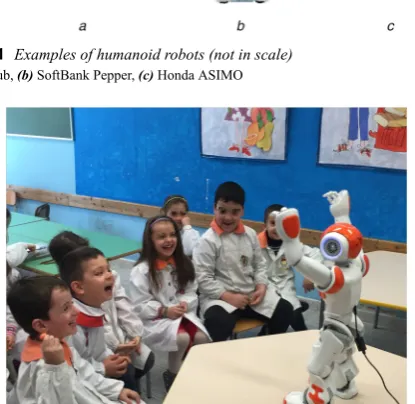
The application of embodied theory to artificial agents is among the motivations for designing new robotic platforms for research to resemble the shape of a human body, known as ‘humanoids’, e.g. the iCub [29], Fig. 1a, Pepper [30], Fig. 1b, and ASIMO [31], Fig. 1c. The iCub, in particular, is designed to resemble a 3–4-year-old child.
1.2 Robots in the education of children
Robots are currently being used in a variety of topics to teach young children, from mathematics and computer programming to social skills and languages, see recent reviews [32, 33], including those with learning difficulties and/or intellectual disabilities [34– 37]. Robots can be a tool through which technical skills can be learned, can act as a peer by providing encouragement or can function as teachers [38–41]. For instance, Tanaka and Matsuzoe [42] show that learning can be enhanced by encouraging children to teach to a robot. Robots can combine the flexibility of a virtual agent with the advantage of being embedded in a physical environment where information can also be sensed as vision, hearing, and tactile perception [43]. Educational robots are ‘engaging, motivating, encouraging imagination and innovation, and may improve literacy and creativity, especially for children’ [44]. Indeed, robots can increase the attention level and engagement in young children [45], see for instance Fig. 2.
However, despite the experimental success, robotics software still needs to evolve to reach full maturity and to produce widely adopted applications that can have an impact on people's lives.
1.3 Objectives of this study and its structure
The objective of this study is to provide background knowledge and directions for further interdisciplinary research in the field of embodied numerical cognition. We also aim to facilitate new
research that combines the disciplines involved in order to achieve mutual benefits. In fact, experimental data from children is used to build CDR simulations, which, in return, can provide objective computational validation and new hypotheses for further research with children. Furthermore, the CDR paradigm can be extended to include the application of numerically capable robots as tools in the classroom to support teaching and learning. The study of this application in controlled experiments can provide greater detail on the learning process, and also provide novel data to refine robots’ cognitive models and behaviour. Finally, improved cognition and autonomy can close the innovation cycle by supporting novel applications in the education of children. The intrinsic advantage of humanising the robots’ learning process is the likely increase in the use of artificial agents in social environments, especially in the education of children [34].
The rest of the paper is organised in two main parts. First, we give an overview of the relevant research about numerical cognition in child psychology and cognitive neuroscience as well as in artificial intelligence and robotics. The aim is to provide a base for the following discussion, with a focus on the embodied nature of numerical cognition, including its impact on teaching and learning strategies. Then, in the second part, we provide future interdisciplinary research directions and discuss the possible benefits to artificial intelligence and robotics as well as the potential applications in developmental psychology research and in mathematics education.
In the first part, Section 2 reviews the special role of the fingers as an embodied tool for number processing, Section 3 presents an overview of embodied strategies in mathematics education, and Section 4 gives a survey of major computation models for numerical cognition in artificial cognitive systems and robots. Without pretending to be fully exhaustive, Section 4 will present more details than the other sections, this is because there are several recent and extensive surveys in the literature about numerical cognition in humans (see for instance those cited earlier in this section), while, as far as we know, there are only two detailed reviews of computational models of numerical cognition [46, 47], one of which [46] focuses on numerosity estimation only and it is somewhat outdated (published in 2005).
The second part includes Section 5, which discusses research in CDR and identifies future directions and possible mutual benefits of closer collaboration and joint experiments in developmental neuroscience and psychology, along with potential applications in the education of children. Finally, Section 6 gives our conclusion.
2 Finger gestures: an embodied tool for number
processing
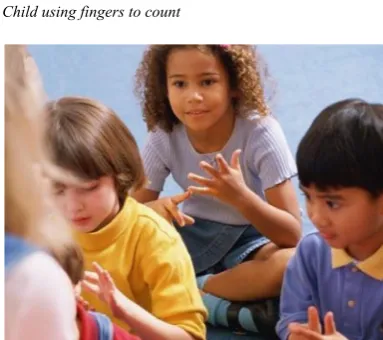
Finger gestures have been thought of as serving as a bridge between possibly innate abilities to perceive and respond to numerosity [48], such as subitising [49], i.e. detecting the numerosity of a small group of items by making a mental estimate without serial enumeration and the development of the capacity to mentally represent and process number as well as linguistic number related concepts [50]. The key role of fingers in early numerical cognition is to provide an embodied representation of the number magnitude [51], which helps to develop from subitising to counting. Indeed, many studies found that finger gestures usually precede verbalisation of number concepts, thus they provide a window to children's early number cognition. For instance, Fig. 3 shows a child using fingers for counting.
[image:3.595.61.269.124.326.2]The study in [52] shows the role of fingers in the development of the one-to-one correspondence principle, i.e. assigning of one distinct counting word to each item to be counted. The same happens for the cardinal principle, i.e. knowing that the last number word reached when counting represents the size of the whole set when labelling small sets [53]. More details on the five counting principles of Gelman and Gallistel can be found in [54]. However, while children often use finger counting to support their early mathematical learning and this habit correlates with better performance in initial stages, it should be pointed out that they may not need gestures in later stages when they have successfully learned the basic concepts [55]. Although there is evidence to show Fig. 1 Examples of humanoid robots (not in scale)
(a) iCub, (b) SoftBank Pepper, (c) Honda ASIMO
activation of regions of the brain responsible for finger movement when adults are working with number – the movement is just inhibited [56, 57].
Finger gestures and counting habits can influence orientation of the mental quantity representation (the ‘number line’) [58], with several studies reporting spatial-numerical association of response codes (SNARC)-like effects correlated with the hand with which people start to count, e.g. right-hand starters showed a stronger left-to-right orientation of their mental number line than left-hand starters [59]. SNARC [60] relates to the fact that people typically associate smaller numbers with the left direction, and larger numbers with the right. An association between small numbers and the starting hand has been found in [57], but other work showed that this can be altered if egocentric or allocentric perspectives are taken into account for the number line [61].
The role of finger gestures is multiple and varies according to the age of the individual and the task, however, a common denominator could be found in the capacity to off-load the working memory [62]. In fact, in the early years, finger pointing helps children to coordinate both keeping track of items to count while tagging them with number words [63]. After that, we observe finger montring [64], which refers to the use of a finger to express configurations for representing cardinal and ordinal number information. Finger montring supports cardinal and ordinal representation for counting quantities or doing basic arithmetic operations [65]. In fact, following the acquisition of finger counting skill, children's initial attempts at arithmetic are often finger-based [66]. For instance, children represent small numbers with a corresponding number of fingers, helping them in keeping quantities while adding these numbers [67], e.g. four fingers on the right hand plus other three on the left hand to solve 4 + 3 = 7. The indirect effect of the five-finger-counting system has been observed in children, who performed mental calculations with a disproportionate number of split-five errors, i.e. deviated from the correct result by exactly five [67]. This effect has been observed also in adults [68], suggesting that there is a strong tendency of using sensorimotor information and structures to support the working memory and the neural links that support this habit can persist in adulthood.
These behavioural observations are confirmed by recent neuroimaging research; see for a review [69], where empirical studies suggest that there is a neural link or even a common substrate for the representation of numbers and fingers in the brain [70]. Neuroimaging data shows neural correlates of finger and
number representations located in neighbouring or even overlapping cortex areas, e.g. [71], suggesting that fingers may have a role in setting up the biological neural networks for more advanced mathematical computations [66]. Importantly, several studies found a permanent neural link between the finger configurations and their cardinal number meaning also in adults. The authors of [57, 72] have found that adult humans activate the same motor cortex areas that control fingers while processing digits and number words, even when motor actions are prohibited. Tschentscher et al. [57] assume this is the result of an early association when finger configurations are used by both children and teachers to support the explanation of numerical concepts, as often observed in empirical studies in the classroom, e.g. [73].
Taken altogether, these results appear to support the hypothesis that fingers provide a scaffold for number cognition, such that if this scaffold is not properly built at the beginning, it can negatively influence mathematical cognition in later stages [74].
3 Embodiment
in
teaching
and
learning
mathematics: the role of fingers
There is a growing understanding within the mathematics education community of ways in which embodiment plays a role in children's mathematics learning. See for instance Fig. 4 shows a teaching session with children using fingers for counting.
Lakoff and Nuñez [3] have performed an influential work in this area, in its connection of physical metaphors with abstract mathematical concepts. Lakoff and Nunez argue that mathematics learning is built on physical experience and give a number of examples of ‘grounding metaphors’ for number and arithmetic that derive from early childhood experience. One of these is ‘arithmetic as object collection’. We know that children are able to subitise
(automatically discern the number of objects in a group) up to four objects from infancy [75]. Regular experience of small and larger collections of objects allows children to extend their conceptions of number (the size of the group) beyond subitisable groups, and to develop foundational concepts of addition and subtraction based on the experience of adding or taking away objects from a group. The ‘arithmetic as object collection’ metaphor can be compared with the ‘arithmetic as motion along a path’ metaphor, which as well as provides alternative conceptions of number (position on a path or line), addition (forward movement or movement to the right along a path or line) and subtraction (backward movement or movement to the left), also supports foundational concepts of zero (the origin of a path) and the concept of number being continuous rather than discrete.
In conjunction with Lakoff and Nunez's [3] account of physical metaphors for mathematical concepts, we can read anthropological accounts of the number in different groups around the world. Most societies have systems for counting, and most of those that have a system for counting use a base 10 system, for instance, Ifrah [76] makes the point that the language of number is often connected with the fingers. The word ‘digit’ derives from the Latin ‘digitus’, meaning finger. In the Ali language found in Central Africa, ‘moro’
is the word for both ‘hand’ and ‘five’, while ‘mbouna’ is a contraction of ‘moro’ and ‘bouna’ and means both ‘two hands’ and ‘ten’.
Given the evidence for a connection between fingers and arithmetic, researchers have begun to investigate implications that this connection might have for mathematics education. Work in this area has shown that children's finger sense – the ability to sense, coordinate and individuate the fingers, also known as finger gnosis – predicts counting and numeracy performance [77]. Taking this forward, Gracia-Ballufuy and Noel [78] were the first to report an intervention to train finger sense in young children and to demonstrate a resulting improvement in numeracy.
The intimate connection between fingers and arithmetical abilities has been confirmed by the study of Reeve and Humberstone [79], results of which show that finger gnosia
[image:4.595.67.259.143.313.2]abilities of children change from pre-school to early school years and that these changes can be associated with the ability to use fingers to aid computation.
Fig. 3 Child using fingers to count
Jay and Betenson [80] argued that, rather than expecting a direct effect of finger training on numeracy ability, the effect on learning is likely mediated by children's use of fingers as a tool in working with numbers. Jay and Betenson showed that an intervention combining finger training with number games (involving different representations of numbers on dice, dominoes, board games, etc.) outperformed either intervention alone. This study provided evidence that children with low levels of finger sense may be being held back from developing good levels of numeracy, and that a relatively brief intervention could support children in improving both finger sense and numeracy. This is attested by Fig. 5, which was a picture drawn by a pupil who took part in the finger training intervention reported in [80]. The picture shows a person with hands drawn in two different ways. The hand on the left of the picture has only four fingers whereas the hand on the right has five distinct fingers represented as separate digits. Jay and Betenson suggested that the training intervention helped this pupil to develop a stronger internal representation of the fingers after the intervention and he had become more aware of the convenience of using the five fingers to represent numbers.
From the pedagogical viewpoint, these experimental results encourage studying whether different finger-based approaches can facilitate arithmetical understanding, and support the development of educational practices that solicit embodied strategies as a tool for stronger numerical cognition [81].
4 Simulation of number cognition in artificial
cognitive systems and developmental robots
This section reviews the major computational models that were created to simulate the development of numerical cognition in artificial cognitive systems and robots.
To facilitate the distinction between the classical and the CDR research, this section is divided into two subsections according to the approach. It should be pointed out that, while CDR models are by definition embodied in robots, some of the classical models may not explicitly include embodiment among the constituent components of the model. However, we have included the most important among classical models for a complete historical review.
Importantly, it should be noted that both the classical and the CDR research has largely focused in creating models of the development of perceptual, social, language cognition, while the number and the complexity of number cognition models are relatively modest if compared with these other domains.
4.1 Early attempts
Earliest attempts to simulate numerical abilities by means of simple computational models were focused on simple mental arithmetic using neural network models.
Initial models were characterised by the associative approach of Ashcraft [82], which assumes that mental arithmetic is based on memory and that arithmetic is a process of stored fact retrieval. This is the case of MATHNET [83], which was based on Boltzmann machines (BMs) [84], a type of neural network that can act as an associative memory. MATHNET was trained to store a set of patterns representing items of arithmetic operations, i.e. two
operands and the result, then employed to predict solutions on unseen problems by exploiting the ability of the BMs to complete partial or noisy patterns. In fact, after training, arithmetic problems are solved by retrieving the stored pattern that most closely matches the partial input pattern, i.e. the two arguments of the operation. In a later study, lesioned MATHNET models showed good adherence to neuropsychological data patients with brain damages [85]. However, the success of MATHNET in replicating human data can be entirely attributed to an implausible frequency manipulation [46].
The first complex connectionist architecture that formally implements and simulates the development of elementary numerical abilities was presented by Dehaene and Changeux [86]. It is focused on the perception and simple processing of non-verbal visual and auditory stimuli. This architecture was modular, with its core represented by a numerosity detection system, which was hand-wired, reflecting the common assumption that numerosity perception is present at birth [87]. The visual inputs are presented one by one to a one-dimensional retina, whereas size is represented by modulating Gaussian distributions. The numerosity of the visual stimulus is then calculated by a summation cluster, which is connected to a short-term echoic memory that processes the auditory input. The final numerosity detectors selectively respond to the summation cluster activity producing the final output. It should be noted that, despite the increased complexity over previous models, the model was able to carry out tasks with pre-verbal elementary abilities and operate only on small sets of items (up to five).
Rodriguez et al. [88] presented a recurrent neural network of the Elman type (recursion on hidden layers [89]) that was capable of counting symbols by means of supervised learning and back-propagation through time [90]. The model was implemented with two inputs, two hidden units, and two outputs to recognise the next symbol in a sequence constructed with a formal language framework, i.e. the input sequences were created using a deterministic context-free language of the form anbn. In practice, to
solve the problem to identify the next in sequence, the network had to develop the ability to count the items in the input sequence. However, Rodriguez et al. aimed at demonstrating that recurrent neural networks were able to count, so the model does not simulate any human behaviour nor comparison with psychological data was attempted.
[image:5.595.102.239.49.170.2]Petersen and Simon [91] conducted a computational study of subitising, in which they proposed two models to explore quantification abilities and how they are developed. Petersen and Simon used a combined and modular approach following the triple-code model (auditory/verbal, visual digits, and an analogue magnitude) [92]. The objective of Petersen and Simon investigation was to provide a possible explanation for the existence of a specific upper limit (believed to be up to four) for the number of items that humans can estimate without counting. The first model was based on the Adaptive Control of Thought -Rational (ACT-R) theory of high-level cognition, proposed by Anderson et al. to model several classic phenomena of visual attention, including tasks such as the sperling, subitising and visual search [93]. The ACT-R model implemented two strategies, providing a simulation of different cognitive abilities that might be involved in numerical cognition: the first strategy implements an associative memory, which, like the biological counterpart, decays in time, while it strengthens and becomes faster after repeated exposure to the same inputs; the second strategy is called ‘the counting procedure’, which tries to retrieve the numerosity when possible, i.e. if the memory trace is strong enough, if not it attempts to count. The counting was modelled in a simplified way, because this was not the focus of the investigation, under the assumption that this ability is available at the same time as subitising, which is in contrast with children experimental data. The second model was a connectionist architecture based on the parallel distributed processing paradigm [94]; it was implemented by a standard multi-layer perceptron, i.e. a three-multi-layer feed-forward neural network. This model simulated subitising only. The network was trained with back-propagation to estimate the numerosity from a two-dimensional retina input representing the arrangement of the items. Fig. 5 Drawing of a pupil clearly showing five finger/digits on the right
Both models were able to simulate the human behaviour, with the ACT-R model showing richer results and stronger reliability in replicating the four items’ upper limit, while the analysis of the results of the connectionist model revealed some inconsistencies. In the case of the ACT-R model, the selection of memory parameters generated the limit, while in the case of the connectionist model the performance was influenced by the number of internal units.
4.2 Advanced computational models
Thanks to the increase in computational capacity, most of the recent models were composed of several modules to accomplish more than one task, thus experimental simulations provided richer results and deeper analyses.
One of the milestones is the work of Ahmad et al. [95], who introduced a very complex multi-network modular system following a mixture-of-experts approach. The proposed architecture included two sub-systems for subitising and counting, which are realised by interconnecting several constituent modules, including connectionist networks that were trained independently. The main constituent architectures included other than the multi-layer feed-forward neural network, recurrent connections of both Elman and Jordan (recursion on output [96]) types in the counting sub-system, and two self-organising map (SOM [97]) architectures in the subitising subsystem. Consequently, the type of training was also differentiated according to the architectures, thus the counting sub-system used a supervised back-propagation learning algorithm, while the subitising an unsupervised Hebbian learning algorithm [98]. In fact, the construction of this system also follows the assumption that subitising is an innate capability while counting should be learned via examples.
The use of unsupervised learning and the SOM architecture represented an innovation with respect to the previous work. Another peculiar aspect of the counting sub-system is a module for ‘pointing’ to the next object to count ‘like a finger’, which is one of the first times that embodiment was included, even if its implications were not studied. However, it must be noted that several details of the system are missing from the description as Rucinski pointed out in his detailed review of Ahmad et al. work (Chapter 3.3 of [47]).
When testing, Ahmad et al. [95] did not follow-up Petersen and Simon's investigation of response times and the transition from subitising and counting, but the sub-systems were tested and results were presented separately. Inputs are 3 × 3 black and white (0, 1) images and the final outputs were obtained by means of ‘gating’ neural networks that were trained to select the response of either sub-systems. One of the characteristics of the subitising system is that, after training, the winning nodes in the SOM network were ordered topologically in a way resembling Fechner's law for numbers: the bigger the size the closer to each other the nodes. The counting sub-system included a comparison with behavioural and performance data from children collected in previous experiments by Fuson et al. [99, 100]. This comparison shows good adherence to the children's data, but also some inconsistency, e.g. the simulation has a higher frequency of counting no objects than children, who rarely make this error. In summary, Ahmad et al. [95] were very ambitious and their model is one of the most complete systems for modelling human counting, including some aspects that can be interpreted to implement embodiment, i.e. the internal number representation and the pointing. Following the same approach, Casey and Ahmad in a following article [101] attempted to model the subitisation limit, where results of the simulations indicate that the limit is due to the differences in the learning algorithms between the feed-forward and the SOM networks.
Verguts et al. [102, 103] studied the mental (or internal) representation of numbers by means of connectionist models that were inspired by neuro-scientific results obtained by Nieder et al.
[104, 105], who confirmed the existence of neurons able to act as numerosity detectors. Verguts et al. propose a number representation system that uses place coding, linear scaling, and constant variability on the mental number line. In practice, the
representation is an extension of the orthogonal one-hot coding (each neuron is fully active only in response to a specific input, while it is zero otherwise), but with multiple activations that exponentially degrade around the one. The first model [102] supports the existence of a ‘summation-coding’ layer that can assist the numerosity detection after supervised training, and produce an efficient input for an unsupervised organisation of number-sensitive neurons such as those observed in vitro by Nieder et al.
[104, 105]. The second model [103] is trained via back-propagation and tested in three tasks: number naming, parity judgment, and comparison, results show adherence with experimental data of [106] and imply that small and large numbers are represented by means of different codings. We should note that Verguts et al.
choice to train the entire model via back propagation seems in contrast with other work, as does the principle that the capacity to process small quantities is innate [48].
Gevers et al. [107] studied the interaction between the representations of number and space by building on Verguts et al.
work [103] and presenting a connectionist model that exhibits the SNARC effect in the parity judgment and number comparison tasks. The model is obtained by adding a few extra layers to the neural network presented in [103], which also provides the weights for the same layers, while for the new one the weights are set by hand to obtain the desired magnitude of the SNARC effect. This model was extended by Chen and Verguts [108] by adding biologically inspired layers to create an explicit representation of the space and, therefore, to associate the numbers with space. However, the ‘space representation’ has been hand-wired in such a way so that it exhibits properties suggested by neuro-scientific data. Indeed, the resulting model was able to simulate not only the SNARC effect, but also several other experimental data and effects, including the spatial attention bias known as the Posner-SNARC effect [109] and, after lesion, the spatial dysfunction found in patients with left hemisphere neglect.
A recent computational simulation of a more advanced arithmetic behaviour has been proposed by Hansen et al. [110] that propose the use of a standard reinforcement learning system [111] to model the evolution of finger-based strategies to solve addition problems. The reinforcement learning approach is considered an example of semi-supervised training as it guides the learner through feedback while exploring the possible solutions. The feedback can be positive (reward) or negative (punishment) according to the quality of the solution, while it can be provided externally by an expert teacher or derived according to the learner internal perception [112]. Hansen et al. [110] decompose addition into a sequence of four elementary subtasks: give operand A; give operand B; count; say how many. In this model, the embodied limitation given by using fingers to represent numbers is directly considered; in fact, the maximum number for the ‘give a number’ task is limited to the five fingers. The aim of Hansen et al. is to resolve the inconsistency of a previous model Strategy Choice And Discovery Simulation (SCADS) by Siegler and Jenkins [113], which rejects faulty strategies via unexplained metacognitive filters. Hansen et al. [110] compare the computational results with data collected from children experiments, ran ad-hoc for the comparison, showing good adherence.
4.3 Deep-learning approach
Some of the recent models tend to adopt a popular category of algorithms and architectures, under the name of ‘deep learning’, which are inspired by complex layered organisation and the functioning of the cerebral cortex [114]. This results in deep-layered processing, which is thought to be a fundamental characteristic of the human brain, making this an essential feature in the computational modelling of human cognition [115]. Deep learning approaches have recently been applied to the modelling of language and cognitive processing, showing how structured and abstract representations can emerge in an unsupervised way from sensory data, through generative learning in deep neural networks, for an overview see [116].
For instance, Stoianov et al. [117] use the mean-field BM architecture and the contrastive divergence learning (CDL) algorithm [118] to model a simple mental arithmetic operation (addition). The mean-field BMs are two-layer architectures with recursion on each layer, while the CDL is an unsupervised stochastic generative learning algorithm that is used to train the network to predict its own inputs. In practice, Stoianov et al. train the model with example input vectors that contain the two operands and the result of the addition, while the model is tested providing only the two operands and recursively run the network until the result is predicted. Stoianov et al. used the model to compare three numerical representations and conclude that the numerosity magnitude representation (also known as the ‘thermometer’ code) gives the best results in simulating simple additions while attracting the best biological plausibility. The numerosity magnitude representation made learning arithmetic facts easier and the model to achieve processing times that match the pattern of human reaction times.
Recently, Stoianov and Zorzi [119] investigated the emergence of the visual number sense with a deep-learning architecture made of one ‘visible’ layer encoding the sensory data and two hierarchically organised ‘hidden’ layers. The model is obtained following a hierarchical processing approach in which each layer is trained by applying CDL algorithm. The first layer is trained using the input examples, while the hidden layers are trained to predict the previous layer internal activations. Each example was a binary 30 × 30 pixels image containing up to 32 randomly-placed non-overlapping rectangular objects, separated by at least 1 pixel. In analysing the results of the computational experiments, Stoianov and Zorzi found that some neural units spontaneously acted as ‘emergent numerosity detectors’ with response profiles resembling those of monkey parietal neurons. This result supports that such a computational model can develop a numerosity estimation capacity with a behavioural signature compatible with the one shown by humans and animals.
4.4 Number cognition in developmental robots
CDR researchers have extensively studied other aspects such as language grounding, see e.g. [22, 24], but very few attempts have been made so far to simulate embodied numerical learning using robots.
A first attempt with the developmental cognitive robotics paradigm was made by Ruciński et al. [47, 120] that explored embodied aspects of the interactions between numbers and space, reproducing three psychological phenomena connected with
number processing: size and distance effect, the SNARC effect and the Posner-SNARC effect. The architecture proposed by Ruciński
et al. follows the principles set by Caligiore et al. [121], therefore, it is split into two neural pathways: ‘ventral’, which elaborates identity of objects, makes decisions according to the task, and processes the language, and ‘dorsal’, which processes the spatial information, i.e. locations and shapes of objects, and sensorimotor transformations that provide direct support for visually guided motor actions. The components of the ‘ventral’ pathway have been selected according to Chen and Verguts’ model [108], while the ‘dorsal’ included the use of a SOM layer for the spatial representation. The results show that the embodied approach allowed achieving a more biologically plausible model and simulations by replacing arbitrary parts of the Chen and Verguts’ model with elements which have direct physical connection and, therefore, more realistic interpretation.
In other work, Ruciński et al. [122] presented a new CDR model to simulate aspects of the earlier work on gesture in counting by Alibali and Di Russo [63], and indeed experimental results showed that pointing gestures significantly improved the counting accuracy of the humanoid robot iCub. The architecture is a recurrent neural network of the Elman type, with two input layers, one for the items to count, i.e. a binary vector, and another for the proprioceptive information, the arm and hand encoder values. The model is trained via the back-propagation through time. In the experiments, the performance is compared with that obtained by the same architecture but without gesture inputs. Statistical analysis of the results of 32 trials shows adherence to the experimental data of Alibali and Di Russo.
Recently, Di Nuovo et al. conducted several experiments [123– 125] with the iCub humanoid robot to explore whether the association of finger counting with number words and/or visual digits could serve to bootstrap numerical cognition in a cognitive robot. The models were based on three recurrent neural networks of the Elman type, which were trained separately and then merged to learn the classification of the three inputs: finger counting (motor), digit recognition (visual), and number words (auditory), i.e. the triple-code model [92]. The novelty of this model was that all inputs were derived from real instances of the numbers from one to ten according to their source: 14 motor encoders of the robot's hands, ten black and white pixels for Arabic digits, and 13 Mel-frequency cepstral coefficients (MFCCs) extracted from the number words. MFCCs are the most commonly used features for speech recognition roughly similar to the auditory system [126]. The model is presented in Fig. 6, where it can be seen that the motor control layer is split into right and left to mimic the two-hemisphere organisation of the brain.
For each input, internal representations were obtained by training the associated recurrent network to predict the following input, i.e. to learn the number sequence. Then, the internal representations were used to classify the number with a softmax
competitive layer, which provides the likelihood of the classification. Results of the various robotic experiments show that learning finger sequencing together with the number word sequences speeds up the building of the neural network's internal links resulting in qualitatively better understanding (higher likelihood of the correct classification) of the real number representations. In fact, an optimal cluster analysis showed that the internal representations of the finger configurations are the ideal basis for the building of an embodied number representation in the robot. The result for fingers and number words is reported in Fig. 7, which presents the optimal cluster dendrogram analysis with optimal leaf order [127].
Furthermore, it is shown that such a cognitive developmental robotic model can subsequently sustain the robot's learning of the basic arithmetic operation of addition [123]. Although, this operation was implemented with an additional handcrafted layer, just to show the possible further evolution of the model.
[image:7.595.60.278.48.296.2]configurations and number words, which had dedicated layers initialised separately using the weights of restricted BMs (RBMs) trained via CDL to replicate the own inputs. Then, the two internal representations layers were merged by a dedicated layer before being connected to the final classification layer. In the last step, the entire architecture was refined via back-propagation. The simulations showed that the model is quicker and more effective in terms of classification likelihood when both fingers and words are provided as input rather than when finger or words are the only input. Furthermore, the model was applied in a simulation of the learning behaviour of bi-cultural children, who can be exposed to different finger counting representations and habits to accompany their number learning. This application scenario was selected because the difficulty of realising a similar study with children and collect quantitative data, in fact, the purpose was to show how computational models can help to generate hypothesis for research in children education. However, the results obtained with the model are plausible in line with qualitative observations previously made with bi-cultural children.
Recently, Di Nuovo [129] investigated the effectiveness of the embodied approach in the handwritten digit (image size 28 × 28 pixels) recognition through a deep-learning model. The model comprised two parts, one for visual recognition and another for motor control, that were created by stacking autoencoders [130], which are similar to RBMs but trained via back-propagation rather than CDL. The two parts were connected via a neural link to simulate the one observed between visual and motor areas in recent neuro-scientific studies [57]. In the simulation experiments, the embodied representation (finger encoder values) was compared to other representations, including the numerosity magnitude [131], showing that fingers can represent the real counterpart of that artificial representation and both are able to maximise the performance.
In a follow-up study, Di Nuovo [132] investigated another deep-learning architecture, the long short-term memory (LSTM) [133], for performing addition with the support of the robot's finger counting. LSTMs are more advanced recurrent neural networks that allow modelling of the working memory and, therefore, they are well suited for modelling arithmetic operations. The model is trained to perform the addition of two handwritten digits with or without finger representations to accompany them. In practice, as in the previous work, the inputs are black and white images (28 × 28 pixels) of handwritten digits and the finger encoders, but in this case, they are provided in sequence and, therefore, the task is to recognise the numbers and directly perform the addition without any intermediate step. The results confirm a significantly improved accuracy when fingers are included in the input sequence along with the digits. Interestingly, the model shows an unusual number of split-five errors, similarly to those observed in studies with humans [67]. This was a spontaneous result, recorded without imposing any constraints to the model.
5 Discussion
This section discusses some of the main themes that emerge from the review of the work presented in the above sections. Themes were identified among those that can solicit future CDR research,
including extending the approach to the realisation of novel applications of robots in the education of children.
5.1 Case of the internal representation of numbers in computational models
An open issue that arises when analysing computational models is about the type of coding that should be used for storing the internal representation of numbers. Indeed, reviewing the literature, it seems that there is no definite consensus among authors. A proper definition of the coding is important to correctly set up the computational models and, consequently, to use them in understanding bias and effects observed in humans.
If we analyse this aspect in the main models presented above, we see that the activity of output units of Dehaene and Changeux's model is lower and wider for larger numbers, which infers a logarithmic coding [134]. Ahmad et al. [95] used the numerosity magnitude or ‘thermometer’ code, which was studied by Zorzi et al. [46, 117, 131], who observed that magnitude information coding should express cardinal meaning and the numerosity magnitude code, or ‘thermometer’ representation shown to give the best results in simulations while attracting the best biological plausibility. On the other hand, Verguts et al. [102, 103] proposed an alternative number representation system to let their model produce many of the effects observed in humans, which was not possible with the numerosity magnitude code.
In trying to resolve this dispute, we recall that several studies with children and adults, e.g. [67, 68], demonstrated that the internal representation of numbers is influenced by the fingers, therefore, the numerosity magnitude is more plausible because it can be considered as an internal representation of fingers, as also shown in [129]. To this end, we should note that Verguts et al.
model is not tested on arithmetic operations, whereas the other models that use the numerosity magnitude code can simulate the addition task, which is one of the most evident cases of number processing facilitated by the fingers. Finally, as hypothesised by Verguts et al. [102, 103], we believe that there could be different representations for small numbers and large numbers.
In summary, we believe that small number representation (1–4) is likely to be innate and hard-wired in the brain, therefore, it can be modelled with unsupervised learning or hand-coded, while large number representation should be derived following embodied cognition theory, i.e. the model should use proprioceptive information which can be provided by a robotic platform, e.g. [123].
5.2 Open research questions and the need for a closer interdisciplinary approach
An open research question in embodied neuroscience is whether the embodiment is realised by establishing a neural link between the areas of the brain that process numbers, perhaps via an Hebbian learning process, e.g. [57], or by reusing brain areas previously developed as a scaffolding for building the number cognition, i.e. there is a common substrate shared by motor control and number processing, e.g. [70]. However, it is difficult to discriminate the two conditions as the current brain imaging technology cannot provide reliable data to give a definite answer. We see this issue as an example of a possible interaction between CDR and experimental psychology because the CDR can be used to model the different alternatives and identify consequential effects that can be used as a hypothesis in experimental studies with children.
An area that should attract more attention from researchers in CDR is the relation between numbers and space, e.g. [135], which can be the base for studying advanced mathematical problems, such as geometry. In this case, we envisage a multidisciplinary research approach in which experimental human data is collected ad hoc to support the creation of the model. This is to allow a perfect reproduction with the robot, which can be constrained in its gestures and movements and could not exactly replicate those of the children. For instance, in the current design, the iCub robot hands have the last two fingers ‘glued’ together, i.e. their movements are actuated by the same motor, and therefore not all of the finger configurations to represent numbers are possible. This Fig. 7 Optimal leaf-order of hidden units’ activations for fingers
[image:8.595.65.279.48.169.2]co-design is a rare procedure, in fact, almost all the models are based and compared on previous studies, tasks of which are often simplified for the robot, but if correctly realised it can achieve higher fidelity yielding richer information. Furthermore, using data collected ad hoc for creating computational models can be beneficial because it can include minor procedural information or results that may be not included in detail when published, but useful to evaluate and refine the model [22, 23].
5.3 Potential applications of embodied robots in the numerical education of children
Use of robots in the classroom can be thought of as broadly fitting with the concept of guided play [136]. A guided play approach allows educators to combine aspects of child-directed and free play with adult guidance and mentorship, e.g. through the cueing of attention to important concepts. In this context, we envision that a robot that could count and perform simple arithmetic procedures, using finger gestures to do so, could provide a useful prompt in guided play.
Guided play with a robot could build on what we know about the self-explanation effect in mathematics education [137]. Self-explanation involves learners generating an Self-explanation for themselves to make sense of new information, and generally leads to improvements in conceptual and procedural knowledge. A robot using its fingers for counting or simple arithmetic could provide a useful prompt for children to explain the robot's behaviour. This could involve a robot either counting or calculating correctly or making particular errors in processes. This would build on a long history of research in mathematics education employing puppets; e.g. Gelman and Meck [138] report a series of studies in which children watched a puppet counting objects and were asked to tell the researcher whether the puppet counted correctly or incorrectly. The advantage of robots over puppets would be that children may be more likely to attribute robots with rationality that they often fail to associate with inanimate puppets. Puppet experiments have been criticised for being confusing to children, who may be unwilling to report an error when they know that the adult manipulating the puppet is really the person carrying out a counting or arithmetic procedure. If a robot carries out a procedure, children may be more likely to interpret this as an authentic attempt to solve a problem – although this remains to be tested.
If a robot is judged by a child to have carried out a procedure by its own volition, then it may be more likely to give rise to meaningful self-explanation by a child. This, in turn, provides opportunities for an adult to guide discussion further. This approach to the use of robotics in the classroom would align well with current directions in video-game-based-learning in early years settings, where the focus is very much on processes rather than outcomes [139].
6 Conclusion
This study conducted a review of the current scientific knowledge about the development of number understanding and basic arithmetic in children and artificial cognitive systems. The review emphasised the close relationship of numerical cognition with the human body, in particular, the fingers, providing strong motivation for the use of an interdisciplinary approach known as CDR for the computational modelling of such a fundamental component of human intelligence.
The aim was to create a common resource of background knowledge that can support closer collaboration among the disciplines interested in the study of numerical abilities in order to produce mutual benefits. For instance, closer collaboration can result in the design of ad-hoc experiments to gather data for computational modelling and, in return, to program numerically capable robots to behave as assistants in experiment with children, attracting their attention, recording data, giving instructions always in the same exact way, exemplify the execution of the tasks and providing feedback.
The possibility to record children data in a repeatable way is one of the benefits that we envisage when researchers from the different disciplines involved will join their effort. Indeed, raw data
from children experiment is usually not publicly available, indeed there are no open ‘benchmark’ databases unlike the typical open data behaviour in machine learning. Computer modellers can use only the post-processed data and statistical analyses for designing and validating models. Furthermore, the validation task does not often match the robot capabilities and a surrogate has to be tested instead. To have a more effective match between real experiments and artificial simulations, we envisage ad-hoc studies that are co-designed in such a way to provide open data, well-matched between robots and children tasks. Furthermore, the availability of open databases will favour the engagement of the machine learning community as happened with other fields of application, such as computer vision, speech recognition, DNA sequencing, and so on.
One of the limits of the computational models so far is that they simulated simple tasks, mostly subitising and/or counting, but mathematics is a lot more than these two basic activities, therefore new research is needed to identify architectures and algorithms that can simulate the learning process that allows children to progress from the basic numerical knowledge and arithmetic to abstract mathematics, which can provide the principles for the design of artificial agents capable of high-level cognition and abstract thinking.
The loop can be closed with further benefits by deploying robots in the classroom to assist the teacher in the mathematical education of children. These teaching assistants could be peers, i.e. capable of mimicking the behaviours of children when learning mathematics. These robots can lead educational activities in the form of a game, during which they interact with speech and gestures to guide the learner through arithmetic procedures and prompt the children to identify errors in the robot behaviours.
We remark that to realise all of these potential benefits, closer collaboration among researchers of the multiple disciplines involved is required to share expertise and co-design the studies.
7 Acknowledgments
Alessandro Di Nuovo acknowledges the support of the EPSRC through the project grant no. EP/P030033/1 (NUMBERS) and of the European Commission under H2020 MSCA-IF grant no. 703489 (CARER-AID).
8 References
[1] Aunio, P., Räsänen, P.: ‘Core numerical skills for learning mathematics in children aged five to eight years – a working model for educators’, Eur. Early Child. Educ. Res. J., 2016, 24, (5), pp. 684–704
[2] Lave, J.: ‘Cognition in practice: mind, mathematics and culture in everyday life’ (Cambridge University Press, United Kingdom, 1988)
[3] Lakoff, G., Nuñez, R.: ‘Where mathematics comes from: how the embodied mind brings mathematics into being’ (Basic Books, New York, USA, 2000) [4] Dackermann, T., Fischer, U., Nuerk, H.C., et al.: ‘Applying embodied
cognition: from useful interventions and their theoretical underpinnings to practical applications’, ZDM, Math. Educ., 2017, 49, pp. 545–557
[5] Glenberg, A.M.: ‘Embodiment as a unifying perspective for psychology’,
Wiley Interdiscip. Rev. Cogn. Sci., 2010, 1, (4), pp. 586–596
[6] Wilson, M.: ‘Six views of embodied cognition’, Psychon. Bull. Rev., 2002, 9, (4), pp. 625–636
[7] Pfeifer, R., Bongard, J., Grand, S.: ‘How the body shapes the way we think: a new view of intelligence’ (MIT Press, Massachusetts, USA, 2007)
[8] Goldin-Meadow, S.: ‘The role of gesture in communication and thinking’,
Trends Cogn. Sci., 1999, 3, (11), pp. 419–429
[9] Dantzig, T.: ‘Number – the language of science’ (Free Press, New York, USA, 1954)
[10] Fischer, M., Kaufmann, L., Domahs, F.: ‘Finger counting and numerical cognition’, Front. Psychol., 2012, 3, p. 108
[11] Soylu, F., Lester, F.K.Jr., Newman, S.D.: ‘You can count on your fingers: the role of fingers in early mathematical development’, J. Numer. Cogn., 2018, 4, (1), pp. 107–135
[12] Goldin-Meadow, S., Levine, S.C., Jacobs, S.: ‘Gesture's role in learning arithmetic’, in Edwards, L.D., Ferrara, F., Moore-Russo, D. (Eds.): New theories of everything: the quest for ultimate explanation, (Information Age Publishing, United Kingdom, 2014), pp. 1–272
[13] Barrow, J.D.: ‘New theories of everything: the quest for ultimate explanation’ (Oxford University Press, United Kingdom, 2008)
[14] Young, C.J., Levine, S.C., Mix, K.S.: ‘The connection between spatial and mathematical ability across development’, Front. Psychol., 2018, 9, p. 755 [15] Wai, J., Lubinski, D., Benbow, C.P.: ‘Spatial ability for STEM domains:
aligning over 50 years of cumulative psychological knowledge solidifies its importance’, J. Educ. Psychol., 2009, 101, (4), pp. 817–835

![Fig. 6 Embodied model with iCub's fingers for counting [124]](https://thumb-us.123doks.com/thumbv2/123dok_us/670950.569648/7.595.60.278.48.296/fig-embodied-model-icub-s-fingers-counting.webp)
