
Process made visible - in and outside the object.
HARRINGTON, Jerome J.
Available from Sheffield Hallam University Research Archive (SHURA) at: http://shura.shu.ac.uk/19758/
This document is the author deposited version. You are advised to consult the publisher's version if you wish to cite from it.
Published version
HARRINGTON, Jerome J. (2015). Process made visible - in and outside the object. Doctoral, Sheffield Hallam University (United Kingdom)..
Copyright and re-use policy
See http://shura.shu.ac.uk/information.html
Sheffield Hallam University Research Archive
ProQuest N um ber: 10697060
All rights reserved INFORMATION TO ALL USERS
The qu ality of this repro d u ctio n is d e p e n d e n t upon the q u ality of the copy subm itted. In the unlikely e v e n t that the a u th o r did not send a c o m p le te m anuscript and there are missing pages, these will be note d . Also, if m aterial had to be rem oved,
a n o te will in d ica te the deletion.
uest
ProQuest 10697060
Published by ProQuest LLC(2017). C op yrig ht of the Dissertation is held by the Author.
All rights reserved.
This work is protected against unauthorized copying under Title 17, United States C o d e M icroform Edition © ProQuest LLC.
ProQuest LLC.
789 East Eisenhower Parkway P.O. Box 1346
Process made
visible - in and
outside the object
Jerom e Joseph H arrington
A thesis subm itted in partial fulfillment of the requirem ents of Sheffield
Hallam University for the degree of Doctor of Philosophy
Declaration
I, Jerome Joseph Harrington, declare th at the enclosed subm ission for the
degree of Doctor of Philosophy, and consisting of a w ritten thesis, DVD
containing six films, and five pullouts which display visual m aterial from the
research, m eets the regulations stated in the handbook for the mode of
subm ission selected and approved by the Research Degrees Sub-Committee
of Sheffield Hallam University.
I declare th at this subm ission is my own w ork and has not been subm itted for
any other academic award. The use of all m aterials from sources other than
Abstract
'Process m ade V isible - In and Outside th e Object'
This research explores the contem porary visibility of m anufacturing
processes, with a particular focus on the production of glass. The context for
this study is the well docum ented sense of disconnection and estrangem ent
said to result from our distance to and unfam iliarity with making processes.
At the centre of the study is ‘The Archive o f Manufacture', an 'archival artw ork'
(Hal Foster) which has been especially collated for this research. The Archive responds to the question - how do we know how som ething is made - and
gathers together 'points of visibility' - secondary sources w here process is
m ade visible, from industry, craft, popular culture, and press coverage.
The study explores The Archive through th ree interrelated questions:
o Why, examines the social, political, and economic context in order to
understand 'drivers' which affect the visibility of process,
o How, explores the formal and m aterial aspects of the photograph, film,
or object through which process is m ade visible,
o W h at is understood - investigates how this m aterial contributes to an
understanding of making process and how it shapes our
understanding of objects.
Initially, The Archive is explored in relation to a wide range of theoretical debates regarding our contem porary relationship with making process. This
Richard Sennett, Matthew Crawford), as well as descriptions of disconnection,
alienation and invisibility (Karl Marx, James Heartfield, David Nye).
Methods from art practice are employed as critical forms of looking to
explore specific examples from The Archive. In particular, close reading as a 'meticulous visual analysis' (Shepard Steiner) is developed as a key method.
The research expands this definition to include the w ritten form of ekphrasis,
and interrogative m aterial and visual making processes.
Through the production of the body of artw orks, the research examines the
contingency for the interpretation of the fragm entary or partial descriptions
of process in The Archive, and the imagined or speculative understanding th at results. The research identifies types of visibility and explores their
limitations, and develops four key principles th at describe how the visibility
of process is effected and how it is subsequently understood. The key
artw orks offer a live experience, w here the view er's interpretation of the
Acknowledgements
I w o u ld lik e to th a n k th e follow ing:
• My family: Julia Keyte, Iris Harrington and Reuben Harrington.
• My supervision team: Becky Shaw w ithout who this thesis would
simply not exist - thank you Becky for your passion, insight and for
providing the clearest feedback I have ever received. Penny McCarthy
who has persistently rem inded me of the im portance of a rt practice as
a research method. Andrew Sneddon who has asked those simple
questions th at pull ap art the things you thought you had already
w orked out.
• All my colleagues in the Fine Art D epartm ent at Sheffield Hallam
University w here I have undertaken this research in the post of
Teaching Researcher in Fine Art.
• Sharon Kivland who has supported me in the publication of two texts:
Fantasies o f Making (Transmission: Hospitality Conference, 2010} and The Archive o f Manufacture (Transm ission Annual, 2013), as well as providing invaluable feedback at confirm ation of PhD stage in 2011.
• A num ber of institutions which have given me the opportunity to
exhibit and publish aspects of the developing research: SI Artspace in
Sheffield, Northland's Creative Glass (Emma Woffenden), The Glazen
Huis, Belgium (Jeroen Maes), SIA Gallery, Sheffield Institute of the Arts,
Sheffield Hallam University (Tim Machin) and the National Glass
Centre, Sunderland (Julia Stephenson and Sebastian Trend), and the
glass departm ent at the Gerrit Rietveld Academie (Mia Lerssi and Jens
Also a big thank you to the following who have helped in a wide range of
ways:
• Alison McConnachie and Ingrid Phillips at Edinburgh College of Art for
their help producing a num ber of Crown Glass disks.
• David Martlew and Dr.Russell Hand for discussions about Crown Glass.
• Jeffery Sarmiento for your positive enthusiasm and support.
• Maria White at Pilkington Glass.
• W arren Hayes for his help in Untitled (Diderot), • The Magic Circle Museum, London.
• Dave Ball at the photographic unit at Sheffield Hallam University for
photographing the Crown Glass Object.
• Dee Hastings-Stroud for her patient help as my dyslexia support
worker.
• Bill Edwards for graphic design help with Delineating an understanding
and the layout of the thesis.
• Craig Stevens for graphic design help with The Archive o f Manufacture pullout.
• Nick Palmer for the production of Plasticine Diderot
• Marcus Sarko for the photography used in Untitled (edge). • Jack Hague for help in animating Untitled (edge).
Finally, I would like to thank the following students for th eir participation in
workshops
• In the production o f Plasticine, ekph rasis an d im agin ed m akin g:
BA Creative Art Practice students: Meg Burgoyne, Hannah Duraid,
Katie Edwardson, Helen Fletcher, Natalie Hall, Rochelle James, Callum
McDonnell, Maya Mihajlovic, Charlotte Pinchin, Joanne Taylor, Laura
Tresidder, Jamie Watkins.
MArt Fine Art and Creative Art Practice Students: Toni Buckby,
Krystina Freeman, Clare Garrett, Alicia Gledhill, Nathan Green, Sophie
Muir, Katie Rowlston, Hannah Waterfield, Kirsten West.
• In the production of D elineating an understanding:
Julie Swallow, Sue Taylor, Madeleine Walton, Helen Frankart, Qiuyuan
Fu, Gareth Bunting, Clare Garrett, Nathan Green, Sophie Muir, Charlotte
DVD with X6 films
Film No.l Untitled (Diderot] 04.40
Film No.2 Making with Plasticine while thinking about glass 04.03
Film No.3 Untitied (edge) 03.10
Film No.4 Meaning Escalator 03.42
Film No.5 Looking at, looking through 04.56
Film No.6 Delineating an understanding 09.07
3 0 1 _ 5
r t
O'
Q)
C Q
TO
Contents
D eclaration i
A bstract ii - iii
A cknow ledgem ents iv - vi
Contents viii - xi
List of illustrations xii - xxii
Chapter 1: Introduction
1.1 In tr o d u c tio n 1 - 1 1
1.1.1 The visibility of process 2 - 9
1.1.2 Thesis stru c tu re and co n ten t 9 -1 1
Chapter 2: The visib ility o f m aking p ro cess
2.1. I n tr o d u c tio n 13 - 1 5
2.2. C o n cern / c e le b r a tio n 17 - 4 6
2.2.1. How concern creates visibility 17 - 30
2.2.2. Summary: w hy and how concern creates visibility 30 - 31
2.2.3. How celebration creates visibility 32 - 44
2.2.4. Sum m ary: w hy and how celebration creates visibility 44 - 46
2.3. N e ar / fa r 4 7 - 65
2.3.1. Far: visibility in a system of d istrib u ted know ledge 47 - 50
2.3.2. Glimpses into unfam iliarity 50 - 52
2.3.3. An a tte m p t to w itn ess global p ro d u ctio n 52 - 59
2.3.5. Summary: n e ar / far 63 - 65
2.4. P ro c e s s / p o r t r a i t ______________________________________ 6 6 - 9 4
2.4.1. A relationship b etw een visibility and context 6 8 - 7 5
2.4.2. Process and co rp o rate ideology 75 - 82
2.4.3. Process / p o rtra it 82 - 89
2.4.4. Summary: process / p o rtra it 89 - 91
2.5. S u m m ary : a c o n flic te d s o u rc e o f in fo rm a tio n 9 1 - 9 4
Chapter 3: Method
3.1 M eth o d in tr o d u c tio n ___________________________________ 9 6 - 9 7
The A rc h iv e o f M a n u fa c tu re 9 8 - 1 0 6
3.2.1 Assem bling The Archive o f M anufacture 9 8 - 1 0 2
3.2.2 Developing C hapter 2 102 -1 0 6
P h a se 1: S tu d io b a s e d a r t p r a c tic e 1 0 7 - 1 3 0
3.3.1 A rtists' process as a form of searching 1 0 8 - 1 1 2
3.3.1.1 Practice as dialogue 112 -1 1 5
3.3.2 Close reading 1 1 6 - 1 1 9
3.3.2.1 M aterial and visual pro cesses as a
form of critical looking 1 1 9 - 1 2 7
3.3.2.2 Ekphrasis as w ritte n form 1 2 7 - 1 3 0
P h a se 2: G e n e ra tin g e v id e n c e th r o u g h p ro v o c a tio n 1 3 1 - 1 4 6
3.4.1 Provocation and loss / provocation and recording 131 -1 3 5
3.4.3 Engaging the subjectivity of others 1 3 8 - 1 4 3
3.4.4 My own approach 143 -1 4 4
3.5 M e th o d s u m m a ry 1 4 4 - 1 4 6
Chapter 4: Four key p rin cip les that d escrib e how
p ro cess is u n d erstood
4.1 In tr o d u c tio n 1 4 8 - 1 4 9
4.2 T h e C row n G lass O b ject (th e fo u n d in g o b je c tl 1 5 0 - 1 6 5
4.2.1 Making as trajecto ry 1 5 1 - 1 5 8
4.2.2 Juncture - The sep aratio n of p rocess and p ro d u ct 1 5 8 - 1 6 1
4.2.3 The founding of four key principles 1 6 1 - 1 6 4
4.3 In fo rm a tio n in a n d o u ts id e th e o b je c t 1 6 5 - 2 0 6
4.3.1 Inform ation outside the object 165
4.3.1.1 U ntitled (D iderot) 1 6 6 - 1 7 2
4.3.1.2 The contingency of th e p h o to g rap h 172 -1 7 8
4.3.2 Inform ation in the object 178
4.3.2.1 Expert know ledge 1 7 8 - 1 8 1
4.3.2.2 Speculation and im agination 1 8 1 - 1 8 5
4.3.2.3 Plasticine, ek p h rasis and im agined m aking 1 8 5 - 2 0 0
4.3.3 Discussion N o.l 2 0 1 - 2 0 6
4.4 T h e c o m p le x in te r p la y o f in fo rm a tio n 2 0 7 - 2 2 4
4.4.1 Fantasies of m aking 2 0 7 - 2 1 8
4.4.2 Glass elim inates all confusion 2 1 8 - 2 2 2
4.5 A co n tin g en t u n d erstan d in g _____
4.5.1 D elineating an u n d e rstan d in g
4.5.2 Discussion No.3
2 2 5 - 2 3 7
2 2 5 - 2 3 1
2 3 3 - 2 3 7
5. Conclusion______________________________________________2 3 8 - 2 5 2
5.1 Sum m ary 239 -2 4 5
5.2 C ontribution to know ledge 246 - 248
5.3 F u rth er w o rk 2 4 8 - 2 5 2
A p p en d ices 2 5 3 - 3 0 9
B ibliography 3 1 0 - 3 2 4
List of illustrations
Chapter
1
:Introduction
Figure 1 The Glass Archive, Jerome Harrington, (2005) 6
Figure 2 Still from Glass Research, British Pathe, (1959) 10
Figure 3 P u llo u tN o .l: The Archive o f Manufacture, Jerome 16 Harrington, (2015)
Chapter 2: Context
Figure 4 Apple faces fresh questions after another apparent 18 suicide by worker at Chinese iPad and iPhone supplier
Foxconn, Daily Mail, (14 June 2012)
Figure 5 Still from Glassworks (1977), Amber Film Productions 22
Figure 6 (left) Glassworks (1977); (right) Diderot and 23 d'Alembert's Encyclopedic (1751)
Figure 7 Alain de Botton, The Pleasures and Sorrows o f Work, 25 (2010). Photographs: Richard Baker
Figure 8 Alain de Botton, The Pleasures and Sorrows o f Work, 26 (2010). Photographs: Richard Baker
[image:16.542.15.529.40.749.2]Figure 10
Figure 11
Figure 12
Figure 13
Figure 14
Figure 15
Figure 16
Figure 17
Figure 18
Figure 19
Figure 20
(Left) Robert Marsden, Robert Marsden, On the edge
(1993), Kettles Yard and Aberystwyth Arts Centre;
(right) Keiko Mukaide, Objects o f our time, Crafts
Council (1997)
Art in Action, (2013). Photograph: Sonia Hawes
Craft skills demonstration area, Wedgewood Museum.
Photograph: Jerome Harrington, (2010)
Craft skills demonstration area, Wedgewood Museum
Photograph: Jerome Harrington, (2010)
(left) Louis Vuitton advertisement, (circa 2010);
(right) Robert Marsden, On the edge (1993), Kettles
Yard and Aberystwyth Arts Centre
The Pilkington Organisation (1959). Photograph: Pilkington Glass
Still from How to build...a nuclear submarine, BBC2,
(2010)
(left) Personal Knowledge; (right) distributed
knowledge. Diagram: Jerome Harrington
BBC News website, (17 April 2013)
Still from Blood Sweat and Luxuries, BBC 3, (2010)
Figure 21
Figure 22
Figure 23
Figure 24
Figure 25
Figure 26
Figure 27
Figure 28
Figure 29
Figure 30
Figure 31
Still from Blood in the Mobile, Frank Poulsen, (2011)
Wedgewood Museum, Skills Demonstration Area -
turning booth. Photographs: Jerome Harrington, (2010)
Still from Restoration Home, BBC 2, (2013)
Near / Far. Diagram: Jerome Harrington
William Henry Fox Talbot: Woodmen, Lacock, (1845)
Diderot and d'Alembert's Encyclopedie - Feather
trader, Volume VIII, Plate II, (1751)
The System of Human Knowledge, Diderot and
d'Alembert's Encyclopedie, (1751)
Diderot and d’Alembert's Encyclopedie - Casting a
statue, Volume VIII, Plate I, (1751)
Diderot and d’Alembert's Encyclopedie - The Tailor,
Volume IX, Plate I, (1751)
(left) Schenectady Works News, General Electric, (2
November 1923), (right) Interior View of Building 85,
Schenectady, (1919). Photographs: General Electric
Archive
Bucket Wheel for General Electric Steam Turbine,
Assembled for factory inspection, (1931). Photographs:
Figure 32
Figure 33
Figure 34
Figure 35
Figure 36
Figure 37
Figure 38
Chapter 3
Figure 39
Figure 40
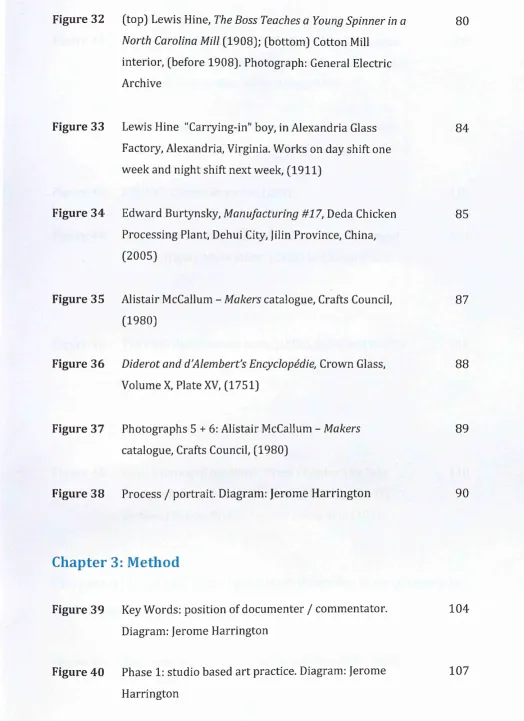
(top) Lewis Hine, The Boss Teaches a Young Spinner in a 80
North Carolina Mill (1908); (bottom) Cotton Mill interior, (before 1908). Photograph: General Electric
Archive
Lewis Hine "Carrying-in" boy, in Alexandria Glass 84
Factory, Alexandria, Virginia. Works on day shift one
week and night shift next week, (1911)
Edward Burtynsky, Manufacturing #17, Deda Chicken 85 Processing Plant, Dehui City, Jilin Province, China,
(2005)
Alistair McCallum - Makers catalogue, Crafts Council, 87
(1980)
Diderot and d'Alembert's Encyclopedie, Crown Glass, 88 Volume X, Plate XV, (1751)
Photographs 5 + 6: Alistair McCallum - Makers 89
catalogue, Crafts Council, (1980)
Process / portrait. Diagram: Jerome Harrington 90
: Method
Key Words: position of documenter / commentator. 104
Diagram: Jerome Harrington
Phase 1: studio based art practice. Diagram: Jerome 107
Harrington
Figure 41 Generative and analytical / reflective phases of artistic 109
process (adapted by Carole Gray from Stroud Cornock's
earlier work on artists' methodology, 1984)
Figure 42 P u llo u t No.2: Generative interchange (October 2009 115
to February 2011). Diagram: Jerome Harrington
Figure 43 Jeff Wall, Clipped Branches, (2001) 118
Figure 44 (left) Simon Starling - Blue, Red, Green, Yellow, Djungel 122 (2002); (right) Aralia fabric, (1928) by Joseph Frank
Figure 45 Elizabeth Price, Bolder, (1999) 122
Figure 46 The Float development team, (1959). Published in 1001 128
inventions that changed the world, Cassell Illustrated, (2009)
Figure 47 Jeremy Deller, It is what it is, (2009) 134
Figure 48 (top) Painting of the Manic Street Preachers by Sara 140
Jayne, in Jeremy Deller's The Uses o f Literacy, (1997); (bottom) Roman Ondak, I'm only acting in it, (2007)
Chapter 4: Four key principles that describe how process is
understood
Figure 50 Five stages of blowing Crown Glass, from, The Crown Glass Cutter and Glazier's Manual, William Cooper, (1835)
153
Figure 51 (left) Flattening the bottom; (right) Final evolution of the disk, Henry Deacon, (1851)
153
Figure 52 Crown Glass cross-section (edge and centre of the disks' cross-section)
154
Figure 53 The Crown Glass Cutter and Glazier's Manual, William Cooper, (1835). This engraving shows a glass disk of 50
inches. The measurements show how this can be cut to
produce the maximum usage. The largest panes
produced are 34 x 16.5 inches and the crosshatched
areas show waste
155
Figure 54 The centre of a Crown Glass Object, or ‘bulls eye' inserted into a window frame. Photograph: Jerome
Harrington, (2012)
156
Figure 55 How do they do it? Discovery Channel, (2006) 157
Figure 56 Juncture and understanding:
(top) 56A: The object's making process as a trajectory
of sequential events
(middle) 56B: three significant stages of juncture (2),
(4) and (5)
(bottom) 56C: The visibility of the object's making
process after juncture (at point of reception)
Diagram: Jerome Harrington
159
Figure 57
Figure 58
Figure 59
Figure 60
Figure 61
Figure 62
Figure 63
Figure 64
Figure 65
Figure 66
Georgian glass and its impact on window design (screen 161
grab]
(top] Diderot and d'Alembert's Encyclopedie, Crown 168
Glass, Volume X, Plate XV (1751]; (bottom] Still from
Untitled (Diderot) (2011)
Diderot and d'Alembert's Encyclopedie, Crown Glass, 169 Volume X, Plate XV, (1751]
Re-drawing of the glass disk to overemphasise its 169
depiction in the Diderot engraving. Drawing: Jerome
Harrington (2011]
Stills from Untitled (Diderot) (2011): 170
61A: Stage one (between 0:00 - 0:44 min]
61B: Stage two (between 0:44 - 1:40 min]
61C: Stage three (between 1:40 - 2:10 min]
Roman Jakobsons' General model of communication. 173
Diagram from David E. Nye's Image Worlds
Crane Follower in Motor Department, Directing Load to 174
be raised, (1920]. Photograph: General Electric Archive
(left] Wooden cabinet, (1868]; (right] Mass-produced 179
glass jar. Photographs: David Pye, (circa 1968]
(left] Diderot and d'Alembert's Encyclopedie, Crown 187
Glass, Plate 16, (1751]; (right] Plasticine Diderot (2011]
Plate XV, Volume X, Crown Glass, from Diderot and
d'Alembert’s Encyclopedie; visible on studio wall. Photograph: Jerome Harrington, (2011]
Figure 67
Figure 68
Figure 69
Figure 70
Figure 71
Figure 72
Figure 73
Figure 74
Figure 75
Figure 76
Model maker Nick Palmer taking one minute of rest. 189
Photograph: Jerome Harrington, (2011]
Nick working on Plasticine Diderot at an early stage in 190
its production. Photograph: Jerome Harrington, (2011]
Nick's workbench - NB. Two clocks which measured 190
working and rest periods. Photograph: Jerome
Harrington, (2011]
Plasticine Diderot (finished model]. Photograph: John 191 Hartley, (2011]
Reconstituting the Plasticine ready for squashing it. 191
Photograph: Jerome Harrington, (2011]
Reconstituting the Plasticine ready for squashing it. 190
Photograph: Jerome Harrington, (2011]
Using a mechanical press to squash the disk. 192
Photograph: Jerome Harrington, (2011]
The Plasticine Disk. Photograph: Jerome Harrington, 192
(2011]
The Plasticine Disk (detail). Photograph: Jerome 193 Harrington, (2011]
The close reading of The Plasticine Disk with students 194
Figure 77
Figure 78
Figure 79
Figure 80
Figure 81
Figure 82
Figure 83
from Sheffield Hallam University. Photograph: Jerome
Harrington, [2011]
(left) Cornelis Koning, Print to Refute the Rumours
Concerning the Images found in an Apple Tree, (1628),
etching; (right) Furniture-maker slices open tree to find
'Jesus' in the rings (Mail Online, 2011)
The presentation of The Plasticine Disk at exhibition.
Photograph: Jerome Harrington, (2011)
Pullout No. 3: Plasticine Diderot Jerome Harrington,
(2011)
Still from Glass Research, British Pa the, (1959)
The Float development team, (1959) Alastair Pilkington
(far left) (on his left) E.Litherland, production manager,
Cowley Hill, George Dickinson, development manager,
J.E.C Thomas, tanks manager, Jack Topping, special
examiner and Richard Barradell-Smith (ex-Rolls Royce),
leader of the float development team. Photograph:
Pilkington Glass
(left) CH3, (1962); (right) Bath control room, UK5, St
Helens (1986). Photographs: Pilkington Glass
(top) Stills from Criss Angel, Walks Through Glass, (circa
2007); (bottom, left) Bending Glass, (bottom, centre)
Dove Through Glass, (bottom, right) Warlock's Amazing Frame. Images courtesy of The Magic Circle, London
199
199
200
208
209
211
Figure 84 Figure 85 Figure 86 Figure 87 Figure 88 Figure 89 Figure 90 Figure 91 Figure 92 Figure 93 Figure 94
‘This is nothing! He says he can tu rn Liebfraumilch
into wine!’ Guardian Food Magazine, (circa 2000}.
Unknown cartoonist
Float glass - the complex interplay of information.
Diagram: Jerome Harrington
Pullout No. 4: Glass eliminates all confusion. Diagram: Jerome Harrington
Glass eliminates all confusion - points A and B. Diagram: Jerome Harrington
‘The second pot of molten ‘metal1 being poured into the
mould, for the manufacture of a 78 in. disc' (1959).
Photograph: Pilkington Glass
A student making a tracing from a photograph.
Photograph: Jerome Harrington, (2012)
Student No. 7 - drawing made in response to Question
No. 2: 'Trace the object being produced1
All nine drawings produced in response to Prompt
No.5: What is the next stage? What happens next?
Pullout No. 5: Delineating an understanding, Jerome Harrington, (2012)
(left) Student No. 5, (right) Student No.8
(left) Student No.8; (right) Student No.6. Drawings
made in response to the question: 'What is the next
stage, what happens next?'
Figure 95 The three photographs used in the workshops: (left) 'The second pot of molten 'metal' being poured into the
mould, for the manufacture of a 78 in. disc', (1959).
Photograph: Pilkington Glass, (middle) 'This panorama
shows the inside of Goddard's High Bay Clean Room',
NASA, (circa 2000). (right) Quality inspection room,
SCHOTT Glass, (circa 2000). Photograph: SCHOTT AG.
Chapter 1
Introduction
1.1 Introduction
My uncle, as usual was serving drinks at a family meal. I w asn't
particularly focusing on him or w hat he said, but he made a comm ent
th at even across a noisy room I heard. Serving wine in lead crystal
glasses, my uncle chipped the rim of one of them. Not particularly
up set by this accident, he stated [with a sense of belief]: ‘...it's OK, I've been told that you can cut the rim o f a glass straight again, by holding it in warm w ater and then cutting it with a pair o f scissors.’
This research begins by asking: how do we know how som ething is made?
W ithin the last ten years, across a wide range of disciplines, and within both
academic and popular culture, a groundswell of publications, exhibitions,
artw orks, television program m es and films have set out to explore our
relationship to making and the m ad e.1 Despite, the potential of this
inform ation to create knowledge of making process - it is am idst this
cacophony of voices, th at my uncle's m isconstrued perception of a m aterial
and a m anufactured object is located.
1 List of examples, m any of th ese are explored w ithin Chapter 2: Popular and academic publications: Research by a n u m b e r of academics who suggest potential benefits from a connection to m aking both for the individual and society at large. David Gauntlett's
M aking is Connecting (2011), Richard Sennett's The Craftsman, [2008], and Michael
Crawford's The Case fo r W orking with y o u r Hands (2009), Alain de Botton - The
Pleasures and Sorrow s o f W ork (2010). Exhibitions: M aterial Intelligence (2009 - Kettles
Yard); Undone- M aking and Unmaking in Contemporary Sculpture (2010 - Henry Moore
Institute); The A r t o f N o t Making: The New A r tis t/A r tis a n Relationship by Michael Petry (2012); The Pow er o f M aking (2011, V&A). Artworks: Simon Starling's One Ton ii (2005) or Melanie Jackson's w o rk A Global Positioning System (2006) which both a tte m p t to visualize the vast n e tw o rk s involved in production in the global context. Television p rogram m es: Jim m y's Food Factory, BBC 1 (2010), How to m ake a nuclear submarine, BBC2, (2010). Films: d o c um entaries examining production in a global context: Blood in
Although this anecdote is specific to one situation, it seems to concur with a
num ber of texts th at propose a gap betw een the objects th at surround us, and
our understanding of their making processes. W riting in 1969, the artist
Robert Morris describes how making process has become distanced from
everyday life:
The very means and visibility for material transformations has become more
remote and recondite. Centers for production are increasingly located outside
the urban environment in what are euphemistically termed 'industrial parks/
In these grim remote areas the objects of daily use are produced by
increasingly obscure processes and the m atter transformed is increasingly
synthetic and unidentifiable. As a consequence our immediate surroundings
tend to read as 'forms’ that have been punched out of unidentifiable,
indestructible plastic or unfamiliar metal alloys. It is interesting to note that
in an urban environment construction sites become small theatrical arenas,
the only place where random distributions are tolerated.
Morris's statem ent of concern pre-em pts m ore recent texts exploring
globalised production, and its im pact.3 These critics note th at we are
separated from production either geographically, through technical
complexity, or via issues th at affect access such as Health and Safety or
privacy.4 Popular w riters, such as Alain de Botton, suggest th at the affect of
this separation is that:
2 Robert Morris [1 9 6 9) , ' Notes on sculpture 4: Beyond Objects', in Art in Theory 1900
2000, Charles Harrison & Paul Wood (ed.), Oxford: Blackwell Publishing, 2002, pp. 881
-885.
3 1 purposefully place Robert Morris's observation in the introduction in order to
em phasise the relevance of art practice in these debates. Morris s investigation of process through his artworks places the artist in a direct relationship with these
questions.
4 Examples from The Archive which reflect these reasons for the invisibility of process: Geographically: Blood in the Mobile; Technical complexity: SCHOTT Clean room images
or satellite production; Health and Safety or privacy: How to Build a Nuclear Submarine.
We are now as imaginatively disconnected from the manufacture and
distribution of our goods as we are practically in reach of them, a process of
alienation which has stripped us of myriad opportunities for wonder,
gratitude and guilt.5
Equally, w riters such as M atthew Crawford argue th at there is a direct
connection betw een our involvement in making process and our relation to
objects; a connection th at for Crawford, is under threat. He examines the
consequences of a ‘depersonalized' relationship, stating: 'the disappearance
of our tools from our common education is the first step tow ard a w ider
ignorance of the w orld of artifacts th at we inhabit.'6 For Crawford, the effect
of this absence is 'passivity, dependence and infantilism.'7
The historic precedent for debate about objects and th eir production as
com m odities is, of course, Karl Marx's Capital w here Marx describes how an object becom es a commodity. While Marx is profoundly aw are of the effort of
hum an labour and its congealm ent in objects, he focuses, critically, on the
disem bodim ent th at takes place as the object becom es a commodity. Through
exchange, the labour of making becomes disguised and its value made
abstract as exchange value. Marx suggests this as a process of
'transcendence', w here our perception of the object is altered. The effect of
this transform ation is th at it appears to stand 'on its head', gaining 'ideas' th at
are not em bedded in its physical form .8 Through the making of a commodity,
our common understanding of objects change and the labour, processes,
m aterials and conditions th at produced it become invisible.
5 Alain de Botton, The Pleasures and Sorrows o f Work,London: Penguin Books Ltd, 2009,
p. 35.
6 Matthew Crawford, The Case fo r Working with Your Hands or Why Office Work is Bad fo r
US and Fixing Things Feels Good,London, Penguin Books Ltd, 2009, p.l.
7 Matthew Crawford, Blackwell Podcast,
<http://w w w .youtube.com /w atch?v=cP oL D iT 03zc> [accessed 11 December 2010],
8 Karl Marx (1 8 6 7 ), Capital, An Abridged Edition,David McLellan (ed.), Oxford: Oxford
While Marx forms the precursor to de Botton and Crawford, there are
significant differences in how and why they discuss production, Capital is concerned w ith the social and political consequences of the capitalist
economy, while de Botton's or Crawford's examinations of work, do so with
an acceptance of capitalism. Their aim is to find autonomy, fulfillment or
happiness for the individual within a capitalist society. For de Botton, this
can be achieved through recognizing the complexity and marvel of the world
of work, and for Crawford it can be achieved by an intim ate connection to
making and fixing things. Despite their differences, w hat they have in
common is a belief th at our altered relationship to production affects how we
relate to and understand objects.
My uncle's perception of how to repair the broken wine glass, suggests a
distance betw een him and the reality of the objects' m aterial properties and
its making process. This gap creates uncertainty and prom pts his speculation.
The repetition of an idea heard elsewhere reveals a perception of this very
particular m aterial - glass. At the time this comm ent was made, I was
studying at the Gerrit Rietveld Academie and blowing glass on a weekly basis,
so my knowledge of its making processes was first-hand and in-depth. I was
fascinated by my uncle's comment, it reflected an understanding of a m aterial
th at from my perspective was so obviously untrue.
The discrepancy betw een my uncle's and my understanding revealed a gap
betw een the layperson and expert. It dem onstrates a situation w here
different levels of knowledge affect the understanding of an object. His
com m ent suggested th at the specific m aterial qualities of glass: hard and
brittle, could be simply m ade malleable by the heat of w arm water. He
understood the object independently of these qualities; as som ething new.
The use of ordinary scissors to repair the glass overlooked the specific tools
and conditions of a wine glass m anufacturing process; conditions th at w ere
seemingly unimaginable to my uncle. However, the fact th at he did not
attem p t w hat he had suggested reveals the transitory nature of this idea,
which once spoken was quickly forgotten or dismissed.
During this period rath er than focus on w hat I could make with glass, I
became increasingly curious about the myths and m isunderstandings of glass.
This m arked the beginning of a process of exposing a cultural perception of
glass, by examining 'found m aterial' - existing evidence w here glass is
described or depicted. The Glass Archive (Figure 1) made in 2005, for example, is a collection of nearly one hundred novels w here the w ord 'glass'
features in the title. By using found material, I could decentralise my own
understanding, and examine how glass is perceived by others. The books'
authors all employed the word 'glass' as a m etaphor to establish or visualise
th eir narrative. The collection assem bles an array and breadth of references
to glass, the inclusivity of the collection exposing a form of 'common
knowledge' about this material.
V A KIM MOLT H y i t t r , It r HOW j
Figure 1: The Glass Archive, Jerome Harrington, (2005)
Through m aking the collection, I was interested in investigating the
relationship betw een the physical reality of the m aterial and 'ideas' of
material. The a rt and culture critic Dave Hickey succinctly illustrates the
interrelation betw een glass and its cultural perception when he speculates on
Glass existed in language before it existed in the world. Its physical attributes
- its aspects of transparency, translucency, reflection and refraction -
probably existed for centuries before the material itself was created; it existed
precisely as the self describing rhetoric of thought and language itself. Upon
its invention then, glass almost inevitably took on the aspect of language and
thought incarnate, defining them in its reflection.9
The Glass Archive can be understood as a link betw een my previous art practice and the current research. Both projects have three significant
aspects in common: 1) each examines found m aterial in order to examine
how knowledge and understanding are constructed. 2) Both projects employ
collecting and archiving processes in order to gather this material. 3) And
finally, both projects explore the relationship betw een the reality of
som ething and imagined or speculative assum ptions made of it.
1.1.1 The v isib ility of p rocess
My uncle's com m ent highlighted how little we know about the m anufacturing
processes of everyday objects and th at we proliferate misconceptions. Prior
to starting this research, I had an intuition th at such m isconstrued
understandings of making and m aterial occur because of a distance from
production processes. Responding initially to the descriptions of a
disconnected relationship with making process from com m entators such as
Morris, de Botton, Crawford or Marx, the question - how do we know how
som ething is made? - prom pted me to make an archive th at would collate
instances w here process is made visible. The Archive o f Manufacture, an 'archival artw o rk '10 aimed to gather 'points of visibility' - images, film and
9 Dave Hickey and Jennifer R. Gross, Josiah McElheny, Boston, Massachusetts: Isabella
Stewart Gardener Museum, 1998, p. 20.
10 Hal Foster, An Archival Impulse, (2004) in, The Archive, Charles Merewether, (ed.), London: W hitechapel Art Gallery, 2006.
objects, from many different sources including factory and craft production,
ancient and modern.
In forming The Archive, it became apparent th at th ere w ere many more examples of secondary forms (still images, films and objects) articulating
making process, rath e r than examples of individuals' own hands-on
experience of making process.11 The m aterial collated in The Archive is, in effect, w hat is left over after process has taken place. This m aterial is the
result of a technical and perceptual juncture th at separates process from
p ro d u c t A key concept within this research, juncture (explored in detail in
Chapter 4) describes a key m oment w here process is discarded or divorced,
and product becomes perm anently distinct from the complexity of its
m anufacturing process. However, juncture as a stage of disavowal does not
equate with the total invisibility of process - depending on the context or
production method, evidence rem ains visible, and the term 'points of
visibility' is used to describe this material. As a result, the research focuses
predom inantly on the secondary forms through which process is made
visible.
The m aterial in The Archive has been explored through th ree interrelated questions:
1 Why, examines the social, political, and economic context in o rd er to understand key factors or 'drivers’ which affect the visibility of
process.
11 The term 'articulate' is used to describe how objects and images comm unicate ideas.
An example of the use of this term in art discourse can be seen in: Aura Satz, jon Wood, (ed.), Articulate Objects: Voice, Sculpture and Performance, Bern Switzerland, 2009.
'When w e talk about 'articulate' objects w e endow a curious at tim es uncategorisable collection of things with the capacity for voice, speech or ex p ressio n , p. 15, and The
articulate objects examined in this book are all in varying degrees brought into speech,
2 How, explores the formal and m aterial aspects of the photograph, film,
or object through which process is made visible.
3 W h at is understood - explores how this m aterial contributes to an
understanding of making process and how it shapes our
understanding of objects.
1.1.2 T h esis structure and con ten t
The following chapter, Chapter 2 examines a range of examples from The Archive o f Manufacture to understand visibility of process in the contem porary context. This chapter identifies and describes types of
visibility, and outlines factors th at affect how making process is made visible.
It concludes th at the 'points of visibility' in The Archive are often a conflicted form of information, and their interpretation is contingent: as likely to be
m isunderstood as it is able to elucidate.
Chapter 3 outlines the m ethods and methodological approach of the research.
I purposefully situate Robert Morris's observation of our relationship with
process within this introduction to emphasise the relevance of the artist in
these m atters. In Morris's practice, an interchange betw een observation,
writing and making suggests the potential of the artist's process to engage
with this area.
Within this research, a similar entwining of theoretical and m aterial m ethods
is used to analysis the m aterial in The Archive. Studio-based art practice, the main m ethod of this research, is uniquely placed to make an analysis of the
points of visibility within The Archive. In studio-based art practice, there is an intim ate relationship betw een process and artefact (both object, or image),
and existing m ethods of analysis which forefront the interpretation of visual
and m aterial aspects of the artefact.
Chapter 4 forefronts a discussion of the artw orks m ade during the research
period. Through the production of and reflection upon this body of artw orks,
the research explores the contingency of the fragm entary or partial
descriptions of process in The Archive. A key aspect of Chapter 4 is the exploration of the limitations of the examples in The Archive to articulate making process, and m isunderstandings of process th at result. This
exploration of an imagined or speculative understanding of making process,
as suggested by my uncle's comment, expands theories of a distanced
relationship as developed by Marx, Morris or Crawford through visual and
m aterial strategies. Within Chapter 4, the artw orks which are discussed, are
presented either on the enclosed DVD, which contains six films (page vii), or
p resented as one of three 'pullouts'.
Finally, although this research references a wide range of making processes
and m aterials, glass is apparent throughout. In the context of the visibility of
m aking process - glass produces a fascinating paradox: its apparent
transparency suggests clarity and visibility (Figure 2) and yet it is this very
Figure 2: Still from Glass Research, British Pathe, (1959)
[image:37.543.24.526.49.652.2]Chapter 2
The visibility
2.1 Introduction
At the beginning of this research, The Archive o f Manufacture was formed to gather together 'points of visibility' - images, films and objects th at have the
potential to contribute to an understanding of making process. In this
chapter, this m aterial is used to explore two interrelated questions: 'why' and
'how' is process made visible? Why, examines the social, political, and
economic context in order to understand key factors or 'drivers' which affect
the visibility of process. How, examines the formal and m aterial aspects of the
photograph, film, or object through which process is made visible.
Over the course of the chapter, the question of 'how' is used to identify a
num ber of specific forms or 'types' of visibility and the potential and
lim itations of the different forms to articulate process is explored. Within the
thesis, this is the first stage of an examination of the formal, structural and
m aterial qualities of the content of The Archive, which is subsequently extended in Chapter 4 through a discussion of the artw orks th at have been
produced.
The Archive informs this chapter in three specific ways: Firstly, throughout, individual examples form detailed case studies, and are discussed in relation
to debates regarding our contem porary relationship with making process.12
Secondly, a large proportion of The Archive's content is presented in this chapter, making this an entw ined visual and theoretical investigation. Finally,
the chapter explores key them es identified through an analysis of the entire
Archive.
Each of the th ree subchapters are structured by two opposing term s which
aim to account for the breadth of examples, and the many differences and
12 It is important to stress that not every example in The Archive is examined in this Chapter. Instead, key exam ples have been selected which are representative the
different types of visibility identified within The Archive.
contradictions th at can be observed w ithin The Archive. 13 The three subsections are:
2.2 Concern / celebration: explores how the visibility of making process reflects two opposing descriptions of our relationship to making and
the made.
2.3 Near / far: investigates how the visibility of making process is affected by our proximity to the site of production.
2.4 Process / portrait: examines the conflicted nature of many of the examples in The Archive o f Manufacture, by examining the m otivating forces and agendas th at produce and distribute them.
Although these subchapters are structured through oppositional term s, these
term s are not intended to describe a binary relationship, which is
oppositional and exclusive. Instead, these term s set up a dialectical
A A
relationship - w here th ere is an interplay betw een the two term s.
13 The use of oppositional term s to structure this chapter is reflective o f a number of the
key texts examined below. These describe our relationship to making and the made through oppositional terms, for example, Marx's description of alienated and non alienated labour, or Peter Dormer’s term s personal know -how and distributed
know ledge. There are many others binary oppositions in the literature. For example,
David Pye (regularity and diversity), Matthew Crawford (agency and loss o f agency),
Alain de Botton (gratitude and guilt).
14 The use of dialectical relationships has been informed by tw o sources: John Plunkett, 'From Optical to Digital (and back again)' uses dialectical to describe the relationship
betw een optical and digital recording processes. He suggests both are involved in a dialectical relationship 'whereby each thinks through the other'. John Plunkett, ’From
Optical to Digital (and back again)', 19: Interdisciplinary Studies in the Long
Nineteenth-Century, vol. 1.6, no. Forum on Digitisation and Materiality, 2008, pp. 1-10,
<h ttp ://w w w .1 9 .b b k .a c .u k /in d e x .p h p /1 9 /a r tic le /v ie w F ile /4 7 9 /3 3 9 > [accessed 1 May
2014].
And in Transforming the Managerial Class: Binary and Dialectical Thinking in
Counseling (2 0 0 9 ), Thomas Harrison, Troyann Gentile, and Terianne Harrison suggest
'Dialectical thinking more closely approximates healthy reality: In reality, nothing is
really black or white. [...] There is an inherent relationship betw een the two.' [...] in
essence, dialectical thought puts m otion into the binary thought process.'
Transforming the Managerial Class: Binary and Dialectical Thinking in Counseling
The Archive 'pullout'
The following 'pullout' displays the content of The Archive o f Manufacture (Figure 3). Each entry is represented by a single image, which is
accompanied by contextual inform ation including the original source of the
entry, its type (image, film, object), and date of its original production. Each
entry is allocated a num ber (1.1) th at is reflective of the order in which the
example entered into The Archive. The m ethod through which The Archive was form ed is detailed in Chapter 3 (page 98).
<h ttp ://w w w .c o u n s e lin g o u tf itte r s .c o m /v is ta s /v is ta s l2 /A rtic le _ 2 5 .p d f > [accessed 21
Figure 3
The
Archive
of manufacture
M a k e rs , C rafts C o u ncil, 1980 Alistair M cCallum P h o to g ra p h (p u b lic atio n ) P h o to g ra p h e r: Ray C a r p e n te r B
M aking It, C rafts C o u n cil, 1982 P au lin e Solven
P h o to g ra p h e r: U n k n o w n C
On th e e d g e , K ettles Yard a n d A b e ry stw y th A rts C e n tre 1993
R o b ert M a rsd e n P h o to g ra p h e r: U n k n o w n D
O b je c ts o f O u r T im e , C rafts C o u n cil 1997 Keiko M u kaid e P h o to g ra p h e r: Philip Say er
1.2
A -Q
C row n Glass, V o lu m e X, P la te XV E n g raving (p u b lic atio n ) D id e ro t a n d D 'A le m b ert's E ncy clop ed ia, 1751 R e p u b lish e d in: C h a rle s C. Gillispie, A D id e ro t Pictorial E n cy clo p ed ia o f T rad es a n d Industry., N ew York: D o v er P u b lic a tio n s Inc., 1993.
R
C astin g a s ta tu e , V o lu m e VIII, Plate I
S
T he Tailor, V o lu m e IX, P la te I T
F lo at G lass (1959) P ilk in g to n
invents cost-effective process
t o m a k e h ig h -q u a lity fla t g lass P h o to g ra p h (p u b lic atio n ) J a c k C h a llo n e r, 1001 In v en tio n s: T h a t C h a n g e d t h e W orld, C assell
Illu stra te d , 2 0 0 9
Im ag e credit: Pilkington B rothers Limited
Q u a lity in s p e c tio n in t h e c le a n ro o m
SCHOTT g la s s C.2000
P h o to g ra p h (p u b lic atio n ) Im a g e c re d it: SCHOTT AG
C ro w n g la s s o b je c t H a n d b lo w n g la s s d isk 2 0 0 9
O b je c t
Im a g e c re d it: J e ro m e H a rrin g to n
►
Philips LCD p r o d u c tio n (c a p tio n in D utch) ITEMS 2, ( p a g e 89) 20 0 3
P h o to g ra p h (p u b lic atio n ) P h o to g ra p h e r : U n k n o w n
1.7
W ine b o ttle c u ttin g w ith s trin g O n lin e - v id e o (n o c o m m e n try ) (still)
C.2000
P h o to g ra p h (p u b lic a tio n )
1.8
P h o to g ra p h s p u b lis h e d in: T h e C rafts in Britain in t h e 2 0 t h
C e n tu ry , T anya H a rro d (1999) A
Still fro m J o h n A n d e rs o n 's 1 9 6 4 film Isaac B u tto n , C o n try P o tte r B
T h e s m ith y in F.H.K H e n rio n 's C o u n try p a v ilio n , S o u th Bank E x h ib itio n 1951
D e sig n C ouncil/D H RC, U n iversity o f B rig h to n
C
C rick et b a ts b e in g m a d e in t h e S p o rt p av ilio n , S o u th Bank E x h ib itio n 1951
D
St D u n s ta n e rs b lin d e d in First W orld W ar le a rn in g to m a k e n e t b a g s C.1920s
St D u n s ta n s 's L o n d o n E
M ichael C a rd e w th ro w in g a t W in c h c o m b e P o tte ry , 7 A u g u s t 1937
P its h a n g e r M a n o r & Gallery, L o n d o n B o ro u g h o f E aling F
D avid Pye u s in g his 'flu tin g e n g in e ', in v e n te d 1 9 4 9 -5 0 C rafts C o u n c il/D a v id C rip p s
ME
H ow d o t h e y d o it?
D o c u m e n try f o r te le v is io n (stili) 2 0 0 6
D isco v ery C h a n n e l Im a g e C red its: DCI
1.10
M a n u fa c tu rin g se rie s P h o to g r a p h (on lin e) 2 0 0 5
E d w ard B urtynsky A
M a n u fa c tu rin g #1 7 B
M a n u fa c tu rin g # 1 0 a /b C
M a n u fa c tu rin g #1 4 D
M a n u fa c tu rin g # 6 a /b
C row n Glass m ark e d to b e c u t P h o to g ra p h (p u b licatio n ) T h e P ilkington O rg a n isa tio n
(1959)
1.12
D id e ro t m o d el
3D m a n n e q in (m u s e u m display) (d a te u n k n o w n )
W orld o f Glass, St H elens
1.13
Blood S w ea t a n d Luxuries D o c u m e n try fo r tele v isio n (still) 2010
BBC 3
D irector: A n n a Stickland
1.14
J
TRi U rges Taiw an to Lift Ban o n 8.5G TFT-LCD In v e s tm e n ts in C hina
P h o to g ra p h (online) C.2010
P h o to g ra p h e r: U nk n o w n
ZERODUR g lass c e ra m ic 1968
P h o to g ra p h (online) Im a g e c re d it: SCHOTT AG
B Glass w a fe r C .2000 C
Glass c a stin g o f a m irro r s u b s tr a te C .2000
D
SEVIRI: ZERODUR M irror C .2000
E
L ighting a n d Im a g in g p ro d u c tio n in M ainz
C .2000 F C lean ro o m C .2000
1.16
1
NASA
P h o to g ra p h (online) A
This p a n o ra m a s h o w s t h e in sid e o f G o d d a rd 's H igh Bay C lean Room , a s s e e n fro m t h e o b s e rv a tio n d e c k C .2000
P h o to g ra p h e r: U n k n o w n
1.17
Glass W orks D o c u m e n try film (stills) 1977
A m b e r films, N e w c astle u p o n Tyne
C am era: P e te r R o b erts S o u n d : G ra h a m D e n m a n & R o g er S c h in d le r Editing: R o g er S c h in d le r D irection: M urray M artin & P e te r R o b erts
1.18
P ilk in g ton Glass P h o to g ra p h (p u b lic atio n ) Im ag e c re d it P ilkington Brothers Limited
R e p ro d u c e d in: Float, P ilk in g to n 's Glass R ev o lu tio n . David Bricknell A
C H 3 ,1962, s h o w in g t h e relativ e p e a c e a n d c le a n lin e s s o f t h e b a th in o p e ra tio n
B
CH3 w a re h o u s e , 1963 C
B ath c o n tro l ro o m , UK5, St H elens, 1986
1.19
Ip ad su ic id e s P h o to g ra p h (online) Mail O n lin e, 14 J u n e 2012 A
This im a g e is b e lie v e d t o s h o w t h e F o x con n w o rk e r p re p a rin g to ju m p fro m a d o rm ita ry b u ild in g o n J u n e 13
2012 C h e n g d u Police B
H ard w ork: A n o th e r F o xco n n w o rk e r h a s c o m m itte d su ic id e , ju s t m o n th s a fte r A p ple h a d r e a c h e d a n a g r e e m e n t w ith th e s u p p lie r to im p ro v e c o n d itio n s
for staff
2012 R eu ters C
Factory staff working on the
A p p le iPad: 9 0 p e r c e n t o f t h e t e c h n o lo g y g ia n t's p ro d u c ts a re m a d e a t F o x c o n n 's p lan ts 2012
R eu ters D
C ra m p e d : A r e p o r t re le a se d e a rlie r th is y e a r f o u n d t h a t F o x co n n e m p lo y e e s o fte n w o rk e d lo n g h o u rs in u n s a fe c o n d itio n s fo r p o o r pay 2 0 1 2
R eu ters
1.20
T h e P ilk in g to n O rg a n is a tio n P h o to g ra p h (p u b lic atio n ) 1959
Im ag e credit: P ilkington Brothers Limited
T h e P ilk in g to n O rg a n is a tio n A
R esearch p a g e 14 B R esearch p a g e 15 C
Fo u r m illion s q u a re f e e t a w e e k p a g e 19
D O u tsiz e discs p a g e 27 E
E m e rg e n c y o p e ra tio n p a g e 28
F
S e a rc h in g te s ts p a g e 31
1.21 1.25
P ro c ess fo r fo rm in g w in d o w g la s s c y lin d e rs, P itts b u rg h P la te G lass C o m p a n y P h o to g ra p h (p u b lic atio n ) C.1923 re p u b lish e d 20 10 T h e C o rn in g M u seu m o f Glass
R e p u b lish e d N ew G lass R eview 31
1.22
M u seu m o f E nglish Rural Life P h o to g ra p h (m u s e u m d isplay) A w h e e lw rig h t u s in g a la th e t o tu rn a w h e e lh u b
M u seu m o f E nglish Rual Life, U n iversity o f R ead ing D ate: U n k n o w n
1.23
J im m y 's F o o d Facto ry D o c u m e n try fo r te le v isio n (stills) BBC1
2010
P re se n te r: Jim m y D o h e rty P ro d u c e n Jerry F oulkes E x ecutive P ro d u c er: G reg L anning
1.24
H o w to b u ild ... A n u c le a r s u b m a r in e
D o c u m e n try fo r tele v isio n BBC2
2010
E x ecutive P ro d u c e n Tina F le tc h e r S eries P ro d u c er: S te v e C ra b tre e
O!
wrmJH
jh
zM
EE
mS3
A Logistical J o u rn e y P h o to g ra p h (p u b lic atio n ) P h o to g ra p h e n Richard Baker P leasu res a n d So rro w s o f Work, Alain De B o tto n 20 0 9
1.26
M a rg u e rite W ild e n h a in s h o w in g t h e m o tio n o f h a n d s m ak in g a p o t P h o to g ra p h (online)
C.1945 O tto Hagel
1.27
C u riosities o f Glass M aking D raw ings (p u b licatio n ) 1849
A psley Pellat
1.28
A
T h e Boss T each es a Y oung S p in n e r in a N o rth C arolina Mill P h o to g ra p h (p u b lic atio n ) 1908
Im age W orlds, C o rp o ra te Id en titie s a t G e n e ra l Electric, David E. N y e(1 9 8 5 ) Lewis Hine
C arrying-in b o y in A lex an d ria Glass Factory, A lex an d ria, Virginia. W orks o n d a y sh ift o n e w e e k a n d
n ig h t sh ift n e x t w e e k P h o to g ra p h (online) 1911
Lewis Hine
S te am fitte r, P e n n sy lv a n ia Railroad P h o to g ra p h (p u b lic atio n ) 1930
Lewis H ine
In d u stry a n d t h e P h o to g ra p h ic im a g e (ed.) F Ja c k H urley 1980
1.29
Q u it Y our D ay J o b - Sea B a b e J e w e lle r P h o to g ra p h (online) C.2010
Im a g e c re d it: S e a b a b e je w e lry
1.30
P h o to g ra p h s fro m G e n e ra l Electric a rc h iv e P h o to g ra p h (p u b lic atio n ) Im a g e W orlds, C o rp o ra te Id en titie s a t G e n e ra l Electric, David E. Nye (1985) G e n e ra l Electric A rchive A
T ra n sfo rm e rs in T estin g Pit 1923
B
B ucket W h eel fo r G.E S te a m T u rb in e 1931 C
E le m e n t a n d M o to r A sse m b ly B en ch C o n v e y o rs, B uilding 26 1929
D
In te rio r v iew o f Bilding 85, S c h e n e c ta d y
1919 E
M e te r C o n v e y o r fo r Final In sp e c tio n o f W a tth o u r M e te rs 1929
1.31
Fa s z i n a t i o n Bu:i k u i s t a l
N a c h tm a n n Bleikristall P h o to g ra p h (p u b lic atio n ) C .2000
P h o to g ra p h e r : u n k n o w n
1.32
A m id t h e e c o n o m ic ru b b le , a re v o lu tio n is b e in g k n itte d A rticle (online)
9 Ju ly 2 0 0 9 Libby Brooks t h e G u a rd ia n O n lin e
1.33
Louis V u itto n a d v e rtis e m e n t P h o to g ra p h (p u b lic atio n ) C.2000
P h o to g ra p h e r : u n k n o w n G u a rd ia n m a g a z in e
1.34
Life G em O nlin e
1.35
M ak in g o f a g la s s b o ttle P h o to g ra p h (p u b lic a tio n ) C .1900
V ictorian E n c y c lo p e d ia P h o to g ra p h e r : u n k n o w n
1.36
H ow t o m a k e firew o rks O n lin e in s tru c tio n s ( p h o to g r a p h s w ith tex t)
C.2000
I n s tru c ta b le u se r: p u d i.d k
1.37
G ra n d D esig n s
T elevision p r o g ra m m e (still) 2010
W ritte n a n d p r e s e n te d : Kevin M cC loud
C h a n n e l 4, Series 7, E p iso d e 27
1.38
W o o d m e n , Lacock P h o to g ra p h (p u b lic atio n ) 1845
W illiam H en ry Fox Talb o t T h e V icto rian s a n d E d w ard ian s
a t w ork , J o h n H an n a v y (2009), S h ire P u b lic a tio n s
1.39
C raft Skills D e m o n s tra tio n Area W e d g e w o o d M u seu m , S to k e-o n -T ren t 2010
Im a g e c re d it: J e ro m e H a rrin g to n
1.40
D igital G lass Blow ing I n te ra c tiv e a n n im a tio n (online) 2010
[image:42.1652.499.1586.22.784.2]1.42
Pride in t h e w o ol: t h e rise o f k n ittin g
P h o to g ra p h (online) 6 July 2011 Perri Lewis th e G u a rd ia n O nlin e
1.43
H ow to m ak e a v in ta g e cak e s ta n d P h o to g ra p h (online)
26 Ju ly 2011 B etty Bee t h e G u a rd ia n O n lin e
1.44
B&Q p la n t p o t O b j e c t 2011 B&Q
1.45
Im ag e u n a v a ila b le T he m a n u fa c tu re o f g lass
D irector: Len Lee & Frank W orth 1959
P ilkington B ro thers Lim ited
1.46
M ad e in Britain
D o c u m e n try fo r te le v isio n (still) 2011
P r e s e n te r Evan Davis E xecutive P ro d u c er: D om inic C rossley-H olland Series P ro d u c er: M ichael Tuft D irector: M artin Small BBC 2
1.47
A re G ib so n g u ita rs killing t h e rain fo re st? A rticle (online) 13 O c to b e r 2011 A d a m B lenford BBC N ew s O n lin e
1.48
- ....
C eram ics a frag ile H istory D o c u m e n ta ry (still) 2011
N arrato r: R uth W ilson D ire c to r David V in cen t E x ecutive P ro d u c er: J o n ty C lay p o le
BBC 4
1.49
n d su p e r-sa te llito '
V iasat b r o a d b a n d 's u p e r-s a te llite ' la u n c h e s
P h o to g ra p h (online) 20 O c to b e r 2011 J o n a th a n A m o s BBC N ew s O nlin e
1.50
Go F igure: W hy d o e s e v ery p e rs o n n eed 200kg o f stool a y e a r?
W hy d o e s e v e ry p e rs o n n e e d 2 0 0 k g o f s te e l a y e a r? A rticle (online) 2 4 N o v e m b e r 2011 M ichael B lastland BBC N ew s O nlin e
W hy d o e s n 't Britain m ak e th in g s a n y m o re ?
A rticle (online) 16 N o v e m b e r 2011 A ditya C h a k ra b o rtty t h e G u a rd ia n O n lin e
1.52
G e rm a n y o n c e a d m ir e d British w o rk m a n s h ip - b u t t h a t w a s a lo n g tim e a g o
A rticle (online) 6 J a n u a ry 2 0 1 2 Ian Ja ck
t h e G u a rd ia n O n lin e
1.54
1 Million W orkers. 9 0 M illion iP h o n e s. 17 S u icid es. W h o 's to B lam e?
A rticle (online) 6 F e b ru ary 2 0 1 2 Jo el J o h n s o n W ired m a g a z in e Blood in t h e M obile D o c u m e n ta ry (still) 2011
D irector: Frank P o u lsen
1.55
T h e s to ry o f t h e S o n y W alk m an P u b lic a tio n
1997
Paul d u Gay, S tu a rt Hall, Linda J a n e s , H u g h M ackay a n d Keith N e g u s D o in g C u ltu ral S tu d ie s - T h e Sto ry o f t h e So ny W alkm an
S a g e P u b lic a tio n s, L o n d o n .
1.56
T h e Real p ric e o f a n iP h o n e: life in t h e F o x c o n n A rticle (online) 13 S e p te m b e r 2 01 2 Je m im a Kiss BBC N ew s O n lin e
1.57
C ro w n G lass C u tte r a n d G lazier's M an u al In stru ctio n m a n u a l 1835
W illiam C o p p e r R e p u b lish e d M ay 20 1 2
1.58
S p in n in g C ro w n Glass P h o to g ra p h (o n lin e) 1951
C h a n c e B ro th ers
1.59
F lash in g o u t C row n Glass D raw ing (online) 1860 Artist: U n k n o w n
1.60
M ad e in D a g e n h a m F e a tu re film (still) 2010
D irector: Nigel Cole
1.61
Ho Ping S ta n d in g B e tw e e n Two Rows S h e S u p erv ises P h o to g ra p h (art ex h ib itio n ) 2003
Polly B raden
1.62
i-u u s h i m; t in i;i. \ss
British Glass P u b licatio n D ate: U n k n o w n P ilkington B rothers
1.63
W orking g u n m a d e w ith 3D p rin te r
A rticle (online) 6 May 2013 R eb ecca M orelle BBC N ew s O n lin e
1.64
M icrosoft s ig n s A n d ro id p a te n t d e a l w ith F o x co nn
A rticle (online) 17 April 2013 A u th o r: u n k n o w n BBC N ew s O n lin e
1.65
C h ild re n 's Glass Blow ing In te ra c tiv e a n im a tio n (still) 2013
2.2 Concern / celebration
This subchapter uses the term s concern / celebration to explore two
opposing descriptions of our relationship to making and the made. It
examines these term s as 'drivers' through which process is made visible.
2.2.1 How concern creates v isib ility
In 2010, a spate of suicides of w orkers at the Foxconn electronics factory in
the Chinese tow n of Shenzhen brought the ethics of global production into the
headlines. Coverage debated the W est's culpability, questioning w hether the
suicides w ere caused directly by factory working conditions. Others
questioned w hether the num ber of suicides although tragic, w ere simply
consistent with suicide rates across all areas of life.15
Online coverage carried the headlines: 'Who died for your iPhone?'16 or 'Is a
phone w orth dying for?'17 In the Daily Mail, the use of photographs directly linked the suicides with the mode of production, by placing a photograph th at
is 'believed to show the Foxconn w orker preparing to jump from a dorm itory
building'18 in close proximity to an image of the factory's production line
(Figure 4]. In online forums users debated the suicides:
15 B rendan O'Neill, Buy an iPad Kill a Chinaman. Spiked Online, 2010. <h ttp : // w w w .s p i k e d - o n li n e .c o m / in d e x .p h p / s i t e / a r t ic l e /8 9 5 4 / >
[accessed 13 D ecem ber 2010].
16 TG Daily, iPhone suicide: is a phone w o rth dying for?,
<h ttp ://w w w .tg d aily .co m /co n su m er/4 3 3 4 0 -ip h o n e -su icid e -is-a -p h o n e-w o rth -d y in g -
for> [accessed 10 D ecem ber 2010].
17 Jenny Uechi, Beyond Robson website, Who died for your iPhone?,
<h ttp ://w w w .b e y o n d ro b so n .c o m /te ch /2 0 1 0 /0 5 /w h o _ d ie d _ fo r_ y o u r_ ip h o n e _ su ic id es_
m ount_at_chinese_m anufacturing_plant/ > [accessed 10 December 2010].
18 Mail Online, Apple faces fresh questions after a n o th e r a p p a re n t suicide by w o r k e r at Chinese iPad and iPhone supplier Foxconn, <h ttp ://w w w .d a ily m ail.co .u k /n e w s /a rtic le -2159457/A pple-faces-fresh-...apparent-suicide-w
<& C hengdu Police
Figure 4: Apple fa ce s fresh questions after another apparent suicide by w orker a t Chinese
iPad and iPhone supplier Foxconn, Daily Mail, (14 June 2012}
I can't imagine how demoralizing it would be to spend your life creating a
product you'd never be able to buy. Sometimes it baffles me how nonchalant I
am about my relative privilege as a middle-class North American. I'm glad
Jenny highlighted these points because I had literally never thought about
how Macs were made until now.19
The Blogger's com m ent is ref



![Figure 11: Art in Action, [2013]. Photograph: Sonia Hawes](https://thumb-us.123doks.com/thumbv2/123dok_us/726943.577029/66.531.36.516.48.686/figure-art-in-action-photograph-sonia-hawes.webp)

![Figure 25: William Henry Fox Talbot: Woodmen, Lacock, (1845]](https://thumb-us.123doks.com/thumbv2/123dok_us/726943.577029/93.530.31.513.38.737/figure-william-henry-fox-talbot-woodmen-lacock.webp)

