Multi-robot team formation control in the GUARDIANS
project
SAEZ-PONS, Joan, ALBOUL, Lyuba <http://orcid.org/0000-0001-9605-7228>,
PENDERS, Jacques <http://orcid.org/0000-0002-6049-508X> and
NOMDEDEU, Leo
Available from Sheffield Hallam University Research Archive (SHURA) at:
http://shura.shu.ac.uk/3877/
This document is the author deposited version. You are advised to consult the
publisher's version if you wish to cite from it.
Published version
SAEZ-PONS, Joan, ALBOUL, Lyuba, PENDERS, Jacques and NOMDEDEU, Leo
(2010). Multi-robot team formation control in the GUARDIANS project. Industrial
Robot, 37 (4), 372-383.
Copyright and re-use policy
See
http://shura.shu.ac.uk/information.html
Multi-robot team formation control in the
GUARDIANS project
Joan Saez-Pons1, Lyuba Alboul1∗, Jacques Penders1and Leo Nomdedeu2
1 Centre for Robotics and Automation, Sheffield Hallam University, Sheffield, UK 2 Computer Engineering and Science, University Jaume I (UJI), 12071 Castell´on, Spain
Abstract. Purpose
The GUARDIANS multi-robot team is to be deployed in a large warehouse in smoke. The team is to assist firefighters search the warehouse in the event or danger of a fire. The large dimensions of the environment together with devel-opment of smoke which drastically reduces visibility, represent major challenges for search and rescue operations. The GUARDIANSrobots guide and accompany the firefighters on site whilst indicating possible obstacles and the locations of danger and maintaining communications links.
Design/methodology/approach
In order to fulfill the aforementioned tasks the robots need to exhibit certain behaviours. Among the basic behaviours are capabilities to stay together as a group, that is, generate a formation and navigate while keeping this formation. The control model used to generate these behaviours is based on the so-called social potential field framework, which we adapt to the specific tasks required for the GUARDIANSscenario. All tasks can be achieved without central control, and some of the behaviours can be performed without explicit communication between the robots.
Findings
The GUARDIANSenvironment requires flexible formations of the robot team: the formation has to adapt itself to the circumstances. Thus the application has forced us to redefine the concept of a formation. Using the graph-theoretic terminology, we can say that a formation may be stretched out as a path or be compact as a star or wheel. We have implemented the developed behaviours in simulation environ-ments as well as on real ERA-MOBI robots commonly referred to as Erratics. We discuss advantages and shortcomings of our model, based on the simulations as well as on the implementation with a team of Erratics.
Originality/value
This paper discusses the concept of a robot formation in the context of a real world application of a robot team (swarm).
Keywords: Collective robotics, Swarm robotics, Formation control, Urban Search
and Rescue robots
1
Introduction
The GUARDIANS3(Group of Unmanned Assistant Robots Deployed In Aggregative Navigation by Scent) project is an FP6, EU funded project, which aims at developing a team (swarm) of heterogenous autonomous robots to assist fire-fighters in search and rescue operations in an industrial warehouse in the event or danger of fire (Penders et al., 2007).
The challenge of the GUARDIANSproject is to apply the team of robots to performing tasks in a real-life situation, when humans (possibly non-experts) are present on the field, and robots need to act alongside the humans and be capable of interacting with them.
The GUARDIANS scenario has been chosen after consulting the South Yorkshire Fire and Rescue Service, UK, referred to hereon as SYFIRE. They indicated that industrial warehouses in the emergency of fire are of major concern. Searching for victims is dangerous due to several, interrelated, factors. Firstly, the enormous dimensions of the warehouses already represent a challenge for a search, which only aggravates by the ex-pected low visibility when smoke develops. Next are the time constraints; the amount of oxygen in the breathing apparatus of a firefighter which suffices only for about 20 minutes, crawling speed if smoke has been developed (approximately 12m a minute) - firefighters can proceed about 240m with a full tank. Taking into account that they have to negotiate 20 minutes of air between getting in and getting out the premises, the maximum advance they can make is only 120m which is less than the largest di-mension of the modern warehouses. Another issue related to the time constraint is such phenomenon as flashover, which can occur very quickly (Clark, 1991). Flashover marks the end of an effective search and rescue, as it means the death of any living being in the blazing environment.
However, SYFIRE pointed out that apart from the presence of smoke, the warehouse is, in general, in a normal and orderly state. This implies that the ground is easily passable and therefore no particular restrictions on robot motion are imposed; even wheeled mini robots are suitable.
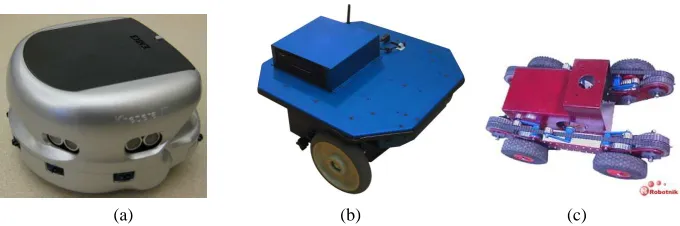
The multi-robot team in the GUARDIANSprojects consists mostly of mini Khepera III and middle-sized Erratic robots, presented in Figure 1.
These robots are intended to be applied in some, possibly large, quantity. An exception is the robot called Guardian, developed by the partner Robotnik Automation. This robot can be a member of a team, but also can perform certain tasks where a more powerful robot may be needed, such as carrying tools for firefighters.
The paper is organised as follows. Section 2 gives a brief introduction to collective robotics, with a focus on GUARDIANSmulti-robot team cooperation and the tasks to be
3G
(a) (b) (c)
Fig. 1. Team robots in GUARDIANS, (a) Khepera III (K-TEAM), (b) ERRATIC robot (Videre Design), (c) Robot Guardian
performed. Section 3 describes the GUARDIANSteam members/agents in detail, their ‘sensing’ capabilities, and formation patterns that agents should be able to produce as a self-organising team. Section 4 is dedicated to the description of the basic control model in GUARDIANSproject, that provides necessary navigation behaviour patterns required of a heterogenous group of robots in the GUARDIANS scenario. Section 4 concludes with discussion on stability analysis of the proposed system. Section 5 proceeds with a description of implementation of the algorithms based on the presented control model, on the Erratics robots, and indicates the encountered challenges. The sections contain short overviews of related work whereappropriate. We decided to follow this structure in order to provide a better understanding of the work done in GUARDIANS. Section 6 briefly discusses current work and concludes the paper. The work presented here is a further extension and updating of the work presented at ICIRA 2009 (Alboul et al., 2009).
2
Collective robotics
Collective, or Team, robotics can be divided into two major streams: accidental or
non-intentional cooperation and intentional cooperation (Rybski et al., 1998).
Conven-tionally, the Swarm robotics paradigm is associated with non-intentional cooperation; cooperation just happens and emerges from the group behaviour without being made explicit. Intentional cooperation can be described as combining particular behaviours aiming at an explicit goal. Robots interacting with people can comprise both aspects, whereas people, in general, interact intentionally with robots.
2.1 GUARDIANSrobot team cooperation
the so-called supportive tasks that can be fulfilled without a human squad-leader, such as deployment on site, positioning as beacons and maintaining communication. Some tasks of both categories overlap, such as searching and navigating the environment; the main difference is that in the first category the robots act within the immediate vicinity of the human, and therefore their sensor range covers only a relatively small area of the environment, whereas in the second category of tasks the robots can disperse on site and therefore the perception of the environment is more global.
In both categories both non-intentional and intentional cooperation are applied. There-fore, some developments from the field of Swarm robotics are used. Swarm robotics research is distinguished by the following criteria (Sahin, 2005): a swarm consists of
(i)a large number, of(ii)homogenous,(iii)autonomous,(iv)relatively incapable or inefficient robots with(v)local sensing and communication capabilities.
The GUARDIANSgroup of robots does not comply directly to this definition. First of all, the group consists of non-homogenous robots (different either by physical parameters, or by their functionality), and human agents can be also part of the group. Secondly, the number of robots in the group may not be very large in particular if robots accompany a firefighter.
However, some characteristics of a swarm are present as well. The GUARDIANSgroup does not have a predetermined size, and due to huge dimensions of a warehouse a large number of robots may be required to fulfil tasks in the second category (criterion
(i)). Communication with the outside might not be possible and the human being will be busy ensuring their own safety, thus autonomy (criterion(iii)) is a requirement. A single robot cannot do much in a large warehouse (criterion(iv)) and as communication cannot be guaranteed the robot cannot help but rely on local information (criterion(v)). Swarm robotics is also often divided into so-called communicative-less and commu-nicative robotics. The former case, in general, means that ‘communication’ is assumed to be implicit, i.e. robots react to each other via ‘sensing’ the environment without ex-plicitly exchanging messages, whereas in a communicative swarm robots can exchange information. In GUARDIANSboth types of swarm robotics are used; some more details are given in Section 3 and Section 4.
The GUARDIANS project uses developments from the swarm robotics field whenever appropriate and in what follows the term ‘swarm’ is also used to describe corresponding behaviours.
2.2 Brief overview of swarm robotics research
Initially, robot swarm research has been focused on mostly centralised approaches (Liu et al., 1989; Barraquand et al., 1992), aiming either at motion planning (Latombe, 1991; Lee, 2004) or leader domination (Desai et al., 2001). However, large number of robots generate dynamic behaviour for which central control is computationally expensive and difficult and centralised motion planning is not appropriate when many agents are involved. Nevertheless, centralised approaches to path-planning are still used, in particular when a smooth trajectory is desired (Belta and Kumar, 2002). Recent re-search emphasises autonomy of the robots (criterion(iii)) and applies distributive con-trol approaches which reduce computational complexity, scalable, provide robustness to failures, and is preferable when no high-order precision is required. Many of these approaches are inspired by natural phenomena. Such approaches include behavioural-based robotics (Balch and Arkin, 1998), artificial potential functions (Reif and Wang, 1999; Egerstedt and Hu, 2001; Gazi and Passino, 2004a; Gazi, 2005a,b), virtual agents or virtual structures (Bachmayer and Leonard, 2002; P. ¨Ogren et al., 2002), artificial springs (Shucker et al., 2006; Li et al., 2009), and probabilistic robotics (Stilwell et al., 2005). Some approaches use optimisation criteria from game theory for navigation con-trol (Wangermann and Stengel, 1999) and robot distribution or area coverage (Cortes et al., 2004). There are also works dealing with improving system performance through adaptation and learning (Patnaik et al., 2005; Uchibe et al., 1999; Asada et al., 1999). Some of these works use global information while others are based on local interac-tions and rules. Moreover, besides bio-inspired models there is current research interest in control-theoretic approaches (Desai, 2001; Muhammad and Egerstedt, 2003), as well as in combined approaches where cooperative control is based on a set of control rules (Tanner et al., 2003a).
Surveys on recent advances and the state of the art in swarms can be found in (Dorigo and Sahin, 2004; Sahin and Spears, 2005; Kumar et al., 2005) and a web database on swarm robotics related literature has been compiled at the site4.
3
G
UARDIANSteam description
In the GUARDIANS scenario the main performers are robots, humans and obstacles, which we identify as classes of GUARDIANSagents. These classes are:
1. Class of robots ri, i=1,2, . . . ,n;
2. Class of humans (fire-fighters) hj, j=1,2, . . . ,m; and
3. Class of obstacles ok, k=1,2, . . . ,l.
The class of robots, which may be heterogenous, can be split in several sub-classes of
homogenous robots and robots may be either holonomic or non-holonomic.
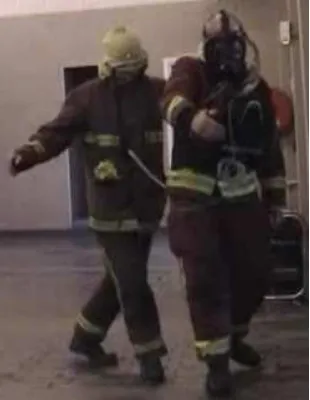
The agents are situated in a domain D⊂R2. In a real-life situation of fire fighting, humans in general move in groups of two: one person takes the role of the leader and the second follows and communicates with the outside (see Fig. 2).
Fig. 2. Demonstration of the search and rescue operation at the trial of the GUARDIANSsystem at the SYFIRE training centre
However, we assume that only one human being is present and that the human takes over the role of leader. Nevertheless the tasks of the robot team is not just to follow the human but also to assist him/her to navigate safely and prevent the human from colliding with obstacles. To a certain extent, robots take the role of the second firefighter acting as a reference unit. The human does not communicate to the robots and is in this context beyond control and performs two basic behaviours: standing still or moving. The robots have to organize themselves formations either surrounding or following the firefighter and maintain this formation throughout.
Robots and humans are referred to as active agents, and obstacles as passive corre-spondingly.
The robots act independently and asynchronously. We also assume that they are
oblivi-ous, meaning that they do neither remember observations nor computations performed
in previous steps contrary to the assumptions made in (Fazenda and Lima, 2007). How-ever, this assumption can be relaxed in order to produce more stable behaviours (see Section 6). The sensing range of each robot may vary from zero to infinity. We refer to the sensing range of a robot as its visibility domain. In the current section the field of
view of each robot is supposed to be 360 degrees, resulting in a circular visibility
do-main. Let us note that a robot can have several visibility domains each for each sensor installed on the robot. However, we can select one main visibility domain and do all the reasoning with respect to it.
of the robot. This assumption does not produce the loss of generality, but simplifies reasoning about the system.
We assume that each robot can ‘recognise’ humans and distinguish robots from obsta-cles and humans. In computational simulations this is done by indicating the class of an agent, for example, by assigning a specific flag to the agents of the same class. In practice, this can be achieved in various ways. Depending on the sensors a tracking system can be developed, focussing on characteristics of the stepping feet (of a human) (Nomdedeu et al., 2008). Other techniques (for communicating robots) which are being developed and tested in the GUARDIANSconsortium, include the use of ultrasonic sen-sors, radio signal intensity, and Infrared sensors. In our implementation trials the robots are able to localise themselves and the other robots in their visibility domains by us-ing a rough map of the environment provided to them. We do not involve here explicit interaction between a robot team and a firefighter, as human-robot interface develop-ment does not belong to the basic behaviours of the robot teams. We refer the reader to related papers of the GUARDIANSconsortium members (Naghsh et al., 2008; Naghsh and Roast, 2008).
3.1 Human-multi-robot team formations
[image:8.612.144.468.356.485.2](a) (b)
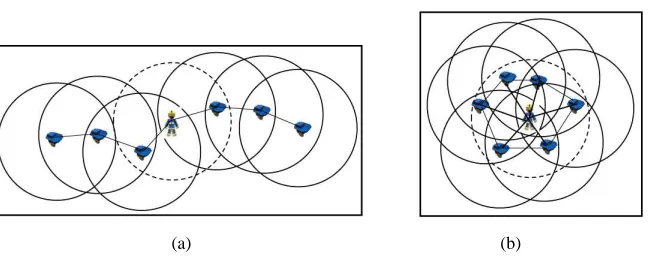
Fig. 3. Two examples of human-multi-robot formations: (a) Maximal formation, (b) Minimal
formation. The visibility domains of robots are indicated as circles with solid boundaries, and the (passive) visibility domain of the human is depicted as a circle with the ‘dashed’ boundary
Definition 1. The GUARDIANSformation represents a connected graph, where nodes are robots or a human and edges are virtual links between the nodes, with the property that each edge is situated in the intersection of the visibility domains of nodes to which the edge is incident.
The definition implies that the distance ribetween neighboring agents (either a robot or
a human) does not exceed the value dmax. This value can be defined to be either smaller
or equal to the (smallest) radius of the visibility domains. It can be smaller in the case if we decide that a robot should react to the agents situated in its visibility domain, in particular, to obstacles, only if they locate within a certain distance dreact.
Our definition of formation is similar to the definition of the formation given in (Tanner et al., 2004).
Neither initial positions, nor final positions of agents are predefined. To some extent, this definition also complies with the definition proposed in (et al., 2004), where the group determines autonomously the most appropriated assignment of positions in the formation.
The definition of formation given above can be specified further.
Indeed, both configurations presented in Figure 3 comply with Definition 1. Both con-figurations can be useful for the GUARDIANS scenario. The one on the left can occur when a group passes a narrow passage, and the one the right may be desirable in an open space. The connected graph that describes a formation may contain loops.
Definition 2. Degree g, g=1, ...,n−1 of a formation is defined as the minimum
num-ber of the visibility domains that contain a spanning tree of the graph of the formation. g is set to∞if there are agents without virtual links in their visibility domains.
Note that if g=∞it means that there is no formation according to definition 1 of formation. In Figure 3 maximal (g=n−1) and minimal (g=1) formations are depicted. In the former case, using the terminology of graph theory, we can say that the resulting formation represents a path. In the latter case the ‘visibility’ domain of the firefighter, which is depicted by a dashed line, contains all the robots, and the obtained graph can be varied from a star through to a wheel to a complete graph. For example, depending on the sensor used the visibility domain of a robot with respect to the human can be of (much) larger radius than the ‘robot-robot’ visibility domain, and in this case the star graph can occur. In the given picture the resulting graph is a wheel. For more detail regarding basic concepts of graph theory, we refer the reader, for example, to the book (Gross and Yellen, 1999).
3.2 Discussion on formation modelling
Gazi, 2005b). In some applications this may be necessary, for example, if robots need to carry a certain object; however in many real-life applications, where dynamics is involved, this may not only be unnecessary but even undesirable. Indeed, if a group of agents needs to move around a complex environment, such as in the GUARDIANS scenario, flexibility is a must so that agents can be spread around or form a tight group depending on the geometry, other features of the environment or specific requirements. Also a desirable feature is the scalability of the formation, i.e. that loss or addition of an agent does not break formation. In (Kostelnik et al., 2002) the studied formations are scalable, however the shape of formation is required to be preserved. Also in (Kostelnik et al., 2002) each robot has a unique ID, contrary to our approach where robots, in most cases, are considered anonymous. Our definition of formation is similar to the concept of neighbouring graph in (Tanner et al., 2003a).
One of the properties of the formation graph in Definition 1 is that the graph is undi-rected, however the indicated property can be relaxed, for example, by assuming that an edge might be situated in the visibility domain of only one node. This situation is pos-sible, when a group of heterogenous robots is involved equipped with sensors with dif-ferent fields of view, and it will transform the formation into a directed graph. Another possibility is to consider formations as multi-layered structures, by taking Definition 1 as the basic layer, that can be further enhanced by attaching certain attributes to its edges and nodes. Such an approach may be particularly useful if dynamic interactions between agents are taken into consideration.
4
Control model
As follows from the description of the GUARDIANSmulti-robot team, the robots should exercise the following behaviours: 1) collision avoidance, 2) obstacle avoidance, 3) for-mation generation, and 4) forfor-mation keeping. Our approach to achieve these behaviours is based on the social potential field framework, which was introduced by Reif and Wang (Reif and Wang, 1999).
The method for generating navigation behaviour patterns in mixed human-robot groups in complex environments has been initially discussed in (Alboul et al., 2008).
We define Robot-Human, Robot-Robot and Robot-Obstacle Potential Functions. The robots have to avoid collisions with the human and obstacles, and at the same time be able to approach and keep the human within their sensor range. While robots ‘sense’ the fire-fighter they execute repulsion behaviour among themselves. In the case if a group of robots has lost a fire-fighter in their visibility domain, we would like that the robot do not disperse and therefore an attraction force is applied towards the robots in a ‘lost’ robot’s visibility domain. We also take into consideration the physical dimensions of the robots and humans, therefore the general form of our potential functions is the following:
Definition 3. The potential function Pkl is a nonnegative function of the distance dkl between agents k and l, satisfying the following properties
1. Pkl(kdklk)−→∞when(kdklk −wrkl)−→0, where wrkl is the distance at which a
2. Pkl has its unique minimum when agents k and l are positioned at a predefined distance; at this distance agents k and l will come to rest, if only one potential Pkl is applied ;
3. Depending on the situation, and the agent’s type, Pkl may either−→0, near Rvis,
which is the radius of the visibility domain of a robot, or, on the contrary,−→∞.
Therefore, the potential functions are defined as follows:
1. Robot-human potential function PHumanbetween the robot riand the Human H is:
PHuman(dHri) =
1
(khrr(drHi −whrr))
2+
1
(khra(drHi −whra))
2 (1)
where khrr, khra, whrr and whra are scaling parameters, and drHi is the distance
be-tween the robot riand the human H.
2. Robot-Robot Potential function PRobot between the robot ri and the robot rj is, in
the presence of the human in the robot visibility domain, is defined
PRobot(d
rj
ri) =
1
(krr(d rj
ri −wrr))2
(2)
where krrand wrrare scaling parameters and d rj
ri is the distance between the robot ri
and the robot rj. Obviously d rj
ri =d
ri
rj. In this case only the repulsion term is present.
In the presence of the human we assume that robots avoid each other, by exerting on each other the repulsive force IR(i,j), the magnitude of which is determined by
the derivative Prr(ri j)of PRobot(d rj
ri)with respect to d
rj
ri.
In the absence of the human in the visibility domain of a robot, the force acting on the robot by other robots in its visibility domain becomes a combination of attraction and repulsion similar to the potential function between the robot and the human in order to avoid spreading robots in the site. The corresponding function is:
PRobot(d
rj
ri) =
1
(krr(d rj
ri −wrr))2
+ 1
(kra(d rj
ri −wra))2
(3)
where krr, kra, wrrand wraare scaling parameters, and d rj
ri is the distance between
the robot riand the robot rj.
3. Robot-Obstacle Potential function PRobot is defined between the robot ri and the
obstacle Osas
PObstacle(drOis) =
1
(kro(drOis−wro))2
(4)
where kroand wroare scaling parameters and drOisis the distance between the robot
riand the obstacle Os. We assume that robots avoid the obstacles and therefore do
The social potential function PSocial of ri is defined as the sum of the aforementioned
potential functions:
PSocial(Xri) =P
O
R(Xri) +P
rj
ri (Xri) +P
H
r (Xri)
= S
∑
s=1
PObstacle(drOis) +
M
∑
j=1,j6=i
PRobot(d
rj
ri) +PHuman(d
H
ri) (5)
The artificial force−→FArti(Xri)which is ‘acting’ on robot riis, therefore, computed as
the sum of gradients of corresponding potential functions:
− →
FArti(Xri) = − →
FArti Obstacle(Xri) +
− →
FArti Robot(Xri) +
− →
FArti Human(Xri)
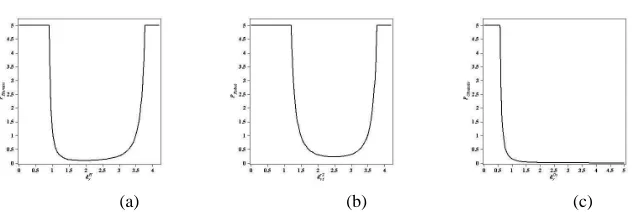
[image:12.612.136.453.344.450.2]Graphs of the described Robot-Human, Robot-Robot (when the human is not present in the visibility domain of a robot) and Robot-Obstacle Potential functions are given in Fig. 4.
(a) (b) (c)
Fig. 4. Profiles of the control potential functions in GUARDIANS: (a) Robot-Human Potential, (b) Robot-Robot Potential in the absence of the human, (c) Robot-Obstacle Potential
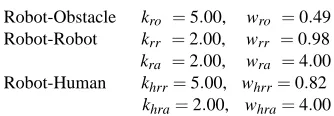
Parameters The parameters of all the employed potential functions are shown in Table 1.
This selection is roughly based on the specifications and characteristics of the consid-ered system. We use the dimensions of an Erratic robot (given in Table 2), but it can be easily adapted to other types of robots.
For example, the robot’s size determines the value of the contact distance, i.e. for the robot-obstacle potential function wrorepresents the distance at which the edges of the
robot and the obstacle may come into physical contact. The value (wro=0.49) is
ob-tained as the sum of the Erratic robot radius rErr≈0.29 and safety margin, which we put
equal to 20 cm . Similar criteria are used for the robot-robot (wrr,wra) and robot-human
(whrr,whra) contact distances. In the case of robots the contact distance wrr=0.98
Table 1. Values of the parameters used in the potential functions employed for simulation
Potential Function Parameter Value
Robot-Obstacle kro =5.00, wro =0.49
Robot-Robot krr =2.00, wrr =0.98
kra =2.00, wra =4.00
Robot-Human khrr=5.00, whrr=0.82
khra=2.00, whra=4.00
an obstacle, as both robots can move. Both parameters wra and whra are equal to the
radius of the visibility of a robot, which is equal to 4 m ( the range of the LRF Hokuyo equipped on a robot). The parameter kro in the potential function (4) determines at
which distance the repulsive potential starts pushing the robot away from the obstacle. Choosing kro=5 ensures that robot riwill not start avoiding the obstacles up to
approx-imately dOs
ri =1.5 meters. This is done in order to decrease the possible oscillating of a
robot.
In order to avoid very large forces acting on robots, we set the values of the potential functions to be constant. In the given examples this constant is equal to 5 at distances close to contact limits or to the radii of the visibility domains. Therefore are potential functions are non–smooth. There are similarities with the potential functions studied in (Tanner et al., 2003a), but they did not consider, for example, contact distances, and the forms of the functions used are different.
4.1 Stability considerations
Artificial potential fields have been extensively used for modelling collective behaviours and distributive control of a group of robots due to their capacity of expressing various interaction patterns. Potential functions have been used successfully in multi-robot nav-igation for obstacle avoidance (Krogh, 1984; Penders et al., 1994), robot aggregation (Gazi and Passino, 2004b,a), and robot formation keeping (Song and Kumar, 2002; Schneider and Wildermuth, 2005).
However, the control models, based on artificial potential fields, have drawbacks such as local minima. Therefore stability and convergence analysis is important in order to establish robustness and limitations of the proposed models.
Table 2. Basic parameters of the ERA-MOBI robot
ERA-MOBI Parameter Value
Dimensions L=40cm, W=41cm, H=15cm Maximum Speed 2ms−1
In general, the models based on artificial potential functions, are discontinuous which makes it hard to analyze behaviorial performance analytically, as the stability of the discontinuous dynamics involves, in general, differential inclusions and non-smooth analysis. Such analysis, if performed, often involves bulky computations (Song and Kumar, 2002; ¨Ogren et al., 2004; Tanner et al., 2003b)
The stability analysis of our control model is based on geometric concepts which al-low avoiding heavy computation while providing qualitative proofs of attainability of desired formations under certain conditions. Some results on stability analysis were presented in (Alboul et al., 2008). The results obtained are similar to those in (Tanner et al., 2003b), but achieved without performing bulky computations.
The main conclusions are the following:
Lemma 1. (Sufficient conditions for formation maintenance)
1. In the absence of obstacles the robots are always gathered around the human, form-ing a minimal formation, if at the initial step the robots and human are in formation according to our definition;
2. In the presence of obstacles, if the human (at rest) and robot agents are in forma-tion at any step, all robots will gather around the human. The degf in of the final
formation does not exceed the deginit of the initial one;
3. If the human moves and robots are in formation at any step, the robot team will follow the human.
In cases 2) and 3) some robots may be lost due to the fact that an obstacle will appear in their visibility domain which may break the formation. We can conclude that formation maintenance depends on visibility maintenance of the robots involved.
The important condition that would prevent undesirable local minima is that the robots have to be in formation, as defined in Section 2, at any step. It means that a robot may not ‘sense’ the leader/human/goal at any step, but a chain (path) must exist consisting of ‘formation’ edges, that connects the robot to the leader/human/goal. Some authors realise this (without explicitly formulating neither sufficient nor necessary conditions). However, in order to avoid local minima, all robots are either assumed to be able to sense the leader or its equivalent at any step, or be able to reproduce the previous steps of the leader ( ¨Ogren et al., 2004; Fazenda and Lima, 2007). This leads to extensive computation and higher complexity of the corresponding algorithms.
5
Examples of Implementation
Our framework has been tested using and Player/Stage software5that allows their direct application to real robots. Simulation results comply with the theoretical considerations regarding formation generation and maintenance, and show that our algorithms are ro-bust and capable to deal with teams of different sizes and failure of individual agents, both robots and humans.
Algorithm The pseudocode of the algorithm that uses the Social Potential Forces ap-proach for the implementation in the real-world scenario is given in Algorithm 1. Each robot calculates the resulting social potential force(Fx,Fy)which determines the
ve-locity of each robot(vx,vy). We use a discrete-time approximation to the continuous
behaviour of the robots, with time-step ∆t. The speed of the robots is bounded to a
maximum velocity Vmax. The output of the compute motion algorithm is a direction and
a speed of the robot.
Algorithm 1 Compute motion 1: for all robots but current robot j do 2: determine the distance r to robot i, i6=j
3: determine the polar angular coordinateθto ri
4: netForce=SocialPotentialForce(r)
5: Fx⇐Fx(netForce)cos(θ)
6: Fy⇐Fy(netForce)sin(θ)
7: end for 8: ∆vx⇐Fx∆t
9: ∆vy⇐Fy∆t
10: vx⇐vx+∆vx
11: vy⇐vy+∆vy
12: ifkvk>Vmaxthen
13: vx⇐(vx×Vmax)/kvk
14: vy⇐(vy×Vmax)/kvk
15: end if 16: speed⇐ kvk
17: direction⇐tan−1(vy/vx)
18: move the robot with the calculated speed in the determined direction
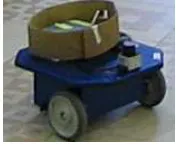
[image:15.612.263.351.559.632.2]System description The approach has been tested on Erratic’s mobile platforms. Four Erratic platforms equipped with: 1) On board computer equipped with wi-fi; and 2) Hokuyo Laser Rangefinder (LRF), model URG-04LX (Finder), ‘participated’ in the trials. One Erratic is depicted in Fig. 5.
As one can see, the robot is equipped with a circularly-shaped additional structure. This has been done in order that robots can detect on another by using the LRF mounted on it. In the performed trial detection was used only for avoiding collisions between the robots, however the aforementioned structure can also be used for robot recognition (by analyzing the laser scan profiles). Initially the tests were conducted without a hu-man agent; and one of the robots ‘played’ the role of a firefighter. Later the tests were performed with a human.
The implementation of our algorithms in the real-world scenario with the Erratic robots represented a challenging issue. Most of the efforts focussed on achieving a reliable way of detecting the components of the mixed multi-robot and human team without using any sort of tracking system. The considered solution required the design of an ar-chitecture environment capable of implementing different robot behaviors (aggregation and following), handle communication, run distinct robot navigation algorithms (local-ization and collision avoidance), define different agent types, interact with the hardware involved (actuators and sensors), interface with the users and everything combined with different software platforms (Player, Javaclient and JADE).
[image:16.612.165.450.416.635.2]In order to mimic relative robot detection and distance estimation (still under devel-opment), robots were provided with a map of the environment in which they localise themselves by using the Adaptive Monte-Carlo localisation method. The map, however, was only approximate, as not all obstacles were included. The robots in the trials were communicating in order to exchange information about their positions.
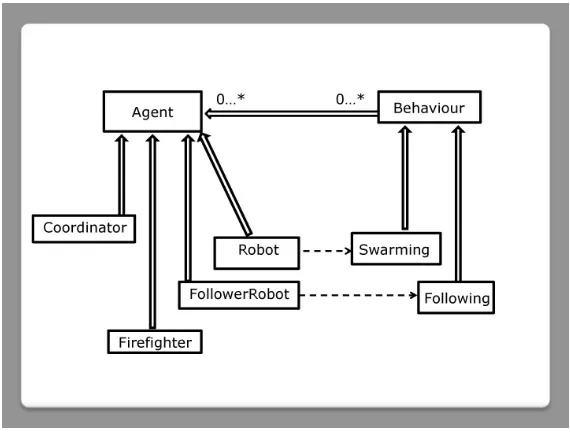
JADE (Java Agent Development Environment)6was used to take care of the agent’s life-cycle and other agent-related issues. JADE provides a runtime environment and agent communication and management facilities for rapid and robust agent-based de-velopments. In our demonstration we have developed several different types of agent, each one having a clear role in the demo. Note that agents here are different from the agents described in Section 3.
Each agent is composed of a set of behaviours that determines how it acts or reacts to stimuli. For our demos we have developed several communication, swarming, and following behaviours, and assigned them in different ways to different agent types to get a set of multi-functional agents. By doing so, we are able to share the robots and human poses through the whole team, allowing swarming techniques to take advantage of these essential data.
JADE agents, used in the GUARDIANSsystem, are the following:
– PlayerRobotAgent. This agent represents the n robots that organise themselves into formation around the human. Each robot makes use of the map interface, the Erratic robot driver, the amcl (adaptive monte-carlo localization) interface, the potential field based motion coordination and the Javaclient for Player.
– CoordinatorAgent. This agent overcomes limitation of the sensors to distinguish and identify the robots relative positions. The main task of the coordinator is to collect the absolute positions of the robots and compile a list of other robots in absolute coordinates.
– PlayerFireFighterAgent. This agent runs on the laptop the human is carrying. It provides the ability to supply position and orientation data to the underlying Player instance and also to the coordinator agent. Both Player clients and JADE agents are informed of the Humans pose.
– PlayerFollowerRobotAgent. This agent follows the human, tracking his position relative to its own, and informing the PlayerFireFighterAgent of the human’s abso-lute position within the environment.
– PlayerPosePublisherRobotAgent. This agent is used to simulate the human be-haviour in the absence of human. Basically it is a remote controlled robot whose motion is totally independent of the other robots. It has the map interface, the amcl driver, the Erratic robot driver, the joystick interface and the javaclient for Player.
Some implementations were demonstrated during the evaluation of the GUARDIANS project’s progress in Brussels in January 2009, later improved in Benicassim and fi-nally demonstrated in Sheffield at the SYFIRE Training Centre where they were met enthusiastically by the audience.
In the first trial, described in (Alboul et al., 2009), the human was not present and its role was ‘performed’ by the teleoperated robot. In the later trial in Benicassim, the human was included in the team, but a special robot followed the firefighter by tracking their feet (Nomdedeu et al., 2008). This robot communicated the coordinates of the firefighter to the other robots. All robots were autonomous. As the set-ups in the trials were different, different combinations the JADE agents were used.
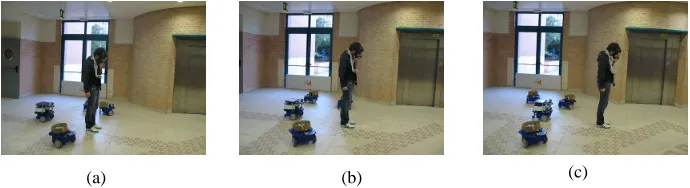
In Fig. 7 and 8 a sequence of video snapshots of the experiments in Benicassim are presented demonstrating formation generation and formation keeping by a group of Erratic’s robots and a human (playing the role of the firefighter).
[image:18.612.137.484.182.275.2](a) (b) (c)
Fig. 7. Snapshots of experiments on formation generation in GUARDIANS: (a) Initial set-up, (b) Formation generation in process (c) Formation is generated
(a) (b) (c)
Fig. 8. Snapshots of experiments on formation maintenance in GUARDIANS: (a), (b),(c) Robots follow the human
Experiment evaluation There are no generally accepted global criteria to evaluate a swarm systems performance, except some notable exceptions as the measures of flexi-bility in (Fukuda et al., 1998), and the measures of behavioral difference in (Balch and Hybinette, 2000). From this, it follows that studies on performance have to address spe-cific tasks, environments, and robots. The main goal of the implementation trials was to demonstrate that robots are able to generate a formation and keep the formation while following a human. The experiments consisted of placing the mobile robots at different starting positions but situating the human at the same starting point for all the different trials.
[image:18.612.137.482.359.453.2]initial robots’ positions and the position of the human in simulation experiments and in the real-world trails were set the same. Several parameters then were compared, such as time to generate a formation, trajectories of the robots and human, travelling time, distances between robots, computation time and others.
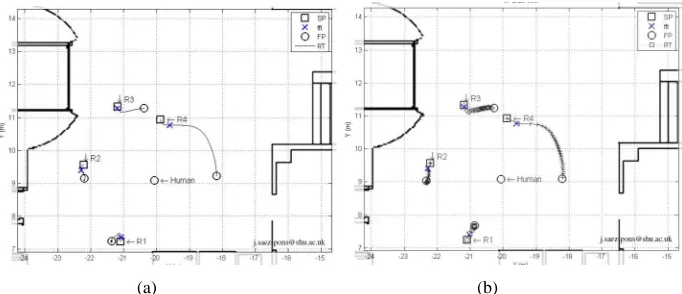
The results of one of the trials are shown in Figure 9 and Figure 10. In Figure 9 forma-tion generaforma-tion results are shown. At the beginning of each trial the human remained still and the robots started moving to generate a formation. Some time was given to the robots to reach their stable situation, which was achieved when the mobile platforms became motionless. In the left picture simulation results are presented, and in the right picture the results of formation generation by real robots are depicted.
[image:19.612.140.481.253.400.2](a) (b)
Fig. 9. Snapshots of experiments on formation generation in GUARDIANS: (a) Simulation results, (b) Real-World experiment results
When the robots stabilized, the human started slowly moving a specific distance in a straight line; in our case this distance was approximately seven meters. When the human had reached the destination they remained still again until the robots had reached a stable position once more. At this point the trial was considered as over. The trajectories of the robots and the human both in a simulated experiment and in the corresponding real-world experiment are shown in Figure 10.
6
Work in development
(a) (b)
Fig. 10. Snapshots of experiments on formation maintenance in GUARDIANS: (a) Simulation results, (b) Real-World experiment results. The path of the human is depicted in red
that will combine the described basic behaviours with other behaviours, such as wall following, ‘previous direction’ following and allow easy ‘switch’ between behaviours. We are also working on robot-robot recognition when there is no map. We are testing other sensors such as ultrasound, as well as methods based on special labelling, such as attaching to a robot a specific shape pattern. Experiments on the latter approach have already been performed and recognition worked well (Alboul et al., 2010).
In the future we are planning to extend the method to robot teams of arbitrary sizes and non-uniform visibility domains (either by their geometric profiles, and/or by ranges). In our trials we will further evaluate performance of robotic teams with special emphasis on fault tolerance and scalability.
Acknowledgements
References
L. Alboul, H. Abdul-Rahman, P. Haynes, J. Penders, and J. Tharin. Guardians multi-robot team as a self-organising system. In (RISE 2010), 2010.
L. Alboul, J. Saez-Pons, and J. Penders. Mixed human-robot team navigation in the guardians project. In International Workshop on Safety, Security and Rescue Robotics
(SSRR 2008), pages 95–101, 2008. ISBN 978-1-4244-2031-5.
Lyuba Alboul, Joan Saez-Pons, Jacques Penders, and Leo Nomdedeu. Challenges of the multi-robot team in the guardians project. In Ming Xie, Youlun Xiong, Caihua Xiong, Honghai Liu, and Zhencheng Hu, editors, Intelligent Robotics and
Applica-tions, volume 5928 of Lecture Notes in Computer Science, pages 112–125. Springer,
2009. ISBN 978-3-642-10816-7.
M. Asada, E. Uchibe, and K. Hosoda. Cooperative behavior acquisition for mobile robots in dynamically changing real worlds via vision-based reinforcement learning and development. Artificial Intelligence, 110(2):275–292, June 1999.
R. Bachmayer and N. E. Leonard. Vehicle networks for gradient descent in a sampled environment. In CDC, pages 112–117, Las Vegas, Nevada, December 2002. T. Balch and R. C. Arkin. Behavior-based formation control for multirobot teams.
IEEETRA, 14(6):926–939, December 1998.
T. Balch and M. Hybinette. Social potentials for scalable multi-robot formations. In
Proc. of the IEEE Conf. on Robotics and Automation (ICRA’00), volume 1, 2000.
G. Baldassarre, S. Nolfi, and D. Parisi. Evolving mobile robots able to display collective behaviour. Artificial Life, 9:255–267, 2003.
J. Barraquand, B. Langlois, and J. C. Latombe. Numerical potential field techniques for robot path planning. IEEE Transactions on Systems, Man, and Cybernetics, 22(2): 224–241, 1992.
Calin Belta and Vijay Kumar. Trajectory design for formations of robots by kinetic energy shaping. In ICRA, pages 2593–2598, 2002.
W. Clark. Firefighting Principles and Practices. Fire Engineering Books, 1991. J. Cortes, S. Martinez, T. Karatas, and F. Bullo. Coverage control for mobile sensing
networks. IEEETRA, 20(2):243–255, 2004.
J. P. Desai. Modeling multiple teams of mobile robots: a graph theoretic approach. In IEEE/RSJ International Conference on Intelligent Robots and Systems (IROS’01), page 381386, 2001.
J. P. Desai, J. Ostrowski, and V. Kumar. Modeling and control of formations of non-holonomic mobile robots. IEEETRA, 17(6):905–908, December 2001.
M. Dorigo and E. Sahin. Special issue on swarm robotics. Autonomous Robots, 17 (2-3), September 2004.
M. Egerstedt and X. Hu. Formation constrained multi-agent control. IEEETRA, 17(6): 947–951, December 2001.
Lemay, M. et al. Autonomous initialization of robot formations. In Robotics and
Au-tomation, Proceedings. ICRA ’04., pages 3018–3023, 2004.
Hokuyo Laser-Range Finder. http://www.hokuyo-aut.jp/.
Toshio Fukuda, Daisuke Funato, Kousuke Sekiyama, and Fumihito Arai. Evaluation on flexibility of swarm intelligent system. In ICRA, pages 3210–3215, 1998.
V. Gazi. Formation control of a multi-agent system using nonlinear servomechanism.
International Journal of Control, 78(8):554–565, 2005a.
V. Gazi. Swarm aggregations using artificial potentials and sliding mode control. IEEE
Transactions on Robotics, 21(6):1208–1214, 2005b.
V. Gazi and K.M. Passino. A class of attraction/repulsion functions for stable swarm aggregations. International Journal of Control, 77(18):1567–1579, December 2004a. V. Gazi and K.M. Passino. Stability analysis of social foraging swarms. IEEETSMC :
Part B, 34(1):539–557, February 2004b.
J. Gross and J. Yellen. Graph Theory and its Applications. CRC Press, 1999.
P. Kostelnik, M. ˘Samulka, and M. J´ano˘sik. Scalable multi-robot formations using local sensing and communication. In Third International Workshop on Robot Motion and
Control (RoMoCo’02), 2002.
B. Krogh. A generalized potential field approach to obstacle avoidance control. In SME
conf. Proc. Robotics Research: The next five years and beyond, pages 11–22, 1984.
V. J. Kumar, N. E. Leonard, and A. S. Morse, editors. Cooperative Control: 2003 Block
Island Workshop on Cooperative Control, volume 309 of Lecture Notes in Control and Information Sciences. Springer-Verlag, 2005.
M. Latombe. Robot motion planning. Kluwer Academic Press, 1991.
L.-F. Lee. Decentralized Motion Planning within an Artificial Potential Framework (APF) for Cooperative Payload Transport by Multi-Robot Collectives. Master’s the-sis, State University of New York at Buffalo, 2004.
Xiang Li, M. Fikret Ercan, and Yu Fai Fung. A triangular formation strategy for collective behaviors of robot swarm. In ICCSA ’09: Proceedings of the
Inter-national Conference on Computational Science and Its Applications, pages 897–
911, Berlin, Heidelberg, 2009. Springer-Verlag. ISBN 978-3-642-02453-5. doi: http://dx.doi.org/10.1007/978-3-642-02454-2 70.
Y.-H. Liu, S. Kuroda, T. Naniwa, H. Noborio, and S. Arimoto. A practical algorithm for planning collision-free coordinated motion of multiple mobile robots. In Proc. IEEE
International Conference on Robotics and Automation, volume 3, pages 1427–1432,
14-19 May 1989.
A. Muhammad and M. Egerstedt. Topology and complexity of formations. In
Proceed-ings of the 2nd International Workshop on the Mathematics and Algorithms of Social Insects, 2003.
A. M. Naghsh, J. Gancet, Tanoto, and C. R. Roast. Analysis and design of human-robot swarm interaction in firefighting. In Proc. Of IEEE Conference of Robot-Human
Interactions (RO-MAN), 2008.
A. M. Naghsh and C. R. Roast. Designing user interaction with robots swarms in emer-gency settings. In Proceedings of the 5th Nordic Conference on Human-Computer
interaction: Building Bridges, 2008.
L. Nomdedeu, J. Sales, E. Cervera, J. Alemany, C. Sebastia, M. Ilzkovitz, J. Penders, and V. Gazi. An experiment on squad navigation of human and robots. In 10th
Inter-national Conference on Control, Automation, Robotics and Vision (ICARCV 2008),
Petter ¨Ogren, Edward Fiorelli, and Naomi Ehrich Leonard. Cooperative control of mobile sensor networks: Adaptive gradient climbing in a distributed environment.
IEEE Transactions on Automatic Control, 49:1292–1302, 2004.
P. ¨Ogren, E. Fiorelli, and N. E. Leonard. Formations with a mission: Stable coordination of vehicle group maneuvers. In Symposium on Mathematical Theory of Networks and
Systems, August 2002.
S. Patnaik, A. Konar, and A. K. Mandal. Improving the multi-agent coordination through learning. IETE JOURNAL OF RESEARCH, 51(5):395–406, September-October 2005.
J. Penders, L. Alboul, C. Roast, and E. Cervera. Robot swarming in the Guardians project. In In ECCS’07. European Conference on Complex Systems’07, 2007. J.S.J.H. Penders, L.S. Alboul, and Braspenning P.J. The interaction of congenial
au-tonomous robots: Obstacle avoidance using artificial potential fields. In Proceeding
ECAI-94, pages 694–698. John Wiley and Sons, 1994.
J. H. Reif and H. Wang. Social potential fields: A distributed behavioral control for autonomous robots. Robotics and Autonomous Systems, 27(3):171–195, May 1999. Paul Rybski, Amy Larson, Michael Lindahl, and Maria Gini. Performance evaluation of
multiple robots in a search and retrieval task. In In Workshop on Artificial Intelligence
and Manufacturing, pages 153–160. AAAI Press, 1998.
E. Sahin. Swarm robotics: From sources of inspiration to domains of application. In
Swarm Robotics: SAB 2004 International Workshop, Santa Monica, CA, USA, July 17, 2004, Revised Selected Papers, pages 10–20. Lecture Notes in Computer Science,
Springer Verlag, 2005.
E. Sahin and W. M. Spears, editors. Swarm Robotics, A State of the Art Survey. Lecture Notes in Computer Science 3342. Springer-Verlag, Berlin Heidelberg, 2005. F. E. Schneider and D. Wildermuth. Experimental comparison of a directed and a
non-directed potential field approach to formation navigation. In Proc. 2005 IEEE Int.
Symposium on Computational Intelligence in Robotics and Automation, 2005.
Brian Shucker, Todd D. Murphey, and John K. Bennett. A method of cooperative con-trol using occasional non-local interactions. In ICRA, pages 1324–1329, 2006. P. Song and V. Kumar. A potential field based approach to multi-robot manipulation.
In Proc. Of the 2002 IEEE Int. Conference on Robotics and Automation, 2002. D.J. Stilwell, B.E. Bishop, and C.A. Sylvester. Redundant manipulator techniques for
partially decentralized path planning and control of a platoon of autonomous vehi-cles. IEEE Transactions on Systems Man and Cybernetics Part B-Cybernetics, 35 (4):842–848, August 2005.
H. G. Tanner, A. Jadbabaie, and G. J. Pappas. Stable flocking of mobile agents, part i: Fixed topology. In CDC, pages 2010–2015, Maui, Hawaii, December 2003a. H. G. Tanner, A. Jadbabaie, and G. J. Pappas. Stable flocking of mobile agents, part ii:
Dynamic topology. In CDC, pages 2016–2021, Maui, Hawaii, December 2003b. H. G. Tanner, G. J. Pappas, , and V. Kumar. Leader-to-formation stability. IEEE
Trans-actions on Robotics and Automation, 20:443–455, 2004.
E. Uchibe, M. Nakamura, and M. Asada. Cooperative behavior acquisition in a multiple mobile robot environment by co-evolution. In Lecture Notes in Artificial Intelligence
J. P. Wangermann and R. F. Stengel. Optimization and coordination of multiagent sys-tems using principled negotiation. Journal of Guidance, Control, and Dynamics, 22 (1):43–50, 1999.
U. Witkowski, S. Herbrechtsmeier, M. El-Habbal, L. Alboul, and J. Penders. Self-optimizing human-robot systems for search and rescue in disaster scenarios. In J Gausemeier, F Ramming, and W Shaefer, editors, Self-optimizing Mechatronic
Sys-tems: Design the Future, 7-th Heinz Nixdorf Symposium, pages 315–329. Heinz