A framework for embedding simulation.
JOSEPH, Lionel.
Available from Sheffield Hallam University Research Archive (SHURA) at:
http://shura.shu.ac.uk/19887/
This document is the author deposited version. You are advised to consult the
publisher's version if you wish to cite from it.
Published version
JOSEPH, Lionel. (2011). A framework for embedding simulation. Masters, Sheffield
Hallam University (United Kingdom)..
Copyright and re-use policy
See
http://shura.shu.ac.uk/information.html
Sheffield Hallam University Research Archive
Learning ana iniormauun ow m u oo Adsetts Centre, City Campus
Sheffield S1 1WD
A M ' '
1 0 2 1 0 0 3 6 6 2
Sheffield Ha!!am University Learning and Information Services
Adsetts Centre, City Campus Sheffield SI 1WD
REFERENCE
ProQuest Number: 10697193
All rights reserved
INFORMATION TO ALL USERS
The qu ality of this repro d u ctio n is d e p e n d e n t upon the q u ality of the copy subm itted.
In the unlikely e v e n t that the a u th o r did not send a c o m p le te m anuscript and there are missing pages, these will be note d . Also, if m aterial had to be rem oved,
a n o te will in d ica te the deletion.
uest
ProQuest 10697193
Published by ProQuest LLC(2017). C op yrig ht of the Dissertation is held by the Author.
All rights reserved.
This work is protected against unauthorized copying under Title 17, United States C o d e M icroform Edition © ProQuest LLC.
ProQuest LLC.
789 East Eisenhower Parkway P.O. Box 1346
A FRAMEWORK FOR EMBEDDING
SIMULATION
Lionel Joseph
A th e s is su b m itte d in p a rtia l fu lfilm e n t o f the re q u ire m e n ts o f
S h e ffie ld H a lla m U n iv e rsity
fo r th e d e g re e o f M a s te r o f P h ilo so p h y
N o v e m b e r 2011
A framework for e in bedding simulation A b s t r a c t
Abstract
A lthough exem plars of successful outcom es from using sim ulation are readily available,
little has been published outlining how sim ulation can be im plem ented in an organisation.
This study exam ines on an experim ental approach on how discrete event sim ulation (D ES)
can be im plem ented in an organisation and the various success and failure factors
associated with it. The im portance of factors like organisational culture, inform ation
m anagem ent, and hum an resource m anagem ent was investigated. To understand the
general challenges faced by organisations in im plem enting sim ulation and other business
process im provem ent techniques, various case studies were discussed. A questionnaire was
also form ulated to invite som e of the well-know n organisations that use sim ulation
technology to evaluate the current m ethods and strategies in im plem enting sim ulation.
The prim ary outcom e was to create a fram ew ork fo r em bedding sim ulation based on the
research from the successful case studies and the findings and outcom es from the literature
survey and questionnaire. The fram ew ork was validated using exam ples of various cases
during the research experience in the collaborating organisation. T he im portance of
creating a structural fram ew ork and its collaboration and co-existence with the current
organisational fram ew ork and required project outcom e(s) were highlighted. In creating a
relevant and w orkable fram ew ork and validating the sam e, this study has contributed
significantly to the research gap established within the existing sim ulation integration
A framework for em beddin g simulation Acknow lodgement
Acknowledgements
I would like to thank all the people for helping me and supporting me throughout my
project. W ithout them , I w ouldn’t have been able to achieve this.
• Dr. D avid C legg, my D irector of Studies, for all his invaluable help and input with my
project.
• Professor T errence Perera, my Second Supervisor for his support and m entor during my
project.
• To all my dear colleagues at the organisation I worked to com plete my research, for
their support, care and co-operation over the period o f 24 months.
And finally, all my friends and fam ily who have supported me throughout the period o f m y
A framew ork for em beddin g simulation
Table of Contents
1 Introduction... 2
1.1 In tro d u ction ...2
1.2 C urrent status o f sim u la tio n ... 4
1.3 B ackground of the s t u d y ... 5
1.4 Justification o f r e s e a r c h ... 7
1.5 A im s & O b je c tiv e s...8
1.5.1 Conduct a literature survey to review the current success factors in im plem enting sim u la tio n ... 8
1.5.2 Conduct a questionnaire survey to review the current practices in sim ulation and its lim ited im plem entation of within industry... 9
1.5.3 D evelop a m ethodical approach to em bed sim ulation in an o rg anisation ...9
1.5.4 V alidate the approach proposed fram ew ork through im plem entation at the collaborating organisation... 10
1.6 S tru ctu r e...10
1.7 S u m m a ry...12
2 Literature Review...13
2.1 In tro d u ctio n ...13
2.2 E valuation o f current business process tools & te ch n iq u e s... 16
A framework for em bedding simulation Table o f Contents
2.2.1 Business process te c h n iq u e s... 16
2.2.2 Business process t o o l s ... 16
2.3 Integration o f current tools and te c h n iq u e s...17
2.3.1 Six sig m a ... 17
2.3.2 VSM (Value Stream M ap p in g )... 18
2.4 G eneric factors affecting the im plem entation o f business process tools & tech n iq u es... 20
2.4.1 U nderstanding change m an a g e m e n t...20
2.4.2 U nderstanding organisational c u ltu re ... 21
2.5 U nderstanding sim ulation and its current sta tu s........21
2.5.1 The uniqueness of a sim ulation s tu d y ... 21
2.5.2 Use o f sim ulation as a tem porary t o o l ... 22
2.6 E m bedding sim ulation into business p ro cesses...24
2.6.1 Fundam entals for integration of sim u latio n ... 24
2.6.2 Defining the objectives and deliverables of a sim ulation p ro je c t... 25
2.6.3 The im portance of creating a fram ew ork for integration of sim u latio n ... 27
2.6.4 Challenges in im plem enting sim u la tio n ... 29
2.7 S u m m ary...30
3 Case Study... 32
3.1 M anufacturing process m odelling o f Boeing 747 m oving line c o n c e p ts...32
3.1.1 Introduction... 32
3.1.2 Flow line c o n c e p t... 32
A framework for em beddin g simulation Table of Contents
3.1.4 C reating a project team fo r sim ulation...33
3.1.5 Justifying and prom oting the use of sim u la tio n... 34
3.1.6 S u m m a ry ...34
3.2 Application O f B usiness Process Sim ulation and Lean T echniques In B ritish T elecom m unications P L C ... 37
3.2.1 In troduction...37
3.2.2 Evolution o f business process tech n iq u e s... 38
3.2.3 Sim ulation as part of business tran sfo rm atio n ...39
3.2.4 K now ledge sharing platform for Sim ulation p ra c titio n e rs... 39
3.2.5 S u m m a ry ...40
3.3 A Foundation to C ontinuous Im provem ent in Solectron C orp oration ... 42
3.3.1 Introduction ...42
3.3.2 Establishing the culture & p h ilo so p h y ... 43
3.3.3 External support & e x p e rtise ... 43
3.3.4 S u m m a ry ... 44
3.4 Sum m ary o f case study fin d in g s...45
4
Research Design & M ethodology... 48
4.1 In trod u ction ... 48
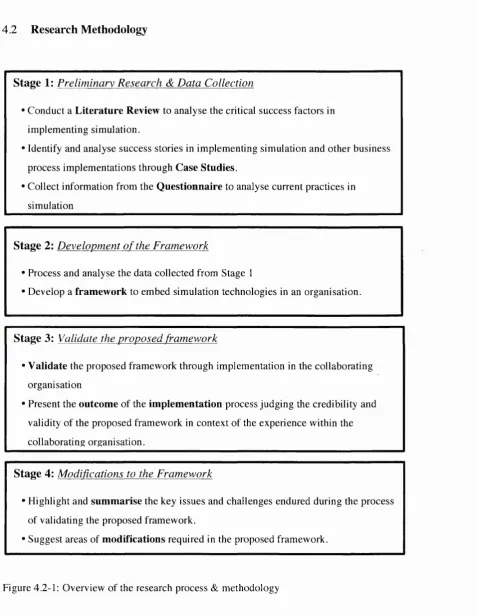
4.2 Research M eth o d o lo g y ... 49
4.3 Research D e sig n...50
4.3.1 Q uestionnaire S u rv ey ... 50
4.3.2 Develop a fram ew ork for em bedding s im u la tio n ... 51
4.3.3 V alidation of the proposed fra m e w o rk ...52
5 Questionnaire...53
5.1 In trod u ction...53
5.2 B usiness a r e a...55
5.3 Introduction to sim u la tio n...58
5.3.1 Evolution of S im u latio n ... 58
5.3.2 C ollaborating to introduce s im u la tio n ...60
5.3.3 Engagem ent of external re so u rc e s...61
5.4 Initialisation and deploym ent o f sim u la tio n ... 62
5.4.1 Level of Interest in sim u la tio n ...63
5.4.2 A cceptance of sim ulation... 64
5.4.3 General aw areness in s im u la tio n ... 65
5.4.4 A nalysing the com m on challenges in prom oting sim ulation... 66
5.5 Sim ulation for the fu tu r e...67
5.5.1 Rate o f success of sim ulation... 68
5.5.2 D evelopm ent of sim ulation pro ject...69
5.5.3 C urrent deploym ent of sim u la tio n ...70
5.5.4 Scope of m ore sim ulation p ro jects... 71
5.6 S u m m ary...72
6 Proposed fram ework... 74
6.1 In trod u ction ... 74
6.2 Easy to F o llo w ... 75
A framework for em beddin g simulation Table of Content
6.4 Stage 1 - In tro d u ctio n...76
6.4.1 A w a ren e ss... 76
6.4.2 E d u c a tio n ... 79
6.5 Stage 2- G uided S u p p o r t...80
6.6 Stage 3- In tegration ... 82
6.7 Stage 4- E m b ed d in g ... 83
6.8 S u m m a ry... 86
6.9 O verview o f the proposed fram ew ork ...87
7 Validation of the
proposed fram ew ork... 88
7.1 B a c k g r o u n d ...88
7.2 Introduction o f business process re-en gineerin g...89
7.3 E valuation o f existing tools & tech n iq u es...90
7.3.1 Lim itation of static m odelling to o ls ... 90
7.3.2 Introduction o f sim ulation as part of business process re-engineering ... 91
7.4 Stage 1- In tro d u ctio n...93
7.4.1 A w a re n e ss... 93
7.4.2 E d u c a tio n ...95
7.5 Stage 2- G uided S u p p o r t... 105
7.5.1 Ensuring the credibility in sim ulation m o d e ls ... 105
7.5.2 Form ation of a sim ulation p ro jec t... 106
7.5.3 G uidelines for presenting sim ulation model results... 110
7.5.4 M anaging a sim ulation project...112
7.6 Stage 3 - In tegration...114
A framework for em beddin g simulation Table o f Contents
7.6.1 Prom oting sim ulation success s to rie s ... 115
7.6.2 Integrating sim ulation with the existing IT and system s fram ew o rk ...115
7.6.3 Identifying m ore opportunities in sim u la tio n ... 117
7.7 Stage 4- E m b ed d in g ... 123
7.8 M odifications to the proposed fr a m e w o r k ... 125
7.8.1 Internal f a c to rs ... 127
7.8.2 External fa c to rs ...129
8 Conclusions & Recomm endations...135
8.1 C o n clu sion s... 135
8.2 D eveloping a fram ew ork for em bedding s im u la tio n ...135
8.3 V alidation o f the proposed fr a m ew o r k ... 136
8.4 C ontribution to K n ow led ge...137
9 R eferences... 138
10 Bibliography...146
11 APPENDIX ...149
11.1 APPE N D IX A: C om m unication regarding platform for technology and inform ation exch a n g e... 149
11.2 APPE N D IX B: Q uestionnaire S u rv ey ... 154
A f r a m e w o r k l o r e m b e c k l i n u s i m u l a t i o n T a b l e o f (' ('intents
11.4 APPENDIX D: Coding for VBA Sequence Creation (Sequence creations
according to part formats)... 161
11.5 APPENDIX E: Example of Automated model run routine...169
C h a p t e r 1 I n t ro d u c t i o n
1 Introduction
1.1
Introduction
Despite huge investm ents in inform ation technology, new system s, and equipm ent, m any
com panies have not im proved their m arket responsiveness and operational efficiency. Still
there are m any com panies within Europe, where the on tim e deliveries are under 95% and
the inventory turn is under 10%. (G reene, 1999). The new m anufacturing processes
including lean m anufacturing largely focus on reducing the operating costs prim arily by
reducing the level of inventory. This concept may not w ork alw ays from the supplier
relationship point of view.
It is apparent that suppliers will give the m ost attention to their biggest clients. If a new
m anufacturing concept m eans reduction in inventory level, through, say a ju st in tim e
planning system , that would mean that you are m aking few er orders fo r inventory and
em phasising on on-tim e delivery from your supplier. H ence, it’s vital that w hile the
production line is stream lined and lean, a level of com prom ise has to be set when it com es
to inventory, orders and m anagem ent.
In a large m anufacturing organisation, it would be a prodigious task to ensure all these
factors gel together, thereby m aintaining the m ost effective supply chain system for
C h a p t e r 1 I n t r o d u c t i o n
M any com panies have established flow lines for certain products or for certain
com ponents, while m aintaining batch production for lower-level item s (M otw ani and
M oham ed, 2002). The key aspect is to identify the current supply chain processes within an
organisation and identify the best possible m anufacturing m ethodology to suit the system .
In a large organisation, w here m anaging the inventory levels are critical to the sm ooth flow
o f the system and any kind o f experim ents to im prove the costs could prove vital, tools like
sim ulation would be a key application.
Using Sim ulation tools, one can create a virtual model of a supply chain and m anufacturing
processes and using the sim ulated model of the processes run various experim ents and
scenarios.
Experim enting with the actual system is usually not cost-effective and often not feasible. A
sim ulation model is a substitute for experim enting with the actual system . T herefore, if the
sim ulation model doesn’t com pletely represent the actual system , it cannot be classified as
“v a lid” , and any decisions m ade with the model are likely to be of lim ited value.
The collaborating organisation chosen for the validation o f the proposed fram ew ork is no
different in this respect to other organisations. The organisation specialises in
m anufacturing Industrial turbines. They are one of the largest turbine m anufacturers in the
w orld. The com pany has decided to adopt the Lean M anufacturing m ethodology as the
fram ew ork for driving change with sim ulation used as a tool for quantifying the likely
benefits for the organisation. As part of im proving the current system a great deal o f tim e
and m oney was spent on new m achines and im proving current system s and m ethodologies.
C h a p t e r 1 I n tr o d u c t i o n
B efore adopting any of these changes, these new m easures had to be justified before being
im plem ented. Sim ulation was seen as an ideal tool but has been used on an ad hock basis
by the organisation. The use of a sim ulation model can help m anagers determ ine the
effects of change before im plem entation: the im pact of layout changes, resource
reallocation, etc. on the key perform ance indicators before and after lean transform ation
w ithout huge investm ent (R Van and De Buf, 1997).
1.2
Current status of simulation
Exem plars of where m odelling and sim ulation is used can be found in alm ost all areas of
com m erce. Ranging from production facilities, (A shby, 2005), through the supply chain,
(Petrovic, Rajat and Radivoj, 1998), to sales (K leijnen, 1999).
Even in m anufacturing, where historically sim ulation has been applied it rem ains at the
periphery of the tools used to solve com plex operational problem s. Even though sim ulation
can be extrem ely beneficial it is difficult to convert "the recognition o f value into an
em brace o f the technology" (Knoll and H eim , 2000).
Research undertaken by (G reasley, 2004) reported that there was a perception am ong
industrial engineers and m anagem ent involved in the sim ulation study that it was a
“one-o ff p r“one-oject." With the benefits gained through undertaking a sim ulation project attained
C h a p t e r 1 In tro d u c tio n
1
.3Background of the study
For m any organisations, the use of sim ulation as a tool in designing, evaluating and
m anaging their business processes have proved to be hugely successful. A lthough the
concept of sim ulation has only started to gain popularity in the early 1990s, the
advancem ent of technology, and gradual migration from a rather prescriptive strategy to
evolutionary strategy m eant that today’s organisations are m ore com fortable experim enting
with new tools and techniques to enhance the overall business perform ance.
The im portance of saving costs and stream lining business processes in a globalised and
highly com petitive business environm ent has becom e param ount. C om panies can take little
risk by m aking a wrong call when developing a service or a product, as there are m ore
com petitors out there with very sim ilar product. A sound business or product strategy is
necessary to ensure the sustainability and com petitiveness in business. Evaluation of the
chosen business or product strategies before or during its various stages of im plem entation
has hence becom e m ore significant than ever before.
The requirem ent for an organisation to enhance its business processes within tim e
constraints has also increased. Since there is a constant developm ent in technologies and
increased availability of business process tools and techniques, often organisations tend to
m igrate from tool to the other.
M oreover, som e of the business process tools even have to com pete with each other for
m ainly three reasons: (i) they cross organisational boundaries by involving custom ers,
C h a p t e r 1 I n t r o d u c t i o n
partners, suppliers and som etim es com petitors, (ii) they com prehend organisational
structures by involving different kinds of business processes, activities and inform ation,
and (iii) they have to share limited resources of tim e, m oney, equipm ent and people (H olst,
2 0 0 1).
Studies show that sim ulation as a tool, m uch like industrial inform ation technology and
com puter integration in general, is not always successfully integrated within the practising
organisations. (M urphy and Perera, 2001); (Jagstam and K lingstam , 2002).
W illiam s (1996) states that few com panies have m anaged to m ake sim ulation a “corporate
norm ” to achieve the on-going, long-term benefits from using the technique.
Given the above, the purpose of this study is to evaluate the current practice o f em bedding
sim ulation in organisations and assessing the various contributing factors to the successes
and failures of these attem pts. The author strongly supports the view that sim ulation is a
technique that should be m ade an integral part of an organisation, which deals with
C h a p t e r 1 I n t ro d u c tio n
1.4
Justification of research
A lthough m any authors have suggested using sim ulation as a long-term strategic tool
(M urphy and Perera, 2002); (H olst, 2001), research has proven that the long-term
im plem entation of sim ulation as a tool in businesses is very lim ited. D espite the obvious
increase in the use of sim ulation, m any organisations have used sim ulation only in
exceptional situations. Very few com panies have m anaged to fully integrate sim ulation into
their business processes (Stanger and R obinson, 1998); (H olst, 2001); (Jagstam and
K lingstam , 2002); (G reasley, 2004)
Mtaavva and Basher (2007) sum m arised the reasons for this lack o f continuous use of
sim ulation as the following:
• There is a lack o f clear guidelines for adopting sim ulation.
• Many organisations cannot devote the necessary resources, com petence, and
organisational support over enough tim e to reap the benefits of sim ulation
integration.
• There is little know ledge of sim ulation and its capabilities am ong the industries. This
results in very little com m itm ent and effort in sim ulation projects.
• Lack of clear objective and scope.
In order to achieve the full potential o f sim ulation technology, it is im portant to em bed
sim ulation into the core philosophy of the organisation and let it develop as a business
process tool. A d-hoc projects can only really lead to ad-hoc results. The current approach
to using sim ulation as a piecem eal tool can only be changed if the organisations begin to
believe that this technology can reap long-term benefits and it can be used and developed
C h a p t e r 1 I n t r o d u c t i o n
within the walls of the organisation itself. The m ain aim of this research is to develop a
fram ew ork for em bedding sim ulation. The literature survey and the findings from the
questionnaire and case studies detailing exam ples of sim ilar exercises and real life
experiences will act as a foundation and know ledge base to the developm ent of the
proposed fram ew ork for this research. The validation of the fram ew ork will detail the
challenges faced by the researcher during the due course of the im plem entation of the
proposed fram ew ork in the collaborating organisation.
1.5
Aims & Objectives
The aim of the research is to exam ine how to em bed the practice of using D iscrete Event
Sim ulation (D E S), create a fram ew ork fo r introducing sim ulation as a day-to-day tool, and
to integrating it within an organisation. The research also aims to validate the proposed
fram ew ork by im plem enting the sam e in the collaborating organisation and docum enting
the validation approach in detail. The research will be perform ed over a period of 24
months in the organisation by the author. This aim will be accom plished through the
follow ing four objectives:
1.5.1 C onduct a literature survey to review the current success factors in im plem enting sim ulation
A literature survey will be conducted to identify som e of the latest business process
techniques and tools available in the industries today. For m ost cases, the introduction of
C h a p t e r 1 I n tr o d u c t i o n
businesses. This survey will attem pt to identify som e of the m ost popular business process
tools and look into how these tools are currently being em bedded in organisations.
Exam ples of success stories in em bedding sim ulation technologies and other business
process im plem entations in organisations will be explored in detail through case studies.
1.5.2 C onduct a questionnaire survey to review the current practices in sim ulation and its lim ited im plem entation o f within industry.
A questionnaire will also be form ulated to invite some of the w ell-know n organisations
using sim ulation technology to share their views and opinions. The key objective behind
conducting the survey is to understand from existing sim ulation practitioners in various
organisations about the challenges they have faced over the due course of im plem entation
of sim ulation projects. The survey will help in evaluating the right m ethods and strategies
in im plem enting sim ulation technology.
1.5.3 D evelop a fram ew ork to em bed sim ulation in an organisation.
A refined and system atic approach will be created based on the inform ation collected from
the literature survey, questionnaire and case studies to develop a fram ew ork that will help
enable com panies to integrate sim ulation technologies into their business processes. Each
of the relevant stages o f the proposed fram ew ork will be explained in detail. It is expected
that this fram ew ork will act as the blueprint to guide com panies to em bed sim ulation
technologies in their business processes.
C h a p t e r I I n t r o d u c t i o n
1.5.4 V alidate the proposed fram ew ork through im plem entation at the collaborating organisation.
The proposed fram ew ork shall be validated by im plem entation of the proposed fram ew ork
at the collaborating organisation. W hile im plem enting the proposed approach at the
collaborating organisation, the author will be using exam ples of various real life situations
during the research experience at the organisation, to validate the approach.
The im portance of creating a structural fram ew ork and its co-relation to the current
organisational fram ew ork and required project outcom e(s) will be highlighted.
In creating a relevant and w orkable fram ew ork, and exam ining the various factors
influencing in achieving the sam e, the author hopes that this study will contribute
significantly to the research gap established within the existing sim ulation integration
studies.
1
.6
Structure
This thesis is broadly divided into eight parts, structured into chapters as follows:
C hapter 1 - Introduction presents with the chosen field of research, background of the study and provides with the m otive in the chosen field. This chapter also sum m arises the
aims and objectives of this thesis.
C h a p t e r I I n t r o d u c t i o n
m odelling and the various factors influencing successful integration of sim ulation in
organisations.
C hapter 3 - C ase Studies reports on three case studies, two o f them analysing the introduction to im plem entation process of sim ulation within their businesses. One case
study analyses how a change philosophy and change m anagem ent was introduced and
im plem ented within an organisation. These studies are analysed and later concluded at the
end o f C hapter 3.
C hapter 4 - R esearch Design & M ethodology explains the design and m ethodology used in this study. This chapter seeks to develop and deploy the research m ethodology for
collecting all the data and inform ation for the contribution to this research objective.
C hapter 5 - Q uestionnaire exam ines the practice o f sim ulation technologies in organisations through a questionnaire survey. This chapter explores how the participating
organisations have com e across various challenges at different stages in integration of
sim ulation and w hat future they see for sim ulation.
Chapter 6 - Proposed Fram ew ork presents the first part of the m ain contributions to this thesis: a m ethodological approach to embed sim ulation in organisations.
C hapter 7 - V alidation o f the proposed fram ew ork presents the experience and the results learned from the validation of the fram ew ork: em bedding sim ulation in the
collaborating organisation. This chapter also discusses the m odifications to the proposed
fram ew ork and the key contributing factors that requires to be considered while applying
m odifications.
C h a p t e r 1 I n t ro d u c tio n
C hapter 8 - C onclusions & R ecom m endations closes this thesis with a discussion on the key contribution from the study.
1
.7Summary
This chapter presented the background of this study, justification and the objectives of the
research. C hapter 2 presents the literature review , which aims to exam ine the current status
o f sim ulation as a business process m odelling tool and the various factors surrounding its
C h a p t e r 2 L i t e r a t u r e R e v ie w
2 Literature Review
2.1
Introduction
O ver the past few decades the use o f sim ulation techniques and tools have gained
popularity. W ith the advancem ent of com puting, pow er sim ulation is becom ing m ore
affordable. A great deal of inform ation can be found on the achievem ents of using
sim ulation in a wide range of areas in various organisations. W hile em phasis has been
given on the results and the achievem ents of using sim ulation, seldom does anyone
docum ent about how they incorporated sim ulation m ethodologies and established a
sim ulation team within the organisation.
This C hapter provides a review on some of the m ost popular, com m only used B usiness
Process R e-Engineering techniques and tools used w idely by organisations. The proportion
of organisations using some of these regular business process tools is high. H ence,
exam ining how these techniques and tools are incorporated into the daily business provides
a good insight into the m ethodologies follow ed by som e of the organisations in integrating
these tools into their businesses. The review also sites exam ples on how increased use of
som e of the static business process-m odelling tools has paved the way for the arrival of
sim ulation into these businesses.
This C hapter further explores the current status o f sim ulation projects and evaluates the
current behaviour using sim ulation on an A dhoc basis. Fundam ental factors behind
C h a p t e r 2 L it e r a t u r e R e v i e w
successful integration o f simulation in business processes and the importance o f creating a
framework for integration o f simulation are specially looked upon. Further research is conducted to identify the key challenges behind successful implementing simulation in business processes.
C h a p t e r 2 L ite ra tu r e R e v ie w
Evaluation of
Current tools
techniques
B u sin e ss P ro cess
B u sin e ss p ro c e ss T e c h n iq u e s
In te g ra tin g
sim u la tio n as
a tool
Im p o rta n c e o f
c re a tin g
fra m e w o rk
D e fin in g
o b je c tiv e s &
d e liv e ra b le s
C a se S tu d y 1 & 2- In te g ra tio n o f S im u la tio n
C a se S tu d y 3- Im p le m e n ta tio n o f a b u sin e ss p ro c e s s
[image:27.613.63.556.90.631.2]m a n a g e m e n t te c h n iq u e
Figure 2.1-1: Structure and overview o f C hapter 2 (Literature Survey) and C hapter 3 (C ase
Study) Understanding
simulation and its
current status
T h e u n iq u e n e s s o f S im u la tio n a s a
S im u la tio n tool
Evaluating the generic
factors affecting
implementation of tools &
techniques
U n d e rsta n d in g c h a n g e U n d e rsta n d in g
m a n a g e m e n t o rg a n isa tio n a l c u ltu re te m p o ra ry
Embedding
simulation in
business processes
Chapter 3- Best
approaches in
implementing tools
& techniques
C h a p t e r 2 L i te ra tu r e R e v i e w
2.2
Evaluation of current business process tools & techniques
2.2.1
Business process techniques
The subject o f managing innovation and change has been widely discussed over the past few decades. Every few years, a new management philosophy, method or technique is developed which is believed to enhance business performance (Hlupic and Currie, 2003). Many o f them originate from North America and are developed by practising management consultants.
Ferrie (1995) defines processes as being “a definable set o f activities which fro m a known startin g-poin t” . Although there are a great number of tools and methods developed to measure and manage change within a given system, choosing the right tool or set o f tools is quite an intricate task to achieve. Perhaps, failure to understand what needs to be measured and managed would be the underlining reason to this. Most o f all, it is also about how one tends to implement and embed these tools and methodologies within the organisation. Lack o f a strong foundation can lead to the tools not been implemented properly.
2.2.2
Business process tools
Gladwin and Tumay (1994) discovered that over 80% o f BPR projects used static flowcharting tools for business process modelling. Prosci (1997) analysed over 60 large international organisations that went through a BPR exercise. It was interesting to note that only 10% o f the organisations used simulation software as a modelling tool. The most
C h a p t e r 2 L i t e r a t u r e R e v i e w
Gladwin and Tumay (1994) argues that one o f the major problems that contribute to the failure o f business process change projects is a lack o f tools for evaluating the effects o f designed solutions before implementation.
2.3
Integration of current tools and techniques
Although there are many popular business process tools and techniques being increasingly used in many organisations across the globe, there are only a few documented applications that emphasise or at least explain about the steps taken by the businesses to incorporate these tools into the business units. Rightly so, other industrialists and businesses that are aspiring users o f business process reengineering techniques would be keen to know how these businesses have achieved successful implementation and the methodology follow ed. Although information on implementation and integration o f simulation as a technique was scarce, the same cannot be said about some o f the more commonly used business processes engineering tools and techniques.
Hence, it was important to shift the attention to similar engineering and management tools and the methods used to incorporate them into various businesses.
2 3 .1 Six sigm a
Six Sigma, a tool that dates back to mid 1980s, helps many organisations to sustain their competitive advantage by integrating their knowledge o f the process with statistics, engineering, and project management (Laureani and Antony, 2004) (Antony and Banuelas,
2002).
C h a p t e r 2 L i t e r a t u r e R e v i e w
Wyper and Harrison (2000) presented the key ingredients for the effective introduction and implementation o f six sigma within manufacturing and services organisations in the UK as the follow ing.
• Management commitment and involvement.
• Understanding o f six sigma m ethodology, tools, and techniques. • Linking six sigma to business strategy.
• Linking six sigma to customers. • Project selection, reviews and tracking. • Organisational infrastructure.
• Cultural change.
• Project management skills. • Linking six sigma to suppliers. • Training programs
• Linking six sigma to human resources Source: (Wyper and Harrison, 2000)
2.3.2 VSM (Value Stream Mapping)
A value stream is a collection o f all actions (value added as well as non-value-added) that
C h a p t e r 2 L i t e r a t u r e R e v i e w
In many organisations VSM is introduced as part o f a tool supporting Lean philosophy along with Total Quality Management (TQM), Just In Time (JIT) and 5s (Sort, Set In Order, Standardise, Shine, Sustain). What distinguishes VSM from all the other supply chain operations tools is its capability o f visualising the processes and the material and
information flow . Taking the value stream means working on the big picture, not individual process. (Abdulmalek and Rajgopal, 2006)
The VS A exercise in BT (Jones et al., 2000) was based around the com pany’s process for providing a basic telephony service. BT has an Operational Research and Design team who work within the company as internal consultants, who work on various projects throughout the BT organisation. To implement V SM s, the team initially interviewed people working in each step o f the process and observed them doing their jobs. Each step was then broken down to a series o f activities and the time taken to complete each activity was recorded. These times were then classifies in to value added or non-value added times.
The project was deemed successful and it later on paved the way for Discrete Event Simulation to be used as the tool for further analysis, which is discussed further in Case
Study 2.
C h a p t e r 2 L i t e r a t u r e R e v i e w
2.4
Generic factors affecting the implementation of business process tools &
techniques
2.4.1 Understanding change management
When implementing a new change, whether it is in the form o f a technique, tool or philosophy, it is important to consider how the change process directly or indirectly affects the people working in the organisation. People are generally the most critical resource, supporter, barrier and risk when managing change. It was important to plan and cater the awareness program(s) and initiatives to tackle these psychological barriers from the start.
Depending on the size (workforce) o f the organisation, and the depth o f its organisational culture, these difficulties and challenges in achieving change may vary. Research has shown some of the common reasons for disinterested in change, which include:
• Employees may not be aware o f the reasons why change is necessary • They feel that there are other more important issues to be dealt with
• They not agree with the proposed change, or feel that there is a better way to achieve the outcome or may disagree about how the change should be implemented
• They feel there is a criticism about the way they do things implied in the change process • Feel that they have done this before and nothing changed
C h a p t e r 2 L i t e r a t u r e R e v i e w
2.4.2 Understanding organisational culture
One o f the most fundamental elements before creating and incorporating a new framework is to understand the psychology and culture o f the current framework in the organisation. A roadmap to successful implementation o f structural change programs, such as TQM or re engineering, is the vulnerability o f such initiatives to powerful, yet poorly understood, cultural influences (D ooley, 2003).
To the extent that change initiatives are values-based, they may clash with cultural patterns o f values, thought, and action already in place. In spite o f many advances in business process technologies, their adoption by the business analyst community has been primarily limited to specialists (Ramachandran et al., 2006). These effects can powerfully inhibit an organisation’s ability to implement successful, durable systemic change.
2.5
Understanding simulation and its current status
2.5.1 The uniqueness of a simulation study
Page (1994) observes that at least until the late 1970s, there actually was such a thing as a typical simulation study, and it could be easily described as involving “system s analysis using a single m odel generated by a relatively sm all group o f m odellers, an alysts, users, and decision makers
Fishwick (1995) describes a simulation study in three stages: 1. Model design,
2. Model execution
C h a p t e r 2 L it e r a t u r e R e v i e w
3. Model analysis.
Page and Nance (1994) explains that in a discrete event simulation possess there are several characteristics that distinguish them from most software-intensive efforts. Som e o f the major factors that distinguish simulation from other software applications are time, correctness, efficiency in execution and varied approaches.
Umeda and Jones (1998) highlights the advantages o f using simulation for optimisation o f supply chain after analysing results from multiple-simulation runs which produced slightly varied results.
2.5.2
Use of simulation as a temporary tool
Despite the obvious increase in the use o f simulation, many companies have used
simulation only in exceptional situations. There is enough evidence on the diverse environments where simulation can be used. Giaglis et al. (1999) suggests that simulation can also be useful for focusing “brainstorm ing” m eetings, where various new ideas can be tested using a simulation model, and informed decisions can be made on the basis o f model results.
Many organisations have seen the use o f simulation evolve, often in something o f a piecemeal fashion (Stanger and Robinson, 1998). The majority o f companies are still using simulation technologies and techniques as a “One O ff” tool. It is not easy to find
C h a p t e r 2 L i t e r a t u r e R e v i e w
state that there is no doubt that simulation is a powerful tool for scenario testing in business process re-engineering projects.
Mclean and Riddick (2000) suggest that companies have to develop their own simulation m odels, which replicates their own operational processes and use these models regularly. Jagstam and Klingstam (2002) highlight the fact that many companies have failed to reap the long-term benefits o f using simulation techniques due to lack o f integration of simulation in their business processes.
Verdanat (2002) emphasised on the importance o f integration o f simulation as a tool deep enough into the organisational framework so that it will play an integral role in shaping the permanent process o f change within the organisation. Sarawgi, Gupta and Sivakumar (2002) highlight the benefits o f simulation being used as a pro-active decision maker tool which can operate as a "what n o w" tool instead o f a "what if' tool. They demonstrated this by making simulation online and offering the sales and marketing functions the capability to reliably predict order completion times for customers and support to real time scheduling decisions. Hughes and Perera (2009) suggest that integrating simulation into the existing Enterprise Resource Planning (ERP) system can accelerate the development o f simulation.
In order to examine good approaches for embedding simulation technologies into business processes, the follow ing section will look at som e major factors for successful developm ent and integration o f simulation.
C h a p t e r 2 L it e r a t u r e R e v i e w
2.6
Embedding simulation into business processes
2.6.1 Fundam entals for integration o f sim ulation
Jagstam and K lingstam (2002) looks at three aspects of the prerequisites: technological,
operational, and organisational and sum m arise the m ain challenges connected to each one
o f the aspects. H ughes and Perera (2009) consider these three aspects as the m ain input
elem ents and explains a fram ew ork fo r im plem enting sim ulation in 5 stages; F oundation,
Introduction, Infrastructure, D eploym ent & Em bedding. A significant level of planning and
change is necessary to incorporate the concept and usage of sim ulation technologies fo r the
purpose o f decision m aking into the m anagem ent fram ew ork.
Holst (2001) suggested to address the sim ulation integration situation by follow ing three
actions;
1. Focused research in selected sim ulation areas,
2. Learning from other disciplines, and
3. D eveloping holistic, generic, and structured approaches to integration.
H ow ever, it also has to be noted that the integration of sim ulation is a never-ending
process. V erdanat (2002) em phasises that behind successful integration and developm ent
o f the use of sim ulation is a carefully considered and docum ented m aster plan that executes
C h a p t e r 2 L i t e r a t u r e R e v i e w
2.6.2
Defining the objectives and deliverables of a simulation project
Page and Nance (1994) emphasises setting the objectives o f a simulation project early to avoid a catastrophic failure o f the project and the credentials o f the simulation tool later on.
Ernest Page & Richard Nance state that:
“E ssentially, a simulation is the basis fo r making som e decision - this decision being based on the answers p ro vid ed by the simulation. Arriving a t the correct decision is the singular
overriding objective o f simulation."
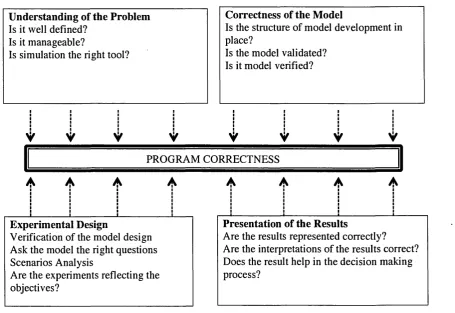
Figure 2.6-1 examines the key factors affecting the correctness o f a simulation m odel, there by influencing the success o f a simulation project.
C h a p t e r 2 L ite ra tu r e R e v i e w
U nderstanding o f the Problem C orrectness o f th e M odel
Is it well defined? Is the structure o f model development in
Is it manageable? place?
Is simulation the right tool? Is the model validated? Is it model verified?
i l l I
i l l i
i l l i
I I I 1
i l l l
y
y
y
y
i l l l
i l l l
i l l l
1 1 l 1
l l l l
y
y
y
y
PROGRAM CORRECTNESS
E xperim ental D esign
Verification o f the model design Ask the model the right questions Scenarios Analysis
Are the experiments reflecting the objectives?
P resentation o f the R esults
[image:38.613.73.529.79.392.2]Are the results represented correctly? Are the interpretations o f the results correct? Does the result help in the decision making process?
Figure 2.6-1: Factors affecting the correctness o f a simulation model
Essentially if simulation as a tool fails to contribute to making the right decision to the process owner or the responsible personnel, it may be deemed as a failure. Due to the ad-hoc nature o f simulation projects, and depending on the size or the project, amount o f time spent and costs, the project could collapse and the damage done can be irreparable. Murphy
C h a p t e r 2 L i t e r a t u r e R e v i e w
2.63
The importance of creating a framework for integration of simulation
Discrete event simulation (DES) has evolved over a few decades now and is moving into a
mature state in which standardisation is a relevant part (Banks et al., 2003). A considerable amount of time will be utilised to accomplish various stages o f the simulation modelling process like data collection, model building and so on. Not so often, the developers or the people responsible will be concentrating on physical or organisational structure they have put together in accomplishing the project.
In large organisations, a structural framework is necessary to ensure that the project accomplishes all its objectives in an orderly fashion. N ow , here com es a question; Most o f the time simulation models are used as a problem-solving tool rather than a day-to-day development tool. So, why is there such a huge need o f structure in place to ensure that the project goes smoothly? The answer to this question depends entirely on how much success you want to achieve from this exercise. If you were purely looking for an answer to a
problem, then as the owner o f the process, you wouldn’t be too bothered with calculating your success on anything more than from finding the answers to the particular problem. However, a more business oriented and structured approach to project management can help achieve better results. Murphy and Perera (2001) explained the best practises of integrating simulation in US companies in four stages:
• Introducing Simulation • Establishing Simulation • Practising Simulation • Developing Simulation
C h a p t e r 2 L i t e r a t u r e R e v i e w
M urphy and Perera (2001) also em phasises the “people d im en sio n ”, “technological
d im en sio n ” and the “organisational d im en sio n ” when designing a fram ew ork fo r better
understanding on the possible challenges related to em bedding sim ulation in an
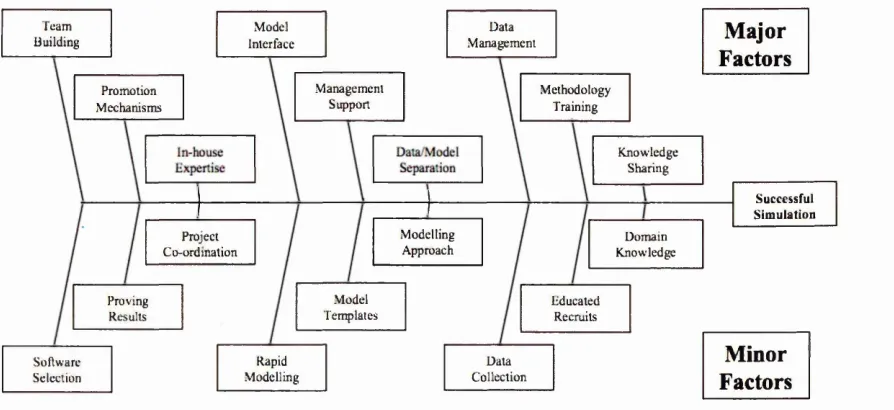
organisation. They identified the success factors in building a successful sim ulation project.
M anagement Support
S u ccessfu l Sim u la tio n Promotion
M echanism s
Project Co-ordination Proving Results M odel Interface Software Selection Data C ollection Rapid M odelling M odelling Approach Data M anagement Team Building educated Recruits M ethod ology
Training
M odel Templates
K now ledge Sharing
Dom ain K now ledge
Major
Factors
Minor
Factors
Figure 2.6-2 M ajor and m inor factors influencing successful sim ulation (source: Key
enablers in the developm ent of sim ulation, Proceedings o f the W inter Sim ulation
C onference, M urphy & Perera, 2001)
Furtherm ore groups distributed throughout a com pany, or across continents m ay develop
sim ulation m odels. Model analysis m ay be the purview of an entirely separate group, or
groups. And the model users may represent yet another diverse collective. C learly, each of
these uses and developm ent paths has unique criteria that determ ine the credibility o f the
sim ulation. Thus m ethods to apply parallelism m ust be reconciled with a given approach
[image:40.614.64.511.191.396.2]C h a p t e r 2 L i t e r a t u r e R e v i e w
2.6.4
Challenges in implementing simulation
A simulation model is not a good representation o f reality if whatever drives the underlying system is not properly represented. Successful simulation projects in business are those, which are implemented, generate measurable results, and impact positively the organisation's financial picture. To achieve these goals, simulation professionals must put as much emphasis and work in finding the best way to reach the future state as they already
put on defining it.
Vidal (2002) suggests that the main reason for needing an implementation management tool is that organisations undergoing process improvement (supported by a simulation project) can reach the to-be follow ing multiple paths, some o f which will lead to success and others to failure, and that the choice o f one such path must depend on the analysis o f the current situation of the business and the impact of internal and external factors over time. Yucesan et al., (2002) also argues that the job gets more difficult in the case o f larger organisations, as they require powerful direction tools that go beyond typical assessment and interpretation techniques.
Vidal (2002) argues that developers should look into the Complete Simulation Project scope rather than just concentrating on the traditional way o f just designing and achieving the deliverables set out by running the experiments in the model. Vidal (2002) also
suggests once a current state model is designed, that this future state model should act as the blueprint for the successful implementation a new system.
C h a p t e r 2 L i t e r a t u r e R e v i e w
2.7
Summary
The aim of this chapter was to review the available literature to identify som e of the m ost
popular business process tools and techniques and look into how they are currently being
integrated in organisations. This chapter began with an introduction to business process
techniques and tools. The m ost com m only used business process tools and techniques were
chosen and exam ples of integration o f these techniques were further explored in detail. T he
literature review also outlined the current practice o f using sim ulation largely as a
tem porary tool on ad-hoc basis and the need of integrating sim ulation to reap the m ost
benefits out of this tool. The chapter further explores the need to em bed sim ulation in
business processes and som e of the generic factors affecting the im plem entation of
business process tools and techniques.
This chapter em phasised the need for setting clear objectives and deliverables when
executing a sim ulation project. The im portance of creating a fram ew ork for integrating
sim ulation and the various challenges associate with it has been explored in detail.
The literature survey further referred to some valuable studies conducted in the past and
experiences shared by authors on some o f the m ajor and m inor factors that needed to be
addressed and looked upon when im plem enting a fram ew ork for sim ulation integration.
In continuation to this chapter, the follow ing chapter looks at two case studies o f success
stories in im plem enting sim ulation technologies in business processes in detail.
A dditionally, one case study also looks into successful business process im plem entations in
C h a p t e r 2 L i t e r a t u r e R ev i
C h a p t e r 3 C a s e S tu d y
3 Case Study
3.1
Manufacturing process modelling of Boeing 747 moving line concepts
3.1.1
Introduction
A s part o f their Business Process Re-Engineering plans, Boeing decided to streamline their final Assem bly line by introducing a Flow Line system . The goal o f the project was to complete the final assembly stages o f the 747 manufacturing process while the Aircraft is on a continuous moving line. During the first two years, the moving line will achieve four major m ilestones, the first o f which was completed on December 10, 2001 when the plane moved for the final 64 feet o f assembly. At the conclusion o f the project the 747 will be on a moving line from the time o f final body join (the joining o f the three major sections o f the plane) until the plane exits the factory.
3.1.2
Flow line concept
The moving assembly line is considered Henry Ford’s greatest contribution to manufacturing, (Lau and Sundaram, 2002). Since Henry Ford first created the model T , in 1914, the benefits o f moving assembly line have gradually created the awareness in mass production companies and many have gradually started to follow the concept.
Over the years, many companies adopted this Flow Line concept across the globe. A Lean
C h a p t e r 3 C a s e S tu d y
w orth pointing out that m any additions were m ade to this concept as it evolved through the
past decades.
3.1.3 Integration o f sim ulation objectives and direction
A ccording to B oeing, the gaining popularity o f D iscrete Event Sim ulation in the airline
industry prom pted them to im plem ent sim ulation m odelling as a key tool to help with Line
balancing. The idea was to analyse the effect of m oving the aircraft through the line on
head counts and shift patterns. M ultiple scenarios were m odelled for each situation to
provide the flow line team with various situations to analyse and plan proactively. All
processes are defined and docum ented by the responsible process owners and stored in a
repository m aintained by the Process M anagem ent Integration group that m anages the
“Integrate and D eploy Processes and P rocedures” process. This group m aintains a
com plete picture of all the processes within Boeing.
3.1.4 C reating a project team for simulation
A process ow ner was not always the m anager. The owners of som e low er-level or
technical processes were “Subject M atter E xp e rts”. The ow ner is fam iliar with the
w orking of the process and is responsible for the planning, m odelling, m easurem ent, and
im provem ent of the process if it is determ ined that the process was to progress to the
m easurem ent step. The process ow ner m ost often worked with a team of individuals to
m odel, m easure, and im prove the process. The process ow ner was responsible fo r ensuring
that the process adheres to all requirem ents and that the output meets the quality agreed to
with the process.
C h a p t e r 3 C a s e S t u d y
3.1.5
Justifying and promoting the use of simulation
Before producing a simulation m odel, the team at Boeing had to justify the need for using simulation tools to their management. Hence, before starting the model creation, the team put together the objectives and the overall benefits o f the project were determined. One o f the key objectives was to conduct scenarios analysis.
The team at Boeing were well aware of the benefits o f using Simulation T ools. They called
this method “Virtual P ro to typ in g”, a concept developed at the University o f Michigan in
early 1990s, which uses computer programs to create design iterations for prototype without the need to build a physical model. The key objectives from the project and the supposed benefits from using a simulation model matched and the project got the go ahead. The benefits from modelling were served as the modelling objectives throughout the modelling course.
The benefits o f the projects were outlined as the following:
• Providing multiple scenario analysis to aid decision making process • Minimising material flow
• Minimising flow times • M inimise resource costs • M aximise efficiency
3.1.6
Summary
C h a p t e r 3 C a s e S tu d y
test stations. This task did not seem to be feasible initially as there were too many tasks being completed in the test bed; it was practically impossible to m ove the stations around. But, having done further work analysis using the simulation model, the team realised that
most o f the work could be separated from the gear and could be done in the moving line. This simplified the list o f tasks to a point were they could comfortably m ove around the stations, to have a better flow line in the Assem bly.
Additional Line balancing ideas and techniques were further tested and analysed using the simulation model. This work initiated the realisation o f the usefulness o f discrete event simulation modelling and the benefits to optimising manufacturing processes on the 747 final assembly floors. The project has given Boeing great confidence in the use o f simulation modelling as a direct support tool in an intense manufacturing/production environment. A s the moving line continues to improve in the future, so will the simulation modelling practices. Findings o f this simulation work are just the tip o f the iceberg (B oeing, 2002).
Lau (2002), an Associate Technical Fellow in Simulation states that they didn’t use any
particular recipe to embed simulation into their culture. “It took a lot o f educational communications and m eetings. We have several internal teams and we use outside talents
also."
It has to be emphasised here that simulation was only used initially to analyse line
balancing. However, the success from the initial project, was then used as the driving force to spur the use Simulation techniques across the Boeing manufacturing line. A dedicated
C h a p t e r 3 C a s e S tu d y
team o f Process Simulation Engineers were set up internally within the Commercial Airplane Manufacturing Research and Developm ent department within B oeing. The team was created from a group o f manufacturing engineers within the organisation itself, which
C h a p t e r 3 C a s e S tu d y
3 .2
Application Of Business Process Simulation and Lean Techniques In
British Telecommunications PLC.
3.2.1 Introduction
Im proving Business Processes is param ount for businesses to stay com petitive in to d a y ’s
m arket place. The level of com petency has increased over the past 3 or 4 decades, as
custom ers now have the choice of m anufacturers or products to choose from . C om panies
are now forced to im prove their business processes to keep on track with the ever-changing
custom er dem ands. O rganisations have gone into two different routes to achieve this aim .
One of the main routes is introducing the concept of Business Process R e-Engineering
within the businesses. Business process reengineering (BPR) is the m ain way in which
organisations becom e m ore efficient and m odernise. BPR transform s an organisation in
ways that directly affect perform ance (C arter, 2005). In the extrem e, R e-engineering
assum es that the current processes is irrelevant, and hence, start over.
T he second m ethod is to follow the route of Business Process Im provem ent, w hich relies
on a different school o f thought than BPR. The purpose of B usiness Process Im provem ent
is to look at the current processes within the system with the help of a series of tools and
methods and analyse different ways to im prove them . Once the current system is analysed
using the data collated from the existing system , im provem ents will be suggested with the
help of the process im provem ent tools. Data will be collected and m easured from the new
C h a p t e r 3 C a s e S tu d y
system . This loop repeats all over again and it is called Continuous Improvement. (Prosci,
2002).
British Telecommunications PLC (BT) faces increasing competitive pressure triggered by the continuing globalisation and development o f new technologies in the telecommunications sector. This has lead to a need to minimise inefficiencies and waste while at the same time maximising the flexibility and speed o f processes and systems to deliver new services to customers. In order to meet this challenge a variety o f business process modelling techniques has been used to identify strategies for improvement. Am ong
them were Value Stream Analyses (V SA ) and Simulation.
3.2.2
Evolution of business process techniques
The Operational Design Group, part o f B T ’s Advanced Communications Technology Centre, has for some years been designing processes and support systems for use in the operational side o f the company. Over the past few years they have began to implement
many techniques including Operations Management, Lean techniques, Process Mapping and Discrete Event Simulation. The Group works on projects throughout the BT Organisation acting as internal consultants. They are involved in a number o f research
C h a p t e r 3 C a s e S tu d y
3.2.3
Simulation as part of business transformation
The operations group included Simulation as part o f a large program put in place to transform the way BT Customer Service operates. The project had a number o f streams all
targeting the efficiency and cost reduction throughout the business. Initially, simulation was used as a tool along side with VSM to test the Business Improvement initiatives set out by the programme team. Using the m odel, the team was able to predict the effects o f the proposed solutions would have on such things like resourcing, quality o f service, costs and overall efficiency. Soon, the limitations o f using a VSM became evident to the team. VSM is largely known to be a “pen cil and p a p e r” based model. It is often created by physically walking down the shop floor and drawing a layout o f the office or factory and mapping the processes. In short, it’s very one-dimensional.
Using simulation, the team were able to represent both the processes and the links