inorganic papers
Acta Cryst.(2006). E62, i55–i57 doi:10.1107/S1600536806005320 Demchenkoet al. Dy
2AlGe2
i55
Acta Crystallographica Section EStructure Reports
Online
ISSN 1600-5368
Dy
2AlGe
2Grigorii Demchenko,aJoanna Kon´czyk,bPavlo Demchenko,a*
Volodymyr Kuprysyukaand
Roman Gladyshevskiia
aDepartment of Inorganic Chemistry, Ivan
Franko National University of Lviv, Kyryla i Mefodiya St. 6, 79005 Lviv, Ukraine, and
bInstitute of Chemistry and Environment
Protection, Jan Dlugosz University, al. Armii Krajowej 13/15, 42-200 Czestochowa, Poland
Correspondence e-mail: [email protected]
Key indicators
Single-crystal X-ray study
T= 295 K
Mean(Ge–Ge) = 0.003 A˚
Rfactor = 0.042
wRfactor = 0.082
Data-to-parameter ratio = 20.7
For details of how these key indicators were automatically derived from the article, see http://journals.iucr.org/e.
Received 8 February 2006 Accepted 14 February 2006
#2006 International Union of Crystallography
All rights reserved
Single crystals of didysprosium aluminium digermanide were synthesized from the corresponding elements by arc-melting in the presence of Ni. The new intermetallic compound crystallizes in the space group P4/mbm and adopts the Mo2FeB2 structure type, with all three crystallographically
unique atoms in special positions of site symmetriesm.2m(Dy and Ge) and 4/m.. (Al). The coordination polyhedra around the metal atoms are distorted pentagonal (Dy), tetragonal (Al) and trigonal (Ge) prisms with 7, 4 and 3 additional capping atoms, respectively.
Comment
Ternary intermetallics of rare-earth metals with formulae
RE2T2XandRE2X02X(whereREis a rare earth metal,Tis a
transition metal, and X and X0 are p-block elements)
crys-tallize mostly in two structure types, viz. the orthorhombic (space group Immm) W2CoB2type (Rieger et al., 1966) and
the tetragonal (space groupP4/mbm) Mo2FeB2type (Rieger
et al., 1964), the latter being a ternary ordered variant of the U3Si2type (Zachariasen, 1949). The distorted derivative of the
U3Si2type with unit-cell doubling along thecaxis is the Zr3Al2
structure type (space group P42/mnm) (Wilson & Spooner,
1960). The ternary ordered variants of the Zr3Al2type are the
U2Pt2Sn (Gravereauet al., 1994) and the Er2Au2Sn structure
types (Po¨ttgen, 1994). An extensive review dealing with intermetallic compounds with ordered U3Si2 or Zr3Al2-type
structures was published recently by Lukachuk & Po¨ttgen (2003). It should be noted that there are no aluminium germanidesRE2AlGe2of the Mo2FeB2type, while aluminium
silicidesRE2AlSi2andRE2Al2Si, as well as indium germanides
RE2InGe2, exist. However, Choeet al.(2002) found another
mode of atomic distribution for aluminium germanides that is realised in the new monoclinic structure type Gd2AlGe2.
Quite recently, Rodewaldet al.(2006) reported a new super-structure of the Mo2FeB2type,viz. a tetragonal phase (space
groupP4/m) with composition Er2.30Ni1.84In0.70.
The RE2T2X and RE2X02X phases have received special
attention for their outstanding physical properties. A precise determination of the crystal structure for phases of these compositions is a basic requirement for the better under-standing of their physical properties. During systematic investigation of the Dy–Al–Ge system (Kuprysyuk, 2005), it was established that the compound Dy2AlGe2forms neither as
a cast alloy nor when annealed at 873 K. The alloy with nominal composition Dy40Al20Ge40 was found to consist of
three different phases, namely of DyAlGe, Dy2AlGe3 and
Dy5Ge3. The new compound, namely Dy2AlGe2, was obtained
Ni—Al—Ge, and we present here the results of a single-crystal structure study.
Dy2AlGe2adopts the Mo2FeB2structure type (Riegeret al.,
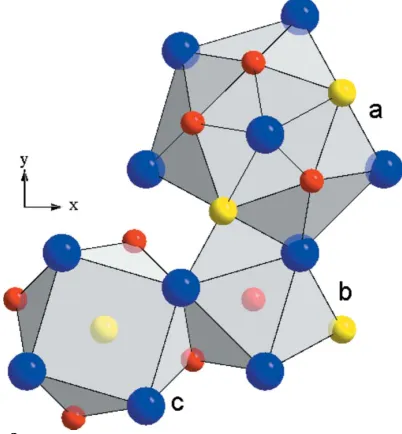
1964). A clinographic projection of the unit cell is shown in Fig. 1. The coordination sphere around Dy (site symmetry
m.2m) consists of 17 atoms, if bonding interactions are considered for distances < 4.3 A˚ , resulting in a distorted pentagonal prism with seven additional capping atoms, [DyGe6Al4Dy7] (Fig. 2a). The bases of the prism have the
composition [Ge3Al2] and five additional Dy atoms cap the
faces of the prism, while two other Dy atoms cap the bases of the prism at a distance of 4.291 (3) A˚ . The coordination polyhedron for Ge (site symmetrym.2m; bonding interactions < 3.1 A˚ ) is a deformed (ratio height/width = 1.17)
triaug-mented trigonal prism [GeGeAl2Dy6] with two [Dy3] bases
and two Al and one Ge as capping atoms (Fig. 2b). The Al atom (site symmetry 4/m..; bonding interactions < 3.4 A˚ ) centres a tetragonal prism [AlGe4Dy8] with two [Dy4] bases
and four additional Ge as capping atoms (Fig. 2c). The structure of Dy2AlGe2adopts class #10 (coordination number
6 +nfor the smallest atom (n= 0–5), a trigonal prism and its derivatives as coordination polyhedron) according to the classification scheme of Krypyakevich (1977).
Dy2AlGe2belongs to the family of two-layer structures, like
more than 70 other inorganic structure types that are listed in the structure type compilation TYPIX (Parthe´ et al., 1993– 1994). The first layer atz= 0 consists of a pentagonal network [Ge2Al], and the second layer at z = 0.5 consists of a 43
2
43 network of Dy atoms (Fig. 3). The structure of Dy2AlGe2can
alternatively be described as an intergrowth of distorted CsCl and AlB2-related slabs of compositions DyAl and DyGe2,
respectively. However, slabs with exactly the same composi-tions and the same structures do not exist as binary phases.
The interatomic distances (Table 1) are in good agreement with the sums of the atomic radii (Emsley, 1991). The shortest distance with the highest deviation (96.5% of the sum of the atomic radii) is observed between Dy and Ge atoms, with a Dy—Ge distance of 2.896 (2) A˚ , which indicates partial covalent bonding.
Experimental
The single crystal used in this work was extracted from a cast alloy of nominal composition Dy25Ni25Al30Ge20, which was prepared by arc
inorganic papers
i56
Demchenkoet al. Dy [image:2.610.314.562.73.332.2]2AlGe2 Acta Cryst.(2006). E62, i55–i57
Figure 1
A clinographic projection of the Dy2AlGe2unit cell, with displacement
[image:2.610.58.271.76.268.2]ellipsoids drawn at the 95% probability level.
Figure 2
The coordination polyhedra around (a) the Dy atom, (b) the Ge atom and (c) the Al atoms. Key: Dy atoms are blue, Ge atoms are red and Al atoms are yellow.
Figure 3
The networks in the structure of Dy2AlGe2. The solid lines show the
pentagonal [Ge2Al] network atz= 0 and the dashed lines show the 43243
[image:2.610.68.269.315.532.2]melting of the elements (purity for Ni, Al and Ge better than 99.9%, and 99.84% for Dy) in an electric arc furnace with a water-cooled copper bottom under an Ar atmosphere (Ti-getter). A preliminary crystal investigation was performed using Laue and rotation methods
(RKV-86 and RGNS-2 chambers, MoKradiation). The chemical
composition of the crystal was determined with an energy-dispersive X-ray spectrometer PV9800 using a standardless procedure. The results of the energy dispersive X-ray (EDX) analysis (in atomic %) are: Dy 39.06, Ni 0.39, Al 26.10, Ge 34.45, with a precision of 2%. These values are close to the composition obtained from the struc-tural refinement. No other impurities were found. According to the EDX spectra, the investigated single crystal contains a very small amount of Ni, close to the detection limit. We performed an X-ray powder analysis (‘DRON-4.13’ powder diffractometer) of the sample with nominal composition Dy40Ni6Ge34Al20, prepared as a cast alloy
and as an alloy annealed at 873 K. However, the phase Dy2AlGe2was
not detected. Therefore, we assume that the title compound forms only as single crystals, stabilized by very small amounts of Ni, or exists in a narrow temperature region.
Crystal data
Dy2AlGe2
Mr= 497.16
Tetragonal,P4=mbm a= 7.019 (3) A˚
c= 4.291 (3) A˚
V= 211.4 (2) A˚3
Z= 2
Dx= 7.809 Mg m3
MoKradiation Cell parameters from 706
reflections
= 4.8–33.2 = 48.99 mm1
T= 295 (2) K
Elongated prism, metallic light grey 0.130.050.03 mm
Data collection
Oxford Diffraction Xcalibur3 CCD diffractometer
!scans
Absorption correction: analytical (CrysAlis RED; Oxford Diffraction, 2005)
Tmin= 0.057,Tmax= 0.292
1833 measured reflections
248 independent reflections 238 reflections withI> 2(I)
Rint= 0.071 max= 33.2
h=10!10
k=10!9
l=6!3
Refinement
Refinement onF2
R[F2> 2(F2)] = 0.042
wR(F2) = 0.082
S= 1.31 248 reflections 12 parameters
w= 1/[2(F
o2) + (0.0073P)2
+ 11.6525P]
whereP= (Fo2+ 2Fc2)/3
(/)max< 0.001 max= 2.20 e A˚3 min=3.04 e A˚3
Extinction correction:SHELXL97
Extinction coefficient: 0.0029 (8)
Table 1
Selected bond lengths (A˚ ).
Dy—Gei 2.896 (2) Dy—Geii 3.0460 (16) Dy—Aliii 3.3605 (14) Dy—Dyiv 3.507 (2) Dy—Dyv 3.6578 (18) Ge—Gevi 2.531 (4) Ge—Alvii 2.7638 (16)
Symmetry codes: (i) xþ1;yþ1;zþ1; (ii) x1 2;yþ
1
2;z; (iii)
xþ1 2;yþ
1
2;zþ1; (iv) x;yþ1;zþ1; (v) xþ 1 2;yþ
1 2;z; (vi)
xþ1;y;z; (vii)xþ1;y;z.
Analysis of the systematic absences using the programABSEN
(McArdle, 1996) led to the extinction symbolP-b- and possible space groupsP4b2,P4bmand centrosymmetricP4/mbm. A statistical test
of the distribution of theEvalues, using the programE-STATSfrom theWinGXsystem (Farrugia, 1999), suggested that the structure is centrosymmetric with a probability of 70%. Taking into account some notes on choosing a centre of symmetry (Marsh, 1995), the structure solution and refinement were also performed in the non-centrosym-metric space groupsP4b2 andP4bm, and in space groupsP4/m(as a model of the Er2.30Ni1.84In0.70structure type),P42/mnm(as a model of
the ordered Zr3Al2structure type) andPbam(as a subgroup ofP4/
mbm). The structure refinement of Dy2AlGe2clearly indicates that
this phase crystallizes in the centrosymmetric space groupP4/mbm, since solution and refinements in the other space groups were less satisfactory and resulted in higherRfactors and atomic displacement parameters. Attempts to refine some variants of statistical atomic distribution in order to adjust the composition determined from EDX spectra, including incorporation of Ni, failed. The atomic coordinates
were standardized using the programSTRUCTURE_TIDY(Gelato
& Parthe´, 1987). The highest maximum residual electron density is 0.84 A˚ from Al and the deepest hole is 1.99 A˚ from Ge.
Data collection: CrysAlis CCD (Oxford Diffraction, 2004); cell
refinement:CrysAlis CCD; data reduction:CrysAlis RED (Oxford
Diffraction, 2005); program(s) used to solve structure:SHELXS97
(Sheldrick, 1997); program(s) used to refine structure:SHELXL97
(Sheldrick, 1997); molecular graphics: DIAMOND (Brandenburg,
1999); software used to prepare material for publication:
SHELXL97.
The authors are indebted to K. Nierzewski for performing the EDX analysis.
References
Brandenburg, K. (1999). DIAMOND. Version 2.1e. Crystal Impact GbR, Bonn, Germany.
Choe, W., McWhorter, S. & Miller, G. J. (2002).Z. Anorg. Allg. Chem.628, 1575–1580.
Emsley, J. (1991).The Elements, 2nd ed. Oxford: Clarendon Press. Farrugia, L. J. (1999).J. Appl. Cryst.32, 837–838.
Gelato, L. M. & Parthe´, E. (1987).J. Appl. Cryst.20, 139–143.
Gravereau, P., Mirambet, F., Chevalier, B., Weill, F., Fourne`s, L., Laffargue, D., Bourre´e, F. & Etourneau, J. (1994).J. Mater. Chem.4, 1893–1895. Krypyakevich, P. I. (1977). Structure Types of Intermetallic Compounds.
Moscow: Nauka. (In Russian.)
Kuprysyuk, V. (2005). PhD thesis, Maria Curie-Sklodowska University, Lublin, Poland.
Lukachuk, M. & Po¨ttgen, R. (2003).Z. Kristallogr.218, 767–787. Marsh, R. E. (1995).Acta Cryst.B51, 897–907.
McArdle, P. (1996).J. Appl. Cryst.29, 306.
Oxford Diffraction (2004).CrysAlis CCD. Version 1.170. Oxford Diffraction Ltd, Abingdon, Oxfordshire, England.
Oxford Diffraction (2005).CrysAlis RED. Version 1.171. Oxford Diffraction Ltd, Abingdon, Oxfordshire, England.
Parthe´, E., Gelato, L., Chabot, B., Penzo, M., Cenzual, K. & Gladyshevskii, R. (1993-1994).TYPIX-Standardized Data and Crystal Chemical Character-ization of Inorganic Structure Types, inGmelin Handbook of Inorganic and Organometallic Chemistry. Heidelberg, Berlin: Springer.
Po¨ttgen, R. (1994).Z. Naturforsch. Teil B,49, 1309–1313.
Rieger, W., Nowotny, H. & Benesovsky, F. (1964).Monatsh. Chem.95, 1502– 1503.
Rieger, W., Nowotny, H. & Benesovsky F. (1966).Monatsh. Chem.97, 378–382. Rodewald, U. C., Lukachuk, M., Heying, B. & Po¨ttgen, R. (2006).Monatsh.
Chem.137, 7–13.
Sheldrick, G. M. (1997). SHELXS97 and SHELXL97. University of Go¨ttingen, Germany.
Wilson, C. G. & Spooner, F. J. (1960).Acta Cryst.13, 358–359. Zachariasen, W. H. (1949).Acta Cryst.2, 94–99.
inorganic papers
Acta Cryst.(2006). E62, i55–i57 Demchenkoet al. Dy
supporting information
sup-1
Acta Cryst. (2006). E62, i55–i57
supporting information
Acta Cryst. (2006). E62, i55–i57 [https://doi.org/10.1107/S1600536806005320]
Dy
2AlGe
2Grigorii Demchenko, Joanna Ko
ń
czyk, Pavlo Demchenko, Volodymyr Kuprysyuk and Roman
Gladyshevskii
Aluminium digermanium didysprosium
Crystal data
Dy2AlGe2
Mr = 497.16 Tetragonal, P4/mbm
Hall symbol: -P 4 2ab
a = 7.019 (3) Å
c = 4.291 (3) Å
V = 211.4 (2) Å3
Z = 2
F(000) = 418
Dx = 7.809 Mg m−3
Mo Kα radiation, λ = 0.71073 Å Cell parameters from 706 reflections
θ = 4.8–33.2°
µ = 48.99 mm−1
T = 295 K
Elongated prism, metallic light grey 0.13 × 0.05 × 0.03 mm
Data collection
Oxford Diffraction Xcalibur3 CCD diffractometer
Radiation source: fine-focus sealed tube Graphite monochromator
ω scans
Absorption correction: analytical
(CrysAlis RED; Oxford Diffraction, 2005)
Tmin = 0.057, Tmax = 0.292
1833 measured reflections 248 independent reflections 238 reflections with I > 2σ(I)
Rint = 0.071
θmax = 33.2°, θmin = 4.8°
h = −10→10
k = −10→9
l = −6→3
Refinement
Refinement on F2 Least-squares matrix: full
R[F2 > 2σ(F2)] = 0.042
wR(F2) = 0.082
S = 1.31 248 reflections 12 parameters 0 restraints
Primary atom site location: structure-invariant direct methods
Secondary atom site location: difference Fourier map
w = 1/[σ2(F
o2) + (0.0073P)2 + 11.6525P] where P = (Fo2 + 2Fc2)/3
(Δ/σ)max < 0.001 Δρmax = 2.20 e Å−3 Δρmin = −3.04 e Å−3
Extinction correction: SHELXL97, Fc*=kFc[1+0.001xFc2λ3/sin(2θ)]-1/4 Extinction coefficient: 0.0029 (8)
Special details
supporting information
sup-2
Acta Cryst. (2006). E62, i55–i57
Refinement. Refinement of F2 against ALL reflections. The weighted R-factor wR and goodness of fit S are based on F2, conventional R-factors R are based on F, with F set to zero for negative F2. The threshold expression of F2 > σ(F2) is used only for calculating R-factors(gt) etc. and is not relevant to the choice of reflections for refinement. R-factors based on F2 are statistically about twice as large as those based on F, and R- factors based on ALL data will be even larger.
Fractional atomic coordinates and isotropic or equivalent isotropic displacement parameters (Å2)
x y z Uiso*/Ueq
Dy 0.17662 (8) 0.67662 (8) 0.5000 0.0102 (3)
Ge 0.6275 (2) 0.1275 (2) 0.0000 0.0123 (4)
Al 0.0000 0.0000 0.0000 0.0098 (13)
Atomic displacement parameters (Å2)
U11 U22 U33 U12 U13 U23
Dy 0.0104 (3) 0.0104 (3) 0.0099 (4) −0.0015 (3) 0.000 0.000 Ge 0.0124 (6) 0.0124 (6) 0.0121 (7) −0.0015 (7) 0.000 0.000
Al 0.010 (2) 0.010 (2) 0.010 (3) 0.000 0.000 0.000
Geometric parameters (Å, º)
Dy—Gei 2.896 (2) Ge—Dyi 2.896 (2)
Dy—Geii 2.896 (2) Ge—Dyii 2.896 (2)
Dy—Geiii 3.0460 (16) Ge—Dyix 3.0460 (16)
Dy—Geiv 3.0460 (16) Ge—Dyxvii 3.0460 (16)
Dy—Gev 3.0460 (16) Ge—Dyvii 3.0460 (16)
Dy—Gevi 3.0460 (16) Ge—Dyxiii 3.0460 (16)
Dy—Alvii 3.3605 (14) Al—Gexiii 2.7638 (16)
Dy—Alviii 3.3605 (14) Al—Geiii 2.7638 (16)
Dy—Alix 3.3605 (14) Al—Gexv 2.7638 (16)
Dy—Alx 3.3605 (14) Al—Gexviii 2.7638 (16)
Dy—Dyxi 3.507 (2) Al—Dyxiii 3.3605 (14)
Dy—Dyiv 3.6578 (18) Al—Dyiii 3.3605 (14)
Dy—Dyxii 3.6578 (18) Al—Dyxix 3.3605 (14)
Dy—Dyxiii 3.6578 (18) Al—Dyxi 3.3605 (14)
Dy—Dyxiv 3.6578 (18) Al—Dyxvii 3.3605 (14)
Ge—Gexv 2.531 (4) Al—Dyvi 3.3605 (14)
Ge—Alxvi 2.7638 (16) Al—Dyxx 3.3605 (14)
Ge—Alix 2.7638 (16) Al—Dyxxi 3.3605 (14)
Gei—Dy—Geii 95.62 (8) Dyxiii—Dy—Dyxiv 122.72 (4) Gei—Dy—Geiii 155.29 (3) Gexv—Ge—Alxvi 116.11 (4) Geii—Dy—Geiii 82.23 (5) Gexv—Ge—Alix 116.11 (4) Gei—Dy—Geiv 155.29 (3) Alxvi—Ge—Alix 127.78 (8)
Geii—Dy—Geiv 82.23 (5) Gexv—Ge—Dyi 132.19 (4)
Geiii—Dy—Geiv 49.09 (7) Alxvi—Ge—Dyi 72.81 (4)
Gei—Dy—Gev 82.23 (5) Alix—Ge—Dyi 72.81 (4)
supporting information
sup-3
Acta Cryst. (2006). E62, i55–i57
Geiii—Dy—Gev 109.72 (5) Alxvi—Ge—Dyii 72.81 (4)
Geiv—Dy—Gev 89.56 (6) Alix—Ge—Dyii 72.81 (4)
Gei—Dy—Gevi 82.23 (5) Dyi—Ge—Dyii 95.62 (8)
Geii—Dy—Gevi 155.29 (3) Gexv—Ge—Dyix 65.46 (4) Geiii—Dy—Gevi 89.56 (6) Alxvi—Ge—Dyix 70.487 (15) Geiv—Dy—Gevi 109.72 (5) Alix—Ge—Dyix 134.40 (3)
Gev—Dy—Gevi 49.09 (7) Dyi—Ge—Dyix 143.21 (4)
Gei—Dy—Alvii 51.79 (2) Dyii—Ge—Dyix 75.94 (4)
Geii—Dy—Alvii 109.11 (4) Gexv—Ge—Dyxvii 65.46 (4) Geiii—Dy—Alvii 105.53 (5) Alxvi—Ge—Dyxvii 134.40 (3) Geiv—Dy—Alvii 151.79 (4) Alix—Ge—Dyxvii 70.487 (15) Gev—Dy—Alvii 88.96 (5) Dyi—Ge—Dyxvii 143.21 (4) Gevi—Dy—Alvii 50.82 (3) Dyii—Ge—Dyxvii 75.94 (4) Gei—Dy—Alviii 51.79 (2) Dyix—Ge—Dyxvii 70.28 (5) Geii—Dy—Alviii 109.11 (4) Gexv—Ge—Dyvii 65.46 (4) Geiii—Dy—Alviii 151.79 (4) Alxvi—Ge—Dyvii 70.487 (15) Geiv—Dy—Alviii 105.53 (5) Alix—Ge—Dyvii 134.40 (3) Gev—Dy—Alviii 50.82 (3) Dyi—Ge—Dyvii 75.94 (4) Gevi—Dy—Alviii 88.96 (5) Dyii—Ge—Dyvii 143.21 (4) Alvii—Dy—Alviii 95.21 (4) Dyix—Ge—Dyvii 89.56 (6) Gei—Dy—Alix 109.11 (4) Dyxvii—Ge—Dyvii 130.91 (7) Geii—Dy—Alix 51.79 (2) Gexv—Ge—Dyxiii 65.46 (4) Geiii—Dy—Alix 50.82 (3) Alxvi—Ge—Dyxiii 134.40 (3) Geiv—Dy—Alix 88.96 (5) Alix—Ge—Dyxiii 70.487 (15) Gev—Dy—Alix 151.79 (4) Dyi—Ge—Dyxiii 75.94 (4) Gevi—Dy—Alix 105.53 (5) Dyii—Ge—Dyxiii 143.21 (4) Alvii—Dy—Alix 79.35 (5) Dyix—Ge—Dyxiii 130.91 (7) Alviii—Dy—Alix 154.96 (3) Dyxvii—Ge—Dyxiii 89.56 (6) Gei—Dy—Alx 109.11 (4) Dyvii—Ge—Dyxiii 70.28 (5) Geii—Dy—Alx 51.79 (2) Gexiii—Al—Geiii 180.00 (8)
Geiii—Dy—Alx 88.96 (5) Gexiii—Al—Gexv 90.0
Geiv—Dy—Alx 50.82 (3) Geiii—Al—Gexv 90.0
Gev—Dy—Alx 105.53 (5) Gexiii—Al—Gexviii 90.0 Gevi—Dy—Alx 151.79 (4) Geiii—Al—Gexviii 90.0 Alvii—Dy—Alx 154.96 (3) Gexv—Al—Gexviii 180.00 (4) Alviii—Dy—Alx 79.35 (5) Gexiii—Al—Dyxiii 124.59 (3) Alix—Dy—Alx 95.21 (4) Geiii—Al—Dyxiii 55.41 (3) Gei—Dy—Dyxi 132.19 (4) Gexv—Al—Dyxiii 58.69 (3) Geii—Dy—Dyxi 132.19 (4) Gexviii—Al—Dyxiii 121.31 (3) Geiii—Dy—Dyxi 54.86 (2) Gexiii—Al—Dyiii 55.41 (3) Geiv—Dy—Dyxi 54.86 (2) Geiii—Al—Dyiii 124.59 (3)
Gev—Dy—Dyxi 54.86 (2) Gexv—Al—Dyiii 121.31 (3)
supporting information
sup-4
Acta Cryst. (2006). E62, i55–i57
Geii—Dy—Dyiv 53.88 (4) Dyxiii—Al—Dyxix 114.06 (3) Geiii—Dy—Dyiv 134.77 (3) Dyiii—Al—Dyxix 65.94 (3) Geiv—Dy—Dyiv 107.82 (3) Gexiii—Al—Dyxi 121.31 (3) Gev—Dy—Dyiv 107.82 (3) Geiii—Al—Dyxi 58.69 (3) Gevi—Dy—Dyiv 134.77 (3) Gexv—Al—Dyxi 124.59 (3) Alvii—Dy—Dyiv 99.42 (3) Gexviii—Al—Dyxi 55.41 (3) Alviii—Dy—Dyiv 57.028 (13) Dyxiii—Al—Dyxi 65.94 (3) Alix—Dy—Dyiv 99.42 (3) Dyiii—Al—Dyxi 114.06 (3) Alx—Dy—Dyiv 57.028 (13) Dyxix—Al—Dyxi 180.000 (19) Dyxi—Dy—Dyiv 151.358 (18) Gexiii—Al—Dyxvii 124.59 (3) Gei—Dy—Dyxii 53.88 (4) Geiii—Al—Dyxvii 55.41 (3) Geii—Dy—Dyxii 53.88 (4) Gexv—Al—Dyxvii 58.69 (3) Geiii—Dy—Dyxii 107.82 (3) Gexviii—Al—Dyxvii 121.31 (3) Geiv—Dy—Dyxii 134.77 (3) Dyxiii—Al—Dyxvii 79.35 (5) Gev—Dy—Dyxii 134.77 (3) Dyiii—Al—Dyxvii 100.65 (5) Gevi—Dy—Dyxii 107.82 (3) Dyxix—Al—Dyxvii 65.94 (3) Alvii—Dy—Dyxii 57.028 (13) Dyxi—Al—Dyxvii 114.06 (3) Alviii—Dy—Dyxii 99.42 (3) Gexiii—Al—Dyvi 55.41 (3) Alix—Dy—Dyxii 57.028 (13) Geiii—Al—Dyvi 124.59 (3)
Alx—Dy—Dyxii 99.42 (3) Gexv—Al—Dyvi 121.31 (3)
Dyxi—Dy—Dyxii 151.358 (18) Gexviii—Al—Dyvi 58.69 (3) Dyiv—Dy—Dyxii 57.28 (4) Dyxiii—Al—Dyvi 100.65 (5) Gei—Dy—Dyxiii 108.780 (16) Dyiii—Al—Dyvi 79.35 (5) Geii—Dy—Dyxiii 108.780 (16) Dyxix—Al—Dyvi 114.06 (3) Geiii—Dy—Dyxiii 50.17 (4) Dyxi—Al—Dyvi 65.94 (3) Geiv—Dy—Dyxiii 95.09 (4) Dyxvii—Al—Dyvi 180.000 (4) Gev—Dy—Dyxiii 95.09 (4) Gexiii—Al—Dyxx 121.31 (3) Gevi—Dy—Dyxiii 50.17 (4) Geiii—Al—Dyxx 58.69 (3) Alvii—Dy—Dyxiii 57.028 (13) Gexv—Al—Dyxx 124.59 (3) Alviii—Dy—Dyxiii 138.77 (3) Gexviii—Al—Dyxx 55.41 (3) Alix—Dy—Dyxiii 57.028 (13) Dyxiii—Al—Dyxx 114.06 (3) Alx—Dy—Dyxiii 138.77 (3) Dyiii—Al—Dyxx 65.94 (3) Dyxi—Dy—Dyxiii 61.358 (18) Dyxix—Al—Dyxx 100.65 (5) Dyiv—Dy—Dyxiii 147.28 (4) Dyxi—Al—Dyxx 79.35 (5)
Dyxii—Dy—Dyxiii 90.0 Dyxvii—Al—Dyxx 65.94 (3)
supporting information
sup-5
Acta Cryst. (2006). E62, i55–i57
Dyiv—Dy—Dyxiv 90.0 Dyxx—Al—Dyxxi 180.000 (4)
Dyxii—Dy—Dyxiv 147.28 (4)