organic papers
Acta Cryst.(2006). E62, o1647–o1649 doi:10.1107/S1600536806010865 Harrisonet al. C
16H13ClO2
o1647
Acta Crystallographica Section EStructure Reports Online
ISSN 1600-5368
1-(4-Chlorophenyl)-3-(4-methoxyphenyl)-prop-2-en-1-one
William T. A. Harrison,a* H. S. Yathirajan,bB. K. Sarojini,c B. Narayanadand J. Indirae
aDepartment of Chemistry, University of Aberdeen, Meston Walk, Aberdeen AB24 3UE, Scotland,bDepartment of Studies in Chemistry, University of Mysore, Manasagangotri, Mysore 570 006, India,cDepartment of Chemistry, P. A. College of Engineering, Nadupadavu, Mangalore-574 153, India, d
Department of Chemistry, Mangalore University, Mangalagangotri 574 199, India, andeDepartment of Physics, University College, Mangalore 575 001, India
Correspondence e-mail: [email protected]
Key indicators
Single-crystal X-ray study
T= 120 K
Mean(C–C) = 0.002 A˚
Rfactor = 0.029
wRfactor = 0.071
Data-to-parameter ratio = 16.3
For details of how these key indicators were automatically derived from the article, see http://journals.iucr.org/e.
Received 23 March 2006 Accepted 24 March 2006
#2006 International Union of Crystallography All rights reserved
The geometrical parameters for the title compound, C16H13ClO2, are normal. Packing in a non-centrosymmetric space group, which is consistent with the non-zero second harmonic generation response, may be influenced by a C— H O interaction.
Comment
The title compound, (I) (Fig. 1), was prepared as part of our ongoing studies (Indiraet al., 2002; Harrisonet al., 2005, 2006) of the non-linear optical (NLO) properties of chalcone derivatives (Uchida et al., 1998). The non-centrosymmetric, polar crystal structure of (I) is consistent with its significant second harmonic generation (SHG) response of 0.8 times that of urea (Watsonet al., 1993).
The geometrical parameters for (I) are normal (Allenet al., 1987) and consistent with those of other recently reported chalcone derivatives (Rosli et al., 2006; Patil et al., 2006). Compound (I) complements several closely related molecules with other 4-substituentsXinstead of Cl (see scheme), namely (II) with X= OH (Moorthiet al., 2005), (III) withX= CH3 (Wanget al., 2005), (IV) withX= H (Rabinovich & Schmidt, 1970), and (V) withX= OCH3(Zhenget al., 1992). The space groups for (I), (II), (III), (IV) and (V) arePna21,Pbca,P21/c,
P21andP212121, respectively. The distribution of space groups for this small family is thus consistent with the observation that chalcones are prone to crystallize as non-centrosymmetric structures (Uchidaet al., 1998).
The molecule of (I) is distinctly twisted about the C6—C7 and the C7—C8 bonds (Table 1), as was also seen for 2-bromo-1-chlorophenyl-3-(4-methoxyphenyl)-2-propen-1-one
(Harrison et al., 2006). The dihedral angle between the benzene ring mean planes (C1–C6 and C10–C15) in (I) is 21.82 (6). Cl1, C7 and O1 deviate from the former mean plane by 0.031 (3), 0.022 (3) and 0.346 (3) A˚ , respectively. The deviations of C9, O2 and C16 from the latter plane are 0.087 (3), 0.038 (3) and 0.049 (3) A˚ , respectively.
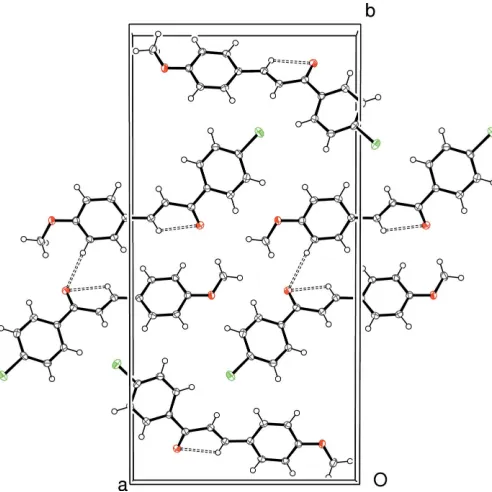
An intermolecular C—H O hydrogen bond (Fig. 2) appears to help to assemble the molecules of (I) into helical stacks about the 21screw axis, propagating in the polar [001] direction.
Experimental
4-Chloroacetophenone in ethanol (1.54 g, 0.01 mol) (25 ml) was mixed with 4-methoxybenzaldehyde (1.36 g, 0.01 mol) in ethanol (25 ml) and the mixture was treated with an aqueous solution of potassium hydroxide (20 ml, 5%). This mixture was stirred well and left to stand for 24 hr. The resulting crude solid mass was collected by filtration and recrystallized from ethanol, yielding clear blocks of (I).
Yield: 90%, m.p.: 380 K, analysis found (calc.) for C16H13ClO2, C 70.5 (70.4%); H 4.72 (4.76%).
Crystal data
C16H13ClO2
Mr= 272.71
Orthorhombic,Pna21 a= 12.8179 (4) A˚ b= 25.5550 (6) A˚ c= 3.9175 (1) A˚ V= 1283.22 (6) A˚3
Z= 4
Dx= 1.412 Mg m
3
MoKradiation Cell parameters from 1708
reflections
= 2.9–27.5
= 0.29 mm1
T= 120 (2) K Slab, colourless 0.500.400.20 mm
Data collection
Nonius KappaCCD diffractometer
!and’scans
Absorption correction: multi-scan (SADABS; Bruker, 2003) Tmin= 0.868,Tmax= 0.944
8514 measured reflections 2815 independent reflections
2569 reflections withI> 2(I) Rint= 0.028
max= 27.5
h=9!16 k=33!32 l=5!5
Refinement
Refinement onF2
R[F2> 2(F2)] = 0.029
wR(F2) = 0.071
S= 1.04 2815 reflections 173 parameters
H-atom parameters constrained
w= 1/[2(F
o2) + (0.0355P)2
+ 0.2552P]
whereP= (Fo2+ 2Fc2)/3
(/)max= 0.001
max= 0.23 e A˚
3
min=0.22 e A˚
3
Absolute structure: Flack (1983), 1131 Friedel pairs
Flack parameter: 0.02 (6)
Table 1
Selected geometric parameters (A˚ ,).
C6—C7 1.496 (2)
C7—C8 1.479 (2)
C8—C9 1.342 (2)
C9—C10 1.461 (2)
[image:2.610.47.293.290.536.2]C5—C6—C7—O1 16.7 (2) O1—C7—C8—C9 6.4 (2)
Table 2
Hydrogen-bond geometry (A˚ ,).
D—H A D—H H A D A D—H A
C9—H9 O1 0.95 2.46 2.8065 (19) 102
C12—H12 O1i
0.95 2.54 3.4828 (18) 175
Symmetry code: (i)xþ1;y;z1 2.
H atoms were positioned geometrically (C—H = 0.95–0.98 A˚ ) and refined as riding, with Uiso(H) = 1.2Ueq(carrier) or 1.5Ueq(methyl carrier). The methyl group was rotated to fit the electron density.
Data collection:COLLECT(Nonius, 1998); cell refinement:HKL SCALEPACK(Otwinowski & Minor 1997); data reduction: HKL DENZO(Otwinowski & Minor 1997),SCALEPACKandSORTAV
(Blessing 1995); program(s) used to solve structure: SHELXS97
(Sheldrick, 1997); program(s) used to refine structure:SHELXL97
(Sheldrick, 1997); molecular graphics: ORTEP-3 (Farrugia, 1997); software used to prepare material for publication:SHELXL97.
We thank the EPSRC National Crystallography Service (University of Southampton) for the data collection. BKS
organic papers
o1648
Harrisonet al. C16H13ClO2 Acta Cryst.(2006). E62, o1647–o1649
Figure 1
View of (I), showing 50% displacement ellipsoids (arbitrary spheres for the H atoms). The possible intramolecular C—H O interaction is indicated by a dashed line.
Figure 2
thanks AICTE, Government of India, New Delhi for financial assistance under the ‘Career Award for Young Teachers’ scheme.
References
Allen, F. H., Kennard, O., Watson, D. G., Brammer, L., Orpen, A. G. & Taylor, R. (1987).J. Chem. Soc. Perkin Trans. 2, pp. S1–S19.
Blessing, R. H. (1995).Acta Cryst.A51, 33–38.
Bruker (2003).SADABS, Bruker AXS Inc., Madison, Wisconsin, USA. Farrugia, L. J. (1997).J. App. Cryst.30, 565–565.
Flack, H. D. (1983).Acta Cryst.A39, 876–881.
Harrison, W. T. A., Yathirajan, H. S., Sarojini, B. K., Narayana, B. & Anilkumar, H. G. (2005).Acta Cryst.C61, o728–o730.
Harrison, W. T. A., Yathirajan, H. S., Sarojini, B. K., Narayana, B. & Vijaya Raj, K. K. (2006).Acta Cryst.E62, o1578–o1579.
Indira, J., Karat, P. P. & Sarojini, B. K. (2002).J. Cryst. Growth,242, 209–214. Moorthi, S. S., Chinnakali, K., Nanjundan, S., Radhika, R., Fun, H.-K. & Yu,
X.-L. (2005).Acta Cryst.E61, o480–o482.
Nonius (1998).COLLECT. Nonius BV, Delft, The Netherlands.
Otwinowski, Z. & Minor, W. (1997). Methods in Enzymology, Vol. 276, Macromolecular Crystallography, Part A, edited by C. W. Carter, Jr & R. M. Sweet, pp. 307–326. New York: Academic Press.
Patil, P. S., Ng, S.-L., Razak, I. A., Fun, H.-K. & Dharmaprakask, S. M. (2006). Acta Cryst.E62, o1465–o1465.
Rabinovich, D. & Schmidt, G. M. J. (1970).J. Chem. Soc. B.pp. 6–9. Rosli, M. M., Patil, P. S., Fun, H.-K., Razak, I. A. & Dharmaprakash, S. M.
(2006).Acta Cryst.E62, o1466–o1468.
Sheldrick, G. M. (1997). SHELXS97 and SHELXL97. University of Go¨ttingen, Germany.
Spek, A. L. (2003).J. Appl. Cryst.36, 7–13.
Uchida, T., Kozawa, K., Sakai, T., Aoki, M., Yoguchi, H., Abduryim, A. & Watanabe, Y. (1998).Mol. Cryst. Liq. Cryst.315, 135–140.
Wang, L., Lu, C.-R., Zhang, Y. & Zhang, D.-C. (2005).Jiegou Huaxue (Chin. J. Struct. Chem.),24, 191–195. (In Chinese.)
Watson, G. J. R., Turner, A. B. & Allen, S. (1993).Organic Materials for Non-linear Optics III, edited by G. J. Ashwell & D. Bloor. RSC Special Publication No. 137, pp. 112–117.
Zheng, J., Zhang, D., Sheng, P., Wang, H. & Yao, X. (1992).Yingyong Huaxue (Chin. J. Appl. Chem.),9, 66–69. (In Chinese.)
organic papers
Acta Cryst.(2006). E62, o1647–o1649 Harrisonet al. C
supporting information
sup-1 Acta Cryst. (2006). E62, o1647–o1649
supporting information
Acta Cryst. (2006). E62, o1647–o1649 [https://doi.org/10.1107/S1600536806010865]
1-(4-Chlorophenyl)-3-(4-methoxyphenyl)prop-2-en-1-one
William T. A. Harrison, H. S. Yathirajan, B. K. Sarojini, B. Narayana and J. Indira
1-(4-Chlorophenyl)-3-(4-methoxyphenyl)prop-2-en-1-one
Crystal data
C16H13ClO2 Mr = 272.71
Orthorhombic, Pna21
Hall symbol: P 2c -2n
a = 12.8179 (4) Å
b = 25.5550 (6) Å
c = 3.9175 (1) Å
V = 1283.22 (6) Å3
Z = 4
F(000) = 568
Dx = 1.412 Mg m−3
Mo Kα radiation, λ = 0.71073 Å
Cell parameters from 1708 reflections
θ = 2.9–27.5°
µ = 0.29 mm−1
T = 120 K
Slab, colourless 0.50 × 0.40 × 0.20 mm
Data collection
Nonius KappaCCD diffractometer
Radiation source: fine-focus sealed tube Graphite monochromator
ω and φ scans
Absorption correction: multi-scan (SADABS; Bruker, 2003)
Tmin = 0.868, Tmax = 0.944
8514 measured reflections 2815 independent reflections 2569 reflections with I > 2σ(I)
Rint = 0.028
θmax = 27.5°, θmin = 3.2°
h = −9→16
k = −33→32
l = −5→5
Refinement
Refinement on F2
Least-squares matrix: full
R[F2 > 2σ(F2)] = 0.029 wR(F2) = 0.071
S = 1.04
2815 reflections 173 parameters 1 restraint
Primary atom site location: structure-invariant direct methods
Secondary atom site location: none
Hydrogen site location: inferred from neighbouring sites
H-atom parameters constrained
w = 1/[σ2(F
o2) + (0.0355P)2 + 0.2552P]
where P = (Fo2 + 2Fc2)/3
(Δ/σ)max = 0.001
Δρmax = 0.23 e Å−3
Δρmin = −0.22 e Å−3
Absolute structure: Flack (1983), 1131 Friedel pairs
Absolute structure parameter: 0.02 (6)
Special details
supporting information
sup-2 Acta Cryst. (2006). E62, o1647–o1649
Refinement. Refinement of F2 against ALL reflections. The weighted R-factor wR and goodness of fit S are based on F2,
conventional R-factors R are based on F, with F set to zero for negative F2. The threshold expression of F2 > σ(F2) is used
only for calculating R-factors(gt) etc. and is not relevant to the choice of reflections for refinement. R-factors based on F2
are statistically about twice as large as those based on F, and R- factors based on ALL data will be even larger.
Fractional atomic coordinates and isotropic or equivalent isotropic displacement parameters (Å2)
x y z Uiso*/Ueq
C1 0.19574 (12) 0.20035 (6) 0.2960 (4) 0.0205 (4)
H1 0.2650 0.2112 0.2462 0.025*
C2 0.12683 (13) 0.23537 (5) 0.4453 (5) 0.0218 (3)
H2 0.1483 0.2700 0.4976 0.026*
C3 0.02617 (12) 0.21890 (6) 0.5169 (4) 0.0200 (3)
C4 −0.00692 (12) 0.16853 (6) 0.4450 (5) 0.0236 (3)
H4 −0.0760 0.1577 0.4979 0.028*
C5 0.06269 (12) 0.13431 (6) 0.2947 (4) 0.0222 (4)
H5 0.0407 0.0997 0.2424 0.027*
C6 0.16443 (10) 0.14935 (5) 0.2180 (5) 0.0173 (3)
C7 0.23496 (12) 0.11027 (6) 0.0517 (4) 0.0190 (3)
C8 0.34886 (12) 0.11936 (6) 0.0601 (4) 0.0191 (3)
H8 0.3764 0.1480 0.1861 0.023*
C9 0.41349 (11) 0.08728 (6) −0.1098 (4) 0.0185 (3)
H9 0.3813 0.0609 −0.2440 0.022*
C10 0.52748 (12) 0.08815 (5) −0.1131 (4) 0.0175 (3)
C11 0.57984 (11) 0.04602 (5) −0.2616 (4) 0.0184 (3)
H11 0.5401 0.0193 −0.3690 0.022*
C12 0.68784 (11) 0.04173 (5) −0.2580 (5) 0.0195 (3)
H12 0.7215 0.0123 −0.3569 0.023*
C13 0.74565 (12) 0.08153 (6) −0.1062 (4) 0.0190 (3)
C14 0.69544 (12) 0.12507 (6) 0.0340 (5) 0.0210 (3)
H14 0.7355 0.1527 0.1299 0.025*
C15 0.58780 (12) 0.12813 (6) 0.0338 (4) 0.0197 (3)
H15 0.5543 0.1575 0.1339 0.024*
C16 0.90530 (12) 0.03755 (6) −0.2288 (5) 0.0257 (4)
H16A 0.9806 0.0415 −0.1942 0.039*
H16B 0.8903 0.0357 −0.4738 0.039*
H16C 0.8814 0.0054 −0.1177 0.039*
O1 0.19706 (8) 0.07117 (4) −0.0837 (4) 0.0237 (3)
O2 0.85193 (8) 0.08157 (4) −0.0835 (3) 0.0234 (3)
Cl1 −0.06159 (3) 0.262892 (14) 0.69857 (14) 0.02734 (11)
Atomic displacement parameters (Å2)
U11 U22 U33 U12 U13 U23
C1 0.0165 (7) 0.0197 (7) 0.0252 (10) 0.0001 (6) −0.0015 (6) 0.0032 (6)
C2 0.0235 (8) 0.0168 (6) 0.0252 (9) 0.0001 (6) −0.0030 (7) −0.0002 (6)
C3 0.0198 (7) 0.0225 (7) 0.0179 (8) 0.0074 (6) −0.0012 (7) 0.0017 (6)
supporting information
sup-3 Acta Cryst. (2006). E62, o1647–o1649
C5 0.0202 (7) 0.0205 (7) 0.0257 (10) −0.0025 (6) −0.0007 (7) −0.0004 (6)
C6 0.0168 (6) 0.0186 (6) 0.0167 (7) 0.0017 (5) −0.0036 (7) 0.0015 (7)
C7 0.0206 (8) 0.0188 (7) 0.0176 (8) 0.0009 (6) −0.0022 (6) 0.0047 (6)
C8 0.0179 (7) 0.0189 (7) 0.0204 (8) 0.0006 (6) −0.0018 (6) 0.0017 (6)
C9 0.0211 (8) 0.0182 (6) 0.0161 (8) −0.0015 (6) −0.0007 (7) 0.0018 (6)
C10 0.0182 (7) 0.0186 (6) 0.0157 (8) 0.0011 (6) 0.0008 (6) 0.0016 (7)
C11 0.0223 (7) 0.0171 (6) 0.0159 (8) −0.0025 (5) −0.0003 (7) −0.0013 (6)
C12 0.0215 (7) 0.0174 (6) 0.0198 (9) 0.0024 (5) 0.0037 (7) −0.0005 (6)
C13 0.0178 (7) 0.0204 (7) 0.0189 (8) −0.0010 (6) 0.0007 (7) 0.0030 (6)
C14 0.0219 (8) 0.0176 (6) 0.0234 (9) −0.0018 (6) −0.0018 (7) −0.0016 (6)
C15 0.0228 (8) 0.0163 (7) 0.0201 (8) 0.0027 (6) 0.0012 (7) −0.0012 (6)
C16 0.0195 (7) 0.0276 (7) 0.0300 (11) 0.0052 (6) 0.0002 (7) −0.0050 (7)
O1 0.0211 (6) 0.0198 (5) 0.0301 (6) −0.0011 (4) −0.0028 (5) −0.0037 (5)
O2 0.0150 (5) 0.0235 (5) 0.0318 (7) 0.0017 (4) −0.0007 (5) −0.0046 (5)
Cl1 0.02487 (18) 0.03005 (18) 0.0271 (2) 0.00920 (15) 0.0001 (2) −0.00342 (19)
Geometric parameters (Å, º)
C1—C2 1.387 (2) C9—H9 0.9500
C1—C6 1.3976 (19) C10—C11 1.396 (2)
C1—H1 0.9500 C10—C15 1.405 (2)
C2—C3 1.386 (2) C11—C12 1.3888 (19)
C2—H2 0.9500 C11—H11 0.9500
C3—C4 1.384 (2) C12—C13 1.392 (2)
C3—Cl1 1.7423 (16) C12—H12 0.9500
C4—C5 1.381 (2) C13—O2 1.3653 (18)
C4—H4 0.9500 C13—C14 1.398 (2)
C5—C6 1.392 (2) C14—C15 1.382 (2)
C5—H5 0.9500 C14—H14 0.9500
C6—C7 1.496 (2) C15—H15 0.9500
C7—O1 1.2312 (19) C16—O2 1.4344 (19)
C7—C8 1.479 (2) C16—H16A 0.9800
C8—C9 1.342 (2) C16—H16B 0.9800
C8—H8 0.9500 C16—H16C 0.9800
C9—C10 1.461 (2)
C2—C1—C6 120.75 (14) C10—C9—H9 116.1
C2—C1—H1 119.6 C11—C10—C15 117.85 (13)
C6—C1—H1 119.6 C11—C10—C9 118.20 (13)
C3—C2—C1 118.84 (14) C15—C10—C9 123.91 (14)
C3—C2—H2 120.6 C12—C11—C10 122.40 (14)
C1—C2—H2 120.6 C12—C11—H11 118.8
C4—C3—C2 121.77 (15) C10—C11—H11 118.8
C4—C3—Cl1 119.04 (12) C11—C12—C13 118.51 (14)
C2—C3—Cl1 119.19 (12) C11—C12—H12 120.7
C5—C4—C3 118.53 (15) C13—C12—H12 120.7
C5—C4—H4 120.7 O2—C13—C12 124.03 (13)
supporting information
sup-4 Acta Cryst. (2006). E62, o1647–o1649
C4—C5—C6 121.49 (14) C12—C13—C14 120.30 (14)
C4—C5—H5 119.3 C15—C14—C13 120.29 (14)
C6—C5—H5 119.3 C15—C14—H14 119.9
C5—C6—C1 118.63 (14) C13—C14—H14 119.9
C5—C6—C7 118.40 (13) C14—C15—C10 120.58 (14)
C1—C6—C7 122.97 (13) C14—C15—H15 119.7
O1—C7—C8 121.77 (14) C10—C15—H15 119.7
O1—C7—C6 119.40 (14) O2—C16—H16A 109.5
C8—C7—C6 118.82 (13) O2—C16—H16B 109.5
C9—C8—C7 120.17 (14) H16A—C16—H16B 109.5
C9—C8—H8 119.9 O2—C16—H16C 109.5
C7—C8—H8 119.9 H16A—C16—H16C 109.5
C8—C9—C10 127.75 (14) H16B—C16—H16C 109.5
C8—C9—H9 116.1 C13—O2—C16 116.71 (12)
C6—C1—C2—C3 0.2 (2) C7—C8—C9—C10 −175.77 (14)
C1—C2—C3—C4 0.3 (3) C8—C9—C10—C11 169.56 (16)
C1—C2—C3—Cl1 −179.03 (13) C8—C9—C10—C15 −8.4 (3)
C2—C3—C4—C5 −0.7 (3) C15—C10—C11—C12 2.2 (3)
Cl1—C3—C4—C5 178.70 (13) C9—C10—C11—C12 −175.87 (15)
C3—C4—C5—C6 0.5 (3) C10—C11—C12—C13 −1.3 (3)
C4—C5—C6—C1 −0.1 (3) C11—C12—C13—O2 179.30 (15)
C4—C5—C6—C7 −179.34 (15) C11—C12—C13—C14 −1.0 (3)
C2—C1—C6—C5 −0.3 (2) O2—C13—C14—C15 −178.00 (15)
C2—C1—C6—C7 178.96 (16) C12—C13—C14—C15 2.3 (3)
C5—C6—C7—O1 16.7 (2) C13—C14—C15—C10 −1.3 (3)
C1—C6—C7—O1 −162.55 (15) C11—C10—C15—C14 −0.9 (3)
C5—C6—C7—C8 −162.25 (15) C9—C10—C15—C14 177.08 (15)
C1—C6—C7—C8 18.5 (2) C12—C13—O2—C16 0.4 (2)
O1—C7—C8—C9 6.4 (2) C14—C13—O2—C16 −179.36 (14)
C6—C7—C8—C9 −174.69 (15)
Hydrogen-bond geometry (Å, º)
D—H···A D—H H···A D···A D—H···A
C9—H9···O1 0.95 2.46 2.8065 (19) 102
C12—H12···O1i 0.95 2.54 3.4828 (18) 175