Interactive media for enhancing learning and creativity in
design and technology education
EHIYAZARYAN, Ester
Available from Sheffield Hallam University Research Archive (SHURA) at:
http://shura.shu.ac.uk/3204/
This document is the author deposited version. You are advised to consult the
publisher's version if you wish to cite from it.
Published version
EHIYAZARYAN, Ester (2007). Interactive media for enhancing learning and creativity
in design and technology education. Doctoral, Sheffield Hallam University.
Copyright and re-use policy
See http://shura.shu.ac.uk/information.html
i Adsetts Centre City Campus | Sheffield Si 1WB 1 0 1 8 7 6 0 5 0 4
Sheffield H .55!7u n iverei^ L earning and IT Services Adseh: ..-entre City Campus 1 Sheffield s i 1WB
ProQuest Number: 10694485
All rights reserved
INFORMATION TO ALL USERS
The qu ality of this repro d u ctio n is d e p e n d e n t upon the q u ality of the copy subm itted.
In the unlikely e v e n t that the a u th o r did not send a c o m p le te m anuscript and there are missing pages, these will be note d . Also, if m aterial had to be rem oved,
a n o te will in d ica te the deletion.
uest
ProQuest 10694485
Published by ProQuest LLC(2017). C op yrig ht of the Dissertation is held by the Author.
All rights reserved.
This work is protected against unauthorized copying under Title 17, United States C o d e M icroform Edition © ProQuest LLC.
ProQuest LLC.
789 East Eisenhower Parkway P.O. Box 1346
Interactive Media for Enhancing Learning and Creativity
in Design and Technology Education
Ester Ehiyazaryan
A thesis submitted in partial fulfilment of the requirements of Sheffield Hallam University
for the degree of Doctor of Philosophy
ABSTRACT 1
INTRODUCTION________________________________________________________2
CHAPTER 1. LITERATURE REVIEW PART 1 - THE NEED FOR
CREATIVITY 7
1.1 . T h e n e e d f o r c r e a t i v i t y 7
1 .1 .1 . Th e e l e m e n t s o f ac r e a t i v e a n d c u l t u r a l e d u c a t i o n 8
The technological challenge 8
The role o f the teacher 10
Collaboration as social interaction 11
Econom ic challenge 13
1.1.2. S u m m a r y - t h e n e e d f o r c r e a t i v i t y 13
1.2. Cr e a t i v i t y ine d u c a t i o n - d e f i n i t i o n a n d f a c t o r s 14
1 .2 .1 . Cr e a t i v i t y in e d u c a t i o n 14
1 .2 .2 . Ch a r a c t e r i s t i c s o f c r e a t i v i t y 14
Using im agination 15
Pursuing purposes 15
Judging value 16
A ffective factors 16
Intrinsic motivation as stimulus 17
Self-esteem and intrinsic motivation 18
1.2.3. C r e a t i v i t y in t h e c o n t e x t o f D e s i g n a n d T e c h n o l o g y e d u c a t i o n 20
N uffield QCA 20
Young Foresight project 25
Play in D& T 28
1 .2 .4 . I n t e r a c t i v e m e d i a p r o j e c t s t a r g e t i n g c r e a t i v i t y in D & T 2 9
Practical Action 31
STEP - Sustainable Technology Education Project 3 2
Learning in context 3 2
Pedagogical effectiveness and interactivity 3 3
Sustainable Design Award 3 3
Pedagogical effectiveness of m ultim edia and interactivity 3 4
InnoEd 3 5
1.2.5. S u m m a r y 36
1.3.
Su m m a r y o fc h a p t e r37
CHAPTER
2 .LITERATURE REVIEW PART
2 -THE ROLE OF
INTERACTIVE MEDIA_________________________________________________ 39
2.1.
Th e r o l eo fi n t e r a c t i v em e d ia in s u p p o r t i n g t h ek e y f a c t o r s o fCREATIVITY
39
2.1.1. I n t r o d u c t i o n 3 9
2.1.2. C o n t e x t 39
Interactive m edia as a tool for context building 40
Narrative guidance and narrative construction 4 3
The potential of narrative as m otivation 4 4
2 .1 .3 . T h e n e e d f o r c o l l a b o r a t i v e l e a r n i n g a n d c o l l a b o r a t i v e p r o b l e m
SOLVING IN D& T - T h e r o l e o f m e d i a i n p r o m o t i n g d i a l o g u e a n d c o l l a b o r a t i o n
4 6
Research on collaborative problem solving as an approach to creative thinking in D&T 47
Collaboration: The concept of 'community' 49
M ultiple forms of representation 52
Peer interaction - friendship, hum our and spontaneity 52
2.1 .4. A p p r o a c h e s t o s u p p o r t i n g c o m p u t e r b a s e d c o l l a b o r a t i v e l e a r n i n g 53
D esigning com puter supported group based learning 55
Task type 57
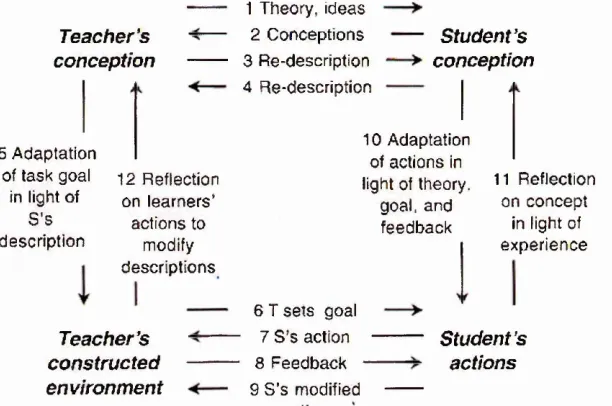
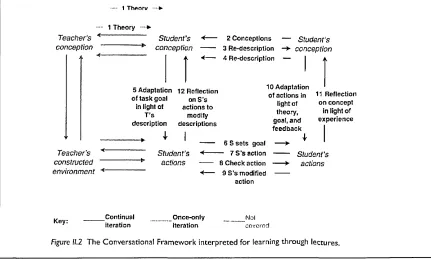
Conversational Fram ew ork 57
Affective issues in com puter supported collaborative learning 60
2 .2 . Ga m e-b a s e dl e a r n i n g - a f o r m o fn o n-a u t h o r i t a r i a n, s t i m u l a t i n g
l e a r n i n g e n v i r o n m e n t 6 2
2.2.1. G a m e - b a s e d l e a r n i n g a n d l e a r n e r a u t o n o m y 62
2.2.2. G a m e - b a s e d l e a r n i n g - a n i m m e r s i v e , m o t i v a t i n g e n v i r o n m e n t 64
2.2.3. G a m e - b a s e d l e a r n i n g a n d p r o b l e m s o l v i n g 66
2.2.4. G a m e - b a s e d l e a r n i n g a s s o c i a l l y s i t u a t e d 67
2.2.5. S u m m a r y 68
2 .3 . Le a r n in g t h e o r y 6 9
2.3.1. I n t r o d u c t i o n 69
2.3.2. G a g n e ’s c o n d i t i o n s o f l e a r n i n g 69
Summary of section 72
2.3.3. C o n s t r u c t i v i s m 73
Cognitive constructivism 74
Situated learning 75
Social constructivism 77
Situating learning in com m unities o f practice 78
Internalisation and legitim ate peripheral participation 78
2 .4 . Su m m a r yo f c h a p t e r 8 2
CHAPTER
3.EPISTEMOLOGY AND THEORETICAL PERSPECTIVE
833 .1 . In t r o d u c t io n 8 3
3 .2 . Th ea im s a n d o b j e c t i v e s o f r e s e a r c h - a n im p a c to n e p i s t e m o l o g y 8 3
3 .3 . Ep is t e m o l o g y 84
3 .4 . Th e o r e t i c a l p e r s p e c t i v e 85
3.4.1. P o s i t i v i s m 86
3.4.2. C o n s t r u c t i v i s m 87
Learning and knowledge as a social construction 88
Im plications of constructivism for the design of learning material and for the design of
the study 90
3.4.3. S c h o o l s o f t h o u g h t 91
Ethnom ethodology 91
Symbolic interactionism 91
CHAPTER 4. M ETHO DO LO G Y OF TH E LEARNING NEEDS INTERVIEW S
98
4 .1 . In t r o d u c t i o n 98
4 .2 . St y l e o fr e s e a r c h m e t h o d o l o g y - a n a p p r o a c h t o a c t i o n r e s e a r c h
WITH ELEMENTS OF ETHNOGRAPHIC ENQUIRY 9 8
4.2.1. P h e n o m e n o l o g y 98
Students' point of view 99
The generation of theory 99
4 .2 .2 . Ac t i o n r e s e a r c h 101
Action research as a process 101
4 .2 .3 . Ac t i o n r e s e a r c h o r e t h n o g r a p h y? 104
4 .3 . In t e r v i e w s 10 5
4.3.1. D a t a g a t h e r i n g -
Focus
G r o u p I n t e r v i e w s 105Locating the field of study 106
Q uestions 106
Pilot study 106
Recording 107
Access 107
Inform ed consent 107
Video recording 108
Com parability and translatability 108
Com parability and sam pling 108
Translatability 109
4 .4 . In t e r v i e w q u e s t io n s 1 0 9
4.4.1. Q u e s t i o n 1 C o n t e x t 109
4 .4 .2 . Qu e s t io n 2 Th e d e s ig n s t a g e s 1 1 0
4 .4 .3 . Qu e s t i o n 3 St u d e n t s' p r i o r i t i e s a n d c r e a t i v i t y 11 2
4 .4 .4 . Qu e s t i o n 4 In s p i r a t i o n / St i m u l u s 113
4 .4 .5 . Qu e s t i o n 5 Wh e r e d o y o u g e t y o u r i n s p i r a t i o n f r o m? 11 4 4 .4 .6 . Qu e s t io n 6 Wh ic h o f t h e s em e d i a h a v e y o u u s e d in y o u r w o r k? Ho w is
EACH OF THESE HELPFUL? 1 1 4
4 .4 .7 . Qu e s t i o n 7 Co l l a b o r a t i v e l e a r n i n g 115
4 .4 .8 . Qu e s t i o n 8 Au t o n o m y a n d r i s k t a k i n g 115
4 .5 . Th e r o l e o f v i d e o r e c o r d in g 1 1 6
4 .6 . Gr o u n d e d t h e o r y - t h e c o n s t a n t c o m p a r i s o nm e t h o d t o d a t a a n a l y s i s
118
4 .6 .1 . Co m p a r i s o n w i t h o t h e r m e t h o d s o fg r o u n d e d t h e o r y 11 9
4 .6 .2 . Po w e rPo i n t p r e s e n t a t i o n s 1 2 0
4.6.3. ATLAS / t i - u s i n g q u a l i t a t i v e d a t a a n a l y s i s s o f t w a r e 121
Com parison 123
Integration 126
D elim iting 127
W riting 127
CHAPTER 5. FINDINGS OF THE LEARNING NEEDS INTERVIEWS
130
5 .1 . In t r o d u c t i o n 1 3 0
5 .2 . Co l l a b o r a t i v e w o r k 1 3 0
5 .2 .3 . Fe e d b a c k 132
5 .2 .4 . Th er o l eo ft h ec o m p u t e r 133
5 .2 .5 . Gu id e l in e: Gu id a n c ea n d e x p e r ie n t ia ll e a r n in g 134
5 .2 .6 . Gu id e l in e: Gu id a n c ea n d f e e d b a c k 134
5 .2 .7 . Su m m a r y - c o l l a b o r a t iv ew o r k 135
5.3.
Au t o n o m y a n dc r e a t i n g l i n e s o fe n q u i r y136
5 .3 .1 . Co n c e p t-o r ie n t e dc o n t e n t / d im in is h e dt e a c h e rr e s p o n sib il it y 136
5 .3 .2 . Dim in ish in g t e a c h e r s’r e s p o n sib il it y 138
5 .3 .3 . Co n c e p to r ie n t e dc o n t e n t 140
5 .3 .4 . Gu id e l in e - Co n c e p to r ie n t e dc o n t e x t 141
5 .3 .5 . Gu id e l in e - Sy st e m in st ig a t e dd ia l o g u ea s g u id a n c e 142
5 .3 .6 . Su m m a r y - c o n c e p to r ie n t e dc o n t e n t 143
5.4.
Ex p e r i e n t i a ll e a r n i n g a n dp r o b l e m s o l v i n g144
5 .4 .1 . Ex p e r ie n t ia ll e a r n in g 144
5 .4 .2 . Pr o b l e m s o l v in g 145
5 .4 .3 . Th e ROLE OF t h ec o m p u t e r 146
5 .4 .4 . Dir ectm a n ip u l a t io n 146
Principles of direct manipulation
1475 .4 .5 . Su m m a r y - e x p e r ie n t ia ll e a r n in g a n d pr o b l e ms o l v in g 148
5.5.
Mu l t i p l er e p r e s e n t a t i o n s o fd a t a148
5 .5 .1 . Su m m a r y - m u l t ip l er e p r e s e n t a t io n s o fd a t a 153
5.6.
St i m u l u sa n din t r i n s i c m o t i v a t i o n153
5 .6 .1 . In t r in sicm o t iv a t io na n d th ec r e a t iv ein d iv id u a l 155
5.7.
Su m m a r yo fc h a p t e r156
CHAPTER 6. ECOWARRIOR - A PROTOTYPE FOR AN INTERACTIVE
MEDIA LEARNING ENVIRONMENT WHICH AIMS TO ADDRESS
LEARNING AND CREATIVITY IN D&T EDUCATION
___________ 158
6 .1 . I n t r o d u c t i o n 1 5 8
6 .2 . e c o W a r r i o r - d i g i t a l g a m e - b a s e d l e a r n i n g f o r s u s t a i n a b l e d e s i g n 1 5 8
6.2.1.
Wh a t is e c oWa r r io r?160
6.2.2.
How is
ec oWa r r io rd if f e r e n tf r o m o t h erl e a r n in gr e s o u r c e s?160
6.2.3.
Na v ig a t io n161
6.2.4.
Ca s es t u d y m o d u l e162
Case study module
-
rationale
162
6.2.5.
Two
PLAYERS GAME MODULE162
Two players game module rationale
163
6.2.6.
Ex pl o r em o d u l e163
Explore module rationale
164
6 .3 . R a t i o n a l e f o r t h e d e r i v a t i o n o f a n i n t e r a c t i v e m e d i a l e a r n i n g
ENVIRONMENT WHICH AIMS TO ADDRESS LEARNING AND CREATIVITY IN THE
D&T
LEARNER 1 6 5
6.3.1.
Sy n t h e siso fr e s e a r c h q u e s t io n s165
6.3.2.
Th en e e dfo r in st r u c t io n - id e n t if y in g t h ea p p r o p r ia t ec o n t e n t167
6.3.3.
Go a l s:168
6.3.4.
Ca s es t u d ym o d u l e171
Module Description
171
Target objective
172
Research questions for Case Study module
173
Conditions of learning provided and design principles
173
6.3.5. T w o p l a y e r s g a m e m o d u l e 177
M odule description 177
Target objective - learning which is personally relevant 178
Conditions o f learning and design features 179
M ethods of data gathering and interpretation 181
6.3.6. E x p l o r e m o d u l e 182
M odule description 183
Target objectives 184
Conditions o f learning and design principles 187
M ethods of data gathering and interpretation 191
CHAPTER 7. EVALUATIVE METHODOLOGY FOR THE ECOWARRIOR
LEARNING ENVIRONMENT__________________________________________ 193
7 .1 . In t r o d u c t i o n 19 3
7 .2 . Lo n g it u d in a l s t u d y 19 4
7.3 . St a g e so ft h es t u d y 1 9 6
7.4 . Sa m p l i n g 1 9 6
7 .5 . Le v e l s o fa n a l y s is 1 9 7
7 .5 .1 . Gr o u p a n a l y s i s - t h e in t e r a c t i o n p a t t e r n s o f i n d i v i d u a l s a n d g r o u p s
197
7 .5 .2 . Cu l t u r a la n a l y s i s 197
7 .6 . Ob s e r v a t i o n a s a n e v a l u a t i o n t e c h n iq u e 19 8
7 .6 .1 . Vid e o o b s e r v a t i o n 198
7 .6 .2 . Pa r t i c i p a n t o r n o n-p a r t i c i p a n t o b s e r v e r? 2 0 0
7 .6 .3 . La b e n v i r o n m e n to r f i e l d s t u d y? 201
7 .7 . Da t a a n a l y s is 2 0 2
7 .7 .1 . Gr o u n d e d t h e o r y 2 0 3
7 .7 .2 . An a l y s i n g d i s c o u r s e 2 0 5
Conversation analysis 2 0 6
7 .8 . Us e r e x p e r i e n c e q u e s t io n n a ir e 2 0 9
7 .9 . Pil o ts t u d y 2 1 0
7 .9 .1 . Fin d i n g s o ft h e p i l o ts t u d y 21 1
7.1 0 . Su m m a r y 2 1 3
CHAPTER 8. ANALYSIS PART 1 - FACTORS INFLUENCING LEARNER
AUTONOMY 215
8 .1 . In t r o d u c t i o n 2 1 5
8 .2 . Na v ig a t io n a n d a u t o n o m y 2 1 6
8 .2 .1 . Na v i g a t i o n a sa n e v a l u a t io n t o o l 2 1 7
8 .2 .2 . Na v i g a t i o n a saw a y o f e s t a b l i s h i n g p e r s o n a l s p a c e 2 2 0
Guideline - N avigation and autonomy 221
8 .3 . Fa c t o r sin f l u e n c i n g l e a r n e r a u t o n o m y 2 2 3
8 .3 .1 . Te a c h e r i n t e r v e n t i o n a n d a u t o n o m y 2 2 4
8 .3 .2 . Te a c h e r m o t i v a t i o n a s a f a c t o r a f f e c t i n g a u t o n o m y 2 3 0 8 .3 .3 . Co l l a b o r a t i o n, n o tc o m p e t i t i o n a n d t h e is s u e o f o w n e r s h i p 2 3 8 8 .3 .4 . Th e i m p o r t a n c e o f f a c e-t o-f a c e c o m m u n i c a t i o n 24 1
8 .3 .5 . Ma k i n g a n e x p e r t o u t o ft h e l e a r n e r 2 5 3
8 .3 .6 . Ti m in g - WHEN t o i n t r o d u c et h e l e a r n i n g e n v i r o n m e n t 2 5 6
G uideline - D efining the role of the teacher in supporting learner autonom y 259 G uideline - D efining the role of the learning environm ent in supporting learner
autonom y 261
G uideline - The significance of learner-to-learner dialogue 262
G uideline - Treating the learner as expert 264
G uideline - W hen to introduce a m ultim edia learning environm ent which aims to affect
learners’ creativity 265
CHAPTER
9.ANALYSIS PART
2 -FACTORS INFLUENCING ATTITUDE
CHANGE
2 6 69 .1 . In t r o d u c t i o n 2 6 6
9 .2 . P e r s o n a l i s i n g t h e i n t e r a c t i o n s , e m o t i o n a l r e s p o n s e a n d c h a n g e in
ATTITUDE 2 6 6
9 .2 .1 . Em o t i o n a l r e s p o n s e a n d c h a n g e in a t t i t u d e 2 6 6
G uideline - em otional response and change in attitude 2 7 3
9 .2 .2 . P e r s o n a l i s i n g t h e l e a r n i n g i n t e r a c t i o n s t h r o u g h t h e N a m e E n t r y
FEATURE 275
G uideline - Personalising the learning interactions through the N am e Entry feature 277 9 .2 .3 . Pe r s o n a l i s i n g t h e l e a r n i n g i n t e r a c t i o n s t h r o u g h t h e As s i g n Va l u e s
FEATURE 2 7 8
9.2.4. P e r s o n a l i s i n g t h e l e a r n i n g i n t e r a c t i o n s t h r o u g h t h e M a t e r i a l s
S e l e c t i o n f e a t u r e 279
Guideline: 283
9 .3 . Na r r a t i v e a n d e m o t i o n a l r e s p o n s e 2 8 4
Guideline - N arrative as a form of attitude change 287
9 .4 . Di s t r ib u t io n o f c o n t r o l a n d e m o t i o n a l r e s p o n s e 2 8 8
9 .4 .1 . A d v e r s e e f f e c t s o n t h e l e a r n e r ’s c a p a c i t y f o r s e l f - d i r e c t e d l e a r n i n g 288
9.4.2. T h e n a t u r e o f t h e t a s k a n d l e a r n e r c o n t r o l 294
Guideline - D ifferentiation by task 296
CHAPTER
10.ANALYSIS PART
3 -SUPPORTING LEARNING THROUGH
DIALOGUE - MAKING LEARNING PERSONALLY RELEVANT
___________ 3 0 010 .1 . In t r o d u c t i o n 3 0 0
10 .2 . Dia l o g u ea n d in t e r n a l t h o u g h t f o r s u p p o r t i n g t h ed e v e l o p m e n t o f
LEARNING - IMPLICATIONS FOR CHOOSING AN APPROACH TO LEARNING THEORY 3 0 0
G uideline - approaches to learning 303
1 0 .3 . T h e r o l e o f s p e c i f i c f o r m s o f i n s t r u c t i o n in s u p p o r t i n g d i f f e r e n t
APPROACHES TO LEARNING - COLLABORATIVE AND INDIVIDUAL 3 0 3
10.3.1. T h e c a p a c i t y o f t h e q u i z f e a t u r e t o s u p p o r t b o t h c o l l a b o r a t i v e a n d
INDIVIDUAL LEARNING 303
10.3.2. T h e c a p a c i t y o f n a r r a t i v e t o s u p p o r t b o t h c o l l a b o r a t i v e a n d
INDIVIDUAL LEARNING 305
1 0 .3 .3 . Th e r o l e o f d i r e c t m a n i p u l a t i o n a n d i n t e r a c t i v e e l e m e n t s in
SUPPORTING BOTH COLLABORATIVE AND INDIVIDUAL LEARNING 309
M atching gam e - ‘D ecom position rates’ exercise 309
Sim ulation 310
1 0 .3 .4 . Gu i d e l i n e - Id e n t i f y i n g w h i c h l e a r n i n g t h e o r y s u p p o r t s l e a r n i n g
1 0 .4 . Co m p e t i t i o nv e r s u s c o l l a b o r a t i o n - a s p e c t s, w h i c hin f l u e n c e
LEARNING 3 1 3
10.4.1. G u i d e l i n e - c o m p e t i t i o n v e r s u s c o l l a b o r a t i o n - a s p e c t s , w h ic h
INFLUENCE LEARNING 3 20
1 0 .5 . Co n v e r s a t i o n a lf r a m e w o r ka n dit s r e l a t i o n s h i pt o v a r i e t i e s o f
LEARNING - DECLARATIVE KNOWLEDGE AND ORIGINAL THOUGHT 3 2 1
10.5.1. CONVERSATIONAL FRAMEWORK AND DECLARATIVE KNOWLEDGE 322
10.5.2. T h e C o n v e r s a t i o n a l F r a m e w o r k a s a n e v a l u a t i v e t o o l 32 4 10.5.3. G u i d e l i n e - t h e C o n v e r s a t i o n a l F r a m e w o r k a s a n e v a l u a t i v e t o o l 325 10.5.4. C o n v e r s a t i o n a l f r a m e w o r k a n d o r i g i n a l t h o u g h t 326
10.5 .5 . Gu id e l in e - Co n v e r s a t io n a l Fr a m e w o r ka n d o r ig in a lt h o u g h t 3 3 5
CHAPTER 11. CONCLUSIONS______________________________________ 337
11.1.
In t r o d u c t i o n337
11.2.
Ke y a r e a so fi n v e s t i g a t i o na n d k e y f i n d i n g s337
11.2.1.
L e a r n e r a u t o n o m y338
The role of the teacher in supporting learner autonomy
339
The role of leamer-to-leamer dialogue in supporting learner autonomy
341
The role of the interactive learning environment in supporting learner autonomy
341
Learner autonomy - conclusions
343
11.2.2.
C o l l a b o r a t i o n344
Collaboration and developing thinking
345
Collaboration and seeing things from a different perspective
345
Leamer-to-leamer collaboration - a unique form of communication
346
The role of the learning environment in supporting collaboration
347
Collaboration - Conclusions
347
11.2.3.
T h e ROLE o f d i a l o g u e348
Supporting collaboration and autonomy
348
Declarative knowledge and creative thought
349
Developing thinking through dialogue
350
The role of dialogue - conclusions
350
11.2.4.
THE ROLE OF THE INTERACTIVE LEARNING ENVIRONMENT351
The role of the learning environment in supporting learner autonomy
351
A flexible learning environment
352
The role of the learning environment in providing differentiation
354
Influencing attitude change - personalisation
354
The role of the learning environment in supporting learning and creativity - conclusions
356
11.2.5.
A t t i t u d e c h a n g e357
Attitude change - Conclusions
359
11.3.
Or i g i n a l c o n t r ib u t io n st o k n o w l e d g e359
11.3.1.
P r o m o t i n g l e a r n e r a u t o n o m y360
11.3.2.
T h e v a l u e o f d i a l o g u e a n d c o l l a b o r a t i o n362
11.3.3.
T h e r o l e o f t h e l e a r n i n g e n v i r o n m e n t364
Flexibility
364
Personalisation
366
11.3.4.
A t t i t u d e c h a n g e366
11.3.5.
T h e e c o W a r r i o r i n t e r a c t i v e l e a r n i n g e n v i r o n m e n t367
11.3.6.
O r i g i n a l c o n t r i b u t i o n s t o k n o w l e d g e - su m m a r y368
11.4.
Li m i t a t i o n s o ft h es t u d ya n ds u g g e s t i o n sf o r f u r t h e r r e s e a r c h368
11.4.2. Re s e a r c h e r i n t e r v e n t i o n 369
11.4.3. Au t o n o m y 370
11.4.4. At t i t u d e c h a n g e 370
11.4.5. Me t h o d o l o g y 371
11.4.6. Di f f e r e n t i a t i o n 371
11.4.7. GENERALISABILITY OF THE STUDY 372
11.5.
De v e l o p m e n t s f r o m t h e w o r k372
Conference papers 372
Research seminars 373
Com petition entries 374
Curriculum developm ent 374
BIBLIOGRAPHY
375
WEB SITE REFERENCES
381
GLOSSARY
381
LIST OF APPENDICES
383
Abstract
This thesis is an exploration of the potential of interactive media to enhance learning and creativity in Design and Technology education. The work focuses on A level which is a stage at which autonomous learning becomes a significant part of the subject’s pedagogy.
This research is interdisciplinary in nature, bringing together the areas of D&T education and interactive media for learning. The gap in knowledge which it targets is the development of interactive learning resources aimed specifically at the creative development of the learner. This is an area which has been given limited attention in interactive media for learning, which has tended to place a focus on declarative knowledge, rather than original thought. In addition, while
D&T education research has explored issues of enhancing creativity, the development of interactive learning resources which are aimed at enhancing creativity in the subject has been limited. Yet as the literature review makes explicit, D&T is an exciting subject area for interactive media development.
Through an action research methodology involving the design and evaluation of an interactive media learning environment entitled ecoWarrior, this research explores a number of key research questions regarding the role of interactive media in enhancing creativity in D&T education. These questions include an exploration of the role of collaboration and dialogue within a computer- supported learning environment; the structuring of the learning content and interactions; issues of user control and learner autonomy; the influence of affective factors on student learning.
The contribution to knowledge of the work can be summarised as identifying specific conditions of learning which would improve the potential of an
interactive learning environment to enhance learning and creativity in D&T. The original contribution to knowledge can be summarised in the following
categories:
• The need to promote learner autonomy, in order to encourage original thinking in the learner. Within this the specific roles of teacher, learners and learning environment are discussed;
• The value of dialogue and collaboration to enhancing creativity in the learner;
• The specific characteristics of an interactive learning environment to enhancing creativity in the learner - namely its flexibility and its capacity to personalise the learning interactions;
Introduction
This thesis is an exploration of how and to what extent the need for creativity in
Design and Technology (D&T) education can be addressed with the aid of
interactive media. The reason for choosing to explore interactive media as a
way of addressing creativity is firstly that research in computer based learning
and interactivity has given little attention to how digital media could be used in
subjects in which creativity is seen as a learning outcome. The use of
technology for supporting creative thought opens unexplored possibilities for
research, defining an area in which an original contribution to knowledge can be
made. Secondly, as is discussed in the literature review chapters 1 and 2,
interactive media is rapidly moving from being a novelty to becoming a
necessity in contemporary classroom teaching and learning practices. This is
why the specific ways in which learning technology is to be integrated in a
subject specific way within the classroom environment needs particular
attention. Specific focus is placed on:
• the changing roles of teacher, computer and learner where an interactive
learning environment is present;
• affective factors which play a role in enhancing learner creativity;
• the role of dialogue and collaborative learning to developing original
thought;
• elements of interactive media, which contribute to attitude change in the
learner.
Chapters 1 and 2 of the thesis constitute a discussion of relevant literature in
the field of interactive media and its potential to supporting creativity in D&T
education. Chapter 1 sets out the issue of creativity in a pedagogical context. A
definition of what creativity means and its key characteristics is provided. Such
a definition allows research to derive specific conditions and factors, which need
to be present in a learning setting in order for creativity to develop. Practical and
research projects which have successfully utilised the pedagogical potential of
interactive media in the subject of D&T are critically discussed, aiming to
Chapter 2 proceeds to an in-depth exploration of existing approaches and
current research into aspects of interactive media, which are able to support the
conditions and factors of creativity identified in Chapter 1. The following topics
are discussed:
• Using interactive media as a tool for context building
• The role of interactive media in promoting dialogue and collaboration
• Game-based learning as a way of stimulus provision and eliciting an
affective response
Alongside these, Chapter 2 discusses specific approaches to pedagogical
design of interactive media learning environments. The discussion of creativity
in an educational context in itself starts to suggest an approach to learning
theory. The section on learning theory builds on this discussion to critically
evaluate approaches varying from instructional design to constructivism and to
identify the optimum approach, where creativity is part of the learning
objectives.
Building upon the contextual scope of the study, Chapter 3 defines the
epistemology and theoretical perspective, which overlook the research
methodology adopted. The choice of epistemology and theoretical perspective
are guided by the research question which chapter 1 and 2 have already started
to delineate - namely - what do D&T students need from interactive media in
order to be creative. In this way, the conditions and factors of creativity are the
defining characteristics, which shape the nature of the epistemology and
theoretical perspective adopted.
The nature of the theoretical perspective which research adopts, necessitates a
phenomenological approach to the study. Students’ perspective on creativity in
the classroom needs to be established and their personal experiences are to
shape the way an interactive learning environment is designed. Chapter 4
describes the methodology to be adopted in gathering data of students’
personal experiences, as well as providing a way for this data to be applied in
practice - as a series of user requirements for the design of an interactive
Chapter 5 discusses the findings of the phenomenological study - referred to in
the thesis as the Learning Needs interviews - of students’ experiences of
creativity in the classroom. On the basis of these findings a series of guidelines
are derived which are summarised as a list of requirements for the design of an
interactive media learning environment which aims to address creativity in the
subject of D&T.
Chapter 6 uses the findings of the Learning Needs interviews as a specification
on which the design of the prototype interactive learning environment - entitled
ecoWarrior - is based. The prototype learning environment is a necessary part
of the action research methodology adopted in chapter 3 - it is the desired
intervention which aims to bring a qualitative change in the subject studied. In
these terms, ecoWarrior is both a practical outcome of the research, which can
be developed further into a full application to be used In schools and a tool for
research. Through using ecoWarrior the research aims to evaluate the
hypotheses and research questions emerging from the Learning Needs
interviews.
Chapter 7 describes the methodology adopted in evaluating the ecoWarrior
learning environment. This methodology is derived from the nature of the
research questions posed in Chapter 5. It is further influenced by the nature of
the research tool and intervention - an interactive media learning environment.
Chapters 8 to 10 discuss the findings of the evaluation of the ecoWarrior
learning environment. The grouping in separate chapters is thematic rather than
chronological, bringing together the three key types of findings arrived at. These
are:
• Factors influencing autonomy;
• Factors influencing attitude change;
• Using dialogue to make learning personally relevant.
While this is a distinct categorisation of factors, the unifying theme, which
summarises all of these, is affective factors in learning. Each of the chapters
interactive learning material aimed at D&T students and having creativity as one
of its learning objectives.
Chapter 8 explores a series of factors, which influence learner autonomy -
whether in a positive or negative way. This chapter has a particularly strong
emphasis on the evolving roles of teacher and learners, as well as that of the
computer within an interactive learning environment. The specific guidelines
derived contribute to a fuller understanding of how to manage the balance of
these entities in a way which would preserve learner autonomy and bring out
original thought.
Chapter 9 is more fully concerned with specific tools of interactive media which
have the capacity to act on the affective layer of learning and bring about
positive attitude change in the learner. These tools are a mixture of interactive
media elements and ways of structuring content. By analysing how students
responded to specific elements chapter 9 gives recommendations for designing
the pedagogical responsiveness of learning material aiming to elicit qualitative
attitude change from the learner.
Chapter 10 explores the dialogic dimension of an interactive learning
environment and the effect it has on making learning personally relevant.
Personalisation being a factor for the development of creativity, chapter 10
examines how specific media elements and structures within ecoWarrior
perform in allowing the learner to develop their thinking and engage in seeing
their work as personally relevant.
The concluding Chapter 11 summarises the findings arrived at within this thesis.
This includes both the findings of the Learning Needs interviews, derived in
chapter 5 and the findings of the ecoWarrior evaluative sessions - chapters 8 to
10. Chapter 11 makes explicit the original contribution to knowledge which this
research has made. It is addressed at a specific audience of educational
researchers and teachers - those working in D&T education and looking for
ways of integrating interactive media in classrooms - as well as targeting
research in integrating creativity in interactive learning environments. Finally,
teaching and learning practices, are discussed and the steps taken towards
Chapter 1.
Literature Review Part 1 - The Need for Creativity
1.1. The need for creativity
In 1999 the Department for Education and Skills and the National Advisory
Committee on Creative and Cultural Education jointly published the document
All Our Futures: Creativity Culture and Education (NACCCE, 1999). The
document called for national reform in view of addressing the need for the
development of a creative and cultural education across all subjects in the
curriculum. However it is the subjects which have creativity as part of their
learning outcomes which are most directly concerned. As Design and
Technology (D&T) is one of these subjects, addressing the creativity issue has
become the focus of attention for educators and researchers in the field. Partly
as a response to the challenge posed by the All Our Futures report, this
research focuses on identifying the optimum way of addressing the issue of a
creative and cultural education in D&T.
The second key element, which this research focuses on, is the increasing role
of interactive media - ICT and learning technology - to facilitate learning. With
initiatives such as Curriculum Online (Curriculum Online), the South Yorkshire
e-learning initiative (South Yorkshire e-Learning Programme), the work of
Futurelab (Futurelab - Innovation in Education), learning resources are
becoming increasingly web and multimedia based, incorporating technology to
enrich the learning experience and are rapidly replacing the paper based
medium.
The move towards a digital future in learning is not only a more efficient way of
knowledge delivery, but further meets the expectations and natural learning
patterns of the current generation of learners. As Prensky identifies, learners
who have grown up with digital media, are also more accustomed to
manipulating and learning from a dynamic and complex, non linear medium
(Prensky, 2001).
As this literature review makes explicit, the potential of interactive media for the
terms of developments in interactive media for learning it is also a subject,
which is significantly under-explored in this respect.
This literature review discusses the potential of interactive media for enhancing
creativity in the D&T learner. It makes explicit how the factors necessary for the
development of creativity in the D&T learner can be addressed through the tools
of multimedia. Further it explores the relationship between the features of
multimedia, creativity and a firm pedagogical basis, which unites these in terms
of an approach to learning and teaching with computers.
Section 1.1.1 explores how the issues suggested by the All Our Futures report
relate to teaching and learning practices in D&T. It further identifies the specific
role, which learning technology can play in bringing about the desired
intervention in terms of creativity in the subject.
1.1.1. The elements of a creative and cultural education
The All Our Futures report identifies several challenges to education:
technological, economic, social and personal. These challenges describe the
kind of change which is desired for the achievement of a creative and cultural
education.
The technological challenge
The technological challenge is defined as the need to educate and prepare
young people to work in a rapidly changing world, which is continuously shaped
and redefined by technology. To make this change positive and progressive,
young people need to find new ways of being creative, which reflect changes in
contemporary lifestyle, technology and science. The report suggests that such
change can be implemented through applying technology in a way, which meets
students’ learning needs, while integrating technology within mainstream
education.
The All Our Futures report sees this process of integration as a task, which, in
order to be successful, needs to be managed and directed by teachers. In this
'...a need to reassert the personal autonomy of teachers and the importance of allowing space for these teachers to experiment with new curricula and new methods.'
(Kimbell, 2000(a) : 4)
The report calls for teachers to develop strategies for teaching and learning,
which introduce technology to students in a progressive and innovative way.
Where empowering the teacher to ‘experiment with new curricula’ \s the aim,
learning technology is the perfect tool for making this possible. While the
provision of technology such as interactive whiteboards, video conferencing
facilities etc. is becoming widespread in schools, it is the integration of these
technologies within a meaningful structure, contributing to the curriculum, that is
the real challenge posed to teachers. As educational technology research has
highlighted, it is access to these facilities in terms of knowledge of how to
exploit them in a learning context which is problematic, and which needs to be
supplemented in the form of a teaching strategy (Laurillard, 2002(c) : 62;
Loveless, 2002 : 13).
It becomes apparent that the technological challenge requires the use of
learning technology to be pedagogically grounded within a teaching strategy.
Properly grounded in this way technology offers enormous potential to teachers.
Researchers have explored approaches to a pedagogical grounding of
instructional media. The publication of Gagne’s Systems approach in his book
The Conditions of Learning (Gagne, 1985) provided a systematic way of
deriving instructional design by analysing the target behaviour, identifying the
skills necessary to achieve this behaviour and developing the learning content
on the basis of developing these skills. Boyle provides a classification of
interactive media design on the basis of learning theory (Boyle, 1997(a)).
Laurillard places the emphasis on the one-to-one teacher to learner dialogue as
the optimum form of learning (Laurillard, 2002(a) : 81).
These are only a few examples of how interactive media has been explored in
the context of learning theory by researchers and pedagogues in view of
However, none of these approaches provides a directed attempt at tackling
learner creativity. Indeed, neither the literature of interactive media for education
nor D&T education research offer much on this, leaving a gap for research to
explore: how do we approach a creative education with interactive media which
is pedagogically grounded?
The role o f the teacher
The introduction of learning technology into the classroom environment
changes the balance of interactions between teacher and learner. This
necessitates a closer look at how the roles of teacher, computer and learner
can be negotiated. An important tenet of the constructivist paradigm sees the
teacher as a facilitator of learning - as opposed to adopting a role of imparting
instruction, the teacher facilitates the learner in constructing their own pathways
through knowledge and understanding (Doolittle, Camp, 1999). Taking the
constructivist model as a basis, computer-based learning environments provide
a rich set of cognitive tools becoming a facilitator of knowledge (Papert,
1980(b)). This in turn means that since a third element is present in the learning
interactions - the computer - adopting most of the responsibilities of learning
facilitator, the teacher’s role becomes uncertain.
Further, while the involvement of the computer in the learning interactions has
brought to life in full force the idea of self-directed learning, Laurillard is critical:
'...beneath the rhetoric o f ‘giving students control over their learning’ is a dereliction o f duty. We never supposed students could do that with a ‘real’ library; why should they be able to do it with an electronic one?’
(Laurillard in Boyle, 1997 : 206)
Crucially, however, self-directed learning bears a relationship to creativity and is
therefore an essential concept for this research. In order for learners to display
creative potential they need to reach a certain degree of autonomy in their
learning (Rutland and Barlex, 2002; Hennessey and Amabile, 1988 :11). This
implies a diminished role of the teacher as an authority figure in the learning
interactions. In exploring the potential of collaborative problem solving in D&T,
Hennessy and Murphy identify that learner autonomy to some extent requires
‘the teacher’s absence is a necessary but insufficient condition for peer
collaboration; also important... are valuing collaboration and giving children the balance o f power in the classroom. ’
(Hennessy and Murphy, 1999 : 25)
This shifts the weight of the learning interactions from teacher-to-learner to
learner-to-learner interactions, specifically where creative problem solving is
concerned. This throws open for discussion the question of the role of the
computer in these interactions as relative to that of the teacher. In this respect
research literature provides evidence that game-based learning provides a non
authoritarian learning environment for students (Adams, 1973 : 9). In such an
environment students are free to take risks and explore. As will be discussed
further in this chapter, the possibility for risk taking without fear of censure as
well as an exploratory potential are two of the key conditions necessary for the
development of learner creativity (Kimbell, 2000(a); Mercer, 2000(a)).
In these terms the computer seems to have an advantage as a non
authoritarian entity, in facilitating an atmosphere of creative exploration. At the
same time there can be no conception of a computer substituting for the role of
the teacher. The question is how to resolve the balance of learning interactions
amongst learner, teacher and computer in order to have a learning environment
which is capable of supporting creativity? This question is further articulated in
Chapter 6 of the thesis as a series of questions regarding user control and
autonomy, and encompassing the respective roles of teacher, learner and
computer within the learning environment (section 6.3.1, User control and
autonomy). In addition the evaluative study of the ecoWarrior learning
environment provides answers to these particular questions in Chapter 8.
C ollaboration as social interaction
Placing technology in the classroom also raises the issue of collaboration. The
All Our Futures report highlights one concern:
'One fear is that young people are not having enough direct contact with others and that this may affect their social development. Second, there are emergent concerns about the possible effects on young people's emotional and
(NACCCE, 1999 : 22)
While this can be seen as an argument against the use of learning technology,
Underwood and Underwood suggest that in fact computer based collaborative
learning environments can positively contribute to social interaction:
‘There are strongly expressed concerns that there may be negative
psychological effects for students working individually at the computer... the majority of parents do not want their children to learn by sitting at a screen all day long. Most normal adult behaviour is interactive...there is a growing body of evidence to show that children are more likely to work collaboratively when working on computer tasks than they are on standard classroom tasks’.
(Underwood and Underwood, 1999 : 11)
Further support for the argument for a collaborative, socially situated approach
to learning technology is provided by Loveless. In her treatment of the
advantages of using digital technologies in the context of creativity, Loveless
identifies collaboration and communication:
‘working with others in immediate and dynamic ways to collaborate on outcomes and construct shared knowledge publishing and communicating outcomes for evaluation and critique from a range of audiences’
(Loveless, 2002 :4 )
Vass similarly reports the relationship between creative problem solving and a
collaborative computer supported learning pair (Vass, 2002).
In these terms rather than hampering communication and social interaction,
digital learning technology is seen as a way of enhancing these aspects in the
learning functions they perform. This thesis explores the potential of dialogue
and collaborative work to creative learning in D&T education. Specific research
questions are elicited in Chapter 6, aiming to evaluate the extent to which
reflective and creative thought develop in learners when using an interactive
learning tool (section 6.3.1, Structuring learning content and learning
interactions). Chapter 10 discusses the findings of research related to the value
Econom ic challenge
The A ll Our Futures report poses a further, economic, challenge. This is defined
as the need to prepare individuals with skills and knowledge that would allow
them to work in careers where the individual's capacity for innovation is of
pivotal importance.
This demand for innovation in industry necessitates the development of
strategies for teaching and learning creativity as a cognitive skill. Teaching and
learning creativity as a way of thinking poses the following questions:
• What is creativity?
• Can it be learned?
• In what way does it figure in the subject of Design and Technology?
• What are the cognitive activities, which students engage in within the
process of designing and how can these be supported?
Looking at creativity as a cognitive skill necessitates an understanding of
learning theory and a teaching strategy with a strong empirical basis, which can
support the acquisition of such a skill.
1.1.2. Sum m ary - the need for creativity
It is becoming apparent that in order to address the challenges posed by the All
Our Futures report, research needs to consider several factors.
Firstly, where learning technology is to be used for the purposes of creativity, it
is necessary for the computer based learning material to be conceived as a
pedagogical tool. This involves seeing the computer based learning material as
part of a learning environment, of which the learner and teacher are an indelible
part. Within this, the respective roles of teacher, computer and learner in the
learning interactions need to be reassessed. In certain aspects technology
overlaps and supplements the role of the teacher, without substituting it.
In addition to this, the need for collaboration needs to be considered as an
approach to pedagogy, where creativity is targeted as a learning objective. As
Accordingly, this research targets two major aspects of learning - defining
pedagogy, which would make learning how to be creative possible and utilising
the potential of multimedia technology to implement such pedagogy.
In order to be able to devise strategies for learning and teaching creativity it is
necessary to form a working definition of creativity in the context of education.
The following section focuses on providing such a definition of creativity, further
situating it in the specific context of the D&T domain.
1.2. Creativity in education - definition and factors
This section examines creativity in an educational context, reviewing the
definitions and key issues that emerge from major projects. It brings these
together in a single model of creativity to inform design of educational
multimedia and associated pedagogy.
1.2.1. Creativity in education
Several approaches to creativity are offered in NACCCE 1999. The democratic
conception assumes that all people can be creative and creative thinking is
beneficial to all areas and subjects of human endeavour (NACCCE, 1999 : 28).
Loveless also recognises the importance of making such a distinction:
‘A key issue in discussing and defining creativity is whether the focus is upon exceptional creative individuals, such as Albert Einstein or Charlie Parker, who shift paradigms in society’s ways of knowing, or upon all individuals and their potential for self-actualisation through ‘little c creativity’ or ‘possibility thinking’ supporting people in making choices in everyday life’
(Loveless, 2002 : 8)
In order to claim that creativity can be nurtured and enhanced as part of
everyday classroom teaching and learning practices, research needs to adopt
the perspective that all learners have the capacity to be creative, and that
through the use of well designed and appropriately targeted learning tools, this
capacity can be developed further.
1.2.2. Characteristics of creativity
The ‘All Our Futures’ report defines creativity as:
(NACCCE, 1999:29)
Using im agination
Apart from describing it as a generative mode of thinking, the NACCCE
definition qualifies imagination as looking for 'an alternative to the expected',
through 'seeing analogies and relationships' (NACCCE, 1999 : 29). Cropley
gives a similar definition of novelty as a necessary characteristic of creativity:
‘a creative product, course o f action or idea necessarily departs from the fam iliar’.
(Cropley, 2001 : 6)
‘Novelty’ as specified by Cropley and ‘imaginative activity’, as specified by the
report All Our Futures, both recognise that a necessary feature of creativity is
providing an alternative to the expected, a solution which departs from the
usual. Generative thought therefore emerges as a necessary part of creative
thinking.
Pursuing purposes
‘Creativity carries with it the idea of action and purpose. It is, in a sense, applied imagination. The imaginative activity is fashioned, and often refashioned, in pursuit o f an objective. To speak o f somebody being creative is to suggest that they are actively engaged in making or producing something in a deliberate way.’
(NACCCE, 1999 : 29)
This statement acts as a condition to the notion of using imagination. It
conditions imagination by emphasising the need for purpose within every
imaginative activity, in order to render such activity valuable. A similar notion is
expressed by Cropley, who maintains that novelty on its own is not necessarily
creative, unless the element of effectiveness is present (Cropley, 2001 : 15). He
supports the idea that unless it is targeted towards achieving a specific goal,
novelty does not have the necessary pedagogical value of a creative outcome.
In terms of a mode of thinking, purpose is the evaluative, reflexive thought
process, which goes side by side with the generative one. Creativity therefore
involves two basic modes of thought - generative and evaluative, which
necessarily means that a learning framework, which aims to support creativity,
Judging value
‘...Evaluating which ideas do work and which do not require judgement and criticism. In this way creative thinking always involves some critical thinking. Understanding this is an important foundation for creative education... Helping young people to understand and manage this interaction between generative and evaluative thinking is a pivotal task of creative education. ’
(NACCCE, 1 9 99 :3 0 )
Within the D&T learning experience judging value would be relevant at a
number of stages in the creative process:
• Deciding which parts of initial research would be valuable for further
creative development and which would not;
• Deciding which idea out of several initial ideas to progress and develop
-i.e. - which has the most potential;
• Writing a brief and specification;
• Evaluating ideas against the specification.
Judging value as a feature of creativity complements Using imagination, in a
way that it identifies a second ‘reciprocal’ mode of thought, other than the
generative, underlying imagination - an evaluative mode, underlying judgement.
Just as with pursuing purposes, such a mode of thought, which demands the
learner to reflect on the generative thought process, would have implications for
the teaching strategy, which will be discussed further in the chapter.
Affective factors
Affective factors in a learner’s creative development can be described as being
concerned with a change in the learner’s attitude. Such factors are managing
uncertainty and supporting self-esteem (Rutland and Barlex, 2002), supporting
divergent thinking (Cropley, 2001), opportunities for play and risk taking in a
non-threatening environment (Adams, 1973; Kimbell, 2000; Loveless, 2002).
Loveless gives a list of characteristics in individuals, which have an impact on
the learners’ creativity:
(Loveless, 2002: 8)
The commonality of all of these is their affective nature (Gagne, 1985(a): 219).
While the author describes these as characteristics of the individual, on the
basis of evidence, which will be discussed further in the chapter, this research
adopts the stance that such affective factors can be nurtured through the
appropriate design and delivery of the learning environment. The following
section explores in more detail some of these factors, and their effect on
creativity.
Intrinsic m otivation as stim ulus
Hennessey and Amabile identify intrinsic motivation as a necessary condition
for creativity (Hennessey and Amabile, 1988: 27). Intrinsic motivation is
described as an activity in which people engage primarily out of their own
interest, as opposed to extrinsic motivation, which is stimulated by a variety of
extrinsic factors and goals. Hennessey and Amabile argue that these
differences in motivation can actually lead to differences in creative
performance (Hennessey and Amabile, 1988: 19). In fact, creative performance
is seen as being in direct relationship with the nature of the motivation involved:
‘ ‘task-involved’, intrinsic motivation will lead to higher levels o f creativity than ‘ego-involved’, extrinsic motivation...when people are intrinsically motivated, they will seek situations that interest them and that require the use o f their creativity and resourcefulness. ’
(Hennessey and Amabile, 1988: 13)
One effect of the type of motivation, identified by Hennessey and Amabile, is
that of the learner’s attitude to feedback. Intrinsically motivated children react
positively to both positive and negative feedback. On the contrary, for
extrinsically motivated children negative feedback produces effects of
‘helplessness and am otivation’ (Hennessey and Amabile, 1988: 20).
This gives us some indication of how we can identify the learners’ motivational
state and the influence it has on learner creativity, specifically in the subject of
• Are students extrinsically or intrinsically motivated? The way they choose
a subject for their projects could be key to answering this question.
• Are they guided by intrinsically motivating factors such as hobbies,
everyday reality, and experiences they have had in the past, which have
made them think?
• At the stage of choosing an idea out of several to progress and develop,
what are the priorities that they apply within the process of selecting
which idea to progress?
• What place is given to how creative the idea is, what potential for
development it has, or what impact it can have to resolving a problem?
Self-esteem an d intrinsic m otivation
Hennessey and Amabile also make a point for the need for autonomy, which
the learner is afforded within the learning process. According to them, autonomy
is closely dependent on the environment in which learning takes place, and
more specifically on the teacher’s attitude to autonomy. The authors maintain
that a classroom dominated by a teacher whose attitude to the learning process
is controlling, would severely suppress intrinsic motivation, self-expression and
therefore self-esteem and will consequently be detrimental to creativity in
students.
Qualities such as learner autonomy and self-esteem come to the forefront as
conditions for the learners’ capacity for original thought. A further aspect, which
emerges is that creativity has to be supported by an ability to take risks and
manage uncertainty:
'...these features would only be effective if students are capable o f managing uncertainty. '
(Rutland and Barlex, 2002)
Motivation should therefore be underpinned by a certain degree of confidence in
the learner - the confidence of being able to make a valid judgement and be
able to defend this judgement before peers, as well as authority. This also
involves the confidence and ability to take calculated risks, and manage the
authority needs to be balanced in such a way as to encourage, and possibly
reward, such an attitude of confidence in the learner (Kimbell, 2002(a)).
Questions, which arise as a result of considering the issue of self-esteem and
motivation in the learner, are:
• To what extent is the D&T classroom a positive learning environment? Is
the attitude of teachers in the D&T classroom controlling or does it
encourage autonomy?
• Do students display self-esteem in the approach to their work, and is this
manifested in a positive attitude to risk taking, and an ability to take
control of their own work?
• Are students autonomous or do they rely to a large extent on the teacher
for guidance?
To sum up it is clear that the characteristics of creativity as identified by A ll Our
Futures are universally accepted and reinforced within research literature on
creativity (Cropley, 2001; Loveless, 2002). The two main modes of thought
within a creative thinking process are generative, which finds application within
the activities of using imagination and being original, and evaluative, which are
applied through judging value and pursuing purposes. These two major modes
of thought do not exist in isolation from one another but rather work in
combination, as a form of natural progression. The implication this makes for a
teaching strategy is that it should incorporate both modes of thinking while also
offering a pedagogical approach to managing the interaction between the two
modes.
Apart from specific modes of thought, research literature on creativity in an
educational context identifies a series of factors - both external and internal -
which have an effect on learner creativity. These can collectively be termed
affective factors since they relate to the affective layer of learning. These factors
make suggestions of how the learning environment and the teachers’ approach
can be tailored in order to enhance creativity in the D&T learner. Research
questions are specifically elicited in Chapter 6 regarding the influence of
affective factors on the learner’s creative potential (section 6.3.1, Affective
learning tool provides some answers to these questions which are discussed in
Chapter 9.
The following section looks more closely at the issue of creativity, specifically in
the subject of Design and Technology. Research projects exploring approaches
to facilitating the delivery of creative education in D&T are discussed. The
contribution, which D&T creativity research makes and which will be explored
within this section, is that of identifying practical approaches to implementing
this definition and the implications this makes for pedagogy and learning
materials design.
1.2.3. Creativity in the context of Design and Technology education
This section looks at how different research and practice based projects and
initiatives in D&T education have addressed the issue of creativity. The projects
discussed have been selected on the basis of having creativity as part of their
learning outcomes or as the focus of research. The first two projects to be
discussed are directly related to the issue of creativity in D&T education. These
are Nuffield QCA and The Young Foresight initiative (Barlex, 2003).
A further focus is placed on discussing projects, which use interactive media as
the vehicle for delivering learning content, which targets creative development.
Examples of such projects are InnoEd, and the work of Practical Action. The
discussion of these projects makes it apparent that the use of interactive media
for encouraging creative development is a largely unexplored subject. In this
way a contextual gap is identified which is to be explored further by this
research.
Nuffield QCA
The Nuffield QCA creativity research project (Nuffield QCA Creativity Research
Project) aimed to identify strategies for promoting creativity in the subjects of
D&T and Art and Design. The project involved interviews and discussion groups
with teachers, which culminated in developing units of work for pupils. A series
of guidelines were derived, serving to inform a national approach to developing
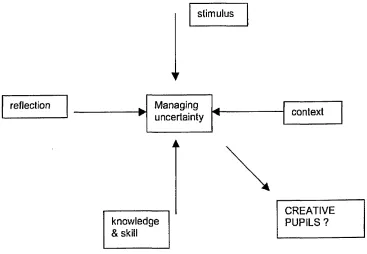
creativity in a classroom context. The following guidelines for supporting
• The activity has to be presented in a context to which the students can
relate;
• The activity has to be supported by a significant stimulus which is often,
but not exclusively, intensely visual;
• Focused teaching is necessary to provide knowledge, understanding and
skills;
• An attitude of continuous reflection needs to be encouraged;
stimulus
context
reflection Managing
uncertainty
knowledge & skill
CREATIVE PUPILS ?
Figure 1 Features of enhancing creativity identified by the Nuffield
QCA project
As is visible from the diagram at the centre of the features for enhancing
creativity, is the factor of managing uncertainty and risk taking in students. The
issue of making affordances for risk taking within classroom teaching and
learning has become a focus of concern for educators and researchers in D&T,
researching methods of promoting creativity in the subject. In his article
[image:33.614.118.485.216.470.2]with encouraging creativity within a curriculum led structure - that rewarding
creativity essentially involves rewarding f