Towards a Sequential One-Pot Preparation of
1,2,3-Benzotriazin-4(3H)-ones Employing a Key
Cp*Co(III)-catalyzed C-H Amidation Step
CHIRILA, Paula, SKIBINSKI, Lauren, MILLER, Keith
<http://orcid.org/0000-0001-8633-6952>, HAMILTON, Alexander and WHITEOAK, Christopher
<http://orcid.org/0000-0003-1501-5582>
Available from Sheffield Hallam University Research Archive (SHURA) at:
http://shura.shu.ac.uk/20914/
This document is the author deposited version. You are advised to consult the
publisher's version if you wish to cite from it.
Published version
CHIRILA, Paula, SKIBINSKI, Lauren, MILLER, Keith, HAMILTON, Alexander and
WHITEOAK, Christopher (2018). Towards a Sequential One-Pot Preparation of
1,2,3-Benzotriazin-4(3H)-ones Employing a Key Cp*Co(III)-catalyzed C-H Amidation
Step. Advanced Synthesis & Catalysis, 360 (12), 2324-2332.
Copyright and re-use policy
See
http://shura.shu.ac.uk/information.html
Towards a Sequential One-Pot Preparation of
1,2,3-Benzotriazin-4(3
H
)-ones Employing a Key
Cp*Co(III)-catalyzed C-H Amidation Step
Paula G. Chirila,
aLauren Skibinski,
aKeith Miller,
aAlex Hamilton
a*and Christopher J.
Whiteoak
a*a Department of Biosciences and Chemistry and the Biomolecular Sciences Research Centre (BMRC), Sheffield Hallam
University, Sheffield, S1 1WB, United Kingdom. E-Mail: [email protected] or [email protected]
Received: ((will be filled in by the editorial staff))
Supporting information for this article is available on the WWW under http://dx.doi.org/10.1002/adsc.201######.
Abstract. 1,2,3-benzotriazin-4(3H)-one derivatives have been recognised for their potential application as pesticides and pharmaceuticals and new methodologies for their preparation, starting from readily accessible reagents would therefore be an attractive proposition. A wide range of differently substituted benzamides are readily available, which provide an excellent substrate scaffold for the application of direct C-H functionalization protocols. In this context, herein we report the use of a Cp*Co(III) catalyst for the amidation of these benzamides, using 1,4,2-dioxazol-5-ones as amidating agent. The isolable intermediate 2- acetamido benzamide products can thereafter be converted to the desired 1,2,3-benzotriazin-4(3H)-one derivatives
through the use of tert-butyl nitrite under mild conditions. It was found to be possible to perform the second step with the crude reaction mixture obtained from the initial C-H amidation step, leading to the overall development of a facile one-pot procedure for the preparation of a range of substituted 1,2,3-benzotriazin-4(3H)-one derivatives, requiring only 5 hours of reaction time, which is also applicable on a gram scale. In addition, the key Cp*Co(III)-catalyzed C-H amidation step has been studied by DFT calculations in order to fully elucidate the mechanism.
Keywords: 1,2,3-benzotriazin-4(3H)-ones; C-H functionalization; cobalt; amidation; cyclization
Introduction
Formation of C-N bonds is one of the most important, yet challenging, transformations in synthetic organic chemistry.[1] Traditionally, both Ullman and Buchwald-Hartwig cross-couplings have provided the most successful routes for the preparation of these important bonds.[2,3] Although well established and used extensively, these methodologies suffer a major drawback, in that a pre-functionalized starting material is required. In this context, and with the explosion of research in the field of direct C-H functionalization,[4] much attention is now beginning to focus on the development of novel C-N bond forming reactions through direct C-H activation approaches.[5]
Bearing in mind that the well-established Buchwald-Hartwig methodology is based on relatively expensive palladium catalysis, more recently, focus has also begun to switch to the application of cheaper, more abundant, first row transition metals, such as iron, nickel and cobalt.[6] As a result of this, particularly since the publication by Kanai and Matsunaga on the powerful Cp*Co(III) catalyst for C-H functionalization protocols in 2013,[7] high-valent cobalt-catalyzed C-H functionalization has started to
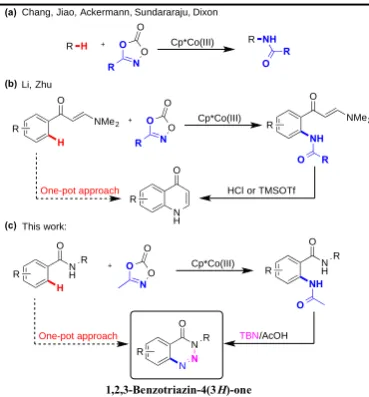
[image:2.595.348.533.421.620.2]Scheme 1. (a) general scheme for Cp*Co(III)-catalyzed amidation of C-H bonds with 1,4,2-dioxazol-5-ones. (b) Example of one-pot approaches to preparation of quinolone products simultaneously reported by Li and Zhu. (c) The sequential one-pot protocol reported in this work for conversion of benzamides to 1,2,3-benzotriazin-4(3H )-ones using Cp*Co(III) catalysis and tert-butyl nitrite (TBN).
Table 1. Optimization studies for Cp*Co(III)-catalyzed synthesis of 2-acetamido-N-isopropylbenzamide.a R H O Cp*Co(III)
NO R
O
+ RNH
O R
Chang, Jiao, Ackermann, Sundararaju, Dixon (a)
(b) O
NMe2
H
Cp*Co(III)
O
NO R
O
+
O NMe2 NH
O R
N H O
HCl or TMSOTf Li, Zhu
(c)
One-pot approach
This work: O
N H R H
Cp*Co(III)
O
NO
O
+
O
NH
O
NN
N O
One-pot approach
N H R R
R R
R
R
R R
TBN/AcOH
Entry Silver salt Base Solvent [mL] T [oC] 1a [%]b
1 AgNTf2 NaOAc 1,2-DCE [2] 80 64
2 AgOTf NaOAc 1,2-DCE [2] 80 23
3 Ag2O NaOAc 1,2-DCE [2] 80 trace
4 AgBF4 NaOAc 1,2-DCE [2] 80 65
5 AgSbF6 NaOAc 1,2-DCE [2] 80 66
6 AgSbF6 NaOPiv 1,2-DCE [2] 80 42
7 AgSbF6 CsOAc 1,2-DCE [2] 80 24
8 AgSbF6 Na2CO3 1,2-DCE [2] 80 63
9 AgSbF6 K3PO4 1,2-DCE [2] 80 50
10 - NaOAc 1,2-DCE [2] 80 trace
11 AgSbF6 - 1,2-DCE [2] 80 40
12 AgSbF6 NaOAc 1,2-DCE [2] 90 62
13 AgSbF6 NaOAc 1,2-DCE [2] 60 60
14 AgSbF6 NaOAc Toluene [2] 80 19
15 AgSbF6 NaOAc 1,4-Dioxane [2] 80 13
16 AgSbF6 NaOAc 1,2-DCE [4] 80 78 (77)c
17 AgOTf NaOAc 1,2-DCE [2] 80 23
a) General conditions: 0.5 mmol N-isopropylbenzamide, 8.0 mol% [Cp*Co(CO)I
2], 16 mol% silver salt, 20 mol% base,
1.20 equiv. 3-methyl-1,4,2-dioxazol-5-one, 2 mL solvent, T [oC], 16 hours. b) Yields of 1a calculated from 1H NMR of crude reaction mixture using mesitylene as internal standard. c) Yield after 4 hours.
attract significant attention, providing a wide range of coupling protocols.[8] In the field of C-N bond formation, several groups have successfully developed and applied Cp*Co(III)-catalyzed protocols.[9-11] One of the most intriguing protocols to be developed involves the use of readily available, easy to handle and bench-top stable, 1,4,2-dioxazol-5-ones (Scheme 1a).[11] These coupling partners are easily prepared on a gram scale and when employed in C-H functionalization protocols, only carbon dioxide is released as waste.
In our current research, we are focused on developing efficient routes to more valuable heterocyclic compounds starting from cheap, readily available, benzamide substrates. Amides are of interest as they are excellent directing groups for a range of C-H functionalization protocols.[12] Indeed, we have recently reported a facile preparation of azepinones using acrolein as coupling partner starting from these benzamides.[13]
Recently, both the groups of Li and Zhu simultaneously reported the one-pot preparation of quinolone compounds using Cp*Co(III) catalysis, aryl enaminone substrates and 1,4,2-dioxazol-5-ones (Scheme 1b).[11j,k] It was possible to isolate the intermediate amidation products, before a facile second reaction takes place, which furnishes the quinolone products. With this approach in mind, we decided to further develop and apply the Cp*Co(III)-catalyzed amidation of benzamides reported by Chang,[11a] before developing a second reaction which
could then be combined in a one-pot manner. Herein, we report the results from this study, providing a novel sequential one-pot procedure for the preparation of 1,2,3-Benzotriazin-4(3H)-ones using
tert-butyl nitrite as key reagent in the second reaction. 1,2,3-benzotriazin-4(3H)-ones are a family of heterocyclic compounds, which have been recognized for their potential application as pesticides and medicines, although their synthesis can be challenging.[14] Besides their use as pesticides and medicines, they have also been studied as useful precursors for Ni(0)-catalyzed heterocycle preparation.[15] Previously, these compounds have been synthesized using a variety of complex multi-step syntheses or from substrates which show limited availability for diversity.The new facile approach for their preparation described in this report would therefore present an attractive proposition and improve their accessibility, likely resulting in widened applications.[16]
Results and Discussion
We initiated our studies with the optimization of the C-H amidation coupling of N-isopropyl benzamide, 1, with 3-methyl-1,4,2-dioxazol-5-one using the [Cp*Co(CO)I2] catalyst, optimizing silver salt, base, solvent, reaction temperature and time (Table 1). The methyl substituted 1,4,2-dioxazol-5-one was selected,
N H O
N H O
H NH
O
[Cp*Co(CO)I2] (8.0 mol%)
silver salt (16 mol%) base (20 mol %)
solvent, T [oC]
O
N O
O
1 1a
Scheme 2. Substrate scope studying the effect of variation in substituent on the aromatic moiety of the N-isopropyl benzamide under the optimized reaction conditions; Isolated yields reported. General conditions: 1.5 mmol benzamide substrate, 8.0 mol% [Cp*Co(CO)I2], 16 mol% AgSbF6, 20 mol% NaOAc, 1.20 equiv. 3-methyl-1,4,2-dioxazol-5-one, 24
mL 1,2-DCE, 80 oC, 4 hours.
although Chang previously observed that this was not the optimal 1,4,2-dioxazol-5-one,[11a] as the objective was to further react the amide in a second reaction and
through use of the methyl, the mass loss will be reduced, increasing the sustainability of the process.[17] For note, in our hands, the 3-phenyl-1,4,2-dioxazol-5-one yielded a slightly decreased conversion (63%) compared to the 3-methyl-1,4,2-dioxazol-5-one (Scheme 2; 78%) under our optimized conditions.
The optimized conditions were found to be similar to those reported by Chang,[11a] although as might be expected, upon use of increased catalyst loading it was found that the reaction was complete in a significantly shorter time of 4 hours (Table 1, entry 16). Decreased catalyst loadings resulted in decreased yields (see supporting information, Table S5). In addition to this, an increased yield was obtained when the solvent was increased from 2.0 to 4.0 mL (Table 1, entry 5 vs. entry 16). For full details on the optimization of the reaction conditions see the Supporting Information.
With the optimized conditions in hand, the substrate scope was studied, broadening the scope reported by Chang (Scheme 2). Electron-withdrawing groups at the para-position afforded good to excellent yields for both weakly (8a, 9a and 10a) and highly deactivating groups (11a). The addition of electron-donating groups at the para position also delivered high yields of amidation products for weakly (2a, 3a,
4a and 12a) and highly (5a, 6a) activating groups.
However, inclusion of cyano at the para-position prevented the formation of the desired amidation product, 19a. This is likely due to the competitive coordination to the Cp*Co(III) catalyst with the necessary substrate binding site, thus inhibiting the amidation reaction.
The protocol also displayed meta-substituent tolerance affording high yields for both fluoro- and methyl-substitution in a regioselective manner (13a,
14a). The fluoro-substituted substrate was found to react at the most sterically hindered site, whereas the methyl- N H O R N H O R H NH O
[Cp*Co(CO)I2] (8.0 mol %) AgSbF6 (16 mol %) NaOAc (20 mol %)
1,2- DCE, 80 oC 4h O N O O N H O NH O N H O NH O N H O NH O N H O N H O NH O N H O NH O N H O NH O S N H O NH O F N H O NH O
F3C
N H O NH O F F F N H O NH O I N H O NH O
F3CS
N H O NH O N 1a: 78% 12a: 83% 3a: 81% 2a: 77%
7a: 89% 9a: >99%
5a: 90% 4a 72%
11a: 70%
8a: 81% 13a: 62%
14a: 75% 15a 58% 16a: 43%
N H O NH O N H O NH O I N H O NH O NC
18a: Traces 19a: Traces 20a: Traces 17a: Traces N H O NH O O 6a: 70% N H O NH O Br 10a: 45% S O N H NH O O O N H NH O xa x NH O + N H O NH O N H O NH O
21a: 77% 22a: 78%
N H O N H O O N H O N H O N H O O N H O Cl NH NH NH NH NH NH O O O O O O 26a: 62% 23a: 20% 27a: 19%
25a: 78% 28a: 20%
24a: 30% N H O R N H O R H NH O
[Cp*Co(CO)I2] (8.0 mol %) AgSbF6 (16 mol %) NaOAc (20 mol %)
Scheme 3. Substrate scope studying the effect of variation in substituent on the nitrogen atom of the benzamide under the optimized reaction conditions. General conditions: 1.5 mmol benzamide substrate, 8.0 mol% [Cp*Co(CO)I2], 16
mol% AgSbF6, 20 mol% NaOAc, 1.20 equiv.
3-methyl-1,4,2-dioxazol-5-one, 24 mL 1,2-DCE, 80 oC, 4 hours.
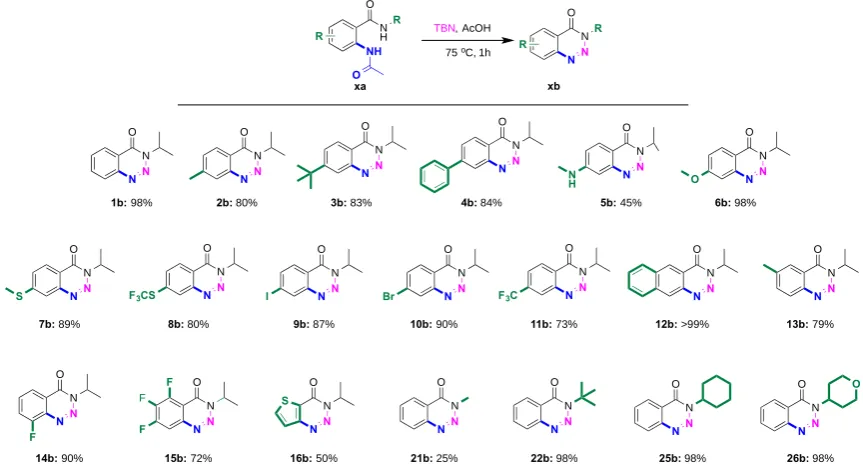
Scheme 4. Substrate scope studying the effect of variation in substituent on the aromatic moiety of the N-isopropyl benzamide and substituent on the nitrogen atom of the benzamide under the optimized reaction conditions; Isolated yields reported. General conditions: 1.0 mmol amidated benzamide, 3.0 equiv. TBN, 3.0 mL AcOH, 75 oC, 1 hour.
Table 2. Effect of reaction temperature variation on conversion of 1a to 1,2,3-benzo-triazin-4(3H)-one.a
Entry T[oC] Yield of 1,2,3-Benzo-triazin-4(3H) -one [%]b
1 25 25
2 50 75
3 75 98
a)
General conditions: 1.0 equiv. 1a, 3.0 equiv. TBN, 3.0 mL AcOH, T, 1 hour. b) Yields of 3a calculated from crude
1H NMR using mesitylene as internal standard.
substituted substrate was found to react at the least sterically hindered C-H. This regioselectivity is the same as we have observed in our previous Cp*Co(III) coupling of methyl vinyl ketone with benzamides and has been previously reported by several groups working with meta-substituted aromatic compounds.[13,18] In addition, the thiophene derivative could also be converted to furnish the corresponding amidation product, 16a.
When substituents were included in the ortho -position of the benzamide substrate, in the case of methyl- or iodo- (17 and 18), no amidation product was obtained. However, when the size of substituent
was decreased to fluoro, the amidation reaction proceeded in good yield (15a).
Thereafter, the effect of replacing the isopropyl amide with other substituents was studied (Scheme 3). Methyl, tert-butyl, cyclohexyl and tetrahydropyranyl were tolerated providing the corresponding amidated products, 21a, 22a, 25a and 26a, in similar yield to the isopropyl derivative. On the other hand, aromatic substituents provided the desired amides, 23a, 24a,
27a and 28a, in relatively poor yield. It was found that at the end of the reaction, there was a complex mixture between the desired amidation product and also the amidation of the amide substituent, and additionally a product displaying amidation of both the aromatic moieties. We have attempted to isolate all these products and their characterization is included in the Supporting Information. This observation is not unexpected as Chang also reported amidation of acetanilides under the optimized reaction conditions.[11a] However, the results showed that the selectivity could be slightly controlled to afford a higher yield of the desired product by the addition of an electron-withdrawing groups at the
para-position of the phenylamine. Consequently, adding a halogen at the para position affords a higher yield of 24acompared to 23a.
With a library of 2-acetamido benzamides in hand and with an interest in conversions utilizing tert-butyl nitrite (TBN) we were pleased to see that upon reacting 2-acetamido-N-isopropylbenzamide, 1a, with TBN in acetic acid (AcOH) at 75 oC, an intriguing transformation towards the cyclic
1,2,3-benzo-triazin-N O NN N O NN N O NN N O NN N O NN N O NN N O NN F F F N O NN N O NN O N O NN N O NN F3CS 1b: 98% 12b: >99% 2b: 80% 3b: 83%
15b: 72% 8b: 80%
22b: 98%
21b: 25% 25b: 98% 26b: 98%
N O NN N O NN I N O NN S N O NN F3C N O NN F S O N NN 14b: 90% 9b: 87% 7b: 89% 4b: 84% 16b: 50%
11b: 73% 13b: 79%
N H O R NH O N O NN R
75 oC, 1h
xa xb N O NN N H 5b: 45% N O NN 6b: 98% O N O NN 10b: 90% Br
TBN, AcOH
R R N H O NH O N O NN TBN AcOH
T [oC]
[image:5.595.98.530.104.340.2]4(3H)-one was observed, in excellent yield (98%). Reducing the temperature at which this conversion is carried out, decreases the yield of 1,2,3-benzo-triazin-4(3H)-one obtained (Table 2). AcOH was chosen as
solvent as in previous work we have observed that highly reactive species are formed from the degradation of tert-butyl nitrite to nitrogen oxide.[19] Typically 1,2,3-benzo-triazin-4(3H)-ones can be
Figure 1. Solvent corrected Free Energy Surface (ΔG298 kcal mol-1) for the amidation of isopropyl benzamide with
3-methyl-1,4,2-dioxazol-5-one. Free energies taken relative to the [Cp*Co(III)(AcO)2] pre-catalyst and associated reagents.
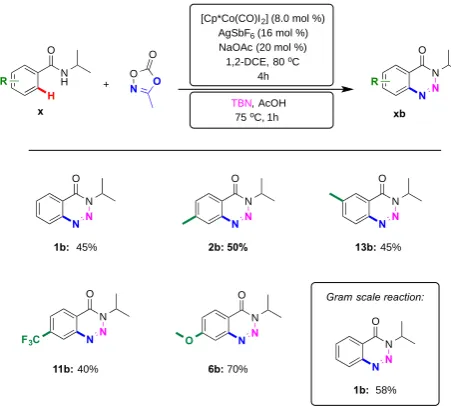
Scheme 5. Examples of conversions of benzamides towards 1,2,3-benzo-triazin-4(3H)-ones by a sequential one-pot protocol developed in this work (including a gram scale synthesis of 1b from 1g of benzamide 1): Isolated yields reported. General conditions: Optimized reaction conditions for each individual step.
prepared through the reaction of methyl-2-aminobenzoate with sodium nitrite.[20] This route limits the facile inclusion of substituents on the aromatic ring, whereas the newly developed protocol described in this report provides a methodology for a wide substituent scope.
With the new facile protocol for the conversion of 2-acetamido-N-isopropylbenzamide, 1a, to 1,2,3-benzo-triazin-4(3H)-one developed, all the remaining 2-acetamido benzamides previously obtained were converted (Scheme 4). Substituents at the para-position of the original benzamide afforded excellent yields of the desired products (2b, 3b, 4b, 6b, 8b, 9b,
10b and 11b). Intriguingly, 5b was obtained as the secondary amine which may result from dealkylation of the dimethylamine in the presence of tert-butoxy radical.[21] High yields of 1,2,3-Benzotriazin-4(3H )-one were also obtained for compounds bearing meta -substituents (13b, 14b). A lower yield of 50% was observed when the thiophene substrate was applied.
Furthermore, 21b was converted in low yield compared to 1b and 22b. This is proposed to result from a less stable intermediate during the reaction with TBN.
Inspired by the work of Zhu and Li,[11j,k] we attempted to synthesize some of our target molecules in a sequential one-pot protocol, to eliminate the need for intermediate work-up. The development of one-pot protocols is highly attractive and attracting increased attention.[22] The obtained yields after one pot reaction with 1b, 2b, 6b, 11b, and 13b (Scheme 5) were comparable to the overall yields of the combined individual steps and exemplify the application of a facile sequential one-pot protocol for the preparation of 1,2,3-benzo-triazin-4(3H)-ones using Cp*Co(III) C-H functionalization catalysis as the key step. To explore the scalability of the new sequential one-pot protocol, a gram scale conversion was attempted. We were delighted to observe an
N H O
H
[Cp*Co(CO)I2] (8.0 mol %)
AgSbF6 (16 mol %)
NaOAc (20 mol %) 1,2-DCE, 80 oC
4h O
N O
O
x 75 oC, 1h
TBN, AcOH N
N
N O
R R
xb
N O
NN
1b: 45%
N O
NN
2b: 50%
N O
NN
13b: 45%
N O
NN F3C
11b: 40%
N O
NN O
6b: 70% +
Gram scale reaction:
N O
NN
[image:6.595.69.295.395.598.2]overall yield of 58%, highlighting the potential of this new synthetic protocol. This yield is slightly higher than the smaller scale reactions (45%) likely as a result of the easier isolation of larger amounts of product.
To further understand the initial Cp*Co(III)-catalyzed amidation step, both deuterium exchange and parallel Kinetic Isotope Effect (KIE) experiments were performed (Scheme 6). The results obtained
Scheme 6. Experimental insights into mechanism of the Cp*Co(III)-catalyzed C-H amidation step.
demonstrate that the C-H activation step is clearly reversible and that C-H cobaltation is kinetically relevant in the rate-determining step of the mechanism.
In addition to the experimental results, and in order to gain an in-depth insight into the mechanism of formation for the new C-N bond, DFT calculations were carried out (Figure 1). The formation of the cationic active catalyst [Cp*Co(OAc)]+ species forms as a result of the loss of acetate ion from the neutral [Cp*Co(OAc)]2 pre-catalyst.[23] Subsequently, the [Cp*Co(OAc)]+ coordinates to the lone pair of the oxygen of the isopropyl benzamide substrate to form the first intermediate (Int1). This is in agreement with our previous DFT study.[13] Subsequent C-H activation leads to the 5 membered cobaltacycle, Int2. This C-H activation step takes place via an energy barrier of 21.5 kcal mol-1. Loss of acetic acid and coordination of the amidating agent, dioxazolone, yields Int3.
The following migratory insertion of the 1,4,2-dioxazol-5-one, with formation of the new C-N bond and concomitant loss of CO2, into the Co(III)-C bond is the rate determining step for the reaction with a barrier of 25.2 kcal mol-1. It should be noted that a stepwise barrier has also been calculated and is 0.5 kcal mol-1 higher in the energy. Interestingly, both the Cp*Co(III)-catalyzed concerted and stepwise mechanisms are significantly higher in energy than the equivalent Cp*Ir(III)-catalyzed CO2 extrusion reported by Chang for the same benzamide substrates.[24] In an effort to understand this difference between the two catalyst systems QTAIM[25] topological analysis of the equivalent transition state structures was carried out. The bond critical point connecting the metal and the 1,4,2-dioxazol-5-one nitrogen was located and the QTAIM parameter for ρ,
∇2
ρ and V(r) all highlight increased stabilization of the imido-like transition state structure for the Cp*Ir(III) catalyst (see supporting information for full details).
At first glance this proposal for the migratory insertion being the rate determining step contradicts the experimentally obtained KIE results, however taking into account the reversibility of the initial C-H activation step having the potential to limit the equilibrium concentration of the following intermediates prior to this migratory insertion, a relatively small KIE is not unexpected.[26]
The insertion step leads to Int4 with a significant stabilization in energy. Which is in agreement with the observed irreversibility of the reaction after the loss of CO2. Entropically unfavorable addition of an acetic acid to the coordination site weakly associated to the benzamide oxygen affords Int5. Coordination of the acetic acid facilitates the last step of the reaction, which is the protonation of the newly installed amide group, with a barrier of 7.8 kcal mol-1, forming Int6.
Dissociation of Int6 releases the 2-acetamido benzamide product and regenerates the active [Cp*Co(OAc)]+ catalyst, completing the catalytic cycle. This mechanism is also in agreement with the DFT study provided by Kim and Chang for the amidation of arylpyridines under Cp*Rh(III) catalysis using the same 1,4,2-dioxazol-5-one amidating agents, although the energies are not directly comparable due to the different substrates being used.[27,28] For completeness, the triplet surface was also analyzed for this mechanism, with all structures being significantly higher in energy, see supporting information for full details. Scheme 7 summarizes the proposed catalytic cycle for the formation 2-acetamido benzamides using both the experimental and the DFT results obtained in this study.
N H O N H O H D
[Cp*Co(CO)I2] (8.0 mol %)
AgSbF6 (16 mol %)
NaOAc (20 mol %) 1,2- DCE/CD3OD (2 mL/0.1 mL)
80 oC, 4h
a a[D2]
N H O N H O NH O
[Cp*Co(CO)I2] (8.0 mol %)
AgSbF6 (16 mol %)
NaOAc (20 mol %) 1,2- DCE, 80 oC
4h O
N O
O
a or a[D5]
1a or 1a[D5]
+
D
H
50% D incorporation
H5/D5
KIE = 2.09
Parallel experiments
(a) H/D exchange
(b) KIE study
Co *Cp OAc + N H O Co *Cp OAc R + H N H O Co *Cp AcOH R + N H O Co Cp* R N + + N H O R H AcOH N H O NH R Substrate coordination CMD step Dioxazolone insertion Proto-demetallation
[Cp*Co(CO)I2]
2 AgSbF6
- 2AgI [Cp*Co(CO)](SbF6)2 2 OAc
-- 2 SbF6
-[Cp*Co(OAc)2]
- OAc
-Generation of cationic catalyst species
Scheme 7. Proposed catalytic cycle for Cp*Co(III)-catalyzed coupling of 1,4,2-dioxazol-5-ones and benzamides for the preparation of 2-acetamido benzamides.
The mechanism for the conversion of 2-acetamido benzamides to the corresponding 1,2,3-benzotriazin-4(3H)-ones is less clear. It is well known that alkyl nitrites are a source of nitrogen oxide (NO)[29] and it is likely that this species reacts with the amide of the 2-acetamido benzamides generating a highly reactive
N-nitrosoamide intermediate, reported recently by Bhanage.[30] This intermediate is thereafter able to cyclize, furnishing the observed heterocyclic products.
Conclusion
In summary, we have demonstrated that using a [CoCp*(CO)I2] catalyst, a wide library of substituted benzamides can be successfully amidated employing readily available 3-methyl-1,4,2-dioxazol-5-one. Furthermore, we have disclosed a novel approach to synthesize valuable 1,2,3-benzotriazin-4(3H)-ones from the intermediate 2-acetamido-N-benzamides through a single step reaction using TBN. The two steps can be combined to provide a sequential one-pot synthesis of 1,2,3-benzotriazin-4(3H)-ones, starting from the readily available and cheap benzamides. Finally, the mechanism of the Cp*Co(III)-catalyzed C-H amidation step has been elucidated for the first time using DFT studies, wherein it has been found that despite an experimentally obtained KIE of 2.09, the migratory insertion is the rate limiting step. This observable KIE arises from the reversibility of the C-H cobaltation step.
Experimental Section
General procedure for amidation of benzamides
Benzamide substrate (1.5 mmol), [Cp*Co(CO)I2] (8.0
mol%, 0.12 mmol), AgSbF6 (16 mol%, 0.24 mmol),
NaOAc (20 mol%, 0.30 mmol), 3-methyl-1,4,2-dioxazol-5-one (1.2 equiv., 1.8 mmol) and 1,2-DCE (24 mL) were added to a 40 mL vial under air. The vial was sealed, and the mixture stirred at 80 oC for 4 hours. The crude reaction mixture was purified by column chromatography, using hexane/EtOAc (8/2) as eluent to provide the analytically pure amidation product.
General procedure for synthesis of 1,2,3-benzotriazin-4(3H)-ones from the amidated benzamides
To an 8 mL vial, under air, was added amidated benzamide (1.0 mmol), AcOH (3.0 mL) and tert-butyl nitrite (3.0 equiv., 3.0 mmol). The vial was sealed, and the reaction mixture was stirred at 75 oC for 1 hour. After this period, the acetic acid was removed under reduced pressure and the crude reaction mixture was purified by column chromatography using hexane/EtOAc (1/1) as eluent to
provide the analytically pure 1,2,3-benzo-triazin-4(3H )-one product
Sequential one-pot procedure for conversion of benzamides to 1,2,3-benzotriazin-4(3H)-ones
Under air, a 20 mL vial was charged with benzamide (0.5 mmol), [Cp*Co(CO)I2] (8.0 mol%, 0.04 mmol), AgSbF6
(16 mol%, 0.08 mmol), NaOAc (20 mol%, 0.10 mmol), 3-methyl1,4,2-dioxazol-5-one (1.2 equiv., 0.6 mmol) and 1,2-DCE (8 mL). The vial was sealed and the mixture was stirred at 80 oC for 4 hours. After this time, the solvent was evaporated under reduced pressure and tert-butyl nitrite (3.0 equiv., 1.5 mmol) and AcOH (3.0 mL) were added to the crude reaction mixture. The reaction was then stirred at 75 oC for a further 1 hour. The AcOH was then removed under reduced pressure and the crude was purified by column chromatography using hexane/EtOAC (1/1) as eluent to provide the analytically pure 1,2,3-benzo-triazin-4(3H)-one.
Full characterization data (including original 1H, 13C {1H},
19F {1H} and COSY NMR for all products) can be found in
the Supporting Information.
Computational details
All DFT calculations undertaken using the ORCA 3.03 computational software. Optimisations were performed at the BP86-D3BJ/def2-TZVP level of theory and final single point energies and solvation corrections calculated at M06/def2-TZVP. Frequencies calculations approximated the ZPE correction and entropic contributions to the free energy term as well as confirming all intermediate were true with no imaginary modes and all transition states had the correct critical frequency of decomposition (imaginary mode). Solvation correction was implemented with the COSMO model for 1,2-DCE. Graphical visualisation using Gabedit 2.4.8 and Avogadro 1.2.0 programs. For full computational details see the Supporting Information.
Acknowledgements
The authors would like to thank the Department of Biosciences and Chemistry and the Biomolecular Sciences Research Centre (BMRC) at Sheffield Hallam University for funding. We would also like to thank Dr Daniel Allwood from Sheffield Hallam University for his insightful comments. CJW and PGC would also like to thank COST Action CA15106 (CHAOS) for funding and providing a fruitful platform for discussion.
References
[1](a) R. Hili, A. K. Yudin, Nat. Chem. Biol., 2006, 2, 284. (b) J. Bariwalab, E. Van der Eycken, Chem. Soc. Rev.,
2013, 42, 9283.
[2] G. Evano, N. Blanchard, M. Toumi, Chem. Rev., 2008,
108, 3054.
[3] P. Ruiz-Castillo, S. L. Buchwald, Chem. Rev., 2016,
116, 12564.
Singh, A. Lei, Chem. Rev., 2017, 117, 9016. e) J.-P. Wan, L. Gan, Y. Liu, Org. Biomol. Chem., 2017, 15, 9031. f) Y. Qin, L. Zhu, S. Luo, Chem. Rev., 2017, 117, 9433.
[5] a) J. Jiao, K. Murakami, K. Itami, ACS Catal., 2016, 6, 610. b) K. Shin, H. Kim, S. Chang, Acc. Chem. Res.,
2015, 48, 1040.
[6] G. Pototschnig, N. Maulide, M. Schnürch, Chem. Eur. J. 2017, 23, 9206.
[7] T. Yoshino, H. Ikemoto, S. Matsunaga, M. Kanai,
Angew. Chem. Int. Ed., 2013, 52, 2207.
[8] For an overview of cobalt-catalyzed C-H functionalization, see: a) M. Moselage, J. Li, L. Ackermann, ACS Catal., 2016, 6, 498. b) D. Wei, X. Zhu, J.-L. Niu, M.-P. Song, ChemCatChem, 2016, 8, 1242. c) T. Yoshino, S. Matsunaga, Adv. Synth. Catal.,
2017, 359, 1245. d) S. Wang, S.-Y. Chen, X.-Q. Yu,
Chem. Commun., 2017, 53, 3165. e) P. G. Chirila, C. J. Whiteoak, Dalton Trans., 2017,46, 9721. f) T. Yoshino, S. Matsunaga, Adv. Organomet. Chem., 2017, 68, 197. g) S. Prakash, R. Kuppusamy, C.-H. Cheng,
ChemCatChem, 2018, 10, 683.
[9] For examples using azides as coupling partners see: a) B. Sun, T. Yoshino, S. Matsunaga, M. Kanai, Adv. Synth. Catal., 2014, 356, 1491. b) B. Sun, T. Yoshino, S. Matsunaga, M. Kanai, Chem. Commun., 2015, 51, 4659.
[10] For an example using carbamates as amidating agents see: P. Patel, S. Chang, ACS Catal., 2015, 5, 853. [11] For examples using 1,4,2-dioxazol-5-ones as
amidating agents see: a) J. Park, S. Chang, Angew. Chem. Int. Ed., 2015, 54, 14103. b) Y. Liang, Y. Liang, C. Tang, Y. Yuan, N. Jiao, Chem. Eur. J., 2015, 21, 16395. c) X. Wang, A. Lerchen, F. Glorius, Org. Lett.,
2016, 18, 2090. d) R. Mei, J. Loup, L. Ackermann,
ACS Catal., 2016, 6, 793. e) F. Wang, H. Wang, Q. Wang, S. Yu, X. Li, Org. Lett., 2016, 18, 1306. f) N. Barsu, M. A. Rahman, M. Sen, B. Sundararaju, Chem. Eur. J., 2016, 22, 9135. g) X. Yu, Q. Ma, S. Lv, J. Li, C. Zhang, L. Hai, Q. Wang, Y. Wu, Org. Chem. Front.,
2017, 4, 2184. h) J. Huang, Y. Huang, T. Wang, Q. Huang, Z. Wang, Z. Chen, Org. Lett., 2017, 19, 1128. i) P. W. Tan, A. M. Mak, M. B. Sullivan, D. J. Dixon, J. Seayad, Angew. Chem. Int. Ed., 2017, 56, 16550. j) F. Wang, L. Jin, L. Kong, X. Li, Org. Lett., 2017, 19, 1812. k) P. Shi, L. Wang, K. Chen, J. Wang, J. Zhu,
Org. Lett., 2017, 19, 2418.
[12] R.-Y. Zhu, M. E. Farmer, Y.-Q. Chen, J.-Q. Yu,
Angew. Chem. Int. Ed. 2016, 55, 10578.
[13] P. G. Chirila, J. Adams, A. Dirjal, A. Hamilton, C. J. Whiteoak, Chem. Eur. J., 2018, 24, 3584.
[14] Z. Khalid, H. A. Ahmad, M. A. Munawar, M. Khan, S. Gul, Heterocycles, 2017, 94, 3.
[15] a) T Miura, M Yamauchi, M. Murakami, Org. Lett.,
2008, 10, 3085. b) T. Miura, M. Morimoto, M. Yamauchi, M. Murakami, J. Org. Chem., 2010, 75, 5359. c) N. Wang, S.-C. Zheng, L.-L. Zhang, Z. Guo,
X.-Y. Liu, ACS Catal., 2016, 6, 3496. d) V. H. Thorat, N. S. Upadhyay, M. Murakami, C.-H. Cheng, Adv. Synth. Catal., 10.1002/adsc.201701143
[16] For an example of the potential of 1,2,3-benzotriazin-4(3H)-ones as precursors for accessing more complex compounds see: J. J. A. Campbell, S. J. Noyce, R. C. Storr, J. Chem. Soc., Chem. Commun., 1983, 22, 1344. [17] P Anastas, N. Eghbali, Chem. Soc. Rev., 2010, 39,
301.
[18] See for examples: a) T. Gensch, S. Vásquez-Céspedes, D.-G. Yu, F. Glorius, Org. Lett., 2015, 17, 3714. b) J. Li, L. Ackermann, Chem. Eur. J., 2015, 21, 5718. c) Y. Bunno, N. Murakami, Y. Suzuki, M. Kanai, T. Yoshino, S. Matsunaga, Org. Lett., 2016, 18, 2216. d) B. Sun, T. Yoshino, M. Kanai, S. Matsunaga, Angew. Chem. Int. Ed., 2015, 54, 12968.
[19] C. J. Whiteoak, O. Planas, A. Company, X. Ribas,
Adv. Synth. Catal., 2016, 358,1679.
[20] T. S. Ibrahim, A. A. Rashad, Z. K. Abdel-Samii, S. A. El-Feky, M. K. Abdel-Hamid, W. Barakat, Med. Chem. Res.,2012, 21, 4369.
[21] For an example of the tert-butoxy radical involved in demethylation of alkyl amines see: R. K. Kawade, D. B. Huple, R.-J. Lin, R.-S. Liu, Chem. Commun., 2015, 51, 6625.
[22] For examples and a discussion the advantages of one-pot procedures see: Y. Hayashi, Chem. Sci., 2016, 7, 866
[23] For an example of a DFT study where cationic cobalt(III) species has been proposed as the active catalyst see: S. Qu, C. J. Cramer, J. Org. Chem., 2017,
82, 1195.
[24] Y. Hwang, Y. Park, S. Chang, Chem. Eur. J., 2017, 23, 11147.
[25] T. Lu, F. Chen, J. Comput. Chem., 2012, 33, 580. [26] For a discussion on the interpretation of KIE values in
transition metal-catalyzed C-H functionalization, see: E. M. Simmons, J. F. Hartwig, Angew. Chem. Int. Ed.,
2012, 51, 3066.
[27] Y. Park, K. T. Park, J. G. Kim, S. Chang, J. Am. Chem. Soc., 2015, 137, 4534.
[28] It appears from a review of the literature that the significance of the C-H cobaltation step as the rate-determining step varies widely with substrate; for example, the KIE for arylpyridines and anilides observed experimentally by Chang was 1.1 and 3.8, respectively, from parallel experiments. See Ref 11a.
[29] Tert-butyl nitrite is a known source of nitrogen monoxide, see: P. G. Wang, T. B. Cai, N. Taniguchi, in: Nitric Oxide Donors: for Pharmaceutical and Biological Application, (Eds.: P. G. Wang, T. B. Cai, N. Taniguchi), Wiley-VCH, Weinheim, 2005.
[30] S. L. Yedage, B. M. Bhanage, J. Org. Chem., 2017,