Surviving in the shadows of war: Polyvictimised children
in post-conflict Angola
COLE, Bankole <http://orcid.org/0000-0001-6741-0467>, MAXWELL, Maureen and CHIPACA, Adelino
Available from Sheffield Hallam University Research Archive (SHURA) at: http://shura.shu.ac.uk/10521/
This document is the author deposited version. You are advised to consult the publisher's version if you wish to cite from it.
Published version
COLE, Bankole, MAXWELL, Maureen and CHIPACA, Adelino (2014). Surviving in the shadows of war: Polyvictimised children in post-conflict Angola. Crime Prevention and Community Safety, 16 (2), 87-104.
Copyright and re-use policy
See http://shura.shu.ac.uk/information.html
1
Surviving in the Shadows of War:
Polyvictimised children in post-conflict Angola
Bankole Cole, Reader in Criminology, Northumbria University, Newcastle-upon-Tyne, UK Maureen Maxwell, Senior lecturer in criminology, University of Lincoln, UK.
Adelino Chipaca, Jurisconsult, Luanda, Angola
Proofs to be sent to:
Dr Bankole Cole
Department of Social Sciences and Languages, The University of Northumbria at Newcastle, Newcastle-upon-Tyne
NE1 8ST
United Kingdom
2
Surviving in the Shadows of War:
Polyvictimised children in post-conflict Angola
ABSTRACT
This article reports on findings from a preliminary study that aims to ascertain the extent to
which a group of 30 15-17 year old Angolan juvenile suspects are polyvictims, as defined by
Finkelhor et al. (2005a, 2007a), and the degree to which their victimisation might be
attributed to the aftermath of the country’s civil war. Analysis of their victimisation
identified the majority as being polyvictims. Research into the context of victimisation
revealed their neighbourhoods as being of primary importance. Findings confirm a direct
link between these children’s victimisation and Angola’s war history. The article concludes
that Angolan authorities need to adopt a psychosocial approach to dealing with the traumatic
experiences of these children and their social development.
3
INTRODUCTION
A state’s obligation to protect its children from violence, maltreatment and abuse, as defined
by Article 19 of the United Nations’ Convention on the Rights of the Child, (hereafter
UNCRC)(UNICEF UK, 1989) is fundamental, yet remains amongst the most controversial
and contested areas of human rights. Between 1996 and 2001, Human Rights Watch (2001)
revealed numerous atrocities against children in several countries worldwide; including
violence and abuse suffered at the hands of the police, in detention correctional institutions, at
school, in orphanages and in the workplace. The United Nations World Report on Violence
against Children (2006) confirmed the multiple nature of such victimisation worldwide. This
report adopts the definition of violence used in Article 19 of UNCRC: “all forms of physical
or mental violence, injury and abuse, neglect or negligent treatment, maltreatment or
exploitation, including sexual abuse.” The key messages of the report are that no violence
against children is justifiable and that all violence against children is preventable. However,
the NGO Advisory Council for Follow-up to the UN Study on Violence against Children
(2011, p.2) revealed how, despite numerous commitments and promises by governments,
violence against millions of children in all settings worldwide continues:
“Children continue to be humiliated, beaten, burned, and sexually abused by the
adults in their lives, their parents, teachers, caregivers, and employers. Children
continue to be traumatized by community violence, trafficking, exposure to
domestic violence, and direct physical, verbal, and sexual assault”.
Most international publications on child victimisation include examples from African
countries engaged in armed conflicts (See Human Rights Watch, 1996; 2012; Women’s
Commission for Refugee Women & Children, 2000; Coalition to Stop the Use of Child
4
studies, producing a fragmented approach which underestimates the true nature of child
victimisation. There exists no unique African study of multiple experiences in various
contexts, with a view to providing a holistic picture upon which to plan appropriate welfare
support and prevention strategies. This article applies the polyvictimisation concept of
Finkelhor et al (2005a and b, 2007a,) amongst others to sample of 30 youths from Angola’s
capital city, Luanda. The aims of the article are to (i) explore the nature of and extent to
which, the research sample of Angolan youth are polyvictims (ii) explore the role that
Angola’s war history and legacy plays in their victimisation, and (iii) suggest approaches to
deal with the resultant trauma experienced by these youth who are living in the shadows of
war.
POLYVICTIMISATION
The concept of polyvictimisation, first coined by David Finkelhor et al (2005a) was based on
a US developmental victimisation survey (DVS) of 2030 children aged 2 – 17 years. It
describes the multiple and interrelated nature of child victimisation, to distinguish it from
traditional child victimisation studies which customarily focus on only one type of
victimisation, such as, sexual abuse. Finkelhor et al (op.cit.) argued that ignoring
polyvictimisation produces a partial picture, which underestimates the burden of victimization
experienced. Past research, they assert, has confirmed that multiple victimisation is common
(see Outlaw et al, 2002), yet the interrelationship between different kinds of victimization
have only been superficially explored. These interconnections are ‘not apparent when only a
few forms of victimization are assessed, (Finkelhor et al, 2005a, p 6). Furthermore, they
contend that focusing on single victimisation, however repeated, may overestimate the
symptoms of single victimisations and miss the larger profile of child victimisation. They
5
victimisation profiles affording a more holistic, comprehensive approach to children’swelfare; one that would “encourage treatment that targets the full range of victimisations to
which children are exposed” (Turner et al, 2010a, p.328). This enables practitioners to target
families mostly in need of support and respond more effectively to curb the negative effects of
children’s exposure to violence,( Finkelhor et al, 2009a: 9). Most importantly: “multiple
victimizations may be a sign that children are poorly supervised or socially isolated and thus
unprotected targets. [Thus], multiple victimizations may be more markers than agents of the
children’s difficulties,” (Finkelhor et al, 2007a, p. 9).
The DVS used a juvenile victimisation questionnaire (hereafter JVQ) consisting of 34
items of youth victimisation divided into five categories: conventional crime, maltreatment,
peer and sibling victimisation, sexual assault and witnessing and indirect victimisation. The
polyvictimised child is defined as a child that had experienced four or more different kinds of
victimizations in separate incidents within the previous year, (Finkelhor et al, 2005b, p.1302).
They further distinguished low victims (four to six victimizations) from high
poly-victims (seven victimisations or more) (ibid; see also Finkelhor et al, 2007a, p.13).
Following the National Survey of Children’s Exposure to Violence (hereafter
NATSCEV), the concept of polyvictimisation was further developed, (Finkelhor et al, 2011a,
p. 293; Finkelhor et al, 2011b, p.3). This survey was conducted on a nationally representative
sample of 4549 children ages 0–17 and their caregivers living in the United States.
NATSCEV expands on the DVS by comprehensively assessing lifetime exposure; it considers
additional forms of violence and includes infants in the sample. That survey asked questions
about 48 types of victimization grouped under seven headings: conventional crime, child
maltreatment, peer and sibling victimization, sexual victimization, witnessing and indirect
victimization, school violence and threat, Internet violence and victimization, (Finkelhor et al,
6
in terms of personal experiences, significant victimisation can also occur from witnessed
events or indirect victimisation, such as abuse of family members. In addition, it was found
that victimisation tends to accumulate for certain individuals with particular characteristics
and living in certain environments.(Finkelhor et al, 2011b, p.4).
Most studies on polyvictimisation identify the polyvictim using numerical assessment
of different victimization that occurred in separate incidents over a specified period of time,
(see. Finkelhor 2007a; 2009b). Equally weighting occurrences erroneously suggest
homogeneity, ignoring the differential effects that diverse forms of victimisation may have
(Finkelhor et al, 2005b). Such assessment is useful in identifying youth most at risk, but could
also adversely under-estimate those not yet identified as polyvictims. That non-polyvictims
may not have suffered the same amount of serious victimisations as polyvictims does not
necessarily make them less a victim or negate their need for welfare support. Furthermore, to
date, all the studies have been conducted mainly in the USA and Canada. The definitions and
findings have yet to be assessed in non-Western countries.
ANGOLA
Angola is often remembered for its lengthy internal political conflicts which began in the
1960s with its struggle for independence from Portugal (achieved in 1975), and followed by a
27-year armed political struggle for power between rival political parties. These wars, like
similar conflicts in several other African countries, for example Mozambique, Burundi,
Rwanda, Sierra Leone, and Liberia involved the use of children as soldiers, (Wessells, 1997;
Coalition to Stop the Use of Child Soldiers, 2004 a, b; Wessells and Monteiro, 2006).
Horrifying accounts of violence and atrocities against children either directly as combatants
or as a result of separation from families, bereavement, forced migrations or displacement are
7
Christian Children’s Fund, 2002; Human Rights Watch, 2002; Wessells & Monteiro, 2006;IRIN, 2007).
Although the civil war ended in 2002, almost three decades of war left Angola with
multiple social and economic problems (Human Rights Watch, 2003). In the post-bellum
period, an estimated 16,000 children required demobilisation, (Coalition to Stop the Use of
Child Soldiers, 2004b). However, as children were not classified as soldiers because of their
age, they received a smaller reintegration support package than their adult counterparts
(World Bank, 2003). Many children orphaned or abandoned as a result of war ended up in
poverty; others abandoned the war-torn hinterland and migrated into cities where they
constitute a significant proportion of the slum dwellers and ‘street children’, especially in the
capital city, Luanda, (Veale and Dona, 2003).
In Angola, it is said that ‘no man or woman has lived totally during peacetime,’
(Rodrigues 2010, p 5). The Human Rights Watch report (2003, p.4) asserted that “almost
every child in Angola has been affected by the conflict either directly or indirectly through
their families or communities.” According to the Angolan National Institute for Statistics,
Instituto Nacional de Estatística, (INE, 2001 cited in Rodrigues, 2010, p.7):
“The war has forced many young people into roles they are not ready to take;
many became providers and heads of households. In the early 2000’s, an
estimated four million households in Angola were headed by young people aged
16 to 20”
Unemployment, poverty, violent crimes, drugs and alcohol abuse and street gang activities by
youths are amongst the problems in Angola associated with the aftermath of the civil war
agro-8
economy, the foundation of subsistence and the dominant cultural mode of life for the
majority of rural Angolans. In addition, increased rural- urban migration has placed intense
pressure on urban social infrastructures. According to the Women’s Commission for Refugee
Women and Children (WCRWC, 2001) education was the most seriously compromised by
the war, when several schools were destroyed. As a result of poverty, education became
inaccessible to many young Angolans, unable to pay required school fees.
The prevailing image of young people in post-conflict Angola is that of a lost
generation, variously described as, for example, “children broken by society,” (De Boeck and
Honwana, 2005); “robbed of their childhood,” (Honwana, 2008, p.145), and “struggling to
survive against all odds,” (WCRWC, 2001, p. 2). The war had turned some children into
drugged killing machines, with powers beyond their age, (UNICEF, 2006). Wessells and
Monteiro (2006, p.125) claim that all Angolan youths have grown up amidst normalised
violence at multiple levels and they are placed at risk of continuing cycles of violence.
Honwana (2005) describes how those traditional institutions which played a significant role
in the initiation of children into adulthood in Angola have been destroyed and the young
people’s perceptions of social reality have been distorted by the experience of war. The
foregoing accounts of post-conflict Angola presuppose that Angola is one non-Western
country where polyvictimisation evidence could be expected.
THE STUDY
This article is based on findings of a study of 15-17 year old juvenile suspects in Angola.
Initial aims of the study were to conduct a survey of juvenile delinquents in the city of
Luanda, with the objectives of acquiring an explanation of the children’s delinquency from
their own accounts and exploring their experiences of victimisation. The overarching aim is
9
contributed to their offending and victimisation, (see Cole and Chipaca, 2014). From the
onset, it was clear the focus had to be limited because of limited reliable databases on
juvenile delinquents in Angola; convicted offenders below the age of 16 are supervised in the
community where access to them is difficult as official records on their whereabouts are
unreliable or inaccessible; and, there are no prisons or detention facilities for young people
convicted of crimes in Angola. Children over the age of 16 found guilty of imprisonable
offences are given half-sentences and detained in adult prisons. Research access to such
children is difficult in Africa, (Human Rights Watch, 2007). The only option left for the
research is the Observation Centre, a secure accommodation in Luanda for 12 - 17 year old
boys awaiting trial. No such facility for girls exists; the official perception is that girls
commit less crime and those awaiting trial remain at home. If found guilty, girls under 16 are
community supervised; girls over 16 are detained in an adult female prison. Consequently,
gender comparisons, although not possible, were identified as a key area for future research.
THE SAMPLE
At the time of the study, February-March 2012, 75 juveniles were housed at the Observation
Centre. Each was approached to participate yet, after full briefing, only 40% responded.
Although they limit comparison with larger studies, numbers do not necessarily inhibit
developing a full understanding of the complex nature of children’s victimisation in different
contexts, necessary to inform effective preventative interventions or welfare provisions for
the victims. Until there are facilities for large scale surveys, curtailed due to infrastructure,
the value of even limited new data cannot be underestimated. Most victim surveys in Africa
have also involved small samples, and the majority of these have excluded children (for
10
Most of the children (22/30) were aged 15 at the time of the study; four children were
aged 16 and four were aged 17. The alleged offences were: murder (8), wounding (8), thefts
(6), robbery (4), possession of a weapon (2), rape (1) and burglary (1). The majority of
children (17) lived with their natural parents, 4 with relatives and 3 with siblings. The sample
also included 3 orphans and 3 ‘street children’. Whereas 11 admitted to living in deprived
areas of the capital, 25 of the children said that violence and youth gang activities are
widespread in Luanda, irrespective of area. Finally, only 4 children were in full time
education at the time of their arrests; 24 children had dropped out of education, the main
reason being the inability of their parents to continue to fund their education. Two ‘street
children’ are illiterate, having lost their parents during the war, when they were infants.
METHOD
The polyvictimisation studies of Finkelhor et al (2005b; 2011b) employed multiple item
victimisation questionnaires. Most polyvictimisation studies have used such questionnaires
(Romano, 2011; Cyr et al, 2013). In this study, a victimisation survey questionnaire was not
used; the questionnaire used consisted of closed and open-ended questions on both the
children’s offending and victimisation. Questions on the children’s experience of
victimisation do not comprise a separate section in the questionnaire; they are incorporated as
parts of other questions to facilitate disclosure of victimisations in various contexts. This
approach provided a victim’s perspective, uncommon in most studies, allowing the children
to explain their victimisation in their own words. As Finkelhor et al. (2005b, p.1309) note,
“polyvictimisation can be effectively measured in several different ways and still serve useful
clinical and research purposes”; the choice of approach depends on the objectives of the
research (ibid.|). They admit that some of the victimisations measured by the JVQ are
11
items is possible and “might be of great value to people interested in poly-victimization, butwho have considerable data collection constraints” (ibid. pp. 1307-1308).
The questionnaire was administered on a one-to-one basis by multi-lingual researchers,
in a secured room at the Centre, to prevent interference. No child was coerced into answering
any of the questions; they were reminded at intervals of their right to leave at will. Unlike
some polyvictimisation studies, the children here answered all the questions on their own, No
question was put to anybody else about the children’s victimisation (see. Finkelhor et al,
2007a). In order to ensure that what the researchers recorded were true records of what the
respondents said, the responses were read back to the children in both Portuguese and local
languages.
One dilemma encountered in this study was classification of victimisation where the
victim perceived his victimisation to be normal or culturally acceptable. For example, 16
children had experienced physical parental discipline at home but regarded their parents as
simply “disciplinarians". One actually attributed his own offending to lack of physically
discipline by parents regarded as “too soft”. This study classified all acts of physical violence
against a child as victimisation, but accepts that further research is needed on perceptions of
children’s victimisation in non-western cultural settings.
RESULTS
Finkelhor et al (2005b: 1301-1302) identify three alternative versions of a poly-victimization
measure: a Separate Incident Version (SIV); a Screener Sum Version (SSV) and a Reduced
Item Version (RIV). This study adopted the SSV approach. Although the number of
victimisations increases with this approach, it is more reflective of how children might have
viewed their own victimisation: as individual events that are not connected. Finkelhor et al
12
‘primary interest in poly-victimization because of its simplicity of administration’. In thisquestions were asked regarding the context, age at the time of victimisation and how they
thought the victimisation had affected them. The children were not asked about how
frequently they experienced any single type of victimisation; each victimisation was recorded
individually.
The children’s accounts of victimisation were grouped under the 5 broad categories
used by Finkelhor et al (2005a, p.16): any physical assaults; any sexual victimisation; any
maltreatment; any property crime and, any witnessed or indirect victimisation. The
respondents did not name any type of victimisation that could have existed outside these
categories. In total, 24 forms of victimisation were recorded (see Table 1.)
TABLE 1
Most polyvictimisation studies define polyvictims in terms of specific numbers or numerical
thresholds with seven plus incidents in a single year constituting high polyvictimisation and
four to six as low polyvictimisation (Finkelhor et al., 2007a, pp.12-19).. Following
NatSCEV, lifetime polyvictims were defined as respondents who had experienced 11 or more
different forms of victimization in their lifetimes (Turner et al, 2010a:, p.325; see also
Finkelhor et al, 2011b). Children in this study were asked to recount their experiences
without any time barrier imposed; thus, it was not clear whether the victimization experiences
recalled occurred during the last 12 months or within a lifetime. Thus, it was not feasible to
use the thresholds suggested by Finkelhor et al. (2007a and 2011b). However, as it is
important to define what constitutes sufficient numbers or types of victimization for a victim
to qualify as a polyvictim in a polyvictimisation study, the threshold in this study was
13
threshold, establishing polyvictimisation figure of 4.8 (averaged 4). Using this criterion, 23
children (76.6%) qualified as polyvictims; and, following Finkelhor et al (2007a)’s
classification, 10 are low polyvictims and 13 are high polyvictims (Table 2)
The polyvictims in this study have suffered a broad range of victimisations in various
contexts; compared with non-polyvictims, their victimisations have consisted of the most
severe forms of victimisation, including the most serious forms of physical assaults (e.g.
assault with a weapon and during gang violence) and sexual violence. In addition, they
include children who have suffered serious abuse, maltreatment or neglect at the hands of
caregivers (domestic slavery) or as a result of separation from families or homelessness. The
polyvictims have also witnessed the most traumatic events including killings and
bereavements in various contexts, including during the war.
TABLE 2
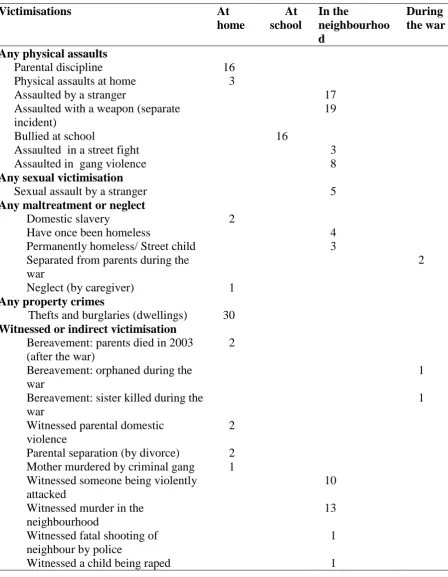
This study was interested in categorising the victimisations according to context: at home; at
school; in the neighbourhood, and during or as a consequence of the war (see Table 3). The
most common victimisation at home was the experience of property crimes; 16 children also
experienced parental physical violence. Some accounts of maltreatments at home were also
given: one homeless child said that he was enslaved by his aunt and another that he was
starved by his uncle. Their accounts include: “I left my aunt’s house because she was using
me as a slave for her children. She did not send me to school. I was always doing all the
domestic work whilst my cousins were attending school, so I ran away to live on the streets”
(Child 1; aged 15). “My uncle smokes cannabis; he is always fighting with neighbours; he
always beat me. He would not give me food. So I ran away to live on the street” (Child 3;
14
reported having suffered neglect due to parental divorce. Three bereavements in the family
were also reported: one child reported witnessing his mother being fatally shot by an armed
gang when he was six years old and two others said that their parents died in separate fire
incidents in 2003. At school, bullying was the only form of victimisation mentioned, with 16
children reporting having been bullied by peers.
The most common context of victimisations was experienced in the children’s
neighbourhoods. Seventeen have been assaulted by a stranger. Nineteen reported assaults
involving a weapon. Some experienced peer violence: eight youth, gang members, narrated
accounts of involvement in gang violence; three other children were involved in street fights
they did not, allegedly, start. Five reported sexual assaults by strangers they met on the
streets. Three ‘street children’ and four others, who said that they had lived on the streets at
some point, specifically talked about neglect and abandonment resulting from homelessness.
They spoke vividly about the dangers of living on the streets; one of them related stories of
how he was ‘chased all the time’ by the police; and ended up stealing ‘because you have to
survive’ (Child 5; aged 17). Ten children witnessed someone being violently attacked in their
neighbourhoods; 13 others claimed that the assaults witnessed resulted in deaths. Other
events included witnessing the rape of a child and the death of a neighbour, allegedly shot by
the police.
TABLE 3
PATHWAYS TO POLYVICTIMISATION
Finkelhor et al (2011b, p. 7) argue there are four pathways for children culminating in
polyvictimisation: living in a family that experiences considerable violence and conflict
15
employment, and substance abuse that might compromise a child’s supervision or create
unmet emotional needs (family disruption and adversity); residing in or moving into a
dangerous community (dangerous neighborhoods); and being a child with pre-existing
emotional problems that increase risky behaviour, engender antagonism, and compromise the
capacity to protect oneself (emotional problems)” (see Finkelhor et al, 2009b for details).
Each pathway is believed to contribute independently to the onset of polyvictimisation, the
emotional problems pathway being most prominent for children under 10 years old and the
other pathways are assumed to be more predictive for older children. This study strongly
supports the ‘dangerous neighborhoods’ pathway. However, while it is possible that children
in this study may have underreported their victimization at home because of the respect for
the privacy of family life that is expected in African cultures, the severity and seriousness of
the victimisations experienced in their neighborhoods totally overshadows victimizations
experienced elsewhere.
More importantly, the majority of these children explained their victimisations as a
direct or indirect consequence of the aftermath of the war. A child gave vivid accounts of
how his sister and parents were killed during the war. As he simply puts it: “All these would
not have happened if I hadn’t lost my parents and sister during the war” (Child 1: aged 15).
Two children also recalled the traumatic effects of being briefly abandoned or separated from
their parents during the war. The street children and homeless migrants from rural areas
(including two who are children of ex-soldiers) blamed the war for their poverty,
homelessness and victimization on the streets. They blamed their victimization to being out
of school, uneducated and spending so much time on the streets. When asked what might
change their lives, 22 children said “if I go back to school”
Most remarkable was the link made by the children between the culture of violence that
16
neighborhood violence has become ‘normal.’ One child said that guns are easily availablebecause “handicapped war veterans are not receiving enough support from the government.
As a consequence, they are selling guns and bullets to young people’ (Child 21; aged 16). As
another child put it: “Now, there is some kind of seeing what is abnormal as normal. In
Luanda, the youth easily wield any kind of weapon to resolve their conflicts and commit
crime. In fact it is quite normal to resolve problems like that’ (Child. 27; aged 17). As Turner
et al (201, p.6) agued, for polyvictims like these, victimisation represents more of a life
condition than a set of events.
POLYVISTIMISATION, TRAUMA AND PSYCHOSOCIAL RESPONSE
Despite the small sample, the experiences of children discussed above raise important
questions about the plight of children in African countries that have recently experienced
political conflicts. Most polyvictimisation studies emphasise the psychological or emotional
development and wellbeing consequences for children. NatSCEV identified a significant
level of distress amongst children classified as polyvictims, “measured by a checklist of
symptoms that included indicators of anxiety, depressions, anger and post-traumatic stress
disorder” (Finkelhor et al, 2007b; Finkelhor et al, 2011b, p.5; Turner et al, 2006; 2010b;).
Such children have lower levels of self-esteem and higher rates of being aggressive and
violent or feeling threatened (Chan et al, 2011; Ford et al, 2012, 2013). Finkelhor et al
(2009, p.2) concluded that polyvictims are more likely than other children to “be more prone
to delinquency, further victimization, and involvement with the child welfare and juvenile
justice systems.” Finkelhor et al (2009b) found that polyvictimisation tended to persist over
time, and that many youths find it difficult to escape polyvictimisation. Traumatic
experiences such as those referred to above leave deep wounds, which heal slowly. Children
17
live more purposeful lives; however, their polyvictimisation must first be acknowledged
before any meaningful intervention work can be done.
This study has identified polyvictimisation as a direct consequence of the experience of
war. Whereas the study did not measure trauma resulting from polyvictimisation, it
ascertained, from the children’s responses, that the events that they had witnessed have been
traumatic in various contexts: 18 children identified times in their lives when they felt alone,
neglected, ignored or “like nobody cared”; 22 children also mentioned being “afraid of being
killed one day”, “being always prepared for anything” and “being made to feel even tougher.”
A number of intervention approaches has been suggested as ways of dealing with the
impact of conflict and post-conflict situations on the mental health and social development of
affected children. The debate has been between supporters of two approaches: the
trauma-focused (clinical/psychiatric) and psychosocial approaches, (Summerfield, 2000; Betancourt
and Williams, 2008; Miller and Rasmussen, 2010). The first advocates the application of
Western psychiatric diagnoses such as post-traumatic stress disorder (PTSD) and
trauma-focused clinical treatments such as narrative exposure therapy to war-affected populations,
irrespective of their cultural background or nationality. This approach focuses narrowly on
the relationship between direct war exposure or its aftermath and mental health. The
psychosocial approach, on the other hand, argues that focusing on trauma and psychological
disorders alone provides a weak starting point in many war affected, post-conflict countries in
the developing world, where the experience of war is inextricably linked to “a host of other
highly stressful conditions or daily stressors, such as poverty, social marginalization,
isolation, inadequate housing, and changes in family structure and functioning,” (Miller and
Rasmussen, 2010, p.8). The psychosocial approach supports an attempt at personal recovery
that is also grounded in social recovery. This approach offers a culturally specific approach to
18
studies on post-conflict situations in Africa and the developing world have generally favoured
the psychosocial approach. Miller and Rasmussen (2010, p.8) cited examples of psychosocial
projects in Afghanistan, Chad, Sri Lanka, Lebanon, Algeria and the West Bank (see also
Wessells and Monteiro, 2006, pp.126-135 on a psychosocial project for the youths in
Angola). However, Jordan et al (2009, p. 12) have argued, after undertaking a systematic
review of the literature on psychosocial interventions to address the mental health and
well-being of children affected by war in 18 countries including Angola, that while the majority of
the studies presented positive results, there was a lack of evidence for efficacy due to a
number of methodological flaws, ranging from a lack of empirical evidence to support the
claims, to incomplete data; neglecting large treatment effects seen in control groups, and poor
research design. These weaknesses made drawing general conclusions about their
effectiveness difficult. It was also noted that there were limited attempts to adapt
interventions to the local context; even though consensus seems to be present in the discourse
favouring multi-levelled community based approaches and cultural adaptations, actual
adherence to these principles was not often reported or lacked depth. Many studies tend to
focus on the children themselves, not on the conditions of their victimisation.
The problems of youths in Angola must be regarded as distinct from the generalised
post-war reconstruction efforts as expressed in jingoistic spin as ‘peace psychology.’ It is
the human right imperative of all Angolan children to be protected from neighbourhood
violence, supported and helped to build self-esteem and empowered with education and skills
to enable them re-enter normal life. As most victimisations took place in the
neighbourhoods, it is there that most efforts should first be directed.
Whereas, proposals for culturally adapted psychosocial models of interventions have
been made (Wessells and Monteiro, 2006); however, with so little evidence of their
19
determine how best to address the challenges that children in affected countries face and
bring wellbeing and justice to help them survive in countries whose problems they have not
helped to create. This paper supports the view expressed by Wessells and Monteiro (2006)
that in order to assist Angolan youths “proactive, holistic approaches are needed that protect
youth, prevent violence, and enable sustainable community development” (Wessells and
Monteiro, 2006, pp. 126-127). An intervention programme that combines working though
families and communities to bring about empowerment, build self-esteem, meet the physical
needs of children, alleviate their poverty and give them education and positive skills and
competencies needed for them to be able to participate meaningfully in society is a must for
the future wellbeing of these children (cf. WCRWC, 2000).
CONCLUSION
This article has reported on a pioneer polyvictimisation study in an African (non-western)
context. In spite of its limitations, the study has identified a large number of polyvictims
amongst the sample of 30 Angolan children in the sample. The study has included children’s
voices and examined polyvictimisation in various contexts. Although no generalisations are
possible from this study, it reveals that in a post-conflict African country such as Angola, the
aftermath of the war lingers on in the current experiences of the youth and that the most
common context for polyvictimisation is the neighbourhood. The article accepts that there are
areas for further research but contends that a case is made for effective state action and
intervention, with a strong support presented for a psychosocial approach to address
20
REFERENCES
Alberto, F. T., (1997) Physical, psychological, and political displacement in Angola and
Mozambique, Development in Practice, 7:4: 490-493.
Alemika, E. (2010) National Criminal Victimization and Safety Survey, 2009 (Nigeria):
Summary of Findings Lagos: CLEEN Foundation.
Betancourt, T.S. and Williams, T., (2008) Building an Evidence Base on Mental Health
Interventions for Children Affected by Armed Conflict. Intervention (Amstelveen). 6
(1): 39–56.
Chan, K.L. Brownridge, D. A., Yan, E., Fong, D.Y.T. and Tiwari, A., (2011) “Child
Maltreatment polyvictimisation: Rates and Short-term Effects on Adjustment in a
Representative Hong Kong Sample”. Psychology of Violence 1. Jan.: 4-15.
Chikwanha, A., B., Gninanfon, A. and Wantchekon, L., (2008) A Survey of Crime Victims in
Benin. African Human Security Initiative. Nairobi.
Christian Children’s Fund (2002) “Peace in Angola Brings Critical Needs”, 11 July.
www.christianchildrensfund.org/emergencies/Angola_peace accessed 1st August 2012.
Coalition to Stop the Use of Child Soldiers (2004a) Child Soldier Use 2003: A Briefing for
the 4th UN Security Council Open Debate on Children and Armed Conflict.
http://www.unhcr.org/refworld/docid/4988067bc.html. London. Accessed 1 August 2012.
Coalition to Stop the Use of Child Soldiers (2004b) Child Soldiers Global Report 2004 –
Angola http://www.unhcr.org/refworld/docid/4988067bc.html. Accessed 1 August 2012.
Cole, B. and Chipaca, A., (2013): ‘Juvenile Delinquency in Angola’ Criminology and
Criminal Justice. published online 23 September 2013
21
Cyr, K., Claire Chamberland, C., Clémentc, M.-E., Lessard, G., Wemmerse, J-A,
Collin-Vézinaf,D., Gagnég, M.-E. and Damant, D., (2013) Polyvictimization and
Victimization of Children and Youth: Results from a Population Survey. Child Abuse
and Neglect. 814-820
De Boeck, F. and Honwana, A. (eds.) (2005). Makers and breakers: Children and youth in
postcolonial Africa, Oxford and Dakar, James Currey and CODESRIA.
Finkelhor, D., Ormrod, R., Turner, H. and Hamby, S.L. (2005a) ‘The Victimization of
Children and Youth: A Comprehensive, National Survey’ Child Maltreatment, Vol. 10,
No. 1, February, pp. 5 – 25
Finkelhor, D., Ormrod, R.K., Heather A. Turner, H.A. and Hamby, S.L. (2005b) Measuring
poly-victimization using the Juvenile Victimization Questionnaire Child Abuse and
Neglect 29 (2005) 1297–1312
Finkelhor, D., Omrod, R.K., and Turner, H.A. (2007a) 'Poly-Victimisation. A Neglected
Component in Child Victimisation'. Child Abuse and Neglect, 31 (1): 7-26.
Finkelhor, D., Ormrod, R.K and Turner, H.A. (2007b) Polyvictimization and Trauma in a
National Longitudinal Cohort. Development and Psychopathology 19: 149 - 166
Finkelhor, D., Turner, H., Ormrod, R., Hamby, S. and Kracke, K., (2009a) Children’s
Exposure to Violence: A Comprehensive National Survey. Office of Juvenile Justice
and Delinquency Prevention (OJJDP), Juvenile Justice Bulletin. October. U.S.
Department of Justice, Washington, DC
Finkelhor, D., Ormrod, R., Turner, H. A., and Holt, M., (2009b) Pathways to
Poly-victimization. Child Maltreatment, 14: 316–329.
Finkelhor, D., Shattuck, A., Turner, H.A., Ormrod, R. and Hamby, S. L. (2011a)
Polyvictimization in Developmental Context Journal of Child and Adolescent Trauma,
22
Finkelhor, D., Turner, H., Ormrod, R., Hamby, S. and Ormrod, R., (2011b)
Polyvictimization: Children’s Exposure to Multiple Types of Violence, Crime, and
Abuse Office of Juvenile Justice and Delinquency Prevention. Juvenile Justice Bulletin.
October. U.S. Department of Justice. Washington, DC
Ford, J. D., Chapman, J., Connor, D.F. and Cruise, K.R., (2012) Complex Trauma and
Aggression in Secure Juvenile Justice Settings. Criminal Justice and Behavior 39:
694-724.
Ford, J.D., Grasso, D. J., Hawke, J. and Chapman, J.F. (2013) Poly-victimization among
Juvenile Justice-involved Youths. Child Abuse and Neglect. Pp 788-800
Honwana, A. (2008). “Children’s involvement in war: Historical and social contexts”,
Journal of the History of Childhood and Youth, 1 (1), pp. 139-149.
Human Rights Watch (1996) Children in Combat Human Rights Watch Children’s Rights
Project vol. 18 No 1(G). January.
Human Rights Watch (2001) Easy Targets: Violence against Children Worldwide. New
York: Human Rights Watch
Human Rights Watch (2002) United Nations: Protect the Displaced in Angola, Human Rights
Watch Press Release, March 5..
http://www.hrw.org/news/2002/03/04/united-nations-protect-displaced-angola . Accessed 3 August 2012.
Human Rights Watch (2003) Forgotten Fighters: Child Soldiers in Angola. Human Rights
Watch Press Release, Vol. 15, No. 10 (A) – April. New York
Human Rights Watch (2007) Paying the Price: Violations of the Rights of Children in
Detention in Burundi. Human Rights Watch Press Volume 19, no. 4(a), March. New
York
Human Rights Watch (2012) No Place for Children: Child Recruitment, Forced Marriage,
23
Integrated Regional Information Networks (In-depth)(IRIN) (2007) Youth in Crisis: Coming
of Age in the 21st Century. Nairobi
Jordans, M. J.D., Tol, W.A., Komproe, I. H. and de Jong, J.V.T.M.,(2009) Systematic
Review of Evidence and Treatment Approaches: Psychosocial and Mental Health Care
for Children in War. Child and Adolescent Mental Health Vol.14, No. 1: 2–14.
Miller, K.E. and Rasmussen, A., (2010) War Exposure, Daily Stressors and Mental Health in
Conflict and Post-conflict Settings: Bridging the Divide between Trauma Focused and
Psychosocial Frameworks, Social Science and Medicine Vol. 70: 7-16
NGO Advisory Council for Follow-up to the UN Study on Violence against Children (2011)
Five Years On: A global update on violence against children. Geneva: The NGO
Advisory Council
Outlaw, M., Ruback, B., and Britt, C. (2002). Repeat and multiple victimizations: The role of
individual and contextual factors. Violence and Victims, 17(2), 187–204.
Rodrigues, C.U., (2010) “Youth in Angola: Keeping the Pace towards Modernity”, Cadernos
de Estudos Africanos [Online], 18/19 http://cea.revues.org/116 Accessed 1st August
2012.
Romano, E., Tessa Bell, T. and Billette, J.-M., (2011): Prevalence and Correlates of Multiple
Victimization in a Nation-wide Adolescent Sample. Child Abuse and Neglect 35: 468–
479.
Summerfield, D. (2000) War and Mental Health: A Brief Overview. British Medical Journal,
July 22nd 321, 7255: 232-235.
Turner, H.A., Finkelhor, D. and Ormrod, R., (2006) The Effect of Lifetime Victimization on
the Mental Health of Children and Adolescents Social Science and Medicine, 62: 13–
24
Turner, H.A., Finkelhor, D., Omrod, R., (2010a) Poly-Victimisation in a National Sample of
Children and Youth,. American Journal of Preventative Medicine 38(3): 323–330.
Turner, H.A., Finkelhor, D. And Ormrod, R., (2010b) The Effects of Adolescent
Victimization on Self-Concept and Depressive Symptoms. Child Maltreatment Vol. 15
No 1 Feb.:76-90.
Turner H., Sherry Hamby, S. and Banyard, V.(2013): Poly-victimization: Childhood
Exposure to Multiple Forms of Victimization. National Children’s Advocacy Center.
http://www.nationalcac.org/images/pdfs/CALiO/poly-victimization%20-%20childhood-exposure-to-multiple-%20forms-victimization.pdf. Accessed 13 May 2013.
UNICEF UK (1989) The United Nations Convention on the Rights of the Child London:
UNICEF
UNICEF (2006) At a glance: Sierra Leone: http://www.unicef.org/index.php accessed 1st
August 2012.
United Nations (2006) World report on violence against children. Geneva: United Nations
United Nations Office on Drugs and Crime (UNODC)(2009) Victimisation Survey in
Rwanda: Executive Summary. Vienna
Veale, A., and Dona, G., (2003) “Street Children and Political Violence: a Socio
-demographic Analysis of Street Children in Rwanda” Child Abuse and Neglect 27:
253–269.
Wessells, M., (1997) Child soldiers. Bulletin of the Atomic Scientists, 53(6): 32–39.
Wessells, M. and Monteiro, C., (2006) “Psychosocial Assistance for Youth: Towards
Reconstruction for Peace in Angola”. Journal of Social Issues, Vol. 62, No. 1, 2006:
25
Women’s Commission for Refugee Women and Children(WCRWC),(2000) UntappedPotential: Adolescents Affected by Armed Conflict. A Review of Programs and
Policies. New York: Women’s Commission for Refugee Women and Children.
Women’s Commission for Refugee Women and Children (WCRWC) (2001). Against all
odds: Surviving the war on adolescents – Promoting the protection and capacity of
Ugandan and Sudanese adolescents in Northern Uganda, Participatory Research Study
with Adolescents in Northern Uganda. New York: WCRWC.
World Bank (2003) Angola: Emergency Demobilization and Reintegration Project, February
26
Table 1: Types of victimisation
Victimisation Children (%) Any physical assaults
Parental discipline 16 (53.3) Physical assaults at home 6 (20.0) Assaulted by a stranger 17 (56.6) Assaulted with a weapon (separate incident) 19 (63.3) Bullied at school 16 (53.3) Assaulted in a street fight 3 (10.0) Assaulted in gang violence 8 (26.7) Any sexual victimisation
Sexual assault by a stranger 5 (16.7) Any maltreatment or neglect
Domestic slavery 2 (6.7) Have once been homeless 4 (13.3) Permanently homeless/ Street child 3 (10.0) Separated from parents during the war 2 (6.7%) Neglect (by caregiver) 1 (3.3) Any property crimes
Thefts and burglaries (dwellings) 30 (100.0) Witnessed or indirect victimisation
27
Table 2: Polyvictimisation
0 - 3 Non- Polyvictim s 4-6 Low Polyvictim s 7 and above High Polyvictim s TOTAL
Number of Children 7 10 13 30
Any physical assaults
Parental discipline 0 5 11 16
Physical assaults at home 0 2 4 6 Assaulted by a stranger 0 7 10 17 Assaulted with a weapon (separate
incident)
0 9 10 19
Bullied at school 2 4 10 16
Assaulted in a street fight 0 1 2 3 Assaulted in gang violence 0 1 7 8 Any sexual victimisation
Sexual assault by a stranger 0 0 5 5 Any maltreatment or neglect
Domestic slavery 0 0 2 2
Have once been homeless 0 0 4 4 Permanently homeless/ Street child 0 0 3 3 Separated from parents during the
war
0 1 1 2
Neglect (by caregiver) 0 0 1 1
Any property crimes
Thefts and burglaries (dwellings) 7 10 13 30 Witnessed or indirect victimisation
Bereavement: parents died in 2003 (after the war)
0 1 1 2
Bereavement: orphaned during the war
0 0 1 1
Bereavement: sister killed during the war
0 0 1 1
Witnessed parental domestic violence
0 0 2 2
Parental separation (by divorce) 0 1 1 2 Mother murdered by criminal gang 0 0 1 1 Witnessed someone being violently
attacked
1 3 6 10
Witnessed murder in the neighbourhood
0 3 10 13
Witnessed fatal shooting of neighbour by police
0 0 1 1
28
Table 3: Polyvictimisation contexts
Victimisations At
home At school In the neighbourhoo d During the war
Any physical assaults
Parental discipline 16 Physical assaults at home 3
Assaulted by a stranger 17 Assaulted with a weapon (separate
incident)
19
Bullied at school 16
Assaulted in a street fight 3 Assaulted in gang violence 8 Any sexual victimisation
Sexual assault by a stranger 5 Any maltreatment or neglect
Domestic slavery 2
Have once been homeless 4 Permanently homeless/ Street child 3 Separated from parents during the
war
2
Neglect (by caregiver) 1 Any property crimes
Thefts and burglaries (dwellings) 30 Witnessed or indirect victimisation
Bereavement: parents died in 2003 (after the war)
2
Bereavement: orphaned during the war
1
Bereavement: sister killed during the war
1
Witnessed parental domestic violence
2
Parental separation (by divorce) 2 Mother murdered by criminal gang 1 Witnessed someone being violently
attacked
10
Witnessed murder in the neighbourhood
13
Witnessed fatal shooting of neighbour by police
1