Effect of Drying Method on the Phenolic Content
and Antioxidant Capacity of Spearmint
Antia OrphAnides, Vlasios GOulAs and Vassilis GekAs
department of Agricultural sciences, Biotechnology and Food science, Cyprus university of Technology, lemesos, Cyprus
Abstract
Orphanides A., Goulas V., Gekas V. (2013): Effect of drying method on the phenolic content and
antioxidant capacity of spearmint. Czech J. Food Sci., 31: 509–513.
The changes in total phenolics, hydroxycinammic acid derivatives, and antioxidant properties of spearmint after five drying treatments (convection oven drying, freeze-drying, microwave drying, and air drying with the sun exposure and without the sun exposure) were investigated. Phenolic composition of dried spearmint was analysed by spectro-photometric assays, while DPPH radical scavenging activity and Ferric reducing/Antioxidant power (FRAP) assay was used to measure the antioxidant properties. The results showed that freeze drying produced dried spearmint that had the highest total phenolics (34.6 ± 1.9 mg/g) content and the most potent antioxidant capacity (126.2 ± 0.4 mg/g for FRAP and 88.1 ± 5.9 mg/g for DPPH, respectively). On the other hand, spearmint that was dried by convection oven and microwave drying presented the lowest amount of phenolic compounds (12.0 ± 0.5 mg/g) and antioxidant potency (49.3 ± 0.7 mg/g for FRAP and 26.9 ± 1.6 mg/g for DPPH, respectively). This might be attributed to the fact that heat-sensitive phenolics were degraded or biotransformed at high temperatures. The loss of phenolic compounds and antioxidant activity reached up to 60% compared to freeze drying.
Keywords: air-drying; freeze-drying; hydroxycinammic acid; Mentha viridis; microwave drying; phytochemical
Herbs have attracted the scientific interest of the biotechnology, cosmetics, pharmaceutical and food industry since they have been used for many purposes as medicinal, flavouring, beverages, dyeing, fragrances, cosmetics, smoking and other industrial uses. Herbs are an excellent source of phytochemicals with potent antioxidative effects
(Papageorgiou et al. 2008). Mentha belongs to
lamiaceae family and includes about 25 species.
Leaves, flowers, and the stem of Mentha spp. are
frequently used as herbal teas or as additives in foods to offer aroma and flavour or to protect
against food-pathogens bacteria (Gibriel et al.
2011). Mentha viridis is usually consumed in
Cy-prus as a dried product for herbal tea or as an ad-ditive in Cypriot traditional cheese called halloumi. Drying is considered as a critical factor for the postharvest management and the merchantability of
herbs. Fresh lamiaceae herbs as spearmint usually
contain 75–80% water, and the water levels need to be lowered to less than 15% for their
success-ful preservation (Dìaz-Maroto et al. 2002). The
drying of herbs inhibits microbial growth and fore-stalls biochemical changes but, at the same time, it can give rise to other changes that affect the herb quality. The changes in appearance and aroma are caused by losses in volatiles or the formation of new volatiles as a result of oxidation or esterification reactions. In addition, the drying of herbs is often accompanied with the loss of bioactive compounds, which may possess antioxidant activity and other
health-promoting properties (Hossain et al. 2010).
loss of the aromatic plants and subsequently of the produced added value products (Keinänen & Julkunen-Tiitto 1996). Many drying methods such as convection oven drying, freeze-drying, microwave drying etc. are also used to preserve
medicinal herbs (Harbourne et al. 2009). To
date, the studies have been mainly focused on the influence of the drying methods on the essential oil or volatile fractions in order to optimise the
drying (Venskutonis 1997; Dìaz-Maroto et
al. 2003; Figiel et al. 2010).
The objective of the present study was to compare different methods for the drying of spearmint. Five common drying methods i.e. convection oven dry-ing (CD), freeze-drydry-ing (FD), microwave drydry-ing (MD), and air drying with the sun exposure (SUD) and without it (SHD) were evaluated in terms of phenolic content and antioxidant capacity.
MATERIAL AND METHODS
Reagents and samples. Standards of gallic acid,
caffeic acid, and 6-hydroxy-2,5,7,8-tetramethyl-chroman-2-carboxylic acid (Trolox) were purchased form Sigma-Aldrich (St Louis, USA). 1,1-Diphenyl-2-picrylhydrazyl radical (DPPH),
4,6-tripyridyl-s-triazine (TPTZ), iron(III) chloride, and all other
common reagents and solvents were obtained from Sigma-Aldrich (St Louis, USA). Folin-Ciocalteu reagent and ethanol (analytical grade) were provided by Scharlau (Barcelona, Spain).
Fresh spearmint (Mentha viridis) was provided
from local organic producer (Lemesos District, Cyprus). The leaves were separated from the stems and subsequently dried with different methods.
Drying methods. Five drying methods were
ap-plied to remove moisture content from spearmint until constant weight. The initial moisture of the leaves was 87.42 ± 0.40%. Table 1 summarises the equipment used and the duration of the drying process. Dried material was stored in a desiccator until phytochemical analysis.
Extraction of phenolic compounds. An
ultra-sound assisted extraction was used to extract phenolic compounds from the dried spearmint. In particular, approximately 0.167 g of the dried spearmint was extracted with 10 ml EtOH. The ultrasound irradiation was applied for 10 min at a power of 6 W by an ultrasound probe (Microson; Misonix Inc., Farmingdale, USA). The extraction was performed at 25°C using water bath. The
ex-tracts were filtered through vacuum equipment, diluted to 20 ml, and were kept at 4°C until analysis.
Determination of total phenolics by Folin-Ciocalteu method. The reaction mixture consisted
of 0.2 ml of the diluted extract, 4.8 ml of distilled water, and 0.5 ml of the Folin-Ciocalteu reagent. After 3 min, 1 ml of saturated sodium carbonate solution was added and the mixture was made up to 10 ml with distilled water. The mixture was thoroughly mixed, allowed to stand for 1 h in the dark at the room temperature, and the absorbance was measured at 765 nm (Jenway 6505 UV-Vis- spectrophotometer, 160A; Keison, Essex, England). Total phenolic content was expressed as mg gal-lic acid equivalents (GAE) per 100 g of the dried spearmint (d.s.) (Goulas & Manganaris 2011).
Determination of total phenolics and hyxroxy-cinammic acid derivatives. Briefly, 1 ml of each
extract was mixed with 1 ml 0.1% HCl-ethanol so-lution and 8 ml 2% HCl-ethanol soso-lution in a 10 ml volumetric flask. The absorbance was measured at 280 and 320 nm in order to evaluate total phenolic content and hydroxycinammic acid derivatives, re-spectively. The corresponding standard curves to the above determinations were prepared using ethanolic solutions of gallic acid and caffeic acid and the results were expressed as mg GAE/100 g d.s. and mg caffeic acid equivalents (CAE)/100 g d.s. (Obied et al. 2005).
Determination of DPPH radical scavenging activity. Two ml of each extract were mixed with
1 ml solution of DPPH• (0.3 mmol/l). The
absorb-ance of the mixture was measured after 30 min incubation time in the dark at 517 nm. The radical scavenging activity was calculated using a standard curve of Trolox and expressed as mg Trolox/100 g d.s. (Goulas & Manganaris 2011).
Determination of total antioxidant activ-ity by FRAP assay. A sample containing 3 ml
of freshly prepared Ferric reducing/Antioxidant power (FRAP) solution (0.3 mol/l acetate buffer (pH 3.6) containing 10 mmol/l TPTZ and 40 mmol/l
FeCl3∙10H2O) and 100 µl of the extract was
incu-bated at 37°C for 4 min and the absorbance was measured at 593 nm. The absorbance change was converted into the FRAP value, by relating the change of absorbance at 593 nm of the test sample to that of the standard solution of Trolox, and the results were expressed as mg trolox/100 g d.s. (Goulas & Manganaris, 2011).
Statistical analysis. Statistical analysis was carried
averages of each treatment was based on the analysis of variance (one-way ANOVA) according to Dun-can’s multiple range test at the significance level 5%
(p ≤ 0.05). The results were presented as average ±
standard error of three replications per sample.
RESULTS AND DISCUSSION
The results showed that all drying methods tested reduce the moisture content below 15%, which is the critical factor for the postharvest management of herbs (Table 1). Particularly, the moisture content ranged between 7.96 ± 1.34% to 10.64 ± 0.18% for the spearmint dried by instrumental drying meth-ods, while SUD and SHD lowered the water content of spearmint to 13.35 ± 0.37 and 13.92 ± 0.99%, respectively. The results revealed the superiority of the instrumental drying methods against the tradi-tional methods. Furthermore, the main benefit of the instrumental drying methods is correlated with the dramatic decrease of the drying time (Table 1).
Total phenolic content of the dried spearmint was determined by two spectrophotometric as-says that are based on different mechanisms.
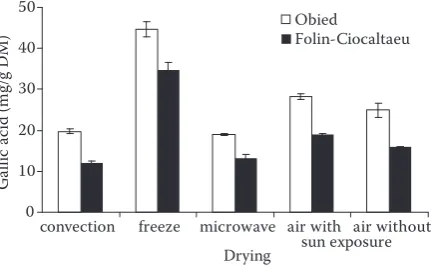
Fo-lin-Ciocalteu method is based on the transfer of electrons in alkaline solution from the phenolic compounds to phosphomolybdic/phosphotungstic acid complexes, while the second method is based on maximum wavelength of phenolic compounds at 280 nm (Medina 2011). The results indicated the superiority of the FD method against the tested methods as the dried spearmint had the highest amount of phenolic compounds, regardless of the analytical method used (Figure 1). The drying of spearmint using convection oven and microwave oven gave the lowest phenolic content. Phenolic content was 1891 ± 20 mg GAE/100 g d.s. for MD and 1976 ± 61 mg GAE/100 g d.s. for CD according to Obied protocol. The traditional drying methods produced dried spearmint with higher phenolic content (2489 ± 183 and 2829 ± 62) compared to CD and MD, but they were inferior compared to FD. Since rosmarinic acid and related compounds
have been mainly found in spearmint (Wang et al.
2004), the hydroxycinnamic acid derivatives of dried spearmint were also evaluated. The results showed a similar trend with total phenolics highlighting the advantage of FD as a drying method for spearmint (Figure 2). Hydroxycinammic acid content of freeze-dried spearmint was 2.2 fold higher than the cor-responding content of microwave-dried spearmint. Then, the antioxidant activity of the dried spear-mint was determined since a close correlation be-tween phenolic compounds and antioxidant activity of herbs belonging to Lamiaceae family has been
demonstrated before (Stagos et al. 2012). FRAP
[image:3.595.62.533.102.191.2]and DPPH assays were used to determine the an-tioxidant properties of the dried spearmint since a single assay can give only a reductive suggestion of the antioxidant potency and must be interpreted with some caution. The chemical complexity of spearmint could lead to scattered results, depend-ing on the test employed (Goulas & Manganaris 2011). The antioxidant assays used are based on
Table 1. Equipment used, drying time and % final moisture content of spearmint for drying methods
Drying method Equipment Time Final moisture (%)
CD convection oven (Venticell 111, MMM Group, Germany) 7.5 h 10.6 ± 0.2
FD laboratory-scale freeze dryer (Christ Alpha 1-4 LD plus, SciQuip Ltd., UK) 48 h 10.5 ± 1.2
MD microwave oven 800 W (DKL Model W-8811) 80 s 8.0 ± 1.3
SUD – 312 h 13.4 ± 0.4
SHD – 312 h 13.9 ± 1.0
CD – convection oven drying; FD – freeze-drying; MD – microwave drying; SUD – air drying with the sun exposure; SHD – air drying without the sun exposure
0 10 20 30 40 50
G
all
ic
a
ci
d (
m
g/
g
DM)
Obied
Folin-Ciocaltaeu
convection freeze microwave air with air without sun exposure Drying
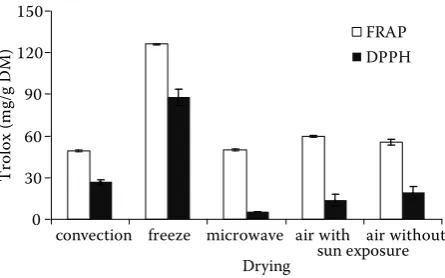
[image:3.595.69.285.574.707.2]different mechanisms that measure the antioxida-tive effect of extracts. In particular, DPPH assay is based on the ability of antioxidants to act as radical scavengers and FRAP assay measures the ability of antioxidants to perform as reducing agents. Both antioxidant assays showed that FD was the most effective drying method (Figure 3). FRAP assay clas-sified the drying method in the order FD > SUD > SHD > MD = CD, while the classification, based on DPPH assay, was slightly changed. Drying with convection oven produced dried spearmint with antioxidant activity resembling that obtained by drying with traditional methods.
Taking into consideration the results of phenolic composition and antioxidant properties, the evalu-ation of the drying methods showed that FD domi-nated against other methods used. Previous studies have also demonstrated the superiority of FD as compared to common drying methods for diverse
plant materials (Harbourne et al. 2009; Rios &
Gutiérrez-Rosales 2010; Goulas & Manganaris 2012). The benefits of FD can be attributed to the fact that this technique minimises the degradation of heat-sensitive spearmint compounds such as
antioxidant phenols because the dehydration of the plant material is performed at low temperatures (Chou & Chua 2001). In addition, the FD enhances the extractability of phenolic compounds from the dried spearmint since ice crystals formed within the sample matrix can rapture the cell structure, which allows the exit of cellular components and the access of solvent (Goulas & Manganaris 2012).
The drying of spearmint with traditional methods induced a significant decrease of phenolic content and the antioxidant activity of in the dried spear-mint compared to the freeze-dried spearspear-mint. In particular, the phenolic content decreased by 36.6 and 44.3% for SUD and SHD, respectively. The loss of phenolic compounds with traditional drying methods may have been caused by enzymatic pro-cesses that occurred during drying. These drying methods could not inactivate the degradative en-zymes such as polyphenol oxidases; therefore they are able to degrade phenolic compounds during long-time drying procedures (Lim & Murtijaya 2007). The lower loss of phenolic compounds in SUD compared to SHD can be attributed to the fact that the former drying method dehydrated spearmint at a higher temperature which resulted in faster inactivation of enzymes.
The loss of phenolic content in spearmint reached up to 55.7 and 57.6 % for CD and MD, respectively. A similar reduction of the antioxidant activity was also monitored. The latter decreased approximately to 60% with both drying methods. The application of heating inactivates enzymes rapidly but they may simultaneously degrade heat-sensitive phenolic compounds (Lim & Murtijaya 2007). Recent works also demonstrated that the temperature af-fects the stability of phenolic compounds in herbal
infusions (Riehle et al. 2013). Furthermore, the
biotransformation of hydroxycinammic acids in aqueous solution with the application of micro-wave irradiation or heating has been described previously (Dawidowicz & Typek 2010).
CONCLUSION
Drying is a very useful technique to extend the shelf-life of spearmint and to produce dried spear-mint with a high phenolic content and a potent antioxidant activity. Significant effects of drying methods on phenolic composition and antioxidant properties of the dried material were found. Among the drying methods tested, FD produced the dried
0 30 60 90 120 150
Trolox (
m
g/g DM)
FRAP DPPH
[image:4.595.64.292.81.214.2]convection freeze microwave air with air without sun exposure Drying
Figure 3. The influence of drying methods on antioxidant properties of dried spearmint as they were determined by FRAP and DPPH assays
0 5 10 15 20 25
Caffeic acid (mg/g DM)
[image:4.595.66.289.578.717.2]convection freeze microwave air with air without sun exposure Drying
spearmint of highest quality in terms of phenolic content and antioxidant potency. On the other hand, drying methods that use high temperatures to dehydrate spearmint cause a dramatic loss of phenolic compounds and antioxidant activity, which reached up to 60%. The evaluation of other drying methods that remove moisture content at low temperatures with the use of irradiation or vacuum stands a challenging prospective.
Acknowledgments. The authors would like to thank
Agroplant Ltd. for kindly providing the organically produced spearmint.
References
Chou S.K., Chua K.J. (2001): New hybrid drying technolo-gies for heat sensitive foodstuffs. Trends in Food Science and Technology, 12: 359–369.
Dawidowicz A.L., Typek R. (2010): Thermal stability of 5-o-caffeoylquinic acid in aqueous solutions at differ-ent heating conditions. Journal of Agriculture and Food Chemistry, 58: 12578–12584.
Díaz-Maroto M.C., Pérez-Coello M.S., Cabezudo M.D. (2002): Effect of different drying methods on the volatile components of parsley (petroselinum crispum L.). European Food Research and Technology, 215: 227–230. Dìaz-Maroto M.C., Pérez-Coello M. S., González Viñas M.A., Cabezudo M.D. (2003): Influence of drying on the flavor quality of spearmint (Mentha spicata L.). Journal of Agricultural and Food Chemistry, 51: 1265–1269. Figiel A., Szumny,A., Gutiérrez-Ortíz A.,
Carbonell-Barrachina Á.A. (2010): Composition of oregano essen-tial oil (Origanum vulgare) as affected by drying method. Journal of Food Engineering, 98: 240–247.
Gibriel Y.A.Y., Hamza A.S., Gibriel A.Y., Mohsen S.M. (2011): in vivo effect of mint (Mentha viridis) essential oil on growth and aflatoxin production by Aspergillus flavus iso-lated from stored corn. Journal of Food Safety, 31: 445–451. Goulas V., Manganaris G.A. (2011): The effect of
post-harvest ripening on strawberry bioactive composition and antioxidant potential. Journal of the Science of Food and Agriculture, 91: 1907–1914.
Goulas V., Manganaris G.A. (2012): Towards an efficient protocol for the determination of triterpenic acids in olive fruit: A comparative study of drying and extraction methods. Phytochemical Analysis, 23: 444–449. Harbourne N., Marete E., Jacquier J.C., O’Riordan
D. (2009): Effect of drying methods on the phenolic
con-stituents of meadowsweet (Filipendula ulmaria) and willow (salix alba). LWT-Food Science and Technology, 42: 1468–1473.
Hossain M.B., Barry-Ryan C., Martin-Diana A.B., Brunton N.P. (2010): Effect of drying method on the antioxidant capacity of six Lamiaceae herbs. Food Chem-istry, 123: 85–91.
Keinänen M., Julkunen-Tiitto R. (1996): Effect of sam-ple preparation method on birch (Betula pendula Roth) leaf phenolics. Journal of Agricultural and Food Chem-istry, 44: 2724–2727.
Lim Y.Y., Murtijaya J. (2007): Antioxidant properties of phyllanthus amarus extracts as affected by different drying methods. LWT-Food Science and Technology, 40: 1664–1669.
Medina M.B. (2011): Determination of the total phenolics in juices and superfruits by a novel chemical method. Journal of Functional Food, 3: 79–87.
Obied H.K., Allen M.S., Bedgood D.R., Prenzler P.D., Robards K. (2005): Investigation of Australian olive mill waste for recovery of biophenols. Journal of Agricultural and Food Chemistry, 53:9911–9920
Papageorgiou V., Mallouchos A., Komaitis M. (2008): Investigation of the antioxidant behavior of air- and freeze-dried aromatic plant materials in relation to their phenolic content and vegetative cycle. Journal of Agricultural and Food Chemistry, 56: 5743–5752.
Riehle P., Vollmer M., Rohn S. (2013). Phenolic com-pounds in Cistus incanus herbal infusions – Antioxidant capacity and thermal stability during brewing process. Food Research International, in press.
Rios J.J., Gutiérrez-Rosales F. (2010): Comparison of methods extracting phenolic compounds from lyophilised and fresh olive pulp. LWT-Food Science and Technology, 43: 1285–1288.
Stagos D., Portesis N., Spanou C., Mossialos D., Aligian-nis N., Chaita E., Panagoulis C., Reri E., SkaltsouAligian-nis L., Tsatsakis A.M., Kouretas D. (2012): Correlation of total polyphenolic content with antioxidant and antibacte-rial activity of 24 extracts from Greek domestic lamiaceae species. Food and Chemical Toxicology, 50: 4115–4124. Venskutonis P.R. (1997): Effect of drying on the volatile
constituents of thyme (Thymus vulgaris L.) and sage (salvia officinalis L.). Food Chemistry, 59: 219–227. Wang H., Provan G.J., Helliwell K. (2004):
Determina-tion of rosmarinic acid and caffeic acid in aromatic herbs by HPLC. Food Chemistry, 87: 307–311.
Received for publication February 4, 2013 Accepted after corrections April 12, 2013
Corresponding author: