JOURNAL OF FOREST SCIENCE, 59, 2013 (7): 267–271
Vertical force requirement for stump lifting
I. Czupy
1, E. Horváth-Szováti
21Institute of Forest and Environmental Techniques, University of West Hungary,
Sopron, Hungary
2Institute of Mathematics, University of West Hungary, Sopron, Hungary
ABSTRACT: In harvest areas the soil preparation is occasionally necessary before reforestation including the re-moval, collection and transportation of stumps from the soil. Issues related to climate change and the shortage of fossil energy sources call for an increased rate of renewable energy sources. Using the stumps removed from the soil as fuel is a significant resource for biomass. For lifting a stump together with its roots a grab mounted on a shovel is generally used. To rationalise this operation, analyses of stump lifting time have been carried out. We tested a ma-chine mounting one grab for stump lifting on three tree types (Scots pine, robinia and poplar) and found functions correlating stump extraction force and stump diameter, which can be used in order to choose the right machine and determine the cost of the operation.
Keywords: bio-energy; stump diameter; stump extraction force; stump extraction machines; stump lifting
As a long-term objective, the European Union aims at 20% of renewable energy sources within the total energy consumption in each member state. The renewable energy utilisation plan of Hungary sets the effective use of potential biomass as an im-portant target. According to certain calculations the total potential biomass production of Hungary is around 350–360 mill. t, the majority of which is based on wood. The utilisation of forestry by-prod-ucts for energy purposes determines an additional income and, therefore, improves profitability. This action serves also regional political goals, offer-ing development possibilities for underdeveloped regions. The technical and technological develop-ment of wood based biomass production may sig-nificantly increase the above total potential biomass production. A detailed analysis of the effects of the utilisation of forestry by-products and mechanisa-tion development are important research fields. In the course of reforestation with complete soil preparation, stumps remaining in the soil have to be removed. This is necessary if the forest stands are not renewed in a natural way (e.g. on sandy soil). In Hungary, over the extensive continuous areas of the Broad Hungarian Plain, soil
prepara-tion, including stump extracprepara-tion, is carried out be-fore rebe-forestation. Kiskunság Forestry and Timber Industrial Inc. carries out stump extraction over naturally non-renewable woodlands, on an average area of 700-800 ha per year. For stump extraction machines able to grab and lift the stumps them-selves are currently used. This research explores the theoretical background of stump lifting.
MATERIAL AND METHODS
the extracting force exponentially increased with the increasing stump diameter. This was a conse-quence of the significant horizontal force compo-nent that occurred when the stump was lifted.
However, stump lifting technology applied now-adays significantly differs from the above-men-tioned one (Horváth 2003). The force required by the current method has not been investigated yet. No data were found in the literature, concern-ing the magnitude of the vertical stump extraction force. Measurements were carried out by means of a hydraulic stump grabbing machine for various tree types (Fig. 1). Pressure values for stump lifting were measured and recorded by using a pressure measurement device connected to the hydraulic system of the stump extraction machine. Then, the stump extraction force along a vertical direction was determined based on the geometry and me-chanical characteristics of the machine. According to the tests performed a stump extraction machine
mounting one grab is able to lift stumps up to 40 cm at the cutting plane. When the stump diameter is larger than 40 cm, several grabs are required for lifting, unless the side roots are cut. During the tests the tree types occurring in the Broad Hungar-ian Plain (i.e. Scots pine or Pinus sylvestris, robinia or Robinia spp. and poplar or Populus spp.) were surveyed, as the removal of their stumps is very of-ten required. The tests were carried out in sandy soils having 20% averaged field capacity. Soil com-paction and moisture content were determined us-ing a 3T System measurement device.
RESULTS AND DISCUSSION
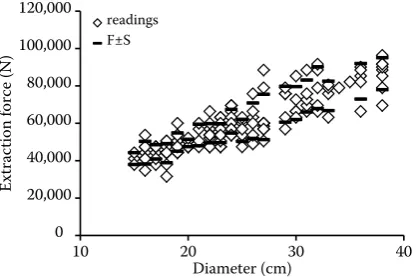
The time elapsed between the lifting of the stumps and the cutting of the trees was approxi-mately constant for all samples (five months), so that this parameter was not indicated as a variable during the tests. The stump diameter at the cutting plane was measured to the nearest 1 cm, while the stump extraction force was determined to the near-est 100 N (Fig. 2).
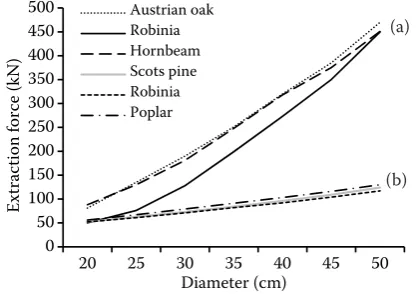
The stump extraction force was compared with the results obtained by Pirkhoffer (1974), using a machine mounting a lifting fork on Austrian oak, robinia and hornbeam (Fig. 3). Based on Fig. 3 it can be stated that the force required to extract stumps having a diameter larger than 25 cm is significantly lower when the stump extraction is performed by using a grabbing machine instead of a lifting fork. This can be explained by the absence of the so called bowl effect in the soil when the stump is lifted verti-cally and no horizontal forces occur (Sitkei 2001).
[image:2.595.64.291.54.227.2]Based on the collected data and measurement re-sults, correlations between stump extraction force
Fig. 1. Stump lifting by means of an extraction machine mounting one grab
0 20,000 40,000 60,000 80,000 100,000
15 20 25 30 35 40
Extraction f
orce
(
N)
Diameter (cm) Scotch pine
Robinia Poplar
[image:2.595.314.523.549.696.2]Fig. 2. Stump extraction force as a function of the stump diameter at the cutting plane
Fig. 3. Comparison of stump extraction force using
differ-ent machines: (a) mounting a lifting fork, onAustrian oak,
robinia and hornbeam and (b) grab-equipped, on Scots pine, robinia and poplar
(b) (a)
0 50 100 150 200 250 300 350 400 450 500
20 25 30 35 40 45 50
Extractio
n
force
(kN
)
Diameter (cm)
[image:2.595.65.286.558.715.2]if the secondary mixed partial derivatives are equal; Eq. (1) fulfils this clause].
First step of iteration: the value of the unknown parameters is estimated: a0, b0 and c0. Then, the f(xi,a,b,c) function with three variables is solved by the Taylor series expansion around the (xi, a0, b0, c0) place until the linear members:
f(xi,a,b,c) = f(xi,a0,b0,c0) + f'a(xi,a0,b0,c0) × (a – a0) + + f'b(xi,a0,b0,c0) × (b – b0) + f'c(xi,a0,b0,c0) × (c – c0) + ε (2)
where:
x1, x2, ... xn – measured diameters for each tree type,
i = 1, 2, … n – stumps for each tree type,
a, b, c – unknown parameters,
a0, b0, c0 – estimated initial values of the unknown parameters,
ε – the residual.
The values of a0, b0 and c0 unknown parameters in the first step are estimated on the basis of mea-surement data (preliminary estimate).
Restructuring:
ˆyi
0 = f(xi,a,b,c) – f(xi,a0,b0,c0) = f'a(xi,a0,b0,c0) × (a – a0) +
+ f'b(xi,a0,b0,c0) × (b – b0) + f'c(xi,a0,b0,c0) × (c – c0) + ε (3)
where: ˆyi
0 – difference vector,
xi – measured stump diameters for each tree type,
a, b, c – unknown parameters,
a0, b0, c0 – estimated initial values of the unknown parameters,
ε – the residual.
The first term is the y values of the measurement results (therefore force values), the second term is into iteration steps with a0, b0 and c0 parameters calculated function values.
The above formula is placed for the sum of squares applied within the smallest squares prin-ciple, and the minimum of the function with three variables obtained in this way is searched. Primary partial derivatives according to a, b and c of the sum of squares to be minimised are made equal to zero (normal equations). The (4)–(6) matrix alge-bra indications, where index 0 marks the vectors or matrixes related to the starting values of the esti-mated parameters, are introduced:
y^
10 f'a(x1,a0,b0,c0) f' b(x2,a0,b0,c0) f' c(x3,a0,b0,c0) –yi =
[
y ^
20
]
, Z0 =[
f'a(x2,a0,b0,c0) f' b(x2,a0,b0,c0) f' c(x2,a0,b0,c0)]
⋮ ⋮ ⋮ ⋮ y^
n0 f'a(xn,a0,b0,c0) f' b(xn,a0,b0,c0) f' c(xn,a0,b0,c0)
– a – a0
x0 =
[
b – b0]
c – c0 (4)–(6)
and stump diameter were studied. More than 150 data were available for each tree type. However, standard deviation of these data was occasionally high (Fig. 4). For an easier statistical analysis the moving average of 3-3 neighbouring data was cal-culated. The force necessary to vertically lift tree stumps was determined in three different ways: by calculation; by regression estimate; by averaging the measurement results.
After determining several possible equations, the regression function describing the correlation between the stump extraction force and the stump diameter, based on logical factors [e.g. fulfilment of the clauses that f(0) = 0 and ] and sta-tistic ones (unfitting analysis, e.g. F-test, reliability analysis), was assumed to be as follows:
f(x) = a × (xb + ecx – 1) (1)
where:
f(x) – stump extraction force (N),
x – stump diameter (cm),
a, b, c – unknown parameters, to be determined.
Eq. (1) best fits the measurement data if the dif-ference between the squared extraction forces measured and those calculated from the regression function is the smallest (smallest squares princi-ple). Eq. (1) is non-linearisable with two unknown parameters. The equation system composed of nor-mal equations cannot be solved in an exact way, so that the method of continual approaches has to be applied (Czupy, Horváth-Szováti 2005). For ex-ample, the method of continual approaches is the iteration procedure performed by the Taylor series expansion. In its course, Eq. (1) is linearly approxi-mated by the Taylor series expansion [the function can be written by a linear approach only if the resi-due e in the Taylor series keeps to zero; this is true
0 20,000 40,000 60,000 80,000 100,000 120,000
10 20 30 40
Extra
cti
on
fo
rc
e
(N
)
Diameter (cm)
[image:3.595.76.285.61.200.2]readings F±S
Fig. 4. Measurement results of stump extraction force as a function of the stump diameter
F – measured value; S – standard deviation
f(x) lim
where: the explanation of symbols see the text above, and at Eqs (2) and (3).
With these the normal equations can be written by matrix Eq. (6) in which ZT is the transpose of matrix Z.
ZT
0 × –y0 = ZT0 × Z0 × –x0 (7) where:
T – the transpose of the matrix,
the other symbols are explained in the text above, and at Eqs (2) and (3).
From this, by multiplying from left by the in-verse of the ZT
0 × Z0 matrix, the difference
be-tween the real parameters and the starting values (–x0) can be estimated as follows:
–x
0 = (ZT0 × Z0)–1 × ZT0 × –y0 (8) where:
T – the transpose of the matrix,
–1 – the exponent indicates the inverse of the matrix, the other symbols are explained in the text above, and at Eqs (2) and (3).
The inverse matrix can be obtained as described above (see terms of applicability of the linear re-gression) (Mundruczó 1981). Using the appropri-ate coordinappropri-ates of the obtained –x0 vector, the start-ing values of the parameters are modified, so that the new refined values of the parameters a1, b1 and
c1 are obtained. Second step of iteration: the proce-dure is repeated using the new starting values (all vectors and matrixes have index 1):
–x
1 = (ZT1 × Z1)–1 × ZT1 × –y1 (9) where: explanation of symbols see the text above, and at Eqs (7) and (8).
0 10,000 20,000 30,000 40,000 50,000 60,000 70,000 80,000 90,000
0 10 20 30 40
Ext
ract
io
n
fo
rc
e
(N
)
Diameter (cm)
average force
[image:4.595.304.532.86.215.2]estimated from Eq. (1) calculated from Taylor series expansion
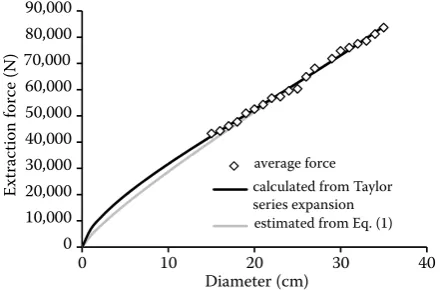
[image:4.595.64.285.567.712.2]Fig. 5. The estimated and calculated regression curves de-scribing stump extraction force as a function of the stump diameter (calculated, regression estimate and averaged)
Table 1. The initial iteration values used for analysing the parameter values measured for Scots pine
Step a b c
0. 4200.0000 0.8079 0.035000
1. 5964.4973 0.6433 0.050449
2. 6601.4450 0.6293 0.042248
3. 6543.7354 0.6368 0.041236
4. 6541.5993 0.6369 0.041189
5. 6541.6217 0.6369 0.041189
6. 6541.6226 0.6369 0.041189
7. 6541.6226 0.6369 0.041189
step – number of iteration steps; a, b, c – value of the un-known parameters in the current iteration steps
Using the appropriate coordinates of vector
x
1, the starting values of the parameters are modified again. The iteration is continued until the param-eters show striking convergence. These results are shown in Fig. 5. The convergence of the method was proved by Hartley (1961).The MAPLE computer algebra system was ap-plied for analysing 150 data measured for each tree type, due to the complexity of the calculation. The parameter values calculated by iteration are docu-mented in Table 1.
For the three tree types the following functions of stump extraction force – stump diameter were obtained:
Scots pine:
f(x) = 6541.6226 × (x0.6369 + e0.041189x – 1),
r2 = 0.9987; mean standard deviation: 6.317 N.
Robinia:
f(x) = 62881.8911 × (x0.6526 + e0.038167x – 1),
r2 = 0.9985; mean standard deviation: 6.041 N.
Poplar:
f(x) = 5432.1293 × (x0.7199 + e0.038392x – 1),
r2 = 0.9978; mean standard deviation 5.879 N. where:
f(x) – stump extraction force (N),
x – stump diameter at the cutting plane (cm),
r2 – correlation coefficient.
CONCLUSION
In the nearest future energy utilisation of stumps extracted in harvest areas is expected to increase in Hungary. According to the test results the force nec-essary for removing the stumps left in the soil de-pends on the following factors:
– method of stump extraction, – tree type (roots),
– stump diameter,
– time elapsed between the lifting of the stump and the cutting of the tree,
– soil texture,
– soil moisture content.
It can be stated that, among various stump ex-traction methods, the force necessary for the verti-cal stump lifting is the smallest one. The functions of stump extraction force and stump diameter de-termined for the surveyed tree types can be applied also elsewhere, in order to choose the appropriate machine and determine the cost of the operation.
References
Czupy I., Horváth-Szováti E. (2005): Experimental defini-tion of the primary force of stump. Hungarian Agricultural Engineering, 18: 64–66.
Hartley H.O. (1961): The modified Gauss-Newton method for fitting of non-linear regression functions. Technometrics,
2:269–280.
Horváth B. (ed.) (2003) Erdészeti gépek. [Forestry Ma-chinery.] Budapest, Szaktudás Kiadó Ház Rt.: 417. (in Hungarian)
Kärhä K., Mutikainen A. (2009): Testing two novel stump lifting heads in a final felling norway spruce stand. In: Sa-volainen M. (ed.): Proceedings of the 4th International Bioenergy Conference and Exhibition. Bioenergy 2009. Jyväskylä, 31. August–4. September 2009. Jyväskylä, The Bioenergy Association of Finland: 441–449.
Laitika J., Ranta T., Asikainen A. (2008): Productivity of stump harvesting for fuel. International Journal of Forest Engineering, 19: 37–47.
Mundruczó G. (1981): Alkalmazott regressziószámítás. [Applied Regression Analysis.] Budapest, Akadémiai Kiadó: 258. (in Hungarian)
Pirkhoffer J. (1974): Magyarországon használt tuskókiemelő gépek maximális emelőképessége meghatározásának vizsgálati módszerei. [Examination of the Stump Lifting Machines in Hungary.] [PhD. Thesis.] Sopron, University of West Hungary: 132. (in Hungarian)
Sitkei G .( 2001): Mechanika a mezőgazdasági tudományok-ban. [Mechanics of agricultural sciences.] In: Glatz F. (ed.) Közgyűlési előadások I. [ General Assembly lectures I.] Budapest, Hungarian Academy of Science: 501–518. (in Hungarian)
Szepesi L. (1966): Erdőgazdasági gépek jellemzői és használata. [Characteristics of Forest Machinery.] Buda-pest, Mezőgazdasági Kiadó: 406. (in Hungarian)
Received for publication January 28, 2013 Accepted after corrections July 8, 2013,
Corresponding author:
Dr. Imre Czupy, University of West Hungary, Institute of Forest and Environmental Techniques, Bajcsy-Zsilinszky utca 4, 9400 Sopron, Hungary