JOURNAL OF FOREST SCIENCE, 62, 2016 (1): 1–7
doi: 10.17221/89/2015-JFS
Evaluating the eff ects of physiographic parameters
on the road cross section in mountain forests
(Case study: northern forests of Iran)
S. Peyrov
1, A. Najafi
2, J. Nourizadeh
31Faculty of Natural Resources, College of Natural Resources, Tarbiat Modares University, Iran
2Faculty of Natural Resources, Tarbiat Modares University, Iran
3Faculty of Information Technology, Qom IT University, Iran
ABSTRACT: Road cross section, as one the main eff ective factors in relation to fi ll and cut volume, was eff ective in costs and disturbance of forest road constructions. In this research, the eff ect of a few physiographic parameters on forest road cross section was evaluated. For this purpose, 192 cross sections on forest roads were delineated selectively in mountain forests in the north of Iran. Th e physiographic factors including elevation, hillside slope, slope aspect, rock base, and soil texture as well as cross section width were measured. After evaluating the data in terms of normality and homogeneity, it was analysed by Spearman’s and Pearson’s correlation tests using SPSS20. One-way ANOVA, two-way ANOVA, and Dun-can grouping tests were used to determine the eff ect of the above-mentioned factors both separately and simultaneously. Results showed that the parameters including hillside slope, rock base, and soil texture had a signifi cant eff ect. Elevation was recognized as a regional parameter due to the lack of any relationship with cross section. Th ere was no signifi cant relation between slope aspect and cross section. Th e hillside slope was defi ned as the most eff ective parameter on the cross section.
Keywords:hillside slope; rock base; soil texture
Among the indicators of development in each country are the quantity and quality of the road net-work, especially in the areas of road and rail trans-portations (Ariel, Gucinski 2000). Construction and maintenance of roads in the forest as an eco-nomic renewable source and as an infl uencing factor on other activities as well as human life are obviously rational and clear. Th e forest road network provides accessibility to diff erent parts of forest to conduct forest management activities such as fi re protec-tion, managing pest invasions and illegal logging as well as marking, forest planting and logging (Maj-nounian et al. 2010). Forest roads are also used to transport raw materials, personnel and equipment as well as to communicate between villages and cit-ies, thus forest roads are of high importance from the point of view of social, economic and cultural perspectives (Erdas et al. 1995). Meanwhile, due to the huge costs associated with the construction and maintenance as well as negative eff ects on forest soil because of soil degradation and displacement,
precipitation amount and type at diff erent heights vary depending on diff erent properties such as hu-midity and soil moisture regime, and hillside stabil-ity, and these changes, in turn, cause changes in the angle of cut-slope and fi ll-slope. Th e slope aspect likely causes the angle of the cut-slope to decrease or increase by infl uencing the moisture content and the stability of hillsides. Th e amount of rock and soil stones as a hardness index of construction exerts a direct eff ect on road cross section so that by increas-ing soil hardness and rockiness the angle of cuttincreas-ing and fi lling trenches will increase relative to the road surface, consequently the horizontal distance of trenches will change (Anonymous 1998). In soft and moist soil, this angle and the distance increase, in turn causing the cross section to increase.
In this regard some researches have been carried out as follows:
Gorton (1985) found in German forests that the length of the fi ll slope was about 3.5, 12 and 22 m for hillside gradients of 45, 60 and 70%. Also, an angle of repose for side-cast material was about 37° and on slopes of over 75% the fi ll cannot be estab-lished at all. Fill slope plays an important role in the overall aesthetic value of road templates.
In evaluating the eff ect of topography on forest road construction in Finland, Hay (1996) assessed factors such as hillside slope; bedrock and soil rupture strength are concluded that the hillside slope is the most important factor in designing the forest roads.
Sedlak (1983) stated that increasing the hillside slope, the width of right-of-way increases and he suggested the standard right-of-way width of 11, 13, 15 and 19 m for slope classes of 30–40, 40–50, 50–60 and 60–70%, respectively. In a study Potoc-nik (2003) assessed rock base and hillside natural slope as some factors infl uencing the road formation width, and results showed that the road formation width could increase up 80% more on a steeper ter-rain (compared to a gentle terter-rain slope) and 20% less on a solid rock base regardless of the terrain slope. It varies between 5.4 m (solid rock base, gentle slope) and 11.4 m (soft rock base, steep slope).
Hosseiniet al. (2010) showed that by decreasing the hillside slope and aggregate diameter, the cutting becomes easier and where the soil is soft and the hill-side has a gentle slope, compared to rocky areas, the damage caused by cutting is greater. A review of the literature shows that the eff ect of these parameters on the cross section has been studied separately but the eff ect of a few probably eff ective parameters has not received enough attention. Th e aim of this study was to evaluate the eff ect of the above-mentioned parameters on cross section on forest roads.
MATERIAL AND METHODS
Study area. Th is investigation was carried out in districts 1 and 2 of Mountain forests, watershed 50, Mazandaran province of Iran. Th e research area is located at 36°30'N and 52°10'E, this region is situ-ated in the central part of the northern margin of the Alborz Mountains and is a part of the Hyrca-nian forests. Mean annual precipitation in the re-gion is 818.8 mm and soils in the study area, based on experimental results and percentage of miner-als, which have originated from calcareous bedrock materials mainly limestone marl, are sandy silt, and predominantly are deep to moderately deep soils. Th e study area totally has approximately 20 km of forest roads of grades 2 and 3. Th e newest roads were constructed 2 years ago, while the oldest roads have over 20 years of lifetime.
Collecting information. In order to conduct this research, the road cross section and physiographic factors, including hillside natural slope, slope aspect, elevation, rock base and soil texture were measured in one-way and grade 2 forest roads. Th is informa-tion was measured in 192 profi les. Natural hillside slope was measured in terms of percentage and was classifi ed in classes, namely 0–15, 15–30, 30–45, 45 to 60 and > 60%. To evaluate the role of elevation and slope aspect, the study area was classifi ed to four el-evation classes, namely 150–400, 400–600, 600–800, and 1,000–1,200 m in terms of elevation, and it was divided into four aspect classes as northern, south-ern, eastern and western aspects. Also the amount of rockiness in each profi le was determined as soft, medium and hard classes (Ghajar et al. 2012). To study the soil in each profi le, 2–3 soil samples were taken from a depth from 0 to 20 cm using an auger outside of the construction boundaries where the soil was undisturbed. Th ese samples were classifi eds in sandy loam, loam, clayey loam and clayey classes (Shahoei 2007).
used to determine the eff ect of each of these factors, while two-way ANOVA was used to assess the means of cross section by two variables simultaneously. Duncan’s test was employed to evaluate the change in the average of cross section in diff erent classes of parameters as well as diff erent composition groups.
RESULTS
Correlation and analysis of variance
Results showed that there was a signifi cant posi-tive correlation between the elevation and hillside slope at a signifi cance level of 1%. Also there is a sig-nifi cant correlation between hillside slope and rock base at a signifi cance level of 1% so that the area be-comes rockier by increasing the slope (Table 1).
Th e results revealed that the parameters hillside slope and elevation had signifi cant positive correla-tions with the cross section operacorrela-tions (P < 0.01). Also, rock base had a signifi cant negative correla-tion with cross seccorrela-tion so that by increasing the rock base the cross section decreased. Also, there was a signifi cant negative correlation between soil texture and cross section (P < 0.01), so by de-creasing the soil particle, the size of cross section increased. No signifi cant correlation was found between slope aspect and cross section (Table 2). ANOVA and Duncan grouping tests were used to better assess this correlation.
Results of ANOVA showed that the road cross section was signifi cantly diff erent between diff erent classes of slope, elevation and rock base (P < 0.01),
whereas between diff erent classes of soil texture it was signifi cantly diff erent (P < 0.05). No signifi cant dif-ference was found between cross section and aspect classes (Table 3). According to the results of Duncan grouping test, the slope classes of 45–60% and > 60% had the highest cross section and the slope class of 0–15% had the lowest cross section, and the remain-ing classes occurred between these two extremes (Fig. 1a). In grouping the parameter elevation, the class 600–800 m showed the highest cross section while the classes 150–400 m and 1,000–1,200 m indicated the lowest cross section, and the class 400–600 m had the intermediate condition (Fig. 1b). In the case of slope aspect, all the classes were classifi ed in the same class (Fig. 1c). Th e results of grouping in rock base showed that soft class had the highest cross sec-tion and hard class had the lowest cross secsec-tion, and the medium rock base exhibited the intermediate condition (Fig. 1d). In the case of soil texture param-eter, it was found that soil texture classes of clayey and clayey loam had the highest cross section but loam and sandy loam classes showed the lowest cross sec-tion (Fig. 1e).
Interaction
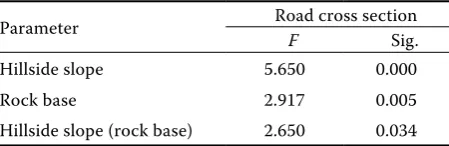
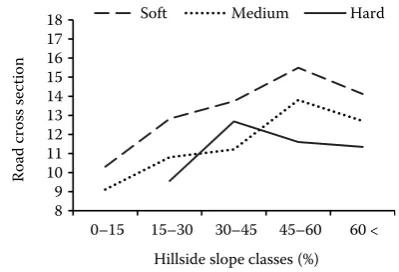
[image:3.595.64.290.73.161.2]Th e two-way ANOVA test showed that the in-teraction of two parameters slope aspect and rock base with cross section is signifi cant (Table 4). Th e interaction of these two parameters showed that by increasing the rock base, the average cross sec-tion increased in all slope classes. In areas with soft
Table 1. Correlation between the studied parameters
Soil texture Rock
base Hillside
slope Parameter
Sig. R Sig. R Sig. R
0.000
0.423**
0.000 0.319** 0.000
0.423** Elevation
0.935 0.006 0.000 0.478** –
– Hillside slope
0.020 –0.181* –
– – – Rock base
Table 2. Correlation between the studied parameters and the road cross section
Road cross section Parameter
Sig. R
0.000 0.491**
Hillside slope
0.001 0.292**
Elevation
0.006 –0.385**
Rock base
0.212 –0.148
Slope aspect
0.015 –0.258*
[image:3.595.304.531.87.190.2]Soil texture
Table 3. Result of the analysis of variance for parameters in road cross section
Road cross section Parameter
Sig. F
0.004 7.910
Hillside slope
0.008 4.069
Elevation
0.039 4.530
Rock base
0.291 1.255
Slope aspect
0.040 2.950
Soil texture
Table 4. Result of the analysis of variance (two-way ANOVA) for hillside slope and rock base parameters in road cross section
Road cross section Parameter
Sig. F
0.000 5.650
Hillside slope
0.005 2.917
Rock base
0.034 2.650
[image:3.595.63.290.657.757.2] [image:3.595.305.530.684.757.2]and medium rock bases it was observed that by in-creasing the hillside slope to 60% the cross section increases while above this value (60%) the width decreases. In rocky areas, by increasing the slope to 45%, the cross section increases, then above this value the cross section decreases (Fig. 2). Results of Duncan’s test in diff erent composition groups of the two parameters of hillside slope and rock base classes showed that in soft and medium classes of the rock base there is a signifi cant diff erence be-tween the average widths of construction opera-tions in diff erent slope classes, so that the classes 45–60 and 0–15% had the highest and the lowest road cross section, respectively, with other classes as intermediate. In the study area, there was no sig-nifi cant diff erence between the averages of cross section in diff erent slope classes (Fig. 3).
[image:4.595.87.479.49.501.2](e)
Fig. 1. Average road cross sections according to classes
8 9 10 11 12 13 14 15 16 17 18
0–15 15–30 30–45 45–60 60 <
Ro
ad
cr
o
ss sectio
n
Hillside slope classes (%)
Soft Medium Hard
Fig. 2 Interaction of two parameters slope aspect and rock base with road cross section
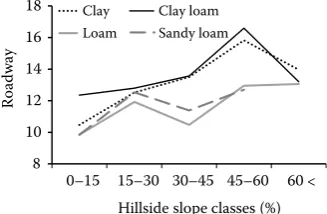
Th e two-way ANOVA test showed no signifi cant interaction between slope and soil texture at a sig-nifi cance level of 5% (Table 5). Th e diagram of
in-(c) (d)
(a) (b)
c
bc bc a
ab
8 10 12 14 16 18
Ro
ad
c
ro
ss
sec
tion
Hillside slope classes (%)
a a
a a
8 10 12 14 16 18
West North East South
Roa
d
cros
s
se
cti
o
n
Slope aspect classes 0–15 15–30 30–45 45–60 60 <
b ab
a
ab
8 10 12 14 16 18
Elevation classes (m)
a
ab
b
8 10 12 14 16 18
Soft Medium Hard
Rock base classes
150–400 400–600 600–800 800–1,000
a a
b b
8 10 12 14 16 18
Roa
d
cros
s
se
cti
o
n
Soil texture classes Clay Clay
loam
[image:4.595.312.512.587.723.2]teraction, however, showed that by decreasing the soil particle size in slopes ranging from 15 to 60% and when the soil texture becomes more clayey, the cross section changes more quickly compared to slope variations (Fig. 4). Results of Duncan’s test in diff erent composition groups of the two pa-rameters of hillside slope and soil texture classes showed that in clay texture there is a signifi cant ference between the average cross sections in dif-ferent slope classes, so that the classes 45–60% and 0–15% had the highest and the lowest road cross section, respectively. Also in the clay loam class the slope class of 60–45% had the highest road cross section and the remaining classes represented the lowest road cross section. In loam and sandy loam classes there was no signifi cant diff erence between the averages of cross section (Fig. 5).
DISCUSSION AND CONCLUSIONS
Th e results showed that the road cross sections in slope classes of 0–15, 15–30, 30–45, 45–60, and > 60% were measured to be 10.62, 12.70, 12.85, 15.96 and 14.28 m, respectively (Fig. 1a). Th e road cross section increased by increasing the slope per-centage up to 60%, after passing this range, the road cross section decreased due to the increased rock base. Most scientists have reported that among the
eff ective parameters in relation to the road cross section slope angle is the most important. Soil ag-gregate stability against displacement in gentle slopes is greater than in steep slopes. Th e steeper the slope, the higher the soil instability and the soil is more likely to slip and move downhill. It should be noted that in very steep slopes the soil depth is very low due to the lack of stability. For this reason, the road cross section will be lower in very steep slopes if this slope is instable how can you road cross section could be decreased. Th us, the medi-um slopes, due to the thick layer of soil, are more exposed to instability and have the maximum road cross section (Sedlak 1983; Gorton 1985; Hay 1996; Potocnik 2003; Parsakhoo et al. 2009). In the case of elevation, the results showed that the class of 600–800 m had the highest road cross sec-tion (15 m) and the classes of 150–400 and 1,000 to 1,200 m with the road cross section 12.68 and 12.7 m, respectively, had the lowest road cross sec-tion. Th e elevation class of 400–600 m with the road cross section 13.20 m represented the intermediate condition (Fig. 1b). Due to the irregular trend of the average road cross section, diff erent elevation classes, i.e. it increases to 800 m, then it decreases at higher elevations, it could be concluded that the elevation is a regional parameter and it is not rec-ognizably correlated with the road cross section. No signifi cant diff erence was found between diff er-ent slope aspect classes and the road cross section (Fig. 1c). In the case of rock base, it was observed that the soft class and hard class had the highest (13.60 m) and the lowest (11.50 m) road cross sec-tion, respectively, and the medium class showed the intermediate condition (Fig. 1d). Th e amount of rock base in soil is considered as a decisive fac-tor for determining the road cross section and road construction project, so that by decreasing the rock base the road cross section increases while by in-creasing the rock base the operation of cutting the trenches is more diffi cult, which in turn decreases the road cross section. Th ese fi ndings confi rm the
a
8 9 10 11 12 13 14 15 16 17
Soft Medium Hard
Roadw
ay
Rock base
0–15 15–30 30–45 45–60 60 < a
bc ab
c
bc
a
b ab ab
ab
[image:5.595.65.287.61.168.2]a a a
Fig. 3. Average road cross sections according to hillside slope and rock base in various classes of forest roads
Fig. 5. Average road cross sections according to hillside slope and soil texture in various classes of forest roads
8 10 12 14 16 18
0–15 15–30 30–45 45–60 60 <
Ro
ad
w
ay
[image:5.595.336.500.62.169.2]Hillside slope classes (%) Clay Clay loam Loam Sandy loam
Fig. 4. Interaction of two parameters slope aspect and rock base with road cross section
b
b
a a
abab b a a
b
a
a
a a
a a
ab
b a
6 8 10 12 14 16 18
Clay Clay loam Loam Sandy loam
Ro
ad
w
ay
Soil texture
[image:5.595.64.290.602.721.2]results of Potocnik (2003). Th e results showed that clay and clay loam classes with 13.90 and 14 m, respectively, had the highest road cross section while loam and sandy loam classes, with 11.95 and 12.03 m, respectively, had the lowest road cross sec-tion (Fig. 1e) Th us, clayey soils with plastic proper-ties resulted in wider road cross section compared to sandy loam soils because by decreasing the ag-gregate size and increasing plasticity the slope of cut-slope will increase and the slope of fi ll-slope will decrease, which in turn causes the increased horizontal width of the cut-slope and fi ll-slope, and consequently increased road cross section (Haar-laa 1973; Hosseini et al. 2012). Th e simultaneous eff ects of the two factors, namely hillside slope and rock base, on the road cross section showed that the average road cross section will decrease in all slope classes by increasing the rock base. Also in both soft and medium classes of rock base, the road cross section increases to a 60% slope, and then the road cross section decreases above 60%. But in hard rock base areas with increasing the slope per-centage to 45% the road cross section increases and beyond this value the road cross section decreases. Th ere were no data for the hard rock base area in slope classes of 0–15% and 15–30% (Fig. 2).
Results of Duncan’s test in diff erent groups of the two parameters for hillside slope and rock base showed that in the soft class there is a signifi cant dif-ference between the average road cross section in diff erent slope classes so that slope classes of 45 to 60% and 0–15% had the highest and the lowest road cross section. Again, in the medium class there is a signifi cant diff erence between the average road cross section operations in diff erent slope classes so that slope classes of 45–60% and 0–15% similarly had the highest and the lowest road cross section, and the remaining classes represent the intermediate condi-tion. In rocky areas there was no signifi cant diff ence between average road cross sections in diff er-ent classes of slope and it could be concluded that in rocky areas changes in road cross section vary more intensely compared to changes in slope (Fig. 3).
Th e interaction graph of soil texture and hillside slope showed that by decreasing the particle size and increasing the percentage of clay in the slope steeper than 30% the road cross section changes more rapidly relative to changes in the slope and also in slopes steeper than 30% the road cross sec-tion in hillsides containing soils with more clayey textures is higher than in soils with loam and san-dy textures. Totally the highest road cross section was found in clayey textures and moderately steep slopes (45–60%). Th is could be due to the higher
thickness of soils in these slopes and the higher soil instability in clayey soils compared to loam ones (Fig. 4) (Anonymous 1998; Nunnally 2000; Nari-mani 2002). Results of Duncan’s test in diff erent composition groups of the two parameters hillside and soil texture showed that in the fi ne texture class there was a signifi cant diff erence between the aver-age road cross sections in diff erent slope classes so that the slope classes of 45–60% and 0–15% had the highest and the lowest road cross section, respec-tively. In the loam clayey texture class there was no signifi cant diff erence between the average widths of construction operations in diff erent slope classes (Fig. 5). Th erefore, the road cross section shows a more sensitive response to changes in clayey soils but in more loamy and sandy soils the sensitivity of road cross section to changes in slopes decreas-es. Finally, with regard to various conditions and mountainous areas at risk the road should not pass through areas with high sensitivity such as hillsides with clayey soils and medium slope to avoid an in-crease in the road cross section and its subsequent destruction as well as to decrease the environmen-tal and economic costs.
R e f e r e n c e s
Anonymous (1998): Colorado Forest Road Field Handbook. Fort Collins, Colorado State Forest Service, Colorado State University: 146. Available at http://static.colostate.edu/ client-fi les/csfs/pdfs/csfs-frst-rd-hndbk-www.pdf Ariel E., Gucinski L.H. (2000): Function eff ects and
manage-ment of forest roads. Forest Ecology and Managemanage-ment, 133: 249–262.
Erdas O., Acar H., Tundy M., Karaman A. (1995): Problems and its suggestion of solution interested in forest agronomy and production, forest roads. Transportation of forest products, forestry mechanization and cadastral. Turkey Forestry Report, 48: 44–79.
Ghajar I., Najafi A., Torabi S.A., Khamehchiyan M., Boston K. (2012): An adaptive network-based fuzzy inference system for rock share estimation in forest road construc-tion. Croatian Journal of Forest Engineering, 33: 313–328. Gorton F. (1985): Praxis und Kosten einer landschaftsscho-nenden Bauausführung von Forst- strassen. Allgemeine Forstzeitung. Wien, 96: 241–244.
Haarlaa R. (1973): Maaston vaikutuksesta metsäteiden ra-kennukseen. Silva Fennica, 7: 284–309.
Hay R. (1996): Seminar on environmentally sound forest road and wood transport. Available at http://www.fao.org/ docrep/x0622e/x0622e01.htm
working operation based on standard method and fi eld study iranian journal of natural resources. Journal of Forest and Wood Products, 63: 240–229. (in Persian)
Hosseini S.A., Khalilpour H., Nevada A.M., Moafi M., Foumani B.S. (2012): Comparing the expenses of forest road cut and fi ll operations with standard rules (study area: northern forests of Iran). European Journal of Experimental Biology, 2:1023–1028.
Jusoff K. (2008): Construction of new forest roads in Malaysia using a GIS-based decision support system. Computer and Information Science, 1: 48.
Majnounian B., Alizadeh S.M., Darvishsefat A.A., Abdi E. (2010): Evaluating of Estimation of Cut and Fill Operations Using GIS and Field Measurement. Watershed Manage-ment Research Journal (Pajouhesh & Sazandegi), 87: 64–69. (in Persian)
Narimani G. (2002): Geometric Design of Highways. Tehran, Tehran University Publication: 590. (in Persian)
Nunnally S.W. (2000): Managing Construction Equipment. 2nd Ed. New Jersey, Prentice Hall: 399
Parsakhoo A., Hosseini S.A., Lotfalian M., Jalilvand H. (2009): Infl uence of hillside gradient on forest road cross section components in a loamy clay soil. American Journal of Ap-plied Sciences, 6: 1212–1216.
Potocnik I. (2003): Forest road formation width as an indi-cator of human impact on forest environment. Ekologia, 22: 298–304.
Ryan T., Phillips H., Ramsay J., Dempsey J. (2004): Forest Road Manual. Dublin, National Council for Forest Research and Development: 170.
Sedlak O. (1983): Forest Road Planning, Location and Construction Techniques on Steep Terrain Logging and Transport in Steep Terrain. FAO Forestry Paper 14. Rome, FAO: 345.
Shahoei S. (2007): Nature and Properties of Soils. Erbil, University of Kurdistan: 880. (in Persian)
Sarikhani N., Majnounian B. (1994): Forest Roads Plan Per-formance and Utilization Guide Line. Tehran, Program and Budget Organization of Iran: 131. (in Persian)
Tan J. (1992): Planning of Forest Road Networks by a Spatial Data Handling-network Routing System. Acta Forestalica Fennica 227. Helsinki, Th e Finnish Forest Research Insti-tute: 85.
Received for publication September 29, 2015 Accepted after corrections November 18, 2015
Corresponding author: