Valence Electron Concentration and Phase Transformations
of Shape Memory Alloys Ni–Mn–Ga–X
Kenichi Yamaguchi
1;*, Shoji Ishida
1and Setsuro Asano
21
Department of Physics, Faculty of Science, Kagoshima University, Kagoshima, 890-0065 Japan 2The Graduate School of=College of Arts and Sciences, The University of Tokyo, Tokyo, 153-0041 Japan
In the Ni2MnGa based alloys with additions of transition element Ni–Mn–Ga–X, the martensitic transformation temperatureTM was observed as a function of the valence electron concentration per atome=a. TheTMðe=aÞstrongly depends one=aand increases with increasing
e=a. In this paper, to examine the effect of Xatom on the phase transformation in Ni–Mn–Ga–Xalloys, the electronic structures for six systems were calculated for four phases, that is, the paramagnetic cubic, the paramagnetic monoclinic, the ferromagnetic cubic and the ferromagnetic monoclinic phases. Moreover, the total energy differencesEðe=aÞbetween two phases among four phases were calculated as a function ofe=a. The variations ofTMðe=aÞwere predicted by the differenceEðe=aÞbetween the cubic and monoclinic structures in a ferromagnetic state. It was found that their correspondence is good for some systems and that the features ofTMðe=aÞreflect the changes of the density of states of Xatoms.
(Received October 9, 2002; Accepted December 13, 2002)
Keywords: shape memory, martensitic transformation temperature, valence electron concentration, electronic structure, total energy, nickel, manganese, gallium, Curie temperature
1. Introduction
Many researchers have reported on the crystal structures and the phase transformations of the Ni–Mn–Ga alloys. The tetragonal structure was observed in the martensitic phase around valence electron concentratione=a¼7:50 (stoichio-metric Ni2MnGa). On the other hand, the orthorhombic and
monoclinic structures were observed.1–4) For example, the orthorhombic structure was observed at thee=a¼7:635and the monoclinic structures at e=a¼7:64, 7.67, 7.72 and 7.78.2,3)It was also reported that the tetragonal phase in the lowere=acan be suppressed by Ni excess.5)Furthermore, it is also predicted theoretically that the tetragonal and orthor-hombic structures may be metastable and the monoclinic structure is the most stable state among these structures for Ni2:17Ni0:83Ga and Ni2(Pd0:17Ni0:83)Ga.6)Thus, it is possible
for the monoclinic structure to appear in martensitic phase in widee=arange.
The martensitic transformation temperature TM and the
Curie temperatureTcfor Ni2MnGa (e=a¼7:50) are 202 and
376 K, respectively.7) The various values of TM were
observed in the wide range from 175 to 626 K in the range
e=a¼7:45{8:10.8–10) For Ni–Mn–Ga alloys, Tc decreases
andTMincreases with increasinge=a.5,9)They merge in the
rangee=a¼7:635{7:70. It was also shown thatTMis lower
than Tc in the lower e=a and higher than Tc in the higher e=a.5,9)Moreover, Xinet al.reported that the values ofTMfor
ferromagnetic alloys Ni–Mn–Ga are higher than 300 K and lower than Tc and that TM is represented by the equation TM ¼702:5ðe=aÞ 5067K as a function of e=a.11) These
results indicate that the martensitic transformation occurs in a ferromagnetic phase for the lowere=aand in a paramagnetic state for the highere=a.
Moreover, Tsuchiya et al. reported three types of
trans-formations: (I) paramagnetic parent phase,ferromagnetic
parent phase , intermediate phase , ferromagnetic
martensitic phase in the rangee=a<7:62, (II) paramagnetic
parent phase,(ferromagnetic parent phase),
ferromag-netic martensitic phase in the range 7:62<e=a<7:65and (III) paramagnetic parent phase,paramagnetic martensitic
phase , ferromagnetic martensitic phase in the range
7:65<e=a.12) The symbol ‘‘,’’ denotes the process of transformation between two phases.
Previously, paying attention to only two systems in a ferromagnetic state, the authors calculated total energy
differencesEbetween the cubic and monoclinic structures
as a function of e=a and related the E with the e=a
dependence ofTM.13)It was found thatEðe=aÞchanges like
a straight line in the range e=a¼7:50{7:625 for the case where Xatoms occupy Ni sites, while like a parabolic line in the range e=a¼7:625{7:77 for the case where Xatoms occupy Mn sites. The characteristic behavior ofEðe=aÞis similar to the behavior ofTMðe=aÞof Ni2:16xCoxMn0:84Ga,
Ni2:20zFezMn0:80Ga and Ni2:16Mn0:84yCoyGa. However, for Ni2þxMn1xGa, the correspondence between Eðe=aÞ and
TMðe=aÞis good in the rangee=a¼7:50{7:625but not good
in the rangee=a>7:625.
In this paper, new four systems and a paramagnetic state will be considered to investigate in more detail the effect of X atom on the phase transformation in Ni–Mn–Ga–Xsystems.
2. Crystal Structure and Method of Calculation
As described in the previous section, it was reported theoretically that the monoclinic structure is the most stable among the cubic, tetragonal, orthorhombic and monoclinic structures for Ni2:17Ni0:83Ga and Ni2(Pd0:17Ni0:83)Ga. Then,
we consider the cubic structure and the monoclinic structure as the parent phase and the martensitic phase, respectively. The symmetry of the monoclinic structure is lower than that of the cubic structure. The cubic structure is treated as a
monoclinic structure with an angle of shown in Fig.1 to
calculate under the same condition. The angle is 71.565
and 98.461 or the cubic structure and the monoclinic
*Graduate Student, Kagoshima University.
structure of Ni2:17Ni0:83Ga.6)When we assume thaty-axis is
vertical to this paper, Mn and Ga atoms are located on the
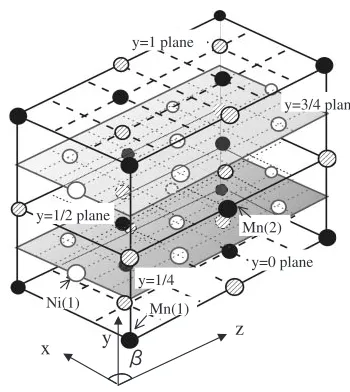
y¼0(or 1) and1=2planes and Ni atoms on they¼1=4and 3=4planes shown in Fig.1. Each of nickel, manganese and gallium in Ni2MnGa has the four different atomic sites in the
unit cell with the P2/m symmetry of the tenth space group. For example, the sites of Ni and Mn atoms are distinguished by such as the symbols of Ni(1), Mn(1) and Mn(2). The Ni(1), Mn(1) and Mn(2) are located at the2j,1aand1fsites. The monoclinic structure has twenty-four atoms in the unit cell, which corresponds to the observed monoclinic structure
having the shuffling of 6 layers of (2 2 0) planes.2) This
monoclinic structure is shown in Fig.2and the symbols open
circles, solid circle and circle with slants denote Ni, Mn and Ga, respectively. The Mn(1), Mn(2) and Ni(1) are the sites where Xatoms occupy. Recently, it was confirmed that the monoclinic structure is equivalent to the tetragonal structure of the named of 2M.14)
The alloy where a sixth of Mn atoms of Ni2MnGa were
replaced with Ni atoms was described as Ni2:17Ni0:83Ga in the
previous papers.6) In this paper, the alloy is described as Ni2(X1=6Mn5=6)Ga where the Ni atoms at the Mn(1) sites are
described in parentheses with the Mn atoms. Here, we consider six systems of Ni–Mn–Ga–Xalloys where Ni or Mn atoms in Ni2MnGa or Ni2(Ni1=6Mn5=6)Ga are replaced with
other transition element. They are listed in Table1, where the name of the systems, the molecular formula and atoms at the Mn(1), Mn(2) and Ni(1) sites are shown. For example, in (Ni5=6X1=6)2(Ni1=6Mn5=6)Ga, Ni atoms are replaced with X
atoms and Mn(1) atoms with Ni atoms. The Nm1-n1 and s-Nm1-m2 are new notation for sys-N1 and sys-M2 in the previous paper, respectively.13)When transition elements are chosen as the Xatoms, these alloys are in the range of
e=a¼7:50{7:77. When we cannot choose a real element as the Xatom for the special value ofe=a, we adopt an artificial atom. For example, the artificial atom is described like Z27.5 where the number of 27.5 means the atomic number and the number of electrons.
Monoclinic Structure
Cubic Structure
1 1 4
3 2 (a)
Ni Mn Ga
Mn,Ga : y=0 or 1 Ni : y=1/4
3 1
3
Monoclinic Structure
Cubic Structure (b)
2
4 3
Mn, Ga : y=1/2 Ni : y=3/4
2
2 4
1 4
Fig. 1 Relation between the cubic and monoclinic structures of Ni–Mn– Ga–Xalloy. The constituent atoms on they¼0andy¼1=4planes are shown in (a) and ones ony¼1=2andy¼3=4planes in (b). The numbers denote the atomic sites in the monoclinic structure. The cubic structure is treated as the monoclinic structure with an angle of¼71:565.
Mn(2)
Ni(1) Mn(1)
y=3/4 plane
y=1/4 y=1/2 plane
y=1 plane
y=0 plane
z y
x
[image:2.595.334.509.68.264.2]Fig. 2 Monoclinic structure. The monoclinic structure has twenty-four atoms in the unit cell, which corresponds to the observed monoclinic structure having the shuffling of 6 layers of (2 2 0) planes.
Table 1 Six systems classified by the site of Xatom (Mn or Ni site) in the shape memory alloys Ni–Mn–Ga–X. The symbols, the molecular formula used in this paper are listed. The atoms at Mn(1), Mn(2) and Ni(1) sites are also shown and the other atoms occupy the regular sites.
Symbol Constituent atom Replaced
of system Molecular formula Mn(1) Mn(2) Ni(1) site
s-m1 Ni2(X1=6Mn5=6)Ga XMn Ni
s-m2 Ni2(Mn5=6X1=6)Ga Mn XNi
Mn
s-Nm1-m2 Ni2(Ni1=6Mn4=6X1=6)Ga Mn XNi
s-Cm2-m1 Ni2(X1=6Mn4=6Co1=6)Ga XCo Ni
s-Nm1-n1 (Ni5=6X1=6)2(Ni1=6Mn5=6)Ga Ni Mn X
[image:2.595.70.266.73.381.2] [image:2.595.45.554.684.785.2]Band calculations were carried out self-consistently by the
LMTO-ASA method.15)The exchange correlation potential
was treated within the framework of the local-spin-density (LSD) approximation.16)
3. Results and Discussion
3.1 Total energy and valence electron concentration
In a previous paper, total energy differencesEbetween
cubic and monoclinic structures were calculated for s-Nm1-n1 (old notation: N1) and s-Nm1-m2 (old notation:
sys-M2).13) Here, E were newly calculated for four systems
listed in Table1except for above two systems. To calculate thee=adependence ofE, transition elements were chosen as Xatoms such as Mn, Fe, Z26.5, Co, Z27.5 and Ni for s-m1 where the value ofe=a changes from 7.50 to 7.625. In this study, a paramagnetic state is newly considered. Therefore, band calculations were performed for four phases; paramag-netic cubic (PC), ferromagparamag-netic cubic (FC), paramagparamag-netic monoclinic (PM) and ferromagnetic monoclinic (FM) pha-ses. The obtained total energies of six systems are the lowest for FM phase among four phases.
At first, we consider the transformation in the ferromag-netic state, that is, the transformation between FC and FM
phases. The total energy differencesEbetween FC and FM
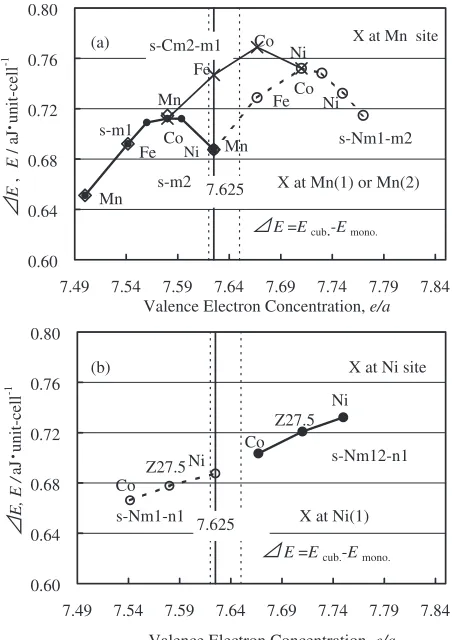
phases is described asEFC-FM. The curves ofEFC-FMðe=aÞ
are shown in Fig. 3(a) for four systems where Xatoms
occupy Mn sites and in Fig. 3(b) for two systems where X
atoms occupy Ni sites. The cases of X= Ni in s-m1 (s-m2) and n1 are equivalent to the case X= Mn in s-Nm1-m2 which correspond toe=a¼7:625. Also, the case of X= Co in s-m1 (s-m2) and the case of X= Ni in s-Cm2-m1 are equivalent to those of X= Mn in Cm2-m1 and X= Co in s-Nm1-m2. The curves for s-m1, s-m2 and s-Cm2-m1 are similar to that of s-Nm1-m2 shown in the previous paper13) and the curve of s-m2 overlaps with that of s-m1 each other. Their shapes are like a parabola with a top at Co. On the other hand, the curves of s-Nm12-n1 is similar to that of s-Nm1-n1 in Fig. 3(b) and the EFC-FMðe=aÞ increases linearly with
increasinge=a.
Thus, the change ofEFC-FMðe=aÞdepends on the site of X
atom (Mn or Ni site) and the value is not unique for e=a. Now, we will discuss the relation betweenEFC-FMðe=aÞand
the martensitic transformation temperatureTM.
Chernenko et al.17) have measured the temperature
dependence of the transformation stress to be
d=dT¼13MPa/K for the alloy Ni–23.5Mn–23.9Ga.
Tsu-chiyaet al.12)have studied thee=adependence ofTMandTc
for Ni–Mn–Ga alloys and estimated the transformation
entropy S to be 48:21018aJ/molK, using the value
d=dT¼13MPa/K. When the e=a changes from 7.50 to
7.625, corresponding change inTMwas observed to be about
100 K. In the same interval, the increase ofEFC-FMðe=aÞis
5:711021aJ/mol. The value is converted to the increase in TM to be 118 K, usingS¼48:21018aJ/molK. Thus, the
correspondence between the variation of the EFC-FMðe=aÞ
and that ofTMis fairly well.
The six curves ofEFC-FMðe=aÞshown in Fig.3are again
shown by the solid and broken lines in Fig.4. The theoretical valuesEFC-FMðe=aÞnear the experimental values are plotted
by solid circles. The experimental values of TM for
Ni2:16xCoxMn0:84Ga, Ni2:20zFezMn0:80Ga and
Ni2:16Mn0:84yCoyGa observed by Khovailo are plotted by open triangle, open square and open circle in the Fig. 4(a), respectively.18)The values ofTMðE) refer to the left (right)
axis. The values ofEFC-FMðe=aÞis plotted so that the values
EFC-FMðe=aÞof the case X= Ni in the s-Nm1-n1 and X=
Mn in the s-Nm1-m2 are superposed on the values ofTM at
e=a¼7:625. The values of TM are distributed near the
EFC-FMðe=aÞ line for s-Nm1-n1 in the range
e=a¼7:54{7:625, while along the EFC-FMðe=aÞ curve for
s-Nm1-m2 in the rangee=a¼7:625{7:71, as described in the
previous paper.13) Thus, the values of TM for
Ni2:16xCoxMn0:84Ga and Ni2:20zFezMn0:80Ga correspond
to those ofEFC-FMðe=aÞfor s-Nm1-n1 and the values ofTM
for Ni2:16Mn0:84yCoyGa correspond to thoseEFC-FMðe=aÞ
for s-Nm1-m2.
In the Fig. 4(b), the experimental values for
Ni2þxMn1xGa are plotted by crosses forTM and by open
diamonds for the Curie temperatureTc.12)TheTM increases
along the EFC-FMðe=aÞ line for s-Nm1-n1 with increasing e=a, while the Tc decreases in the range e=a¼7:50{7:65.
And the TM and Tc are nearly equal in the range
e=a¼7:65{7:71. The values of TMðe=aÞ distribute along
X at Mn site
0.60 0.64 0.68 0.72 0.76 0.80
7.49 7.54 7.59 7.64 7.69 7.74 7.79 7.84
Valence Electron Concentration, e/a
E
,
E
/ aJ
unit-cell
-1
Co
Ni
7.625 Co
Fe
Co
Ni
Mn
E =E cub.-E mono. Fe
Mn Fe
Mn
X at Mn(1) or Mn(2) s-m1
s-Cm2-m1
s-Nm1-m2
s-m2
Ni (a)
X at Ni site
0.60 0.64 0.68 0.72 0.76 0.80
7.49 7.54 7.59 7.64 7.69 7.74 7.79 7.84
Valence Electron Concentration, e/a
E, E /
aJ
unit-cell
-1
Ni
7.625
E =E cub.-E mono. Co
Co
Ni
Z27.5
Z27.5
X at Ni(1) s-Nm12-n1
s-Nm1-n1 (b)
[image:3.595.314.540.73.393.2]Eðe=aÞline of s-Nm1-n1 in the rangee=a¼7:50{7:65. In the rangee=a>7:625, the values ofTMdo not distribute near
the broken curve for s-Nm1-m2 but the curve for s-Nm12-n1.
Thus, it was found that the Eðe=aÞ for s-Nm12-n1
corresponds to the TMðe=aÞ of Ni2þxMn1xGa in the range
e=a¼7:65{7:71.
3.2 Intermediate state
In the previous section, we considered above the transfor-mation in the ferromagnetic state and also we will consider the paramagnetic state in followings. The differences
(E¼EEFM) of total energies between the FM phase
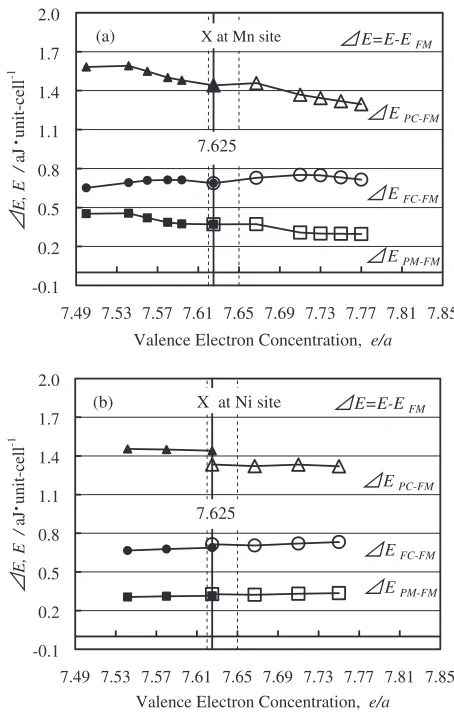
with the lowest total energy and the other phase are plotted as a function ofe=ain Figs.5(a) and (b). The differencesEare shown in Fig.5(a) for the case where Mn atoms are replaced with Xatoms and in Fig.5(b) for the case that Ni atoms are replaced with Xatoms.
In Fig. 5(a), the three curves with solid symbols in the rangee=a¼7:50{7:625and with open symbols in the range
e=a¼7:625{7:77 are drawn for s-m1 and s-Nm1-m2, respectively. The symbols ‘‘triangle’’, ‘‘circle’’ and ‘‘square’’
correspond to EPC-FMðe=aÞ, EFC-FMðe=aÞ and
EPM-FMðe=aÞ, respectively. In Fig. 5(b), the differences
Eare drawn by the three straight lines for Nm1-n1 and s-Nm12-n1 as in Fig.5(a).
Here, we refer to the experimental results that the martensitic transition occurs in the ferromagnetic state for
the lower e=a. In the range e=a¼7:50{7:70, the
EFC-FMðe=aÞ varies like a parabolic or straight line as
described above, while theEPC-FMðe=aÞandEPM-FMðe=aÞ
decrease with increasinge=a. The increase ofEFC-FMðe=aÞ
corresponds to the increase of TM and the decrease of
EPC-FMðe=aÞandEPM-FMðe=aÞcorresponds to the decrease
ofTc.
Our results show that the total energy becomes lower in order of PC, FC, PM and FM phases and suggest the possibility of four kinds of transitions as follows:
100 200 300 400 500 600 700 800
7.48 7.53 7.58 7.63 7.68 7.73 7.78
Valence Electron Concentration, e/a
Transformation Temperatures,
TM
,
Tc
/K
7.625
(b)
s-Nm1-n1
s-Nm12-n1
7.71
100 200 300 400 500 600 700 800
7.48 7.53 7.58 7.63 7.68 7.73 7.78
Valence Electron Concentration, e/a
Transformation Temperature,
TM
/K
s-Nm1-m2 (a)
s-Nm1-n1
7.625 7.71
0.684 0.780
0.732
0.639
E
,
E
/ aJ
unit-cell
-1
0.684 0.780
0.732
0.639
E
, E
/ aJ
unit-cell
-1
Fig. 4 Comparison between phase transformation temperatures and total energy differences. The values of martensitic transformation temperatureTMrefer to the left axes and those of total energy differenceEto the right axes. The solid and broken curves are the curves ofEshown in Fig.3. The solid curves with solid circles show the curves ofEFC-FMðe=aÞwhich are comparable with the experimental values. In (a), the open squares, open triangles and the open circles indicate the values of TM for Ni2:16xCoxMn0:84Ga, Ni2:20zFezMn0:80Ga and Ni2:16Mn0:84yCoyGa, respectively.18)In (b), crosses and diamonds indicate the values ofTM andTc for Ni2þxMn1xGa, respectively.12)
E=E-E FM
-0.1 0.2 0.5 0.8 1.1 1.4 1.7 2.0
7.49 7.53 7.57 7.61 7.65 7.69 7.73 7.77 7.81 7.85
Valence Electron Concentration, e/a
E, E /
aJ
unit-cell
-1
7.625
E PC-FM
E FC-FM
E PM-FM X at Ni site
(b)
E=E-E FM
-0.1 0.2 0.5 0.8 1.1 1.4 1.7 2.0
7.49 7.53 7.57 7.61 7.65 7.69 7.73 7.77 7.81 7.85 Valence Electron Concentration, e/a
E, E
/
aJ
unit-cell
-1
7.625
E PC-FM
E FC-FM
E PM-FM
X at Mn site
(a)
[image:4.595.70.528.76.259.2] [image:4.595.311.538.362.719.2](Trans.1) PC!FC!FM,
(Trans.2) PC!PM!FM,
(Trans.3) PC!FM and
(Trans.4) PC!FC!PM!FM.
Thus, there is the possibility that FC and PM phases become the intermediate phase between PC and FM phases. Now, we
compare our results with those of Tsuchiya et al.12) As
described in the introduction, they reported three types of transitions in three regions: (I)7:5>e=a, (II)7:62<e=a< 7:65and (III)7:65<e=a. We guess that Trans.1 correspond to the transition in the rangee=a<7:65where their observed intermediate state may be a ferromagnetic phase with a structure different from the monoclinic structure, Trans.2 does to the transition in the range e=a>7:65 and Trans.3 does to the transition in the range 7:62<e=a<7:65. The magnetic transition is not natural in the Trans.4 among our four types of transitions. Therefore, Trans.4 may be not observed. We have to consider entropy in order to discuss transitions accurately.
3.3 Density of states
In the previous section, it was found that curves of the differencesEðe=aÞare similar for the four systems of s-m1, s-m2, s-Nm1-m2 and s-Cm2-m1 where the Xatoms occupy the Mn sites. The similarities are also seen in the curves of s-Nm1-n1 and s-Nm12-n1 where the Xatoms occupy the Ni sites. It is natural to pay attention to Xatoms in considering
energy differences due to differences of e=a and systems,
because the difference ofe=a and systems is due to the X atoms. It is expected that the change in the total density of state (DOS) due to the difference ofe=aand system mainly comes from the change in the local DOS of Xatom (X-DOS). The change in the DOS affects the change of total energy
differencesEbetween cubic and monoclinic structures.
Then, we pay attention to the relation between theEðe=aÞ
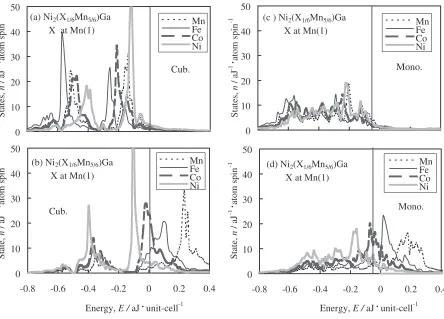
and the X-DOS for case that the X atom occupies the Mn sites. The X-DOS curves for s-m1 are shown in Fig.6where the curves of the cubic structure are shown for the majority
and minority spins in Figs. 6(a) and (b) and those of the
monoclinic structure in Figs.6(c) and (d). The variation in the X-DOS for X = Mn, Fe, Co and Ni atoms is quite similar to that of s-Nm1-m2 (old notation: sys-M2).13)The vertical line denotes the Fermi energy. Since the Xatom in the cubic structure is surrounded by eight Ni atoms, the X-DOS has the characteristics of the bcc structure, that is, the X-DOS is composed of two large peaks. The large valley between the two peaks disappears in the monoclinic structure and the occupied states generally move to the states with the lower energy. Therefore, we can guess that the band energy for the monoclinic structure is lower than that of the cubic structure. In the minority spin states, the X-DOS curve shifts from the higher energy region to the lower energy region beyond the Fermi energy, when the Xatom changes from Mn to Ni in the order of Mn, Fe, Co and Ni. On the other hand, in the majority spin state, the two large peaks under the Fermi energy shift to the higher energy region with increasing e=a except for the
(a) Ni2(X1/6Mn5/6)Ga X at Mn(1)
0 10 20 30 40 50
States,
n
/ aJ
-1
atom spin
-1
States,
n
/ aJ
-1
atom spin
-1
State,
n
/ aJ
-1
atom spin
-1
State,
n
/ aJ
-1
atom spin
-1
Mn Fe Co Ni
Cub.
(b) Ni2(X1/6Mn5/6)Ga X at Mn(1)
0 10 20 30 40 50
-0.8 -0.6 -0.4 -0.2 0 0.2 0.4
Energy, E / aJ unit-cell-1 Energy, E / aJ unit-cell-1
Mn Fe Co Ni
Cub.
(d) Ni2(X1/6Mn5/6)Ga X at Mn(1)
0 10 20 30 40 50
-0.8 -0.6 -0.4 -0.2 0 0.2 0.4
Mn Fe Co Ni
Mono. (c ) Ni2(X1/6Mn5/6)Ga
X at Mn(1)
0 10 20 30 40 50
Mn Fe Co Ni
Mono.
[image:5.595.77.521.434.753.2]case X= Mn. We can roughly guess from these changes that the difference of band energy between cubic and monoclinic structures becomes larger with increasing atomic number of
Xatom. Therefore, theEincreases with increasing atomic
number.
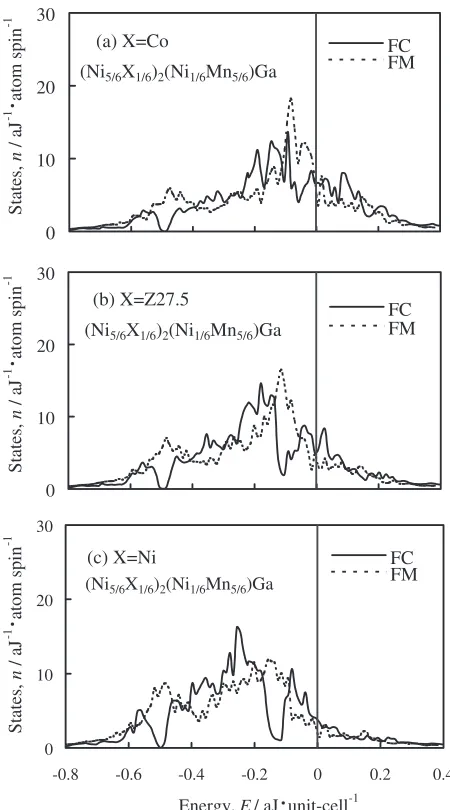
Next, we turn our attention to the case that the Xatoms occupy the Ni sites. The X-DOS curves for s-Nm1-n1 are shown in Figs.7and8. The curves of Co, Z27.5 and Ni in FC and FM phases are compared for the majority and minority spins in Figs.7 and 8, respectively. The change of the X-DOS due to the difference of Xatom is small in the majority spin for both of the FC and FM phases. On the other hand, the difference of the X-DOS between the FC and FM phases becomes larger in the minority spin, when Xatom changes from X= Co to Ni. The changes bring the linear increase in
EFC-FMðe=aÞ.
4. Conclusion
To investigate in more detail the effect of Xatom on the phase transformation in Ni–Mn–Ga–Xsystems, the
electro-nic structures were calculated for six Ni2MnGa based
systems listed in Table1. The total energies were also
calculated for four phases, which are PC, FC, PM and FM phases. Since the total energies become lower in order of the PM, FC, PM and FM phases, there is possibility that the FC and PM phases become an intermediate phase between PC and FM phases.
For the six systems treated in this paper, the total energy
differences EFC-FMðe=aÞ between FC and FM phases
calculated by changing the Xatom in Ni–Mn–Ga–Xalloys from Mn to Ni among transition elements. TheEFC-FMðe=aÞ
have a similar e=a dependence if the Xatom occupies the
same atomic site (Ni or Mn site).
It was shown that the increase of the martensitic transformation temperature TM due to the increase of e=a
(Ni5/6X1/6)2(Ni1/6Mn5/6)Ga
0 10 20 30
FC FM (a) X=Co
(Ni5/6X1/6)2(Ni1/6Mn5/6)Ga
0 10 20 30
FC FM (b) X=Z27.5
(Ni5/6X1/6)2(Ni1/6Mn5/6)Ga
0 10 20 30
-0.8 -0.6 -0.4 -0.2 0 0.2 0.4
Energy, E / aJ unit-cell-1
States,
n
/ aJ
-1
atom spin
-1
States,
n
/ aJ
-1
atom spin
-1
States,
n
/ aJ
-1
atom spin
-1
FC FM (c) X=Ni
Fig. 7 Local DOS of Xatoms in s-Nm1-n1. The DOS of X= Co, Z27.5 and Ni in (Ni5=6X1=6)2(Ni1=6Mn5=6) Ga are shown in (a), (b) and (c), respectively. The DOS curves for the majority spin state in FC and FM phases are drawn by the solid and dotted lines, respectively. The vertical line shows the Fermi energy.
(Ni5/6X1/6)2(Ni1/6Mn5/6)Ga
0 10 20 30
States,
n
/ aJ
-1
atom spin
-1
States,
n
/ aJ
-1
atom spin
-1
States,
n
/ aJ
-1
atom spin
-1
FC FM (a) X=Co
(Ni5/6X1/6)2(Ni1/6Mn5/6)Ga
0 10 20 30
FC FM (b) X=Z27.5
(Ni5/6X1/6)2(Ni1/6Mn5/6)Ga
0 10 20 30
-0.8 -0.6 -0.4 -0.2 0 0.2 0.4
Energy, E/ aJ unit-cell-1
FC FM (c) X=Ni
[image:6.595.313.538.71.476.2] [image:6.595.57.279.71.474.2]from 7.50 to 7.625 is comparable to that of TM which is
converted from the increase ofEFC-FMðe=aÞ. Therefore, the
e=a dependence of TMðe=aÞ corresponds to that of
EFC-FMðe=aÞ for s-Nm1-n1 in the range e=a<7:625 and
those for s-Nm1-m2 and s-Nm12-n1 in the range
e=a>7:625. Thus, the TMðe=aÞ may be predicted from the
Eðe=aÞwhich is not unique against the value ofe=a. The variation of Eðe=aÞ due to the difference of the Xatoms mainly comes from the variation of the X-DOS in Ni–Mn– Ga–Xalloys.
Acknowledgments
The authors wish to thank Professor Koichi Tsuchiya of Toyohashi University of Technology for giving information and significant discussions. This work was supported by a Grant-in-Aid (13640638) for scientific Research from the Ministry of Education, Science and Culture of Japan.
REFERENCES
1) V. A. Chernenko, C. Segui, E. Cesari, J. Pons and V. V. Kokorin: Phys. Rev.B57(1998) 2659–2662.
2) K. Inoue, K. Enami, M. Igawa, K. Inoue, Y. Yamaguchi and K. Ohoyama: Proc. Int. Conf. on Solid-Solid Phase Transformations (1999) pp. 1120–1123.
3) J. Pons, V. A. Chernenko, R. Santamarta and E. Cesari: Acta Mater.48
(2000) 3027–3038.
4) U. Stuhr, P. Vorderwisch and V. V. Kokorin: J. Phys. Condens. Matter.
12(2000) 7541–7545.
5) A. N. Vasil’ev, A. D. Bozhko, V. V. Khovailo, I. E. Dikshtein, V. G. Shavrov, V. D. Buchelnikov, M. Matsumoto, S. Suzuki, T. Takagi and J. Tani: Phys. Rev.B59(1999) 1113–1120.
6) S. Ishida, M. Furugen and S. Asano: Int. J. Appl. Electr. Mechan.12
(2000) 41–48.
7) P. J. Webster, K. R. A. Ziebeck, S. L. Town and M. S. Peak: Philos. Mag.49B(1984) 295–310.
8) V. A. Chernenko, V. A. L’vov, M. Pasquale, S. Besseghini, C. Sasso and D. A. Polenur: Int. J. Appl. Electro. Mechan.12(2000) 3–8. 9) V. A. Chernenko: Scr. Mater.40(1999) 523–527.
10) V. A. Chernenko, E. Cesari, V. V. Kokorin and I. N. Vitenko: Scr. Metall. Mater.33(1995) 1239–1244.
11) X. Jin, M. Marioni, D. Bono, S. M. Allen and R. C. O’Handley: J. Appl. Phys.91(2002) 8222–8224.
12) K. Tsuchiya, A. Tsutsumi, H. Nakayama, S. Ishida, H. Ohtsuka and M. Umemoto: J. Phys. IV, in press.
13) K. Yamaguchi, S. Ishida and S. Asano: Mater. Trans.43(2002) 846– 851.
14) K. Inoue: Private communication.
15) K. Andersen, O. Jepsen and D. Glotzel: Proc. Int. School of Physics
‘‘Enrico Fermi’’ Course 89, ed. by F. Bassami, F. Fumi and M. P. Tosi
(North-Holland, Amsterdam, 1985) pp. 59–176.
16) V. L. Moruzzi, J. F. Janak and A. R. Williams:Calculated Electronic
Properties of Metals, (Pergamon, New York, 1978) pp. 1–22.
17) V. A. Chernenko, V. V. Kokorin, O. M. Babii and I. K. Zasimchuk: Intermetalics6(1998) 29–34.