Physical Properties of Shelled and Kernel Walnuts
as Affected by the Moisture Content
Ebubekir AltuNtAS and Mehmet Erkol
Department of Agricultural Machinery, Faculty of Agriculture, university of Gaziosmanpasa, tasliciftlik, tokat, turkey
Abstract
Altuntas E., Erkol M. (2010):Physical properties of shelled and kernel walnuts as affected by the moisture content. Czech J. Food Sci., 28: 547–556.
The variations in physical properties such as the size dimensions, unit mass, sphericity, projected area, bulk density, true density, volume, coefficient of friction on various surfaces, and terminal velocity of shelled and kernel walnuts as a function of the moisture content were determined. With an increase in the moisture content, the sphericity, projected area, bulk density, volume, and porosity of shelled and kernel walnuts increased, whereas the true density linearly decreased. Studies on rewetted walnuts showed that the terminal velocity increased from 14.17 m/s to 15.50 m/s, and from 12.60 m/s to 14.35 m/s, for shelled and kernel walnuts, respectively. The static and dynamic coefficients of friction of shelled and kernel walnuts on chipboard and plywood surfaces also increased linearly with an increase in the moisture content.
Keywords: walnut (Juglans regia L.); physical properties; moisture content
The walnut (Juglans regia L.) has a rich nu-tritient composition (oil, protein, vitamin and mineral) and high calorific content. Walnuts are mainly produced in China, USA, Iran, and Turkey. Turkey provides 11% of the world production of 1 150 000 t (FAO 2006).
Walnut cultivars differ in the ability to produce light-coloured kernels under different climatic conditions. Important quality factors of walnuts are the size, colour, level of internal damage caused by insects, and level of external damage, such as adhering hull tissue and broken shells (Ramos 1998). Walnuts are the second most important product after hazelnuts of Turkey. Walnuts have a special value in traditional Turkish foods. The most important walnut cultivars are: Şebin, Yalo-va 1, 2, 3, 4 and Bilecik (Şen 1986; Akça 2001; Çağlarırmak 2003). The physical properties of shelled and kernel walnutsas established by the Turkish Standard Institute – TS 1275 and TS
1276 (TSE 1990, 1991) are the shelled and kernel weights, kernel ratio, shell shape, and size dimen-sions (TSE 1990, 1991).
The information on the physical properties such as the size dimensions, sphericity, porosity, volume, bulk and true densities, coefficient of friction, and terminal velocity is important to design the equip-ments used in harvesting, transporting, storing, handling, and processing of shelled and kernel walnuts. The coefficient of friction of shelled and kernel walnuts on various surfaces is also impor-tant to design the conveying, transporting, and storing equipments. Bulk density and porosity play an important role in designing the storage facilities of walnuts.
mahalebs (Aydin et al. 2002), arecanut kernels (Kaleemullah & Gunasekar 2002), groundnut kernels (Olajide & Igbeka 2003), almond nuts and kernels (Aydin 2003), shea nuts (Aviara et al. 2005), pine nuts (Özgüven & Vursavuş 2005), African nutmegs (Burubai et al. 2007), and olive fruits (Kılıçkan & Güner 2008). Koyuncu et al. (2004) and Sharifan and Derafshi (2008) stud-ied the mechanical behaviour of walnut cultivars under compression loading. However, there is a paucity of technical information and data in the scientific literature with regards to the physical properties of shelled and kernel walnuts as affected by the moisture content. Therefore, the objective of this study was to investigate physical properties of shelled and kernel walnuts as affected by the moisture content changes.
MAteriAlS And MethodS
The walnuts were obtained in the production year of 2006 from thewalnut orchard of a native producer in Denizli, Turkey. The Yalova-1 wal-nut cultivar was used in this study. The samples were cleaned to remove the impurities and dam-aged and broken walnuts. The initial moisture contents of the walnut samples were determined by oven drying at 105 ± 1°C for 24 h (Suthar & Das 1996). The desired moisture contents of the shelled and kernel walnuts were obtained using the method recommended by Olaniyan and Oje (2002). In this method, the walnut samples at the desired moisture levels were prepared by soaking the walnuts in water for 3 h and 12 h, respectively. The samples were stored in cellophane bags in the freezer at about –10°C for 48 hours. Subsequently, they were removed from the freezer 24 h before the experiment to allow their gradual thawing and obtain moisture equilibrium within the samples. The moisture contents for the shelled and kernel walnuts ranged between 11.46% to 23.16% and 4.93% to 32.25% d.b. (dry basis), respectively.
Physical properties of shelled and kernel wal-nuts were investigated at three moisture levels. Ten replications of each test were conducted at each moisture level. For each moisture content, the length, width, thickness, and unit mass of the shelled and kernel walnuts were measured with randomly selected 100 walnuts. The length, width, thickness, and shell thickness of the walnuts were measured by a dial-micrometer to an accuracy of
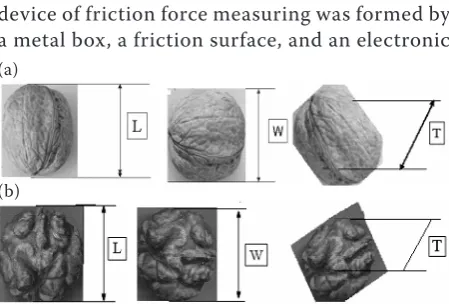
0.01 mm. The geometric mean diameter (Dg) and sphericity (Φ) of the shelled and kernel walnuts were calculated using the following relationships (Mohsenin 1970):
Dg = (LWT)⅓ (1)
Φ =
[
Dg]
× 100 (2)l
where: l – length W – width
t – thickness in mm (Figure 1)
The unit mass of the shelled and kernel walnuts was measured with a digital electronic balance with a sensitivity of 0.01 g. The shelled and kernel walnuts were placed on a sheet of paper, and the boundary lines were traced. The projected area was measured by a digital planimeter (Roller-Type, KP90N, No.R02443, Koizumi, Japan) (Si-risomboon et al. 2007).
The true density of the shelled and kernel walnuts was determined by the toluene (C7H8) displace-ment method (Mohsenin 1970; Sitkei 1976; Sacilik et al. 2003). Bulk density was determined using the standard test weight procedure (Singh & Goswami 1996).
The porosity (ε) was determined by the follow-ing equation:
ε =
[
1 – ρb]
× 100 (3)ρt
where:
ρb, ρt – bulk and true densities, respectively (Mohsenin
1970)
[image:2.595.306.531.577.729.2]The coefficient of friction of the shelled and ker-nel walnuts was measured by a friction device. The device of friction force measuring was formed by a metal box, a friction surface, and an electronic
Figure 1. Description of three perpendicular dimensions of shelled (a) and kernel (b) walnuts
(a)
0 5 10 15 20 25 30 35 40 45
N
um
be
rof
th
es
am
pl
e
Shelled walnut dimension Length (mm)
Width (mm) Thickness (mm) Mass (g)
Mass (g) 16.63–17.42 17.42–18.21 18.21–19.00 19.00–19.79 19.79–20.58 20.58–21.38
Thickness (mm) 32.88–33.54 33.54–34.21 34.21–34.88 34.88–35.54 35.54–36.21 36.21–36.88
Width (mm) 34.88–35.42 35.42–35.96 35–96–6.50 36.50–37.04 37.04–37.58 37.58–38.13
Length (mm) 42.13–42.79 42.79–43.46 43.46–44.13 44.13–44.79 44.79–45.46 45.46–46.13
unit (Kara et al. 1997; Altuntas & Demirtola 2007). Friction force was measured with a loadcell, converted by the ADC (Analog digital converter) card, and the data were recorded in a computer. The schematic appearance of the friction force measuring device is shown in Figure 2. The coef-ficient of friction (µ) is defined as the ratio between the measured friction force (F) and normal force (N). The maximum value of the friction force was obtained when the box started operating. This value was used to calculate the static coefficient of friction. While the box continued to slide on the friction surface at 0.02 m/s velocity, the dy-namic coefficient of friction (average value) was measured. The experiments were conducted using friction surfaces of chipboard and plywood. For each experiment, the sample box was emptied and refilled with a different sample of the same moisture content (Sacilik et al. 2003).
The terminal velocities of the shelled and kernel walnuts were measured using an air column. A walnut sample was dropped into the air stream at
the top of the air column through which air was blown upwards to suspend the walnuts in the air stream in each test. The air velocity was measured by Testo 425 (Lenzkirch, Germany measurement range 0–20 m/s) electronic anemometer having a least 0.01 m/s count (Mohsenin 1970).
Statistical analyses were conducted with Micro-soft Excel and SPSS 10.0 Micro-software (SPSS 2000). The results of the experiments were analysed based on the randomised complete block design with a split plot.
reSultS And diSCuSSion
Size dimension
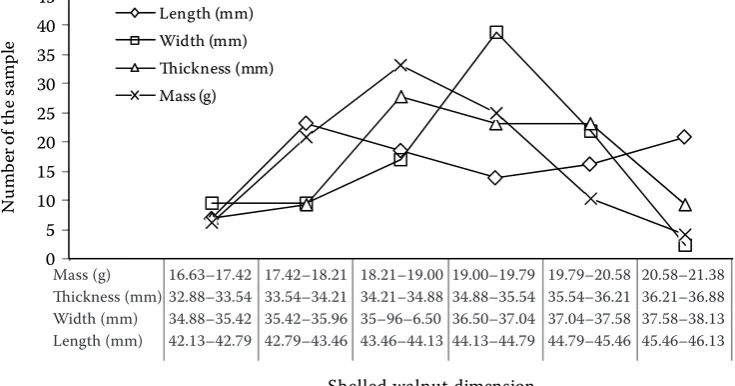
Approximately 72% of the shelled walnuts had a length ranging from 42.79 mm to 45.46 mm, about 78% of the samples a width ranging from 35.96 mm to 37.58 mm, about 75% a thickness ranging from 34.21 mm to 36.21 mm, and about 79% a unit mass ranging from 17.42 g to 19.79 g at 11.46% moisture content (Figure 3). With kernel walnuts, about 85% had a length ranging from 32.08 mm to 35.42 mm, about 79% a width ranging from 28.08 mm to 32.33 mm, about 96% a thickness ran-ging from 23.50 mm to 27.25 mm, and about 69% a unit mass ranging from 6.96 g to 8.58 g at 4.93% moisture content (Figure 4). The average length, width, thickness, geometric mean diameter, and unit mass of the shelled walnut ranged between 44.25 mm to 44.80 mm, 36.58–37.00 mm, 34.99 mm
Travel direction
Loadcell Normal force Friction force
[image:3.595.63.291.85.181.2]Friction surface Sample
Figure 2. A schematic appearance of the measuring device of friction force
[image:3.595.111.479.528.721.2]to 35.55 mm, 38.18 mm to 38.97 mm and 18.84 g to 21.28 g, respectively, as the moisture content increased from 11.46% to 23.16% d.b.
As the moisture content increased from 11.46% to 23.16%, the average shell thickness of the walnuts increased from 1.628 mm to 1.667 mm. The effect of the moisture content on the shell thickness of walnuts was not significant.
Sphericity
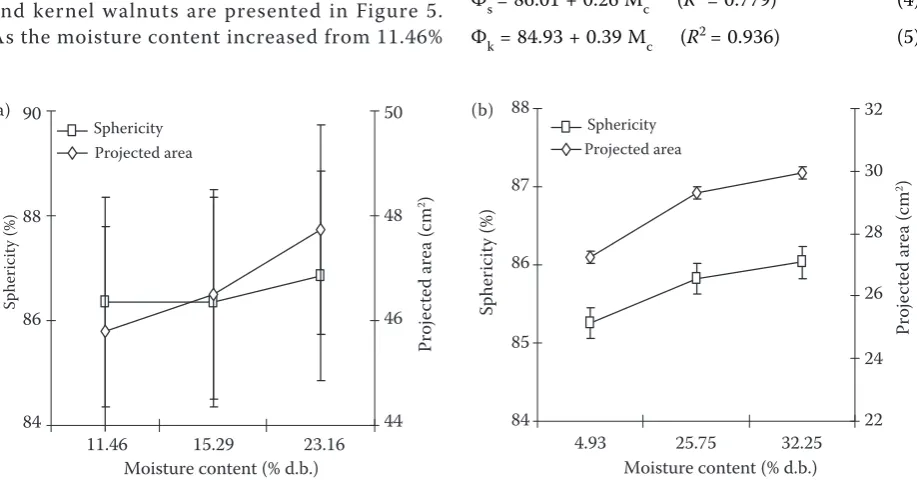
The results obtained of sphericity of the shelled and kernel walnuts are presented in Figure 5. As the moisture content increased from 11.46%
to 23.16%, the average sphericity of the shelled walnuts increased from 86.34% to 86.85%, re-spectively. The corresponding sphericity values for the kernels increased from 85.26% to 86.03% as the moisture content increased from 4.93% to 32.25%, respectively. The effect of the moisture content on kernel sphericity of walnuts was sta-tistically significant (P < 0.05). The relationship between the moisture content (Mc) and sphericity of the shelled walnuts (Φs) and sphericity of the kernel walnuts (Φk) were defined by the follow-ing equations;
Φs = 86.01 + 0.26 Mc (r2 = 0.779) (4)
Φk = 84.93 + 0.39 Mc (r2 = 0.936) (5)
Spher
ic
ity (%)
Moisture content (% d.b.)
Pr
oj
ec
te
d ar
ea (
cm
2)
11.46 15.29 23.16 Sphericity
Projected area 90
88
86
84
50
48
46
44
Spher
ic
ity (%)
Moisture content (% d.b.)
Pr
oj
ec
te
d ar
ea (
cm
2)
88
87
86
85
84
32
30
28
26
24
22 Sphericity
Projected area
[image:4.595.109.485.86.286.2]4.93 25.75 32.25
[image:4.595.69.528.498.738.2]Figure 5. Effect of moisture content on sphericity and projected area of shelled (a) and kernel (b) walnuts
Figure 4. The frequency distribution curves of kernel walnut length, width, thickness and unit mass of the walnut at 4.93% moisture content (d.b.)
0 10 20 30 40 50 60 70
N
um
be
rof
th
es
am
pl
e
Kernel walnut dimension Length (mm)
Width (mm) Thickness (mm) Mass (g)
Mass (g) 5.88–6.42 6.42–6.96 6.96–7.50 7.50–8.04 8.04–8.58 8.58–9.13
Length (mm) 31.25–32.08 32.08–32.93 32.92–33.75 33.75–34.58 34.58–35.42 35.42–36.25
Width (mm) 25.25–26.67 26.67–28.08 28.08–29.50 29.50–30.92 30.92–32.33 32.33–33.75
Thickness (mm) 22.25–23.50 23.50–24.75 24.75–26.00 26.00–27.25 27.25–28.50 28.50–29.75
Similar trends have also been reported by Aydın et al. (2002) for Turkish mahaleb and by Gezer et al. (2003) for apricot pit and kernel.
Projected area
The experimental results for the projected area of the shelled and kernel walnuts with respect to the moisture content are given in Figure 5. Linear increases in the projected areas for the shelled and kernel walnuts were observed from 45.80 cm2 to 47.74 cm2, and from 27.24 cm2 to 29.93 cm2 with the increasing moisture content from 11.46% to 23.16%, and from 4.93% to 32.25%, respectively. The value of the walnut projected area generally increased with an increase in the moisture content with both the shelled and kernel walnuts. A sligth increase (4.06%) with the shelled and a considerable increase (8.99%) with kernel walnuts occured in the projected areas at the moisture contents studied (Figure 3). The effects of the moisture content on the projected areas of the shelled and kernel walnuts were statistically significant (P < 0.05). The relationships between the moisture content (Mc) and the projected area of the shelled walnuts (Ps) or the projected area of the kernel walnuts (Pk) were described by the following equations:
Ps = 44.74 + 0.97 Mc (r2 = 0.975) (6)
Pk = 26.14 + 1.35 Mc (r2 = 0.910) (7)
Similar trends have also been reported by Gezer et al. (2003) for apricot pit and kernel, by Aydın (2002) for hazelnut and kernel, by Aydın (2003) for almond nut and kernel, by Pliestic et al. (2006) for filbert nut and kernel, and by Aydın (2006) for peanut and kernel..
Bulk density
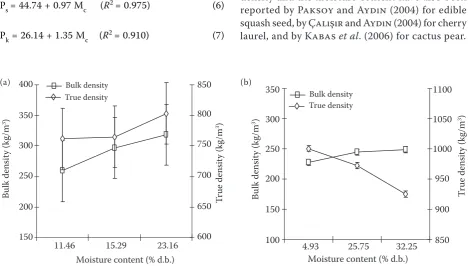
The bulk density at different moisture levels for the shelled (ρbs) and kernel walnuts (ρbk) va-ried from 259.19 kg/m3 to 318.04 kg/m3 and from 227.22 kg/m3 to 248.63 kg/m3, respectively (Figure 6), indicating an increase in the bulk density with an increase in the moisture content. The bulk density of the walnuts increased for the shelled ones and the kernels as the moisture content increased. The effect of the moisture content on the bulk density of the shelled walnuts and of the kernel walnuts was statistically significant (P < 0.05). The rela-tionships between the moisture content (Mc) and bulk densities of shelled and kernel walnuts were described by the following linear equations:
ρbs = 232.57 + 29.43 Mc (r2 = 0.974) (8)
ρbk = 218.60 + 10.71 Mc (r2 = 0.898) (9)
Positive linear relationships between the bulk density and the moisture content have also been reported by Paksoy and Aydın (2004) for edible squash seed, by Çalışır and Aydın (2004) for cherry laurel, and by Kabas et al. (2006) for cactus pear.
Bulk density (kg/m
3)
Moisture content (% d.b.) 11.46 15.29 23.16 400
350
300
250
200
150
Tr
ue density (kg/m
3)
850
800
750
700
650
600 Bulk density
True density
Bulk density (kg/m
3)
Moisture content (% d.b.) 4.93 25.75 32.25 350
300
250
200
150
100
Tr
ue density (kg/m
3)
1100
1050
1000
950
900
850 Bulk density
[image:5.595.64.533.472.738.2]True density
Figure 6. Effect of moisture content on bulk density and true densities of shelled (a) and kernel (b) walnuts
true density
The true density of the shelled and kernel walnuts at different moisture levels varied from 761.60 kg/m3 to 803.42 kg/m3 and from 1000.44 to 924.91 kg/m3, respecively (Figure 6). The true density of the shelled and kernel walnuts generally decreased as the moisture content increased. The effect of the moisture content on the true density of the shelled walnuts was not statistically significant. An increase (5.20%) for the shelled walnuts and a decrease (7.55%) for the kernel walnuts in true density were recorded in the moisture content range from 11.46% to 23.16% and from 4.93% to 32.25% for the shelled and kernel walnuts, res-pectively. Negative linear relationships between the moisture content (Mc) and the true density of the shelled (ρts) and kernel walnuts (ρtk) were described by the following equations:
ρts = 734.86 – 20.91 Mc (r2 = 0.811) (10)
ρtk = 1041.40 – 37.77 Mc (r2 = 0.979) (11)
The negative linear relationships between true density and the moisture content have also been reported by Pliestic et al. (2006) for filbert nut and kernel, by Aydin (2002) for hazelnut and kernel, and by Akar and Aydın (2005) for gumbo fruit, respectively.
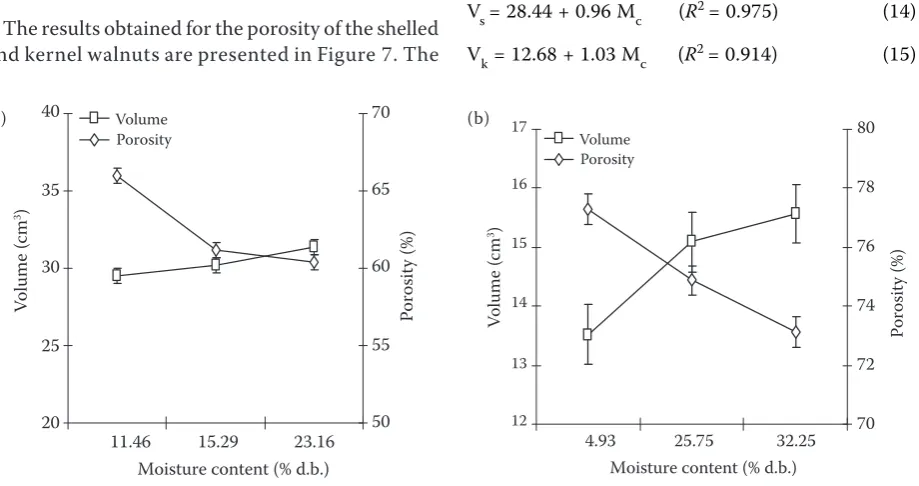
Porosity
The results obtained for the porosity of the shelled and kernel walnuts are presented in Figure 7. The
porosity of the shelled and kernel walnuts decreased with an increase in the moisture content. The effect of the moisture content on porosity was statisti-cally significant. The relationships between the moisture content (Mc) and porosity of the shelled (εs) and kernel (εk) walnuts were described by the following equations:
εs = 68.08 – 2.78 Mc (r2 = 0.852) (12)
εk = 79.27 – 2.09 Mc (r2 = 0.992) (13)
Similar results were also reported by Gezer et al. (2003) for apricot pit and kernel, by Aydin et al. (2002) for Turkish mahaleb, and by Çalışır and Aydın (2004) for cherry laurel.
Volume of walnut
The data obtained for the volumes of the shelled and kernel walnuts are presented in Figure 7. The average volumes of the shelled and kernel walnuts increased with an increase in the moisture content. The volume increases (6.08%) for the shelled and (13.17%) for the kernel walnuts were recorded at the moisture contents studied. The effect of the moisture content on the shelled and kernel walnuts volumes was significant (P < 0.05). The relation-ships between the moisture content (Mc) and the volumes of the shelled (Vs) and kernel (Vk) walnuts were described by following equations:
Vs = 28.44 + 0.96 Mc (r2 = 0.975) (14)
Vk = 12.68 + 1.03 Mc (r2 = 0.914) (15)
Volume (
cm
3)
Moisture content (% d.b.)
Por
osity (%)
11.46 15.29 23.16 Volume
Porosity 40
35
30
25
20
70
65
60
55
50
Volume (
cm
3)
Moisture content (% d.b.)
Por
osity (%)
17
16
15
14
13
12
80
78
76
74
72
70 Volume
Porosity
[image:6.595.71.531.498.741.2]4.93 25.75 32.25
Figure 7. Effect of moisture content on volume and porosity of shelled (a) and kernel (b) walnuts
Similar incremental trends have been reported by Özarslan (2002) for cotton seed; by Sahoo and Srivastava (2002) for okra seed, and by Ses-siz et al. (2007) for caper.
terminal velocity
As the moisture content increased, the aver-age volumes of the shelled and kernel walnuts increased (Figure 8). The terminal velocity of the shelled walnuts increased from 14.17 m/s to 15.50 m/s with the increase in the moisture con-tent studied, respectively. The terminal velocity
of the kernel walnut increased from 12.60 m/s to 14.35 m/s. The effect of the moisture content on the terminal velocity of the kernel walnut was statistically significant (P < 0.01). The relation-ships between the moisture content (Mc) and the terminal velocity of the shelled walnuts (Vts) and that of the kernel walnuts (Vtk) were described by the following equations:
Vts = 13.33 + 0.67 Mc (r2 = 0.823) (16)
Vtk = 11.90 + 0.88 Mc (r2 = 0.893) (17)
[image:7.595.67.523.82.261.2]The results are similar to those reported by Ay-din et al. (2002) for Turkish mahaleb, by Aydin
Table 1. Regression coefficients and coefficient of determinations for static and dynamic coefficients of friction on various friction surfaces
Walnut Surface Regression coefficient Coefficient of determination (r2)
intercept (A) slope (B)
Shelled
static coefficient of friction
chipboard 0.42 0.04 0.923
plywood 0.25 0.05 0.996
dynamic coefficient of friction
chipboard 0.40 0.03 0.964
plywood 0.26 0.02 0.964
Kernel
static coefficient of friction
chipboard 0.12 0.01 0.750
plywood 0.09 0.02 1.000
dynamic coefficient of friction
chipboard 0.11 0.01 0.750
plywood 0.08 0.02 0.964
Ter
minal ve
lo
city (m/s)
Moisture content (% d.b.) 11.46 15.29 23.16 18
16
14
12
10
Ter
minal ve
lo
city (m/s)
Moisture content (% d.b.) 4.93 25.75 32.25 18
15
14
13
12
11
[image:7.595.62.533.529.758.2]10
Figure 8. Effect of moisture content on terminal velocity of shelled (a) and kernel (b) walnuts
(2002) for hazelnut, by Aydin (2003) for almond nut and kernel, by Paksoy and Aydin (2004) for edible squash seed, and by Akinci et al. (2004) for Juniperus drupacea fruits. The terminal velocities of the walnuts obtained in this study were higher than of the above mentioned agricultural materials. This probably resulted from the mass increase of the individual walnuts per unit frontal area which were exposed to the air flow with an increase in the moisture content (Konak et al. 2002).
Static and dynamic coefficient of friction
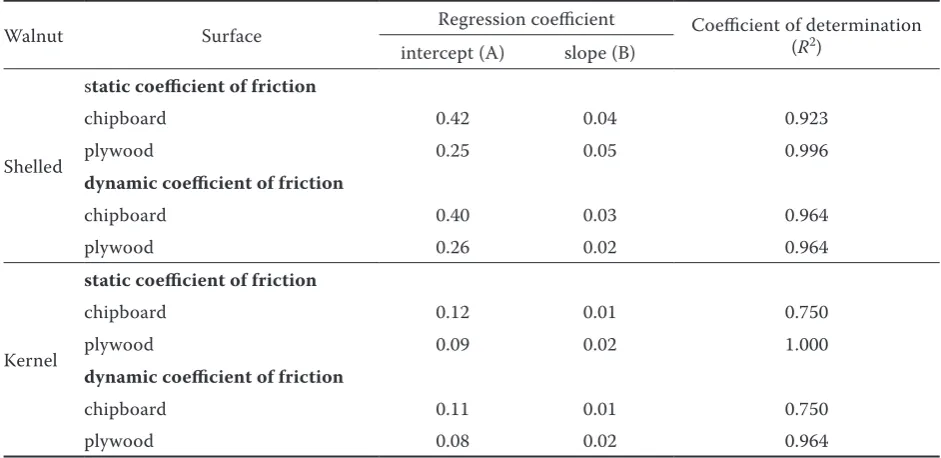
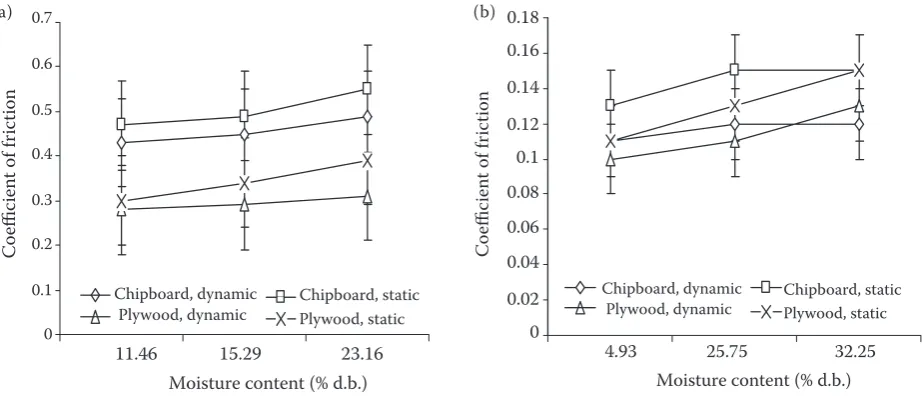
The results of the static and dynamic coefficients of friction on various surfaces, namely chipboard and plywood surfaces, obtained with the shelled and kernel walnuts, were compared and are given in Figure 9. The static coefficient of friction was higher at any moisture content than the dynamic coefficient of friction. The static and dynamic coefficients of friction linearly increased with re-spect to the moisture contents on the two surfaces. The linear equations for both static and dynamic coefficients of friction on all three surfaces could be described as:
µ = A + BMc (18)
where:
µ – coefficient of friction
A, B – regression coefficients; the corresponding values are given in Table 1.
The static and dynamic coefficients of frictions for the shelled walnuts were higher on chipboard than those obtained on plywood for all the moisture contents studied. Due to the increasing adhesion between the product and the surface of the shelled and kernel walnuts at higher moisture content (Nimkar & Chattopadhyay 2001; Konak et al. 2002; Özarslan 2002); the moisture content of the walnuts increased and the static and dynamic coefficients significantly increased. The effects of the moisture content and friction surfaces on the static and dynamic coefficients of friction were significant for the kernel walnuts (P < 0.05). The effects of the moisture content and plywood fric-tion surface on the static and dynamic coefficients of friction were significant for the shelled walnuts (P < 0.05). Similar results were found by others (Pliestic et al. 2006; Aydın 2006).
ConCluSionS
The following conclusions are drawn from the investigation on the physical properties of shelled and kernel walnuts as functions of the moisture content.
The size dimensions, unit mass, sphericity, pro-jected area, bulk density, volume, porosity, and terminal velocity of the shelled and kernel walnuts increased.
The true density linearly decreased with an in-crease in the moisture content.
Co
effic
ien
t of f
ric
tion
Moisture content (% d.b.) 11.46 15.29 23.16 0.7
0.6
0.5
0.4
0.3
0.2
0.1
0
Chipboard, static Chipboard, dynamic
Plywood, static Plywood, dynamic
Co
effic
ien
t of f
ric
tion
Moisture content (% d.b.) 4.93 25.75 32.25 0.18
0.16 0.14 0.12 0.1 0.08 0.06 0.04 0.02 0
Chipboard, static Chipboard, dynamic
[image:8.595.68.530.83.282.2]Plywood, static Plywood, dynamic
Figure 9. Effect of moisture content on static and dynamic coefficient friction of shelled (a) and kernel (b) walnuts against chipboard and plywood surfaces
The static and dynamic friction coefficients of the shelled and kernel walnuts on chipboard and plywood surfaces increased with an increase in the moisture content.
Acknowledgements.The authors are greatful to Dr. Hikmet Gunal for critical reading and correcting the English.
references
Akar R., Aydin C. (2005): Some physical properties of gumbo fruit varieties. Journal of Food Engineering, 66: 387–393.
Akça Y. (2001): Walnut Growing. Arı Ofset, Tokat, Turkey. (in Turkish)
Akinci I., Ozdemir F., Topuz A., Kabas O., Canakci M. (2004): Some physical and nutritional properties of
Juniperus drupacea fruits. Journal of Food
Engineer-ing, 65: 325–331.
Altuntas E., Demirtola H. (2007): Effect of moisture content on physical properties of some grain legume seeds. New Zealand Journal of Crop andHorticultural Science, 35: 423–433.
Aviara N.A., Oluwole F.A., Haque M.A. (2005): Ef-fect of moisture content on some physical properties of sheanut (Butyrospernum paradoxum). International Agrophysics, 19: 193–198.
Aydin C. (2002): Physical properties of hazel nuts. Bio-system Engineering, 82: 297–303.
Aydin C. (2003): Physical properties of almond nut and true. Journal of Food Engineering, 60: 315–320. Aydin C. (2006). Some engineering properties of
pea-nut and kernel. Journal of Food Engineering, 79: 810–816.
Aydin C., Öğüt H., Konak M. (2002): Some physical properties of Turkish Mahaleb. Biosystem Engineer-ing, 82: 231–234.
Balasubramanian D. (2001):. Physical properties of raw cashew nut. Journal of Agricultural Engineering Research, 78: 291–297.
Burubai W., Akor A.J., Igoni A.H., Puyate Y.T. (2007): Some physical properties of African nutmeg (Monodora myristica). International Agrophysics,21: 123–126.
Çağlarırmak N. (2003): Biochemical and physical properties of some walnut genotypes (Juglans regia L.). Nahrung/Food, 47: 28–32.
Çalışır S., Aydın C. (2004): Some physico-mechanical properties of cherry laurel (Prunus lauracerasus L.) fruits. Journal of Food Engineering, 65: 145–150.
FAO (2006): Statistical database. Available at http://fao-stat.fao.org (accessed 12. 11. 2006)
Gezer I., Haciseferoğulları H., Demir F. (2003): Some physical properties of Hacıhaliloğlu apricot pit and its kernel. Journal of Food Engineering, 56: 49–57.
Kabas O., Ozmerzi A., Akinci I. (2006): Physical properties of cactus pear (opuntia ficus india L.) grown wild in Turkey. Journal of Food Engineering,
73: 198–202.
Kaleemullah S., Gunasekar J.J. (2002): Moisture-dependent physical properties of arecanut trues. Bio-system Engineering,82: 331–338.
Kara M., Turgut N., Erkmen Y., Güler I.E. (1997): Determination of coefficient of friction of some gran-ules. In: 17. National Symposium on Mechanization in Agriculture. Tokat, Turkey: 609–614. (in Turkish) Kılıçkan A., Güner M. (2008): Physical properties and
mechanical behavior of olive fruits (olea europaea L.) under compression loading. Journal of Food Engineer-ing, 87: 222–228.
Konak M., Çarman K., Aydin C. (2002): Physical prop-erties of chickpea grains. Biosystems Engineering,
82: 73–78.
Koyuncu M.A., Ekinci K., Savran E. (2004): Crack-ing characteristics of walnut. Biosystem EngineerCrack-ing,
87: 305–311.
Mohsenin N.N. (1970): Physical Properties of Plant and Animal Materials. Gordon and Breach Science Publishers, New York.
Nimkar P.M., Chattopadhyay P.K. (2001): Some phys-ical properties of green gram. Journal of Agricultural Engineering Research,80: 183–189.
Olajide J.D., Igbeka J.C. (2003): Some physical proper-ties of groundnut kernels. Journal of Food Engineering,
58: 201–204.
Olaniyan A.M., Oje K. (2002): Some aspects of the mechanical properties of shea nut. Biosystems Engi-neering,81: 413–420.
Olaoye J.O. (2000): Some physical properties of castor nut relevant to the design of processing equipment. Journal of Agricultural Engineering Research,77: 113–118.
Özarslan C. (2002). Some physical properties of cotton seed. Biosystems Engineering, 83, 169–174.
Özgüven F., Vursavuş K. (2005): Some physical, me-chanical and aerodynamic properties of pine (Pinus pinea) nuts. Journal of Food Engineering, 68: 191– 196.
Pliestic S., Dobricevic N., Filipovic D., Gospo-daric, Z. (2006). Physical properties of filbert nut and kernel. Biosystems Engineering, 93: 173–178. Ramos D.E. (1998): Walnut Production Manual.
Univer-sity of California, Division of Agriculture and Natural Resources, Oakland, California. Publication 3373. Sacilik K., Öztürk R., Keskin R. (2003): Some
physi-cal properties of hemp grain. Biosystems Engineering, 86, 213–215.
Sahoo P.K., Srivastava A.P. (2002): Physical properties of okra seed. Biosystems Engineering,83: 441–444. Şen S.M. (1986): Walnut Growing. Eser Matbaası,
Sam-sun-Turkey. (in Turkish)
Sessiz A., Esgici R., Kızıl S. (2007): Moisture-depen-dent physical properties of caper (Capparis ssp.) fruit. Journal of Food Engineering,79: 1426–1431.
Sharifian F., Derafshi M.H. (2008): Mechanical be-havior of walnut under cracking conditions. Journal of Applied Sciences,8: 886–890.
Sitkei G. (1976): Mechanics of Agricultural Materials. Budapest, Akademia Kiado.
Singh K.K, Goswami K.K. (1996). Physical properties of cumin seed. Journal of Agricultural Engineering Research, 64: 93–98.
Sirisomboon P., Pornchaloempong P., Rompho-phak T. (2007): Physical properties of green soybean: criteria for sorting. Journal of Food Engineering, 79: 18–22.
SPSS (2000): SPSS for Windows. Student version. Release 10.0.9 Spss Inc /L United States.
Suthar S.H, Das S.K. (1996). Some physical properties of karingda [Citrus lanatus (Thunb) Mansf ] seeds. Journal of Agricultural Engineering Research, 65: 15–22.
TSE (1990): Unshelled walnuts, TS 1275. Turkish Stan-dard Institute, Ankara-Turkey.
TSE (1991): Walnut kernels. TS 1276,. Turkish Standard Institute, Ankara-Turkey.
Received for publication October 25, 2008 Accepted after corrections March 31, 2010
Corresponding author:
Assoc. Prof. Dr. Ebubekir Altuntas, University of Gaziosmanpasa, Faculty of Agriculture, Department of Agricultural Machinery, 60240 Tasliciftlik, Tokat, Turkey