Aroma and flavour belong among the most impor-tant food quality criteria. They are major attributes that influence the selection and consumption of food. Cheese flavour results from the breakdown of milk proteins, fat, lactose, and citrate due to en-zymes from microorganisms, coagulants, and milk. Many volatile compounds are potentially involved in cheese flavour: hydrocarbons, alcohols, alde-hydes, ketones, esters, fatty acids (FA), lactones, sulphur- and nitrogen-containing compounds. To analyse the cheese flavour by gas chromatography (GC), it is necessary to extract these compounds from their matrix. Many of them are present only at very low concentrations and several methods for their extraction and concentration have been
developed: e.g. steam distillation, extraction with organic solvents, surfactants, and supercritical fluids, headspace techniques, dialysis, and solid-phase extraction (CARBONELL et al. 2002; FERNÁN- DEZ-GARCÍA et al. 2002; QIAN et al. 2002). How-ever, these methods have some drawbacks: they are time-consuming, require large volumes of samples or solvents, some volatile compounds can be damaged or lost, etc.
The solid-phase microextraction (SPME) is a rela-tively new sample preparation technique, based on the partition of the analyte between the extraction phase on the outside of a small fused-silica fibre, and the matrix. SPME was introduced by Arthur and Pawliszyn (PAWLISZYN 1997; KATAOKA et al.
Solid-Phase Microextraction for Analysis
of Mould Cheese Aroma
EVA VÍTOVÁ
1, BLANKA LOUPANCOVÁ
1, JANA ZEMANOVÁ
1, HANA ŠTOUDKOVÁ
1,
PAVEL BŘEZINA
2and LIBOR BABÁK
11
Institute of Food Science and Biotechnology, Faculty of Chemistry, Brno University
of Technology, Brno, Czech Republic;
2Department of Food Engineering,
Faculty of Technology, University of Tomas Baťa, Zlín, Czech Republic
Abstract
VÍTOVÁ E., LOUPANCOVÁ B., ZEMANOVÁ J., ŠTOUDKOVA H., BŘEZINA P., BABÁK L. (2006): Solid-phase microextraction for analysis of mould cheese aroma.Czech J. Food Sci., 24: 268–274.
Solid-phase microextraction coupled with gas chromatography was used for the analysis of volatile aroma compounds in Niva cheese. The extraction conditions were very mild, which minimises thermal, mechanical, or chemical modifica-tion of the sample; the method is rapid, simple, and cheap. In total, 54 compounds were identified in Niva cheese using this method: 3 hydrocarbons, 5 aldehydes, 11 ketones, 18 alcohols, 3 esters, 10 fatty acids, and 4 sulphur compounds. These aroma compounds were quantified and subsequently the changes in the concentrations of them were studied throughout the ripening period. Most of the volatile compounds identified were present at all stages of the cheese ripening, their amounts changing significantly, however, in most cases the final concentration in the ripe cheeses was similar to the initial concentration in the unripe cheese.
2000) for the extraction of organic compounds from environmental samples, but now it has gained a lot of interest in a broad field of analysis including the analysis of food. Very interesting possibility is the use of SPME in the food aroma analysis. Many authors describe the analysis of flavour and off-flavour of some foods, e.g. fruit, vegetables, meat, drinks and dairy products (PÉRÉS et al. 2001; FRANK et al. 2004; MALLIA et al. 2005).
The aim of our work was to develop a sim-ple, rapid, and cheap method for the extraction of the aroma compounds of cheese, based on SPME. Mould cheese was used to evaluate our method and the optimised method was used for monitoring the changes throughout Niva cheese ripening.
MATERIALS AND METHODS
Chemicals.The following chemicals were used as standards: pentadecane, heptadecane, dimethyl disulphide, dimethyl sulphide, dimethyl trisul-phide, benzothiazol, phenylacetaldehyde, hexanal, 8-nonen-2-one, decan-2-one, heptadecan-1-ol, heptadecan-2-ol, hexadecan-2-ol, myristic acid, benzoic acid, pentadecanoic acid, palmitic acid, phenylethyl-acetate, pentyl-benzoate (Sigma-Al-drich, Germany), phenylethanol, ethanal, propanal, hexanoic acid, isobutanoic acid, isopentanoic acid, capric acid, 3-hydroxybutan-2-one, nonan-2-one, pentan-2-one, undecan-2-one, heptan-2-on (Merck, Germany), methanol, propan-1-ol, propan-2-ol, butanol, pentan-1-ol, pentan-2-ol, octan-1-ol, nonan-2-ol, 2-methylpropan-1-ol, 3-methylbu-tan-1-ol, acetone, propan-2-one, butan-2-one, butanoic acid, acetic acid, propionic acid, ethyl-acetate (Lachema, CR), heptane, ethanol, hep-tan-2-ol, dodecan-1-ol, benzaldehyde (J.T. Baker, the Netherlands), oct-1-en-3-ol, butan-2,3-dione (Fluka, Switzerland). All the chemicals were of chemically pure grade.
Samples.Niva cheese (50% dry matter, 55% fat in dry matter) was manufactured according to the traditional procedures in a dairy in Český Krum-lov. The cheeses were sampled at 5, 15, 25, 35, 45, and 55 days of ripening. The cheese samples were stored at –12°C before use.
For analysis, grated cheese was placed in a vial (4 ml), sealed by a septum-type cap and held in a water bath. During this time, the sample was sometimes shaken to homogenise and to increase the transfer of the analytes to the headspace. After
the equilibration time, the SPME fibre was inserted in a vial for the sampling process.
SPME.The SPME fibre CarboxenTM /polydimethyl-
siloxane 85 µm was purchased from Supelco (Belle-fonte, PA, USA). The extraction was carried out by HS-SPME mode.
Gas chromatography and mass spectrome-try (GC-MS).Gas chromatograph TRACETM GC
(ThermoQuest, I) equipped with flame ionization detection and split/splitless injection port, DB-WAX capillary column (30 m × 0.32 mm × 0.5 µm; J. & W. Scientific, Folsom, CA).
The injector – 250°C, splitless mode, the desorp-tion time 5 min, linear purge closed for 5 min.
The oven temperature program – 40°C for 1 min, 40–200°C at 5°C/min, 200°C for 7 min. The detec-tor 220°C. The carrier gas (N2) 0.9 ml/min.
GC-MS analyses – gas chromatograph GC 8000 (Carlo Erba, I) coupled to a MS TRIO 1000 (Fisons Instruments, USA). The carrier gas He, the GC column and other operating parameters were the same as described.
The reproducibility, linearity and detection limits. The reproducibility of the method was determined by five replicate extractions of five standard compounds chosen under optimal con-ditions. The standards were added to the matrix of the ripe cheese. The results were expressed as relative standard deviations (RSD) of the peak area counts.
The method of standard addition was used for the assessment of the linearity and detection limits. The standards at different concentrations (within the range 0.003–20 µg/g) were added to the matrix (ripe cheese sample).
RESULTS AND DISCUSSION
There are two possibilities of SPME extraction: direct immersion SPME (DI-SPME), where the fibre is exposed to the liquid sample, and headspace SPME (HS-SPME), where the fibre is exposed to the headspace above the sample. The HS-SPME mode is preferred for volatile compounds because it provides greater selectivity, sensitivity, and ra-pidity, and an elongated fibre lifetime.
Selectivity can be altered by changing the phase type and thickness according to the characteristics of the analytes – volatile compounds require a thick phase coat. Various fibres were tested and finally CarboxenTM/polydimethylsiloxane 85 µm fibre
volatile aroma compounds as confirmed by many authors (PÉRÉS et al. 2001; FRANK et al. 2004).
Altering the sample conditions can optimise the extraction yield. The following parameters were optimised: equilibration time, extraction time, temperature, and sample weight, with the aim to maximise the compound recovery while keep-ing a reasonably short total analysis time. Also desorption parameters were optimised. SPME is an equilibrium process, hence under equilibrium conditions precision and sensitivity are expected to be optimal. However, it is not necessary to reach full equilibrium, if constant extracting conditions are maintained. The optimal SPME parameters selected for the subsequent analyses were:
– equilibration time 30 min; – extraction time 20 min; – extraction temperature 35°C; – sample amount 1 g;
– desorption temperature 250°C; – desorption time 5 min.
The reproducibility was good, RSD of the standard analyses were in the range of 2–11%. Detection limits differed for the various compounds analysed, with small volatile molecules they were higher owing to their bad affinity to the fibre, and were in the range of 0.003–0.2 µg/g. The linearity was also good, the correlation coefficients were all over 0.98.
Identification of aroma compounds in Niva cheese
The flavour of cheese originates from microbial, enzymatic, and chemical transformations. The breakdown of milk proteins, fat, lactose, and citrate during ripening gives rise to a series of volatile and non-volatile compounds which may contribute to the cheese flavour. Several degradation types occur simultaneously and the ultimate result will be a very wide range of compounds. The factual contribution of them to the flavour of cheese is largely unknown.
Proteolysis in cheese during ripening plays an important role in the development of texture. However, it also contributes to the taste of cheese by the production of peptides and free amino ac-ids. Large peptides do not contribute directly to the cheese taste, but can be hydrolysed to shorter peptides that may be bitter. Free amino acids are the final products of proteolysis. Very extensive proteolysis occurs in blue-mould cheeses (SO-RENSEN & BENFELDT2001).
Lipolysis is most important for the blue cheese flavour. Lactic acid bacteria present in starter cul-tures are generally only weakly lipolytic, most of the FA coming from the triglycerides degradation by moulds. Compounds generated by lipid metabo-lism predominate among the aroma compounds identified in blue cheese (QIAN et al. 2002).
Niva is soft blue-veined cheese manufactured from pasteurised cow milk. It has a crumbly tex-ture, white to light beige interior with blue veining and a pleasant salty, piquant flavour. It is aged at least two months to achieve the typical appearance and flavour. It is known that free FA, odd-carbon chain methyl ketones, and secondary alcohols are the major contributors to the characteristic fla-vour of blue cheese, so the flafla-vour development during the cheese ripening is dependent on milk triacylglycerols hydrolysis by Penicillium roqueforti lipases and subsequent oxidation of FA to methyl ketones. However, a large number of other volatile compounds have been identified in blue cheeses (SABLÉ & COTTENCEAU1999; UR REHMAN et al. 2000; QIAN et al. 2002).
The identification of the individual compounds in the sample is difficult, owing to their low centrations in cheese and the relatively high con-centrations of other compounds. The identification was carried out by GC-MS and confirmed by comparison of the retention times with those of standard substances. The mass spectra for all the compounds were compared with standard mass spectra provided by the database of the equipment. In total, 54 compounds were identified in Niva cheese: 3 hydrocarbons, 5 aldehydes, 11 ketones, 18 alcohols, 3 esters, 10 fatty acids, and 4 sulphur compounds.
production is mainly due to the activity of lactic acid bacteria. It can be reduced to acetoine (3-hy- droxybutan-2-one) with buttery aroma and the latter can be further reduced to butane-2,3-diol, which does not have a flavour impact (CURIONI & BOSSET2002). Biacetyl was identified as very important to blue cheese, in which acetoine was also detected. As mentioned previously, in mould cheese methyl ketones are the most abundant aroma compounds, the major ones being heptan-2-one and nonan-2-one (CARBONELL et al. 2002; QIAN et al. 2002; FRANK et al. 2004).
Eighteen alcohols were identified in Niva cheese: ethanol, propan-2-ol, propan-1-ol, 2-methylpro-pan-1-ol, pentan-2-ol, butanol, 3-methylbutan-1-ol, pentan-1-ol, methanol, heptan-2-ol, oct-1-en-3-ol, octan-1-ol, nonan-2-ol, phenylethanol, dodecan-1-ol, heptadecan-dodecan-1-ol, hexadecan-2-ol and hep-tadecan-2-ol. Primary alcoholsare formed by the proper aldehydes reduction. They impart a fruity, nutty note to the cheese flavour, and in certain cheeses high levels of them can cause flavour defects. Secondary alcohols are formed by en-zymatic reduction of the corresponding methyl ketones. They have similar but heavier flavour notes than methyl ketones. Ethanol comes from lactose fermentation. It has a limited role in the cheese aroma despite its high levels, but it con-tributes to the formation of esters (CARBONELL et al. 2002). 3-methylbutan-1-ol was found at high concentrations in mould cheeses. The principal secondary alcohols in mould ripened cheeses are heptan-2-ol and nonan-2-ol, which correspond to the high methyl ketone contents. They have less influence on the cheese flavour than methyl ketones, however, they may indirectly contribute to it because of their ability to form esters with FA (SABLÉ & COTTENCEAU1999).
Ten FA were identified in Niva cheese: acetic, capric, isobutanoic, propionic, isopentanoic, buta-noic, hexabuta-noic, myristic, benzoic, pentadecabuta-noic, and palmitic acids. Fatty acids are important com-ponents of the flavour of many cheese types. They may originate from lipolysis, a lower proportion of short-chain FA originate from the degradation of lactose and amino acids, and they can also be derived from ketones, esters, and aldehydes by oxidation (CURIONI & BOSSET2002). Long-chain FA (> 12 carbon atoms) play a minor role in the flavour owing to their relatively high perception thresholds. Short and moderate-chain, even-num-bered FA (C4-C12) have much lower perception
thresholds and characteristic notes (vinegar, sour). Moreover, free FA also serve as precursors to me-thyl ketones, alcohols, lactones, and esters (SABLÉ et al. 1999; VÍTOVÁ et al. 2004). On the other hand, higher concentrations of free FA can cause off-flavours (e.g. rancid). Short-chain free FA acids are important contributors to the characteristic flavour of blue cheeses and were identified by many authors at high concentrations (SABLÉ & COTTENCEAU 1999; QIAN et al. 2002).
Three esters were identified in Niva cheese: ethyl-acetate, phenylethyl-acetate and pentyl-benzoate. Esters are common cheese volatiles. Esterification reactions occur between short- to medium-chain FA and alcohols. Most esters in cheeses are described as having sweet, fruity, and floral notes. Some of them have very low perception thresholds and their contribution is heightened by synergistic effect. Further, they can contribute to the aroma of cheese by minimising the sharpness and the bitterness imparted by FA and amines (CURIONI & BOSSET2002). GONZALES DE LLANO et al. (1990) found high proportions of methyl and ethyl esters in ripe blue cheese, QIAN et al. (2002) consider ethyl butanoate and ethyl hexanoate to be important compounds contributing to the blue cheese aroma.
Five aldehydes were identified in Niva cheese: propanal, ethanal, hexanal, phenylacetaldehyde, and benzaldehyde. Straight-chain aldehydes may result from β-oxidation of unsaturated FA or from amino acids by Strecker degradation. Branched-chain aldehydes probably originate from amino acid degradation via enzymatic as well as non-enzymatic, e.g. Strecker degradation, processes (CURIONI & BOSSET2002). Aldehydes are transi-tory compounds in cheese because they are rapidly reduced to primary alcohols or oxidised to the corresponding acids (CARBONELL et al. 2002). They are characterised by green-grass or herbaceous aroma and can be very unpleasant when their concentrations exceed certain values. QIAN et al. (2002) consider 2-methylpropanal and 3-methyl-butanal to be important compounds contributing to the blue cheese aroma.
reported in many cheeses, although usually at low concentrations (CARBONELL et al. 2002).
Four sulphur compounds were identified in Niva cheese: dimethyl sulphide, dimethyl disulphide, dimethyl trisulphide, and benzothiazol. Sulphur compounds originate from methionine and cysteine degradation. These components are described as having strong garlic, onion, or very ripe cheese odours. Their perception thresholds are very low and they are probably involved in the final aroma of mould cheeses. ORTIGOSA et al. (2001) consider them to be indispensable to achieve the charac-teristic aroma of white mould cheese, QIAN et al. (2002) introduce methional and dimethyl trisulfide as important compounds contributing to the blue cheese aroma.
Changes of aroma compounds during ripening of Niva cheese
SPME-GC procedure was also used to study the volatile compounds evolution during the ripening of Niva cheese, the method of standard addition was chosen for quantification, the standards were added to grated cheese in a vial.
As mentioned before, cheese ripening includes microbiological and enzymatic processes contrib-uting to the unique flavour and textural charac-teristics. Knowledge of these changes could allow standardisation of the cheese manufacturing and a better control of the process. But only in a few kinds of cheese have these changes been described in depth. In the case of Niva cheese, most of the volatile compounds identified were present at
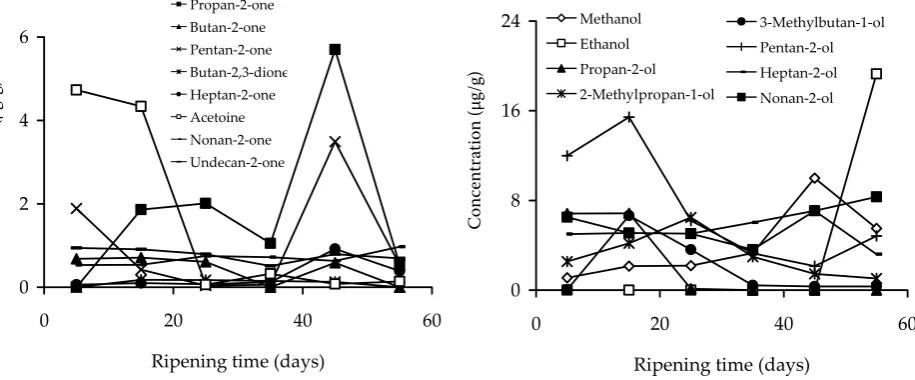
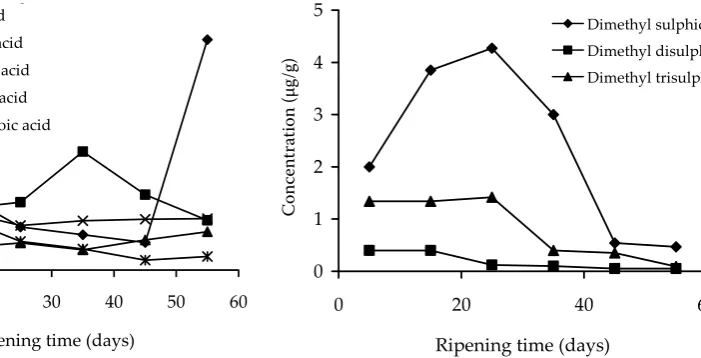
all stages of the cheese ripening, however, their amounts changed significantly. The changes of the most important and most abundant compounds chosen are graphically expressed in Figures 1–4. Each value represents the mean of three replicate determinations, RSD was in all cases to 10%. Ke-tones, alcohols, and FA were quantitatively the most important compounds present.
The changes of ketonesin Niva cheese are pre-sented in Figure 1. As can be seen, their concen-trations increased during ripening with maximum after about 40 days. Only acetoine was present at a high concentration in unripe cheese and then its amount sharply decreased. The increase in the ketones concentrations during ripening is charac-teristic for many kinds of cheese as confirmed by many authors, this fact being linked to lipolysis (CARBONELL et al. 2002).
Ethanol and pentan-2-ol were the most abundant alcohols in Niva cheese. GONZALES DE LLANO et al. (1990) describe the evolution of methyl ketones and 2-alkanols in blue cheese as parallel: the contents of both increased during the first part of the ripening and then decreased after reaching their maximum after 60 days. Also in other types of cheeses, alco-hols are quantitatively the main chemical family and their contents increase significantly, but at different rates during ripening (CARBONELL et al. 2002). In our case, no significant increase was found in alcohols concentrations in Niva cheese (Figure 2), with the exception of ethanol.
To changes of short-chain fatty acids in Niva cheese are presented in Figure 3. No significant increase in their amount was found (except acetic
0 2 4 6
0 20 40 60
Ripening time (days)
C on ce nt ra tio n ( m g/ g)
Figure 1. Changes of ketones during ripening of Niva cheese
0 2 4 6
0 10 20 30 40 50 60
Ripening time (days)
[image:5.595.66.305.537.726.2]C on ce nt ra tio n ( m g/ g) Propan-2-one Butan-2-one Pentan-2-one Butan-2,3-dione Heptan-2-one Acetoine Nonan-2-one Undecan-2-one
Figure 2. Changes of alcohols during ripening of Niva cheese Conc en tra tion (µg/g) 0 8 16 24
0 20 40 60
Ripening time (days)
C on ce nt ra tio n ( m g/ g) Methanol Ethanol Propan-2-ol 2-Methylpropan-1-ol 3-Methylbutan-1-ol Pentan-2-ol Heptan-2-ol Nonan-2-ol 0 8 16 24
0 20 40 60
Ripening time (days)
C on ce nt ra tio n ( m g/ g) Methanol Ethanol Propan-2-ol 2-Methylpropan-1-ol 3-Methylbutan-1-ol Pentan-2-ol Heptan-2-ol Nonan-2-ol 0 8 16 24
0 20 40 60
Ripening time (days)
[image:5.595.71.529.538.728.2]acid), although some authors noticed an increase in the concentrations of volatile FA during the ripening of various kinds of cheese (MULET et al. 1999; VÍTOVÁ et al. 2004).
As reported by some authors, the concentra-tions of esters can decrease or increase during the ripening of various kinds of cheese (MULET et al. 1999; CARBONELL et al. 2002). GONZALES DE LLANO et al. (1990) describe the evolution of esters in blue cheese as similar to those of ketones and alkanols. The formation of them was slower, attaining the maximum after 180 days (end of ripening). Three esters identified in Niva cheese reached maximum concentrations (only about 0.1 µg/g) in about 40 days of ripening.
The contents ofaldehydes mostly increase dur-ing the ripendur-ing of various cheeses (CARBONELL et al. 2002). In the case of Niva cheese, the contents of the aldehydes identified reached maximum in about 40 days, the ethanal content decreased during ripening. The maximum concentrations of them were in the range of 0.4–0.8 µg/g.
[image:6.595.68.312.81.258.2]The contents of sulphur compounds identified in Niva cheese decreased during ripening, dimethyl sulphide was present in the highest concentration (Figure 4).
To summarise, the analytical method based on SPME combined with GC is a simple and rapid method for the analysis of the volatile compounds in cheese. It minimises thermal, mechanical, and chemical modifications of the matrix, it is con-sequently suitable for the characterisation of the cheese aroma, but not only cheese as it can be
applied to various foods. Some important aroma compounds in Niva cheese were identified and quantified using this method. Although impor-tant changes of them took place during ripening, in most cases, the final concentrations in ripe cheeses were similar to the initial concentrations in the unripe cheese.
List of symbols
FA – fatty acid
GC – gas chromatography
GC-MS – gas chromatography-mass spectrometry SPME – solid-phase microextraction
DI-SPME – direct immersion SPME HS-SPME – headspace SPME
RSD – relative standard deviation
References
CARBONELL M., NUNEZ M., FERNANDEZ-GARCIA E. (2002): Evolution of the volatile components of ewe raw milk La Serena cheese during ripening. Correlation with flavour characteristics. Lait,82: 683–698.
CURIONI P.M.G., BOSSET J.O. (2002): Key odorants in various cheese types as determined by gas chroma-tography-olfactometry. International Dairy Journal, 12: 959–984.
[image:6.595.164.515.83.262.2]FERNÁNDEZ-GARCÍA E., CARBONELL M., NUNEZ M. (2002): Volatile fraction and sensory characteristics of Manchego cheese. 1. Comparison of raw and pasteurized milk cheese. Journal of Dairy Research, 69: 579–593. Figure 4. Changes of sulphur compounds during ripening of Niva cheese
Figure 3. Changes of fatty acids during ripening of Niva cheese
0 1 2 3 4 5
0 20 40 60
Ripening time (days)
C
on
ce
nt
ra
tio
n
( m
g/
g)
Dimethyl sulphide Dimethyl disulphide Dimethyl trisulphide
0 1 2 3 4 5
0 20 40 60
Ripening time (days)
C
on
ce
nt
ra
tio
n
( m
g/
g)
Dimethyl sulphide Dimethyl disulphide Dimethyl trisulphide
Conc
en
tra
tion (µg/g)
0 6 12 18 24 30 36
0 10 20 30 40 50 60
Ripening time (days)
C
on
ce
nt
ra
tio
n
( m
g/
g)
Acetic acid Butanoic acid Propionic acid Hexanoic acid Isopentanoic acid
0 6 12 18 24
0 10 20 30 40 50 60
Ripening time (days)
C
on
ce
nt
ra
tio
n
( m
g/ Acetic acid
Butanoic acid Propionic acid Hexanoic acid Isopentanoic acid
Conc
en
tra
FRANK D.C., OWEN C.M., PATTERSON J. (2004): Solid phase microextraction (SPME) combined with gas-chro-matography and olfactometry-mass spectrometry for characterization of cheese aroma compounds. Lebens-mittel Wissenschaft und Technologie, 37: 139–154. GONZALES DE LLANO D., RAMOS M., POLO C., SANZ J.,
MARTINEZ-CASTRO I. (1990): Evolution of the volatile components of an Artisanal blue cheese during ripen-ing. Journal of Dairy Science, 73: 1676–1683.
KATAOKA H., LORD H.L., PAWLISZYN J. (2000): Applica-tions of solid-phase microextraction in food analysis. Journal of Chromatography A, 880: 35–62.
MALLIA S., FERNÁNDEZ-GARCÍA E., BOSSET J.O. (2005): Comparison of purge and trap and solid phase micro-extraction techniques for studying the volatile aroma compounds of three European PDO hard cheeses. International Dairy Journal, 15: 741–758.
MULET A., ESCRICHE I., ROSSELLO C., TARRAZÓ J. (1999): Changes in the volatile fraction during ripening of Mahón cheese. Food Chemistry, 65: 219–225. ORTIGOSA M., TORRE P., IZCO J.M. (2001): Effect of
pasteurization of ewe’s milk and use of a native starter culture on the volatile components and sensory char-acteristic of Roncal cheese. Journal of Dairy Science, 84: 1320–1330.
PAWLISZYN J. (1997): Solid Phase Microextraction, Theory and Practice. Wiley-VCH, New York.
PÉRÉS CH., VIALLON C., BERDAGUÉ J.L. (2001): Solid-phase microextraction-mass spectrometry: a new approach to the rapid characterization of cheeses. Analytical Chemistry, 73: 1030–1036.
QIAN M., NELSON C., BLOOMER S. (2002): Evaluation of fat-derived aroma compounds in Blue cheese by dynamic headspace GC/olfactometry-MS. Journal of the American Oil Chemist’s Society, 79: 663-667. SABLÉ S., COTTENCEAU G. (1999): Current knowledge of
soft cheese flavor and related compounds. Journal of Agricultural and Food Chemistry, 47: 4825–4836. SORENSEN J., BENFELDT C. (2001): Comparison of
ripen-ing characteristics of Danbo cheeses from two dairies. International Dairy Journal, 11: 355–362.
UR REHMAN S., BANKS J.M., BRECHANY E.Y., MUIR D.D., MCSWEENEY P.L.H., FOX P.F. (2000): Influence of ripen-ing temperature on the volatiles profile and flavour of Cheddar cheese made from raw or pasteurised milk. International Dairy Journal, 10: 55–65.
VÍTOVÁ E., ZEMANOVÁ J., BEZDĚKOVÁ Š., BABÁK L., LOU-PANCOVÁ B., BŘEZINA P. (2004): Changes of free fatty acids during ripening of Niva cheese. Czech Journal of Food Sciences, 22: 310–313.
Received for publication September 29, 2005 Accepted after corrections January 13, 2006
Corresponding author:
Ing. EVA VÍTOVÁ, Ph.D., Vysoké učení technické v Brně, Fakulta chemická, Ústav chemie potravin a biotechnologií, Purkyňova 118, 612 00 Brno, Česká republika