Whereas mineral supply by feeding mineral mixtures is a reliable method to prevent micro- and macronutrient deficiencies for dairy cows, an adequate supplementation of essential ele-ments is more difficult to implement in grazing systems (McDowell 1996). Salt blocks or other free-choice methods are the most common ways to supply grazing animals with minerals. However, it is well known that the individual consumption from blocks or licks is extremely variable and the uptake per day is changing within the grazing period (Underwood and Suttle 1999). Regarding trace elements, this might be a serious problem, as the supplementation has to be well balanced because of the short scale between deficiency and excess. In the case of selenium, for example, the
concentration in the diet of beef cattle should be at least 0.1 mg Se/kg dm but should not exceed 2 mg Se/kg dm (Anonymous 1996). The require-ments for copper and zinc are 10 and 30 mg/kg dm, respectively (Anonymous 1996); however, ac-cording to the latest regulation by the European Commission (Anonymous 2003), the concentra-tions in cattle diets should not exceed 35 mg/kg dm for Cu and 150 mg/kg dm for Zn. It is evident, that the trace element supplementation has to be extremely precise, which is hardly practicable by free choice supplementation of minerals.
The ideal case to ensure adequate trace ele-ment supply of grazing animals would be a situ-ation with sufficient concentrsitu-ations in grazed herbage. However, the concentrations of essential
Effects of liming and nitrogen application on the trace
element concentrations of pastures in low mountain range
H. Laser
Institute of Plant Production and Plant Breeding II, Justus-Liebig-University of Giessen,
Germany
ABSTRACT
In less intensively managed grassland, the micronutrient concentrations in herbage are apparently more likely to be in levels between barely sufficient and deficient than to be excessively high. Insufficient amounts of selenium, cop-per, manganese, and zinc cause physiological disorders in ruminants. Three identical field trials on pastures with different soil pH and organic matter content were established to assess the effect of liming and nitrogen fertilization on the micronutrient concentrations in herbage. In the case of selenium the effect of a selenate application on the Se concentration in plants was also tested. The effect of liming on the micronutrient concentrations was not always consistent with initial hypotheses. Only Mn and – to a smaller extent – Zn concentrations changed markedly with an increasing soil pH (P < 0.01). Marked differences between concentrations in primary growths and secondary growths were evident for all trace elements. The effect of added nitrogen was negligible. Se concentrations in the plant tissue in plots without selenate application averaged 21.3 µg Se/kg dm in 2002 (standard error SE = 18.63) and 48.7 µg Se/kg dm in 2003 (SE = 38.97). Sufficient Se concentrations (> 100 µg Se/kg dm) were only found in herbage fertilized with selenate. Mn concentrations met the requirements for ruminants in most cases (mean Mn concen-tration in 2002 = 104.2 mg Mn/kg dm; standard error SE = 62.76; mean Mn concenconcen-tration in 2003 = 67.5 mg Mn/kg dm; SE = 35.91). The average Zn concentrations were 33.5 mg Zn/kg dm in 2002 (SE = 6.46) and 34.0 mg Zn/kg dm in 2003 (SE = 7.52). The average Cu concentrations were 10.5 mg Cu/kg dm in 2002 (SE = 1.24) and 9.9 mg Cu/kg dm in 2003 (SE = 1.93). Therefore, 41.7% of the measured values for Zn and 31.3% of Cu concentrations remained under the recommended levels of > 30 mg Zn/kg dm and > 10 mg Cu/kg dm.
Keywords: copper; manganese; selenium; zinc; animal nutrition; pastures
micronutrients in grassland plants are also very variable (Whitehead 2000). The supply for plants mainly depends on the release from lithosphere, atmospheric deposits, input by mineral or organic fertilizers, and several soil characteristics. The release from lithosphere can hardly be influenced and weathering of rocks is usually a slow process. In the past, human activities, above all metallurgy and combustion of fossil fuels, were a substantial source of many trace elements, leading to critical high values in forage and foods in several areas. However in recent years, the atmospheric depos-its have been decreasing rapidly. In Germany, for example, the emissions of Se (Anonymous 2002) decreased from 115 t Se/area in 1985 (area of
former FRG plus GDR = 357 021 km2) to 25 t Se
per area in 1995 (after reunion, the same catch-ment area). Copper emissions decreased from 459 to 79 t Cu/area, zinc from 1900 to 452 t Zn/area, and Mn from 459 to 79 t/area within the same period. Considering the continuous development of the technical standards of environmental tech-nology, it is likely that this decline has been still going on. Although this is undoubtedly a desirable development for the environment, the other side of the coin is the loss of a steady source of trace elements in forage and food. The compensation of this decline by mineral fertilizers, liquid manure or sewage sludge is common practice on arable land, but those are no reliable ways for trace elements on pastures. These options are uneconomic in less
intensively managed grassland or even forbidden. Apparently, soil pH is one of the most important factors to influence the uptake of several elements by plants. Selenium, for example, was found to be more available at high pH than under more acid conditions (Geering et al. 1968, Gissel-Nielsen 1971, Gissel-Nielsen et al. 1984, Yläranta 1993). On the other hand, an increasing pH furthers the immobilization of heavy metals like copper or zinc. At higher pH values the formation of complex compounds with organic matter and hydrous metal oxides and the adsorption by other soil constitu-ents like clay or Fe oxides increases (Whitehead 2000), whereas soil acidification causes increasing heavy metal concentrations in grassland vegetation (Blake and Goulding 2002). The uptake of trace elements by plants and the influence of different soil properties have been studied intensively as far as comparatively high levels in soil (wastewater contamination or sewage sludge application or as a result of calculated steps of soil enrichment) are concerned. However, little information is available of these processes at marginal levels of micronu-trients in soils in temperate humid regions.
[image:2.595.64.532.498.762.2]Most studies indicate the zinc and copper con-centrations in herbage from extensively managed grassland to be below or close to the minimum values needed for an adequate supply for rumi-nants (Jilg and Briemle 1993, Teroede 1997). The manganese concentrations are apparently sufficient for the nutrition of beef cattle. Selenium might
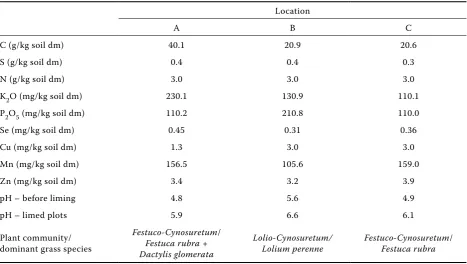
Table 1. Chemical characteristics of the soils in different experimental locations and type of plant cover
Location
A B C
C (g/kg soil dm) 40.1 20.9 20.6
S (g/kg soil dm) 0.4 0.4 0.3
N (g/kg soil dm) 3.0 3.0 3.0
K2O (mg/kg soil dm) 230.1 130.9 110.1
P2O5 (mg/kg soil dm) 110.2 210.8 110.0
Se (mg/kg soil dm) 0.45 0.31 0.36
Cu (mg/kg soil dm) 1.3 3.0 3.0
Mn (mg/kg soil dm) 156.5 105.6 159.0
Zn (mg/kg soil dm) 3.4 3.2 3.9
pH – before liming 4.8 5.6 4.9
pH – limed plots 5.9 6.6 6.1
Plant community/ dominant grass species
Festuco-Cynosuretum/ Festuca rubra + Dactylis glomerata
Lolio-Cynosuretum/
be the most serious problem, as 99% of analyzed herbage samples from low mountain pastures are deficient (Laser 2004). This study focuses on the potential effects of soil pH on Zn, Cu, Mn, and Se concentrations in herbage at levels between barely sufficient and deficient including possible effects of liming and nitrogen application.
MATERIAL AND METHODS
Three identical experiments on low-input pas-tures in different locations in low mountain ar-eas of Central Germany were set up in a Latin Rectangle design with three replicates. Data on soil characteristics and sward composition are shown in Table 1. The locations were chosen based on a screening of more than 100 locations, in which soil pH and carbon content were the most important criteria.
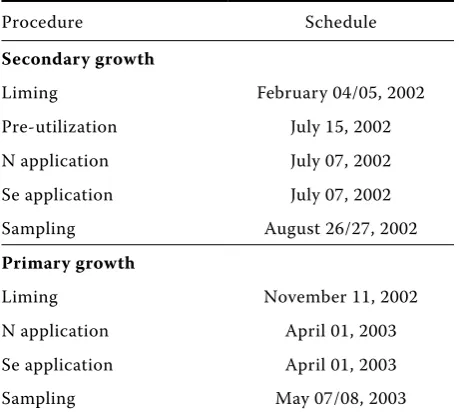
Weather data are shown in Table 2. Treatment plots at all sites were laid out to include the effects of liming (0 or 4 t CaO/ha), N application (0 or 80 kg N/ha/area applied as calcium ammonium nitrate) and Se application (0, 4, and 12 g Se/ha). The selenium levels varied to ensure deficient, marginal and safe concentrations in forage for beef cattle. The prior screening of untreated locations indicated 99% of 183 tested herbage samples in the research areas as deficient in Se (Laser 2004).
The extremely fine lime (95% CaCO3,particle size:
100% < 0.315 mm and 85% < 0.075 mm) caused an average increase of soil pH from pH 4.8 up to pH 5.9 at location A, from pH 5.6 to pH 6.6 at location B, and from pH 4.9 to pH 6.1 for lo-cation C (Table 1). The range of soil pH in this experiment is thus representative for the ma-jority of grassland soils in low mountain range in Central Europe. Selenium was sprayed as an
aqueous solution of Na2SeO4, which enables an
optimal distribution of Se. To minimize adhesion of the solution on leaves, it was sprayed before the vegetation period or immediately after the previ-ous harvest. The plant samples were taken from secondary growths in 2002 and primary growths
in 2003. The time schedule for all procedures (date of liming, pre-utilization, N application, Se application, and sampling) is shown in Table 3. Se concentrations were determined by the Atomic Absorption Spectroscopy (= AAS) in hydride tech-nique (Anonymous 1997). Se in plant tissue was extracted after microwave-assisted extraction of samples in high-pressure vessels. Concentrations of Cu, Mn, and Zn in herbage and soil were also determined by the AAS; however, plant samples
were digested by chemical incineration in HNO3,
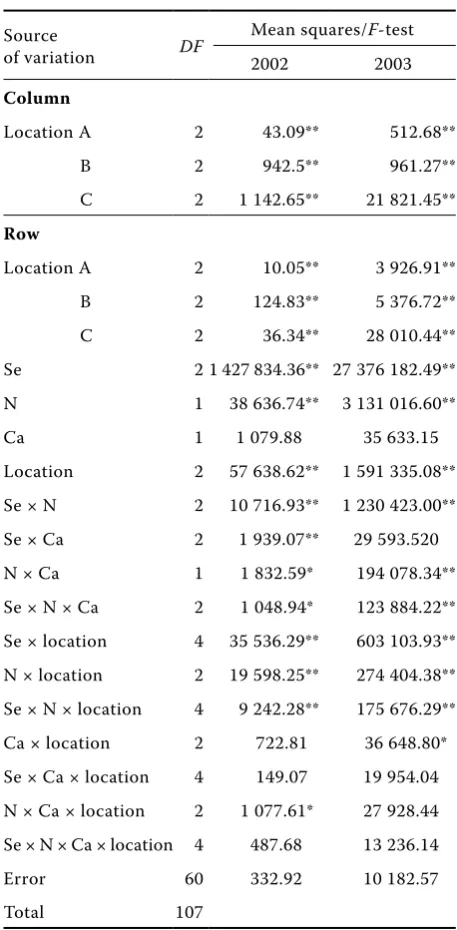
HClO4 and H2SO4 (Rosopulo et al. 1976), whereas soil samples (= 0–10 cm) were digested in aqua regia. Total C concentrations in soil and plant tis-sue were determined according to Dumas (= CNS inflammation, Anonymous 1998). Every harvest was separately analysed by the analysis of variance (ANOVA, Table 4) including the following fac-tors: location, liming (= Ca), N application (= N) and Se application (= Se). Differences in mean
values were demonstrated by using the F-test at
P≤ 0.05 and P≤ 0.01. Normality of distribution
was checked by the Kolmogoroff-Smirnoff test. For comparison of all treatments the LSD test was used at the confidence level of 95%. The LSD values in Figures 1 and 2 refer to all
treat-Table 2. Rainfall and mean temperature
Location
2002 2003
rainfall
(mm/year) (°C) (average)temperature (mm/year)rainfall (°C) (average)temperature
A (220 m above sea level) 1133.2 10.9 613.0 9.6
[image:3.595.63.533.80.157.2]B & C (550 m above sea level) 1234.1 8.1 959.0 8.3
Table 3. Time schedule
Procedure Schedule
Secondary growth
Liming February 04/05, 2002
Pre-utilization July 15, 2002
N application July 07, 2002
Se application July 07, 2002
Sampling August 26/27, 2002
Primary growth
Liming November 11, 2002
N application April 01, 2003
Se application April 01, 2003
[image:3.595.304.534.555.761.2]ments (location × Ca × N × Se). The LSD values in Figure 4 refer to the combination of factors (location × Ca × N). The data concerning the efficiency of the Se applications (illustrated in Figure 3) were not analysed statistically. Those data are only estimated in a calculation based on the following formula: efficiency of applied Se (%) = (g Se/ha in plots with Se application – g Se/ha in plots without Se application)/g Se/ha applied to plots × 100. The statistical procedures of all other features were calculated in the computer programme SPSS for Windows 10.0 (Anonymous 2000).
RESULTS AND DISCUSSION
Selenium
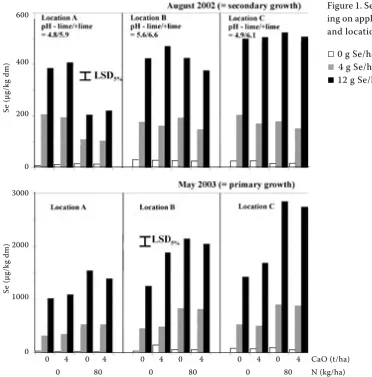
Figure 1 shows the selenium concentrations in herbage of the three experimental sites as influ-enced by the application of selenate and nitrogen and by liming. Concentrations in herbage of plots without selenate application are generally below the recommended value of 100 µg Se/kg for beef cattle (Anonymous 1996). This is consistent with the results from other investigations (Bahners and Hartfiel 1987, Laser 2004) indicating insufficient selenium concentrations in the majority of plant samples from pastures. No effect of liming or N fertilization is evident for plots without sele-nium. However, the effect of nitrogen application is highly significant (P < 0.01, Table 4) because of the marked effects in plots treated with selenium. The effect of N on the Se concentration is not uniform, causing higher Se concentrations in the primary growth but decreased concentrations in the secondary growth in location A, maybe due to a dilution effect. The effect of the N fertilizer on Se concentrations also depends on the loca-tion factor. The interacloca-tion Se × N × localoca-tion is significant (P < 0.01) in both years (Table 4). A general diluting effect on concentrations due to increasing dry matter production as a result of liming or nitrogen application is not evident. The effect of liming (Ca) in plots treated with selenium is influenced by N level. The interactions N × Ca and Se × N × Ca were significant (P < 0.05) in 2002 and highly significant (P < 0.01) in 2003 (Table 4). However, the effect of liming on Se concentrations is sometimes significant but generally negligible, despite of the clear effect of liming on soil pH. Apparently, soil pH is less important than it is described in literature. Probably the major
[image:4.595.303.532.92.558.2]immo-bilisation of Se in soil sets in at lower soil pH and the mobilisation increases at higher pH than found in this experiment (minimum pH 4.8, maximum pH 6.6). However, such extreme pH levels are an exception in extensively managed grasslands under the humid conditions of Central Europe. This is the main reason why high Se concentrations in herbage are much more frequent in grassland un-der arid conditions, where soil pH is often much higher (Gissel-Nielsen et al. 1984).
Table 4. Sources of variation for selenium concentra-tions in plant tissue (µg Se/kg dm)
Source
of variation DF
Mean squares/F-test
2002 2003
Column
Location A 2 43.09** 512.68**
B 2 942.5** 961.27**
C 2 1 142.65** 21 821.45**
Row
Location A 2 10.05** 3 926.91**
B 2 124.83** 5 376.72**
C 2 36.34** 28 010.44**
Se 2 1 427 834.36** 27 376 182.49**
N 1 38 636.74** 3 131 016.60**
Ca 1 1 079.88 35 633.15
Location 2 57 638.62** 1 591 335.08** Se × N 2 10 716.93** 1 230 423.00**
Se × Ca 2 1 939.07** 29 593.520
N × Ca 1 1 832.59* 194 078.34**
Se × N × Ca 2 1 048.94* 123 884.22** Se × location 4 35 536.29** 603 103.93** N × location 2 19 598.25** 274 404.38** Se × N × location 4 9 242.28** 175 676.29**
Ca × location 2 722.81 36 648.80*
Se × Ca × location 4 149.07 19 954.04 N × Ca × location 2 1 077.61* 27 928.44 Se × N × Ca × location 4 487.68 13 236.14
Error 60 332.92 10 182.57
Total 107
Se = amount of added selenium, N = amount of added nitrogen, Ca = amount of added lime
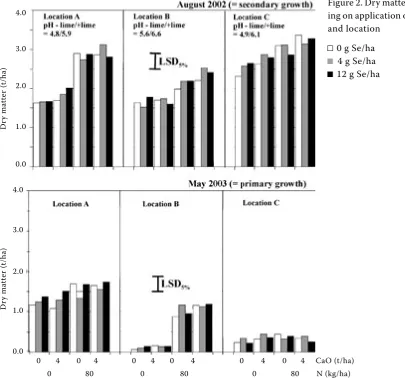
In plots applied with selenium, the selenium levels are much higher in the primary growth than in the secondary growth. This is due to low yields (Figure 2) at early May due to the prema-ture date and relatively low spring temperaprema-tures, especially at the locations B and C. The applica-tion of 12 g Se/ha causes an immoderate increase in Se concentrations. The amount of 4 g Se/ha
applied as Na2SeO4 ensures adequate
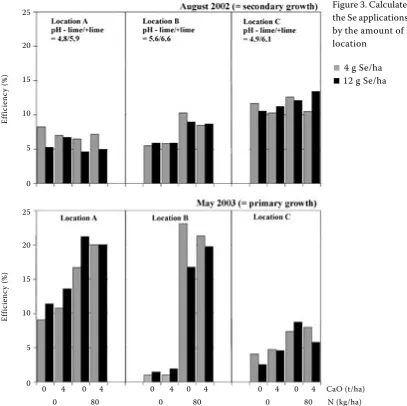
concentra-tions irrespective of location, fertilization, soil pH and growth. However, the proportions of Se taken up by plants compared to applied Se are only between 5 and 13% for the secondary growth and between 3 and 23% for the primary growth (Figure 3), depending on N supply and location. Apparently, remaining selenium amounts are transferred into volatile compounds, leached from the soil, or fixed (Gissel-Nielsen et al. 1984). According to Hamdy and Gissel-Nielsen (1977) liming causes an increase in selenium leaching. At high soil pH the predominant form of inorganic
Se is selenate (SeO4), which is less adsorbed on
soil constituents than selenite (SeO ). In
con-sequence, SeO4 is easily available for plants but
[image:5.595.62.435.60.438.2]also more liable to leaching. It might explain why liming does not enhance the efficiency of applied selenium. The majority of added sele-nium is likely to be fixed. High concentrations of C in soil reduce the amount of total soluble Se and promote the transformation of selenate to organically associated Se (Neal and Sposito 1991). This might be a reason for significantly lower Se concentrations in herbage from loca-tion A, where C concentraloca-tions in soil were the highest. The question is if usually high concentra-tions of organic matter in grassland soils imply the risk of an accumulative effect by annual Se application (Yläranta 1993). The use of highly available selenate sources enables to increase the selenium concentrations up to recommended levels in forage by the application of 4 g Se. Considering losses by Se volatilization of 1–2 g Se/ha/area in rural grassland (Haygarth et al. 1994) and decreasing atmospheric depositions of Se by 2–3 g Se/ha/area on average (Germany, period between 1985 and 1995), the addition of
Figure 1. Se concentration depend-ing on application of Se, N, and Ca and location
0 4 0 4 0 4 0 4 0 4 0 4 CaO (t/ha) 0 80 0 80 0 80 N (kg/ha) 600
400
200
0
3000
2000
1000
0
Se
(µ
g/
kg
d
m
)
S
e
(µ
g/
kg
d
m
) □∎ 0 g Se/ha4 g Se/ha
4 g Se in grassland systems would be undoubt-edly harmless to the environment.
Copper, manganese, zinc
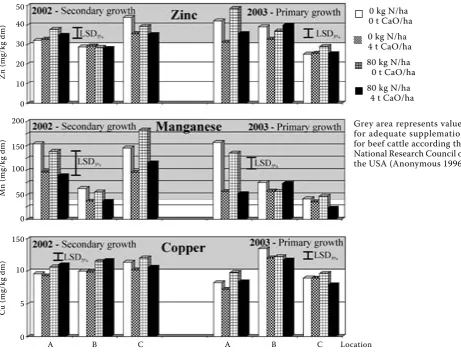
Figure 4 shows the concentrations of copper, manganese and zinc in herbage of the three experi-mental sites. It shows the values of all treatments except for variants with selenium application. Added Se caused no significant effect on the Cu, Mn or Zn concentrations (data not shown). Even in the primary growth in 2003 with Se concen-trations up to 2.5 mg/kg dm the content of the three heavy metals was not higher than in herbage without Se fertilization.
The three locations show highly significant
(P < 0.01)differences in Zn, Mn and Cu
concen-trations in herbage. Location is the most important factor of variation for all elements. However, it is not clear if this is due to different soil pH or different element concentrations in soil. In the case of low Mn concentrations in herbage from
location B both explanations are possible (Table 1). The increasing pH value caused by liming resulted in a significant decrease in Mn concentrations in several growths. This effect was very important at location A (P < 0.001), which has the lowest soil pH (pH 4.8), but also for the secondary growth at location C (pH 4.9). The effect of liming is less clear for Zn and not significant for Cu, although the effect on soil pH was very clear. The appli-cation of nitrogen shows no constant effect on the concentrations of Zn, Mn and Cu. Although N fertilization increases dm yield, no dilution effect is evident.
[image:6.595.64.470.63.441.2]Considering the nutrition of beef cattle, the animal requirements for the essential nutrients Zn and Cu are certainly not met absolutely. The amounts of both elements are close to the recom-mended levels (Anonymous 1996), sometimes even slightly below. The manganese supply is mostly safe but the amounts are very variable (between < 25 and > 175 mg Mn/kg dm). Recent studies have emphasized the problem of increasing heavy metal releases as a consequence of soil acidification in
Figure 2. Dry matter yield depend-ing on application of Se, N, and Ca and location
□ 0 g Se/ha
∎ 4 g Se/ha ∎ 12 g Se/ha
0 4 0 4 0 4 0 4 0 4 0 4 CaO (t/ha) 0 80 0 80 0 80 N (kg/ha)
D
ry
m
at
te
r
(t
/h
a)
D
ry
m
at
te
r
(t
/h
a)
4.0
3.0
2.0
1.0
0.0
4.0
3.0
2.0
1.0
grassland systems (Blake and Goulding 2002). In our experiment the effect of soil pH is less impor-tant for the Cu and Zn concentrations, consider-ing values between pH 4.8 and 6.6. In view of low concentration levels in herbage even a tripling of the values found in this experiment would not be critical for animal health. The mobilization of both elements probably sets in at lower values than pH 4.5 or pH 4.0, however such extreme conditions are not very common in Central Europe.
The question is why soil pH is less important for Cu and Zn uptake by plants on soils with low levels than in oversupplied soils. Apparently, lim-ited amounts of available trace elements are likely to increase the importance of mechanisms in the rhizosphere that improve the uptake of the nu-trients. Possible measures of plants to improve the availability of trace elements at low levels are the expression of root exudations (Kochian 1993) or the use of vesicular-arbuscular mycorrhicae (Clarkson 1985). In conditions with minimal or
marginal levels of trace elements, mycorrhizal infected plants were found to extract much larger amounts from the soil, whereas an addition of the element to the soil progressively diminished the effect of the infection (Cooper and Tinker 1978, Gildon and Tinker 1983). It is possible that these effects compensated the demobilising effect of increasing pH by liming.
[image:7.595.67.475.61.467.2]Heavy metals and selenium might be harmful elements in areas near industrial complexes, waste-water polluted areas, abandoned waste dumps or arable lands fertilized with high amounts of sew-age sludge or treated with herbicides containing heavy metals. However, taken up in traces, most of these elements are essential nutrients and it is getting more and more common that their amounts in herbage from extensively managed grasslands become deficient. The supply of grazing animals (e.g. suckler cow herds) with minerals including micronutrients is an aspect that is worth future attention, as animal health and human nutrition are
Figure 3. Calculated efficiency of the Se applications as influenced by the amount of N and Ca and location
∎ 4 g Se/ha ∎ 12 g Se/ha
0 4 0 4 0 4 0 4 0 4 0 4 CaO (t/ha) 0 80 0 80 0 80 N (kg/ha)
E
ff
ic
ie
nc
y
(%
)
E
ff
ic
ie
nc
y
(%
)
25
20
15
10
5
0
25
20
15
10
5
Figure 4.Effect of liming and N on zinc, manganese and copper concentrations in two growths from different locations
concerned. It is necessary to discuss inexpensive and safe supplementation methods for trace ele-ments including indirect methods like fertilization. The approach to control the nutrient composi-tion in forage requires more studies of soil/plant interactions in “marginal” concentration levels between barely sufficient and deficient.
Acknowledgements
I am grateful to my advisor, Prof. Dr. Dr.h.c. Wilhelm Opitz von Boberfeld, for his backing and encouragement.
REFERENCES
Anonymous (1996): Nutrient Requirements for Beef Cattle. 7th ed. Publ. Nat. Res. Coun., National
Aca-demy Press, Washington D.C.
Anonymous (1997): Methodenbuch, Band III. Die che-mische Untersuchung von Futtermitteln. 4. Ergän-zungslieferung. VDLUFA-Verlag, Darmstadt. Anonymous (1998): DIN/ISO 13878,
Bodenbeschaf-fenheit – Bestimmung von Gesamtstickstoff durch trockene Verbrennung (Elementaranalyse). Verl. Beuth, Berlin u. Köln.
Anonymous (2000): SPSS for Windows. Version 10.0. SPSS Software, Munic.
Anonymous (2002): Atmosphärische Emissionen von 9 prioritären Schwermetallen in Deutschland 1985 bis 1995. Umweltbundesamt (ed.). Available at http:/www. umweltbundesamt.de/luft/emissionen/bericht/aktuel-le-daten/schadstoffe/schwermetalle/HM Prio.pdf. Anonymous (2003): Commission regulation (EC)
No. 1334/203 of 25 July 2003. Amending the con-ditions for authorisation of a number of additives belonging to the group of trace elements. L 187/11–L 187/15.
Bahners N., Hartfiel W. (1987): Beeinflussung des Se-lengehaltes von wirtschaftseigenen Futtermitteln
□
0 kg N/ha0 t CaO/ha 0 kg N/ha
4 t CaO/ha
▦
80 kg N/ha 0 t CaO/ha∎
80 kg N/ha 4 t CaO/haGrey area represents values for adequate supplemation for beef cattle according the National Research Council of the USA (Anonymous 1996)
A B C A B C Location 50
40
30
20
10
0 200
150
100
50
0
150
10
5
0
C
u
(m
g/
kg
d
m
)
M
n
(m
g/
kg
d
m
)
Z
n
(m
g/
kg
d
m
durch Selen- bzw. NPK-Düngung. D. wirtschaftseig. Futter, 33: 5–12.
Blake L., Goulding K.W.T. (2002): Effects of atmospheric deposition, soil pH and acidification on heavy metal contents in soils and vegetation of semi-natural eco-systems at Rothamsted Experimental Station, UK. Plant Soil, 240: 235–251.
Clarkson D.T. (1985): Factors affecting mineral nutri-ent acquisition by plants. Ann. Rev. Plant Physiol.,
36: 77–115.
Cooper K.M., Tinker P.B. (1978): Translocation and transfer of nutrients in vesicular-arbuscular mycor-rhizas. II. Uptake and translocation of phosphorus, zinc and sulphur. New Phytol., 81: 43–52.
Geering H.R., Cary E.E., Jones L.H.P., Allaway W.H. (1968): Solubility and redox criteria for the possible forms of selenium in soils. Soil Sci. Soc. Am. Proc.,
32: 35–40.
Gildon A., Tinker P.B. (1983): Interactions of vesicular-arbuscular mycorrhizal infections and heavy metals in plants. II. The effects of infection on the uptake of copper. New Phytol., 95: 263–268.
Gissel-Nielsen G. (1971): Influence of pH and texture on plant uptake of added selenium. J. Agr. Food Chem.,
19: 1165–1167.
Gissel-Nielsen G., Gupta U.C., Lamand M., Wester-mark T. (1984): Selenium in soils and plants and its importance in livestock and human nutrition. Adv. Agron., 37: 397–455.
Hamdy A.A., Gissel-Nielsen G. (1977): Fixation of selenium by clay minerals and iron oxides. Z. Pfl.-Ernähr. Bodenkde, 140: 63–70.
Haygarth P.M., Fowler D., Stürup S., Davision B.M., Jones K.C. (1994): Determination of gaseous and particulate selenium over rural grassland in the U.K. Atmos. Environ., 28: 3655–3663.
Jilg T., Briemle G. (1993): Futterwert und Futter-akzeptanz von Aufwüchsen aus extensiv genutztem Grünland bei wachsenden Rindern. D. wirtschaftseig. Futter, 39: 23–35.
Kochian L.V. (1993): Zinc absorption from hydroponic solutions by plant roots. In: Robson A.D. (ed.): Zinc in Soils and Plants. Kluwer Acad. Publ., Dordrecht: 45–57.
Laser H. (2004): Selenium concentrations in herbage from various swards in low-input grassland systems. Grass. Sci. Eur., 9: 1008–1010.
McDowell L.R. (1996): Feeding minerals to cattle on pasture. Anim. Feed Sci. Technol., 60: 247–271. Neal R.H., Sposito G. (1991): Selenium mobility in
ir-rigated soil columns as affected by organic carbon amendment. J. Environ. Qual., 20: 808–814.
Rosopulo A., Hahn M., Stärk H., Fiedler J. (1976): Ver-gleich verschiedener Veraschungsmethoden für die naßchemische Bestimmung von Mengen- und Spu-renelementen in Kulturpflanzen. Sonderh. Landw. Forsch., 32: 199–209.
Teroede H. (1997): Untersuchungen zur Nähr- und Mineralstoffversorgung von Mutterkuhherden auf ausgesuchten Standorten in Mecklenburg-Vorpom-mern. [Ph.D. Thesis.] Freie Universität Berlin. Underwood C.B.E., Suttle N.F. (1999): The Mineral
Nutrition of Livestock. 3rd ed. CABI Publishing,
Wallingford, UK.
Whitehead D.C. (2000): Nutrient elements in grassland. Soil – Plant – Animal Relationships. CABI Publish-ing, Wallingford, UK.
Yläranta T. (1993): Selenium fertilization in Finland: Selenium soil interactions. Norw. J. Agr. Sci., 11: 141–149.
Received on February 19, 2007
Corresponding author:
Priv. Doz. Dr. Harald Laser, Institute of Plant Production and Plant Breeding II, Justus-Liebig-University of Giessen, Senckenbergstr. 3, D-35390 Giessen, Germany