Minimum-tillage management practices are associated with expectations for benefits in crop production economics as well as in conserving the soil and increasing its fertility. Technical progress has supported and facilitated the development of minimum-tillage practices. There may, however, be risks related to the use of these practices un-der diverse farming conditions and to the neces-sity for subsequent inputs required to stabilize yields and maintain the quality parameters of the production. Hůla et al. (2008) note that the terms minimum tillage and conservation tillage should not be used interchangeably. Some of the minimum-tillage practices are also soil-conserving in nature. An approximate distinction regards the protective function of plant residues on the soil’s surface. From this perspective, the treatment of post-harvest plant residues and use of cover crops
is important. In reduced tillage systems occurs an accumulation of post-harvest plant residues in the topsoil layer. In terms of phytopathology, however, these residues may be an infection source for a range of diseases, among which particularly important are ear and seed diseases caused by fungi of the Fusarium genus (Váňová et al. 2009a). The pathogens have a chance to stay in the soil, reproduce and spread. Optimum conditions for the development of G. graminis var. tritici are in soils at temperatures of around 10–20°C, which are sufficiently moist and rather firm. In these conditions, the pathogen develops more intensively. Root damage that was slight up to this time now develops more strongly, the infected roots darken and the number of smaller roots and root hairs is reduced. In contrast to root diseases, such as
G. graminis, stem-base diseases do not have
epi-Effect of soil tillage practices on severity of selected diseases
in winter wheat
M. Váňová
1, P. Matušinsky
1, M. Javůrek
2, M. Vach
21
Agrotest Fyto, Ltd., Kroměříž, Czech Republic
2Crop Research Institute, Prague, Czech Republic
ABSTRACT
Soil tillage practices involving various depth, intensity, and different methods of loosening the soil and treating plant residues have changed significantly in recent years and have spread also due to technical advance. The reasons are not only in expected benefits for crop production economics but also in preserving and increasing soil fertil-ity. Although the practices were known for decades, their greatest development and use was seen only in the last 15 years, when decreasing production costs, efficient technology and effective herbicides were the main reasons for their development. At present, they are regarded as important alternatives to conventional management practices with moldboard plowing. Minimum soil tillage practices can contribute to effective soil management, however, risks associated with using these practices in various farming conditions shall be regarded. For cereals, these risks also include disease severity that is conditioned by several circumstances, which change along with the crop man-agement practice, variety assortment or weather in individual years. Diseases that can be of greater importance in relation to the conservation soil tillage practice are stem-base diseases, root diseases and Fusarium head blight. Our experiments did not demonstrate an increased demand for protection against Fusarium head blight, foot diseases and take-all in the given system (three-crop rotation where wheat followed white mustard). Individual years were an important factor.
Keywords: eyespot; Fusarium head blight; take-all; stem-base diseases; soil management
demic progression. Their harmfulness lies in de-creasing yields by about 10–30%, depending on the intensity of their occurrence, which is highly variable between individual years. In the 13 years prior to 2007, there were years with higher rates of eyespot infection, such as 1994, 2001, and 2005, and years with lower infection, like 1997, 2000, 2004, and 2006. The year 2007 was among the years with higher occurrence of eyespot.
In the work presented here, the occurrence of the mycotoxin deoxynivalenol (DON) (which is a product from the occurrence of Fusaria spp. in ears), stem-base diseases and take-all in winter wheat, was monitored in a three-crop rotation system comprising 66% of cereal crops and where winter wheat was grown after a preceding crop of white mustard. Various tillage systems were compared.
MATERIAL AND METHODS
Field experimental design. The experiment was run from 1995 in a temperate semiarid climate, 338 m above sea level (Prague-Ruzyně), with an annual mean air temperature of 8.2°C, and mean annual precipitation of 477 mm. It was established as a rotation of three crops (winter wheat, spring barley, and pea, from 2005 – white mustard). Winter wheat followed mustard.
Four treatments (tillage practices) were set-up: (1) conventional tillage (CT) as a control treatment, i.e. moldboard plowing to a depth of 0.20 m, usual seedbed preparation and sowing; (2) no tillage (NT), i.e. sowing with special drill machine into no-tilled soil after straw of preceding crop clearing away; (3) no tillage + mulch (NTM), i.e. direct drill-ing into no-tilled soil covered with preceddrill-ing crop (pea) post-harvest residues and chopped straw; (4) minimum tillage (MTS), i.e. shallow loosening (about 0.10 m deep) and chopped straw with post harvest residues of preceding crop incorporating.
All crop stands (including CT) were sown with a John Deere 750A drill machine (Deere and Company, USA).
The field site has a soil of clay-loam texture (Orthic Luvisol, FAO Taxonomy), with a bulk density of 1.5–1.65 g/cm3 (CT–NT), pH(KCl) 7.7, average electrical conductivity 12.5 mS/m, organic carbon 1.8–2.09%, total N 0.164%, Mehlich 3 P 155–207 mg/kg (NT–CT), K 285–413 mg/kg (NT–CT). Three levels (low, medium, high) of nitrogen fertilization were used for all crops; 50, 100, and 150 kg N per ha for winter wheat. The P
and K fertiliser doses were determined and applied according to P, K content in the soil. Standard herbicides were used, depending on the intensity of weed infestation.
Determination of mycotoxin DON in winter wheat grain samples. An average sample ob-tained through quartering was cleansed of im-purities (chaff, grains and seeds of other species, and impurities of inorganic origin). The sample was mixed, homogenized, and then a representa-tive quantity was taken, and 200 g samples were ground subsequently.
The instrument used for measurements consist-ed of HP1100 Binary Series LC system (Agilent Technologies, USA) and a mass spectrometer with ion trap mass analyzer (Finnigan LCQ Deca, USA).
Among the determined mycotoxins, we chose mycotoxin DON, for which limits in grain have been established in the EU.
Evaluation of eyespot incidence. Evaluation was performed visually at the base part of the main stem during the milky-wax maturity stage. Stems were evaluated according to the Scott and Hollins scale (1974). In this evaluation, not only the spots or browning typical of eyespot are evalu-ated but the entire complex of symptoms on the stem base and also in the area of the node. The incidence of infection was evaluated according to a disease index (DI).
DI = [(n1 + 2n2 + 3n3) × 100]/[3 × (n0 + n1 + n2 + n3)]
where: n is the number of plants; 0 – no symptoms of infection; 1 – slight infection where less than half of the stem perimeter is brownish; 2 – infection where more than half of the stem perimeter is brownish; 3 – strong infection where the entire stem is brownish and the infected tissue is partly rotten.
DI = 0a + 10b + 30c + 60d + 100e
t
where: a, b, c, d and e represent the number of plants in individual categories and t is the total number of moni-tored plants.
Data analysis was carried out using Statistica 7.0 software.
RESULTS AND DISCUSSION
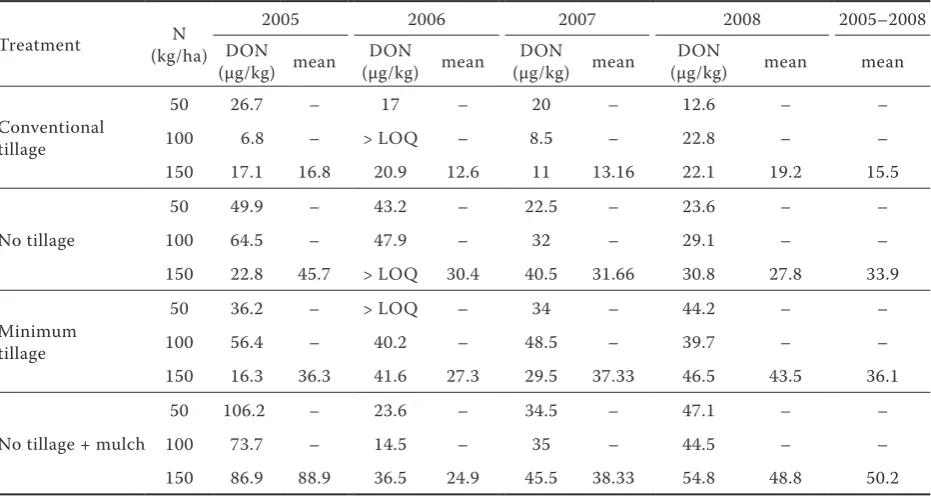
Level of mycotoxins permitted in cereal grains is limited by law, and in the case of the mycotoxin DON, in particular, it is 1.250 µg/kg. This limit was not exceeded in any of the examined samples. The highest value measured during 2005–2008 was 106.2 µg/kg.
For the experiments, we used the Akteur variety, which is ranked medium for its sensitivity to the diseases (Chrpová et al. 2008) in experiments with and without inoculation. The three-crop rotation system in which monitoring was conducted had a high proportion of cereals that were host plants for Fusarium head blight (winter wheat and spring barley). But the immediately preceding crop was white mustard, which is not a host plant upon which infectious material would form in large measure. Corn is such a crop, and after this preceding crop the Fusarium infection was higher (Váňová et al. 2009b). Table 1 summarises the results from
2005–2008. The highest occurrence was detected in 2005 and differences between that year and the following years were statistically significant (Table 2). Tillage practice also had statistically significant effect on the values of DON content in grain. The least amount of DON (statistically significant) was in the treatment with conven-tional tillage (CT). Values were higher in the treat-ments using conservation tillage (NT and MTS). Differences between them were not statistically significant. The highest DON content was found in grain from the NTM treatment – direct sowing into mulch from chopped straw. This difference was statistically significant (Table 3).
[image:3.595.65.531.497.745.2]Stem-base diseases are a significant group of diseases in crop rotations with high proportions of cereals. They are causation of considerable yield losses and high plant protection costs not only when the crop immediately preceding is winter wheat or winter barley but also after other preceding crops, such as rapeseed following winter wheat or winter barley. If tillage is used for rapeseed after these preceding crops and the straw is plowed in and in the following years it is again mixed into the topsoil profile by tillage, then it becomes a source of infection for the following winter wheat and infection with stem-base diseases can be high (Meynard et al. 2003). It is only the winter wheat that is a main host plant from the three crops in the aforementioned crop rotation. That significantly
Table 1. Content of DON in grain (determined using HPLC in 2005 and 2006 and ELISA in 2007 and 2008, average of 4 replications)
Treatment (kg/ha)N
2005 2006 2007 2008 2005–2008
DON
(µg/kg) mean (µg/kg) mean DON (µg/kg) meanDON (µg/kg)DON mean mean
Conventional tillage
50 26.7 – 17 – 20 – 12.6 – –
100 6.8 – > LOQ – 8.5 – 22.8 – –
150 17.1 16.8 20.9 12.6 11 13.16 22.1 19.2 15.5
No tillage
50 49.9 – 43.2 – 22.5 – 23.6 – –
100 64.5 – 47.9 – 32 – 29.1 – –
150 22.8 45.7 > LOQ 30.4 40.5 31.66 30.8 27.8 33.9
Minimum tillage
50 36.2 – > LOQ – 34 – 44.2 – –
100 56.4 – 40.2 – 48.5 – 39.7 – –
150 16.3 36.3 41.6 27.3 29.5 37.33 46.5 43.5 36.1
No tillage + mulch
50 106.2 – 23.6 – 34.5 – 47.1 – –
100 73.7 – 14.5 – 35 – 44.5 – –
150 86.9 88.9 36.5 24.9 45.5 38.33 54.8 48.8 50.2
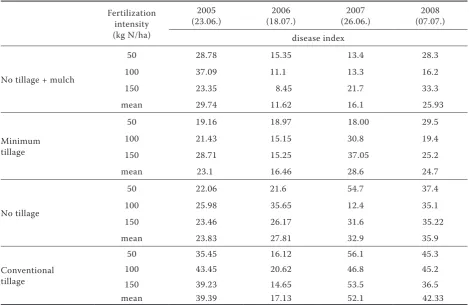
reduces the infection potential. In spite of that, the disease index for winter wheat in this experiment was not negligible. The highest detected percentage value of the disease index was 46.8 (Table 4). There was no statistically significant difference among the fertilization intensities (50, 100, and 150 kg N/ ha). There were statistically significant differences among the monitored years. The least infection was in 2006, and in other years the infection was higher by a statistically significantly amount.
The statistical analysis showed relationships be-tween the incidence of eyespot and tillage method and incorporating of plant residues as follows: the differences among the conservation tillage treat-ments, direct sowing into mulch from chopped straw of white mustard (no tillage + mulch, NTM) and conservation tillage sowing into shallow-tilled soil with chopped post-harvest preceding crop residues incorporated (minimum tillage, MTS) and
conservation tillage of direct sowing into untilled soil after removal of straw from the preceding crop (NT) were not statistically significant (Tables 5 and 6). The occurrence of eyespot was higher by a statistically significant amount in the treatment with conventional tillage. Similar results occur in the literature in connection with the fact that in the case of classical tillage undecomposed infected plant residues are brought into the seedbed area through tillage and are subsequently a source of infection.
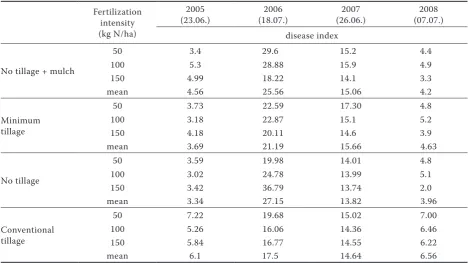
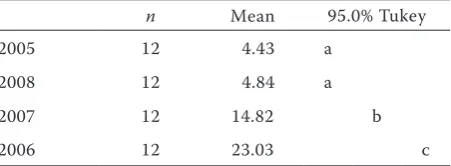
[image:4.595.305.531.79.163.2]Take-all. Upon statistical processing of the re-sults (Table 7), only the influence of year was found to be significant. In 2006 and 2007, the occurrence was higher by a statistically signifi-cantly amount (Table 8). The preceding crop is the most important element as to the occurrence of take-all. If a cereal follows after another cereal, then the likelihood of infection by the pathogen
Table 2. Multiple range tests for deoxynivalenol
n Mean 95.0% Tukey
2005 12 72.4 a
2008 12 23.9 b
2007 12 30.1 b
[image:4.595.63.291.79.164.2]2006 12 34.8 b
Table 3. Multiple range tests for deoxynivalenol
n Mean 95.0% Tukey No tillage + mulch 12 50.2 a
Minimum tillage 12 36.1 b
No tillage 12 33.9 b
Conventional tillage 12 15.5 c
Table 4. Evaluation as to incidence of eyespot during 2005–2008 (BBCH 83)
Fertilization intensity (kg N/ha)
2005
(23.06.) (18.07.)2006 (26.06.)2007 (07.07.)2008 disease index
No tillage + mulch
50 28.78 15.35 13.4 28.3
100 37.09 11.1 13.3 16.2
150 23.35 8.45 21.7 33.3
mean 29.74 11.62 16.1 25.93
Minimum tillage
50 19.16 18.97 18.00 29.5
100 21.43 15.15 30.8 19.4
150 28.71 15.25 37.05 25.2
mean 23.1 16.46 28.6 24.7
No tillage
50 22.06 21.6 54.7 37.4
100 25.98 35.65 12.4 35.1
150 23.46 26.17 31.6 35.22
mean 23.83 27.81 32.9 35.9
Conventional tillage
50 35.45 16.12 56.1 45.3
100 43.45 20.62 46.8 45.2
150 39.23 14.65 53.5 36.5
[image:4.595.63.539.456.761.2]is high. The crops decreasing the risk of infection are: broadleaf plants, corn, oats and root crops. Including these plants into the rotation decreases the risk, but it does not provide direct protection against the fungi since even after these preceding crops the roots can be infected and thus require direct protection. The breaker which is white mustard, plays a very important role in this ex-periment. It plays the most important positive role with respect to root diseases. Although the pathogen survives saprophytically from year to year on the root system of a sensitive plant and is able to sustain itself in the soil without the presence of a host, the rate of infection is always lower. Stands established in early autumn are usu-ally more infected since the pathogen has more suitable conditions for its development (higher soil temperature) and more time for spreading through the stand. Late sowings, however, can also be risky, because the stand may, among other
things, have poorer emergence due to bad weather, be weakened, and subsequently be attacked by other pathogens (Fusaria). Conservation practices of soil tillage, properly applied in particular soil and climate conditions, were one of the methods how to realize crop production for lower costs with concurrent long-term positive influence on the soil fertility.
[image:5.595.305.533.91.177.2]Improvement of especially physical soil proper-ties, soil biota development and overall soil fertil-ity increase is being the main aim of the aspect. Utilisation of post-harvest residues and pre-crop straw, retained on soil surface or incorporated shallowly into the soil, brings also negative effects. This organic matter, infested by fungi pathogens, can be the reservoir of infection for several next years. As an example it is possible to mean world-wide increased occurrence of Fusarium pathogens that infest field crops cultivated in conditions of conservation soil tillage prolonging the retention
Table 5. Multiple range tests for disease index of eyespot by soil management
n Mean 95.0% Tukey No tillage + mulch 12 20.86 a
Minimum tillage 12 23.22 a
No tillage 12 30.11 a b
[image:5.595.63.288.94.179.2]Conventional tillage 12 37.74 b
Table 6. Multiple range tests for disease index of eye-spot by year
n Mean 95.0% Tukey
2006 12 18.26 a
2005 12 29.01 b
2008 12 32.22 b
2007 12 32.45 b
Table 7. Evaluation of take-all occurrence in 2005–2008
Fertilization intensity (kg N/ha)
2005
(23.06.) (18.07.)2006 (26.06.)2007 (07.07.)2008 disease index
No tillage + mulch
50 3.4 29.6 15.2 4.4
100 5.3 28.88 15.9 4.9
150 4.99 18.22 14.1 3.3
mean 4.56 25.56 15.06 4.2
Minimum tillage
50 3.73 22.59 17.30 4.8
100 3.18 22.87 15.1 5.2
150 4.18 20.11 14.6 3.9
mean 3.69 21.19 15.66 4.63
No tillage
50 3.59 19.98 14.01 4.8
100 3.02 24.78 13.99 5.1
150 3.42 36.79 13.74 2.0
mean 3.34 27.15 13.82 3.96
Conventional tillage
50 7.22 19.68 15.02 7.00
100 5.26 16.06 14.36 6.46
150 5.84 16.77 14.55 6.22
[image:5.595.63.537.496.759.2]Corresponding author:
[image:6.595.65.291.92.175.2]Ing. Marie Váňová, CSc., Zemědělský výzkumný ústav Kroměříž, s.r.o., Kroměříž, Česká republika e-mail: [email protected]
Table 8. Multiple range tests for disease index of take-all by year
n Mean 95.0% Tukey
2005 12 4.43 a
2008 12 4.84 a
2007 12 14.82 b
2006 12 23.03 c
of residues on soil surface (Sturz and Bernier 1987, Summerell et al. 1990, Wang 1996, Miller et al. 1998, Dill-Macky and Jones 2000).
In diseases where the source of infection is plant residues, it can be expected that their potential for infection will change in connection with changes in how those residues are handled, while naturally also depending on their amount. In our experi-ments, it was not confirmed that the given system (a three-crop rotation system where wheat follows white mustard) would increase the demand for protection against Fusarium head blight, stem-base diseases and take-all. A great importance of individual years was observed.
REFERENCES
Chrpová J., Váňová M., Šíp V. (2008): Die Bewertung der Ährenfusariosenresistenz bei in der Tschechischen Republik registrierten Winterweizensorten unter verschiedenen Prü-fungsmethoden. 59. Tagung der Vereinigung der Pflanzen-züchter und Saatgutkaufleute Österreichs, 19–22.
Dill-Macky R., Jones R.K. (2000): The effect of previous crop residues and tillage on Fusarium Head Blight of wheat. Plant Disease, 84: 71–76.
Hůla J., Procházková B., Badalíková B. (2008): Minimalization of soil tillage. Profi Press, Praha, 248. (In Czech)
Meynard J.M., Doré T., Lucas P. (2003). Agronomic approach: cropping systems and plant diseases. Comptes Rendus Biolo-gie, 326: 37–46.
Miller J.D., Culley J., Fraser K., Hubbard S., Meloche F. (1998): Effect of tillage practice on Fusarium head blight of wheat. Canadian Journal of Plant Pathology, 20: 95–103.
Puhl T., Hermes J. (1999): Neue Boniturmethode zur Feststellung des Schwarz-fleckigkeitsbefalls. Getreide, 5: 38–39.
Scott P.R., Hollins T.W. (1974): Effects of eyespot on the yield of winter wheat. Annals of Applied Biology, 78: 269–279. Sturz A.V., Bernier C.C. (1987): Survival of cereal root pathogens
in the stubble and soil of cereal versus noncereal crops. Cana-dian Journal of Plant Pathology, 9: 205–213.
Summerell B.A., Burgess L.W., Klein T.A., Pattison A.B. (1990): Stubble management and the site of penetration of wheat by Fusarium graminearum group 1. Phytopathology, 80: 877–879. Váňová M., Hajšlová J., Polišenská I., Jirsa O., Klemová Z. (2009a):
Mycotoxin occurrence in winter wheat grain under various soil tillage practices in relation to preceding crop and weather con-ditions in a given year. Obilnářské listy, 17: 115–118. (In Czech) Váňová M., Klem K., Matušinský P., Trnka M. (2009b): Prediction
model for deoxynivalenol in wheat grain based on weather conditions. Plant Protection Science, 45: 1–5.
Wang Y.Z. (1996): Epidemiology and management of wheat scab in China. In: Dubin H.J. Gilchrist L., Reeves J., McNab A. (eds.): Fusarium Head Scab: Global Status and Future Pros-pects, 97–105.